© 2015, IRJET ISO 9001:2008 Certified Journal Page 91
SEISMIC EVALUATION OF BEAM-COLUMN JOINTS USING
GFRP BARS IN MULTI-STOREY BUILDING USING ETABS
Gajendra
1, D K Kulkarni
21
PG Student, Civil engineering, SDMCET Dharwad, Karnataka, India
2
PhD (Associate Professor), Civil engineering, SDMCET Dharwad, Karnataka, India
---***---Abstract –
The objective of the paper is to study theseismic behavior of beam-column joint using GFRP bars in multi-storey building using ETABS. The beam-column joint plays a critical role in ensuring performance of RC frame structures in resisting the design force, particularly induced by earthquake force. In case of design, it is very important to design beam-column joint precisely because the individual member such as a beam or column in case of considerable damage can be strengthened by some methods, but a beam- column joint cannot be strengthened once it form the plastic hinge. The Reinforced concrete beam-column joint are commonly used in a structure such as parking and road overpasses which might be exposed to weather condition and application of de-icing salts. So to overcome the steel corrosion problem glass fiber reinforced polymer (GFRP) reinforcing bars used in such type of structure and FRP bars are non-corrodible. GFRP materials shows the linear-elastic stress-strain characteristics up to failure, which raises concerns on their performance in beam-column joints in which energy dissipation, through plastic behavior, is required. Hence study is required to evaluate the overall seismic behavior of GFRP reinforced concrete frames. This work contains study of seismic behavior of beam-column intersections using GFRP bars in multi-bay, multi-storey buildings. Their behavior is studied for various building heights of G+3, G+5 and G+7 using ETABS 9 for seismic load using pushover analysis. The performance of joints in the G+3, G+5 and G+7 buildings the reinforcement type as the varying parameter. Pushover analysis was carried out for M3 and V2 type of hinges for beams and P-M-M hinges for columns.
Key Words:
Seismic performance, GFRP bar
reinforcement, Beam-column joint, Pushover analysis,
and ETAB software etc…
1.
INTRODUCTION
In RC frame buildings, portion of column that are common to beams at their intersection are called beam-column joint. In general the performance of framed structures depends on the individual members such as beam and column when there is only gravity load acting on the structure. But when lateral load acting on the structure then performance of the structure depends not only with the individual member, also with the integrity of the joints. The beam-column joint plays a critical role in ensuring performance of RC frame structures in resisting the design force, particularly induced by earthquake force. In case of design, it is very important to design beam-column joint precisely because the individual member such as a beam or column in case of considerable damage can be strengthened by some methods, but a beam- column joint cannot be strengthened once it form the plastic hinge. Many researches are going around the worldwide to understand the behavior of beam column joint in a better manner. The RC beam-column joint are normally used in a structure such as road crossings and parking which might be uncovered to climate condition and application of de-icing salts. So to overcome the steel corrosion problem fiber reinforced polymer (FRP) reinforcing bars used in such type of structure.
© 2015, IRJET ISO 9001:2008 Certified Journal Page 92 carried out as per the IS codes of practice (456 and
IS-1893 part 1: 2002) Hence, it is clear that unless the beam-column joints are designed to sustain these forces and deformations, the performance of the structures will not be satisfactory, under all the loading conditions, especially under seismic conditions.
2.
LITERATURE REVIEW
R. Vidjeapriya et al, conducted an experimental study on 1/3rd scale precast reinforced concrete beam-column joint contacts exposed to reversal cyclic loading. The results are obtained in such a way that the load carrying capacity of the monolithic sample is greater than precast samples [1]. C. Antony Jeyasehar et al, studied the performance of RC framed beam-column joints under the cyclic loading is stated. The joints have been casted with the sufficient, lacking shear capacity and bond of the reinforcement at the beam-column joint. The displacement is increased monotonically using the hydraulic push and pull of the jack. The capacity of energy dissipation of retrofitted beam-column joint with the various SIMCON patterns has been related [2]. Mohamed Mady et al, studied that the beam-column joint reinforced with GFRP bars and stirrups under the seismic load. Five types of prototypes (T-shaped beam-column joint) was created and tested under the seismic load condition. They also studied that the longitudinal and transverse reinforcement type and bar ratio as the variable parametric study. The experimental results showed that without any significant residual deformation the GFRP reinforced joints can sustain a 4.0% drift ratio [3]. S. Pampanin et al, studied that characteristic seismic susceptibility of RC framed beam-column joint contacts were analysed and design under the gravity load. They made trial on 2/3rd scaled of beam-column joints sub-assemblies with structural deficiency of Italian construction preparation between the 50’s and 70’s were
done under the seismic loads [8]. A.Vijayakumar,
Dr.D.L.Venkatesh babu et al, studied the pushover analysis for the better understanding of non-linear seismic evaluation of the structure more precisely as the development of the destruction and failure can be drawn. After analysis of the pushover the pushover curve shows the performance point and corresponding displacement, capacity spectrum and demand spectrum. And also shows the level of performance of the structural element and also max base shear carrying capacity of the structure for various zones [9].
3.
METHODOLOGY
3.1 Building and loading
I. Low and high raise RC frame building
II. Combination of gravity load and earth-quake load
3.2 Modelling and Analysis Method
I. 3D modelling for analysis using ETABS
II. The building is analysed by and Pushover
analysis
4.
PUSHOVER ANALYSIS
The pushover analysis is also called as non-linear static analysis. It is an approximate analysis method. The main objective of the pushover analysis is to find out the displacement and base shear graph. The ETAB software is able to predict the displacement level and corresponding base shear where the first yield point in the structure occurs. To analysis the pushover analysis the hinge properties were to assign to the beam and column as per FEMA 36 for concrete member. The pushover analysis is quite simple when it is compare to other non-linear methods such as dynamic analysis. And also the pushover analysis will take less time for the analysis.
5.
DESCRIPTION OF FRAME STRUCTURE
A four, five and eight storey Reinforced concrete framed structure with assumed sizes of beam and column including the reinforcement detail and the location of the building were selected as shown in Fig1. The beam-column joint in building is evaluated and strengthened by GFRP bars subjecting it to Gravity and Earthquake load.
Fig1 Typical plan at first floor (at Height H = 3 m)
© 2015, IRJET ISO 9001:2008 Certified Journal Page 93
5.1 Design parameters
5.1.1 Geometrical parameters
Storey height : 3m
No of storey : 4, 6, 8
No of bays in X direction : 4 No.
No of bays in Y direction : 3 No.
The bay width in X direction : 5m
The bay width in Y direction : 4m
Thickness of slab : 120mm
Grade of concrete : M25
Live load : 3KN/m2
Floor finish load : 1KN/m2
5.1.2 Earthquake parameters
Zone : V
Importance Factor, I : 1
Type of soil : Medium soil,
Response Reduction Factor, R : 5
Seismic Zone Factor, Z : 0.16
Response Spectrum : As per IS 1893-2002
6.
RESULTS AND DISCUSSIONS
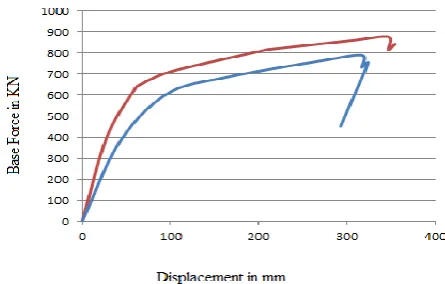
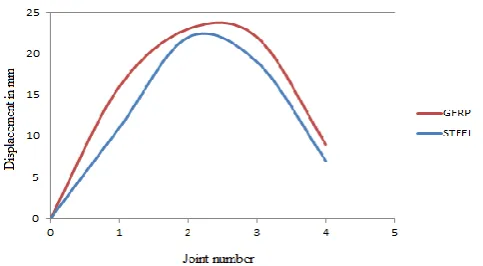
[image:3.595.320.534.278.413.2]The fig 2, 3 AND 4 shows the base force v/s displacement for all models. From figure it observed that load carrying capacity of GFRP model is more compared to STEEL model, but after reaching failure point STEEL model deflects due to the residual strength, while in case of GFRP model failure is sudden as GFRP bars have linear elastic stress- strain characteristics up to failure. In ETABS rigid diaphragm is provided on each story so all joints at a particular story will have same amount of displacement. Fig 5, 6 and 7 shows comparison of displacement for all models. From figure it can be seen that joints in GFRP model is having higher displacement than STEEL model, this is because GFRP bars are having low modulus of elasticity, which makes them flexible. Fig 8, 9 and 10 shows the comparison of drift for all models. From figure it can be seen that joints in GFRP model is having higher drift than STEEL model, this is because GFRP bars are having low modulus of elasticity, which makes them flexible. Table 1 shows performance point and base shear for all models. From table it can be observed that building with GFRP bars is having less displacement than steel and it is attracting more base force.
[image:3.595.315.538.443.585.2]Fig 2 Base shear v/s displacement of G+3 model
[image:3.595.315.537.605.741.2]Fig 3 Base shear v/s displacements of G+5 models
Fig 4 Base shear v/s displacements of G+7 models
© 2015, IRJET ISO 9001:2008 Certified Journal Page 94 Fig 6 Max displacements at each storey for G+5 models
[image:4.595.42.284.442.575.2]Fig 7 Max displacements at each storey for G+7 models
Fig 8 Maximum storey drift at each storey for G+3 models
Fig 9 Maximum storey drift at each storey for G+5 models
Fig 10 Max storey drift at each storey for G+7 models
Table 1 Comparison of performance point of models
7.
CONCLUSION
Load carrying capacity of the GFRP reinforced building is higher than steel reinforced building which is major advantage of GFRP bars.
As we raise the height of storey it is observed that GFRP bars are performing very well as compare to STEEL, hence GFRP bars can be used effectively for high storey buildings.
The large deformations were showed by GFRPbar, which allows the GFRP reinforced building to satisfactorily dissipate the seismic energy.
Since GFRP bar with smaller thickness possess higher strength, the congestion of reinforcement in beam-column joint is less. Thus, due to more efficient concreting response of BC joint with GFRP is better.
As far as performance point is concerned, it isfound that as we increase the GFRP
reinforcement ratio, the displacement of building is decreasing at higher loads and performance of building is becoming well within the permissible limits given in IS 1893 (part-1) 2002.
G+3 G+5 G+7
Cases Performance
point
Performance point
Performance point Base
force
Displac ement
Base force
Displac ement
Base force
Displac ement
KN Mm KN Mm KN mm
GFRP 774 141 842 191 835 249
[image:4.595.46.319.612.741.2]© 2015, IRJET ISO 9001:2008 Certified Journal Page 95
After reaching failure point steel bars deflect due to the residual strength, while in case of GFRP bars failure is quick as GFRP bars have linear elastic stress-strain characteristics up to failure. With increase in storey height this behaviour is clearly observed from Base-shear v/s Displacement curve.
Building reinforced with GFRP bars, fails at higher displacement than Steel, so we can say that low young’s modulus (E) of GFRP reinforcement lead to reduce the overall stiffness of structure which is advantage on the overall structural behaviour. If the young’s modulus of elasticity is low for a material, the strain is more for same stress as compared to a material having high modulus of elasticity.REFERENCES
1. R. Vidjeapriya and K.P.Jaya, “Experimental Study on Two sample of Mechanical Precast Beam-Column Contacts under Reverse Cyclic Loading”, ASCE Journal of Composites of Construction, Jan 2012
2. C. Antony Jeyasehar and K. Ravichandran, “Cyclic Behaviour of Beam Column Joint Retrofitted With Simcon Laminates”, ASIAN Journal of Civil Engineering, July2012
3. Mohamed Mady, Amr Ragaby and Ehab
El-Salakawy, “Seismic Behaviour of
Beam-Column Joints Reinforced with GFRP Bars and Stirrups”, ASCE Journal of Composites of Construction, Nov-Dec 2011
4. Weichen Xue, Bin Cheng, Renguang Zheng, Liang
Li and Jie Li, “Seismic Performance of Non-prestressed and Prestressed HPC Frames under Low Reversed Cyclic Loading”, ASCE Journal of Composites of Construction, Nov 2011
5. Bing Li and Sudhakar A. Kulkarni, “Seismic
Behaviour of RC framed Exterior Wide Beam-Column Joints”, ASCE Journal of Composites of Construction, Jan 2010
6. Saleh H. Alsayed, Tarek H. Almusallam, Nadeem A.
Siddiqui and Yousef A. Al-Salloum, “Seismic Restoration of Corner RC Beam-Column Joints With CFRP Composites”, ASCE Journal of Composites of Construction, Nov-dec 2010
7. Bing Li and H. Y. Grace Chua, “Seismic Performance of Strengthened RC framed structure of Beam-Column Joints with FRP Composite material”, ASCE Journal of Composites of Construction, Oct 2009 8. S. Pampanin, G.M. Calvi and M. Moratti, “Seismic
Behaviour Of R.C. Beam-Column Joints Designed For Gravity Loads”, Elsevier Science Ltd., 12th European Conference on Earthquake Engineering 9. A.Vijayakumar, Dr.D.L.Venkatesh babu, “A Survey of Methodologies for Seismic Evaluation of Building”, Canadian Journal on Environmental, Construction and Civil Engineering, June 2011 10. P. Poluraju, P. V. S. Nageswara Rao, “Pushover
Analysis of Reinforced Concrete Frame Structure Using SAP 2000”, International Journal of Earth Sciences and Engineering, Oct 2011