© 2015, IRJET.NET- All Rights Reserved
Page 202
Measured Data of Hourly Global Solar Irradiation Using Two
Curve-Fitting Methods
Aditi Pareek
1, Dr.Lata Gidwani
21
Department of Renewable energy and Electrical Engineering, University college of Engineering, Rajasthan
Technical University Kota, Rajasthan, INDIA.
---***---Abstract - Solar energy has an important role toachieve the goal of replacing fossil fuels and significant potential to reduce green house gas emissions. Accurate information on solar radiation is very essential for engineers, architects and agriculturist to design the energy systems based on the solar source. The radiation data is highly useful for the designing of solar energy related electricity generation systems. The data was filtered by using polynomial fitting method. This paper studies the use of polynomial fitting to the global solar radiation that was measured by using Pyranometer model no. CMP11 at Kolayat, located in Rajasthan, India. Measured hourly global solar radiation data of Kolayat in May 2015 were analyzed in this work. The two curve –fitting methods that were found to be suitable to be applied to the filtered solar radiation data is the polynomial fit and the sinusoidal fit. Author have been takensolar radiation data every five minute during 6:00-20:00 . The polynomial data fitting method was used for data smoothing and was tested by using different degrees of polynomial curve fittings. The error measurement was calculated by using the root mean square error (RMSE) and by determining the R2 value. The polynomial fittings were
carried out by using MATLAB.
Key Words:
Curve-fitting; polynomial fit and
sinusoidal fit; Global solar radiation data; Matlab
1.
INTRODUCTION
The demand for energy is increasing exponentially as the human population increases dynamically [1-2].The solar radiation is an instantaneous power density measured in units of kW/m2. In providing alternative energy sources and in electricity generation solar radiation prediction and forecasting plays a vital role [3]. In Karim et al. [4] the best polynomial fitting degree for solar radiation data is calculated using RMSE (root mean square error) and r2 value. The curve fitting methodology requires the interpolation or approximation of the given data sets which are subjected to certain constraints such as continuity, error measurement, etc. Karim and Piah [5]
and Karim et al. [6] have discussed the applications of curve fitting methods (interpolating and approximating method) in font designing and shape preserving interpolation which can be considered as important in certain applications. The rest of this paper is structured as follows. In section II solar radiation data collection and solar radiation Data using Polynomial fitting is discussed. Section III presents the Data fitting model frame work. Results are discussed and summarized In Section IV. Finally, In Section V conclusions are drawn.
2. SOLAR RADIATION DATA COLLECTION
The emitted solar radiation is the electromagnetic
Radiation that is emitted by the sun in the wavelength Region of 280 nm to 4000 nm [1]. The instantaneous
global solar radiation value at STP is estimated to be 1000 W/m2, while the value of power density outside the earth’s atmosphere is 1353W/m2 [7]. At Kolayat, the data is measured by using Pyranometer model no. CMP11 as shown in Figure1. Data is captured by using computerized data acquisition system.10MW solar power plant as shown in Figure 2.
© 2015, IRJET.NET- All Rights Reserved
Page 203
Fig-1(b): Pyranometer CMP11
[image:2.595.43.287.83.492.2]
Fig-2: 10 MW Solar Power Plant, Kolayat, Rajasthan
2.1 Polynomial data fitting
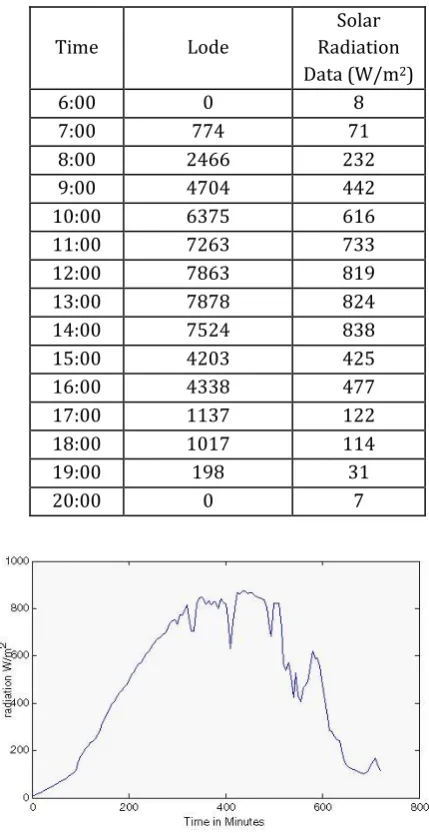
Polynomial data fitting is used for filtering and smoothening of global solar radiation data received in the stations. It was tested by various degrees of solar radiation data. The literature for doing curve fitting is well established and can be found in [8–12]. The solar radiation data is obtained shown in Table 1 and it is represented graphically in Fig3. There are various degrees of polynomial curve fitting such as linear polynomial, quadratic polynomial, cubic polynomial, 4th degree polynomial, 5th degree polynomial, 6th degree, 7th degree, 8th degree, 9th degree polynomial and so on. These polynomials are applied on the received solar radiation data for a perfect fitting. . Table 3 shows all the polynomial fitting results. Rmse which gives an error value and r2 (coefficient of distribution) gives the goodness of fitting of data.
Table -1: Daily Average of Measured Global Solar Radiation Data (KOLAYAT 09 -MAY 2015)
Time Lode
Solar Radiation Data (W/m2)
6:00 0 8
7:00 774 71
8:00 2466 232
9:00 4704 442
10:00 6375 616
11:00 7263 733
12:00 7863 819
13:00 7878 824
14:00 7524 838
15:00 4203 425
16:00 4338 477
17:00 1137 122
18:00 1017 114
19:00 198 31
20:00 0 7
Fig- 3: Graphical Representation (09-MAY 2015)
[image:2.595.325.540.129.546.2]© 2015, IRJET.NET- All Rights Reserved
Page 204
Table-2: Measured Peak Solar Radiation Data Every FiveMinute (Kolayat 09-May 2015)
Time Lode Radiation
Data (W/m2)
Time Lode Radiation
Data (W/m2)
12:05 7965 833 13:05 8034 867
12:10 7782 815 13:10 8013 862
12:15 7887 829 13:15 8010 874
12:20 7860 825 13:20 8001 872
12:25 7743 798 13:25 7893 862
12:30 7983 841 13:30 7860 864
12:35 7836 824 13:35 7887 865
12:40 7752 817 13:40 7650 856
12:45 7266 763 13:45 7684 848
12:50 6177 630 13:50 7719 842
12:55 7242 743 13:55 7626 841
From Wu and Chan [3], we believe the best model for the fitting of solar radiation data is quadratic polynomial shown in Fig.5(b) Since it gives better indication to the solar radiation data compare with other polynomial fitting model. Polynomial of nth degree
y= a0 + a1x + a2x2 +……+ an xn (1)
This can be achieved by defining the error of fitting model:
ei y f xi i yi a a xi a xi a xn i n
= - ( )= -
n
0+ 1 + 2 2+ +....s
(2)Taking sum square of the error in (2) gives us
S i e y a a x a x a x
N
i i
N
i i i i n in
= = - + + + +
=0 =
2
0 0 2
2 ... 2
n
s
(3) To obtain least square fitting, the sum of error in (3) must be minimized. Hence,
s
ai=0,i=0,1,.... .n (4)
The values of a0, a1, …….., an which gives the best least square polynomial equation for the given data.
ᵡ = Chi Square yi = actual value
xi = calculated Y fit value σi = weight
y = mean of actual values
x = mean of calculated Y fit values
R = i
( )( )
( ) ( )
x x y y
x x y y
i i
i i i i
-
-- 2 - 2
(5) R y y i i i =
-1 2 2
( ) (6) 2 2
=
F
-H
G
I
K
J
i i i i y x (7)3. DATA FITTING MODEL FRAMEWORK
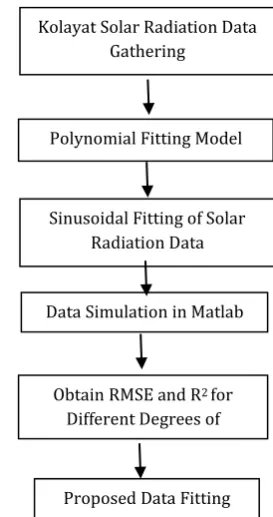
This section will gives framework for solar radiation data fitting. Figure 4 shows the framework.
Fig-4: Data Fitting Frame work
Figure 4 shows the basic block diagram which describes the flow of polynomial data fitting and sinusoidal fitting methods.
4. RESULTS AND DISCUSSION
Author apply polynomial fitting (regression) starting with degree 1 (linear) until degree 9th. All the polynomial
Kolayat Solar Radiation Data Gathering
Polynomial Fitting Model
Sinusoidal Fitting of Solar Radiation Data
Data Simulation in Matlab
Proposed Data Fitting Model
ObtainRMSE andR2 for
[image:3.595.380.517.365.624.2]© 2015, IRJET.NET- All Rights Reserved
Page 205
coefficients are calculated based on 95% confidenceinterval. Table 3 summarized all the polynomial fitting results. Figs. 5 (a) until 5 (i) shows the polynomial fitting for solar radiation data.
Table-3:
Polynomial fittingPolynomial Fitting Statistics
RMSE R2
n=1
y=0.26*x+3.8e+02
297.7
0.00916
7
n=2
y = - 0.0069*x^{2}
+ 5.2*x - 2.1e+02
65.28
0.9568
n=3
Y=-4.3e-06*x^{3}-
0.0023*x^{2}+3.9*x-1.3e+02
61.35
0.9657
n=4
y = 4.3e-08*x^{4} -
6.6e-05*x^{3}
+
0.026*x^{2} - 0.61*x +
26
60.28
0.9759
n=5
y = 5.5e-11*x^{5} -
5.7e-08*x^{4}-2.1e-06*x^{3}+0.009*x^{2}
+ 1.1*x -13
48.84
0.9767
n=6
y = 3.9e-13*x^{6} -
7.8e-10*x^{5}+6.3e-
07*x^{4}-0.00026*x^{3}+
21.68
0.9962
0.056*x^{2} - 2.2*x +
40
n=7
y = 5.5e-16*x^{7} -
1e-12*x^{6}
+
6e-
10*x^{5}-6.3e-
08*x^{4}-8.4e-05*x^{3}+ 0.033*x^{2}
- 0.99*x +26
20.61
0.9994
n=8
y = - 1.9e-18*x^{8}
+6.2e-15*x^{7} -
7.6e-12*x^{6}
+
4.7e-
09*x^{5}-1.5e-06*x^{4}+0.00018*x^{
3}
+0.0071*x^{2}+
0.028*x + 17
20.09
0.9994
n=9
Y= 6e-23*x^{9} -
2.8e-19*x^{8} + 4e-16*x^{7}
- 6.4e-15*x^{6} -
5.2e-10*x^{5} + 5e-07*x^{4}
-0.00019*x^{3}
+
0.031*x^{2} - 1.9*x +
29
© 2015, IRJET.NET- All Rights Reserved
Page 206
(a)(b)
(c )
(d)
(e)
© 2015, IRJET.NET- All Rights Reserved
Page 207
(g)(h)
(i)
Fig-5: Various polynomial fitting (a) n=1 (b) n=2 (c) n=3 (d) n=4 (e) n=5 (f) n=6 (g) n = 7 (h) n = 8 (i) n = 9
From Figs. 5(a) until 5 (i), it can clearly be seen that once the degree of the polynomial is increasing, the fitting graphs will starting to wiggle. Among the entire fitting model, quadratic, cubic and quartic polynomials seem to give better results as compare with the other fitting model.For polynomial fitting with degree are quadratic, cubic and quartic, the value of RMSE and R2 can be obtained in Table 3. From the table, Polynomial fitting with 9th degree gives better R2 (0.9996) and RMSE is 10.09.
Fig.6: Sinusoidal fitting
There is trade-off between less RMSE and higher R2 value. From figure6 Sinusoidal fitting gives better R2 (0.9328) and RMSE is 74.98.
5. CONCLUSIONS
© 2015, IRJET.NET- All Rights Reserved
Page 208
ACKNOWLEDGEMENT
The author would like to thank NVR Infrastructure and Services Pvt. Ltd. for its data support.
REFERENCES
[1]
Karim, S.A.A., Singh, B.S.M, Karim, B.A., Hasan, M.K., Sulaiman, J., Josefina, B. Janier., and Ismail, M.T. (2012). Denoising Solar Radiation Data Using Meyer Wavelets. AIPConf.Proc.1482:685-690.
http://dx.doi.org/10.1063/1.4757559.
[2] Karim, S.A.A., Singh, B.S.M., Razali, R. and Yahya, N. Data Compression Technique for Modeling of Global Solar Radiation. In Proceeding of 2011 IEEE International
Conference on Control System, Computing and
Engineering (ICCSCE) 25-27 November 2011, Holiday Inn, Penang, pp. 448-35,(2011a).
[3] Wu, J. and Chan, C.K. Prediction of hourly solar radiation using a novel hybrid model of ARMA and TDNN. Solar Energy 85:808-817, 2011.
[4] Samsul Ariffin Abdul Karim and Balbir Singh
Mahinder Singh,’’ Global Solar Radiation
Modeling Using Polynomial Fitting’’ Applied
Mathematical Sciences, Vol. 8, 2014, no. 8, 367 – 378.2012.
[5] Karim, S.A.A and Piah, A.R.M (2009). Rational Generalized Ball Functions for Convex Interpolating Curves. JQMA 5(1): 65-74.
[6] Karim, S.A.A., Karim, B.A., Hasan, M.K. and Sulaiman, J. (2010d).Font Designing Using Generalized Ball Basis. In Proceedings of EnCon2010, 3rd Engineering Conference on Advancement in Mechanical and Manufacturing for Sustainable Environment April 14-16, 2010, Kuching, Sarawak, Malaysia, ISBN 978-967-5418-10-5.
[7] Thekaekara, M.P. (1973). Solar Energy Outside the Earth’s Atmosphere. Solar Energy 14. p. 109.
[8] R.E. Childs, Donald G.S. Chuah, S.L. Lee, K.C. Tan. Analysis of solar radiation data using cubic splines. Solar Energy,Volume32 ,Issue 5, 1984, Pages 643-653.
[9] Donald G. S. Chuah, S. L. Lee. Solar radiation in peninsular Malaysia—Statistical presentations. Energy
Conversion and Management, Volume 22, Issue 1, 1982,
Pages 71-8.
[10] Genc, A., Kinaci, I., Oturanc, G., Kurnaz, A., Bilir, S. and Ozbalta, N. Statistical Analysis of Solar Radiation Data Using Cubic Spline Functions. Energy Sources, Part A:
Recovery, Utilization, and Environmental Effects. 24:12 1131-1138. (2002).
[11] De Boor, C. 2001. A Practical Guide to Splines. Springer-Verlag New York.
[12]Dr.P.M.BeulahDevamalar,Dr.V.ThulasiBai,D.Jahnavi, V.Vidhyawathy, Gap Filling of Solar Radiation Data using Polynomial Fitting and Wavelet Transform Comparison, International Journal for Scientific Research & Development, Vol. 2, Issue 12, 2015 | ISSN (online): 2321-0613 pp.no.268-270.
BIOGRAPHIES
Aditi Pareek received the B. tech .degree in Electronics Instrumentation and control Engineering from the Global Institute of technology (GIT), jaipur India in 2011. She is currently working toward the M. Tech. degree in Renewable Energy Technology at Department of Renewable Energy, Rajasthan Technical University, Kota, India. Her current interests include Solar Energy, Artifical Neural Networks Technique, optimal control.
Dr. Lata Gidwani received her B.Tech in Electrical Engineering from CTAE, Udaipur, India in 2000 and M. Tech. in Power Systems from MNIT, Jaipur, India in 2002. She has done Ph.D. from MNIT, Jaipur, India in 2012. She is currently working as Associate Professor in Electrical Engineering
Department, Rajasthan Technical
University, Kota, India. She has