2018 International Conference on Physics, Computing and Mathematical Modeling (PCMM 2018) ISBN: 978-1-60595-549-0
Power Filtering Based Wind Farm Power
Fluctuation Smoothing Control Strategy
Ying-cheng XUE
Yancheng Institute of Technology, Yancheng, Jiangsu 224001, China
Keywords: Wind power generation, Pitch angle control, Fuzzy control, Power fluctuation, Active power smoothing, Wind farm, Power filtering.
Abstract. The output active power of the wind-power generator fluctuates with the change of the wind speed, which affects the output power quality of the wind farm. In order to reduce output power fluctuation of wind farm, based on analyzing of Wind Power Fluctuation Spectrum, an active power smoothing control strategy had been proposed through the pitch angle control and speed control of the generator. The simulation results show that the proposed control strategy can effectively reduce the output active power fluctuations of wind farm.
Introduction
Wind energy is a renewable energy with the greatest potential for development and utilization at present. The output power of wind farms (WF) depends on wind speed. Due to the unexpected and stochastic fluctuations of wind speed, when the capacity of wind turbines in the power system exceeds a certain proportion, the fluctuation of wind power will cause the power system frequency to deviate from the standard frequency [1-2]. The frequency protection relay may be misoperated to threaten the safe operation of the power system.
In addition, most of wind farms are located at the end of power grid. The fluctuation of output power of wind farms will also affect the power quality of wind farms. Therefore, how to effectively use wind energy and suppress power fluctuations of input power grid is an important and meaningful research point.
Based on the analysis of the power spectrum of wind turbines, a control strategy that can effectively suppress the wind power fluctuation of wind farms is put forward. The new control strategy does not need to add new hardware devices, and uses inertial control and spatial filtering to stabilize the high-frequency wind power fluctuations. The wind power fluctuation in the low frequency section is controlled by the pitch control, and the wind power fluctuation in the middle frequency band is controlled by the generator speed. The effectiveness of the proposed control strategy is verified by the wind power simulation of 24 direct drive permanent magnet synchronous wind turbines.
2. Organization of the Text.
Frequency Spectrum Analysis of 1.WTG Power Fluctuation
[image:1.595.61.536.631.732.2]
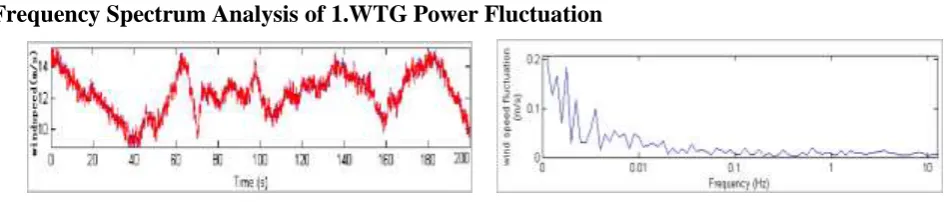
Figure 1. A typical 200s wind profile and fluctuation spectrum.
high frequency fluctuation components. The fluctuation is mainly concentrated in low (less than 0.01 Hz) and intermediate frequency (0.01 and 1 Hz) regions, while 0.1Hz to 10Hz bands are also sensitive to power system, and high frequency fluctuations (1 Hz or above) are small, most of which can be absorbed by inertia of generators.
Wind Field Power Smoothing Control Based on Frequency Division
WTG1
WTG2
WTGn
Low pass filtering
WTG1 speed control Bandpass filter
Average
Pmax 2
1 2 1 1
max d d v
P
1 v k k v 2 1 2 1 1
max d d v
P
s
1
Pe pe
e
p'
WTG1 pitch control distribution
[image:2.595.101.496.154.297.2]distribution
Fig.2wind farm power smoothing control strategy
E
*
E J
E* * 2
pref
PI Inertial control * f P filtering df k d f dt
Figure 2. Wind farm power smoothing control strategy.
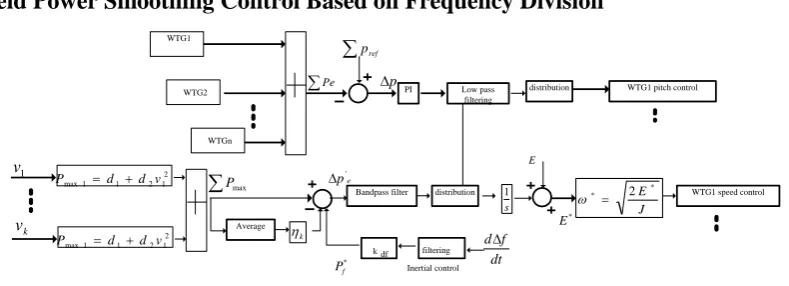
Based on the spectrum analysis of the above power fluctuation, a wind field power smoothing control strategy based on power filtering is presented in Figure 1. First, the high frequency fluctuation is filtered through the system inertial control and spatial filtering. Secondly, because of the low frequency correlation of wind, they can't be filtered out through spatial smoothing. Variable pitch control is used to stabilize low-frequency wind power fluctuations, while the middle frequency band is controlled by generator speed control. The inertial control in Figure 1 is used to change the inertia of the wind turbine, assist in reducing the high frequency fluctuation and improve the dynamic characteristics of the system.
In this paper, the output power of the whole farm is
pe as a feedback signal for smoothing control.Because the high frequency part has been eliminated by spatial smoothing, the advantage of using
pe as feedback signal is that the cut-off frequency of feedback loop is higher and the dynamicresponse is faster.
As shown in Figure 1, the controller is synthesized by a two part filter. The low pass filter is used to deal with large and slow fluctuation of wind speed, and removes the low frequency components of wind speed fluctuation. The bandpass filter is used to deal with small and fast wind speed fluctuations, which has not been removed by spatial filtering.
In order to improve the operation of the generator stability, figure 1 will mean maximum output power multiplied by the adjustment coefficient, the maximum value of this generator is given power that is less than the corresponding wind turbine power curve, can avoid the generator speed limit, resulting in unstable operation, can be obtained through fuzzy reasoning, see section four. The given power of the generator is less than the maximum value of the power curve of the corresponding wind turbine. It can avoid the generator speed exceeding the limit and cause unstable operation. It can be obtained through fuzzy control, as shown in the fourth section.
Pitch Control Reference Power
The reference power Pref of the pitch control is selected according to the average wind speed. The
average wind speed is calculated by the exponent moving average method. So the latest wind speed data have a high weighting factor. Pref is determined by formula (1).
refn ref
ref
ref p p p
p
3 ) ( 2
1 2 *
n C
R
Prefn P
V
(2) ) ( ) ( , * * OPT P P OPT C
C
(3)
) 1 ( ) 1 ( )
(i k V i k
V
V n n n
(4) 1 2 i k (5)
In the formula, 1 is the average wind speed, and the 2 is the data collected by the I, and the Prefn is the reference output of nth wind turbines.
Power Allocation
Each WTG needs to coordinate the power distribution to ensure that the output power Pgn of the WF is a reference value. If a WTG output decreases rapidly with the decrease of the wind speed, the other WTG should output more power. The traditional method usually determines the output power only according to the WTG capacity. The output power is allocated according to the ratio of WF output
power commands Pcom and *
max
_ n
g p
, and each WTG reference output power is PgN:
Each WTG reference output power Pgn depends on the WF reference output power of the wind farm and the allocation method.
g n
gn P
P _max
(6) * max _ n g com P P (7) The is the ratio of the WF output power command Pcom to p*g_maxn.
Simulation Results and Analysis
In this paper, a wind farm model [3] is used. It is assumed that each WTG wind speed time series is the same. It only delays tmn in time, assuming that the average wind speed of the wind in the X
direction is VWmean, and any two spatial locations are (xm, ym) ` (xn, yn), tmn =(xm- xn)/ Vn
.In order to minimize the correlation of the wind speed model of WTGs, a random number generator is used to allocate any two WTG distances and the number of WTG of the wind farm is 24. The wind turbine model is a variable speed wind turbine (GE 1.5MW) model with a power electronic interface. The detailed parameters of the model can be referred to [4]
Figure 5 (a) is an hour time series of wind speed, with an average wind speed of 12 m / sec. Figure 5 (b) is a single WTG output power, and the power fluctuates with the wind speed. Figure 5 (c) is the total output power of the wind farm. When the wind farm is in the traditional control mode and the pitch angle is fixed, figure 5 (d) is the total output power of the wind farm, when the pitch angle is involved in smooth control.
low frequency part basically does not exist, and the overall output is relatively straight, as shown in Figure 5 (d).
(a) wind speed. (b) single WTG output power.
(c) the total output power of the (d) the total output power of the wind wind farm when the pitch angle is fixed. farm when the pitch angle changes.
Figure 5. Wind farm power space smoothing and pitch control.
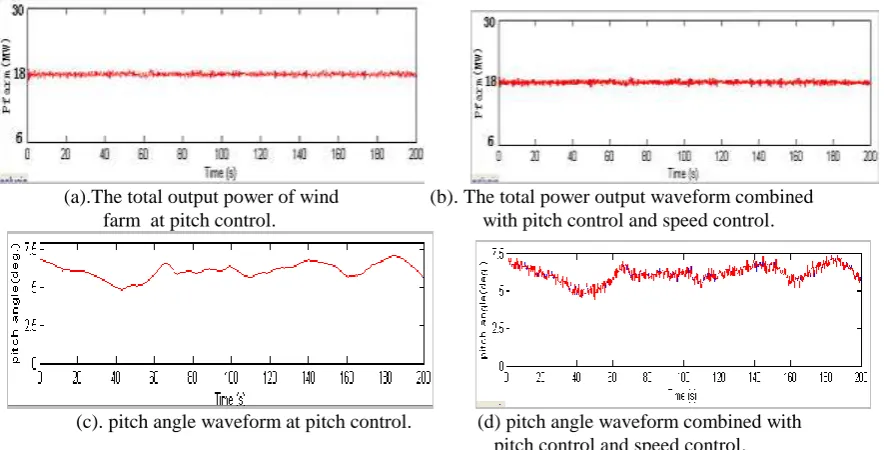
Figure 6 is the waveform of combination of pitch control and speed control. The high frequency part of wind speed fluctuation can be effectively restrained by speed control, and the low frequency of wind speed fluctuation is controlled by pitch. Figure 6 (a) is the total output power of the wind farm using pitch control.
Figure 6 (b) is a combination of pitch control and speed control of, compare Figure 6(a) and Figure 6(b), it can be seen that the two kinds of measurement of wind power control is almost the same, the total harmonic distortion THD is only slightly different.
Figure 6 (c) is the pitch angle waveform of the pitch control. Figure 6 (d) is the pitch angle waveform combined with pitch control and speed control.
Compared with Figure 6 (c), the change of figure 6D is obvious. Figure 6 (c) is rough, and the amplitude of high frequency component is reduced. Therefore, the contribution of the speed control to the high frequency component to suppress the fluctuation of wind speed is obvious.
(a).The total output power of wind (b). The total power output waveform combined farm at pitch control. with pitch control and speed control.
[image:4.595.79.518.113.312.2]
(c). pitch angle waveform at pitch control. (d) pitch angle waveform combined with pitch control and speed control.
[image:4.595.78.521.508.733.2]Conclusion
On the basis of analyzing the power fluctuation spectrum of wind power generator, a smooth control strategy of active power of wind farm combined with pitch control and speed control is proposed. The new control strategy uses inertial control and spatial filtering to suppress high-frequency wind power fluctuations, and adopts pitch control to stabilize low-frequency wind power fluctuations, and the wind power fluctuation in the middle frequency band is controlled by the generator speed.
The simulation results show that when the auxiliary device is not needed, the output of the wind farm with large number of WTG has the effect of spatial smoothing. The total output of the wind farm is used as feedback signal, and the pitch control can effectively suppress the low frequency fluctuation of the active power of the wind farm. Combined with variable speed control, the rotor inertia can absorb considerable wind power fluctuations, reduce pitch movements and mechanical wear.
The control strategy proposed in this paper is conducive to improving the power quality and grid stability of grid connected wind turbines, and reducing other energy storage devices required by smoothing means.
References
[1]C. Luo and B. T. Ooi, Frequency deviation of thermal power plants due to wind farms, IEEE Trans. Energy Convers., vol. 21, no. 3, pp. 708-716, Sep. 2006.
[2]Changling Luo, H. Golestani Far, H. Banakar, Ping-Kwan Keung, B.T. Ooi, Estimation of Wind Penetration as Limited by Frequency Deviation, PES General Meeting 2006, IEEE, Jun. 18-22 2006, P 1-8.
[3]Ushiwata K, Shishido S, Takahashi R, et al. Smoothing control of wind generator output fluctuation by using electric double layer capacitor[C]. International Conference on Electrical Machines and Systems, Seoul, Korea, Oct. 8~11, 308-313.