2018 International Conference on Computer, Electronic Information and Communications (CEIC 2018) ISBN: 978-1-60595-557-5
Study on Production of Polyhydroxyalkanoates (PHAs) by Bacterial
Consortium from Excess Sludge
Qiu-yang XU, Chao QIU, Rui XIA and
Xu-jie LU
*Hainan Tropical Ocean University, Sanya, Hainan 572022, China
*Corresponding author
Keywords: Activated sludge, PHAs, Mixed bacteria.
Abstract. In this experiment, the synthesis of PHAs is studied by the microbial flora in the activated sludge, the aim is to reduce the production cost of PHAs and realize the reduction and resource recovery of residual sludge. The remaining sludge from this experiment was taken from the second sink of Lizhigou sewage purification plant, the PHAs was synthesized by using glucose and sodium acetate as carbon source culture and acclimatization sludge. Under normal temperature, the control PH was between 6.9 and 8.4, and COD was in the first stage: N: P=100:5:1, continuous cultivation of 7-15d, and the second stage controlled COD: N: P=200:10:2. By regulating COD, the accumulation of PHAs reached 7.24% when COD=1000. By controlling the time of N source and P source respectively, it is found that the synthesis quantity of PHAs increased with the control time, up to 4.03% and 5.01%. The experiment is also found that the higher the C/P ratio, the greater the synthesis amount of PHAs, which can reach to 6.53%, but the sludge is easy to expand at this time.
Introduction
Polyhydroxyalkanoates (PHAs) is the intracellular storage of microorganisms that are synthesized by adequate carbon sources and other nutrients. Because of its’ good mechanical properties, biocompatibility, total degradability, it has become a hotspot in the field of biomaterials in recent years[1-3]. Also, its sources are widely renewable. At present, PHAs mass production process mainly use single bacteria synthesis PHAs. Because the single-bacterial reaction is demanding and costly to the reactor, it is not conducive to large-scale promotion. As the solid waste produced in the process of municipal wastewater treatment, the residual sludge is huge, and with the improvement of water treatment facilities, the amount of sludge will increase continuously. At present, the disposal of residual sludge is generally dehydrated and sintered, which is not fully utilized, resulting in a great waste of the abundant microbial resources of the residual sludge. PHAs is a kind of intracellular energy storage material synthesized by cells in the environment with extremely poor environmental conditions, and PHAs can be synthesized when N, P source is deficient and C source is sufficient. Activated sludge is rich in N and P sources, which can be synthesized by continuous supplementation of C source. Until the 1990 s the continued use of excess sludge using single bacterium fermentation preparation PHAs, but limited by the high cost of specific substrates and the high cost of equipment disinfection of price for PHAs high, difficult to promote. Since the 1990s, the synthesis technology of PHAs has been developed, which greatly reduces the requirement of PHAs synthesis for equipment and substrate, but the industrial production of PHAs is still mainly based on single bacteria fermentation. When it comes to the nutritional among the synthesis of PHAs, enrichment can obtain through feeding in a carbon source periodically changed mode [4]. Besides, the control of oxygen is the key of a series of techniques for the preparation of PHAs.
Materials and Methods
The Reaction Device
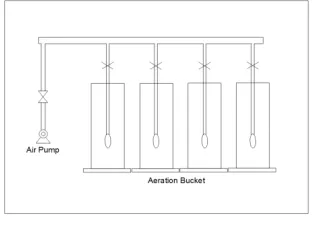
(V=2000mL) and aeration device. The domestication of activated sludge and the synthesis of PHAs are all completed in different stages with the same size configuration. The reactor device structure is presented in Figure 1. It equipped with aeration device, which can control the oxygen content of the access device and control the type of reaction.
Figure 1. Reactor device structure.
The active culture operation sequence is set to 12h per cycle, anaerobic (precipitation) 4h, aerobic 8h, and 2 cycles per day. The reactor used pH meter and thermometer to monitor parameter changes during the experiment. Sample selection under the liquid level position of 5-10cm. The detection of all kinds of indicators, including COD, TP, NO3-N, etc. When the sample is analyzed, the mixed water sample will be filtered by qualitative filter paper , and the filtrate will be diluted with a certain amount. The analysis of MLSS and SVI use quantitative filter paper. At the beginning of the experiment, a certain amount of sludge is inoculated in the reactor for the domestication of PHAs as a mixed bacterial source, and the sludge is inoculated from the second sink of Lizhigou sewage purification plant. In the experiment of synthesizing PHAs, sodium acetate, glucose, ammonium chloride and potassium dihydrogen phosphate are used as carbon source, N source and P source. The concentration of MgSO4 in the original water is 100mg/L, including 1mL microelement solution per liter of water whose microelement content is presented in Table 1.
Table 1. Microelement content of nutrient solution.
Content Concentration (mg/L) Content Concentration (mg/L)
KI 1.18 ZnSO4•7H2O 0.12
CuSO4•5H2O 0.03 MnCl4•H2O 0.12
EDTA 3.00 FeCl3•6H2O 1.50
CaCl2•7H2O 0.15 H3BO3 0.15
Sludge Active Domestication
During the active recovery phase of sludge, the activated sludge is initially finished into the reactor, and the initial MLSS is controlled at about 2000mg/L. During the period of the reactor, aerobic operation is adopted, with a daily aeration of 20h and a deposition of 4h. In the process of aerobic aeration every day, the sludge discharge is about 150mL. Using sodium acetate and glucose as the carbon source for artificial water distribution, the water inlet COD is controlled at 100mg/L and the ratio of nutrients is controlled by COD:N:P=100:5:1. The purpose of this stage is to make the community structure and bacteria in the reactor to be replaced and propagated more frequently under perfect oxygen condition, so that the activity of sludge can be recovered quickly. Excess sludge active recovery process for about 7 to 15 days, according to the dosing inoculation sludge activity situation, adjust days running, and through the state of SVI, microbial sludge activity recovery. When the apparent characteristics of sludge from black to yellow, SVI in 80-150, the state of zoogloea, appeared metazoan, sludge biofacies is rich, can be thought of viable hybrid system is the basic recovery, active recovery process is complete.
[image:2.612.141.470.442.512.2]source is abundant, the microorganism will grow and store the PHAs in the body. When the N source or P source is scarce, the microorganisms decompose PHAs as energy. On this basis, the aerobic dynamic feeding method[5-6], make the reactor in the substrate between the rich and the lack of cyclical change, to inhibit the growth of other microorganisms, domesticated a powerful PHAs flora of storage capacity. The operation mode of the domestication cycle is water inlet (with artificial preparation of waste water), aeration, stirring, carbon source, precipitation and instantaneous water outlet, with a period of 12h.
After the injection of sludge, the MLSS and SVI that are measured are shown in Figure 2.
[image:3.612.222.390.183.301.2]0 1 2 3 4 5 6 7 8 9 10 11 12 13 14 15 16 17 1600 1800 2000 2200 2400 2600 2800 3000 MLSS(mg/L) SVI Run Time/d M L S S (m g /L ) 0 20 40 60 80 100 120 140 160 S V I
Figure 2. Changes of SVI and MLSS in activated sludge operation.
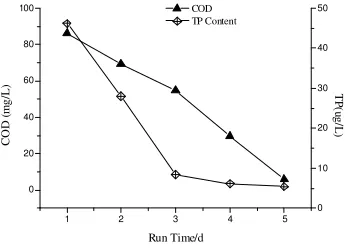
The newly invested sludge is black, its’ activity is poor, but its’ settlement is good. With the continuous addition of the substrate, the activity of the sludge gradually recovered, and the color changed from black to tan, and the MLSS increased to about 3000mg/L, and the SVI increased from about 86 to 156. This is mainly because the artificial water distribution contains almost no inorganic impurities, good biodegradability and low content of inert ingredients and inorganic substances in the sludge. On the 7th day of the activity recovery, the microscopy is performed, and found that the zoogloea are well. At the same time, there is the emergence of the metazoan. At this time, the activity of the sludge is basically recovered. The content of COD and P is measured for 5 consecutive days during the active recovery period, and the variation of COD and P content is shown in Figure 3.
1 2 3 4 5
0 20 40 60 80
100 COD
TP Content Run Time/d C O D ( m g /L ) 0 10 20 30 40 50 T P (u g /L )
Figure 3. Changes in COD and TP in sludge active recovery.
[image:3.612.220.395.464.588.2]0 200 400 600 800 1000 1200 1400 1600 0
1 2 3 4 5 6 7 8
PH
As
%
[image:4.612.231.370.78.195.2]COD(mg/L)
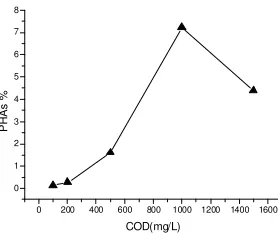
Figure 4. The effect of COD concentration on the synthesis of PHAs.
As can be seen from the figure, when COD=1000mg/L, the content of PHAs reached to 7.24%. Therefore, the water inlet concentration of COD is unchanged at 1000mg/L when the enriched sludge is extensively synthesized. (PHAs% means that the extracted PHAs is the percentage of the dry weight of the domesticated sludge.)In this experiment, the N source and P concentration in the reactor are controlled, and the microorganism is in unsteady state. In the abundant medium (g/L), C/N=30, C/P=114; In the N restriction medium (g/L), take C/N = 150, C/P = 114; In the phosphorous medium, C/N=30, C/P=570. The sludge is activated and the sludge is activated. The activated sludge is first cultured in a rich medium for 24h, so that the bacteria could grow to ensure sufficient amount of bacteria. After that, 24h are cultured respectively in N restriction and P limiting culture medium respectively, so that it is in long-term growth and starvation condition, which led to its synthesis of PHAs. According to the results obtained from the experiment, the second culture can regulate the incubation time of the bacteria group in the medium containing N and P to 40h, so as to ensure that the bacteria group is hungry enough. Among them, the group of bacteria that is obtained from the alternation of abundant - N starvation is called the N-limiting bacteria group, and the group of bacteria which is obtained from the alternation of abundant - phosphor starvation is called the limited phosphor bacteria group. Among them, the proportion of various nutrients is added as shown in Table 2.
Table 2. Nutrient composition (V=10L).
System Blank Lack P Lack N Balance
Glucose /g 0 13.7 13.7 13.7
CH3COONa(g/L) 0 17.08 17.08 17.08
NH4Cl(g/L) 0 1.261 0.256 1.261
KH2PO4 0 0.07678 0.3848 0.3848
[image:4.612.171.443.470.576.2]increasing N concentration in the sludge. The release of N come from the N-release bacteria in the sludge. With the running time increases, the N concentration decreases gradually. It shows that the P-limiting bacteria grow and multiply. limit P sludge cultivation, the excess sludge carbon source for a long time, the P source lack of state, and using the artificial water distribution, water distribution of carbon source type is single. As the test continues to run, community structure of diminishing the whole sludge degradation, and not improve for a long time, finally active sludge bulking sludge.
1 2 3 4 5 6 7 1.0 1.5 2.0 2.5 3.0 3.5 4.0 4.5 5.0 5.5 P H A s (% )
Run Time (/d)
Lack P Lack N
[image:5.612.142.470.156.275.2]0 1 2 3 4 5 6 7 8 9 0.0 0.2 0.4 0.6 0.8 1.0 1.2 1.4 N C o nt en t/ u g Run Time/d NH3-N NO3-N
Figure 5.N/P limiting time change PHAs synthesis. Figure 6.N changes in the sludge.
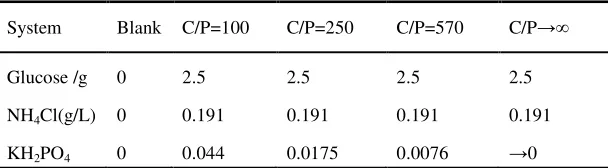
Based on the trait of water inflow which COD: N: P = 100:5:1, this experiment limit P nutrition elements, keep the water COD = 1000 mg/L and the concentration of N invariant, gradually reduce the amount of P element. Then converted into corresponding COD and the ratio of P, continue to run 3 to 4 days after each change conditions. In this experiment, sample analysis is performed in C/P=100, C/P=250, C/P=570 and C/P to infinity as shown in Table 3.
Table 3. Nutrient content underP limited (V=1L).
System Blank C/P=100 C/P=250 C/P=570 C/P→∞
Glucose /g 0 2.5 2.5 2.5 2.5
NH4Cl(g/L) 0 0.191 0.191 0.191 0.191
KH2PO4 0 0.044 0.0175 0.0076 →0
In the above experimental study, the adjustment of the nutrition proportion is gradually carried out, and there is a gradual and gradual reduction of N and P in the domestication. However, because of the time, the PHAs successfully extracted from the sludge limiting bacteria is successfully extracted from C/P to infinity, and the extraction content is 6.53%.
Extract PHAs From Active Sludge
Sodium hypochlorite method is used to extract a few sets of sludge samples which could synthesize PHAs. Sodium hypochlorite method is a common method to extract PHAs, and sodium hypochlorite plays an important role to break cell wall. The PHAs is extracted by sodium hypochlorite method. First, take a part of from activated sludge samples has been reacted , rotate speed of 4000 r/min for 20 minutes., refuse to go to that will the sludge supernatant fluid transferred to small beaker, join 15mL NaClO, with the same parameters of centrifugal 20 min. Continue to discard the supernatant liquid, add a proper amount of distilled water and centrifuge for 10min. And then remove the mud sample, adding suitable amount of acetone, centrifuge for 10 min, then abandon that the remaining
supernatant fluid material dry 60 ~ 70 ℃ for 30 min. Again take dry mud sample in a test tube, add 15
ml chloroform, at 60 ℃ water bath heating 1 h, pour into a glass dish with a liquid in a test tube, 60 ~
70 ℃ drying 1 h or get thin layers of PHAs extracts. The final extract is similar in appearance to
[image:5.612.154.458.388.472.2]Figure 7. Picture of extracted PHAs.
Results and Discussion
This construction use aerobic dynamic supply feeding in sludge treatment. It successfully extract PHAs from active sludge, and through the simulate water domesticate feeding active sludge to study
the appropriate control method, then develop a feasible method for the synthesis of PHAs.We found
that different COD concentrations had a certain effect on the accumulation of PHAs product from microorganisms in activated sludge. When COD=1000mg/L, PHAs accumulated a maximum of 7.24%. When the synthesis of PHAs by means of N restriction adopted, the increasing of N source and P source can increase the proportion of PHAs, which is 4.03% and 5.01% respectively, but it will
decrease by the adding growth time.Different carbon and P ratios affect the accumulation of PHAs.
When C/P goes to infinity, the synthesis amount of PHAs is 6.53%, and the sludge is easy to expand. PHAs production by activated sludge shows another way of PHAs production is using mixed nutrient source feeding activated sludge, under the appropriate conditions and enrichment of PHAs production, may be a promising method of PHAs production, it can be value to environment pollution, reduce the amount of excess sludge, at the same time get PHAs. However, the production of PHAs in this experiment is too low to be further determined for the synthesized PHAs, so further study is needed on how to improve the synthesis of PHAs.
Acknowledgments
The authors are grateful to the scientific research and trial-production project of Sanya (2015KS13), the doctoral scientific research foundation of Hainan Tropical Ocean University (QYXB201502).
References
[1] Suchada Chanprateep. Production and Characterization of Biodegradable Terpolymer Poly (3-Hydroxybutyrate -co-3- Hydroxyvalerate- co-4- Hydroxybutyrate ) by Alcaligenes[J]Journal of Biosciences, 2006,(1).
[2] Everest Akaraonye, Tajalli Keshavarz, Ipsita Roy. Production of poly hydroxyalkanoates: the future green materials of choice[J]Journal of Chemical Technology Biotechnology, 2010, (6).
[3] K. D. Wend Landt, W. Geyer. Possibilities for controlling a PHB accumulation process using various analytical methods[J]Journal of Biotechnology, 2005, (1).
[4] Davide Dionisi, Mauro Majone, Viviana Papa, et al. Biodegradable Polymers From Organic Acids by Using Activated Sludge Enriched by Aerobic Periodic Feeding[J]. Biotechnology and Bioengineering, Vol. 85, No. 6, March 20, 2004.
[6] Wang Jie, Peng Yong-zhen, Yang Xiong, Wang Shu-ying. Effect of various types carbon source on the synthesis of PHA of aerobic granular sludge[J].China Environmental Science, 2015, 35(8):2360-2366.