Volume 2012, Article ID 817157,14pages doi:10.1155/2012/817157
Research Article
Generalized
q, w
-Euler Numbers and Polynomials
Associated with
p
-Adic
q
-Integral on
Z
p
H. Y. Lee, N. S. Jung, J. Y. Kang, and C. S. Ryoo
Department of Mathematics, Hannam University, Daejeon 306-791, Republic of Korea
Correspondence should be addressed to C. S. Ryoo,[email protected]
Received 18 June 2012; Accepted 4 October 2012
Academic Editor: A. Bayad
Copyrightq2012 H. Y. Lee et al. This is an open access article distributed under the Creative
Commons Attribution License, which permits unrestricted use, distribution, and reproduction in any medium, provided the original work is properly cited.
We generalize the Euler numbers and polynomials by the generalized q, w-Euler numbers
En,q,waand polynomialsEn,q,wx : a. We observe an interesting phenomenon of “scattering”
of the zeros of the generalizedq, w-Euler polynomialsEn,q,wx:ain complex plane.
1. Introduction
Recently, many mathematicians have studied in the area of the Euler numbers and polynomials see 1–15. The Euler numbers and polynomials possess many interesting properties and arising in many areas of mathematics and physics. In14, we introduced that Euler equationEnx 0 has symmetrical roots forx1/2see14. It is the aim of this paper to observe an interesting phenomenon of “scattering” of the zeros of the generalized
q, w-Euler polynomialsEn,q,wx :ain complex plane. Throughout this paper, we use the following notations. ByZp, we denote the ring of p-adic rational integers, Qp denotes the field of p-adic rational numbers, Cp denotes the completion of algebraic closure of Qp, N denotes the set of natural numbers,Z denotes the ring of rational integers,Qdenotes the field of rational numbers,Cdenotes the set of complex numbers, andZ N∪ {0}. Letνp
be the normalized exponential valuation ofCpwith|p|pp−νpp p−1. When one talks of q-extension,qis considered in many ways such as an indeterminate, a complex numberq∈C, orp-adic numberq∈ Cp. Ifq∈Cone normally assume that|q|<1. Ifq ∈Cp, we normally assume that|q−1|p< p−1/p−1so thatqx expxlogqfor|x|p≤1
xq 1−q x
1−q, x−q
1−−qx
Compared with1,4,5. Hence, limq→1x xfor anyxwith|x|p ≤1 in the presentp-adic case. Letdbe a fixed integer, and letpbe a fixed prime number. For any positive integerN, we set
Xlim
← N
Z
dpNZ
,
X∗
0<a<dp
a,p1
adpZp
,
adpNZ p
x∈X |x≡amoddpN ,
1.2
wherea∈Zlies in 0≤a < dpN. For any positive integerN,
μqadpNZp qa
dpN q
1.3
is known to be a distribution onX, compared with1–10,14. For
g∈UDZp
g|g:Zp → Cpis uniformly differentiable function
. 1.4
Kim defined the fermionicp-adicq-integral onZp
I−q
g
Zpgxdμ−qx Nlim→ ∞
1
pN
−q
0≤x<pN
gx−qx. 1.5
From1.5, we also obtain
qI−q
g1
I−q
g 2qg0, 1.6
whereg1x gx1 see1–3.
From1.6, we obtain
qnI−q
gn −1n−1I−q
g 2q n−1
l0
−1n−1−lqlgl, 1.7
wheregnx gxn.
As well-known definition, the Euler polynomials are defined by
Ft 2
et1 e Et∞
n0
En tn n!,
Ft, x 2 et1e
xteExt∞
n0
Enxt n
n!,
with the usual convention of replacingEnxbyEnx. In the special case,x0,En0 En are called then-th Euler numberscf.1–15.
Our aim in this paper is to define the generalizedq, w-Euler numbersEn,q,waand polynomialsEn,q,wx:a. We investigate some properties which are related to the generalized
q, w-Euler numbersEn,q,waand polynomialsEn,q,wx:a. Especially, distribution of roots forEn,q,wx : a 0 is different fromEnx 0
s. We also derive the existence of a specific interpolation function which interpolate the generalizedq, w-Euler numbersEn,q,waand polynomialsEn,q,wx:a.
2. The Generalized
q, w
-Euler Numbers and Polynomials
Our primary goal of this section is to define the generalizedq, w-Euler numbersEn,q,wa and polynomialsEn,q,wx : a. We also find generating functions of the generalizedq, w -Euler numbersEn,q,waand polynomialsEn,q,wx:a. Letabe strictly positive real number. The generalized q, w-Euler numbers and polynomials En,q,wa, En,q,wx : a are defined by
∞
n0
En,q,wa tn n!
Zpw
axeaxtdμ
−qx, 2.1
∞
n0
En,q,wx:a tn n!
Zpw
ayeayxtdμ
−q
y, fort, w∈C, 2.2
respectively.
From above definition, we obtain
En,q,wa
Zpw
axaxndμ
−qx,
En,q,wx:a
Zpw
ayxayn dμ−q
y.
2.3
Letgx waxeaxt. By1.6and usingp-adicq-integral onZ
p, we have
qI−q
g1
I−q
g
Zpw
ax1eax1tdμ
−qx
Zpw
axeaxtdμ
−qx
qwaeat1
Zpw
axeaxtdμ
−qx
2q.
2.4
Hence, by2.1, we obtain
∞
n0
En,q,wat n
n!
2q
By1.6,2.2andgy wayeayxt, we have
∞
n0
En,q,wx:a tn n!
2q qwaeat1e
xt. 2.6
After some elementary calculations, we obtain
∞
n0
En,q,wx:a tn n! 2q
∞
n0
−1nqnwaneantext. 2.7
From2.6, we have
En,q,wx:a n
k0
n k
xn−kEk,q,wa
xEq,wa
n,
2.8
with the usual convention of replacingEq,wanbyEn,q,wa.
3. Basic Properties for the Generalized
q, w
-Euler
Numbers and Polynomials
By2.5, we have
∂ ∂x
∞
n0
En,q,wx:at n
n! ∂ ∂x
2q qwaeat1e
xt
t
∞
n0
En,q,wx:at n
n!
∞
n0
nEn−1,q,wx:a tn n!.
3.1
By3.1, we have the following differential relation.
Theorem 3.1. For positive integers n, one has
∂
∂xEn,q,wx:a nEn−1,q,wx:a. 3.2
By Theorem3.1, we easily obtain the following corollary.
Corollary 3.2integral formula. Consider that
q
p
En−1,q,wx:adx 1 n
By2.5, one obtains
∞
n0
En,q,wxy:at n
n!
2q qwaeat1e
xyt
∞
n0
En,q,wx:a tn n!
∞
k0 ykt
k
k!
∞
n0
n
k0
n k
Ek,q,wx:ayn−k
tn n!.
3.4
By comparing coefficients oftn/n! in the above equation, we arrive at the following addition theorem.
Theorem 3.3addition theorem. Forn∈Z,
En,q,wxy:a n
k0
n k
Ek,q,wx:ayn−k. 3.5
By2.5, form≡1mod 2, one has
∞
n0
mn 2q
2qm
m−1
k0
−1kqkwakEn,qm,wm
xak
m :a
tn n!
m−1
k0
−1kqkwak
∞
n0
En,qm,wm
xak
m :a
mtn n!
m−1
k0
−1kqkwak 2q qmwmaemat1e
xakt
2q
1qwaeate xt
∞
n0
En,q,wx:a tn n!.
3.6
By comparing coefficients oftn/n! in the above equation, we arrive at the following multiplication theorem.
Theorem 3.4multiplication theorem. Form, n∈N
En,q,wx:a mn
2q
2qm
m−1
k0
−1kqkwakE n,qm,wm
xak
m :a
From1.6, one notes that
2q
Zpqw
axaeaxatdμ
−qx
Zpw
axeaxtdμ
−qx
∞
n0
qwa
Zpw
axaxandμ
−qx
Zpw
axaxndμ
−qx
tn n!
∞
n0
qwaEn,q,wa:a En,q,wa
tn
n!.
3.8
From the above, we obtain the following theorem.
Theorem 3.5. Forn∈Z, we have
qwaEn,q,wa:a En,q,wa
2q, if n0,
0, if n >0. 3.9
By2.8in the above, we arrive at the following corollary.
Corollary 3.6. Forn∈Z, one has
qwaaEq,wanEn,q,wa
2q, if n0,
0, if n >0, 3.10
with the usual convention of replacingEq,wanbyEn,q,wa.
From1.7, one notes that
∞
m0
2q n−1
l0
−1n−1−lqlwalalm
tn m!
qn
Zpw
axaneaxantdμ
−qx −1n−1
Zpw
axeaxtdμ
−qx
∞
m0
qnwan
Zpw
axaxanmdμ
−qx −1n−1
Zpw
axaxmdμ
−qx
tm m!
∞
m0
qnwanEm,wan:a −1n−1Em,wa t m
m!.
3.11
Theorem 3.7. Forn∈Z, one has
qnwanEm,wna:a −1n−1Em,wa 2q n−1
l0
−1n−1−lwalqlalm. 3.12
4. The Analogue of the
q
-Euler Zeta Function
By using the generalizedq, w-Euler numbers and polynomials, the generalizedq, w-Euler zeta function and the generalized Hurwitz q, w-Euler zeta functions are defined. These functions interpolate the generalized q, w-Euler numbers and q, w-Euler polynomials, respectively. Let
Fq,wx:at 2q
∞
n0
−1nqnwaneantext
∞
n0
En,q,wx:at n
n!. 4.1
By applying derivative operator,dk/dtk|
t0to the above equation, we have
dk
dtkFq,wx:at
t0 2q
∞
n0
−1nqnwananxk, k∈N, 4.2
Ek,q,wx:a 2q
∞
n0
−1nqnwananxk. 4.3
By using the above equation, we are now ready to define the generalizedq, w-Euler zeta functions.
Definition 4.1. Fors∈C, one defines
ζq,wax:s 2
∞
n1
−1nqnwan
anxs . 4.4
Note thatζwax, sis a meromorphic function onC. Note that, ifw → 1,w → 1, and a1, thenζq,wax:s ζx:swhich is the Hurwitz Euler zeta functions. Relation between ζwax:sandEk,wx:ais given by the following theorem.
Theorem 4.2. Fork∈N, one has
ζq,wax:−k Ek,wx:a. 4.5
By using4.2, one notes that
dk
dtkFq,w0 :at
t0 2q
∞
n0
Hence, one obtains
Ek,q,wa 2q
∞
n0
−1nqnwanank. 4.7
By using the above equation, one is now ready to define the generalized Hurwitz
q, w-Euler zeta functions.
Definition 4.3. Lets∈C. One defines
ζq,was 2
∞
n1
−1nqnwan
ans . 4.8
Note thatζq,wasis a meromorphic function onC. Obverse that, ifw → 1,q → 1, anda1, thenζwas ζswhich is the Euler zeta functions. Relation betweenζwasandEk,wsis given by the following theorem.
Theorem 4.4. Fork∈N, one has
ζq,wa−k Ek,q,wa. 4.9
5. Zeros of the Generalized
q, w
-Euler Polynomials
E
n,q,wx
:
a
In this section, we investigate the reflection symmetry of the zeros of the generalizedq, w -Euler polynomialsEn,q,wx:a.
In the special case, w 1 and q → 1, En,q,wx : a are called generalized Euler polynomialsEnx:a. Since
∞
n0
Ena−x:a− tn n!
2
e−at1e a−x−t
2
eat1e xt∞
n0
Enx:a tn n!,
5.1
we have
Enx:a −1nEna−x:a forn∈N. 5.2
Let
Fq,wx:t 2q qwaeat1e
xt∞
n0
En,q,wx:at n
n!. 5.3
Then, we have
Fq−1,w−1a−x:−t
2q−1
q−1w−ae−at1e
a−x−t
wa 2q qwaeat1e
xt
wa
∞
n0
En,q,wx:at n
n!.
5.4
Hence, we arrive at the following complement theorem.
Theorem 5.1complement theorem. Forn∈N,
En,q−1,w−1a−x:a −1nwaEn,q,wx:a. 5.5
Throughout the numerical experiments, we can finally conclude thatEn,q,wx:a, x∈
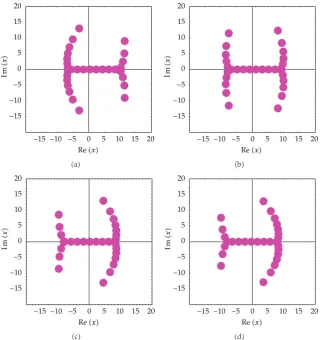
Chas not Rex a/2 reflection symmetry analytic complex functions. However, we observe thatEn,q,wx : a, x ∈ Chas Imx 0 reflection symmetry see Figures1,2, and 3. The obvious corollary is that the zeros ofEn,q,wx:awill also inherit these symmetries.
If En,q,wx0:a 0, then En,q,w
x∗0:a0, 5.6
where∗denotes complex conjugationsee Figures1,2, and3.
We investigate the beautiful zeros of the generalized q, w-Euler polynomials En,q,wx : aby using a computer. We plot the zeros of the generalized Euler polynomials En,q,wx:aforn30, a1,2,3,4, andx∈CFigure1. In Figure1top-left, we choose n 30, q 1/2, w 1, anda1. In Figure1top-right, we choosen30, q 1/2, w2, anda2. In Figure1bottom-left, we choosen30, q1/2, w3, anda3. In Figure1 bottom-right, we choosen30, q1/2, w4, anda4.
We plot the zeros of the generalized Euler polynomialsEn,q,wx : aforn 30, a 2, w2, andx∈CFigure2.
In Figure2top-left, we choosen30, q 1/10, w 2, anda2. In Figure2 top-right, we choosen30, q3/10, w2, anda2. In Figure2bottom-left, we choosen 30, q7/10, w2, anda2. In Figure2bottom-right, we choosen30, q9/10, w2 anda2.
20 15 10 5 0 −5 −10 −15
20 15 10 5 0 −5 −10 −15
Im
(
x
)
Re(x)
a
20 15 10 5 0
−5 −10 −15
20 15 10 5 0 −5 −10 −15
Im
(
x
)
Re(x)
b
20 15 10 5 0 −5 −10 −15
20 15 10 5 0 −5 −10 −15
Im
(
x
)
Re(x)
c
20 15 10 5 0 −5 −10 −15
20 15 10 5 0 −5 −10 −15
Im
(
x
)
Re(x)
[image:10.600.137.462.84.440.2]d
Figure 1: Zeros ofEn,q,wx:afora1,2,3,4.
Stacks of zeros ofEn,q,wx : afor 1 ≤ n ≤ 30, q 1/2, w 4,anda 4 from a 3-D structure are presentedFigure4.
Our numerical results for approximate solutions of real zeros of the generalized En,q,wx:aare displayedTables1and2.
We observe a remarkably regular structure of the complex roots of the generalized
q, w-Euler polynomialsEn,q,wx :a. We hope to verify a remarkably regular structure of the complex roots of the generalizedq, w-Euler polynomialsEn,q,wx:a Table1.
Next, we calculated an approximate solution satisfying En,q,wx : a, q 1/2, w 2, a2, x∈R. The results are given in Table2.
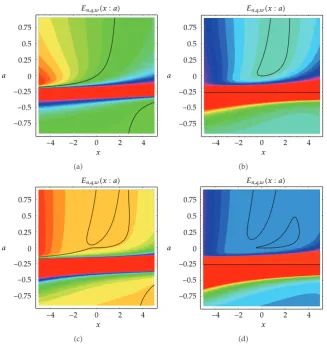
Figure5shows the generalizedq, w-Euler polynomialsEn,q,wx:afor real−9/10≤ q≤9/10 and−5≤x≤5, with the zero contour indicated in blackFigure5. In Figure5 top-left, we choosen1,w 2, anda2. In Figure5top-right, we choosen2,w2, and a2. In Figure5bottom-left, we choosen3,w2, anda2. In Figure5bottom-right, we choosen4, w2, anda2.
20 15 10 5 0 −5 −10 −15
20 15 10 5 0 −5 −10 −15
Im
(
x
)
Re(x)
a
20 15 10 5 0 −5 −10 −15
20 15 10 5 0 −5 −10 −15
Im
(
x
)
Re(x)
b
20 15 10 5 0 −5 −10 −15
20 15 10 5 0 −5 −10 −15
Im
(
x
)
Re(x)
c
20 15 10 5 0 −5 −10 −15
20 15 10 5 0 −5 −10 −15
Im
(
x
)
Re(x)
[image:11.600.140.461.96.437.2]d
Figure 2: Zeros ofEn,q,wx:aforq1/10,3/10,7/10,9/10.
Table 1: Numbers of real and complex zeros ofEn,q,wx:a.
n q1/2, w2, a2 q1/2, w4, a4
Real zeros Complex zeros Real zeros Complex zeros
1 1 0 1 0
2 2 0 2 0
3 3 0 1 2
4 2 2 2 2
5 3 2 1 4
6 4 2 2 4
7 3 4 3 4
8 4 4 2 6
9 3 6 3 6
10 4 6 2 8
11 5 6 3 8
12 6 6 4 8
[image:11.600.131.468.500.688.2]−6−5−4−3−2−1 0 1 2 3 4 5 6 7 8 90 10 20
n
Re(x)
a
−7−6−5−4−3−2−1 0 1 2 3 4 5 6 7 80 10 20
n
Re(x)
b
−7−6−5−4−3−2−1 0 1 2 3 4 5 6 70 10 20
n
Re(x)
c
−6−5−4−3−2−1 0 1 2 3 4 5 60 10 20
n
Re(x)
[image:12.600.145.454.96.351.2]d
Figure 3: Real zeros ofEn,q,wx:afor 1≤n≤25.
Im(x
)
Re(x
)
10
0
−10
10 0
−10 30
20
10
0
n
[image:12.600.186.412.411.657.2]Table 2: Approximate solutions ofEn,q,wx:a 0, x∈R.
n x
1 1.3333
2 0.3905,2.2761
3 −0.4011,1.560,2.841
4 −1.0546,0.6907
5 −1.5732,−0.17085,1.829
6 −1.9151,−1.0557,0.9680,2.94
7 0.10585,2.106,3.68
8 −0.7557,1.2442,3.26,4.00
9 −1.6091,0.3825,2.382
10 −2.392,−0.4793,1.521,3.52
11 −3.013,−1.3411,0.6590,2.66,4.4
0.75
0.5 0.25
0 −0.25 −0.5 −0.75
−4 −2 0 2 4
x a
En,q,w(x:a)
a
0.75
0.5 0.25
0 −0.25 −0.5 −0.75
−4 −2 0 2 4
x a
En,q,w(x:a)
b
0.75 0.5
0.25 0 −0.25 −0.5 −0.75
−4 −2 0 2 4
x a
En,q,w(x:a)
c
0.75 0.5
0.25 0 −0.25 −0.5 −0.75
−4 −2 0 2 4
x a
En,q,w(x:a)
d
[image:13.600.137.465.306.653.2]the degree of the polynomialEn,q,wx:a, the number of real zerosREn,q,wx:alying on the real
plane Imx:a 0 is thenREn,q,wx:an−CEn,q,wx:a, whereCEn,q,wx:adenotes complex zeros.
See Table 1 for tabulated values ofREn,q,wx:a and CEn,q,wx:a. We plot the zeros of En,q,wx : a, respectivelyFigures1–5. These figures give mathematicians an unbounded capacity to create visual mathematical investigations of the behavior of the roots of theEn,q,wx : a. Moreover, it is possible to create a new mathematical ideas and analyze them in ways that generally are not possible by hand. The authors have no doubt that investigation along this line will lead to a new approach employing numerical method in the field of research of
q, w-Euler polynomialsEn,q,wx:ato appear in mathematics and physics.
References
1 M. Acikgoz and Y. Simsek, “On multiple interpolation functions of the N ¨orlund-type q-Euler
polynomials,” Abstract and Applied Analysis, vol. 2009, Article ID 382574, 14 pages, 2009.
2 A. Bayad, “Modular properties of elliptic Bernoulli and Euler functions,” Advanced Studies in
Contemporary Mathematics, vol. 20, no. 3, pp. 389–401, 2010.
3 M. Cenkci, M. Can, and V. Kurt, “p-adic interpolation functions and Kummer-type congruences for
q-twisted andq-generalized twisted Euler numbers,” Advanced Studies in Contemporary Mathematics,
vol. 9, no. 2, pp. 203–216, 2004.
4 L. Jang, “A note on N ¨orlund-type twisted q-Euler polynomials and numbers of higher order
associated with fermionic invariantq-integrals,” Journal of Inequalities and Applications, vol. 2010,
Article ID 417452, 12 pages, 2010.
5 T. Kim, “On theq-extension of Euler and Genocchi numbers,” Journal of Mathematical Analysis and
Applications, vol. 326, no. 2, pp. 1458–1465, 2007.
6 T. Kim, “q-Volkenborn integration,” Russian Journal of Mathematical Physics, vol. 9, no. 3, pp. 288–299,
2002.
7 T. Kim, “q-Euler numbers and polynomials associated withp-adicq-integrals,” Journal of Nonlinear
Mathematical Physics, vol. 14, no. 1, pp. 15–27, 2007.
8 T. Kim, J. Choi, Y-.H. Kim, and C. S. Ryoo, “A Note on the weightedp-adicq-Euler measure onZp,”
Advanced Studies in Contemporary Mathematics, vol. 21, pp. 35–40, 2011.
9 B. A. Kupershmidt, “Reflection symmetries of q-Bernoulli polynomials,” Journal of Nonlinear
Mathematical Physics, vol. 12, supplement 1, pp. 412–422, 2005.
10 E.-J. Moon, S.-H. Rim, J.-H. Jin, and S.-J. Lee, “On the symmetric properties of higher-order twisted
q-Euler numbers and polynomials,” Advances in Difference Equations, vol. 2010, Article ID 765259, 8
pages, 2010.
11 H. Ozden, Y. Simsek, and I. N. Cangul, “Euler polynomials associated withp-adicq-Euler measure,”
General Mathematics, vol. 15, no. 2, pp. 24–37, 2007.
12 C. S. Ryoo, T. Kim, and L.-C. Jang, “Some relationships between the analogs of Euler numbers and
polynomials,” Journal of Inequalities and Applications, vol. 2007, Article ID 86052, 22 pages, 2007.
13 C. S. Ryoo, “A note on the weighted q-Euler numbers and polynomials,” Advanced Studies in
Contemporary Mathematics, vol. 21, pp. 47–54, 2011.
14 C. S. Ryoo and Y. S. Yoo, “A note on Euler numbers and polynomials,” Journal of Concrete and Applicable
Mathematics, vol. 7, no. 4, pp. 341–348, 2009.
15 Y. Simsek, O. Yurekli, and V. Kurt, “On interpolation functions of the twisted generalized
Submit your manuscripts at
http://www.hindawi.com
Hindawi Publishing Corporation
http://www.hindawi.com Volume 2014
Mathematics
Journal ofHindawi Publishing Corporation
http://www.hindawi.com Volume 2014
Hindawi Publishing Corporation http://www.hindawi.com
Differential Equations
International Journal of
Volume 2014
Applied MathematicsJournal of
Hindawi Publishing Corporation
http://www.hindawi.com Volume 2014
Hindawi Publishing Corporation
http://www.hindawi.com Volume 2014
Hindawi Publishing Corporation
http://www.hindawi.com Volume 2014 Mathematical PhysicsAdvances in
Complex Analysis
Journal ofHindawi Publishing Corporation
http://www.hindawi.com Volume 2014
Optimization
Journal of Hindawi Publishing Corporationhttp://www.hindawi.com Volume 2014
Combinatorics
Hindawi Publishing Corporation
http://www.hindawi.com Volume 2014 International Journal of Hindawi Publishing Corporation
http://www.hindawi.com Volume 2014
Journal of
Hindawi Publishing Corporation
http://www.hindawi.com Volume 2014
Function Spaces
Abstract and Applied Analysis Hindawi Publishing Corporation
http://www.hindawi.com Volume 2014
International Journal of Mathematics and Mathematical Sciences
Hindawi Publishing Corporation
http://www.hindawi.com Volume 2014
The Scientific
World Journal
Hindawi Publishing Corporationhttp://www.hindawi.com Volume 2014
Hindawi Publishing Corporation
http://www.hindawi.com Volume 2014
Discrete Dynamics in Nature and Society Hindawi Publishing Corporation
http://www.hindawi.com Volume 2014 Hindawi Publishing Corporation
http://www.hindawi.com Volume 2014
Discrete Mathematics
Journal ofHindawi Publishing Corporation
http://www.hindawi.com Volume 2014
Hindawi Publishing Corporation
http://www.hindawi.com Volume 2014
Stochastic Analysis