2018 International Conference on Computer, Communication and Network Technology (CCNT 2018) ISBN: 978-1-60595-561-2
Improvement and Application of Decision Tree C4.5 Algorithm
Jie YE
1and Li-duo HOU
21
School of Computer and Engineering, Guizhou University of Commerce, Guiyang 550014, Guizhou, China
2
School of Computer Science and Technology, Guizhou University, Guiyang 550025, Guizhou, China
*Corresponding author
Keywords: Decision tree, C4.5 algorithm, Information entropy, Pruning, Engineering quality supervision.
Abstract. The C4.5 algorithm as the most popular decision tree algorithm, there are still some deficiencies, C4.5 algorithm uses post-pruning to solve the over-fitting problem, but increase the modeling overhead, in response to this problem the idea of combining over-fitting branches ahead of time in the process of creating a decision tree is proposed and improved on the original C4.5 algorithm, which solves the problem of long decision-making time and large models of the decision tree. Experimental verification shows that the improved algorithm has a significant improvement in model simplification and model accuracy. The improved algorithm is applied to the "Engineering Quality Decision Support System" to provide supervision and decision-making support for the supervisory department.
Introduction
In recent years, the rapid development of data mining technology, decision tree algorithm as a branch of data mining classification algorithm is favored, because of its excellent data analysis efficiency, intuitive and easy to understand, high precision characteristics. In the current decision tree algorithm, the most widely used is the C4.5 algorithm.
However, the C4.5 algorithm uses post-pruning to solve overfitting. Therefore, a complete decision tree needs to be constructed, which results in the problem that the complexity of the decision tree model is too large. When the amount of data is large, the full growth decision book will consume a lot of time, but the messy branches in the decision tree that are prone to overfitting will be pruned after being grown, thus increasing the overhead of the algorithm. Based on the discovery of these cluttered branches during the growth of the decision tree, and stopping its growth in advance, but also need to avoid the problem of "visual limitations" of the pre-pruning, an improved C4.5 algorithm with variable parameters was proposed.
C4.5 Decision Tree Algorithm
C4.5 Decision Tree Algorithm Principle
The core idea of the C4.5 algorithm is to use information gain as an attribute selection criterion at all levels of the decision tree. By selecting the largest attribute of information gain as the test attribute of the sample partition, the purpose of classifying the test data set with the minimum amount of information is achieved.
Suppose there are n samples in the set S, it is assumed that the classification attribute C has m different values, namely Ci (i=1, 2,..., M). Let ni be the number of samples in Ci. For class attribute C, the information entropy of the sample set S divided into m classes can be expressed as:
m
Among the many test attributes of the sample, we chose one of the test attributes A. Assuming that A has k different values, we can also use the test attribute A to divide the sample set S into k classes, namely Sj (j=1, 2,..., K). At this time, Aij (i=1, 2,..., M) (j=1, 2,..., K) is expressed as the number of samples belonging to both the Sj class and the Ci class. Then the expected entropy caused by attribute A partitioning sample set S can be expressed as:
) ( log ) ( 2 1 ij m i ij
j P P
S
E =−
∑
⋅=
The information entropy of the sample subset Sj can be expressed as:
) S ( E n A A A ) , ( j k 1 j mj 2j 1j ⋅ + ⋅ ⋅ ⋅ + + =
∑
= A S EIn this way, we can calculate the information gain of attribute A based on the above information, which can be expressed by the following formula:
) , ( ) ( ) ,
(S A E S E S A
Gain = −
The information gain rate is actually equal to the information gain/entropy. The reason why the information gain rate index is used is that if the information gain is used to select the test attribute, the result will make the decision tree tend to tend to those attributes with a variety of attribute values, so we To avoid this phenomenon, the information gain rate is calculated as follows:
among them: ) , ( ) , ( ) ( A S SplitInfo A S Gain A
GainRatio = ( , ) log2( )
1 j k j j P P A S
SplitInfo =
∑
⋅=
C4.5 Decision Tree Algorithm Modeling Process
This study is based on WEKA data mining platform C4.5 algorithm data modeling and data analysis, in the WEKA platform C4.5 algorithm implementation process shown in Figure 1.
Figure 1. Implementation of C4.5 algorithm in WEKA platform.
Problems with Decision Tree Algorithms
Because the C4.5 algorithm uses a post-pruning strategy, the following problems occur when modeling with the C4.5 algorithm:
(1) Using the C4.5 algorithm to model, the decision tree is pruned after full growth, thus increasing the time spent in the modeling process.
(2) The pruned branch also contains part of the feature description of the decision tree, but it has not been used after pruning. As a result, resources are wasted.
C4.5 Decision Tree Algorithm Improvement
The Core Idea of Improvement
Aiming at the problems existing in the C4.5 algorithm in 1.3, an improved C4.5 algorithm with variable parameters is proposed to make full use of the data set and incorporate the former pruning idea.
The core idea of the improved algorithm is: When a certain node of the decision tree needs to be split, the information entropy of each instance subset related to that node is calculated in advance. It will contain fewer instances (less than β) and the information entropy is greater than the average information entropy of the instance subset. The subset of (1+α) is marked and treated as a hashed subset, and the splitting process of this subset is stopped early. I In order to avoid being caught in the problem of "visual constraints", these disorganized subsets are merged as a new instance subset of the node for the subsequent splitting process. Where α represents the magnitude of the increase in the average information entropy, ranging from 0 to 1, where β represents the minimum number of instances, and the introduction of α mainly leads to a decrease in the accuracy of the decision tree for some branches. The introduction of β is used to control where the decision tree merges so that it is neither close to the leaf nor to the root of the decision tree. So that the combined subset of instances can have more data support, so that the sample data can be effectively used, and the consolidation of the instance subsets can also avoid the process of redundant branches continuing to split downward, thereby reducing the modeling. Time and time spent after pruning.
Improved Algorithm Flow
The improved algorithm is mainly to determine in advance which branch is easy to produce the overfitting phenomenon in the process of creating the decision tree, and merge these branches. The implementation process of the improved algorithm is shown in Figure 2, where in the dotted line in the figure represents the place the modified part based on the original algorithm. The specific implementation process of the improvement part is shown in Figure 3:
Figure 2. Implementation of the improved C4.5
algorithm.
Treatment of Special Problems
There are problems in modeling with improved algorithms. We have adopted the following methods to deal with these problems:
(1) The test attribute will still appear in the subsequent splitting process after the sub-collection of the instance sub-collection. This increases the depth of the tree to a certain extent. Here, it is necessary to unify the value of the merged data set on the test attribute. Change to the same value.
(2) If the merged branch is still a disorderly branch, the decision tree is pruned after the growth of the decision tree using the post-pruning strategy.
Experimental Comparison and Analysis
This paper uses Java language to rewrite the original C4.5 algorithm, and integrates the algorithm into the WEKA data mining platform, selects the pre-processed data in the engineering quality supervision system for testing, Using 10 cross-validation methods, the C4.5 algorithm and the improved algorithm were compared and analyzed in terms of modeling speed, model generation scale, and model accuracy. The experimental environment is CPU: 2.6 GHz, memory: 4 GB, and Windows 7 operating system.
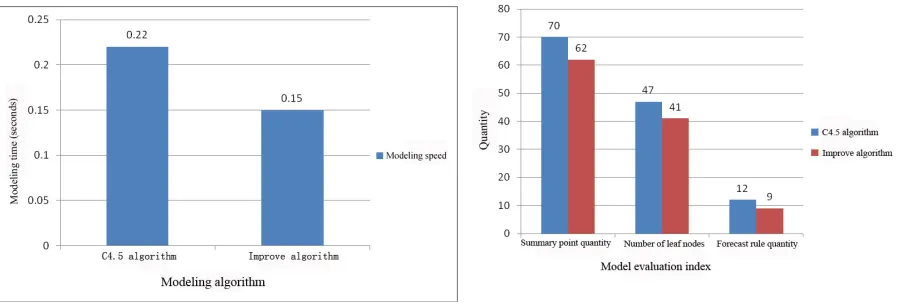
[image:4.612.83.532.349.501.2]Two kinds of algorithms were used to model the quality evaluation data of the barrage, and the comparison between the modeling time and the scale of the nodes was shown in Figure 4 and Figure 5.
Figure 4. Comparison of modeling speed. Figure 5. Comparison of number of nodes and number of rules.
From the perspective of modeling speed, although the improved algorithm requires time-consuming merger of the redundant branches during the modeling process (the time complexity is linear), but because the algorithm removes the modeling process of the redundant branches, it is greatly improved the modeling speed. From the experimental results, the improved algorithm modeling time is less than the original C4.5 algorithm.
From the node scale, the original C4.5 algorithm has 70 nodes in the decision tree model generated by the two algorithms. The improved algorithm has 62 nodes, the number of nodes is reduced by 11.42%, the leaf node is also reduced from 47 to 41. Because of the decrease of the leaf node, the prediction rules are also relatively reduced. Therefore, the model of the algorithm is improved. The pattern becomes clearer and easier to understand, and the rules generated are more succinct and clearer, which provides convenience for the application of subsequent models.
comparison results of the accuracy of the three groups of decision tree models are shown in the figure. 6.
Figure 6. Comparison of model accuracy.
It can be seen from Fig. 6 that the improved algorithm has higher accuracy in the three sets of experimental data, and the improved algorithm has high accuracy in the decision tree models built on the boosting substation and barrage projects. In the original C4.5 algorithm, although the accuracy of the model in the sluice project is slightly lower than that of the original C4.5 algorithm, the average accuracy improvement of the three models is 0.65% higher than that of the original C4.5 algorithm. Looking at the overall situation of the data, the model accuracy of the improved algorithm is slightly better than the original C4.5 algorithm.
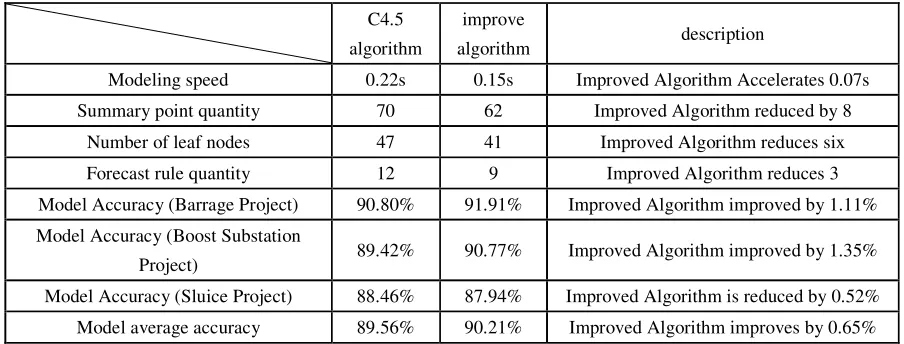
[image:5.612.83.535.456.628.2]Table 1 shows the overall performance comparison between the two algorithms. It can be seen from Table 1 that the improved algorithm is superior to the C4.5 algorithm in the number of nodes in the decision tree, the modeling speed, and the average accuracy of the model. Therefore, the improvement is improved. The algorithm is more adaptable to engineering quality supervision decisions.
Table 1. Comparison of performance of improved algorithm and C4.5 algorithm.
C4.5
algorithm
improve
algorithm description
Modeling speed 0.22s 0.15s Improved Algorithm Accelerates 0.07s
Summary point quantity 70 62 Improved Algorithm reduced by 8
Number of leaf nodes 47 41 Improved Algorithm reduces six
Forecast rule quantity 12 9 Improved Algorithm reduces 3
Model Accuracy (Barrage Project) 90.80% 91.91% Improved Algorithm improved by 1.11%
Model Accuracy (Boost Substation
Project) 89.42% 90.77% Improved Algorithm improved by 1.35%
Model Accuracy (Sluice Project) 88.46% 87.94% Improved Algorithm is reduced by 0.52%
Model average accuracy 89.56% 90.21% Improved Algorithm improves by 0.65%
Improved C4.5 Algorithm Application
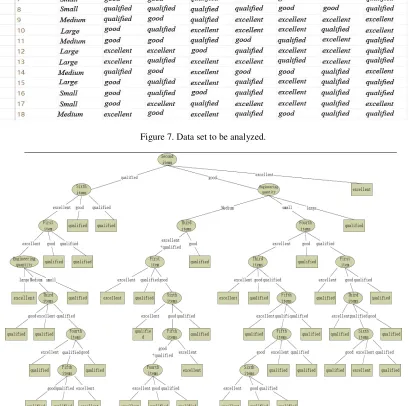
The decision tree model generated using the improved algorithm for data analysis and modeling is shown in Figure 8.
Figure 7. Data set to be analyzed.
Figure 8. Decision tree model generated by improved algorithm modeling.
[image:6.612.106.516.179.585.2]management department to discover the impact on the project quality early. The factors that enable them to find problems in advance, solve problems in time, and achieve the purpose of rainy days.
Conclusion
The above experimental analysis and application can see that the improved algorithm is less in the modeling time than the original C4.5 algorithm, and is also smaller than the original C4.5 algorithm in the model scale, and the improvement in the overall accuracy of the model is also considered to be better than the original C4. 5 The algorithm is high, which fully shows that the improved algorithm improves the efficiency of decision tree construction. This algorithm is applied to engineering quality supervision and decision-making, predicts future projects through decision tree rules, and helps regulatory authorities to discover potential problems in engineering projects in advance. To reduce the occurrence of engineering accidents.
Acknowledgements
Guizhou Province Big Data Application Engineering Research Center (Qian Jiao KY[2017]022)
References
[1] Chen Jin, Luo Delin, Mu Fenxiang. An improved ID3 decision tree algorithm[C]//Proc of 4th international conference on IEEE computer science and education. Chengdu: IEEE, 2009:127-130.
[2] Wang Liming. Research on Decision Tree Learning and Pruning Algorithm[D]. Wuhan University of Technology, 2007.
[3] Li Mingzhuang. Research and application of data mining algorithms based on decision tree [D]. China University of Petroleum, 2008.
[4] Kantardzic M. Data mining: concepts, models, and algorithms[M]. New York: John Wiley and IEEE Press, 2003.
[5] Han Jiawei, Kamber M. Data mining concepts and technologies [M]. Fan Ming, Meng Xiaofeng, translation. Beijing: Mechanical Industry Press, 2012.
[6] Niu Xiaotai. Support vector selection algorithm based on KNN algorithm and 10-fold cross validation method[J]. Journal of Central China Normal University: Natural Sciences, 2014, 48(3): 335-338.
[7] "The New Specification Table for Water Conservancy and Hydropower Engineering Construction Quality Assessment Form" (MLD), Ministry of Water Resources of the People's Republic of China (SL176-2007) Beijing China Water Conservancy and Hydropower Press, 2003. [8] Xu Lei. Traffic Data Mining Based on Decision Tree C4.5 Improved Algorithm [J]. Microprocessors, 2010, 12(6):57-59.
[9] Liu Zhihui, Zhang Quanling. Research overview of big data technology[J].Journal of Zhejiang University: Engineering Science, 2014, 48(6):957-972.
[10] Han Jiawei, Kamber M, Pei Jian. Data mining: concepts and techniques[M].3rd ed. Burlington: Elsevier Science, 2011.
[11] Meng Xiaoming, Chen Huiping, Zhang Tao. Research on web transaction clustering algorithm based on WEKA platform[J]. Computer Engineering and Design, 2009, 30(6):1332-1334.