2019 International Conference on Computation and Information Sciences (ICCIS 2019) ISBN: 978-1-60595-644-2
Design of a Teaching Network for a Practice
Course on Mobile Communication System
Zhiwei Xu, Jie Ni and Ai Xu
ABSTRACT
Online teaching has become a common teaching method in current social environment and how to design and apply online teaching platform, which is considered as the important basis for the smooth development of online teaching, has become the focus of research. Based on the practical course of mobile communication system, this paper explores the design and application of online teaching platform.
1. INTRODUCTION
As a highly comprehensive and professional course in the category of electronic communication, mobile communication leads to the wide application of mobile communication technology in social life, which also sharply and continuously increases the demand for both the types and quantities of communication service in society. The ever-changing development of modern communication technology makes it necessary to strengthen the cultivation of students' practical skills and narrow the gap between the skills they have learned in school and the skills they need for their job[1]. Therefore, the course of mobile communication system practice is set up, aiming to combine the theoretical knowledge of mobile communication with curriculum practice so as to develop
and cultivate excellent talents in the field of communication technology, which requires the close connection between the teaching content and the practical projects, focusing on the adoption of suitable and diversified teaching methods.
Compared with traditional teaching methods, online teaching exhibits characteristics of openness, flexibility, interactivity and dispersion, etc., which makes breakthrough in the traditional closed type of teaching mode, enabling students to learn at any time and any place through online connection and interaction of multimedia information.
Therefore, the decision is made to develop a practical online teaching and learning platform, aiming to improve the teaching quality of this course.
Internet-based teaching service provided in this platform breaks the limitation of region and time existing in traditional teaching and the design objectives shall comply with the points as follows:
(1) Service function: targeting Internet users, no matter in school or in society, self-learning is available for all Internet users at any time in any place. The virtual service of online teaching provides audience with effective sense of substitution and establishes real-timer online interaction, enabling teachers and students to communicate and exchange ideas with each other’s in a convenient way.
(2) Architecture: the system adopts B/S structure, which is open to all online users through the Internet.
(3) System performance: the platform provides the public with teaching services of a wide range. The performance of the server must be taken into consideration to guarantee that the platform is able to meet the needs of more than 1,000 users for online learning at the same time.
2. FUNCTIONAL ANALYSIS
2.1 Overall Requirement Description
processes shall be conducted based on data flow diagrams. Finally, performance demand indicators of the system shall be given based on practical needs.
2.2 Functional Requirements
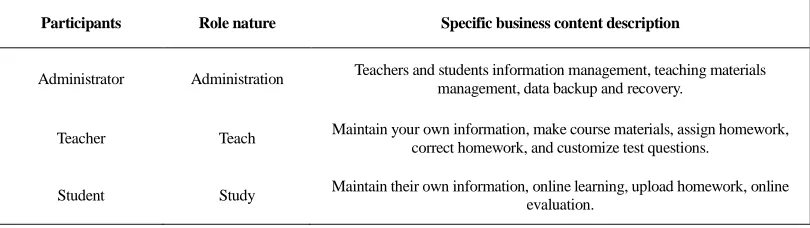
Users of the higher education online teaching platform can be divided into three categories: system administrators, teachers and students. Table Ⅰ is the description of the three categories of system participants.
The system contains data of two categories, namely, user basic information and teaching materials.
The main business process of the system administrator is to initialize user information, maintain user information, import teaching materials, and maintain teaching materials (add, delete, change and inquire).
[image:3.612.104.509.496.610.2]Teacher users and student users are closely connected with each other and the most direct connection is assignments and assessments and they share roughly similar business process as follows: first, teachers formulate assignments or exam papers and release them, data is entered into database, students inquire assignments or exam papers, finish them online, and submit them, answers are entered into database, teachers grade them (data flow from database to teachers), teachers submit assessment results, the results are entered into database, students inquire assignment results or grades of exams.
TABLE I. THREE TYPES OF NETWORK TEACHING PLATFORM SYSTEM PARTICIPANTS.
Participants Role nature Specific business content description
Administrator Administration Teachers and students information management, teaching materials
management, data backup and recovery.
Teacher Teach Maintain your own information, make course materials, assign homework,
correct homework, and customize test questions.
Student Study Maintain their own information, online learning, upload homework, online
2.3 Non-functional Requirements
The non-functional requirements of the system shall be described from the perspective of security and service performance.
Service performance: system performance measures the stability of the system while providing services, including the system robustness, real-time performance, CPU load and online user load [2].
Security:
Operation authority
Reasonable design of different levels of operation authority can be used to prevent employees from operating beyond their authority. Different employees have different levels of authority with corresponding safety requirements in data and operation[3].
Data security
Formulate specific data backup strategy and carry out regular data backup operation. Security measures from the perspective of password, anti-virus
[image:4.612.172.443.461.656.2]Software, firewall and port configuration shall be well accomplished to effectively guarantee the stable operation of network. Important information in information table of database shall be encrypted by encryption algorithm to keep data content from being easily deciphered in cases of server under attack and data loss [4,5].
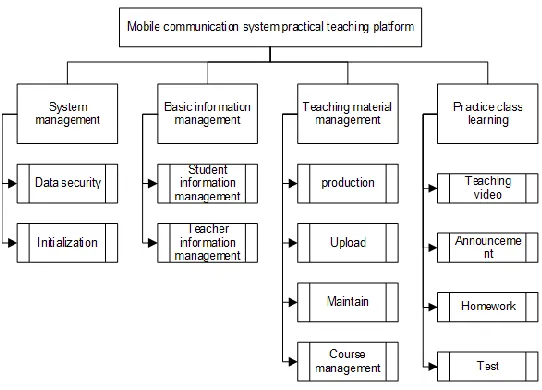
2.4 Functional Architecture
The functional architecture describes all the functions provided for users by the system with specific design and classification of the fine-grained function of each functional module. The system functional architecture is as shown in Figure1.
3. SYSTEM DESIGN
3.1 Structural Design
The system development must take the overall robustness, easy maintenance, scalability and security of the system into full consideration and adopt MVC three-layered architectural design, which, based on the difference of function types in system design process, divides the system into three layers of model - view - controller and separates system interface, data and business logic from each other without any interference, benefiting the design and management of more complicated application programs due to its ability to care and focus only on design in one aspect at different times. This design pattern is able to reduce the relevance and coupling between objects[6-8].
3.2 Operating Mechanism
4. DATABASE DESIGN
The data storage structure in the database plays the crucial role in guaranteeing the efficient operation of the teaching platform. Great attention shall be attached to the data storage structure in the process of designing database so as to guarantee the efficient data storage and reading and ensure data consistency and integrity.
4.1 Data Partitioning
Data partitioning in the database must be accurate and the precondition of data call is accurate data within a reasonable range. The consistency of data in each data table should be guaranteed. Otherwise data conflicts caused by data inconsistency in the two data tables will result in incorrect operation results. In order to achieve more efficient database transactions, it shall carry out data table nesting inside the database, which will not only improve the efficiency of database call operation, but also guarantee database security with the help of trigger[9].
4.2 Design of Data Table
The database mainly contains course information, data information, announcement information, user information, teaching video information, assignment or assessment information, assignment or assessment information records[10]. Data table structure design shall not only include all above-mentioned information, but also finish the identification of each data table and complete the matching of all kinds of information through matching templates in the data table so as to provide convenience for the system in data call. Information in the database can be quickly extracted in the process of system running so as to obtain corresponding information.
5. CONCLUSIONS
colleges pay attention to the cultivation of communication talents. Based on reality, this paper analyzes the advantages of online teaching platform for the development of mobile communication system in practice, puts forward the design idea of the platform and carries out the design planning of the platform. The use of online teaching platform breaks the limitations of traditional education mode and integrates numerous educational resources, which greatly helps teaching work for teachers, plays a positive role in promoting learning efficiency of students, provides convenience for communication between teachers and students and achieves the goal of improving students’ learning effect and education level.
REFERENCES
1. Xie S., Li B. and Keung G.Y. 2008. “Cool streaming: Design, Theory, and Practice,” IEEE
Transactions on Multimedia, 2012, 14(8): 1661-1671.
2. Ted Husted, Cedric Dumoulin and George Franciscus. “Struts in Action: Building web applications with the leading Java framework,” Manning Publications, 2013, 24(3): 22-40. 3. Jackson Michael. 2005. “Problem frames and software engineering,” Information and Software
Technology, 2005, 47(14): 903-912.
4. Wu D.P., Hou Y.T. and Zhu W.W. 2014. “Streaming Video over the Internet: Approaches and
Directions,” IEEE Transactions on Circuits and Systems for Video Technology, 2014, 24(6):
282-300.
5. David Johnson, Alexei White and Andre Charland. 2012. “Strategies for building high
performance application,” USA: John Wiley, 2012, 32-41.
6. Chu Y.H., Rao S.G. and Seshan S. 2012. “A case for end system multicast,” IEEE Journal on
Selected Areas in Communications, 2012, 30(8): 1456-1471.
7. Alur D, Dan M and Crupi J. 2003. “Core J2EE patterns,” Prentice Hall, 2003, 14(19): 1745-1769.
8. Jackson Michael. 2005. “Problem frames and software engineering,” Information and Software
Technology, 2005, 47(14): 903-912.
9. Neil Eliot, David Kendall and Michael Brockway, 2018, “A Flexible Laboratory Environment
Supporting Honeypot Deployment for Teaching Real-World Cybersecurity Skills,” IEEE
Journals & Magazines, 2018, 34884-34895.
10. C. Blum, P. Dubois, R. Molva and O. Schaller. 1997. “A development and runtime platform for
teleconferencing applications,” IEEE Journal on Selected Areas in Communications, 1997,