C o m m u n i c a ti o n e m p o w e r m e n t
fr a m e w o r k : a n in t e g r a tiv e
fr a m e w o r k t o s u p p o r t e ff e c tiv e
c o m m u n i c a ti o n a n d i n t e r a c ti o n
b e t w e e n c a r e r s a n d p e o pl e livi n g
wi t h d e m e n ti a
M o r ri s, LE, M a n s e ll, W, Willi a m s o n , T, Wr ay, A a n d M c Ev oy, P
h t t p :// dx. d oi.o r g / 1 0 . 1 1 7 7 / 1 4 7 1 3 0 1 2 1 8 8 0 5 3 2 9
T i t l e C o m m u n i c a tio n e m p o w e r m e n t f r a m e w o r k : a n in t e g r a tiv e f r a m e w o r k t o s u p p o r t eff e c tiv e c o m m u n i c a tio n a n d
in t e r a c ti o n b e t w e e n c a r e r s a n d p e o pl e livi n g wi t h d e m e n ti a
A u t h o r s M o r r i s , LE, M a n s ell, W, Willi a m s o n , T, Wr ay, A a n d M c E v oy, P
Typ e Ar ticl e
U RL T hi s v e r si o n is a v ail a bl e a t :
h t t p :// u sir. s alfo r d . a c . u k /i d/ e p ri n t/ 4 8 3 6 9 / P u b l i s h e d D a t e 2 0 1 8
U S IR is a d i gi t al c oll e c ti o n of t h e r e s e a r c h o u t p u t of t h e U n iv e r si ty of S alfo r d . W h e r e c o p y ri g h t p e r m i t s , f ull t e x t m a t e r i al h el d i n t h e r e p o si t o r y is m a d e f r e ely a v ail a bl e o nli n e a n d c a n b e r e a d , d o w nl o a d e d a n d c o pi e d fo r n o
Communication Empowerment Framework: An integrative framework to
support effective communication and interaction between carers and people
living with dementia
Lydia Morris a, Warren Mansell b, Tracey Williamson c, Alison Wray d & Phil
McEvoy e
a Institute of Dementia, School of Health and Society, University of Salford, United
Kingdom
bSchool of Health Sciences, University of Manchester, United Kingdom
c School of Health and Society, University of Salford, United Kingdom
d School of English, Communication & Philosophy, Cardiff University, United
Kingdom
e Six Degrees Social Enterprise, Salford, United Kingdom
Correspondence concerning this article should be addressed to Lydia Morris,
Institute of Dementia, School of Health and Society, Allerton Building, Frederick
Road Campus, University of Salford, M6 6PU. Email: [email protected]
Conflict of interest: The authors confirm that there are no known conflicts of
Acknowledgements: We thank Dr Margaret Garner for reviewing an earlier
version of this manuscript.
Funding: This framework was developed as part of a project funded by the
Big Lottery Fund [grant number 10010293441]. This research was supported by an
Abstract
Objectives: To demonstrate the utility of integrating three theoretical perspectives
(Mentalization Theory, Perceptual Control Theory and the Communicative Impact model),
which jointly illuminate the communication challenges and opportunities faced by family
care partners of people with dementia. To point the way to how this framework informs the
design and delivery of carer communication and interaction training.
Method: Conceptual synthesis based on a narrative review of relevant literature,
supported by examples of family care partners.
Results: We use the conceptual models to show how the capacity to mentalize (‘holding
mind in mind’) offers a greater sense of control over internal and external conflicts, with the
result that they can be deescalated in pursuit of mutual goals.
Conclusions: The integrative conceptual framework presented here highlights specific
psychological and relational mechanisms that can be targeted through carer training to
enhance communication with a person living with dementia.
Key words: Mentalization; Control Theory; communication; dementia; carer
Short title: Integrative communication framework: carers and people living with
Introduction
In their recent systematic review of communication training-interventions for carers of
people living with dementia, Morris, Horne, McEvoy & Williamson (2017) found that it is
possible to improve carers’ knowledge of communication strategies and skills. However, only
a minority of the reviewed studies found improvements in the wellbeing of carers or people
living with dementia. Knowing that certain interventions are effective in improving
knowledge and skills does not always translate to knowing how to improve wellbeing. One
reason for this may be the absence, or limited efficacy, of theoretical models underpinning
training interventions. Even where a training approach is effective for knowledge and skills
development, the lack of adequate underpinning theory can prevent an understanding of the
mechanisms through which beneficial effects are realised (Elvish, Lever, Johnstone, Cawley,
& Keady, 2013; Popay et al., 2006). Consequently, it will be difficult to identify and justify
potential routes towards improvements in training-interventions, and also to distinguish in a
principled way between which input is actually enhancing specific communication and
interactive abilities, rather than only building general knowledge of potential strategies.
Where detailed conceptual models are presented (e.g. Haberstroh, Neumeyer, Krause,
Franzmann, & Pantel, 2011), the primary skills-related focus tends to be quite narrow and
cognitively superficial; for example, advice on eliminating distractions and delivering limited
content information in short, simple sentences. While such strategies will certainly be helpful,
they do not encompass important considerations that affect interactive success, such as the
dynamics of relationships and the capacity to understand and accommodate the other person’s
perspective. A recent systematic review indicated that in order to support carers with
behaviour that challenges emotional support for carers’ negative feelings and unmet
psychological needs is important and could help maintain relational connections (Feast et al.,
One of the most prevalent conceptual frameworks underpinning training-interventions is
person-centred care (Morris et al., 2017; Eggenberger, Heimerl, & Bennett, 2013). But even
such approaches (Kitwood, 1997; Mitchell & Agnelli, 2015) could be considered limited if
their vital emphasis upon treating people living with dementia as individuals with purpose
and meaning is insufficiently underpinned by an understanding of what is required to achieve
this aim (Brooker, 2003; Higgs & Gilleard, 2016). Additionally, person-centred theories have
primarily been developed for professional rather than family care relationships (e.g. Brooker,
2003; McCormack & McCance, 2006) and thus do not accommodate the additional relational
and emotional dynamics of the latter. They have been criticised as not taking into account
the degree of “interdependencies and reciprocities” (Nolan, Ryan, Enderby, & Reid, 2002, p.
203), which are particularly nuanced in family relationships (Smebye & Kirkevold, 2013),
and for positioning people living with dementia as passive recipients of care instead of active
agents (Bartlett & O'Connor, 2007; Smebye & Kirkevold, 2013).
[Table 1 near here]
The development of effective communication training-interventions requires a
conceptualization of how interaction fits into the emotional and cognitive landscape.
Associated guidance for carers on how to navigate and change this landscape should be
beneficial in helping them to improve the quality of their communication experience. This
article maps the broader context of interaction, by demonstrating the main determinants of
communication breakdown or challenge, and how they might be addressed in practice. Three
existing models are integrated: Mentalization theory (Fonagy, 1991; Fonagy & Target,
1997), Perceptual Control Theory (PCT) (Powers, 1973) and the Communicative Impact
model (Wray, 2016). All three have in common the reciprocity of effective engagement with
the strain than those they care for in improving communication, effective change will not be
unidirectional. At the very least, rather than only changing their own communication choices,
carers are required to create the conditions under which the person with dementia also has
different choices in interaction. The reason for this is that communication occurs at the
interface of both parties’ agendas, and is shaped by their respective goals and perceptions
(Moyle, 2010; Steeman, Casterlé, Dierckx, Godderis, & Grypdonck, 2006). Although the
carer’s perspective is the necessary focus for the development of carer training, the aim is to
foster communication that enables both parties to be more in control of how interactions
transpire.
The integrated framework outlined in this paper (Communication Empowerment
Framework) has been developed to inform a communication and interaction
training-intervention known as Empowered Conversations (Six Degrees Social Enterprise 2018),
which is described in detail in a separate article. This framework emphasizes the importance
of care partners trying to understand the perspective of the person they are caring for and
indicates ways in which perspective-taking can be impaired. It demonstrates how carers can
develop this understanding without losing sight of their own goals and responses. The
framework indicates how communication can break down and ways in which it can be
enhanced to support connected relationships. It specifies how conflicts can arise and indicates
how they can be addressed. In this paper, challenges to communication and interaction are
first detailed. Then the three theoretical models that inform the framework are described and
finally the Communication Empowerment Framework is specified.
Key conceptual terms, marked in bold in the text, are defined in Table 1.
Several factors potentially contribute to difficulties in communication between family
carers and people living with dementia, and it is these factors that need to be accommodated
and explained in the conceptual modelling that follows.
1) Understanding change: Carers can have difficulties understanding the changing
internal world of a person living with dementia. As cognition is compromised, it can impact
not only on memory capacity, but also personality and, directly or indirectly, the content and
manner of a person’s communication (Pozzebon, Douglas, & Ames, 2016). Meanwhile, the
person living with dementia is also trying to navigate these changes and may attribute them to
others, and the environment. This in turn complicates the carer’s task in trying to sustain
stability in the relationship and in everyday activities.
2) Language: Dementia often causes changes in the production and comprehension of
language (Bayles & Tomoeda, 2014; Obler & De Santi, 2000; Watson, Aizawa,
Savundranayagam, & Orange, 2012; Wray, 2016). Carers may have difficulty understanding
a person living with dementia, as their diminishing linguistic resources impede or reduce
expression, or lead to unconventional solutions for getting meaning across (Pozzebon et al.,
2016; Wray, 2016). Breakdowns in communication can result in either the person living with
dementia or the carer getting frustrated, bored or tired about not being able to communicate
as they would like; for example, when the carer needs to repeat things many times, or the
person with dementia repeats the same anecdotes.
3) Theory of mind: There is evidence that some people living with dementia experience
difficulties with theory of mind, i.e. inferring others’ mental states on the basis of
immediately available information (e.g. facial expression or tone of voice) (Bora, Eryavuz,
Kayahan, Sungu, & Veznedaroglu, 2006; Bora, Walterfang, & Velakoulis, 2015; Heitz et al.,
2016). This can put strain on the relationship with a carer, who may feel underappreciated
4) Role changes and interpersonal dependence: Increased dependence, along with
cultural expectations, typically result in changes in the roles and relationship dynamics
between a person living with dementia and a family carer (Butcher, Holkup, & Buckwalter,
2001; Russell, 2001). In turn, relationship changes may lead to departures from pre-existing
communicative and interaction patterns. For example, a spouse or child may feel increasingly
cast in a parent role (Pozzebon et al., 2016). During this transition, there may be considerable
uncertainty about how to respond appropriately in certain situations (Polk, 2005; Wray, 2014)
5) Grief: Carers may also be experiencing a complex grief response (Butcher et al.,
2001) as they observe the ongoing changes that the person living with dementia is
undergoing, and experience their own emotional and social responses associated with the
‘loss’ of the person to the disease (Pozzebon et al., 2016). People have varying capacity for
‘adaptive coping’: the assimilation and acceptance of this change that will enable “restoration
of coherence to the narrative of [their] lives” (Schut & Stroebe, 1999, p. 202).
6) Practical pressures, fatigue and social isolation: For many carers, the sheer quantity
of hours during which they are responsible for a person living with dementia, which may
extend to 24-7, make it all but impossible to get the emotional and physical distance needed
for reflecting on how they are responding during interaction (Wray, 2016). Social encounters
are often much reduced, and it can be difficult for some carers to seek support, if they fear
stigmatization, or that others will not understand the nature and extent of their challenges
(Pozzebon et al., 2016).
7) Attachment: Close family carers have significant ‘attachment relationships’ with
those that they are caring for (see section 3.1). Interactions may be emotionally intense, often
with unspoken and unrecognized tensions and expectations arising from the long history of
relationships can make it more difficult to maintain the cognitive distance needed for a
considered response.
Overall conceptualization
The framework that is proposed here draws together aspects of three theoretical accounts
of how human beings negotiate their world and maintain psychological wellbeing.
Mentalization Theory relates to our perceptions about ourselves and others. Perceptual
Control Theory concerns the ways in which conflict between our intrapersonal and
interpersonal goals can impact on our external relationships. The conflict element of the
Communicative Impact model addresses our internal and external responses to tensions
arising (a) within our inner world, (b) in our external relations and (c) at the interface of the
two. The theories are briefly outlined below, each being integrated with the one before, to
develop a composite account that can shed more light on the deeper intricacies of dementia
communication.
The intention is to present general principles without being positivistic. Every person is
different and so is every interactional event. There are many cultural differences too, that
shape communicative episodes. For example, in westernized culture, dementia is generally
viewed as a medical condition caused by disease, but in some cultures dementia is considered
a mental illness or a normal part of aging (Hinton, Franz, Yeo, & Levkoff, 2005; Narayan et
al., 2015). There is also substantial evidence that the experience of being a family carer
differs significantly across cultural groups (Napoles, Chadiha, Eversley, & Moreno-John,
2010). In ethnic minority groups subcultures can develop that contradict the dominant
narratives of diagnosis and care (Cohen, 1998; Ikels, 1998; Mahoney, Cloutterbuck, Neary, &
impact on carer experience. The framework we propose is not intended to undermine specific
religious frameworks or cultural norms, or treat carers or people with dementia as one
homogenous group. While it does assume that people with dementia experience cognitive and
perceptual changes that are not a normal part of aging, it is shaped to inform techniques and
training-interventions that can be used creatively to explore the meaning and implications of
individuals’ religious and cultural frameworks.
Mentalization
Mentalization is “the imaginative mental activity that enables us to perceive and interpret
human behaviour in terms of intentional mental states (e.g., needs, desires, feelings, beliefs,
and goals…)” (Fonagy & Luyten, 2009, p. 1357). This “holding the mind in mind” (Allen,
Fonagy & Bateman, 2008, p. 3) begins with ourselves, but needs to extend to imagining the
mental states of others. We do not have direct access to others’ mental states, so we are
reliant on various indirect points of access. One is our experience of our own mental states.
We are likely to make associations with states and behaviours that we have experienced
ourselves. For example, if someone looks tearful, we may infer likely thoughts contributing
to this emotional response with reference to what we think would lead us to a similar
response, e.g. someone has just said something unkind, or an event has put them in mind of
something sad. However, our own mental states are not always a reliable point of reference,
for at least two reasons. Firstly, we do not necessarily understand ourselves very well, and
therefore are compromised in making inferences about others (Allen, Fonagy, & Bateman,
2008). Secondly, we may have complex and inaccurate beliefs about the connections between
our own mental states and external factors, built up over many years; these may then
A second point of access is our pre-existing models of the mind of the particular
individual, based on knowing them for a long time, and experiencing them from our own
(previous) role perspective. As roles, situations and personalities change in the course of
dementia, it will become difficult to fully sustain these models, and attempting to do so may
eclipse the cues indicating what the other person is actually communicating. If emotions are
high, a carer will likely find it hard to slow their thinking down to evaluate the best approach
in communication and care. This is because “mentalizing goes offline in the context of
intense emotional arousal as the fight-or-flight response comes online” (Allen, Fonagy &
Bateman, 2008, p. 133-134). At times of intense emotional arousal, patterns of brain
functioning and responding can become more automatic and instinctive (Arnsten, Mathew,
Ubriani, Taylor, & Li, 1999; Mayes, 2000). The threshold for switching from a mentalizing
and flexible response to a more automatic response will vary between individuals (Mayes,
2000).
Consequently, it will be easier for a carer to work with the seven challenges for
communication (section 2) if he or she has capacity for ‘good mentalizing’: an accurate and
effective understanding of (a) his or her personally important goals; and (b) the other person’s
perspective that takes into account what is really important to them. As we shall see later,
goals, rather than externalized behaviours, are crucial to understanding the dynamics of
communication, and they are key to how mentalizing occurs. Research suggests that carers’
attempts to mentalize are worth the effort. A recent analysis of video data from nine people
living with dementia highlighted that even when the carer could not understand the message
that was being communicated, attempts to understand and empathize were appreciated
(Alsawy, Tai, McEvoy, & Mansell, 2017).
A key influence on mentalization theory is attachment theory, according to which infants
protect, soothe and look after them (Ainsworth, 1978; Ainsworth, Blehar, Waters, & Wall,
1978). Bowlby (1982) proposes that from such interactions with caregivers, individuals
develop a mental representation of the self in relation to others, along with expectations about
they should behave, and how others will behave, in social relationships. These constitute an
important default for mentalizing, and thus, internal representations of attachment
relationships influence interactions in adults across a range of contexts (Gleeson &
Fitzgerald, 2014; Korver-Nieberg, Berry, Meijer, & Haan, 2014; Robles & Kane, 2014).
Significant attachment relationships shape our sense of identity or self (Fonagy, 1999;
Pittman, Keiley, Kerpelman, & Vaughn, 2011; Shaver, Mikulincer, Sahdra, & Gross, 2016).
In dementia care, long-established attachment relationships are disturbed: the child becomes
the carer of the parent, or the wife shifts from intimate partner to a carer role. The significant
relational changes experienced may challenge carers’ sense of their own identity (Butcher et
al., 2001; Shaver & Mikulincer, 2007; Tuomola, Soon, Fisher, & Yap, 2016). Nolte et al.
(2013) found that in young healthy adults, attachment-related stress interfered with the
functioning of brain regions associated with mentalization more than other kinds of stress did.
Thus, the loss of the ability to mentalize, mentioned above, may be particularly acute in
family relationships, where the stress is commonly attachment-related.
An example of an attachment challenge that family carers may face is the conflict between
wanting the person to be ‘as they were’, yet having to deal with them ‘as they are’, that is,
with the cognitive, memory, communication and personality changes resulting from
dementia: “Seeing the person they had known for so long, who still was physically the same
person but in many other ways so different, was an incongruity that at times seemed unreal”
(Butcher et al., 2001; p. 46). As noted in section 2, grief is a common response to caring for a
person with dementia (Pozzebon et al., 2016). A recent study of family dementia carers
knowledge, personhood and closeness (Ennis, Tai, McEvoy, & Mansell, 2017). These
constitute multiple potential losses, and a capacity for adaptive coping (Schut & Stroebe,
1999) is not guaranteed. Where adaptive coping is successful, the capacity to mentalize
means that it will often manifest as a recalibration of the carer’s assumptions and priorities, as
in Box 1.
[Box 1 near here]
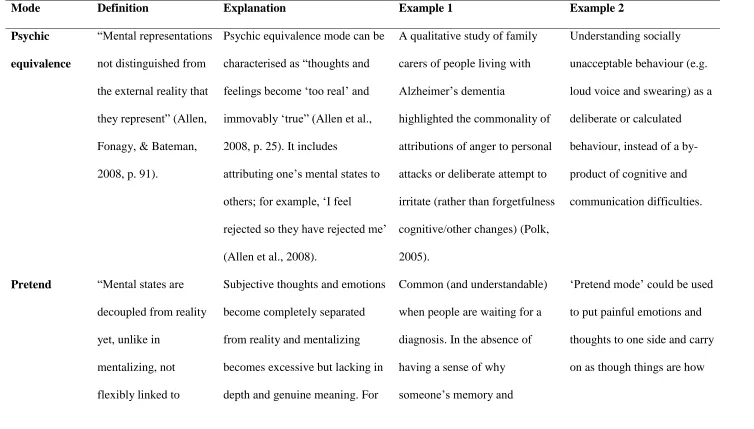
Certain detrimental ‘modes’ can result from inadequate mentalization. In ‘psychic
equivalence’ mental states are experienced as external reality, e.g. because I feel angry, they
intended to anger me (Allen et al., 2008, p. 25). In ‘pretend’ mode, the mental state becomes
detached from external reality, so that extensive mentalizing is needed to rationalize the
feelings, e.g. explaining away dementia symptoms rather than facing the facts about their
cause (Allen et al., 2008, p. 249). In ‘teleological’ mode, mental states are externalized as
actions, as with self-cutting to communicate emotional pain (Allen et al., 2008, p. 350). See
Table 2 for more details of these mentalization modes.
[Table 2 near here]
Perceptual Control Theory (PCT) and conflict
Where mentalization theory focuses on ‘modelling minds’, PCT relates more specifically
to the goals of those involved in interactions and how the individual engages externally. The
theory is based on the tenet that life, and thereby effective functioning, is a process of
control. Control in this sense means the attempt to match one’s experiences with internally
priorities and what happens in the world. Without it, or when the person attempts to sustain
multiple goals that are incompatible, conflict will be experienced and, where the priorities are
important ones, distress (Kelly, Mansell, & Wood, 2015). Problems with control are
associated with reduced well-being and psychopathology (e.g. Chorpita & Barlow, 1998;
Fitzsimons & Fuller, 2002; Gray, Ozer, & Rosenthal, 2017; Harrow, Hansford, &
Astrachan-Fletcher, 2009), and control-related conflict has been identified in the experience of family
carers of people living with dementia (Shim, Barroso, & Davis, 2012). From a PCT
perspective, enduring conflict between people’s valued goals is a primary cause of loss of
control, which manifests as distress and unwanted psychological symptoms, such as stress,
low-mood and irritation (Alsawy, Mansell, Carey, McEvoy, & Tai, 2014).
Goals are conceptualized in a hierarchy, with the higher-levels, often associated with
longer term values, setting the reference values for lower-levels (Powers, 1973). For example,
the higher-level goal ‘be a good friend’ sets the goal ‘keep in regular contact’, which could
lead to actions such as texting friends, meeting regularly, etc. Higher-level references often
represent longer-term goals and values. Enduring conflict between higher-level references
significantly contributes to loss of control and distress, as higher-level references specify a
range of lower-level references (Alsawy et al., 2014; Kelly, Mansell, & Wood, 2011; Kelly et
al., 2015).
The theory recognizes that since complete influence over events is rarely possible, the way
to sustain adequate control, and thus avoid conflict and distress, is to recognize and adjust or
abandon goals that cannot be achieved (Brandtstädter, 2009; Morris, Mansell, & McEvoy,
2016; Powers, 1973). This change happens through a trial and error process termed
reorganization (Powers, 1973). Full resolution of internal conflict requires reorganization at
the source of the conflict: which can be experienced as a shift in one’s priorities, having an
Higginson & Mansell, 2008). Since higher-level conflict is particularly likely to endure, and
promote significant distress (Kelly et al., 2011, 2015), a recognition of higher-level
conflicting goal(s) is generally required to regain control. In turn, increased awareness of
internal goals is important for re-establishing perceived control and hence resilience (Dias et
al., 2015; Harmell, Chattillion, Roepke, & Mausbach, 2011).
People living with dementia may have a decreased capacity to rethink their situation,
calibrate their goals appropriately, and act to achieve them, with the result that they
experience reduced control (Moyle, 2010; Steeman et al., 2006). This leaves them vulnerable
to their circumstances, making it vital that carers are able to manage any resulting
externalized conflict, as explored in the next section.
Conflict and reduced Communicative Impact
Like PCT, Wray’s Communicative Impact model (Wray, 2016) identifies the achievement
of personal goals as central to sustaining a sense of control over one’s life. Her model,
however, specifically focuses on the role of communication in achieving these goals, and the
‘communicative impact’ that a person’s interactive turns have in moulding their world as they
want and need it to be. Much of the purpose of communication, in this view, is getting others
to act as agents when it is not possible for the speaker to achieve change directly. Since
people have multiple goals, communication is subtle. For example, a rude request to close a
door may result in a closed door, but undermine the goal of sustaining a valued relationship.
As a result, humans’ linguistic and non-verbal choices in communication are carefully
tailored to navigate maximising success on several fronts at once.
In dementia, communication is a significant casualty (Wray, 2018), with associated impact
communication, easily disturbed by changes in language patterns and relationships, are
further undermined by the conflicts arising from unmet goals, as laid out in PCT.
Interpersonal conflicts, such as arguments, expressions of frustration and anger, etc., can be
conceptualized as external manifestations of internal conflict (Wray, 2016). Often, the failure
to deploy communication effectively to achieve multiple, possibly contradictory, personal
goals generates an emotional response (e.g. anger, stress or depression) that impedes effective
mentalization.
Wray’s model offers specific insights into the problems that can occur when
communicating with a person living with dementia. One is a paradox that can arise between
the desire to treat a person living with dementia as ‘like me’, where the person’s behaviour as
viewed as bounded by normal social conventions, versus re-mentalizing, to see the person as
‘not like me’, which accommodates any behaviour that would otherwise be upsetting or
offensive (Wray, 2013). The latter option can protect the carer’s emotional state by
neutralising hurtful or annoying behaviours. However, distancing like this could draw the
carer into dehumanising the person with dementia (Feast et al., 2016). Wray argues that if the
high-level goal of being a good person conflicts with the high-level goal of self-protection
through distancing, the carer may be trapped in guilt and anxiety, leading to extreme stress.
Wray proposes that if we once we recognize how internal conflict can be the source of
external conflict, “it becomes possible to identify options for resolving conflict, which are not
available if conflict is located only in the external social space” (Wray, 2016, p. 117).
Box 2 is an example of how awareness of internal conflicted goals can result in
constructive attempts to meet the goals of all involved in the interaction. It was recounted by
a carer at one of our Empowered Conversation training courses and has been fully
anonymised and adapted to protect identities.
Towards supportive interventions in carer training: the Communication Empowerment
Framework
Carers may face many challenges, but they are also capable of identifying the positive
aspects of their role (Brodaty & Donkin, 2009). Furthermore, people living with dementia can
draw on considerable resources of resilience (Desai, Desai, McFadden, & Grossberg, 2016).
One method for supporting both carers and people living with dementia is training for carers.
Research indicates that the acquisition of knowledge and skills can support carer resilience
and the maintenance of positive relationships with those cared for (Donnellan, Bennett, &
Soulsby, 2015); for example, understanding how memory changes influence communication
can enable more accurate mentalization. In particular, communication-focused training
interventions can enhance perceived coping and control (Dias et al., 2015; Eggenberger et al.,
2013; Harmell et al., 2011).
Jointly, the theories and models reviewed above offer new insights into how this can be
achieved. In the Communication Empowerment Framework, these theories are integrated;
generating a means for emphasizing the importance of care partners trying to understand the
perspective of the person they are caring for, while not losing sight of their own goals and
experiences. This framework specifies how conflicts can arise and indicates how these can
be addressed. It indicates other specific ways that communication can break down and be
enhanced.
Training programmes need to provide techniques for responding to daily challenges that
encourage the resolution of internal conflicts between higher-level goals, because this will
increase the scope for control and thus promote resilience (Alsawy et al., 2014; Dias et al.,
and resolving higher-level conflicts is also likely to improve communication, because it
reduces the likelihood of external conflict. In turn, good relationships make it easier to spend
time together and share activities, which people living with dementia identify as important to
them (Alsawy et al., 2017). Carers benefit through the fulfilment of higher-level goals like
creating joy and supporting the person living with dementia, someone they have loved and
known for a significant amount of time (Butcher et al., 2001; Russell, 2001). Raising
awareness of higher-level goals thus exposes not only self-oriented priorities but also
other-oriented ones, enabling a creative approach to working with conflicting goals (Morris,
Mansell, & McEvoy, 2016).
Carers learn that even when an interaction features elements of conflict, such as
disagreement or verbal aggression, shared cooperative goals may underpin it. For example, it
is likely that both parties want to achieve lower-level goals (e.g. the successful eating of a
meal) alongside higher-level ones (e.g. sustaining calm and good humour). Drawing carers’
attention to the probability that any external conflict is not born of contradictory goals but of
different, perhaps misleading, ways of achieving aligned goals can be enough to help the
carer re-mentalize the situation to exploit the underlying harmony in their intentions. Thus,
even if there is conflict at one level of the control system, identifying collaborative goals can
stop conflict escalating (Morris et al., 2016; McClelland, personal communication). Box 3
gives an example.
[Box 3 near here]
A key focus of the framework provided is recognizing how communicative behaviours on
the part of the carer can unintentionally undermine the experience of control in the person
they are caring for. For example, if the carer is aggressive, or unable to achieve basic
have a reduced range of options for responding. Since enduring goal conflicts are likely to
cause distress and stress (Gray et al., 2017; Kelly et al., 2015), helping carers to work around
them is crucial.
Carers need to be supported in effective mentalizing, taking into account the current
situation and not remaining in thrall to historical goals that can no longer apply. Mentalizing
involves an integrated response to self and other and takes into account all perceptual data
reasonably accurately, including the present situation, the likely perspective of the other
person, and their own goals and emotional responses. “Great effort is required to attend to
and reflect on mental states, especially when striving to hold multiple perspectives in mind in
the midst of strong emotions” (Allen et al., 2008, p. 70).
It is also important to reassure carers that the temporary loss of mentalization is
normal, since our attention fluctuates with context and mood. Thus, it is not a matter of
having to sustain a highly deliberated perspective all the time, but of recognizing the risks of
prolonged and intense loss of mentalization for precious interpersonal relationships.
Ineffective mentalizing occurs when a particular mode (see section 3.1) is used rigidly and
inflexibly (Lemma, Target, & Fonagy, 2011; Morris & Mansell, in press). For example, if
frustration becomes all-consuming, then it is likely to become difficult not to link it to the
external reality (psychic equivalence mode – see Table 2), such as believing that the person
with dementia is being deliberately annoying. If the teleological mode is entered, the carer
may act on the emotion, by showing physical or verbal aggression (Asen & Fonagy, 2017a,
2017b). Although acknowledging anger is the first step, carers can be helped to recognize
how, when anger is the dominant state, mentalizing becomes difficult and it is easy to lose
perspective. That is when people do things that they later regret, and cause estrangement from
those around them (Asen & Fonagy, 2017a). Rigid use of mentalization modes becomes
the truer reflection of the carer’s core intentions, such as commitment and care (Morris &
Mansell, in press).
Conclusion
We have shown how conflicts within and between people, with regard to their higher- and
lower-level goals, are more or less inevitable, and that they are likely to result in emotional
responses that shape the content and tone of communication. Since language is a window on
our thoughts, it is very difficult fully to shield others from the emotive power behind our
words and non-verbal signals. Carers of people living with dementia experience high levels
of stress on account of their situation and the many conflicting goals they must deal with,
including those that relate to their non-carer identities. They also often have a high level of
commitment to maintaining connection with the person they are caring for.
Carers can be effectively supported by the opportunity to reflect on how these
dynamics play out in their daily lives, and being helped to develop mentalization strategies
that can give them the capacity to identify and then fulfil their own, and the others’, goals.
We have described challenges that can affect communication between carers and people
living with dementia. Responding creatively to these challenges and building on strengths
and resilience can lead to more satisfying communication. This paper details specific
psychological and relational mechanisms that can be targeted to enhance communication; the
Communication Empowerment Framework. This framework indicates (a) why it is important
for both individuals in a conversation to feel that they have control, and (b) how the carer can
be equipped to recognize intra- and interpersonal goal conflicts and resolve them. Key
elements that facilitate the resolution of internal and external conflicts include being able to
identify the source and nature of the conflict, engage with changes in emotion, and sustain an
awareness of how thoughts and relationships are shifting.
For this reason, our training approach, Empowered Conversations, focuses on the above
elements, as a way of helping carers develop enhanced mentalization and facilitate cognitive
flexibility (Morris & Mansell, in press; Morris, Mansell, Amos, & Edge, 2016); a flexibility
of awareness in relation to important goals that results in appropriate practical actions.
Examples of methods to enhance these processes include being able to express and discuss
concerns in order to elaborate mentalization of self and others; engaging with conflicts and
changes in emotion enhances the ability to consider strong emotions and respond flexibly.
Empowered Conversations also provides carers with techniques that will assist the person
with dementia to connect with their goals and regain control. For example, carers are taught
the ‘invitation to respond’ technique, which allows people living with dementia to respond if
they want to. Details of the techniques used in Empowered Conversations are presented in
our companion paper (in preparation) and on our website,
http://empowered-conversations.co.uk/.
In summary, the key features of the Communication Empowerment Framework enable it
to generate direct practical implications. It supports care partners to ‘hold in mind’ both their
goals and the likely goals of the person they are caring for. It specifies ways in which
communication can be impaired and related ways it can be enhanced; these include attention
to emotion and non-verbal communication and the impact each of these can have on
communication. Further, it delineates ways in which carers can be supported to identify and
References
Ainsworth, M. D. (1978). The Bowlby-Ainsworth attachment theory. Behavioral and brain
sciences, 1(3), 436-438.
Ainsworth, M. D., Blehar, M. C., Waters, E., & Wall, S. (1978). Patterns of attachment:
Assessed in the strange situation and at home: Hillsdale, NJ: Erlbaum.
Allen, J. G., Fonagy, P., & Bateman, A. W. (2008). Mentalizing in clinical practice. London,
England: American Psychiatric Pub.
Alsawy, S., Mansell, W., Carey, T. A., McEvoy, P., & Tai, S. J. (2014). Science and practice
of transdiagnostic CBT: a Perceptual Control Theory (PCT) approach. International
Journal of Cognitive Therapy, 7(4), 334-359.
Alsawy, S., Tai, S., McEvoy, P., & Mansell, W. (2017). “It’s nice to think somebody’s
listening to me instead of saying ‘oh shut up’”. People with dementia reflect on what
makes communication good and meaningful. Manuscript submitted for publication.
Arnsten, A., Mathew, R., Ubriani, R., Taylor, J., & Li, B. (1999). Alpha-1 noradrenergic
receptor stimulation impairs prefrontal cortical cognitive function. Biological psychiatry,
45(1), 26.
Asen, E., & Fonagy, P. (2017a). Mentalizing family violence part 1: Conceptual framework.
Family process, 56(1), 6-21.
Asen, E., & Fonagy, P. (2017b). Mentalizing family violence Part 2: Techniques and
interventions. Family Process, 56(1), 22-44.
Bayles, K. A., & Tomoeda, C. K. (2014). Cognitive-communication disorders of dementia
(2nd ed.). San Diego, CA: Plural Publishing.
Bora, E., Eryavuz, A., Kayahan, B., Sungu, G., & Veznedaroglu, B. (2006). Social
state decoding may be a better predictor of social functioning than mental state reasoning.
Psychiatry research, 145(2), 95-103.
Bora, E., Walterfang, M., & Velakoulis, D. (2015). Theory of mind in behavioural-variant
frontotemporal dementia and Alzheimer's disease: a meta-analysis. J Neurol Neurosurg
Psychiatry, 86(7), 714-719.
Bowlby, J. (1982). Attachment and loss: Retrospect and prospect. American journal of
Orthopsychiatry, 52(4), 664.
Brandtstädter, J. (2009). Goal pursuit and goal adjustment: Self-regulation and intentional
self-development in changing developmental contexts. Advances in Life Course Research,
14(1), 52-62.
Brodaty, H., & Donkin, M. (2009). Family caregivers of people with dementia. Dialogues
Clin Neurosci, 11(2), 217-228.
Brooker, D. (2003). What is person-centred care in dementia? Reviews in clinical
gerontology, 13(3), 215-222.
Butcher, H. K., Holkup, P. A., & Buckwalter, K. C. (2001). The experience of caring for a
family member with Alzheimer’s disease. Western Journal of Nursing Research, 23(1),
33-55.
Chorpita, B. F., & Barlow, D. H. (1998). The development of anxiety: the role of control in
the early environment. Psychological bulletin, 124(1), 3.
Cohen, L. (1998). No aging in India: Alzheimer's, the bad family, and other modern things:
Univ of California Press.
Desai, A. K., Desai, F. G., McFadden, S., & Grossberg, G. (2016). Experiences and
Perspectives of Persons with Dementia. In M. Boltz & J. E. Galvin (Eds.), Dementia Care
Dias, R., Santos, R. L., Sousa, M. F. B. d., Nogueira, M. M. L., Torres, B., Belfort, T., &
Dourado, M. C. N. (2015). Resilience of caregivers of people with dementia: a systematic
review of biological and psychosocial determinants. Trends in psychiatry and
psychotherapy, 37(1), 12-19.
Donnellan, W. J., Bennett, K. M., & Soulsby, L. K. (2015). What are the factors that facilitate
or hinder resilience in older spousal dementia carers? A qualitative study. Aging & mental
health, 19(10), 932-939.
Eggenberger, E., Heimerl, K., & Bennett, M. I. (2013). Communication skills training in
dementia care: a systematic review of effectiveness, training content, and didactic methods
in different care settings. International Psychogeriatrics, 25(3), 345-358. doi:
10.1017/S1041610212001664
Elvish, R., Lever, S.-J., Johnstone, J., Cawley, R., & Keady, J. (2013). Psychological
interventions for carers of people with dementia: A systematic review of quantitative and
qualitative evidence. Counselling and Psychotherapy Research, 13(2), 106-125.
Ennis, L., Tai, S., McEvoy, P., & Mansell, P. (2017). The phenomenology of good
communication from the perspectives of family caregivers of people with dementia.
Manuscript in preparation.
Feast, A., Orrell, M., Charlesworth, G., Melunsky, N., Poland, F., & Moniz-Cook, E. (2016).
Behavioural and psychological symptoms in dementia and the challenges for family carers:
Systematic review. The British Journal of Psychiatry, 208(5), 429-434.
Fitzsimons, S., & Fuller, R. (2002). Empowerment and its implications for clinical practice in
mental health: A review. Journal of Mental Health, 11(5), 481-499.
Fonagy, P. (1991). Thinking about thinking: Some clinical and theoretical considerations in
the treatment of a borderline patient. The International journal of psycho-analysis, 72(4),
Fonagy, P. (1999). Attachment, the development of the self, and its pathology in personality
disorders. Treatment of personality disorders, 53-68.
Fonagy, P., & Luyten, P. (2009). A developmental, mentalization-based approach to the
understanding and treatment of borderline personality disorder. Development and
psychopathology, 21(4), 1355-1381.
Fonagy, P., & Target, M. (1997). Attachment and reflective function: Their role in
self-organization. Development and psychopathology, 9(4), 679-700.
Gianakis, M., & Carey, T. A. (2008). A review of the experience and explanation of
psychological change. Counselling Psychology Review, 23(3), 27-38.
Gianakis, M., & Carey, T. A. (2011). An interview study investigating experiences of
psychological change without psychotherapy. Psychology and Psychotherapy: Theory,
Research and Practice, 84(4), 442-457.
Gleeson, G., & Fitzgerald, A. (2014). Exploring the association between adult attachment
styles in romantic relationships, perceptions of parents from childhood and relationship
satisfaction. Health, 6(13), 1643.
Gray, J. S., Ozer, D. J., & Rosenthal, R. (2017). Goal conflict and psychological well-being:
A meta-analysis. Journal of Research in Personality, 66, 27-37.
Haberstroh, J., Neumeyer, K., Krause, K., Franzmann, J., & Pantel, J. (2011). TANDEM:
Communication training for informal caregivers of people with dementia. Aging & Mental
Health, 15(3), 405-413. doi: 10.1080/13607863.2010.536135
Harmell, A. L., Chattillion, E. A., Roepke, S. K., & Mausbach, B. T. (2011). A review of the
psychobiology of dementia caregiving: A focus on resilience factors. Current psychiatry
Harrow, M., Hansford, B. G., & Astrachan-Fletcher, E. B. (2009). Locus of control: Relation
to schizophrenia, to recovery, and to depression and psychosis—A 15-year longitudinal
study. Psychiatry research, 168(3), 186-192.
Heitz, C., Noblet, V., Phillipps, C., Cretin, B., Vogt, N., Philippi, N., . . . Demuynck, C.
(2016). Cognitive and affective theory of mind in dementia with Lewy bodies and
Alzheimer’s disease. Alzheimer's research & therapy, 8(1), 10.
Higginson, S., & Mansell, W. (2008). What is the mechanism of psychological change? A
qualitative analysis of six individuals who experienced personal change and recovery.
Psychology and Psychotherapy: Theory, Research and Practice, 81(3), 309-328.
Higgs, P., & Gilleard, C. (2016). Interrogating personhood and dementia. Aging & mental
health, 20(8), 773-780.
Hinton, L., Franz, C. E., Yeo, G., & Levkoff, S. E. (2005). Conceptions of dementia in a
multiethnic sample of family caregivers. Journal of the American Geriatrics Society, 53(8),
1405-1410.
Ikels, C. (1998). The experience of dementia in China. Culture, Medicine and Psychiatry,
22(3), 257-283.
Kelly, R. E., Mansell, W., & Wood, A. M. (2011). Goal conflict and ambivalence interact to
predict depression. Personality and Individual Differences, 50(4), 531-534.
Kelly, R. E., Mansell, W., & Wood, A. M. (2015). Goal conflict and well-being: A review
and hierarchical model of goal conflict, ambivalence, discrepancy and
self-concordance. Personality and Individual Differences, 85, 212-229.
Kitwood, T. (1997). Dementia reconsidered: The person comes first. Buckingham: Open
Korver-Nieberg, N., Berry, K., Meijer, C. J., & Haan, L. (2014). Adult attachment and
psychotic phenomenology in clinical and non‐ clinical samples: A systematic review.
Psychology and Psychotherapy: theory, research and practice, 87(2), 127-154.
Lemma, A., Target, M., & Fonagy, P. (2011). Brief dynamic interpersonal therapy: A
clinician's guide. Oxford, UK: Oxford University Press.
Mahoney, D. F., Cloutterbuck, J., Neary, S., & Zhan, L. (2005). African American, Chinese,
and Latino family caregivers' impressions of the onset and diagnosis of dementia:
cross-cultural similarities and differences. The Gerontologist, 45(6), 783-792.
Mayes, L. C. (2000). A developmental perspective on the regulation of arousal states. Paper
presented at the Seminars in perinatology.
McCormack, B., & McCance, T. V. (2006). Development of a framework for person‐ centred
nursing. Journal of advanced nursing, 56(5), 472-479.
McEvoy, P., Eden, J., Morris, L., & Mansell, W. (2016). Dementia: towards a perceptual
control theory perspective. Quality in Ageing and Older Adults, 17(4), 229-238.
McLean, A. (2007). The person in dementia: A study of nursing home care in the US:
University of Toronto Press.
Mitchell, G., & Agnelli, J. (2015). Person-centred care for people with dementia: Kitwood
reconsidered. Nursing Standard, 30(7), 46-50.
Morris, L., Horne, M., McEvoy, P., & Williamson, T. (2017). Communication training
interventions for family and professional carers of people living with dementia: a
systematic review of effectiveness, acceptability and conceptual basis. Aging & mental
health, 1-18.
Morris, L., & Mansell, W. (in press). A systematic review of the relationship between
rigidity/flexibility and transdiagnostic cognitive and behavioral processes that maintain
Morris, L., Mansell, W., Amos, R., & Edge, D. (2016). Experiences of a transdiagnostic
group, the Take Control Course, for clients with common mental health problems: a
qualitative study. Manuscript submitted for publication.
Morris, L., Mansell, W., & McEvoy, P. (2016). The take control course: Conceptual rationale
for the development of a transdiagnostic group for common mental health problems.
Frontiers in psychology, 7.
Moyle, W. (2010). Is quality of life being compromised in people with dementia in long-term
care? International Journal of Older People Nursing, 5(3), 245-252.
Napoles, A. M., Chadiha, L., Eversley, R., & Moreno-John, G. (2010). Reviews: Developing
culturally sensitive dementia caregiver interventions: Are we there yet? American Journal
of Alzheimer's Disease & Other Dementias®, 25(5), 389-406.
Narayan, S. M., Varghese, M., Hepburn, K., Lewis, M., Paul, I., & Bhimani, R. (2015).
Caregiving experiences of family members of persons with dementia in south India.
American Journal of Alzheimer's Disease & Other Dementias®, 30(5), 508-516.
Nolte, T., Bolling, D. Z., Hudac, C. M., Fonagy, P., Mayes, L., & Pelphrey, K. A. (2013).
Brain mechanisms underlying the impact of attachment-related stress on social cognition.
Frontiers in human neuroscience, 7.
Obler, L. K., & De Santi, S. (2000). Eliciting language from patients with Alzheimer's
disease. In L. Menn & N. B. Ratner (Eds.), Methods for studying language production (pp.
403-416). Mahwah, NJ: Lawrence Erlbaum Associates
Pittman, J. F., Keiley, M. K., Kerpelman, J. L., & Vaughn, B. E. (2011). Attachment,
identity, and intimacy: Parallels between Bowlby's and Erikson's paradigms. Journal of
Family Theory & Review, 3(1), 32-46.
Polk, D. M. (2005). Communication and family caregiving for Alzheimer's dementia:
Popay, J., Roberts, H., Sowden, A., Petticrew, M., Arai, L., Rodgers, M., . . . Duffy, S.
(2006). Guidance on the conduct of narrative synthesis in systematic reviews. A product
from the ESRC methods programme Version, 1, b92.
Powers, W. T. (1973). Behavior: The control of perception: Aldine Chicago.
Pozzebon, M., Douglas, J., & Ames, D. (2016). Spouses’ experience of living with a partner
diagnosed with a dementia: a synthesis of the qualitative research. International
psychogeriatrics, 28(4), 537-556.
Robles, T. F., & Kane, H. S. (2014). The attachment system and physiology in adulthood:
Normative processes, individual differences, and implications for health. Journal of
personality, 82(6), 515-527.
Russell, R. (2001). In sickness and in health: A qualitative study of elderly men who care for
wives with dementia. Journal of Aging Studies, 15(4), 351-367.
Schut, M., & Stroebe, H. (1999). The dual process model of coping with bereavement:
Rationale and description. Death studies, 23(3), 197-224.
Shaver, P. R., & Mikulincer, M. (2007). Adult attachment strategies and the regulation of
emotion. In J. Gross (Ed.), Handbook of emotion regulation (Vol. 446-465). New York:
Guilford Press
Shaver, P. R., Mikulincer, M., Sahdra, B., & Gross, J. (2016). Attachment Security as a
Foundation for Kindness Toward Self and Others. In B. K.W. & L. M. R. (Eds.), The
Oxford Handbook of Hypo-egoic Phenomena. Oxford, UK: Oxford University Press
Shim, B., Barroso, J., & Davis, L. L. (2012). A comparative qualitative analysis of stories of
spousal caregivers of people with dementia: negative, ambivalent, and positive
Steeman, E., Casterlé, D., Dierckx, B., Godderis, J., & Grypdonck, M. (2006). Living with
early‐ stage dementia: A review of qualitative studies. Journal of advanced nursing, 54(6),
722-738.
Tuomola, J., Soon, J., Fisher, P., & Yap, P. (2016). Lived experience of caregivers of persons
with dementia and the impact on their sense of self: A qualitative study in Singapore.
Journal of cross-cultural gerontology, 31(2), 157-172.
Watson, B., Aizawa, L. D., Savundranayagam, M. Y., & Orange, J. (2012). Links among
communication, dementia and caregiver burden. Canadian Journal of Speech-Language
Pathology and Audiology, 36(4), 276-283.
Wray, A. (2013). Mislaying Compassion: Linguistic Triggers of Inadequate Caregiving. In B.
H. Davis & J. Guendouzi (Eds.), Pragmatics in Dementia Discourse (pp. 117-145).
Newcastle-Upon-Tyne: Cambridge Scholars Publishing.
Wray, A. (2014). Formulaic language and threat: the problem of empathy and compassion in
Alzheimer’s disease interaction. In R. T. Schrauf & N. Mueller (Eds.), Dialogue and
dementia: cognitive and communicative resources for engagement (pp. 263-286). New
York: Psychology Press
Wray, A. (2016). Mechanisms of conflict and aggression in the dementia context. Journal of
Language Aggression and Conflict, 4(1), 114-140.
Wray, A. (2018). Dementia: the 'communication disease'. Youtube video.
Table 1. Glossary of key terms used.
Term Definition Example
Mentalization The activity of perceiving and interpreting
human behaviour in terms of mental states.
Such mental states include emotions, needs and
goals.
Realising that you are avoiding someone because you feel hurt by something
they have done. Seeing that someone’s face is screwed up in a certain way and
inferring that they maybe angry.
Attachment
relationship
A significant relationship from which an
individual is predisposed to seek support,
protection and care. A relationship underpinned
by a strong emotional bond.
Spouse, long-term romantic partner, child, parent are all significant attachment
relationships. For example, a child is predisposed to seek care from a parental
figure, and this is the case even if there are difficulties within the relationship
or the required care is not always forthcoming.
Reference
values or goals
Internal standards based on genetic
predisposition and/or past experience and
encompassing values, beliefs, etc. A set of
personal ‘just rights’.
A good cup of coffee is milky but strong; being a good person means being
kind, caring etc.
Control Capacity to match a perception to a desired
reference value.
Managing to be a supportive carer; Managing to keep feelings of stress at
Control system
(hierarchical)
Internal reference values that are arranged in a
hierarchical network. Higher-level goals support
a range of lower-level ones.
The self-concept of being caring (higher-level goal) leads to the sub-goal of
providing support when needed and, in turn, the lower-level, shorter-term goal
of always being available if a loved one needs support.
(Goal) conflict The state when two control systems attempt to
control an experience with respect to two (or
more) opposing reference values.
Some carers can feel oppressed by not being able to manage their time as they
want. The goal ‘I want to be able to control what I do’ is in conflict with the
goal ‘I want to be responsive and supportive at all times’.
Reorganization Changes arising from an awareness of conflict
between reference values. Trial-and-error
gradually results in reduction in the conflict. A
shift in perspective could indicate that
reorganization has successfully occurred.
A carer realizes that supporting the person living with dementia is more
important than being in control of their own schedule. They realize that is
important to take breaks and look after themselves when possible and so
‘soften’ their goal of providing support ‘at all times’ to ‘I’ll do my best to be
responsive and supportive’.
Awareness An index of the current focus; reorganization
occurs at the focus of current awareness.
A carer is able to pinpoint a source of conflict between goals that are
important to them and thus mentalize around it.
Cognitive
flexibility
A flexibility of awareness that involves a broad
awareness of higher-level (important) goals, and
a mobility of awareness that enables these to be
Making time in various ways to respond to ill health in a loved one, by
modifying one's goals in line with an overall higher-level goal ‘I want to
Table 2: Modes of experience when mentalization breaks down
Mode Definition Explanation Example 1 Example 2
Psychic
equivalence
“Mental representations
not distinguished from
the external reality that
they represent” (Allen,
Fonagy, & Bateman,
2008, p. 91).
Psychic equivalence mode can be
characterised as “thoughts and
feelings become ‘too real’ and
immovably ‘true” (Allen et al.,
2008, p. 25). It includes
attributing one’s mental states to
others; for example, ‘I feel
rejected so they have rejected me’
(Allen et al., 2008).
A qualitative study of family
carers of people living with
Alzheimer’s dementia
highlighted the commonality of
attributions of anger to personal
attacks or deliberate attempt to
irritate (rather than forgetfulness
cognitive/other changes) (Polk,
2005).
Understanding socially
unacceptable behaviour (e.g.
loud voice and swearing) as a
deliberate or calculated
behaviour, instead of a
by-product of cognitive and
communication difficulties.
Pretend “Mental states are
decoupled from reality
yet, unlike in
mentalizing, not
flexibly linked to
Subjective thoughts and emotions
become completely separated
from reality and mentalizing
becomes excessive but lacking in
depth and genuine meaning. For
Common (and understandable)
when people are waiting for a
diagnosis. In the absence of
having a sense of why
someone’s memory and
‘Pretend mode’ could be used
to put painful emotions and
thoughts to one side and carry
reality” (Allen et al.,
2008, p. 249).
carers, this could involve getting
caught up in explanations of the
motives and intentions person that
they are caring for that have little
basis in reality.
perception is changing, it is easy
to get into elaborate- but
inaccurate- explanations.
we want them to be
(McEvoy, 2018).
Teleological “Mental states are
expressed in
goal-directed actions instead
of explicit mental
representation such as
words; for example,
when self-cutting is
employed as a way of
communicating
emotional pain” (Allen
et al., 2008, p. 350).
This refers to the assumption that
doing something can solve
emotional difficulties; for
instance, anger can be resolved by
violence or destruction of
property.
Task-focused rather than
person-centred care, where evidence of
‘care’ is what has been done
rather than our own and others’
mental states (McEvoy, 2018).
Assuming that the other
person no longer cares about
them if they are unable to
express their care in words
(this mode can demand very
physical and concrete
Box 1: An example of adaptive coping by a dementia carer
“Fred's spouse believed that they were not living in their real home that they had
occupied since the early 1960s and wanted to be taken ‘home, to the other place, it is so
much nicer.’ After months of frustration, Fred decided that he would, in his words, ‘take
charge’ and formulated a plan in which they would ‘go home, to the other place. His wife
wanted to take certain items, so Fred phoned their daughter, who ‘quickly caught on and
went along with it,’ to transport the items to ‘the other place’ while he and his spouse were
Box 2: Addressing conflicting goals
When she visited her Mum, who had dementia, Claire sometimes ironed while watching
TV. She did this because she felt she needed a break. But she was also aware that her Mum
was distressed when she was ironing. Claire experienced both an internal conflict between
wanting a break and not wanting her Mum to be distressed, and an external conflict,
because of the way her Mum’s distress manifested. Claire inferred that her Mum thought
Claire was ignoring and excluding her. Through awareness of her internal conflicted goals,
Claire was able to recognize that she was not fully meeting either of her goals fully: her
Mum’s distress meant she did was not really having a break. She realized that it would be
more of a break for her if her Mum was involved in the ironing process, because then her
Mum would not be distressed. So, she asked her Mum to pass her the clothes. Through
identifying her internal goals (one of which directly referred to another person’s goals)
Claire was able to reach a positive compromise. If she has just focused on reducing her
Mum’s distress, she might not have arrived at this solution; for example, she might have
Box 3: The de-escalation of external conflict
Elaine is getting increasingly irritable with Burt, whom she is caring for. She finds
herself snapping at him. Even so, some elements of collaborative low-level collective
control are still present, such as using a common language and orientating her body
towards him (McClelland, personal communication). Suddenly, she realises that she is
snapping and notices that he seems a bit withdrawn. She reflects that she does not want to
upset him (her higher-level goal) and that she values their relationship (shared higher-level
goal). It is likely that these higher-level goals are at the periphery of Elaine’s awareness
throughout the interaction, tempering her reactions. She probably also has a higher-level
perception that physical violence is unacceptable (Wray, 2013), which contributes to her
not being physically aggressive (McClelland, personal communication). Training can help
carers like Elaine more quickly and easily to identify shared and collaborative goals, with a