International Journal of Emerging Technology and Advanced Engineering
Website: www.ijetae.com (ISSN 2250-2459, ISO 9001:2008 Certified Journal, Volume 6, Issue 5, May 2016)
94
Modeling the Individual Knowledge Sharing Barriers in Small
and Medium Enterprises: An ISM Methodology
Shweta Tandon
1, Ashish Dwivedi
2, Ubaid Ahmad Khan
31,2M.Tech Student, 3Associate Professor, Dept. of ME, Shambhunath Institute of Engineering& Technology, Allahabad, India
Abstract— Knowledge sharing is one of the knowledge management fundamental activities in which management and knowledge management has been focused. Effective KS depends on several factors, some of these factors facilitate KS activities and some factors prevent effective KS. Effective knowledge transfer and sharing Factors can be divided into two factors which will be soft and hard. Based on communication model this paper studies barriers of knowledge sharing in organization. The objective of this paper is to develop the relationships among the identified IKS barriers. Further, this paper is also helpful to understand mutual influences of barriers and to identify those barriers which support other barriers (driving barrier) and also those barriers which are most influenced by other barriers (dependent barrier).
Keywords-- Individual Knowledge Sharing barriers, interpretive Structural Modeling, Knowledge Sharing, driving power
I. INTRODUCTION
In order to expand and use knowledge, organizations may set up arrangements where members of a certain group can be brought together to discuss various matter, collaborate, ask questions, and solve problems. A community of practice plays a significant role in organizations in that there is a need for management of knowledge in a systematic manner, Alvesson(2002). Knowledge management has become important concept. It concerns making a work environment supporting collaboration, team work, knowledge sharing, and continuous learning. Knowledge is generally recognized as an asset that will give organizations a competitive advantage – it is the key to success. From this standpoint, it is essential for companies to identify the knowledge that can provide them with that influence. Due to the hasty globalization of knowledge markets, knowledge sharing in communities is a key factor in achieving international success Brown(2003) and Wenger (2002).The main objective of KM is to distribute right knowledge from right people to right people at right time Riege(2005).
In this research paper, fourteen IKSBs have been identified in Indian Engineering industries. ISM methodology has been applied to develop a hierarchy of the identified IKSBs. IKSBs at the root of hierarchy are called (driver barriers) and at the top of the hierarchy are known as (dependent barriers). Once managers get the hierarchy of the identified IKSBs, they will be able to adopt some strategies to overcome them according to their driving power, because driver barriers are the root cause for other barriers. This paper is organized into five sections, including the introduction and literature review to identify the IKSBs. The third section presents the ISM model development and MICMAC analysis. Fourth section presents conclusion, while the fifth section presents future directions.
II. LITERATURE REVIEW
The critical review of the literature gives an idea that most of the research work carried out has been concentrated on KM and its enablers in industries. The literature review regarding Analytic Network Process (ANP) describes it as a multi – criteria decision making tool which incorporates interdependencies and feedback both. Thus the literature review can be classified into following main areas:
Literature review for knowledge and KM
Literature review for KM enablers in industries.
Literature review for models / frameworks / architectures for implementation of KM.
Literature review for Analytic Network Process (ANP) application for strategic decision – making.
The basic building block of knowledge is data, the processing of data resulting in information, and as a consequence of processing information knowledge is derived. Knowledge is the next natural progression after information; that is, a higher order than information.
International Journal of Emerging Technology and Advanced Engineering
Website: www.ijetae.com (ISSN 2250-2459, ISO 9001:2008 Certified Journal, Volume 6, Issue 5, May 2016)
[image:2.612.47.294.140.561.2]95
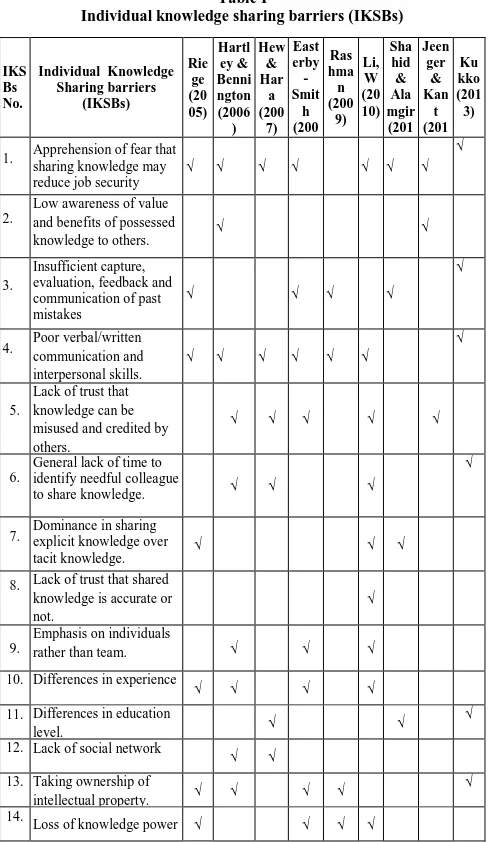
Table I
Individual knowledge sharing barriers (IKSBs)
IKS Bs No.
Individual Knowledge Sharing barriers (IKSBs) Rie ge (20 05) Hartl ey & Benni ngton (2006 ) Hew & Har a (200 7) East erby -Smit h (200 8) Ras hma n (200 9) Li, W (20 10) Sha hid & Ala mgir (201 1) Jeen ger & Kan t (201 2) Ku kko (201 3)
1. Apprehension of fear that sharing knowledge may reduce job security
√ √ √ √ √ √ √ √
2.
Low awareness of value and benefits of possessed knowledge to others.
√ √
3.
Insufficient capture, evaluation, feedback and communication of past mistakes
√ √ √ √
√
4. Poor verbal/written communication and interpersonal skills.
√ √ √ √ √ √
√
5.
Lack of trust that knowledge can be misused and credited by others.
√ √ √ √ √
6.
General lack of time to identify needful colleague
to share knowledge. √ √ √
√
7. Dominance in sharing explicit knowledge over tacit knowledge.
√ √ √
8. Lack of trust that shared knowledge is accurate or not.
√
9.
Emphasis on individuals
rather than team. √ √ √ 10. Differences in experience
level.
√ √ √ √
11. Differences in education
level. √ √
√
12. Lack of social network √ √
13. Taking ownership of
intellectual property. √ √ √ √
√
14.
Loss of knowledge power √ √ √ √
III. ISMMETHODOLOGY AND MODEL DEVELOPMENT
According to Vittal (2005), it is a set of criteria to measure success of quality management, and project management programs which have been established clearly. It is defined as a method for developing the hierarchy of system variables in order to represent the model. In ISM the judgment of the group decides whether and how the variables are related. Since it is based on relationships therefore it is structural.
Indeed, without measuring KM effort there is no way to manage organization‟s intellectual capital full capability, to emphasize on establishing criteria to measure knowledge management outcomes is vital and imperative. If the number of variable in the problem is Increase then the complexity of ISM is increase. So for developing an ISM model we can use a limited number of variables. The variables which affect less in a problem are not considered in the development of ISM model. These models were not statistically valid.
A. Structural Self-Interaction Matrix (SSIM)
For developing SSIM, the following four symbols have been used to denote the direction of relationship between IKSBs (i and j):
• V is used for the relation from IKSB i to IKSB j (i.e. if IKSB i helps to achieve IKSB j).
• A is used for the relation from IKSB j to IKSB i (i.e. if IKSB j helps to achieve IKSB i).
• X is used for both direction relations (i.e. if IKSB i and j both are helps to achieve each other).
• O is used for no relation between two IKSB (i.e. if IKSB i and j are unrelated).
Table II
Structural self-interaction matrix (SSIM)
IKSB
No. 14 13 12 11 10 9 8 7 6 5 4 3 2 1
1 V V V V V O O V O O O O X X
2 V O V V V O V V O V O O X
3 V O V V O O V O O V O X
4 V O V V O V V V O V X
5 V V V V O O X V O X
6 V V V O V X O X X
7 V V V V O X O X
8 V V V V O O X
9 V A V V O X
10 V O V X X
11 V O V X
12 V A X
13 V X
International Journal of Emerging Technology and Advanced Engineering
Website: www.ijetae.com (ISSN 2250-2459, ISO 9001:2008 Certified Journal, Volume 6, Issue 5, May 2016)
96
B. Development of the Reachability MatrixIn this step SSIM is converted into the initial reachability matrix by transforming the information of each cell of SSIM into binary digits (i.e. 1 or 0).
This has been done with the following rules:
1. If the cell (i, j) is assigned with symbol „V‟ in the SSIM, cell (i, j) entry becomes 1 and the cell (j, i) entry becomes 0 in the initial reachability matrix. 2. If the cell (i, j) is assigned with symbol „A‟ in the
SSIM, cell (i, j) entry becomes 0 and the cell (j, i) entry becomes 1 in the initial reachability matrix. 3. If the cell (i, j) is assigned with symbol „X‟ in the
[image:3.612.56.279.360.597.2]SSIM, cell (i, j) entry becomes 1 and the cell (j, i) entry also becomes 1 in the initial reachability matrix. 4. If the cell (i, j) is assigned with symbol „O‟ in the SSIM, cell (i, j) entry becomes 0 and the cell (j, i) entry also becomes 0 in the initial reachability matrix.
Table III Final reachability matrix
IKSB No. 1 2 3 4 5 6 7 8 9 10 11 12 13 14 DP 1 1 1 0 0 0 1* 1 1* 1* 1 1 1 1 1 11 2 1 1 0 0 1 1* 1 1 1* 1 1 1 1* 1 12 3 0 0 1 0 1* 0 0 1 0 1* 1 1 1* 1 8 4 0 0 0 1 1 1* 1* 1* 1 1* 1 1 1* 1 10 5 0 0 0 0 1 1* 1 1 1* 1* 1 1 1 1 10 6 0 0 0 0 0 1 1 0 1 1 1* 1 1 1 8 7 0 0 0 0 0 1 1 0 1 1* 1 1 1 1 8 8 0 0 0 0 1 0 1* 1 0 1* 1 1 1 1 8 9 0 0 0 0 0 1 1 0 1 1* 1 1 1 1 8 10 0 0 0 0 0 0 0 0 0 1 1 1 0 1 4 11 0 0 0 0 0 0 0 0 0 1 1 1 0 1 4 12 0 0 0 0 0 0 0 0 0 0 0 1 0 1 2 13 0 0 0 0 0 0 0 0 0 0 0 1 1 1 3 14 0 0 0 0 0 0 0 0 0 0 0 0 0 1 1 DPP 2 2 1 1 5 7 8 6 7 11 11 13 10 14
DP-Driving power, DPP- Dependence power.
In addition, there is one basic concept which is essential to understand the ISM methodology termed as the concept of transitivity.
Transitivity can be explained with the following example. If element „a‟ relates to element „b‟ (i.e. aRb) and element „b‟ relates to element „c‟ (bRc), then transitivity implies element „a‟ relates to element „c‟ (aRc). Transitivity is the basic assumption in ISM and is always used in this modeling approach (Raj et al., 2008). Thus, after imposing the transitivity relationships by 1* final reachability matrix has been developed as shown in table III.
C. Partitioning of the Reachability Matrix
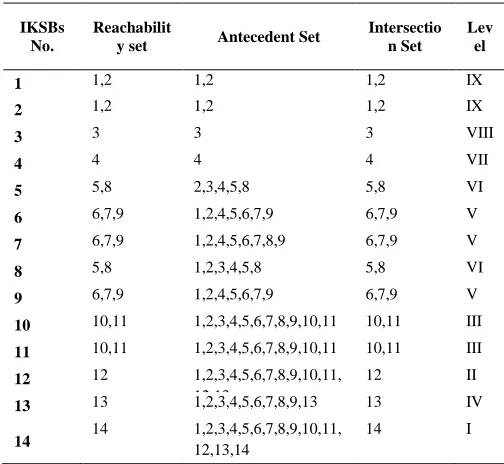
In the present work, the fourteen IKSBs have been identified. Reach ability set, antecedent set, intersection set and levels have been tabulated with the help of final Reach ability matrix for all IKSBs. Level identification process of these IKSBs has been completed in fourteen iterations for the partitioning of the final Reach ability matrix, summarized in table-IV.
Table IV
Partitioning of the reachability matrix showing all iterations and levels of the IKSBs
IKSBs No.
Reachabilit
y set Antecedent Set
Intersectio n Set
Lev el
1 1,2 1,2 1,2 IX
2 1,2 1,2 1,2 IX
3 3 3 3 VIII
4 4 4 4 VII
5 5,8 2,3,4,5,8 5,8 VI
6 6,7,9 1,2,4,5,6,7,9 6,7,9 V
7 6,7,9 1,2,4,5,6,7,8,9 6,7,9 V
8 5,8 1,2,3,4,5,8 5,8 VI
9 6,7,9 1,2,4,5,6,7,9 6,7,9 V
10 10,11 1,2,3,4,5,6,7,8,9,10,11 10,11 III
11 10,11 1,2,3,4,5,6,7,8,9,10,11 10,11 III
12 12 1,2,3,4,5,6,7,8,9,10,11,
12,13
12 II
13 13 1,2,3,4,5,6,7,8,9,13 13 IV
[image:3.612.317.569.377.609.2]International Journal of Emerging Technology and Advanced Engineering
Website: www.ijetae.com (ISSN 2250-2459, ISO 9001:2008 Certified Journal, Volume 6, Issue 5, May 2016)
97
Level ISM MODEL Rank
[image:4.612.47.281.127.544.2]
Fig.1. ISM Model showing all the Levels of individual Knowledge Sharing Barriers (IKSBs)
D. Development of the ISM Model
Considering the above nine levels, an ISM model including transitivity links can be obtained. Number of indirect and direct links depends on the relationships assigned by „1‟ or „1*‟ in the final reach ability matrix which can be shown by large number of arrows. In the development of ISM model, the top level IKSBs is positioned at the top of the model and second level IKSBs is placed at second position and so on, until the bottom level is placed at the lowest position in the model as shown in fig.1.
E. MICMAC Analysis
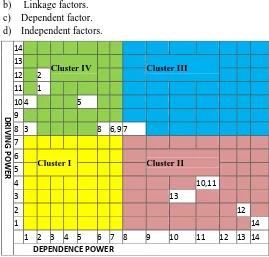
MICMAC means cross-impact matrix multiplication applied to classification. The main purpose of MICMAC is to find out the drive power and dependence power of each factor. MICMAC based on the principle of multiplication properties. On the basic of their drive power and dependence power they are classified into four groups: a) Autonomous factors.
[image:4.612.321.590.235.492.2]b) Linkage factors. c) Dependent factor. d) Independent factors.
Fig. 2 Cluster Formation by MICMAC Analysis
IV. RESULTS AND DISCUSSIONS
The results of this study can help in the strategic and tactical decisions for an organization to move from a traditional system to IKS system. The main strategic decision relies on the commitment of top management for the adaptation of IKS. Once the top management commits itself it will help the organization to implement the IKS and the firm can sample some strategic and tactical benefits such as: better competitive edge, development of engineering and management expertise, ability to introduce new products faster to the market, reduced work-in-process, improved quality, improved response to demand variation as per latest technology, improved working conditions and improved ability to design or process change-over with integration of IT systems.
1
2
3
4
5
6
7
8
9
9
8
7
6
5
4
3
2
1
D
R
IV
IN
G
PO
WE
R
14 13
Cluster IV Cluster III 12 2
11 1
10 4 5
9
8 3 8 6,9 7
7 6
Cluster I Cluster II 5
4 10,11
3 13
2 12
1 14
1 2 3 4 5 6 7 8 9 10 11 12 13 14
DEPENDENCE POWER
8-Lack of trust that shared knowledge is accurate or
not. 5-Lack of trust that shared
knowledge can be misused and credited by others.
14-Loss of knowledge power
12-Lack of social network
13-Taking ownership of intellectual property 11-Differences in
education level
7-Dominance in sharing explicit knowledge over
tacit
9- Emphasis on individuals rather than team.
4- Poor verbal/written communication and interpersonal skills.
3- Insufficient capture, evaluation, feedback and communication of past
mistakes.
2 - Low awareness of value and benefits of possessed knowledge to
others. 10-Differences in experience
level
6-General lack of time to identify needful
colleague to share knowledge
1- Apprehension of fear that sharing of knowledge may
International Journal of Emerging Technology and Advanced Engineering
Website: www.ijetae.com (ISSN 2250-2459, ISO 9001:2008 Certified Journal, Volume 6, Issue 5, May 2016)
98
The levels of different IKSBs are important in better understanding and their implications in Successful implementation of IKS. An insight into the ISM model indicates the operational level IKSBs that are very much powerful to hamper the successful operation and implementation of IKS.
REFERENCES
[1] Alvesson, M., 2002.Understanding organisational Culture. SagePublications. London.
[2] Brown, M.M. (2003), “Technology diffusion and the „knowledge barrier‟: the dilemma of stakeholder participation”, Public Performance & Management Review, Vol. 26
[3] Wenger, E., McDermott, R. & Snyder, W. (2002). Cultivating Communities of Practice: A Guide to Managing Knowledge. Harvard Business School Press, Boston
[4] Riege, A.(2005), “Three-dozen Knowledge-Sharing Barriers Managers Must Consider”, Journal of Knowledge Management, Vol. 9(3).
[5] Hartley, J., and Bennington, J (2006) – „Copy and Paste, or Graft and Transplant? Knowledge Sharing Through Inter-Organizational Networks‟, Public Money and Management.
[6] Hew, K.F. & Hara, N. (2007). Empirical study of motivators and barriers of teacher online knowledge sharing. Educational Technology Research and Development.
[7] Easterby-Smith, M., Lyles, M. A., Tsang, E. W., (2008)–„Inter-organizational Knowledge Transfer: Current Themes and Future Prospects‟, Journal of Management Studies, Vol 45(4).
[8] Rashman, L., Withers, E., Hartley, J. (2009) – „Organisational learning and knowledge in public service organizations: A systematic review of the literature‟, International Journal of Management Review, vol 11.
[9] Li, W. (2010). Virtual knowledge sharing in a cross cultural context. Journal of Knowledge Management, Vol. 14.
[10] Shahid, A. and Alamgir, R (2011) ICT enabled knowledge sharing: Impact of ICT on knowledge sharing barriers – The Case of Avanade. Master Thesis in IT Management (EIK034) Malardalen University.
[11] Jeenger, P and Kant, R (2012) International Journal of Mechanical and Industrial Engineering (IJMIE) ISSN No. 2231 – 6477, Vol- 2, Iss-4
[12] Kukko, Marianne (2013), Knowledge Sharing Barriers of Acquisitioned Growth: A Case Study from a Software Company, International Journal of Engineering Business Management, Int. j. eng. bus. manag., 2013, Vol. 5, 8:2013
[13] Vittal S. Anantatmula,Outcomes of Knowledge Management Initiatives(2005), International Journal of Knowledge Management, pp. 50-67.
[14] Mc Adam, R. and. Reid, R. "A comparison of Public and private sector perception and use of knowledge management," Journal of European Industrial Training, 2000.