Implementation of a renewed
questionnaire, applied in the
adolescent contact moment in
Child Health Care, by GGD Twente
Noëlle Klein Gunnewiek
MSc Thesis
Health Sciences – Innovations in Public Health
July 2017
Supervisors University of Twente: Dr. M. (Magda) Boere-Boonekamp Dr. C.H.C. (Stans) Drossaert
Supervisor GGD Twente: Drs M.T. (Marlie) Cerneus-Hoffman
Master Thesis Health Sciences
Implementation of a renewed questionnaire,
applied in the adolescent contact moment in
Child Health Care, by GGD Twente
Analysis of the facilitating and impeding determinants.
Author Noëlle Klein Gunnewiek
Student number s1753150
Master Health Sciences
Track: Innovations in public health
Institution University of Twente
Faculty of Behavioural, Management
and Social Sciences
Supervisors University of Twente Dr. M. M. (Magda) Boere-Boonekamp Dr. C.H.C. (Stans) Drossaert
Abstract
Background.In 2009 the National Institute for Public Health and the Environment in the Netherlands has published an advice, which consisted of a recommendation for an extra contact moment for adolescents in preventive Child Health Care (CHC). GGD Twente organizes this extra contact moment in the third or fourth class in high school. During the contact moment CHC professionals ask the adolescents to fill in a questionnaire about their health status and behavior. In 2015 GGD Twente
developed a renewed questionnaire, which is web-based, interactive and based on the concept of positive health. At the moment, the renewed questionnaire is in a try-out phase and in the end it has to be implemented in the whole Twente region.
Objective. The research objective of this study is to find out which determinants have a facilitating or impeding influence on the implementation process of the renewed questionnaire developed by GGD Twente to support the contact moment between adolescents and CHC professionals at high schools, according to the opinions of the stakeholders involved.
Methods. This research is characterized as an explorative research with qualitative data collection methods. By interviewing the adolescents (N=6) and mentors (N=4) and organizing an online focus group for CHC professionals (N=4), the opinions of the stakeholders about the facilitators and impeders in the implementation of the renewed questionnaire were collected. The MIDI, the youth web space framework and the concept of positive health were used to analyse the data.
Results. Nineteen of the 29 determinants presented in the MIDI were identified by the stakeholders as facilitating and/or impeding. The most mentioned facilitator is “client satisfaction”. Most of the stakeholders agreed that the renewed questionnaire is more fun to fill in for the adolescents compared to the former questionnaire. Most striking impeder is “client cooperation”. Main reasons among the adolescents are that they did not cooperate in the extra functions applied in the questionnaire and that some of them would not fill in the truth if they had a problem. The adolescents stated that the questionnaire is not quite relevant because the questionnaire did not deliver them anything and they would not ask the GGD for help if this was needed. The stakeholders gave many recommendations in regard to the determinants associated with the ‘adopting person’. Most stakeholders agreed that if the client cooperation should be optimized, the class situation wherein the questionnaire is being filled in has to change. Not all mentors were informed well about the procedures around the renewed questionnaires. At the moment it is hard for the professionals to read the outcomes and in some cases the professionals do not know what to do, so the procedure after the questionnaires are filled in is unclear.
Conclusion. Different determinants may positively or negatively affect the implementation of the renewed questionnaire. The most important facilitators are associated with the innovation itself, which is overall an improvement compared to the former paper-and-pencil administered questionnaire. Adolescents do like the questionnaire and are willing to cooperate. However, the questionnaire should be more effective if the adolescents should fill in the questionnaire in a situation wherein the adolescents sit separately, it is quiet and every adolescent stays for a certain time period. Mentors should be more aware of the procedures around the
Samenvatting
Achtergrond. In 2009 heeft het Rijksinstituut Volksgezondheid en Milieu een advies uitgebracht waarin een aangeraden wordt om een extra contact moment in de jeugd gezondheidszorg te implementeren. GGD Twente organiseert dit extra contact moment voor adolescenten in de derde of vierde klas van de middelbare school. Tijdens het contact moment vragen de JGZ professionals de adolescenten om een vragenlijst in te vullen over hun gezondheid en gedrag. In 2015 heeft GGD Twente een vernieuwde vragenlijst ontwikkeld, welke web-based, interactief en gebaseerd op het concept van positieve gezondheid is. Momenteel bevindt de vernieuwde
vragenlijst zich in een try-out fase en uiteindelijk zal deze geimplementeerd worden in heel regio Twente.
Doelstelling. De doelstelling van dit onderzoek is het uitvinden welke determinanten een bevorderende of belemmerende invloed hebben op het implementatieproces van de vernieuwde vragenlijst ontwikkeld door GGD Twente, voor het ondersteunen van het contact moment tussen adolescenten en JGZ professionals op middelbare scholen, volgens de betrokken partijen.
Methode. Het onderzoek is exploratief met kwalitatieve data collectie methodes. Door het interviewen van adolescenten (N=6) en mentoren (N=4) en het organiseren van een online focus groep voor JGZ professionals (N=4) zijn de meningen over de bevorderende en belemmerende determinanten bij de implementatie van de
vernieuwde vragenlijst verzameld. De MIDI, het youth web space framework en het concept van positieve gezondheid zijn gebruikt al voor de data analyse.
Resultaten. Negentien van de 29 MIDI determinanten zijn geidentificeerd door de betrokkenen als bevorderend en/of belemmerend. De sterkste bevorderaar is “client tevredenheid”. De meeste betrokkenen waren het erover eens dat de vernieuwde vragenlijst leuker is om in te vullen dan de vorige vragenlijst. De determinant
“medewerking client” is het meest belemmerend. De belangrijkste oorzaak is dat de adolescenten niet meewerkten bij de extra functies en dat sommige van hen het niet eerlijk zouden invullen als ze een probleem hadden. De vragenlijst is niet echt relevant voor de adolescenten omdat het hen niets opgeleverd heeft en ze zouden niet aankloppen bij de GGD als ze hulp zouden willen. De betrokkenen gaven veel aanbevelingen geassocieerd met de ‘gebruiker’. De meeste betrokkenen waren het erover eens dat de medewerking van de gebruikers geoptimalizeerd zou worden als de vragenlijst in een andere situatie ingevuld zou worden. De mentoren waren niet allemaal goed ingelicht over de procedures rondom het invullen van de vragenlijst. Voor de professionals zijn de uitkomsten momenteel nog lastig uit te lezen en in sommige gevallen is het moeilijk voor de professionals te beslissen wat ze moeten doen, dus de procedure nadat the vragenlijsten zijn ingevuld is onduidelijk.
Conclusie
.
Verschillende bevorderende en belemmerende determinanten kunnen effect hebben op de implementatie van de vernieuwde vragenlijst. De meeste bevorderende determinanten hebben te maken met de innovatie zelf, welke een vooruitgang is ten opzichte van de vorige vragenlijst. Adolescenten vinden dePreface
This thesis is written to finish the master Health Sciences, with a specialization in Public Health Innovations, at the University of Twente. During the period of working on this assignment I had the opportunity to experience GGD Twente from inside. It was interesting to be part of such an important organization for the public health in the Twente region.
First, I would like to thank all the participants in this research. I noticed that because of the timing of my research it was difficult to participate for some of you, but
therefore I am extra thankful that you did. You all gave me relevant input for my research.
Next, I would like to thanks my supervisors from the University of Twente, Magda Boere-Boonekamp and Stans Drossaert. Despite Magda’s busy schedule we always managed to see each other and discuss my research every two weeks. Stans gave me input from other perspectives, which was very useful.
Finally, I would like to thank my supervisor from GGD Twente, Marlie Cerneus. Marlie really helped me to reach the participants. I appreciated the fact that you gave me your trust to do my own thing and you supported me if necessary.
Noëlle Klein Gunnewiek
Index
Index ... 6
1 Introduction ... 8
1.1 Child health care for adolescents ... 8
1.2 The adolescent contact moment in Twente ... 9
1.3 Objective and research question ... 10
2 Theoretical context ... 11
2.1 Child health care in the Netherlands ... 11
2.2 Positive health ... 11
2.3 Digital applications ... 12
2.4 Innovation process ... 14
3 The Innovation ... 15
3.1 Aims and conditions ... 15
3.2 Development ... 15
3.3 Content ... 16
3.4 Design and use ... 18
4 Methods ... 19
4.1 Study design ... 19
4.2 Study sample ... 19
4.3 Data collection ... 20
4.4 Data analysis ... 21
4.5 Ethical considerations and approval ... 23
5 Results ... 24
5.1 The innovation ... 24
5.1.1 Facilitators... 24
5.1.2 Impeders ... 25
5.2 The adopting person ... 26
5.2.1 Facilitators... 26
5.2.2 Impeders ... 27
5.3 The organization ... 29
5.3.1 Facilitators... 29
5.3.2 Impeders ... 29
5.4 Similarities and differences between the stakeholders ... 30
5.5 Recommendations ... 31
5.6 Youth web space framework ... 32
5.7 Positive health ... 32
5.8 Technical errors ... 33
6. Discussion ... 34
6.2 Youth web space framework and positive health ... 35
6.3 Comparison with literature ... 36
6.4 Strengths and limitations of the study ... 36
6.5 Future research ... 37
6.6 Practical recommendations ... 37
6.7 Conclusion ... 38
References ... 39
Appendix 1 The CHC offer ... 42
Appendix 2 The MIDI determinants ... 43
Appendix 3 Professionals information letter ... 45
Appendix 4 Interview schedule adolescents ... 47
Appendix 5 Interview schedule mentors ... 49
Appendix 6 Online focus group schedule professionals ... 51
Appendix 7 Full interview and focus group transcripts ... 53
Appendix 8 Stakeholders’ recommendations ... 73
1
Introduction
In 2009 the National Institute for Public Health and the Environment in the
Netherlands (RIVM) has published an advice, which consisted of a recommendation for an extra contact moment in preventive child health care (CHC), for the age period of 12-19 years. One of the conclusions in this advice was that adolescents need more tailored and individual information and the opportunity to ask face-to-face questions about their own health status and healthy behavior (van Heerwaarden, 2013).
All children in the Netherlands have the right to get child health care until the age of 18. Municipalities are responsible for the CHC, so the municipal health
services (GGD’s) carry out the CHC (NCJ, 2015). The legal definition of CHC is: The public health care, whereby a national preventive health care package is actively provided to all children until the age of 18 (Ministerie van Volksgezondheid, Welzijn en Sport , 2016). Since the 1st of January 2015 a new basic program of CHC exists. The basic program CHC describes which package of preventive health care should be offered to every child in the Netherlands. The package is further explained in chapter 2. The CHC is the only party in health care which has an image of all children and provides them individual and longitudinal preventive care on a regular basis (NCJ, 2015).
1.1 Child health care for adolescents
The national professional context describes the CHC contact moments for the different development phases of children (NCJ, 2015). In appendix 1 a table is presented with the individual preventive activities, the CHC offers for every child. Before 2013 a standard contact moment for adolescents (after the age of 12 or after the second year in high school) did not exist. The last contact moment between the CHC and adolescents was during the second year of high school. If the CHC professionals had worries about an adolescent, the option was to send an invitation for an individual consultation to the adolescent, which is called “onderzoek op indicatie” (consultation on indication). There was no standard screening for adolescents (Cerneus, 2016).
However, during the adolescence phase important changes in biology,
behavior, cognitive skills and executive functions take place. Adolescents are inclined to attempt riskful or dangerous activities, but they are not yet capable of controlling these activities (Crone, 2008). These factors influence the adolescents’ health status and healthy behavior. Therefore, it should be useful for CHC professionals to have contact with adolescents (van Heerwaarden, 2013). In the 2013 “Lenteakkoord” (a legal agreement), €26 million was released by the government to strengthen and intensify programs aimed at promoting healthy lifestyles of children, with fighting obesity as main goal. Part of this plan is the impulse of €15 million for municipalities to intensify the contact between adolescents (from 13 years and older) and CHC professionals by organizing the extra contact moment (van Heerwaarden, 2013). Extra information about the contact moment is provided in the theoretical context, chapter 2.
The ministry of Health, Welfare and Sport (VWS) asked the National Center of CHC (NCJ) to compose a substantive guide with information about the formulation and design of the adolescent contact moment to support the GGD’s (van
CHC professionals play a big role in the contact moment. It is important that they are flexible, positive, solution focused, normalizing and they should give advice and help independent from their own norms and values (Cerneus, 2016).
1.2 The adolescent contact moment in Twente
[image:9.595.137.457.306.532.2]GGD Twente organizes the contact moment in the third or fourth class in high school (14-16 year old adolescents). Before the actual contact moment takes place, the GGD deliberates with the concerning school about the content of the contact moment. Schools are invited to bring forward their preferences (Cerneus, 2016). The contact moments with the adolescents are organized through a class meeting, existing of two parts. The CHC physicians and nurses start with a class about health and healthy behavior and they explain what the CHC/GGD can mean for the adolescents. In the second and last part of the class meeting, the adolescents are asked to fill in a questionnaire. The mentor is also present, which means that the professionals, the mentors and the adolescents are the stakeholders involved in the process of filling in the questionnaire. An overview of stakeholders is presented in figure 1.
Figure 1: The adolescent contact moment and the stakeholders involved.
The aim of the questionnaire is to get insight in the health status and lifestyle of every adolescent. Based upon the completed questionnaire the CHC physician or nurse has the option to invite the adolescent for a conversation. Besides this, the
adolescent has the option to contact a CHC professional by chatting or making an appointment (Backhaus & Cerneus, 2015).
The questionnaire is paper-and-pencil administered and the approach is problem-focused. After having used the questionnaire for two years the GGD
concluded in 2015 that the questionnaire is outdated because of, among other things, the current technical possibilities to make the questionnaire web-based, the design and the interactivity. Besides this, GGD Twente wanted to implement another
Chapter 3 highlights the developing process, the underlying considerations and the content of the renewed questionnaire.
In a couple of months, the renewed questionnaire has to be implemented in the whole Twente region. The CHC professionals involved in the adolescent contact moment should use the renewed questionnaire instead of the current questionnaire. The understanding of the facilitators and critical determinants, or impeders, can help to develop a tailored implementation strategy for a successful implementation. The current try-out phase can be used to make clear what the experiences and opinions of the involved stakeholders are. By analyzing these experiences and opinions, the facilitating and impeding determinants can be identified.
1.3 Objective and research question
The research objective of this study is to find out which determinants have a facilitating or impeding influence on the implementation process of the renewed, questionnaire developed by GGD Twente to support the contact moment between adolescents and CHC professionals at high schools, according to the opinions of the stakeholders involved. The questionnaire is renewed by using a different form (digital), a different approach (positive health), adding several functions and a new design. A more extended explanation about the conditions and aims of the renewed questionnaire, can be found in chapter 3.
To achieve the objective of this study, the following research question is defined: What are the facilitating and impeding determinants in the implementation of the renewed questionnaire developed by GGD Twente, which is applied in the contact moment between adolescents and CHC professionals on high schools, according to the stakeholders?
2
Theoretical context
In this chapter, a further explanation of the following subjects is presented: child health care in the Netherlands, new concepts in CHC such as positive health and digital applications and theoretical background of innovation processes.
2.1 Child health care in the Netherlands
The core tasks of the CHC, described in the basic program, are:
- To systematically follow and review the development of children;
- To signal problems and to detect specific disorders in an early stage;
- To provide preventive information, advice, instruction and help;
- To judge if extra help or care is needed;
- To directly arrange proper help or care;
- And to collaborate and to give advice.
Important in every contact moment are the specific circumstances of children and his or her family and environment (NCJ, 2015).
CHC in the Netherlands is transforming, more flexibility and tailored care are key elements. CHC professionals constantly anticipate in collaboration with parents on the specific needs of children. Often children and/or parents can find a solution within their own network and if necessary, timely support of the CHC can be provided. In the end, children and their family should become able to care for themselves again, with or without support from their own network. If CHC
professionals signal problems, they can quickly send children to curative care, proper child health care or another relevant caregiver. The CHC physician has the function of a gatekeeper, which underlines the natural role of CHC on the area of tailored care (NCJ, 2015).
CHC maintains contact with children continuously (until the age of 18), wherein attention goes to prevention, early detection and support. In the begin phase (0-4 years) the contact is close, thereafter the contact becomes less intensive. From the age of 14, the contact is (partly) non-binding and on the initiative of the adolescent his or herself (van Heerwaarden, 2013). On overview of all contact moments is presented in appendix 1.
The NCJ states that the support of CHC through the adolescent contact moment has a positive effect on the (education) opportunities and participation of adolescents. In the end, every adolescent should be able to contribute to the society and stand up for him or herself. This goal can be accomplished by creating
awareness about health status and healthy behavior among the adolescents and to (preventively) support and coach the adolescent to increase their own abilities. More precisely, it means that adolescents from 14 years old can ask questions about health to the CHC and can have a conversation with a physician’s assistant, a CHC nurse or a CHC physician. Besides this, adolescent with (starting) problems are actively approached and supported, CHC can send adolescents to specialists and CHC collaborates with schools and parents (van Heerwaarden, 2013).
2.2 Positive health
defined as: “The ability to adapt and to self-manage, in the face of social, physical and emotional challenges” (Huber, et al., 2016). The concept ‘positive health’ is subdivided into six dimensions: mental functions and perception, bodily functions, quality of life, spiritual/existential dimension, daily functioning and social and societal participation (Huber, et al., 2016).
The concept is introduced in the Netherlands in 2012 by physician-researcher Machteld Huber. Nowadays the concept and the term ‘positive health’ is recognized in several fields of health care in the Netherlands, including CHC (van
Steekelenburg, Kersten, & Huber, 2016). Integrating the concept of positive health in CHC implies that more attention goes to positive and protecting factors instead of problems and medical standards. This means that CHC professionals involved in the adolescent contact moment have to focus more and more on acceptation (of
problems and situations), abilities and coping with certain (problem) behavior. CHC professionals ask questions such as: “what can you do”, “where are you good at” and “what do you need to feel good and to function as good as possible”. Several aspects of health and feelings of adolescents are taken into account (van Heerwaarden, 2013). All these activities fit within the concept of positive health. The concept opens a door to a new focus in health care (van Steekelenburg, Kersten, & Huber, 2016) and fits to other trending terms in the health care sector at the moment, such as patient-centered care, family-centered care and patient-empowerment (Verharen, 2016).
2.3 Digital applications
Another new concept in CHC is the entering of digital applications. Adolescents today have adopted the use of digital media in their daily life (Vandewater & Lee, 2009). They are part of a generation which is using a whole bunch of technologies, such as tablets, video game consoles, mobiles and other Wi-Fi capable devices (Vodanovich, Rohde, Dong, & Sundaram, 2011). Prensky (2001) uses the term ‘Digital Natives’. Adolescents can be seen as digital natives because they are ‘native speakers’ of all digital media, devices and other digital sources (Prensky, 2001). In combination with the new developed technologies and media, working with digital and online
applications can have many advantages. For example, an online questionnaire for adolescents at school. An online questionnaire has advantages compared to paper-and-pencil questionnaires for the moderator as well as for the user, such as the possibility to give direct and tailored feedback, possibilities for direct checking for consistency and missing answers and cost and time advantages (van de Looij-Jansen & de Wilde, 2008). Compared to a paper questionnaire, an online
questionnaire about health indicators will not have major differences in results in a school setting (van de Looij-Jansen & de Wilde, 2008) (Mangunkusumo, et al., 2005). In questionnaires with topics about lifestyle behavior, most of the times the way of administration has also no significant effect on the responses of adolescents. However, signs of socially desirable responses are more likely to be found in a paper-and-pencil questionnaire than in a digital, online questionnaire (Vereecken & Maes, 2006).
In a web space designed for children, it is important how the content is presented. In this regard, the ease of use and the interactivity are crucial factors for the success of a web space for youth (Vodanovich, Rohde, Dong, & Sundaram, 2011). Interactivity is especially important when it comes to capturing attention of youth. Interactive websites consist of two components: users can easily add information and the function of interpersonal communication (asynchronous or synchronous). Web spaces for youth should be ‘fun’ to use, which can be
Another way to include interactivity in a youth web space and to make the space ‘fun’ to use is to add elements of gamification. Gamification means that non-gaming systems are completed with video game elements, with the aim of improving users’ engagement and experiences (Deterding, Sicart, Nacke, O'Hara, & Dixon, 2011). Examples of these video games elements are an interactive design,
animations and visual feedback. Elements of gaming could increase the motivation of adolescents to join initiatives such as online training programs (Boendermaker, Boffo, & Wiers, 2015).
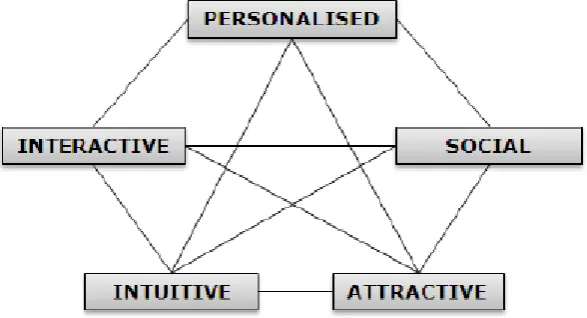
Vodanovich, Rohde, Dong and Sundaram (2011) proposed a “Youth web spaces application interface framework”, shown in figure 2. In this framework, youth is defined as people between the age of 13 and 19 (Vodanovich, Rohde, Dong, & Sundaram, 2011).
The five terms in the framework represent the different dimensions, with
requirements which are important in the design process of a web space for youth. “Personalized” points out that the user should be able to personalize the web space or the behavior of the user should be adapted. The requirement of interactivity refers to the aim of making the web space fun to use. The intuitive dimension deals with the difficulty of the web space. This requirement helps users to easily understand the information and navigate on the platform. Users should not have to use tutorials or manuals to understand what they have to do, this should be obvious. The
[image:13.595.150.444.251.410.2]personalized, interactive and intuitive dimensions are quite general and do not address especially to youth. Up-to-date and ‘cool’ designs tailored to youth fit in the attractiveness dimensions. This makes the web space attractive and youth specific. The social dimension refers to requirements of showing who contributed to what and allowing users to show their identity in the virtual world. An example is a discussion board, wherein every message is connected to a user with an individual user page. The five dimensions are interrelated to each other, so all the dimensions should be considered in developing an application for youth (well-being). The dimensions can enforce as well as constrain each other (Vodanovich, Rohde, Dong, & Sundaram, 2011).
2.4 Innovation process
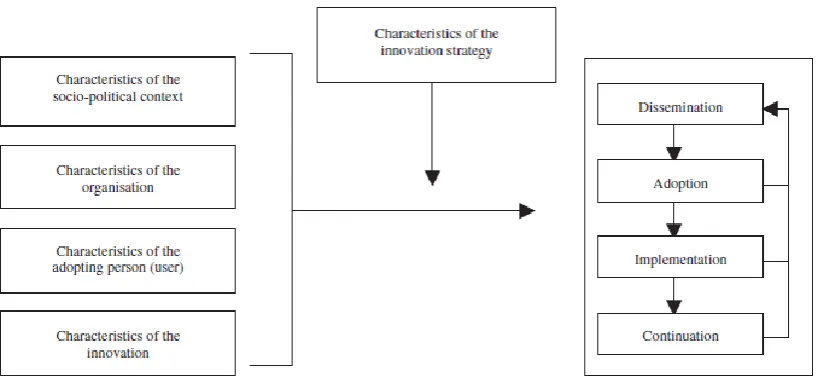
Implementing an innovation in health care is often a complex process. The term ‘innovation’ refers to new programs, interventions or guidelines (Rogers, 2003). Many determinants can positively and negatively affect the implementing process, or the actual change. The implementation is part of a whole innovation process. Fleuren, Wiefferink and Paulussen (2004) developed a framework (figure 3) with the four main stages of innovation and four related categories of determinants. The four phases of the innovation process are critical because in each of the stages a desired change can possibly occur (Fleuren, Paulussen, Van Dommelen, & Van Buuren, 2014). In the dissemination or diffusion phase, the innovation is spread out. The adoption phase is the first crucial phase where professionals decide whether to use or not use the innovation. During the third phase, the implementation, the professional has put the innovation into his or her daily practice (Fleuren, Wiefferink, & Paulussen, 2004). In the continuation phase the use of the innovation is continued. Different
determinants can affect the transition between stages in a positive and/or negative way. These determinants are associated with characteristics of four different groups: the innovation, the adopting person or the user, the organization or the socio-political context.
Because there are factors that positively and/or negatively affect an innovation process, measurement of these determinants is essential to make the design of tailored implementation strategies possible. Therefore, a measurement instrument is needed, based on the framework outlined above. Fleuren et al., developed a
measurement instrument. First, they included 60 potentially relevant determinants out of literature and in the end they reduced this to 29 determinants. The 29 selected determinants are included and described in the by Fleuren et al., developed measurement instrument for determinants of innovations (MIDI). The determinants and descriptions are presented in appendix 2. The instrument can be used by
implementation researchers, before or after the specific innovation is introduced. The MIDI is not validated but offers help to collect information to judge the relative
importance of determinants for a successful implementation of the innovation (Fleuren, Paulussen, Van Dommelen, & Van Buuren, 2014).
This chapter consisted of additional theoretical information, substantive to the subject of this study. The information included the subjects: youth health care in the
[image:14.595.93.503.325.516.2]3
The Innovation
This chapter explains the innovation, with information about the aims, the
development, the content and the design and use. The innovation is the renewed questionnaire of GGD Twente.
GGD Twente developed a renewed questionnaire to replace the current
questionnaire. This renewed questionnaire should, just like the current questionnaire, be used by CHC professionals during the adolescent contact moment at high schools (3th/4th class). With conducting the questionnaires, the CHC professionals fulfill their (individual) screenings task. Problems of individual adolescents can be signaled and the CHC professionals can judge if extra help, support or care is needed. The questionnaire does not function as a monitoring instrument, such as the E-MOVO (GGD Twente, 2016). The aim of the E-MOVO is to present aggregated data (by summary statistics) of the health of a population of children, while the questionnaire for the adolescent contact moment does not give results of a population group, but signals individual possible problem behavior and gives a view of the individual adolescents’ health status. If the professionals signal a problem, they will take action to help and support the adolescent. GGD Twente has consciously decided to
separate the screening and monitoring function, because they believe that for signaling problems and for reaching individuals this is the most effective way to fulfill the CHC tasks.
3.1 Aims and conditions
GGD Twente had a clear view of how the questionnaire should have to look like and which effects the questionnaire should have, compared to the current questionnaire. The outcomes of the questionnaire should be a foundation for the CHC professionals to execute their legal tasks, which consists of signaling an adolescent’s riskful
behavior or problems, offer the adolescent tailored advice, support and help and send the adolescent through to specialists if this is needed and demanded. Analyzing and interpreting the individual results should also be less time consuming for the CHC professionals. Besides this, the adolescent should become more aware of his or her health status and healthy behavior, he or she should be provided with direct, tailored feedback and he or she should know where he or she can ask for help and/or advice. The following conditions are set up to reach these effects:
- The questionnaire is web-based.
- The concept of positive health is implemented in the questionnaire.
- Elements of gamification are applied to make the questionnaire more attractive and fun to use.
- The questionnaire is interactive.
3.2 Development
Before the actual decision was made to develop a new questionnaire, GGD Twente explored what other GGD’s already had developed. GGD Gelderland-Midden already used an online questionnaire, which gave the GGD Twente a good idea of the
possibilities, but the tool did not fit exactly the aims, which GGD Twente had set up. Main goals for the questionnaire of GGD Twente are that the concept of positive health is implemented, that the questionnaire is interactive and that gamification is used. At that moment, there was no other questionnaire that fulfilled these conditions, so GGD Twente decided to develop their own questionnaire.
- Health promotors at GGD Twente; - Financial manager from the GGD; - The developing company;
- Members of the development workgroup: 1 CHC physician and 4 CHC nurses. The professionals, who used the questionnaire in the try-out phase, have been to a meeting where the new questionnaire is presented and further explained. Based on the experiences, the questionnaire is already adjusted and some features are changed by GGD Health promotors, who are responsible for the development of the new questionnaire.
3.3 Content
GGD Twente decided to include fifteen topics based on the concept of positive health and their previous experiences. Each topic is represented by a question. Table 3 presents the topics, questions, answer scales and the corresponding dimensions of positive health. The selected topics are among others based on the six dimensions of positive health: physical functions, mental well-being, the spiritual-existential
dimension, quality of life, societal participation and daily functioning. The developers were forced to not include every (possibly) relevant topic and/or question. GGD Twente believes that it is not effective to use a questionnaire with too many
questions. First because it becomes boring for adolescents to fill in a questionnaire if there are too many questions. Second, because it is not always the best way to ask everything in the screening stage. The goal is to trace the adolescents who (maybe) have a problem and/or want help. In a follow-up consultation, the professional can ask the more specific and sensitive questions. GGD Twente believes that
[image:16.595.83.504.450.771.2]adolescents are more likely to share their feelings and thoughts by using this method. GGD Twente also invested in functionalities on their website to compensate for the excluded questions.
Table 3: The topics and questions included in the online questionnaire, developed by GGD Twente.
Nr. Topic Question Answer scale Dimension of positive health
1 Gaming How often do you game?
Never – very often
Mental well-being, societal participation 2 Use of
alcohol
Do you use alcohol? Never – way more than good for me
Physical functions 3 Smoking How much do you
smoke?
Never – a lot Physical functions
4 Use of drugs
Do you use drugs? No, never – more than good for me
Physical functions 5 Risk of
sexually transmitted diseases and pregnancy
If we talk about preventing venereal diseases, then how do you see yourself?
I do not take any risk – I often take risks
Physical functions
6 Fatigue and energy
How do you feel most of the time?
Tired - energetic Mental well-being, daily functioning 7 Weight How do you think about
your bodyweight?
Unsatisfied - satisfied
Physical functions, mental well-being 8 Sports How often do you sport? Never – a lot Physical functions,
societal participation 9 Somber or
cheerful
How do you feel most of the time?
Somber – cheerful
Mental well-being, the spiritual-existential dimension, quality of life
events something you are still suffering from?
anything I experienced – I often suffer from something I experienced
spiritual-existential dimension, quality of life
11 Learning For your education you have to study. How do you experience this?
Very hard – very easy
Daily functioning, societal participation 12 Happiness How do you feel most of
the time?
Very unhappy – very unhappy
Mental well-being, the spiritual-existential dimension, quality of life
13 Home What do you think of your home-situation?
Problematic – carefree
Daily functioning, societal particpation, quality of life
14 The meaning of life
How do you experience your life?
Meaningless – useful
Mental well-being, the spiritual-existential dimension
15 Sexual orientation
How do you think about your sexual preference?
I am struggling with that – I feel fine with that
Quality of life
With the questions, the CHC professionals aim to identify the health status and behavior of individual adolescents. Different from the current questionnaire, this new questionnaire is based on the concept of positive health. GGD Twente did this by adding several elements, such as using subjective answer scales (instead of a 1-10 scale) which increases the adolescent's self-control and the questionnaire focuses on “what can I do” and “what do I need to feel good and to function as good as
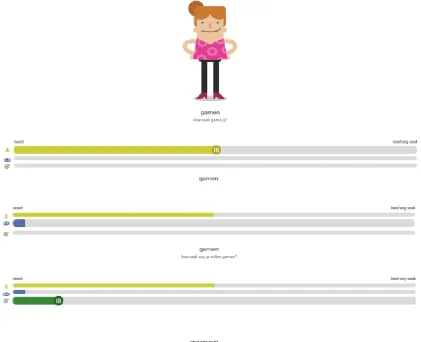
possible”. The adolescent decides what is wrong and what is right. The developer did this by asking about his or her current health status/behavior and thereafter asking if the adolescent wants to change this status/behavior. This is shown in figure 4. Between these questions there is shown what other similar (gender and level of education) adolescents have filled in. If the adolescent does not want to change the status/behavior, no attention will be paid on that specific topic. If he or she wants to change the status/behavior, direct feedback and advice is offered, which makes the questionnaire more interactive. In this way the adolescent chooses by him or herself if his or her health status/behavior is good or bad and GGD Twente gives the help and/or support which is necessary and relevant according to the adolescent him or herself, instead of GGD Twente doing everything what is necessary or possible.
During filling in the questionnaire, several functionalities are offered, which make the questionnaire interactive. First, the adolescent gets direct feedback on his or her answer. This is shown in the last sentence in figure 4. The adolescent gets extra information about the topics where he or she filled in that he or she wants to change his or her status or behavior. After finishing a topic the adolescent is invited to share tips to other adolescents about the former topic. Lastly, at the end of the
questionnaire it is possible to request a summary of the answers.
3.4 Design and use
The questionnaire is digital and online administered or in other words, web-based. Game elements are applied by adding an animation which gives the questionnaire a video game look. During the contact moment, the physician and/or nurse gives the adolescents a link, which they can enter on their computer, smartphone or tablet. The link gives them access to the questionnaire. Because there are some personal
[image:18.595.94.516.187.529.2]questions, the adolescent should fill in the questions in private. Figure 4 presents the questionnaire, with the topic ‘gaming’ and the three beams and direct feedback.
Figure 4: The process of questioning in the digital questionnaire developed by GGD Twente, example subject: gaming.
4
Methods
This chapter explains the methods used in this research, including the study design, the study sample, the data collection and analysis and the ethical considerations and approval.
4.1 Study design
This research is characterized as an explorative research with qualitative data collection methods. Qualitative research methods are used to explore deeper understandings of respondents’ beliefs, perspectives and experiences about certain subjects. At various stages of a research process, such as the data collection stage, qualitative methods can be used (Stewart, Gill, Chadwick, & Treasure, 2008). This qualitative research is carried out through semi-structured interviews with
adolescents and mentors and an online focus group with CHC professionals to identify the stakeholders’ opinions regarding facilitating and impeding determinants in the implementation of the online questionnaire developed by GGD Twente. The determinants and corresponding descriptions of the Measurement Instrument for Determinants of Innovation (MIDI), by Fleuren et al. (2004) were used to analyze the data and answer the main research question. The MIDI consists of four domains with a number of determinants. The four domains are determinants associated with the innovation, the adopting person, the organization and the socio-political context. Together there are 29 determinants, which are described and presented in appendix 2. To answer the sub research question, the Youth web spaces application interface framework by Vodanovich, et al. (2011) and the concept of positive health by Huber, et al. (2016) were use for data analysis.
4.2 Study sample
The research is executed at the child health care department of GGD Twente. Since February 2017 the renewed questionnaire has been available for CHC professionals to use during the contact moment with adolescents at high schools in Twente. Stakeholders involved in this research are CHC professionals (physicians and nurses), adolescents between the age of 14-16 and class mentors. Approximately 150 adolescents of eleven different classes and four different schools filled in the questionnaire and six CHC professionals conducted the questionnaire (data until the 23th of March 2017). These stakeholders are directly involved in the contact moment, wherein the online questionnaire will be filled in.
Professionals
After the professionals signed up for participating in the online focus group on Facebook they received an information letter about the use of Facebook, their
behavior in the group, the expectations from the moderator as well as what the professionals could expect form the moderator, the rights of the professionals and the way they give informed consent. The information letter is provided in appendix 3.
Mentors
The inclusion criterion for the mentors was: the mentor was present during a contact moment between adolescents and CHC professionals, wherein the questionnaire is filled in by the adolescents or knows that the questionnaire is filled in by his or her mentor class. The mentors were recruited through the contacts of a health promotor and CHC professionals who already had contact before with some mentors from classes who filled in the questionnaire. Mentors from senior general secondary education (HAVO) and pre-university education (VWO) classes, wherefrom the contact details are obtained from the health promotor, were invited by e-mail. The invitation letter contained information about the objective and the method of the study and the need for participants. The CHC professionals were asked to send the contact details from mentors from preparatory secondary vocational education (VMBO) classes by e-mail. None of the mentors and CHC professionals replied to the requests. A week later, reminders were sent by e-mail. The CHC professionals replied that they were going to search for the contact details. Up till the end of this research, after another reminder, the researcher did not receive the contact details of the mentors of the VMBO classes from the CHC professionals. The researcher decided to invite the mentors of the HAVO and VWO classes by phone, through the general telephone number of the school. After these phone calls, four mentors agreed to participate in the interviews.
Adolescents
The inclusion criterion for the adolescents was: the adolescent has filled in the online questionnaire during a contact moment with CHC professionals. The adolescents were recruited through their class mentors. During the phone calls from the
researcher with mentors of the HAVO and VWO classes, two mentors were asked for permission to interview the adolescents and to invite three adolescents for the
interviews. This invitation should comprise the request to the adolescents to inform their parents and to give their parents the option to object that their child was going to participate. The researcher and mentors planned the appointments for the interviews directly. Two days before the appointments the researcher sent an e-mail to the mentors with the question if they had been able to arrange that three adolescents were going to participate in the interview. The mentors replied the same day, six adolescents had agreed to participate in the interviews.
4.3 Data collection
Table 4: Research method and number of respondents included per stakeholder group
The research method used for the professionals was an online focus group. An online focus group is an interactive way of conducting online qualitative group discussions (Lijadi & van Schalwyk, 2015). The online focus group method has advantages as well as disadvantages compared to a face-to-face focus group method (Lijadi & van Schalwyk, 2015). In case of this research the biggest considerations are the time, effort and geographical advantages of online focus groups compared to face-to-face focus groups. The platform used for the online focus group was a secret Facebook group. Facebook gives the option to form a special secret interest group to interact with other members. The group initiator acts as facilitator and has a lot of options, including raising questions about relevant issues (Lijadi & van Schalwyk, 2015).
The secret Facebook group was open for reactions for fourteen days. During the first four days, three questions per day were posted in Dutch. The questions were about the content and visualization of the questionnaire, the professionals’ tasks around the questionnaire and the (expected) effectiveness of the questionnaire. The respondents were free to decide the best moment to reply to the questions. The complete set of questions is presented in appendix 6.
The four mentors were two by two mentor of the same class, two of a HAVO class and two of a VWO class. The adolescents and mentors came from the same school. Three out of the four mentors were present during a contact moment wherein the questionnaire is filled in. The mentor who was not present during a contact moment wherein the questionnaire had been filled in knew about the online
questionnaire through e-mail contact with a GGD Twente health promotor about the online questionnaire. In the semi-structured interviews with mentors, the mentors were asked about their task during the moment wherein adolescents are filling in the questionnaire and their thoughts about the questionnaire. The mentors were not asked in detail about the content of the questionnaire and they were not asked about any personal or medical information of (individual) adolescents. The interview had the maximum duration of 20 minutes and the spoken language was Dutch. The interviews took place at the school where the concerned mentor was working during a mentor class, break or free hour of the mentor. The interview design can be found in appendix 5.
Three of the adolescents were in a HAVO class and three of the adolescents were in a VWO class. All of the adolescents were present during a contact moment wherein the questionnaire had been filled in. The semi-structured interviews with the adolescents had the maximum duration of 25 minutes and the spoken language was Dutch. The interviews took place at the school of the concerned adolescent during a mentor class, and if it was necessary during a part of their break. In the interviews the adolescents were asked about their view, opinion and experience about/with the questionnaire. There were no questions about personal or medical information. The interview design can be found in appendix 4. The interviews were recorded.
4.4 Data analysis
The interviews with the mentors and adolescents were transcribed verbally and anonymized. For the transcription, the Express Scribe software is used. Transcribing
Stakeholder Research method Number of respondents
included Adolescents Semi-structured interviews 6
Mentors Semi-structured interviews 4
software makes it possible to playback the recordings repeatedly. It makes it possible to playback and typing at the same time (Baily, 2008). Transcribing data can be seen as the first step of the analysis because it is an interpretive process and making judgments cannot be prevented (Baily, 2008). The data of the online focus group was directly copied from the secret Facebook page to a word document. This data is also anonymized. The transcriptions of the interviews and text out of the online focus group were used for analysis.
To analyze the data out of the interviews and online focus group the six steps of analyzing qualitative data in health care research, described by Plochg et al. (2007) were followed. The steps are: ordering the data and making it workable for analysis, getting a global overview of the data, starting a detailed analysis, deepening the detailed analysis, searching for a meaningful representation of the results and making an interpretation of the analysis as a whole. The transcribing software Atlas.ti was used for the analysis. When using qualitative data analysis (QDA) software it is easier to remind of the raw data because a just few clicks are needed to get back into the raw data. The advantage is that the developed theoretical thoughts can be easily verified or falsified. In this way, the validity of the results increases (Friese, 2014). A codebook was created for the deductive coding process based on the determinants of the MIDI. First it was decided which determinant fitted to the quote (code 1-29) and then it was decided if the quote was a facilitator, impeder or recommendation (F, I or R). If a participant described a determinant positively according to the implementation of the questionnaire, the determinant was labelled as facilitator. If a participant
described a determinant negatively according to the implementation of the questionnaire, the determinants was labelled as impeder. If a participant gave a recommendation about a determinant it was labelled as a recommendation. The code also consists of a P, M or A, according to if it is described by a professional, mentor or adolescent. Table 5 presents a part of the codebook.
Table 5: Part of the codebook used in this research.
Code Explanation
1AF Determinant 1 of the MIDI, described by
an Adolescent, labelled as Facilitator
1AI Determinant 1 of the MIDI, described by
an Adolescent, labelled as Impeder
1AR Determinant 1 of the MIDI, described by
an Adolescent, labelled as Recommendation
If relevant fragments out of the text were corresponding to one (or more) of the determinants of the MIDI they were coded with one (or more) codes out of the codebook. All of the codes were arranged in order of the determinants of the MIDI. The facilitating and impeding determinants were subdivided by group of stakeholder. Another subdivision was made for the stakeholders’ recommendations.
Table 6: Dimensions of the youth web spaces application linked to relevant determinants of the MIDI.
Dimensions of the youth web spaces application framework
Linked determinants of the MIDI
Personalized Compatibility, relevance for client, client satisfaction, client cooperation
Interactive Observability, client cooperation
Intuitive Complexity, compatibility, client
satisfaction
Social Relevance for client, client satisfaction
Attractive Client satisfaction
To analyze the data with the concept of positive health, the quotes linked to the MIDI determinant “Awareness of content of innovation” were used.
4.5 Ethical considerations and approval
The study was reviewed and approved by the institutional Ethical Committee of the University of Twente, application number 17255. All participants were informed about the aim of the research before the actual interview or online focus group took place. The participants of the interview received a brief explanation before the interview about the recordings, privacy, data management and the possibilities of quitting the interview and asking questions. The participants were asked to sign an informed consent after reading the conditions.
The participants of the online focus group received an information letter per e-mail with information about: privacy, behavior in the group, the existence of the group, the possibility of quitting, informed consent and the possibility of asking questions or give comments. With participating the participants declared their consent.
The adolescents are non-proficient participants. Because of this, their mentors are asked to give permission to interview the adolescents. The mentors gave information about the research and told the adolescents to tell their parents that they were going to participate in a research and they gave them the option of
submitting an opt-out. Before the interviews started, the mentors asked the
5
Results
In this chapter, the results of the interviews with six adolescents and four mentors and the online focus group with four professionals are presented.
Nineteen of the 29 determinants presented in the MIDI by Fleuren et al. (2004), were identified by the professionals, mentors and adolescents as facilitating and/or
impeding. Three of these determinants were identified in the category “associated with the organization”, the other determinants were identified in the categories “associated with the innovation” (seven determinants) and “associated with the adopting person” (nine determinants). None of the participants mentioned a
determinant associated with the social political context. Some participants mentioned technical errors in the innovation, which is not mentioned as a determinant in the MIDI. The technical errors are presented at the end of this chapter.
The presentation of the results is categorized by the different determinant groups, with the associated facilitators, impeders and recommendations. The facilitators, impeders and recommendations are summarized and substantiated by relevant quotes. All quotes from the professionals, mentors and parents classified by facilitators and impeders are presented in appendix 7.
5.1 The innovation
The determinants associated with the innovation are facilitating as well as impeding. The determinant “relevance for client” is most frequently mentioned by the
stakeholders. The determinant “correctness” is only mentioned by professionals and not by the other stakeholders. The mentors only mentioned something about the procedural clarity, compatibility and the relevance for client. Table 7 presents the identified determinants associated with the innovation, including examples of a facilitating and an impeding quote.
5.1.1 Facilitators
Professionals mentioned that the online questionnaire (the innovation) fits better to the adolescents than the former paper questionnaire. They think that the functions of direct feedback, the adolescents’ own decision of asking for help and the extra information are relevant for the adolescents. The renewed questionnaire’s content is fine and there is a sufficient number of questions according to the professionals, which indicates that the determinants “correctness” and “completeness” are
facilitating. The professionals believe that they know which procedures they should follow and declared that the procedural method is clear, which makes “procedural clarity” a facilitator.
The quotes of the mentors indicated that the procedures are clear for the mentors, which can be seen as a facilitator. For example, one mentor said: “I believe
it’s my task to let the adolescents know that it is important to fill in the questionnaire seriously and that they should fill in the questionnaire only for themselves. And that they should not look to each other, which they are inclined to do really quickly during questionnaires.” “Compatibility” is also a facilitator according to three mentors, they believe the questionnaire fits better to the adolescents’ perceptions because it is digital. One mentor agreed with the professionals about the facilitator “relevance for client”. She mentioned that an adolescent only wants to change his or her behavior if he or she really experiences to have a problem by him or herself, so the third beam by the questions is a strong addition and makes the questionnaire more relevant.
could imagine that the questionnaire can be really useful for some adolescents, especially because of the extra information and the possibilities for direct help. This indicates that “relevance for client” is a facilitator. One adolescent said really clear:
“There was a possibility of contacting the GGD, I think I would do that if I would want help”. The adolescents are the only participants who did mention the determinant “observability” as a facilitator. They declared that the outcomes were clear and not surprising. Another adolescent, who chose to e-mail the outcomes to his or herself, said that the overview of outcomes or results he or she received was clear, but also because he or she already knew what was in it.
5.1.2 Impeders
Seven professionals mentioned an impeder associated with the innovation. One of the impeders is “procedural clarity”. In the following scenario, it is for a certain professional not clear which step she should take: “Sometimes a problem is
indicated, but the person does not want help. What should I do?” According to the determinant “observability”, one professional declared that certain movements of the doll can be misunderstood, like the adolescent gave a “wrong” answer, but there is no “wrong” answer. This indicated that the visibility of the outcomes could not be always clear for the adolescents, which makes the determinant an impeder.
Although the mentors have clear in mind what they think of which procedure they should follow during the contact moment, it is declared three times by mentors that they did not get clear instructions about the procedure from the GGD. In this way, it is possible that the procedure which they believe is right to follow does not exactly match with the GGD’s expectations. This makes “procedural clarity” also an impeding determinant. One mentor declared: “I knew that the GGD would come to
distribute the questionnaire, that was the only thing what was clear to me.” The determinant “relevance for client” is also an impeder according to a mentor. The mentor doubts about the relevance of the questionnaire for the adolescents because there are a lot of questionnaires, not only from the GGD. The adolescents become tired of questionnaires, according to the mentor.
During filling in the questionnaire, it was clear which steps the adolescents had to take, however, it was not clear for the adolescents what happened after the questionnaires were filled in. In this way, the total procedure is not clear to the
adolescents and the determinant “procedural clarity” can be seen as an impeder. The adolescents mentioned that they do not totally experience the questionnaire as relevant for themselves, which makes the determinant “relevance for client” an impeder. Especially the extra functions such as the possibility to give tips and the extra information during the questions are not relevant for the adolescents who participated in the interview. One adolescent declared: “There are a lot of people
[image:25.595.85.493.688.767.2](adolescents) who think: I just want to finish this questionnaire as quick as possible and then it is ok. And actually, I thought the same, but maybe there are some who do give tips or so.” In the case of asking help there are also doubts which makes the questionnaire less relevant. One adolescent mentioned that he or she would not ask the GGD for help if he or she needs help. He or she would go to his or her parents or the general practitioner, but not the GGD.
Table 7: Determinants associated with the innovation, identified by the stakeholders and examples of associated quotes.
Determinants mentioned
Example of a facilitating quote Example of an impeding quote
Procedural clarity “The method is clear”
(professional)
(professional) Correctness “Good content of the questions”
(professional)
-
Completeness “I did not really miss something in the questionnaire”
(adolescent)
“The explanation, or the ‘desired score’ is not always relevant I think. I mean the third beam”
(professional) Complexity “The questionnaire was very
easy to understand and the questions are absolutely not difficult” (adolescent)
“I thought some questions are a little bit complicated, I do not know exactly which one but one of all those questions” (adolescent)
Compatibility “It fits better to the students from nowadays, that digital
questionnaire. It fits better to their perceptions” (mentor)
“I think some students think this is really childish, those dolls. That they think sorry, but I am not 11 anymore, that they show resistance”
(mentor) Relevance for
client
“The adolescents are more stimulated to think about their own situation and about how they want to see certain aspects in their lives. This possibly makes them looking for possibilities and/or solutions earlier, for example by asking us for help or visiting the websites for extra information”
(professional)
“The questionnaire did not deliver me anything”
(adolescent)
5.2 The adopting person
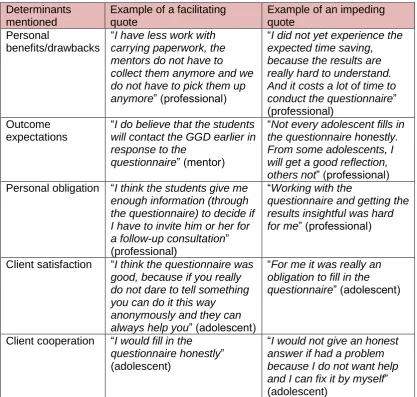
Most of the quotes regarding the adopting person, deal with the “client cooperation” and “client satisfaction”, so a lot is said about the role of the client in the
implementation process. In this case the adopting person can be the professional, the mentor or the adolescent, because all of them have to adopt the innovation or the renewed questionnaire. The adolescent functions as the client. Table 8 presents the identified determinants associated with the adopting person, including examples of a facilitating and an impeding quote.
5.2.1 Facilitators
Three quotes from the professionals show personal benefits for the professionals themselves. Two professionals declare that due to the renewed questionnaire they have less paperwork. The professionals declared a lot about the “outcome
expectations” in a positive way, which makes this determinant a facilitator. Not every professional is completely sure about the probability of achieving the clients’
objectives as intended by the innovation, but the professionals mentioned: “By all means, the adolescents are being stimulated to think about their own situation” and
“Adolescents know for sure where they can ask for help”. The professionals
professionals’ point of view. The innovation fits within their tasks because they can get a good view of the individual adolescent’s health status out of the answers. One professional declared: “On the basis of the digital questionnaire I can sufficiently decide if I should invite someone for a follow-up consult”. The professionals have
clear in mind which support they expect from the mentors. These expectations are corresponding among the professionals. Three professionals declared that they are well informed about the renewed questionnaire, which indicates that the determinant “knowledge” is a facilitator.
The mentors feel responsible for certain tasks around the questionnaire, which makes “personal obligation” a facilitating factor in the implementation process. Two mentors declared that they want to be involved in the contact moment and that they want to know what the adolescents are doing. The mentors have clear in mind which support they expect from the GGD professionals and two of them mentioned that they received clear instructions and information from the GGD about the questionnaire. Three mentors declared that they should send an adolescent, who comes to them with a problem, through to the GGD, if they cannot help him or her. In this way, the determinant “subjective norm” is a facilitating determinant.
The adolescents are quite satisfied about the questionnaire. The following quotes, among others, support that the determinant “client satisfaction” is a facilitator:
“I think the questionnaire was good, because if you do not dare to say something about a problem you have, you are able to do it in this way”, “I liked the questionnaire and it was easy to fill in”, “The questions were not boring or so, it was not tedious”, “I like the fact that it is digital, there is more action and you were able to see what others filled in, so I like this” and “I think the amount of questions is good”. Client cooperation can also be seen as a facilitator because the adolescents declare that they filled in the questionnaire honestly. About their cooperation in the extra functions such as giving tips to others and the extra information they mention that it could be really effective for adolescents who already have problems. “Knowledge” is also a facilitator in the adolescents’ point of view because three adolescents declared that they know that the GGD is there to help them and they declared that they know that their parents will not be involved if they ask for help from the GGD.
5.2.2 Impeders
would not send an adolescent through to the GGD if he or she has a problem or would only send the adolescent through to the GGD if the problem is only specifically related to health issues. In this way, the determinant “subjective norm” is an impeder. Most impeding quotes of the adolescents are associated with the determinant “client cooperation”. Two adolescents declared that they would not fill in the
questionnaire honestly if they know in advance that they do not want help. Another adolescent declared that he or she thinks that many adolescents would not fill in the questionnaire honestly because they are afraid someone in the room sees their answers. Six quotes of the adolescents state that they would not do anything with the functions of giving tips and reading extra information. Main reasons for not giving tips is that they just do not want to spend too much time on the questionnaire, they do not care about giving tips to others and that they just cannot think of any tip. One
adolescent mentioned that he or she believes that the GGD does not have a good reflection of the individual adolescent’s health status. The adolescents do not have high outcome expe ctations of the questionnaire, therefore the determinant “outcome expectations” is an impeder. Some quotes indicated that the determinant “client satisfaction is also an impeder, such as: “It was an obligation to fill in the
[image:28.595.84.502.366.763.2]questionnaire, of course I prefer this instead of a normal class, but in our case, it was instead of free time and I really prefer free time” and “That option of giving tips and the extra information is really not necessary for me”.
Table 8: Determinants associated with the adopting person, identified by the stakeholders and examples of associated quotes.
Determinants mentioned
Example of a facilitating quote
Example of an impeding quote
Personal
benefits/drawbacks
“I have less work with carrying paperwork, the mentors do not have to collect them anymore and we do not have to pick them up anymore” (professional)
“I did not yet experience the expected time saving, because the results are really hard to understand. And it costs a lot of time to conduct the questionnaire”
(professional) Outcome
expectations
“I do believe that the students will contact the GGD earlier in response to the
questionnaire” (mentor)
“Not every adolescent fills in the questionnaire honestly. From some adolescents, I will get a good reflection, others not” (professional)
Personal obligation “I think the students give me enough information (through the questionnaire) to decide if I have to invite him or her for a follow-up consultation”
(professional)
“Working with the
questionnaire and getting the results insightful was hard for me” (professional)
Client satisfaction “I think the questionnaire was good, because if you really do not dare to tell something you can do it this way
anonymously and they can always help you” (adolescent)
“For me it was really an obligation to fill in the questionnaire” (adolescent)
Client cooperation “I would fill in the questionnaire honestly”
(adolescent)
“I would not give an honest answer if had a problem because I do not want help and I can fix it by myself”