Visual, Spatial and Temporal Quality in
Video-Based Reconstruction of People:
Achieving, Prototyping and Evaluating
Robert Andrew Aspin
University of Salford
School of Computing, Science and Engineering
2014
Contents
1 Introduction 1
1.1 Subject of Research . . . 3
1.2 Motivation and Setting . . . 5
1.2.1 Related Research . . . 9
1.2.2 The oCtAVE system . . . 10
1.2.3 Issues and challenges with the oCtAVE system . . . 13
1.3 Timeliness . . . 15
1.4 Aim and Objectives . . . 17
1.5 Scope . . . 19
1.6 Methodology . . . 22
1.7 Impact of Literature Review on Research . . . 24
1.8 Chapter Summary . . . 26
2 Background 30 2.1 Introduction . . . 31
2.2 Case for 3D Reconstruction of a Person . . . 32
2.3 Techniques for 3D reconstructions . . . 35
2.4 Analysis of 3D reconstruction . . . 40
2.5 Rational for research direction . . . 42
2.6 Chapter Summary . . . 44
3 An Initial Study into Voxel Based Evaluation and Rendering of 3D Reconstructed Human-like Forms 46 3.1 Introduction . . . 48
3.2 Approach . . . 49
3.2.1 Requirements . . . 52
3.2.2 First Generation Simulator . . . 53
3.2.3 Second Generation Simulator . . . 58
3.3 Experimentation and Evaluation . . . 61
3.3.1 First Generation Simulator . . . 61
3.4 Discussion . . . 71
3.5 Conclusion . . . 73
3.6 Chapter Summary . . . 74
4 An Approach for GPU Aligned Integrated Rendering and Reconstruction 75 4.1 Introduction . . . 77
4.2 Requirements . . . 80
4.3 Theoretical Description . . . 81
4.4 Approach . . . 85
4.5 Implementation . . . 89
4.5.1 Sampling . . . 94
4.5.2 Fragment Evaluation . . . 101
4.6 Evaluation . . . 103
4.6.1 Initial evaluation of performance . . . 104
4.6.2 Evaluation of performance using real-world capture data compared with simulated capture data . . . 118
4.7 Discussion . . . 129
4.8 Conclusion . . . 139
4.9 Chapter Summary . . . 141
5 Validating the Approach 143 5.1 Introduction . . . 144
5.2 Approach . . . 147
5.2.1 Analysis . . . 150
5.3 Case Study . . . 160
5.3.1 Impact of Number of image sources (cameras) on re-construction quality . . . 164
5.3.2 Impact of Texture resolution on reconstruction/render-ing performance . . . 169
5.3.3 Impact of sampling interval on reconstruction/render-ing quality . . . 175
5.4 Discussion . . . 183
5.4.1 Case Study . . . 185
5.4.2 Wider impact of the objective analysis approach . . . . 187
5.5 Conclusion . . . 188
5.6 Chapter Summary . . . 189
6 Discussion and Conclusion 191 6.1 Summary of Work Done . . . 191
6.3 Review of Aim and Objectives . . . 194
6.4 Review of Methodology . . . 198
6.5 Contributions of Research to Literature . . . 199
6.6 Conclusion . . . 201
6.6.1 Short Comings of the Research . . . 207
6.6.2 Future Research Directions . . . 209
A First Generation: Code samples 230 A.1 Volume Rendering: GLSL Vertex Shader Code . . . 230
A.2 Volume Rendering: GLSL Fragment Shader Code . . . 232
B Third Generation: Code samples 240 B.1 Slice Plane Sampling GLSL Code . . . 240
B.1.1 Slice Plane Sampling Vertex Shader . . . 240
B.1.2 Slice Plane Sampling Fragment Shader . . . 241
B.1.3 Slice Plane Sampling Fragment Shader with Occlusion Testing . . . 247
B.2 Ray Cast Sampling GLSL Code . . . 254
B.2.1 Ray Cast Sampling Vertex Shader . . . 254
List of Figures
1.1 The oCtAVE system: Overview . . . 11
1.2 The oCtAVE system: CAVE configuration . . . 12
1.3 The oCtAVE system: Schematic . . . 14
1.4 3D Video based reconstruction pipeline . . . 20
3.1 First Generation Simulator: Proof of Concept . . . 50
3.2 Second Generation Simulator: A configurable platform . . . . 50
3.3 Voxel Occupancy Model . . . 54
3.4 Camera positioning . . . 63
3.5 Performance Test: 2nd Generation, Occupancy . . . 66
3.6 Performance Test: 2nd Generation, Image Size . . . 68
3.7 Performance Test: 2nd Generation, Volume Size . . . 69
3.8 Performance Test: 2nd Generation, Multiprocessing . . . 70
4.1 Third Generation Simulator: GPU Shape and Texture . . . . 79
4.2 Model of Walking Person used for testing . . . 88
4.3 Comparison of 3D reconstructions against source models . . . 90
4.4 Intersection of projected images forming reconstruction . . . . 93
4.5 Sampling planes used to intersect reconstruction volume . . . 96
4.6 Reconstruction formed by evaluating projected images with sampling planes . . . 102
4.7 Performance Test: 3rd Generation, Number of source cameras 106 4.8 Performance Test: 3rd Generation, Image Size . . . 107
4.9 Performance Test: 3rd Generation, Occupancy . . . 109
4.10 Performance Test: New Approach, Number of Source Cameras impact on reconstruction and rendering times . . . 112
4.11 Performance Test: New Approach, Number of Source Cameras impact on application framerate . . . 112
4.12 Performance Test: New Approach, Source image size impact on reconstruction and rendering times . . . 115
4.14 Performance Test: New Approach, Occupancy impact on
re-construction and rendering times . . . 117
4.15 Performance Test: New Approach, Occupancy impact on ap-plication framerate . . . 117 4.16 Datasets used for testing: Sample Reconstructions . . . 120 4.17 Performance Test: New Approach, Sampling density impact
on performance . . . 121 4.18 Performance Test: New Approach, Number fo source’s impact
on performance . . . 125 4.19 Performance Test: New Approach, Impact if differing graphics
hardware on performance . . . 127 4.20 Artefacts (shadows) created by reconstruction process . . . 131 4.21 3D reconstruction without and without occlusion testing . . . 137
5.1 Spot the Difference: Effects of sampling variation on
recon-struction . . . 144
5.2 Simulated capture tool configurations . . . 147
5.3 Evaluation images taken from virtual surround camera . . . . 149
5.4 Outline of applications and data flows . . . 153
5.5 Image pair undergoing evaluation of quality . . . 154
5.6 Mercator projected plot of analysis of form errors . . . 156
5.7 Mercator projected plot of analysis of colour (greyscale)
dis-crepancy . . . 158
5.8 Two different variations of volume space sampling . . . 161
5.9 Analysis of colour (greyscale) for differing numbers of
recon-struction source camera . . . 166
5.10 Central (view) band analysis of colour (greyscale) for differing
numbers of reconstruction source cameras . . . 167
5.11 Analysis of form for differing numbers of reconstruction source cameras . . . 169 5.12 Central (view) band analysis of form for differing numbers of
reconstruction source cameras . . . 170 5.13 Analysis of colour (greyscale) for differing source image
reso-lutions . . . 173 5.14 Central (view) band analysis of colour (greyscale) for differing
source image resolutions . . . 174 5.15 Analysis of form for differing source image resolutions . . . 175 5.16 Central (view) band analysis of form for differing source image
5.18 Central (view) band analysis of colour (greyscale) for differing sample intervals . . . 180 5.19 Analysis of colour (greyscale) for differing sample intervals . . 181 5.20 Central (view) band analysis of colour (greyscale) for differing
Abstract
Capturing, recreating and representing a high fidelity virtual representa-tion of the dynamic human form has long been a target for a diverse range of applications including tele-presence, games, film and TV special effects. The complexity of the challenge, to achieve a lifelike, faithful and believable repre-sentation, is such that a wide range of techniques and approaches have been developed. These are both due to research lead curiosity and requirements to address specific objective for particular problems.
This work starts from a novel standpoint: that the processes of surfac-ing, tessellation and textursurfac-ing, commonly used in 3D reconstruction, are computationally expensive and un-necessary. This work argues that by inte-grating the reconstruction and rendering processes into a single process that is aligned with the architecture of modern graphics hardware, a lightweight component solution can be achieved that is suitable for application on the end user systems within the many application domains.
In order to achieve this aim the research undertaken seeks to both define an appropriate technique and develop detailed understanding of the recon-struction process pipeline and impacting factors. This is achieved through a complementary investigation of the tools and frameworks that are necessary to support iterative development of the approach with reliable, repeatable objective assessment. This reasons that by understanding the nature of the capture, reconstruction and presentation pipeline and by objective evalua-tion of the emerging reconstrucevalua-tion techniques this research will define an approach for 3D video based reconstruction that effectively utilises the pro-cessing potential of a single system to deliver acceptable levels of performance (speed) and fidelity (visual quality) for a componentised, multi-purpose 3D reconstruction and rendering solution.
Chapter 1
Introduction
This thesis presents a novel simulation framework for objective exploration
of video based 3D reconstruction approaches. This offers repeatable
experi-mentation and reliable objective comparison as part of an iterative research
process. The framework is used to explore a case study which seeks to map
the reconstruction/rendering processes to the features and functionality of the
GPU system and define frameworks and tool sets for the evaluation and
ob-jective evolution of these techniques. This both demonstrates the approach
taken, and establishes metrics for controlled objective evaluation against
al-ternate approaches reported by other researchers. The case study of an
evolv-ing technique is used to question the need for model formevolv-ing processes
(sur-face fitting, tessellation, decimation, and texturing), in real-time generation
of animated 3D forms from video based data. The standpoint is that these
processes are slow and un-necessary. This argues that by moving to a more
direct, combined reconstruction and rendering process, which utilises
achieved entirely within the programmable graphics hardware pipeline. This
offers future scalability within a single system architecture.
3D video based reconstruction, of the human form, is widely seen as
advantageous for application in tele-present communication and
collabora-tive virtual environment systems. The approach combines the advantageous
features of traditional collaborative virtual environment user tracking (body
posture and position) with the fidelity of video conferencing (appearance) to
present the observer with a human representation that is spatially integrated
and of sufficient quality to portray visual emotion. In essence, the observer
can both see the virtual participant and see what they are looking at, whilst
also engaging with none verbal communication queues to enhance
communi-cation
The original contribution to knowledge of this work is, therefore, the
inves-tigation of lightweight approaches to 3D reconstruction aligned to consumer
type hardware platforms. Supporting this will be investigation into
simula-tion frameworks to support development of understanding of the condisimula-tions
for video based 3D reconstruction as part of a toolkit for continual objective
analysis of the evolving process for reconstruction and rendering.
This introduction establishes the rational for the research described in
this thesis. Fundamentally this chapter will seek to inform the reader of
the rational for the research and present an overview of the work. This is
presented by answering the following set of key questions:
• What is the subject of this research?
• Why is it timely to consider this now?
• Who potentially benefits from the research presented here?
• How will the research be conducted?
• How does this work relate to the research group?
1.1
Subject of Research
The general subject of this research is 3D video based reconstruction and is
targeted at the rendering and reconstruction of a person captured by
multi-ple, synchronised video streams. This is a wide domain, with multiple active
researchers and a wide variety of techniques and approaches [44, 32, 24, 56].
However, the general principles common to the majority of these, are that
a surface is formed, or fitted, around the intersection of segmented video
images denoting the subject of reconstruction. This reconstructed surface is
then, typically, tessellated, optimized and textured, before being passed to
the rendering pipeline. The objective is to present a lifelike, faithful and
be-lievable dynamic representation of a person with sufficient fidelity to convey
the nuances of gesture, expression and posture unique to each individual. In
achieving this, these reconstructions seek to enhance communication by
en-gaging the emotional, non-verbal effects that initiate and steer conversation
fragments, communicate empathy and establish trust. The 3D
representa-tions of people captured, reconstructed and presented using such methods
have use in tele-present and collaborative systems, both immersive and
sig-nificant improvements over traditional tracked avatar models that cannot
recreate the fidelity and detail of human expression [71].
This work concentrates on a specific objective; the reconstruction and
rendering of a dynamic entity from multiple segmented and synchronised
video streams. This is similar to the aims of others, however the work takes a
novel standpoint; that the formation of 3D models from the video stream data
is computationally expensive and un-necessary. By understanding the nature
of the capture, reconstruction and presentation pipeline and by objective
evaluation of the emerging approach against truth data this research will
define an approach for 3D video based reconstruction that effectively utilises
the processing potential of a single system to deliver acceptable levels of
performance (speed) and fidelity (visual quality) for a componentised,
multi-purpose 3D reconstruction and rendering solution.
The stepping off point for this research is based on previous
investiga-tions into 3D medical imaging which demonstrated techniques for real-time
3D volumetric visualisation [5, 4]. These applied an alignment of the data
structure and operations with the architecture and functionality of consumer
graphics hardware to deliver both performance gains and interactive
func-tionality. Applying this approach to the problem of 3D reconstruction will
enable the goal of the research to be met by removing the need for polygon
forming through the direct rendering of the volumetric data set formed by
the initial process in space carved reconstruction approaches.
To support the investigation into reconstruction processes understanding
of the reconstruction pipeline, and its impact on the reconstruction process
simulation, prototyping of data and process and objective evaluation of
tech-nique. This both supports the development process with dependable,
repeat-able analysis and allows objective measures between variants of technique to
be assessed as evolutions in approach are made. This enabled rapid
recon-figuration of a virtual capture environment which allowed refined synthetic
data sets to be produced whilst also offering the ability to undertake
accu-rate performance evaluation and highly detailed holistic objective analysis of
the resultant reconstructions against truth data gained from the virtualised
capture source.
The combination of both novel technique and a novel framework for
in-vestigation, prototyping and comparative objective evaluation form the
sub-stantial contributions of this work.
1.2
Motivation and Setting
Video Conferencing and Collaborative Virtual Environments (CVEs) both
of-fer the facility to display a tele-present representation of a remotely located
participant within a communication platform. However, both approaches
present issues which hinder natural conversation. Video Conferencing
en-ables the participants to see what each other looks like and recognise facial
gesture and expression which form none verbal queues to support natural
conversation. However, the lack of spatial alignment can prevent these from
being accurately focused and identified. Put simply, when the person on
the screen appears to be making eye contact, they are looking directly into
use tracking mechanisms, commonly linked to an artificial representation, an
avatar, which is presented within a common spatial reference mediated by
the shared virtual environment. In effect the participants are sharing the
same space, with the tracked avatars displaying the gross movements and
virtual position of the participants. However, the fidelity of the avatar
can-not capture the detail of video, meaning that expression is lost. This is seen
in the increased use of corrective discussion which fragments conversation
and inhibits natural communication [33]. While Video Conferencing
sup-ports temporal interaction supporting conversation, it is poor at facilitating
spatial references for effective communication. Conversely, CVEs strongly
support spatial referencing, but lack the fine, none verbal queues that
sup-port conversational flow. Both spatial and temporal elements are seen as
part of the key requirements for effective collaboration [78], supporting
so-cial interaction which is critical to seamless collaboration [31]. Provided this
integration can be achieved with sufficient real-time performance and visual
fidelity, it is hoped that significant reductions in the ambiguity and
fragmen-tation in communication experienced within other tele-present and mixed
media collaborative systems can be achieved [33].
Replicating a dynamic human in a virtual form offers advantages to many
domains, particularly those concerned with virtual communication such as
distributed collaborative systems and emotional engagement. These include
games, film and TV, Video Conferencing (tele-presence) and Collaborative
Virtual Environments. Currently film/video based media, including video
conferencing, can convey with great fidelity subtle nuances such as non-verbal
communi-cation. However, the fixed viewpoint these media present imagery does not
consider the spatial relationship between the virtual and real world
partic-ipants as important. As a result these paradigms struggle to support the
communication cues of individual trust, engagement and empathy
relation-ships that need to cross the boundary of the spatial domains. Research shows
that immersive collaborative virtual environments can combine the features
of these two domains to address the weaknesses of each in supporting
en-hanced communication at a distance [71].
Video based 3D reconstruction seeks to address the recreation and
rep-resentation of a dynamic human within a medium in which temporal and
spatial factors can be aligned to deliver effective distributed communication,
collaboration, empathy and engagement. Many different approaches are
re-ported for the general problem of 3D reconstruction. However, the specific
problems of fidelity and performance necessary to support communication
techniques based on shape from silhouette [7], for the formation of a visual
hull [44], or image based rendering approaches [89] are common. The first
two of these model forming processes, aim to solve the holistic problem,
enabling free-viewpoint observation, but impose higher computational load
requirements with the need for complex and extensive computing resources
to achieve real-time rates. Image based rendering (IBR) approaches offer a
relatively lightweight approach with little computational load, but are
con-strained in that the representation is only accurate for a single specific point
of observation.
This research seeks an approach to 3D reconstruction that combines the
ren-dering approach coupled with the holistic integrity of the model forming
processes.
Graphics inspired processes work best when each element can be
pro-cessed independently of all others as part of a massively parallel pipeline.
As an example consider the difference between local and global illumination
models commonly used in graphics rendering. In a local model only the
drawn pixel (fragment) is considered against the configuration of lights and
viewpoint. This approach is inherently very fast and ideally suited to the
underlying hardware. In a global lighting model the propagation of a ray
of light, from source to eye, including all the events of refraction, reflection,
diffraction, etc. that this ray encounters against all of the objects in the
scene must be evaluated. This approach is inherently accurate, but does
not translate well to graphics hardware and is traditionally implemented as
a non-real-time system, such as ray-tracing or radiosity, enacted on a more
general purpose processor; the CPU. The core argument of this research is
that current processes are akin to global illumination methods. Precise, but
slow; some acceleration can be gained by optimization and most recently
mi-grating appropriate sub-processes to graphics co-processing hardware (GPU),
however, there will always be bottlenecks. This research is seeking the
equiv-alent of the local illumination model; a technique that is ideally suited to the
underlying hardware, which can leverage this infrastructure effectively and
due to its inherit structure will scale uniformly with future evolutions of that
hardware.
This research is therefore looking for an approach that delivers acceptable
com-puting resources end-users are likely to have rather than the facilities and
resources research centres might utilise.
1.2.1
Related Research
This research has been undertaken within a research centre with a wider
agenda in this area. During the time this research was undertaken related
research was also undertaken by others.
Duckworth [19] undertook related research. This followed a similar aim,
in terms of reconstructing people, but investigated the use of heterogeneous
processor clusters to gain performance through parallel processing in the
solution of more traditional surface based reconstruction techniques.
Moore [61] investigated the process of capturing and segmenting image
data from multiple synchronised video streams with the aim of delivering
low latency image data, from an integrated capture and immersive display
system, in a manner than could support the related research of both this
work and that of Duckworth.
During the course of this research, collaboration between the
indepen-dent researchers was supported by their common supervisor to define and
enact experimentation evaluating the impact of the generated
reconstruc-tions. These experiments enacted subjective evaluation of the reconstructed
forms, through the matching of the participants eye gaze to that of the
re-constructed form’s, to establish the quality of representation of non verbal
1.2.2
The oCtAVE system
While this research is seeking a lightweight, componentisable 3D
reconstruc-tion and rendering solureconstruc-tion, it is supported by a unique research facility, the
oCtAVE, that offers both data capture, in the form of synchronised video
streams, and large scale immersive visualisation [64]. At the time of starting
the research this facility was under construction. This was one influencing
factor in the use of simulation frameworks for initial investigations and the
use of these also enabled prototyping of issues, such as camera placement,
that were integrated into the facility as construction progressed. As the
oC-tAVE developed successive iterations of the simulation framework were
con-structed which accurately reflected the configuration and parameters of the
oCtAVE system to ensure simulation environments and the physical system
had matching characteristics.
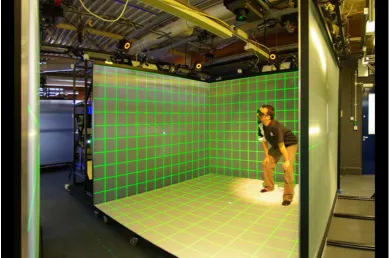
The oCtAVE system is a mixed reality/multi modal system that offers
both visualisation and capture functionality. The display system comprises
14 projected surfaces which can be re-configured into multiple display formats
enabling it to replicate a variety of conventional systems such as power-walls
and CAVEs [14, 15]. 8 surfaces are constructed as moveable, back projected
rigs vertical screens forming the walls of the system, with the remaining 6
surfaces being formed by fixed roof mounted projectors forming the floor
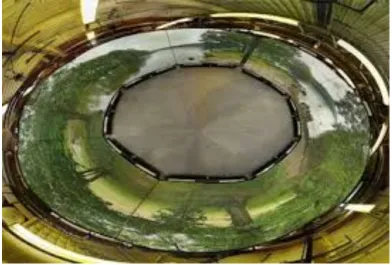
surfaces. For the majority of time this is configured as an 8 sided, 5.5m
diameter octagonal system with a projected floor (Figure: 1.1).
The display system can operate in a similar manner to traditional CAVE
provide head tracked stereo display to all screens for an immersive experience
1.2, or each screen can be used independently as a single large screen display.
Tracking of the user within the system is enacted using a Vicon
MX-F40 system. This is supported by an array of Basler ethernet cameras which
provide video capture. Cameras are mounted to the infrastructure supporting
the display screens and can be moved/relocated as needed.
Rendering (display) is provided by a cluster of Sun Ultra40 systems,
equipped with nVidia FX-5600 graphics cards, each attached to a single
Christie S3K projector to form a single rendering pipeline. Additional
com-putation is provided by a SunFire x4600 system. All comcom-putation resources
are connected by a dedicated local network (Cisco Catalyst 4900M @10Gb/s)
1.3.
Audio facilities within the system were not utilised in this research,
how-ever these are provided by an experimental waveform synthesis system
ren-dered through an array of 256 speakers to provided spatially localised sound
sources [65].
1.2.3
Issues and challenges with the oCtAVE system
The oCtAVE system is an experimental research platform supporting a wide
range of research activities. As such, it is constantly evolving and
chang-ing and has an element of instability associated with any research platform.
It is also a significantly larger system than this research was targeting for
the platform on which the rendering/reconstruction approach would operate
typical high end consumer system with a large screen display, rather than
a monitor, attached. These systems were used as one of the test platforms
for performance testing and were similar in performance to the laptop
sys-tems used to develop the techniques and the simulator. The screen size of
the system approx 2.5m x 2.2m was also used as the basis for calculation
of occupancy, used in performance evaluation, where the proportion of the
screen occupied by a 1:1 scale reconstruction of a person was considered as
one of the independent factors influencing reconstruction/rendering speed.
The primary use of the oCtave system was for capture of data sets for
experimental reconstruction (referred to as ”Salford” datasets). These were
captured using the Basler camera system to record multiple video streams
of an actor within the system. These streams were synchronised, segmented
and prepared as part of a fellow student’s research activity [61]. The image
sets and segmentation data gained though this research were used as test
data within this research and other collaborative research within the wider
group [19, 72]. In this camera placement for the capture system was informed
by the initial studies performed within this research (Chapter: 3).
1.3
Timeliness
Achieving believable and faithful 3D reconstruction reconstructions aims to
cross the boundary presented by the Uncanny Valley [75] and engender
virtu-alised human forms with the visual features necessary to effectively
commu-nicate trust, emotion, and conversational interaction across the virtual/real
availabil-ity of high speed, high resolution cameras have enabled researchers to make
significant progress towards this goal [29, 55, 58, 44, 24].
While the performance increase of traditional CPU based computation
shows signs of slowing, the processing power available from graphics
hard-ware, through the reprogrammable GPU pipeline is increasing at an
accel-erating rate. This is primarily achieved through the exploitation of massive
parallelism in both the processing units and the memory architecture that
feeds them [52].
The view, presented by this thesis, is that to achieve such reconstructions
in an accessible and usable format, that can be delivered to end-user systems,
approaches for the reconstruction and rendering process need to be aligned to
these rapidly evolving GPU architecture, rather than though the utilisation
of computing clusters or CPU resources. This requires a re-consideration
of the algorithmic approaches taken. Rather than seeking localised gains
within sequential stages of the process, where many sub-processes need to be
co-ordinated and controlled, creating bottlenecks, an approach in which each
independent fragment of the reconstruction can be evaluated independently
is required. This should both maximise the use of the parallel computation
hardware and offer future scalability with the relentless increase in GPU units
available within a single hardware device.
This research is therefore seeking a solution in which each screen pixel,
or rather the fragment processing pipeline controlling it, can be considered
an independent processing unit for the calculation of the 3D reconstructed
form. This, therefore, seeks an approach that matches the current state of
for increases, on current and emerging hardware, both as a scalable system
directly dependent on the number and performance of GPU units available
within the rendering hardware. The assumption is that by combining the
reconstruction and rendering process, and enacting both within the GPU
system as a process that aligns to the graphics card architecture, current state
of the art performance can be achieved within the limitations imposed by a
single consumer type system. This further assumes that as future graphics
card performance increases, the performance of the reconstruction technique
will similarly improve to a point where it is viable for the majority of end
user systems.
1.4
Aim and Objectives
Aim: To improve upon the temporal and visual quality of 3D video based
reconstruction through new approaches to developing, doing and measuring
it.
This work will study and understand the input characteristics, process
pipeline and quantifiable objective measures of 3D video based reconstruction
that are necessary to deliver a framework for targeted
reconstruction/render-ing technique development.
Specifically the objectives for this research are:
• O1: Develop novel approaches to holistically measure the visual, spa-tial and temporal qualities of video based reconstruction while varying
and objective measurement approaches that support development of 3D
video based reconstruction processes towards specific goals of
perfor-mance (speed) and fidelity (visual quality).
• O2: Develop a novel reconstruction/rendering technique that improves the visual, spatial and temporal qualities of video based reconstruction.
This will determine algorithms and approaches and techniques that can
be successfully utilised in the creation of an efficient and effective
re-construction/rendering technique
• O3: Assess the novel technique for improving the balance of visual and spatial qualities by applying a novel approach to objectively measure
its holistic performance. This seeks to determine through repeatable
objective analysis that the novel technique for 3D reconstruction aligns
to the standards set by current state of the art.
These can be articulated into a single research question: Can 3D video
based reconstruction and rendering be combined and reduced to remove
com-putationally expensive processes and deliver a GPU aligned approach that
matches current state of the art performance and quality metrics within a
componentisable form suitable for future consumer type systems.
These objectives and their relationship to the overall aim of the work
can bee seen as a set of overlapping domains which each contribute to the
answering of the research question. The inherent interdependency of the
objectives suggests an approach that iteratively refines understanding for
each objective as the work refines it’s solution and validates the approaches
1.5
Scope
This work is primarily concerned with the reconstruction of the dynamic
objects from multiple, synchronised video streams. Within this the work
concentrates specifically on the reconstruction and rendering of the human
form, from the point at which segmented video images are delivered to the
host system through to the presentation of a rendered form within a free-view
point application. Capture, synchronisation and segmentation of the video
streams is a significant challenge outside of this research 1.4 and is actively
pursued by others [61], and while the findings of this study have informed
related works [62] this is not a fundamental goal of the research. In recent
years the use of depth based imaging systems has also become increasingly
relevant [97, 98], however these devices are in their infancy with resolutions
and speeds that cannot currently offer the levels of fidelity required across
an entire human form [88].
Within the technological platform the work seeks a solution to the
re-construction/rendering process that does not require external computational
resources. Therefore the platform boundaries for the approach are that it
should deliver levels of performance and fidelity similar to established
ap-proaches within the confines of a single computer system and the
graphi-cal processing units contained by it. This will be assessed against a priori
published findings, which report achieved performance in the range of 12-15
frames per second (fps) [102, 13, 90] and present images of the reconstruction
used in subjective evaluation [58, 57].
ipated to be a process of iterative refinement. Fundamental to this is the
establishment of a robust platform for objective experimentation. This will
allow evaluation of, and how, the evolving techniques used for
reconstruc-tion/rendering approach the goals of the research. To this end it is necessary
to consider the capture of source data and additional measurement of the
reconstruction subject for objective analysis in a dependable and repeatable
experimental context.
Physical configuration, and re-configuration of a camera network
compris-ing the capture environment is a time consumcompris-ing occupation, dependent on
research outside the scope of this work, and open to sources of error (for
ex-ample: signal noise, calibration timing, segmentation inconsistencies.), that
reduce the objectivity of the quantifiable analysis. Holistic, objective analysis
of fidelity of reconstruction, requires the capture and evaluation of additional
datasets which are physically impracticable due to the limitations of cameras
placement and dynamism of the source object. Understanding the nature of
the input data configuration, and its impact on the resultant form is essential
to achieve focused research towards the objectives set. Therefore the scope
of the research is defined to include tools, and techniques that aid
under-standing of the capture data and its impact on the resultant form with the
intention of formulating a framework for exploration of the capture system,
understanding of the reconstruction/rendering pipeline, and objective
anal-ysis, against source data, as part of a iterative development process which
enables objective evaluation of variants of technique against both alternate
iterations and reported data on external research. This aims to deliver a
quan-tifiable objective measures which assess the accuracy of the reconstructed
form to that of the source object and evaluate the matching of the surface
texture to that of the source object’s appearance.
1.6
Methodology
The research methods used reflect common practices within the computer
sci-ence domain. The work is predominately formative, being concerned with the
definition of process/method/algorithm, concept, and framework. Research
methods adopted reflect common approaches, in this domain, of literature
review, concept implementation, simulation and case study [70]. This reflects
a design and modelling approach common to a high proportion of computer
science literature [96].
Common practice, within the 3D reconstruction community, is that
imple-mented algorithms are tested within a simulated environment and reported
in terms of raw performance and visual evaluation of imagery generated.
Within the VR/Tele-presence community it is common for these algorithms
to be incorporated into prototype systems for subjective evaluation of the
resultant forms impact on human factors such as conversational flow,
emo-tive engagement and trust. Whilst this work is more closely aligned with the
former, the fine grained iterative nature of technique refinement would, it
was felt, make subjective evaluation of fidelity, between two approaches with
small variation in operation, unreliable.
The process for research was devised to enable rapid prototyping through
outside the scope of the research and reducing the dependence on
physi-cal infrastructure and resources that would impose time and logistiphysi-cal
con-straints. In essence simulation frameworks supporting conceptual
implemen-tations that are reported as case studies in the 3 key chapters of the thesis
(Chapters: 3-5).
Iterative evolution of technique and simulation toolkit, within a
frame-work of objective analysis, though research informed enhancements is used to
enable refinement towards the research aim. Refinement of approach and step
changes made, informed by continual literature review in which features of
published approaches are considered against the parameters of the technique
being evolved and incorporated into new variants for objective evaluation
against the previous benchmark. Repeatable quantifiable objective analysis
is, therefore, seen as an important factor in the research process.
Funda-mental to this is the establishment of tools and mechanisms for gathering
reconstruction data sets that are capable of being related to a truth data
set. This allows the quality of the reconstructed form to be objectively
com-pared to the original source form. Obviously using video acquisition of a real
person simply provides the data set for reconstruction without any ability
to capture a truth based form. Using a simulated virtual capture space
al-lows this reconstruction data set to be obtained from a 3D geometric model
which itself forms the definitive base for comparison. Research into methods
of comparative evolution of the 3D reconstruction against the base model
are then used deliver a stable and consistent measure of quality that can be
used to evaluate the fidelity of the different variants of reconstruction
evolutionary cycle is inspired by established theory and adapted into the
principles of the approach. Assessment of performance and quality for
suc-cessive evolutions are required at each stage to ensure that the impact of the
evolution is fully understood and to map the progress made both in terms
of performance and quality. This mapping of alternate approaches enables
a clear investigation of improvement with the ability to discard approaches
that, while theoretically sound, do not assist in achieving the overall goal of
the research.
This mapping of evolution in approach is essential to determine the
matching of approach to goal. However, the ultimate aim of this research
is to define an approach that is comparable to current techniques, while
of-fering the potential for future enhancement. In order to achieve this the
evaluation of the emerging technique must be grounded in comparison to the
established approaches. In order to achieve this the final solution needs to be
evaluated to determine both how it compares to other approaches and how it
matches the metrics required for tele-presence in collaborative
communica-tion systems. Ultimately this will enable the profiling of the final approach,
delivering metrics determining appropriate application and configuration as
a mapping to problem domain.
1.7
Impact of Literature Review on Research
The initial prototype was constructed using tacit knowledge of the problem
area as a test-bed to understand the problem domain. Prior understanding
a basic approach to space carving [44, 42] to formulate a 3D reconstruction
and rendering technique that fulfilled the general principles of free-viewpoint
rendering [28] without the need for tessellation and surface forming which
were common to this approach [30, 6, 27].
Following the initial study a more informed standpoint was taken in which
the problems and issues arising from the initial prototype were investigated.
In particular the issue of improving the believability and faithfulness of the
reconstruction was highlighted as a key target [63, 71, 80] to move towards
achieving the levels of fidelity necessary to replicate face-to-face meetings
[77]. Fundamentally this was a concern to move from a simple reconstructed
form, to a reconstruction in which the appearance of the subject was mapped
to the shape generated through reconstruction [100, 30]. Given the nature
of the reconstruction, which had no tessellated surfaces onto which texture
could be mapped [66], approaches for projecting textures and evaluating
them at the surface intersection were sought [23]. This lead to a significant
change in the reconstruction approach. It was realised that while texture
from the capture cameras could be projected onto the volume surface, this
was essentially the same technique that was being used as a pre-process to for
the space carved volume. With this realisation the reconstruction technique
under development was re-created to integrate both the space-carving and
surface texturing within a single integrated process that operated within the
GPU resources of the graphics hardware.
In refining the approach to 3D reconstruction emphasis was placed on
achieving reconstruction performance (speed) comparable to state of the art
reconstruction domain were considered [1, 24, 26, 30, 16]. From these
es-timates of state of the art performance could be drawn [102, 13, 90] which
indicated that within the system specification being used a target of 12-15
fps was required. However in all these cases this was defined only as the
reconstruction time, not an end-to-end cycle time. Further refinements to
the reconstruction algorithm were also made by applying the principles of
’floating textures’ for weighting the texture blending operations within the
surface projections [20].
Validating the approach sought to introduce objective measures for
assess-ing the fidelity of the reconstruction. Specifically this sought to complement
traditional subjective evaluation processes [87, 56, 102] by introducing direct
comparison of the reconstruction against the ’truth’ subject. In achieving
this the work aimed to improve the development process by enabling
objec-tive, evidence based decision making during the iterative refinement cycle.
While approaches exist for assessing the video quality of the reconstruction, ie
inter-frame analysis, [22, 18], the only reference to objective analysis against
source data [39] was limited to utilising ’live’ capture information and could
not holistically assess the overall fidelity of the reconstruction.
1.8
Chapter Summary
This is formative research which is seeking an alignment of
reconstruction/ren-dering processes, for 3D video based reconstruction of a person, with the
architectures of modern GPU based graphics systems. To structure the
into objectives which address a research question which has been defined to
provide coverage of the research scope and define a programme of work by
which the aim will be addressed.
The work seeks to develop greater understanding of the process and
influ-encing factors surrounding the general problem of 3D video based
reconstruc-tion of a dynamic human. The starting posireconstruc-tion is that current approaches
utilise un-necessary and computationally expensive stages in the formation
of their reconstructions. In particular these relate to the surfacing,
tessella-tion and texturing of the generated reconstructed form. This research argues
that these stages can be removed by defining an integrated reconstruction
and rendering approach that is aligned to GPU based systems. This should
deliver acceptable quality and speed performance within a component
so-lution that matches typical, all be it currently high end, end user systems.
To enhance the research process a simulation framework will be used to
in-vestigate influencing factors, improve developmental research prototypes and
enable objective analysis of the evolving solution.
The thesis is organised into the following chapters which establish the
context for the research (Chapter 2), present the core contributions (Chapters
3-5), and review the outcomes of the research against the aim, objectives and
research question (Chapter 6)
• Chapter 2: Background, undertakes a literature review of the state of
the art in the related fields of research.
• Chapter 3: An Initial Study into Voxel Based Evaluation and
point for the research and early evolutions of technique and simulation
in which previous understanding of medically inspired volumetric
visu-alisation techniques are explored as a basis for 3D reconstruction and
rendering without the need for model forming.
• Chapter 4: An approach for GPU aligned integrated rendering and
reconstruction, presents the inspirational jump between the ’massively
brutal’ and naive voxel solution toward a more GPU aligned approach
which utilises features of the rendering pipeline to deliver a working,
integrated reconstruction/rendering prototype. This also covers a
sub-stantial change in the nature of the simulation framework towards a
platform for repeatable experimentation which supports the
develop-ment process and establishes methods of objective evaluation of
per-formance (speed) and fidelity(visual quality)
• Chapter 5: Validating the Approach, undertakes objective evaluation
of the final reconstruction/rendering approach. In this quantitative
analysis of the holistic reconstruction form is undertaken to
estab-lish benchmarks for visual quality and accurate measurement of
per-formance (speed) are made to assess the matching against other
ap-proaches and characterise the scalability of the approach with evolving
GPU systems.
• Chapter 6: Discussion and Conclusion, reflects on the methods
devel-oped and approaches taken and contextualises the work against the
identified state of the art and more recent developments in the field.
Chapter 2
Background
This chapter seeks to establish the context of the research. This is presented
through literature review, and provides a description of the current state of
the art for both the domains of real-time 3D reconstruction of people and
a wider review of tele-presence and collaborative virtual environments as a
mechanism for supporting effective communication.
These reviews establish the state of the art of current approaches that are
addressed by the research presented here and define the metrics for evaluation
of the work. In essence this will review the foundational principles for the
research undertaken; establishing the theoretical underpinnings of each and
exploring the scientific assumptions made.
This chapter concludes with a rational for the research direction which
2.1
Introduction
The starting point for the research is to utilise previous understanding into
the display of volume based data [5, 4] to establish a basic prototype for
developing understanding of the factors and issues that impact upon
recon-struction fidelity and performance. This literature review is used to establish
the state of the art, in terms of reconstruction approaches, common features
of the capture/reconstruction pipeline and standards of performance and
fi-delity, including the approaches by which these were evaluated. This is an
active field of research, with multiple approaches to the reconstruction
pro-cess proposed and implemented. Initial understanding of these are sought,
though the literature review, to identify general categories of approach and
position the starting point. Of particular interest is the overlap between
model forming approaches and image based rendering techniques as the
ini-tial conceptual implementation draws on features of both. There is a
signifi-cant corpus of material for this field, with many of the published articles also
presenting some analysis of reconstruction performance and subjective, visual
presentation of quality. However, in initial literature reviews evidence of
con-sistent approaches to speed measurement and objective evaluation of fidelity
do not have strong representation. Reported used of a simulation framework
for supporting developmental research is virtually non-existent. Therefore
the specifications, definition and realisation of the simulation framework and
evaluation metrics, while guided by the literature review, are established
2.2
Case for 3D Reconstruction of a Person
Reconstructing the face-to-face meeting has long been a goal for tele-presence
and collaborative virtual environments [77]. The most important factor in
this is the representation of the participants within the shared collaborative
environment. Traditionally this has been enacted through the use of 3D
geo-metric representations of a person (an avatar) which mirrors the participant’s
actions though body tracking [12]. While it is important to ensure holistically
congruent virtual characters, especially in immersive settings [94], the avatars
in question are not synthetic virtual characters, but ’iconic’ representations
linked to the actions of real people.
To ensure that communication and collaboration are as effective as
pos-sible it is desirable that the human participant has a similar empathetic
engagement with the virtual avatar to that they would experience if they
were face-to-face with the other participant [71]. However, the human being
is a complex system, presenting high levels of expression in non-verbal cues
that need to be captured and remotely represented. These are not portrayed
by traditional pre-constructed, geometrically modelled, avatars. As
com-putational power has increased and with the development of newer higher
quality, multipoint tracking systems, the approach has remained similar, but
enacted with a finer level of detail. Connecting these user tracked avatars
to animation models further expands the range and scale of the avatar
fea-tures that can be portrayed by determining appropriate animation sequences
that can be triggered to represent identified emotional states [63]. However,
gross feature on actual tracked data and fine detail on implied simulation [91].
Furthermore, in order to create an effective, interactive 3D environment
non-verbal gestures must be continually updated to reflect the person and enable
low latency communication and collaboration between the real and virtual
occupants of the immersive environment. Failure to meet these conditions
leads to an abnormal representation that debilitates the real occupant as
they cannot emotionally relate to their virtual colleague [75].
Attempts to incorporate a live captured, and reconstructed, person, as
opposed to a synthetic avatar, within interactive 3D environments are not
new and have their origins in the early VirtualPlace experiments where a
sin-gle silhouette of the participant was projected into the graphical environment
[41].
The recent availability of high quality video capture, and support for
network, and computational infrastructures that can effectively utilise these,
increases fidelity of source data. Given this, researchers have made attempts
to directly capture the animated form of the real user and use this information
to create accurate representations of them within a synthetic environment
[80]. Approaches, such as the free viewpoint video system, pioneered by the
BBC [28], uses multiple images to compose a 3D image that can be navigated
in the same manner as any other 3D environment. However, the typical
approach is to carve a volume, prior to surfacing with a tessellated geometric
topology, which is subsequently textured with the image data captured from
the original sources [100, 30]. While effective, the algorithmic complexity
of this approach makes it ill suited to the real-time requirements of
which a large number of cameras can be positioned, is difficult to achieve in
an immersive virtual environment where the user must occupy an enclosed
space that forms the projection surfaces for the display system itself.
The Blue-C display system [79] attempted to resolve some of these
is-sues. This adaptation of an immersive projection system utilises transparent
screens that can be switched from an opaque state to a transparent state to
enable synchronised cameras to capture imagery through the screen material,
while also enabling projected imagery to be displayed on the screens during
the opaque phase of operation. While this approach enabled the research
and development of a real-time free viewpoint solution, issues still exist with
respect to the performance and accuracy of the reconstruction approach and
the compromises that must be made between the immersive projection
sys-tem and the capture syssys-tems [83].
The Cisco Tele presence system [76] presents an alternative vision for how
tele-presence could be achieved. In this case physical infrastructure
estab-lishes fixed seating positions and screen placements to create the impression
of an integrated space; one half real, the other virtual. While this offers
a high quality tele-presence experience [101], it does so without attempting
reconstruction, instead relaying on fixed alignment of spaces within a
tradi-tional video conferencing environment. However, this approach does indicate
quality metrics for the visual form which present the presentation of a
re-mote participant in 1:1 scale using HD (1920x1200) resolution displays at
30hz refresh.
The European Integrated Beaming project (FP7-ICT: 248620) is seeking
vir-tual/physical barrier to enable remote embodiment of a participant which is
able to physically interact with the displaced location [82]. In this the use of
mixed reality, multi modal displays enables participants to interact with
oth-ers through a range of capture and display devices that enable multi-sensory
embodiment and communication mediated through a range of technologies
including spatialised audio, haptics, mobile embodiments, etc. [85]. While
the use of tracked participants linked to a 3D avatar is commonly used within
the project, the inclusion of a additional spatially located devices utilises
video and depth imaging to locate embodiments in the physical environment
[68, 86].
2.3
Techniques for 3D reconstructions
Traditional approaches to representing a virtual user within an immersive
collaborative virtual environment have sought to connect an artistically
gen-erated character (avatar) to a tracked human body. As computational power
has increased, and with the development of newer, higher quality, multipoint
tracking systems, the approach has remained similar, but refined to ever finer
levels of detail. Connecting these user tracked avatars to animation models
further expands the range and scale of the avatar features that can be
por-trayed by determining appropriate animation sequences that can be triggered
to represent identified emotional states [63]. However, the result is an iconic
virtual representation of the tracked user that bases the gross features on
actual tracked data and fine detail on implied simulation.
recreate the 3D visual appearance of a moving thing. The use of such
tech-niques is growing in applications such as film and TV production, sports
com-mentary and collaborative virtual environment applications/tele-presence,
particularly as a way of capturing and representing participating actors. A
virtual human created by such means is fundamentally different to a
conven-tional CGI avatar, most notably because it approximates a faithful
reproduc-tion rather than an iconic one. Of particular interest was the use of VBR to
reconstruct people in a remote space to support real time non-verbal
interac-tion in collaborative, interactive 3D environments. While it is important to
ensure virtual characters are recognizable and engaging, especially in
immer-sive settings [94], conventional avatars are not synthetic virtual characters,
but iconic representations of real people. To ensure that communication and
collaboration are as effective as possible it is thought desirable that the
hu-man participant within the immersive environment has a similar empathetic
engagement, with the virtual character, to that they would experience if
face-to-face with the other participant. Fundamentally, the capture of features,
such as facial expression, eye-gaze, body positioning, etc, impart important
visual cues that enhance the flow of communication between participants
[84]. Failure to meet these conditions leads to an abnormal representation
that debilitates the real occupant as they cannot emotionally relate to their
virtual colleague [75].
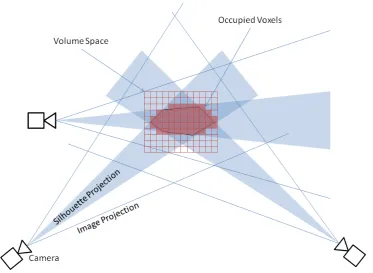
In conventional approaches each image is projected into the
reconstruc-tion space, either as a segmented silhouette, or a profile curve derived from
it. The geometric shell is then defined as the surface of the volume enclosed
as space carving [44, 42]. The resultant shell is tessellated to form a set
of 3D vertices and indices denoting draw-able triangles, in some cases these
are optimized into efficient, render-able geometries [100, 30, 58]. Further
evaluation of the vertices maps texture data from the camera images to the
form before the reconstruction is passed into a 3D rendering process for
graphical display from any viewpoint [56]. In theory, if this can be achieved
fast enough, with the computational processing taking place between each
frame refresh, a new geometric form and texture set can be displayed for
each rendered frame, thereby achieving the goal of real-time animated 3D
reconstruction [1]. This creation of an approximation to the visual hull is
the most established method of video based reconstruction. Laurentini [44]
and Matusik [58] demonstrate how projection of multiple, vectorized
silhou-ette edges enables the computation and shading of visual hulls (geometric
shells denoting the form surface) which reconstruct 3D humans. Yue [103],
further expands these approaches to incorporate human body part
segmen-tation, thereby overcoming the difficulties within visual hull approaches to
construct concave regions and applying the techniques to reconstruction of
articulated human reconstruction. These polyhedral approaches are further
developed by Franco and Boyer [1, 24] to demonstrate how, with sufficient
performance, these reconstructions can be utilized in mixed reality
environ-ments.
These geometric approaches seek to resolve the 3D reconstruction as a
holistic whole which generates a 3D model that can be viewed from any angle.
As such they are the most popular techniques for human reconstruction.
in the back-projection of points to all silhouettes. Attempts to overcome
this have predominantly sought to adapt or optimize heavy weight CPU
based processes to utilize cluster networks or GPU processing for speedup
of critical sub-processes [102]. However, this approach does not inherently
scale as more computational resources are added and significantly increases
system costs [56, 93]. In addition, the formation of a 3D form, enacted prior
to the texturing and display, disconnects two stages of the process that are
effectively utilising the same data. The result of this is that discrepancies
in the generated form, either due to mis-matched camera calibrations, or
localised depth artefacts, are further emphasised during the 3D rendering
process when source images are applied to the surface within a texturing
process. Floating Textures [20] seeks to reduce this problem by applying
texture through view-point weighted, projective texturing which seeks to
match the best image source to the viewer position. Further elaboration of
this technique also allows for depth based assessment of projective texture
occlusion to reduce additional effects such as ghosting within the textured
form.
A common alternative to polyhedral hull forming is to use projected
source images to populate a volume space comprised of voxels [13]. This
is typically enacted as a pre-processing stage, delivering a 3D texture (voxel
map) containing the reconstruction form’s occupancy, and in some cases,
localized colour values. In a few instances, this volume model is rendered
directly, with the populated colour voxels denoting the surface texture of
the reconstruction form [66]. However, it is more common to skin a binary
marching cubes algorithm and apply texture to the resultant geometric form
[13, 25, 56, 30, 26, 90, 102]. In recent years the emphasis of research in these
techniques appears to have shifted to concentrate more on the mapping of
texture to a surface of sufficient quality [20, 57]. Yue further expands these
approaches to incorporate human body part segmentation, thereby
overcom-ing the difficulties within visual hull approaches to construct concave regions
and applying the techniques to reconstruction of articulated human
recon-struction [103].
Depth Based Image Rendering (DIBR) techniques seek to minimize the
computational load by attempting to create a reconstruction that is valid
from a single viewpoint, rather than solving a complete model [89]. Typically
these approaches project source image(s) into the 3D environment where
they are mapped onto an intermediate geometry located at the approximate
spatial position of the reconstruction target [16]. Whilst effective these are
often limited solutions that constrain the motion of the observer within tight
proximity to the position of image capture [21]. These approaches have
an inherent lower computational overhead than view-independent geometric
solutions with high texture fidelity, but generally lack the three dimensional
depth of geometric solutions.
High Dynamic Range (HDR) imaging [53] is a potentially enhancing
tech-nology that could improve the fidelity of reconstruction. The extended range
of image fidelity, which enhances contrast in shadowed regions, offers a
signif-icant improvement in the potential problem areas for person reconstruction
such as eye sockets, where shadows hinder the capture of features such as
baseline stereoscopic imaging [54] and recent innovations are seeing
adapta-tions of the techniques to support video capture [92] which would support
video based 3D reconstruction. 3D reconstruction based on the combination
of depth and HDR imaging is reported [36], suggesting that processing of
the HDR composition is possible within the latency constraints for real-time
reconstruction for a single HDR imaging device. However, it is uncertain if
this would be possible for multiple video streams. The capture and initial
processing of imagery is outside the scope of this research, but the
deliv-ered imagery would be direct replacements for the imagery current acquired
through traditional video cameras.
2.4
Analysis of 3D reconstruction
Objective, quantitative analysis of 3D representation is rare in published
lit-erature. Authors of the many reconstruction techniques typically present
little more than mathematical explanations of their approaches which are
more concerned with the core principles of hull forming, processing
architec-ture, etc [56, 59]. With most of the research raw performance (i.e. speed
of reconstruction) is seen as important, however this typically considers only
the reconstruction time and does not include the additional rendering and
associated data preparation time. All the published approaches utilise
dif-ferent hardware configurations and platforms and leverage these to achieve
broadly similar performance (speed of calculation) rates. In most cases these
are close to that considered acceptable in video (30fps), however, the wide
configu-ration make objective comparison of the quality and performance of different
techniques extremely challenging [39].
Whilst basic measures of performance are commonly presented, little
other than the inclusion of example images is typically presented to
demon-strate quality. Stroia-Williams [87] and Matsuyama [56, 102] present
compar-ative images of their resultant form and discuss how these compare against
the source of their reconstruction. Similar demonstration of quality is also
presented for recent developments in the application of texture (Floating
Textures), where a set of comparative images are presented, denoting the
implications of differing approaches on the resultant textured form, which
relate the differing approaches to a ground truth image for subjective review
[20]. Kepplinger [38] argues that adequate approaches for robust subjective
assessment of free viewpoint video is lacking and more needs to be done
to define the quality influencing factors that might formulate a framework
for evaluation. In Depth Image Based Rendering Techniques (DIBR)
tech-niques such as Peak-Signal-to-Noise-Ratio (PSNR) and Video Quality
Met-ric (VQM) are commonly used to assess the resultant representation, from
a single viewpoint, of 3D video delivery [22] and these form the basis for
identifying quality improving techniques [18]. Kilner [39] presents a
frame-work for objective quality assessment in free-viewpoint video production. In
this dissatisfaction with subjective analysis and conventional pixel-wise
eval-uation is expressed, arguing that these measures do not reflect the quality
of view synthesis as perceived by the user. In this model, an evaluation of
image pairs, based on a leave-one-out test, is used to measure reconstruction