International Journal of Emerging Technology and Advanced Engineering
Website: www.ijetae.com (ISSN 2250-2459,ISO 9001:2008 Certified Journal, Volume 4, Issue 8, August 2014)
663
An Efficient Radio Resource Management Algorithm for Base
Station Power Optimization
Sameer Yadav
1, Pallavi Bondriya
21,2
Technocrat Institute of Technology, Bhopal, India
Abstract— The importance of base station as a wireless access point is rapidly growing and huge data volumes are being transported through the base station, so the power consumption became an critical issue. In this paper, a new radio resource management algorithm is proposed which aims the reduction of supply power consumption at the base station for multi-user MIMO-OFDM. The proposed algorithm optimizes power-saving mechanisms for discontinuous transmission, antenna adaptation and power control. In our proposed method supply power consumption is reduced by using efficient multi-user resource allocation management technique. Our MATLAB simulation results shows that our proposed algorithm minimizes the supply power consumption at base station by large scale and it depends on the different system loads.
Keywords— Power Optimization, Base Station, Resource Management.
I. INTRODUCTION
The mobile users and their data transfer, data downloading and uploading is rapidly growing and the base station consumes more power due to high traffic of calling and data packets in a cellular network. The energy efficiency is becoming major problem in base stations [1]. The base station may be fully active or it may be idle it depends on its geographical location and time of day. In both situation of low-load and high load data traffic at base station, energy is fully utilized by base station, there is no flexibility for balancing the energy efficiency. The power-saving operation on the base station side negatively affects the mobile terminalby more power consumption in mobile terminal or reducing the quality of service in mobile terminal [2].
In the reference to different power-saving radio resource management technique [1], Power control is the most important issue in cellular network today. Minimizing power consumption in important as well as power control is also beneficial for link adaptation and interference reduction [2]. The power control algorithm is computationally complex in multi-user Orthogonal Frequency Division Multiplexing (OFDM) [9][10] and it does not consider a transmit power constraint or a power model [3].
The analysis of Multiple-Input Multiple-Output (MIMO) transmissions shows that the power saving depends on many factors like data rate, signal-to-noise ratio and optimal number of transmit antennas [4]. The significance of power consumption in circuit, Antenna Adaptation and Discontinuous Transmission are also power saving radio resource management techniques.
II. SYSTEM &POWER MODEL
The system model of wireless cellular system consists of one serving base station and multiple mobile users which creates point to multipoint system at base station. The base station transmitter contains antennas and total transmit power is shared by all antennas. System resources are equally shared among users through Orthogonal Frequency Division Multiple Access (OFDMA) using spatial streams [3][9][10]. The wireless cellular system operates orthogonally such that individual resource unit cannot be shared among antennas of the users.
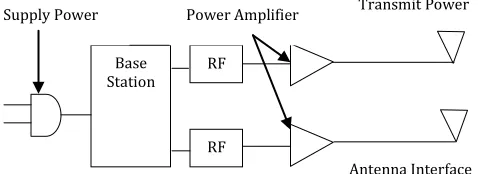
[image:1.612.328.567.490.577.2]The power model of wireless cellular system estimates and calculates the total supply power consumption, i.e. the overall device power consumption of the base station.
Figure 1: Components of Power Modeled Base Station
The power model allows to estimate RF transmission power to supply power consumption. This power model is mapped from a real base station hardware implementation, and that is capable to capture the most relevant power consumption effects in base stations which are commercially available. This linear model is verified by an advanced realistic model and detailed hardware model [2]. To analyze the energy efficiency, this linear power model provides a foundational map.
Base
Station RF
RF
Supply Power Power Amplifier Transmit Power
International Journal of Emerging Technology and Advanced Engineering
Website: www.ijetae.com (ISSN 2250-2459,ISO 9001:2008 Certified Journal, Volume 4, Issue 8, August 2014)
664 A RF chain components contains the section of a small-signal transceiver, a Power Amplifier and the antenna interface in this power model as shown in figure 1. The power amplifier consumes a large part of the total power due to its low energy efficiency. The adaptive antenna works for adaptation of the respective RF chain in which each transmit antenna is connected to an RF chain. When fewer RF chains are active then the base station consumes less power. In this model, there is no delay or additional power cost incurred by putting a base station into discontinuous transmission mode or enabling/disabling an RF chain. The supply power consumption value is estimated when operating with a single RF chain [4].
III. BACKGROUND
Some modern energy efficient algorithms are analyzed and reviewed in this section.
1. Minimal average power consumption downlink [5]:
The average supply power at base station is minimized in single cell multi-user orthogonal frequency division multiple access (OFDMA) downlink resource allocation on a flat-fading channel [5]. It was observed that a system wide allocation of powers transmitted is optimal. If only anyone link degrades then the resource allocation strategy which minimizes total power consumption needs the transmission power on all links to be increased. It is observed that for mobile stations with equal channels with different rate requirements, it uses optimized power to assign equal transmit powers with equal transmit durations [5]. A power model is taken to map transmit power to supply power which relate the effectiveness of power control for operation. The estimation and measurement of power control in base stations in terms of load dependence factor is more than 50% [9][10][11].
Limitations: (i). The effective measurement and estimation of power control completely depends on the underlying hardware and architecture.
(ii). The load dependence factor is considered for measurement of a base station in place of absolute consumption values.
2. MMSE Optimization with Per-Base-Station Power Constraints [6][12]:
The interference problem of conventional cellular system is minimized with the help of cooperative transmission with multiple base stations in this minimum mean square error (MMSE) approach [6][12].
This technique minimizes the limitation of linear transceiver design for MIMO system with power consumption per base station. There are four design goals considered:
(i). Minimizing total sum-MSE issued for per-base-station power consumption.
(ii). Minimizing total transmit power issued for total sum-MSE target and per-base-station power consumption.
(iii). Minimizing the highest weighted user-MSE issued for per-base-station power consumption.
(iv). Minimizing total transmit power issued for user-MSE targets and per-base-station power consumption.
For these limitations, globally optimizing transmitters are derived by reformulating the limitations as convex Second Order Cone Programs (SOCPs). The iterative algorithms are proposed for a joint transmitter/receiver optimization [6][12]. The joint transceiver optimization exploits for the optimal transmitter, the receivers are updated as linear MMSE filter.
Limitation: The error rate increases exponentially for overloading condition.
3. Impact of receiver interference cancellation techniques on the base station power consumption [7]:
The effect of receiver interference cancellation techniques are analyzed and investigated on the base station downlink transmission power with inter-cell interference for a multiple-input multiple-output (MIMO) communication system [7]. The power consumption of signal processing module are defined in place of specifying absolute values, as a proportion of the power consumption of power amplifier module. The effect of signal processing module as well as receiver interference cancellation techniques are determined on total power consumption of the base station. This technique estimates that the power consumed at the signal processing module is not overlooked while working with receiver interference cancellation techniques, when evaluating the base station total power consumption [7]. When power consumption of signal processing module exceeds its limit, then it contributes for increasing of the total power consumption of base station as compared to the additional power required by the power amplifier module to solve inter-cell interference [7].
International Journal of Emerging Technology and Advanced Engineering
Website: www.ijetae.com (ISSN 2250-2459,ISO 9001:2008 Certified Journal, Volume 4, Issue 8, August 2014)
665 4. Powering Rural Network [8]:
The issue of powering rural networks have been discussed and analyzed by rural power researchers. This network is focused to operate with renewable autonomous energy resources [8]. This approach is conducting a trace-based analysis of the developed power-saving technique and in this approach the technology are implemented and deployed in a rural area for utilizing a renewable energy resource. The similar mechanisms are explored for saving energy in urban networks also as they are assumed as overlapping cellular stations [8].
Limitation: The unreliable grid power is a major limitation in powering rural network.
IV. PROPOSED PROTOCOL
In this section we describe an efficient radio resource management algorithm for base station power optimization which overcomes the limitations of the previous techniques discussed in the background section.
The solution of the OFDMA supply power minimization problem is based on a simplification of the system assumptions. This problem is solved by presenting a convex sub problem with an optimal solution.
It is assumed that channel gains on all resources are equal to center resource unit in place of time and frequency-selective fading. The center resource unit is selected due to the highest correlation with all other resources. The application of mean or median over a MIMO channels set were determined to result in a channel with lower capacity. Using equal-power pre-coding and estimating uncorrelated antennas, the link capacity is calculated. The equal-power pre-coding provides a direct connection target rate and between total transmit power. OFDMA and Time Division Multiple Access (TDMA) are equivalent on block fading channels with real-valued resource sharing. The resource allocation via TDMA is selected without loss of generality. These calculations determines to establish a convex optimization problem that is efficiently solved.
The spectral efficiency for user k is calculated by
Where, = target rate,
vector of channel eigenvalues per user,
Pk = transmission power,
MT = number of active transmit antennas, noise spectral density,
The resource share μk ∈ (0, 1] is the normalized representation of the share of time.
The transmission power is the function of the target rate, which depends on the number of transmit and receive antennas.
The above equation can be reduced as: For 1×2 SIMO:
For 2×2 MIMO:
Where is the i-th member of .
On the base station side, the number of RF series used for reception at the mobile terminal could be adapted for power saving. The power-saving benefit of received antenna adaption is much smaller than in transmitted antenna adaption and power amplifier is present in each RF series.
Power Allocation Method:
The real-valued resource sharing μk is mapped to the
OFDMA resource count per user mk ∈ N as
Where K = number of users N = number of subcarriers
Through the ceiling operation in above equation, the possible rounding effects are compensated by adjusting the number of discontinuous transmission time slots can be presented as idle time slot:
The remaining time slots are available for transmission as active time slot:
International Journal of Emerging Technology and Advanced Engineering
Website: www.ijetae.com (ISSN 2250-2459,ISO 9001:2008 Certified Journal, Volume 4, Issue 8, August 2014)
666 The number of assigned resource units per user mk is
equally sub-divided into the number of resources per user and time slot mkt as
The remaining unassigned resources is
Resources are allocated to different mk,t in a round-robin
method.
V. SIMULATION &PERFORMANCE EVALUATION
[image:4.612.337.546.370.537.2]For assessment of the performance of the efficient radio resource management algorithm for base station power optimization, the simulations are conducted in MATLAB. The MATLAB simulations are configured as follows: mobiles are uniformly distributed around the base station on a circular cell with radius 300m and a minimum distance of 35m to the base station to avoid peak signal to noise ratio. Fading is computed with 8 dB shadowing standard deviation, and the frequency-selective channel with 3m/s mobile velocity. All transmit and receive antennas are considered as mutually uncorrelated. The system parameters for our MATLAB simulation are listed in Table 1.
Table 1
System Parameters for Simulation
Variables Name of Varisbles Values
K Number of users 15
T Number of time slots 10
N Number of subcarriers 60
MR Number of receiving antennas 2
MT Number of transmitting antennas
2
PS Power consumption in discontinuous transmission
150 W
PO Circuit power consumption 200 W
ΔPM Slope power increment 4.8
Pmax Maximum transmission power
48 dBm
Tframe Duration of frame 10 ms
T Duration of time slot 1 ms
W System bandwidth 10 MHz
w Subcarrier bandwidth 200 KHz
No Noise power spectral density 4×10²¹W/Hz
The following transmission techniques are evaluated for our simulation:
The maximum power consumption at base station is obtained by constant transmission at maximum power by following:
•
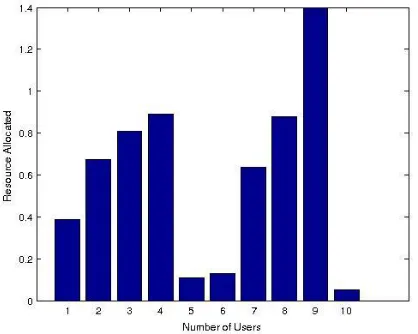
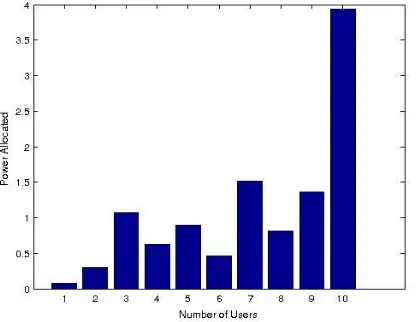
Bandwidth Adaptation selects the minimum number of subcarriers to achieve the rate target. The idle modes are not utilized and all scheduled subcarriers transmit Pmax/N transmission power spectral density. [image:4.612.47.292.491.690.2]The MATLAB simulation results using system parameters taken in Table 1 by taking genetic techniques as well as particle swarm optimization (PSO) technique for optimization panel are shown in from figure 2 to figure 7. These figures plot the graph for resource allocation and power allocation with respect to number of users sharing the base station of the system.
International Journal of Emerging Technology and Advanced Engineering
Website: www.ijetae.com (ISSN 2250-2459,ISO 9001:2008 Certified Journal, Volume 4, Issue 8, August 2014)
[image:5.612.63.271.146.307.2]667 Figure 3: Estimation of power allocation with respect to number of
[image:5.612.335.546.299.482.2]users by genetic technique
Figure 4: Estimation of fitness value by genetic technique
Figure 5: Estimation of resource allocation with respect to number of users by PSO technique
For our optimization technique, we used two optimization panel namely genetic optimization technique and particle swarm optimization technique to simulate results. The result of our MATLAB simulation can be summarized by following points:
The estimation of resource allocation with respect to number of users by genetic optimization technique is shown in graph of figure 2.
The graph shown in figure 3 presents the estimation of power allocation with respect to number of users by genetic optimization technique.
[image:5.612.55.272.334.694.2] The estimation of fitness value by genetic optimization technique is presented in figure 4 where blue dots represents the mean fitness whereas back dots represents the best fitness.
Figure 6: Estimation of power allocation with respect to number of users by PSO technique
[image:5.612.336.547.511.692.2]International Journal of Emerging Technology and Advanced Engineering
Website: www.ijetae.com (ISSN 2250-2459,ISO 9001:2008 Certified Journal, Volume 4, Issue 8, August 2014)
668
Similarly by using particle swarm optimization (PSO) technique in optimization panel, the estimation of resource allocation with respect to number of users is shown in the graph of figure 5.
The estimation of power allocation with respect to number of users by particle swarm optimization (PSO) technique is presented in the graph of figure 6.
Figure 7 presents the estimation of fitness value by particle swarm optimization (PSO) technique where blue dot shown in y axis represents the mean fitness whereas black dots represents the best fitness.
VI. CONCLUSION &FUTURE WORK
In this paper, base station supply power saving techniques are analyzed, examined and evaluated their performance with a model of base station power consumption. We defined and presented the scheduling problem of minimizing supply power consumption at base station for the downlink of multiuser MIMO-OFDM. Our efficient radio resource management algorithm for base station power optimization is proposed to solve the scheduling problem. The MATLAB simulation results presents that our proposed algorithm is capable of minimizing supply power consumption over all target link rates by large scale. Our power saving technique also works at low target data rates which are mostly attributed to discontinue transmission and adaptive antennas. This efficient radio resource management algorithm for base station power optimization can be applied to various types of base stations, the result of this simulation clearly depends on the used power model.
The base station in future will have different properties and power consumption characteristics. The future work of this model will also lead to assist embedded hardware developments for power optimization. Another future directions will be planned into the effects of hardware switching times and hardware limitations on adaptive antennas due to the limited operating area.
REFERENCES
[1] Yi Zhang, Budzisz, L., Meo, M., Conte, A., Haratcherev, I., Koutitas, G., Tassiulas, L., Marsan, M.A., Lambert, S., ―An overview of energy-efficient base station management techniques‖, 24th Tyrrhenian International Workshop on Digital Communications - Green ICT (TIWDC), 2013, DOI: 10.1109/TIWDC.2013.6664210, pp. 1 – 6
[2] Won-Yong Shin, Hyoseok Yi, Tarokh, V., ―Energy-efficient base-station topologies for green cellular networks‖, IEE Consumer Communications and Networking Conference (CCNC), 2013, DOI: 10.1109/CCNC.2013.6488431, pp. 91 – 96
[3] Kai-Uwe Schmidt, Adolf Finger, ―Constructions of Complementary Sequences for Power-Controlled OFDM Transmission‖, International Workshop, WCC 2006, Bergen, Norway, March 14-18, 2006, IISN 0302-9743, Volume 3969, 2006, pp 330-345
[4] He, A., Srikanteswara, S., Kyung Kyoon Bae, Newman, T.R., Reed, J.H., Tranter, W.H., Sajadieh, M., Verhelst, M., ―Power Consumption Minimization for MIMO Systems — A Cognitive Radio Approach‖, IEEE Journal on Selected Areas in Communications, Volume: 29 , Issue: 2, DOI: 10.1109/JSAC.2011.110218, pp. 469 - 479
[5] Holtkamp, H., Auer, G., Haas, H., ―Minimal average consumption downlink base station power control strategy‖, IEEE 22nd International Symposium on Personal Indoor and Mobile Radio Communications (PIMRC), 2011, DOI: 10.1109/PIMRC.2011.6139957, pp. 2430 – 2434
[6] Shuying Shi, Schubert, M., Vucic, Nikola, Boche, H., ―MMSE Optimization with Per-Base-Station Power Constraints for Network MIMO Systems‖, IEEE International Conference on Communications, 2008. ICC '08. DOI: 10.1109/ICC.2008.771, pp. 4106 – 4110
[7] Ku, I., Cheng-Xiang Wang, Thompson, J., Grant, P, ―Impact of receiver interference cancellation techniques on the base station power consumption in MIMO systems with inter-cell interference‖, IEEE 22nd International Symposium on Personal Indoor and Mobile Radio Communications (PIMRC), 2011 DOI: 10.1109/PIMRC.2011.6139818, pp. 1798 – 1802
[8] Haakana, J., Kaipia, T., Lassila, J., Partanen, J., ―Reserve Power Arrangements in Rural Area Underground Cable Networks‖, IEEE Transactions on Power Delivery, 2014, Volume: 29 , Issue: 2, DOI: 10.1109/TPWRD.2013.2280041, pp. 589 – 597
[9] Ng, D.W.K., Lo, E.S., Schober, R., ―Energy-Efficient Resource Allocation in OFDMA Systems with Hybrid Energy Harvesting Base Station‖, IEEE Transactions on Wireless Communications, 2013, Volume: 12 , Issue: 7, DOI: 10.1109/TWC.2013.052813.121589, pp. 3412 – 3427
[10] Chi-ying Tsui, Pedram, M., Despain, A.M., ―Power efficient technology decomposition and mapping under an extended power consumption model‖, , IEEE Transactions on Computer-Aided Design of Integrated Circuits and Systems, Volume: 13 , Issue: 9, DOI: 10.1109/43.310900, pp. 1110 – 1122