Onedimensional vs. twodimensional
based features: Plant identification
approach
Tharwat, A, Gaber, T and Hassanien, AE
http://dx.doi.org/10.1016/j.jal.2016.11.021
Title
Onedimensional vs. twodimensional based features: Plant identification
approach
Authors
Tharwat, A, Gaber, T and Hassanien, AE
Type
Article
URL
This version is available at: http://usir.salford.ac.uk/id/eprint/52075/
Published Date
2017
USIR is a digital collection of the research output of the University of Salford. Where copyright
permits, full text material held in the repository is made freely available online and can be read,
downloaded and copied for noncommercial private study or research purposes. Please check the
manuscript for any further copyright restrictions.
One-Dimensional vs. Two-Dimensional based Features:
Plant Identication Approach
Alaa Tharwata,b, Tarek Gaberb,c,1,∗, Aboul Ella Hassanienb,d
aFaculty of Engineering, Suez Canal University, Egypt
bScientic Research Group in Egypt (SRGE), http://www.egyptscience.net cFaculty of Computers and Informatics, Suez Canal University, Ismailia, Egypt
dFaculty of Computers and Information, Cairo University, Egypt
Abstract
The number of endangered species has been increased due to shifts in the
agri-1
cultural production, climate change, and poor urban planning. This lead to
2
investigating new methods to address the problem of plant species
identi-3
cation/classication. In this paper, a plant identication approach using 2D
4
digital leaves images was proposed. The approach used two features
extrac-5
tion methods based on one-dimensional (1D) and two-dimensional (2D) and the
6
Bagging classier. For the 1D-based methods, Principal Component Analysis
7
(PCA), Direct Linear Discriminant Analysis (DLDA), and PCA+LDA
tech-8
niques were applied, while 2DPCA and 2DLDA algorithms were used for the
9
2D-based method. To classify the extracted features in both methods, the
Bag-10
ging classier, with the decision tree as a weak learner was used. The ve
11
variants, i.e. PCA, PCA+LDA, DLDA, 2DPCA, and 2DLDA, of the approach
12
were tested using the Flavia public dataset which consists of 1907 colored leaves
13
images. The accuracy of these variants was evaluated and the results showed
14
that the 2DPCA and 2DLDA methods were much better than using the PCA,
15
PCA+LDA, and DLDA. Furthermore, it was found that the 2DLDA method
16
was the best one and the increase of the weak learners of the Bagging classier
17
yielded a better classication accuracy. Also, a comparison with the most
re-18
lated work showed that our approach achieved better accuracy under the same
19
dataset and same experimental setup.
20
Keywords: Plant Identication, Principal Component Analysis, Linear
∗Corresponding author
Email addresses: [email protected] (Alaa Tharwat ), [email protected] (Tarek Gaber ), [email protected] ( Aboul Ella Hassanien)
Discriminant Analysis (LDA), Bagging classier, weak learners, 2DLDA, 2DPCA, Direct-LDA, Leaf Image, Leaves Images, Small Sample Size (SSS), PCA+LDA
1. Introduction
21
Plants are a vital element of the Earth's ecology system. They maintain a
22
healthy breathable atmosphere. Almost the entire oxygen, needed for humans
23
and other animals breathe, are produced by plants, thus without plants, there
24
is no life on the earth (Gaber et al., 2015; Chaki et al., 2016). In addition,
25
plants can be used as an alternative energy source, e.g., bio-fuel (Chaki and
26
Parekh, 2012). There are various species of plants which are subject to the
27
danger of extinction. Saving endangered species of these plants from becoming
28
extinct and protecting their wild places is important for our health and the
29
future of our children. The impact of biodiversity loss may lead to fewer new
30
medicines, greater vulnerability to natural disasters and greater eects from
31
global warming. Therefore, there is a need for protecting plants and classifying
32
them into dierent species. For this purpose, plant identication techniques
33
have become a hot area of research.
34
Traditional plant identication can be achieved by a manual matching of
35
the plant's characteristics including leaves, fruits, owers, and stem, against
36
an atlas. Such identication requires extensive knowledge and it makes use of
37
complex terminology in a way that even a professional botanist needs to spend
38
much time in a eld to achieve plant identication. The plant identication
39
could be automatically achieved through using the plants' features that are
ex-40
tracted from their images and then these features can be classied using various
41
classier techniques such as, Neuro-Fuzzy Classier (Chaki et al., 2016),
Sup-42
port Vector Machine (SVM) (Arun Priya et al., 2012a), etc. Since some plants'
43
owers and fruits are seasonal and their colors are changed according to the
44
season, the leaves are more suitable to identify plants than owers and fruits.
45
Hence, the majority of the existing computer-based plant identication has used
the leaves of plants (Chaki and Parekh, 2012; Chaki et al., 2015, 2016). The
47
automatic plant identication based on information technology is a very vital
48
task for dierent parties: agriculture, pharmacological, forestry science.
Auto-49
matic plant identication process will achieve fast, cheap, and accurate systems,
50
which provide a great help to medicine, industry, and foodstu production, as
51
well as to biologists, chemists, and environmentalists.
52
This paper describes an approach addressing the plant identication
prob-53
lem by using features that are extracted from digital images of plant leaves as it
54
is a low-cost and convenient way to get leaf images dataset. The approach used
55
two features extraction techniques (one-dimensional (1D) and two-dimensional
56
(2D) based) with the Bagging classier. For the 1D-based techniques, PCA,
57
PCA+LDA, and Direct-LDA techniques were applied, while 2DPCA and 2DLDA
58
algorithms were used for the 2D-based method. To classify the extracted
fea-59
tures in both methods, the Bagging classier, with the decision tree as a weak
60
learner was used.
61
The rest of the paper is organized as follows; Section (2) summarizes the
62
related work of the plant identication based on machine learning. Section (3)
63
highlights the feature extraction methods and the classier used in the design
64
of the proposed approach which is presented in Section (4). The experimental
65
results are reported in Section (5) while the results' discussion and the conclusion
66
are presented in Section (6) and Section (7), respectively.
67
2. Related Works
68
There are a number of plant identication approaches that used digital
im-69
ages (Valliammal and Geethalakshmi, 2011; Arora et al., 2012; Arun Priya et al.,
70
2012b; Satti et al., 2013). Satti et al. classied plant leaves based on 2D
im-71
ages. They used Flavia image dataset and applied many preprocessing steps on
72
the leaf images (Satti et al., 2013). Their approach achieved accuracy 85.9%
73
and 93.3% using k-Nearest Neighbour (k-NN) and Articial Neural Networks
74
(ANN) classiers, respectively. Arora et al. applied the Speed Up Robust
tures (SURF) to extract the features from leaf images and then used the Random
76
Forest (RF) classier and tested their approach using Plant Leaves II dataset
77
(Arora et al., 2012). In another research, Caglayan et al. utilized color and
78
shape features to classify 32 dierent kinds of plants. They used SVM, k-NN,
79
RF, and Naive Bayes (NB) classiers and the RF classier achieved the best
80
accuracy (96%) (Caglayan et al., 2013). Arun et al. transformed the leaf images
81
into grayscale and applied boundary enhancement operations (Arun Priya et al.,
82
2012b). They then used the PCA to extract features and then used SVM and
83
k-NN for classication. They used Flavia dataset and achieved the accuracy of
84
78% to 81.3% using k-NN classier.
85
Valliamma et al. proposed identication approach for ower images dataset
86
(Valliammal and Geethalakshmi, 2011). They applied Preferential Image
Seg-87
mentation (PIS) and other enhancement operations to the images. They then
88
used the image thresholding to obtain some features and then used the
prob-89
abilistic curve for classication. They used a dataset of 500 owers images.
90
In another research, Uluturk and Uger converted the plant leaf images into
91
grayscale, the region of interest was segmented and the features were extracted
92
(Uluturk and Ugur, 2012). Probabilistic Neural Networks (PNN) classier was
93
then used of Flavia dataset and the classication rate was 92.5%.
94
Recently, Chaki et al., proposed a plant recognition approach using both of
95
texture and shape features (Chaki et al., 2015). The texture features were
ex-96
tracted by Gray Level Co-occurrence Matrix (GLCM) and Gabor lter while the
97
shape features were extracted using the curvelet transform coecients and the
98
invariant moments. This approach was tested using two neural-based classiers:
99
a feed-forward back-propagation Multi-Layered Perceptron (MLP) and a
Neuro-100
Fuzzy Classier (NFC) to classify 31 plant species of leaves images. In another
101
study, (Chaki et al., 2016) proposed another approach based on ridge lter and
102
curvelet transform with a Neuro-Fuzzy classier. The classication accuracy of
103
almost all classes (plant species) was 100%. However, it needs preprocessing
104
step which imposes more CPU time.
3. Preliminaries
106
In this section, the background of the PCA and LDA methods are introduced.
107
Moreover, the details of how to use both methods in vector or matrix form are
108
explained below.
109
3.1. Feature Extraction Method
110
The aim of the feature extraction step is to transform the objects'
proper-111
ties into numeric values. There are many types of features for an image such as
112
shape, texture, and color features. The shape features are used to describe the
113
shape of the image or the Region of Interest (ROI) while the texture features
114
describe the texture analysis of the image. The texture features methods are
115
generally classied into two methods: sparse method and dense method. In
116
the sparse method, the interest points are rst detected and then a local patch
117
around these points is constructed, and nally, invariant features are extracted.
118
Scale Invariant Feature Transformation (SIFT) is one of the most common
al-119
gorithms in the sparse descriptor method (Lowe, 1999; Tharwat et al., 2015). In
120
the dense method, the local features are extracted from each pixel over the input
121
image. Local Binary Patterns (LBP) is one of the most common algorithms in
122
dense method (Ojala et al., 2002; Tharwat et al., 2014b). The color features are
123
widely used in image retrieval due to its robustness against image size variation
124
and orientation (Salvador et al., 2004). The feature extraction techniques used
125
in the proposed approach are highlighted below.
126
3.1.1. An Overview of PCA
127
(PCA) is one of the classical feature extraction techniques that is widely
128
used in the areas of pattern recognition and computer vision since Turk and
129
Pentland (Turk and Pentland, 1991) used it for face recognition in 1991. From
130
that time, PCA has been widely used in face recognition and many other pattern
131
recognition applications such as dimensionality reduction (Moore, 1981), face
132
recognition (Turk and Pentland, 1991; Yang et al., 2004), and ear recognition
133
(Tharwat et al., 2012).
The PCA is an unsupervised method that is used to search for a new space
135
(PCA space or eigen space), WP CA, which reduces the d-dimensional feature
136
vectors tok-dimensional feature vectors (wherek < d).
137
Given I = {I1, I2, . . . , IM}, whereIi ∈ Rd is the ith pattern or sample,d
138
is the dimension or the number of features of Ii, and M is the total number
139
of samples. PCA searches for the PCA space (WP CA) which represents the
140
direction of the maximum variance of the given data. The PCA space consists
141
ofkorthonormal and uncorrelated Principal Components (PCs). The rst step
142
of the PCA method is to calculate the covariance matrixΣas follows:
143
Σ = 1
M −1D×D
T, (1)
D={d1, d2, . . . , dM}= M
X
i=1
Ii−µ (2)
whereµ= M1 PM
i=1Iiis the mean of all samples. The eigenvalues ({λ1, λ2, . . . , λd})
144
and eigenvectors ({v1, v2, . . . , vd}) of Σ are then calculated. The eigenvector
145
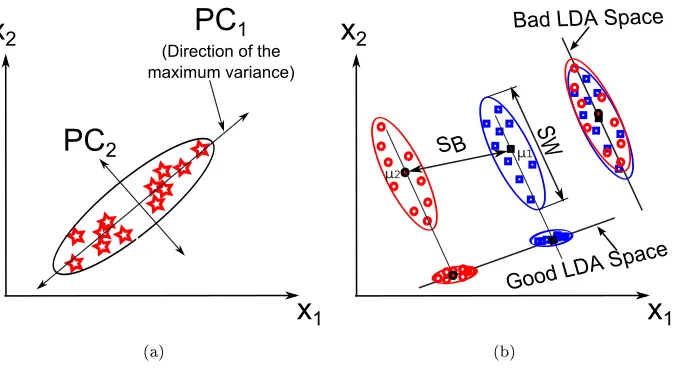
with the highest eigenvalue represents the rst principal component and it has
146
the maximum variance as shown in Figure 1a (Turk and Pentland, 1991; Strang,
147
2003). As shown in the gure, the rst principal component (PC1) points to the
148
maximum variance. Algorithm (1) summarizes the steps of the PCA technique.
149
3.1.2. An Overview of LDA
150
LDA is also a well-known algorithm for feature extraction and
dimensional-151
ity reduction. LDA is widely used in dierent applications such as biometrics
152
(Marcialis and Roli, 2002; Tharwat et al., 2014a), bioinformatics (Wu et al.,
153
2009), and chemoinformatics (Mitchell, 2014). LDA is a supervised
dimension-154
ality reduction and feature extraction method (Galdámez et al., 2015). It nds
155
the projection space that maximizes the ratio of the between-class variance,
156
SB, to the within-class variance, SW, and hence guaranteeing maximum class
157
separability as shown in Figure 1b (Welling, 2005). From the gure, there are
158
two sub-spaces that can be selected to represent the LDA space. As shown, in
x
1x
2PC
1(Direction of the maximum variance)
PC
2(a)
x
1x
2SB
μ1μ2
S
W
Good LDA S
pace
Bad LDA Space
[image:8.612.141.479.135.320.2](b)
Figure 1: A visualization of the PCA and LDA techniques; (a) PCA, (b) LDA.
Algorithm 1 : PCA
1: Given a feature matrix which consists of all training samples, each sample is represented by a single column as follows,I= [I1, I2, . . . , IM] , whereM
represents the total number of samples,Ii represents a training sample.
2: Compute the mean of all classes (total mean)µ= M1 PM
i=1Ii. 3: Subtract the mean from all training samples as follows,Di=Ii−µ.
4: Compute covariance matrixCov=M1−1PM
i=1Di∗DiT.
5: Compute eigenvectorsV and eigenvalues λof the covariance matrix.
6: Sort eigenvectors according to their corresponding eigenvalues.
7: Select k eigenvectors that have the largest eigenvalues WP CA =
{v1, v2, . . . , vk}. The selected eigenvectors represent the projection space
of PCA (WP CA).
the bad LDA space, the two classes cannot be discriminated because the SB
160
between the two classes decreased. On the other hand, in the good LDA space,
161
SW is decreased whileSB is increased and hence the two classes are perfectly
162
discriminated.
163
Assume the training samples belong to C classes. The aim of the LDA
method is to search for the subspace,WLDA, which maximizesSBand minimizes
165
SW as follows:
166
J(w) = W
T
LDASBWLDA
WT
LDASWWLDA
, (3)
SB = C
X
i=1
ni
M(µi−µ)(µi−µ)
T, (4)
SWi = 1
ni ni
X
j=1
(Iji−µi)(Iji−µi)T, (5)
SW = C
X
i=1
ni
MS
i
W (6)
where ni is the number of samples of classi, µi = n1
i
Pni
j=1Iji is the mean of
167
classi,µ=C1 PC
i=1µi= M1 P M j=1I
i
j represents the global mean or the mean of
168
all samples,Iji is the jth sample in theith class,M =PC
i=1ni, andSWi is the
169
within-class matrix of theith class. Algorithm (2) summarizes the steps of the
170
LDA technique.
171
In practice, SW is always singular, this is the so-called singularity, Small
172
Sample Size (SSS), or under-sampled problem. This problem is common in LDA
173
technique and it results from high-dimensional pattern classication applications
174
or a small number of training samples available for each class compared with the
175
dimensionality of the sample space (Lu et al., 2005; Ye and Xiong, 2006). The
176
SSS problem occurs when theSW is singular2. The upper bound of the rank3
177
ofSW isM−C, while the dimension ofSW isd×d(Lu et al., 2005; Feng and
178
Wu, 2014). Thus, in most casesd >> M−Cwhich leads to SSS problem. For
179
example, in face recognition applications, the size of the face image may reach
180
2A matrix is singular if it is square, does not have a matrix inverse, and/or its determinant
is zero; hence not all columns and rows are independent (Strang, 2003).
3The rank of the matrix represents the number of linearly independent rows or columns
to 100×100 = 10000pixels, which represent high-dimensional features and it
181
leads to a singularity problem.
182
There are two common solutions to SSS problem. The rst solution is to
183
use a non-singular intermediate, e.g. PCA space, to reduce the dimension of
184
the original data to be equal to the rank ofSW, hence SW becomes full-rank
185
andSW can be inverted. The second solution is to remove the null-space ofSB
186
which contains no useful information for recognition by diagonalizing SB and
187
then diagonalizingSW. These two solutions were used in this paper.
188
Algorithm 2 : Linear Discriminant Analysis (LDA)
1: Given a set ofM samples[Ii]Mi=1, each of which is represented as a column as follows,I= [I1, I2, . . . , IM]and each sample is represented bydfeatures.
2: Compute the mean of each class,µi, and the total mean of all samples,µ.
3: Compute within-class scatter matrix, SW, as in Equations (5 and 6) and
the between-class scatter matrixSB as in Equation (4).
4: Calculate the eigenvalues (λ) and eigenvectors (V) ofSW−1SB as follows:
SBV =SWV λ (7)
5: Sort the eigenvectors in descending order according to their corresponding eigenvalues, then use the rst,k, eigenvectors as a lower dimensional space
(WLDA).
3.1.3. One-Dimensional Feature Extraction Technique:
189
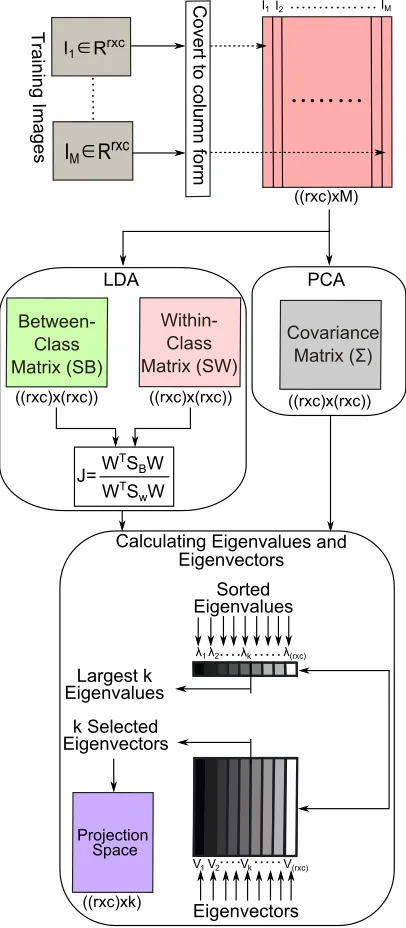
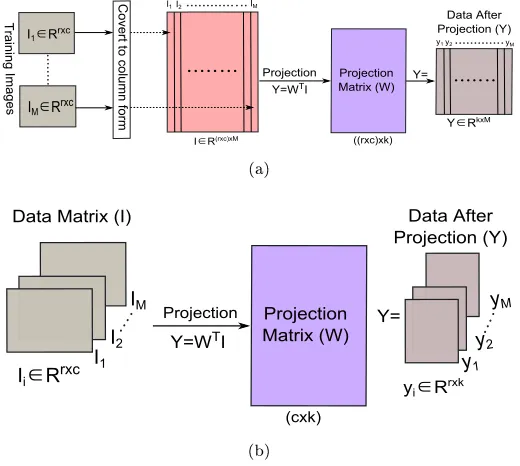
The classical PCA (i.e. 1DPCA) and LDA (i.e. 1DLDA) use one-dimensional/vector
190
form to calculate projection spaces as shown in Figure 2. In both methods, a
191
two-dimensional image (Ii(r×c), ∀i= 1,2, . . . , M) is rst converted into one
192
feature vector (column or row), where r and c represent the number of rows
193
and columns of the image, respectively. All the feature vectors are then
con-194
catenated to form a feature matrix (I ={I1, I2, . . . , IM}), whereM refers to
195
the total number of images. The PCA and LDA spaces,WP CAand WLDA, of
196
this matrix (I) can be calculated. The features are then extracted by
ing the feature matrix on the calculated spaces as follow,Y =WTI, whereW
198
represents the lower dimensional space (i.e. PCA or LDA) (see Figure 3a).
199
I1I2
wwrxcJxMJ
IM
Train
ingEImage
s
I1∈Rrxc
wwrxcJxwrxcJJ
PCA
CovarianceE MatrixEwΣJ
I
M∈
R
rxcCovertEtoEcolum
nEform
λ1λ2 λwrxcJ
V1V2 VwrxcJ
Sorted Eigenvalues
Eigenvectors kESelected
Eigenvectors
Vk λk
LargestEkE Eigenvalues
Projection ESpace
wwrxcJxkJ
CalculatingEEigenvaluesEandE Eigenvectors
LDA
wwrxcJxwrxcJJ wwrxcJxwrxcJJ
WTS
BWEE
WTS
wW
J=
Within-ClassE MatrixEwSWJ
[image:11.612.204.407.170.634.2]Between-ClassE MatrixEwSBJ
Vector representation may lead to a high-dimensional data. Hence, it is
dif-200
cult to calculate the covariance matrix in PCA due to its large size. Moreover,
201
the high-dimensional data leads to SSS problem in LDA. These two problems
202
can be solved using the two-dimensional methods, i.e. 2DPCA and 2DLDA.
203
Projection
Y∈RkxM DataCAfterC ProjectionC(Y)
Y=WTI
I∈R(rxc)xM
Y=
((rxc)xk) ProjectionC MatrixC(W)
y1y2 yM I1I2 IM
Train
ingCImage
s
I1∈Rrxc
IM∈Rrxc
CovertCtoCcolum
nCform
(a)
Projection
yi∈Rrxk Data After Projection (Y)
Y=WTI
Data Matrix (I)
Y=
(cxk) Projection Matrix (W)
Ii∈Rrxc
I1
I2
IM
y1 y2
yM
[image:12.612.176.436.204.437.2](b)
Figure 3: A visualization of the projection of one-dimensional and two-dimensional methods; (a) one-dimensional method, (b) two-dimensional method.
3.1.4. Two-Dimensional Feature Extraction Techniques
204
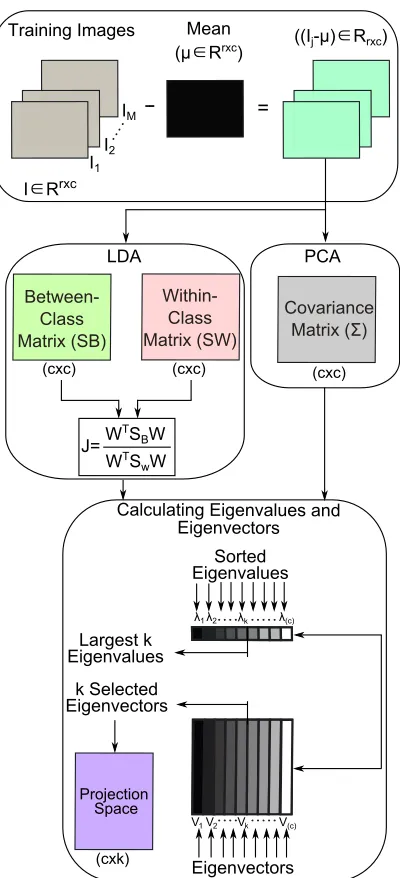
The spaces of the PCA and LDA techniques can be calculated in
two-205
dimensional/matrix form, i.e. 2DPCA and 2DLDA, as shown in Figure 4.
206
Hence, there is no need for the step of converting each image into one
vec-207
tor prior to feature extraction step which saves more computational time. As in
208
one-dimensional technique, the PCA and LDA spaces, WP CA and WLDA, are
209
calculated and the features are then extracted by projecting the feature matrix
210
on the calculated spaces as follows,Y =WTI(see Figure 3b).
3.1.4.1. Two Dimensional PCA (2DPCA). The aim of the 2DPCA method is
212
to nd the PCA space,WP CA, to project the two-dimensional image (Ii∈ Rr×c)
213
as follows,Yi =WP CAT Ii, whereYi is the projected feature vector of the image
214
Ii. First, the M two-dimensional images are used to calculate the covariance
215
matrix (Σ∈ Rc×c) as in Equation (8). The eigenvalues and eigenvectors ofΣ
216
are then calculated andkoptimal eigenvectors, i.e. projection axes, are selected.
217
In other words, the 2DPCA method then searches for the PCA spaceWP CA=
218
{v1, v2, . . . , vk} which maximizes the variance as in classical PCA, wherevi is
219
theith principal component and k is the number of selected eigenvectors that
220
represent the PCA space. This projection space is used for feature extraction of
221
the image as follows,Yi =WP CAT Ii, where Yi ∈ Rr×k represents the projected
222
feature vectors, i.e. feature matrix or feature image, of the imageIi(Yang et al.,
223
2004).
224
Σ = 1
M −1
M
X
j=1
(Ij−µ)T(Ij−µ) (8)
whereµis the mean of all training images,M is the number of training images,
225
andIj represents thejthtraining image.
226
3.1.4.2. Two Dimensional LDA (2DLDA). The aim of the 2DLDA method is
227
to nd the LDA space, WLDA, to extract the features by projecting the
two-228
dimensional image on the LDA space usingYi=WLDAT Ii. AssumeIirepresents
229
one image and M two-dimensional images are used to calculate within-class
230
matrix (SW) and between-class variance (SB). The eigenvalues and eigenvectors
231
ofS−W1SB are then calculated andk optimal eigenvectors are selected to form
232
the LDA space, i.e. Fisher projection matrix using WLDA = {v1, v2, . . . , vk}
233
which maximizes the ratio betweenSB andSW as in classical LDA, whereviis
234
theitheigenvector.
235
3.2. The Bagging Classier
236
The Bagging classier is one of the ensemble classiers creating its ensemble
237
by training dierent classiers or weak learners on a random distribution of
TrainingkImages
ــ
Meank Bμ∈Rrxcw
=
BBIj-μw∈Rrxcw
I∈Rrxc
λ1λ2 λBcw
V1V2 VBcw
Sorted Eigenvalues
Eigenvectors kkSelected
Eigenvectors
Vk λk
Largestkkk Eigenvalues
Projection kSpace
Bcxkw
CalculatingkEigenvalueskandk Eigenvectors I1
I2
IM
Bcxcw
PCA
Covariancek MatrixkBΣw
LDA
WTS BWkk
WTS wW
J=
Within-Classk MatrixkBSWw
Between-Classk MatrixkBSBw
[image:14.612.208.408.121.560.2]Bcxcw Bcxcw
Figure 4: Visualized steps to calculate a projection space of two-dimensional PCA and LDA (2DPCA and 2DLDA) methods.
a training dataset. A weak learner is a simple, fast, and easy to implement
239
classier such as single level decision tree or simple neural networks (Kuncheva,
240
2014).
Generally, as given in Algorithm (3), a Bagging classier consists of two
242
phases: training and testing. In the training phase, for each iteration, t, a
243
number of training samples are selected randomly (Si), and these samples are
244
used to train one weak learner (Ct) as shown in Figure 5. In the testing phase, all
245
the weak learners are used to classify an unknown sample (Itest). The outputs
246
of all weak learners are combined using majority voting method to determine
247
the nal decision (Kuncheva, 2014).
248
Algorithm 3 Bagging Classier Algorithm
1: Given a training setI= (I1, y1), . . . ,(IM, yM), whereyirepresents the label
of samplesIi ∈IandM denotes the total number of samples in the training
set.
2: while (t < T) do
3: Select a sampleStfromI.
4: UseStto train the current weak learnerCt.
5: end while
6: Given new test patternItest.
7: ClassifyItest using all weak learners.
8: Combine the outputs of all weak learners to determine the nal prediction.
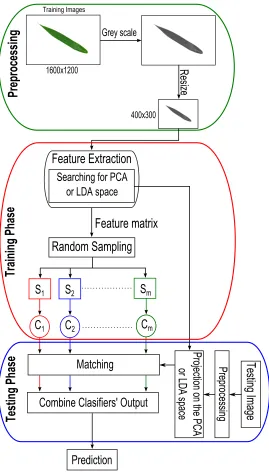
4. Proposed Approaches
249
The proposed plant identication approach consists of two phases. In the
250
rst phase, two main feature extraction methods (1D-based and 2D-based) were
251
used. In the 1D-based feature extraction method, 1DPCA, Direct LDA (DLDA),
252
and (PCA+LDA) techniques were used while in the 2D-based method, 2DPCA
253
and 2DLDA were applied for the feature extraction step. For the identication,
254
in both techniques, the Bagging classier was used to identify the type of the
255
unknown leave image as shown in Figure 5. As shown in Figure 5, the proposed
256
model has two main phases: training and testing phases.
4.1. Training Phase
258
In the training phase, M images (IM
i=1) were used to train the proposed
259
model. In the 1D-based method, each image was rst transformed into one
260
vector and then all training images' vectors were combined into a matrix,I =
261
[I1, I2, . . . , IM](see Figure 2). In the 2D-based method, the training image was
262
not changed but represented as 2D matrix as seen in Figure 4. The PCA or LDA
263
spaces,W, of I were then constructed. The features were then extracted from
264
all training images by projecting the images on the space. These features were
265
used to train the Bagging model. The steps of the training phase are explained
266
in detail in Algorithm (4).
267
Algorithm 4 : Training Phase 1: Read the training images.
2: if (1D-based method) then
3: Convert all imagesIi(r×c), i= 1, . . . , M into vectorsIi((r×c)×1).
4: Combine all feature vectors into a matrix (I= [I1, I2, . . . , IM]).
5: else
6: Deals with images in 2D form (i.e. matrix representation).
7: Combine all feature vectors into a matrix (I= [I1, I2, . . . , IM]).
8: end if
9: Compute the projection space (W).
10: Project I on the projection surface (W) to obtain the features as follows, Y =WTI.
11: Train the Bagging classier using the extracted features,Y.
4.2. Testing Phase
268
In the testing phase, an unknown leave image (Itest) was tested for its plant
269
identication. To do so, rstly the leave features were extracted by projecting
270
it on the projection space, W, that was computed in the training phase, i.e.
271
Ytest = WTItest. The computed vector Ytest was classied using the Bagging
S
mCombineEClasifiersyEOutput
TestingEImag
e
RandomESampling
S
2S
1S
mC
mC
2C
1Training Phas
e
Matching
Prediction
Testing
Phase
TrainingEImages
FeatureEExtraction
SearchingEforEPCAE
orELDAEspace
FeatureEmatrix
Proj
ectionEonEtheEPC
AE
orELDA
Espace
GreyEscale
Resize
Preproces
sing
Prep
rocessin
gE
1600x1200
[image:17.612.172.441.124.596.2]400x300
Figure 5: Plant identication system using leaves' images
classier's model that has been also built in the training phase. Detailed steps
273
of this phase are given in Algorithm (5)
Algorithm 5 : Testing Phase
1: Read an unknown leave image (Itest).
2: if (1D-based method)) then
3: Convert this imageItest(r×c)into a vector form,Itest´ ((r×c)×1).
4: else
5: Deals with the image in 2D form (i.e. matrix representation).
6: end if
7: Project the unknown 2D image on the projection space to getytest.
8: Match betweenytest withY using the Bagging model that built during the
training phase to nd the class label of the unknown image.
5. Experimental Results
275
To evaluate our proposed approach, the Flavia public dataset was used.
276
This dataset consists of 1907 colored leaves images with size (1600×1200)
277
and collected from 33 dierent species. The selected images are in dierent
278
orientations, illumination, and quality. In this paper, all colored images were
279
converted into grey scale images as shown in Figure 5. Next, all images were
280
resized to be 400×300 to reduce the computational time. Figure 6 shows
281
dierent samples from the dataset.
282
Four scenarios were designed to evaluate the performance and accuracy of the
283
proposed model (using 1DPCA, PCA+LDA, DLDA, 2DPCA, and 2DLDA). In
284
these scenarios, the Bagging classier ensemble, with dierent numbers of weak
285
learners was used to match the unknown image with the trained images. Due
286
to the high dimensionality of the data, 1DLDA was not suitable for the feature
287
extraction. The reason of this high-dimensionality of the one-dimensional form
288
of the image wasd= 400×300 = 120000and henced >> M−Cwhich leads to
289
SSS problem, whereM is the total number of samples andC is the number of
290
classes. To avoid this problem, PCA+LDA and Direct LDA (DLDA) methods
291
were used for the feature extraction in the one-dimensional method.
292
In the rst scenario, the accuracy of the two methods (1D-based and
Figure 6: Sample of dierent leaves' images (one sample from each class or plant).
based) was investigated through testing dierent percentages of training images
294
of each plant type, i.e. class. The training images were selected randomly from
295
the database while the remaining images, were used during the testing phase.
In this scenario, the size of Bagging classier was ve. The accuracy and CPU
297
time of this scenario are shown in Figure 7.
298
10 20 30 40 50 60 70 80 90
45 50 55 60 65 70 75 80 85 90 95
Number of Training Images
Accuracy (%) 1DPCA
PCA+LDA DLDA 2DPCA 2DLDA
(a)
10 20 30 40 50 60 70 80 90
0 0.01 0.02 0.03 0.04 0.05 0.06 0.07 0.08 0.09 0.1
Percentage of Training Images (%)
CPU Time (sec)
1DPCA PCA+LDA DLDA 2DPCA 2DLDA
[image:20.612.167.444.171.587.2](b)
Figure 7: Accuracy and CPU time of the proposed model using 1DPCA, PCA+LDA, DLDA, 2DPCA, and 2DLDA with dierent percentages of the training images and ve weak learners of the Bagging classier; (a) Accuracy, (b) CPU time.
The second scenario was designed based on the results of the rst one in
10 20 30 40 50 60 70 80 90 60
65 70 75 80 85 90 95 100
Percentage of Training Images (%)
Accuracy (%)
2DLD−5C 2DLD−51C 2DLD−201C 2DPCA−5C 2DPCA−51C 2DPCA−201C
(a)
10 20 30 40 50 60 70 80 90
0 0.1 0.2 0.3 0.4 0.5 0.6 0.7
Percentage of Training Images (%)
CPU Time (sec)
2DLD−5C 2DLD−51C 2DLD−201C 2DPCA−5C 2DPCA−51C 2DPCA−201C
[image:21.612.166.444.129.506.2](b)
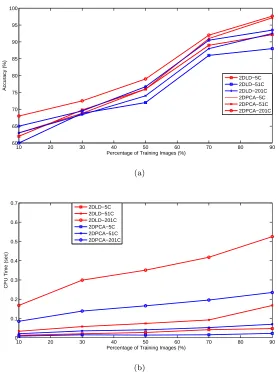
Figure 8: Accuracy and CPU time of the 2D-based method with dierent number of training images and weak learners of the Bagging classier.
which the 2D-based methods gave better results than that of the 1D-based one.
300
Thus, the aim of this scenario was to further understand the eect of changing
301
the number of training images and to evaluate the accuracy and the performance
302
stability over the standardize data. In this scenario, the 2DPCA and 2DLDA
303
were used to extract the images' features. The Bagging classier was then used
304
in many experiments at dierent values of its weak learners (i.e. 5, 51, and
0 50 100 150 200 250 300 350 400 450 86
88 90 92 94 96 98 100
Ensemble Size
Accuracy (%)
[image:22.612.169.442.136.330.2]2DLDA−Test 2DLDA−Training 2DPCA−Test 2DPCA−Training
Figure 9: A comparison between the training and testing accuracy of 2DLDA and 2DPCA method using dierent ensemble sizes.
201). In addition, the percentage of training images was ranged from 10% to
306
90%. The results obtained from this scenario are shown in Figure 8. Moreover,
307
a comparison between the training and testing accuracy of the Bagging model
308
is shown in Figure 9.
309
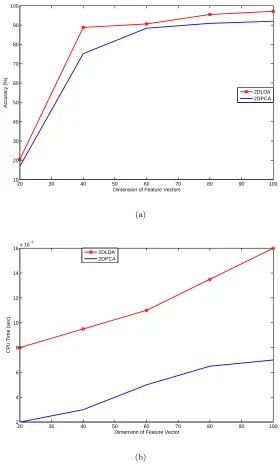
The third scenario was conducted to investigate the relationship between the
310
accuracy and the dimension of the feature vectors of the 2DPCA and 2DLDA
311
methods. In other words, the accuracy of the 2DPCA and 2DLDA was tested
312
against dierent numbers of eigenvectors constructing the projection space. In
313
this experiment, series of dierent dimensions were used. Moreover, 90% of the
314
images from each class were used to train the model, while the other images
315
were used to test the model. In addition, there were 51 weak learners in the
316
Bagging classier. Figure 10 shows the results of this experiment.
317
The fourth and last scenario was conducted to compare the accuracy of the
318
2DLDA method when dierent classiers (Bagging,k-NN, and MLP) were used.
319
In all experiments of this scenario, 51 weak learners were used in the Bagging
20 30 40 50 60 70 80 90 100 10
20 30 40 50 60 70 80 90 100
Dimension of Feature Vectors
Accuracy (%)
2DLDA 2DPCA
(a)
20 30 40 50 60 70 80 90 100
2 4 6 8 10 12 14 16x 10
−3
Dimension of Feature Vector
CPU Time (sec)
2DLDA 2DPCA
[image:23.612.165.445.135.603.2](b)
Table 1: Accuracy rate of the proposed model using Bagging,k-NN, and MLP classiers.
Class Bagging k-NN MLP Class Bagging k-NN MLP Class Bagging k-NN MLP
1 98 94 98 12 100 94 92 23 98 94 96
2 100 90 98 13 100 86 94 24 100 90 96
3 97 90 95 14 96 86 92 25 100 92 94
4 100 94 96 15 98 92 92 26 98 94 94
5 96 96 96 16 92 90 92 27 98 94 96
6 98 90 92 17 96 92 92 28 98 90 96
7 100 92 88 18 96 82 88 29 100 92 97
8 96 85 90 19 98 94 96 30 98 90 94
9 94 88 86 20 96 92 96 31 92 87 92
10 98 92 94 21 92 87 90 32 98 86 92
11 98 84 92 22 86 81 82 33 100 96 96
classier, ve nearest neighbours (k = 5) in the k-NN classier, and 30 and
321
33 nodes for the hidden and output layers, respectively, in the MLP classier.
322
Moreover, 90% of the images from each class were used to train the model, while
323
the other images were used to test the model. The accuracy of each class of this
324
experiment are summarized in Table 1
325
6. Discussion
326
From the results of the rst scenario, shown in Figure 7, the following
re-327
marks can be drawn. Firstly, in terms of accuracy issues, the accuracy of all ve
328
variants (i.e. 1DPCA, PCA+LDA, DLDA, 2DPCA, and 2DLDA) was improved
329
when the number of training images was increased. This can be explained, as
330
reported in (Brain et al., 1999), using more training images will decrease the
331
variance4 and hence decreases the overtting. Secondly, the accuracy of the
332
2D-based methods (i.e. 2DPCA and 2DLDA) was better than that of the
1D-333
based methods (i.e. 1DPCA, PCA+LDA, and DLDA). Thirdly, the 2DLDA
334
method achieved the best accuracy and the 1DPCA-based one accomplished
335
the worst accuracy. Fourthly, DLDA method achieved accuracy better than
336
PCA+LDA method because PCA+LDA method loses more information than
337
DLDA as mentioned in Section 3.1.2.
338
In terms of the CPU performance, from Figure 7b, it can be noticed that
339
the 2DPCA is the most ecient algorithm among all other methods and the
340
DLDA is the worst one. This can be explained as the high dimensionality of the
341
one-dimensional data. Mathematical interpretation of this point shows that the
342
size of the image covariance matrix using 2DPCA (c×c) is much smaller than
343
in 1DPCA ((r×c)×(r×c)). As a result, less time is required to determine
344
the corresponding eigenvectors when the 2DPCA is used. For example, in our
345
case, the size of the image after resizing it was400×300. Hence, to calculate
346
the covariance matrix of 2DPCA, it is required to multiply two matrices of
347
(300×300). But, when using the 1DPCA, all training images are converted into
348
one vector (1×120000), and the covariance matrix is computed by multiplying
349
two matrices(M×120000)×(120000×M), whereM represents the total number
350
of training images. Thus, 2DPCA method takes CPU time much lower than
351
1DPCA method. Similarly, 2DLDA involves the eigen-decomposition of matrix
352
SW andSB which have dimensions much smaller than in 1DLDA method. This
353
reduction dramatically reduces the computational time and memory space of
354
2DLDA method (Ye et al., 2004). Moreover, in 1DLDA,SW is singular in most
355
cases because the dimension of the samples is greater than the number of samples
356
in each class. However, 2DLDA overcome this problem eciently because the
357
rank of any training image is equal tomin(r, c). Hence, the rank ofSW is less
358
than or equal to(M−C).min(r, c)(Li and Yuan, 2005). Thus, in 2DLDA,SW
359
is nonsingular when Equation (9) is true. In real practical problems, Equation
360
(9) is always satised. Thus,SW is always nonsingular, hence, SSS problem can
361
be solved using 2DLDA (Li and Yuan, 2005).
362
M ≥C+ c
min(r, c) (9) From Figure 8 the following remarks can be noticed. Firstly, the higher
363
number of iterations of Bagging classier used, the better classication accuracy
achieved. However, this was accomplished on the cost of taking more CPU time
365
(see Figure 8b). Secondly, the 2DLDA method achieved identication accuracy
366
better than that of the 2DPCA method, but this was also accomplished with
367
more CPU time. This is because of LDA searches in the space that extracts the
368
most discriminative features, while the PCA searches in the space that extracts
369
the data with the high variance. Thirdly, increasing the ensemble size led to the
370
complexity of the bagging model and hence took more CPU time and may lead to
371
the overtting problem. Figure 9 shows a comparison between the training and
372
testing accuracy. In this gure, the training accuracy of 2DLDA and 2DPCA
373
methods was increased till it reached to an extent at which it remained constant.
374
On the other hand, the testing accuracy was increased when the ensemble size
375
was increased till it reached to an extent after which it reduced again. As shown
376
in the gure, the best ensemble size was approximately 201.
377
From Figure 10a, two remarks can be noticed. First, the accuracy of the
378
2DPCA and 2DLDA methods is proportional with the number of eigenvectors.
379
Second, a major change (about 60%) in the accuracy achieved when the
percent-380
age of the eigenvectors was increased from 20% to 40%. But, a minor change
381
(about 5%) in the accuracy achieved when the percentage of the accuracy ranged
382
from 40% to 100 %. This means that the most discriminative feature are
con-383
centrated nearly in the rst half of the eigenvectors. In terms of CPU time and
384
from Figure 10b, it is clear the computational time of the 2DPCA and 2DLDA
385
methods increased when more eigenvectors were used to construct the PCA or
386
LDA space.
387
From Table 1, two remarks can be seen. First, the Bagging classier achieved
388
the best accuracy rate (97.15%), while MLP and k-NN classiers achieved
389
93.15% and 90.18%, respectively. The accuracy of the classes was ranged from
390
86% to 100% when Bagging classier was used.
391
To further evaluate our proposed approach (2DPCA and 2DLDA which gave
392
the best results), a comparison was conducted with some state-of-the-art
ap-393
proaches which used dierent feature extraction methods and classiers for the
394
same dataset. The results of this comparison are shown in Table 2. From this
Table 2: A comparison between our proposed plant identication method and some of state-of-the-art methods in terms of, classication accuracy, size of database images, feature extraction methods.
Author Feature Extraction Method
Classication Method
Database
Images Results
(Arun Priya et al., 2012b) Digital Morphological Features (DMFs) + PCA
k-NN
SVM
5 classes (331 images)
k-NN (78%)
SVM (94.5%)
(Caglayan et al., 2013) Color+Shape
k-NN
SVM NB RF
32 classes (1897 images)
k-NN (94.2%)
SVM (92.9%) NB (88.95%) RF (96.32%)
(Satti et al., 2013) Color+Shape k-NN ANN
33 classes (1907 images)
k-NN (85.9%) ANN (93.3%)
(Chaki et al., 2015) Texture+Shape NFC MLP
31 classes (930 images)
NFC (81.6%) MLP (87.1%)
(Chaki et al., 2016) Shape+Texture (statistical) NFC 30 class
(600 images) NFC (97%)
Proposed Model
1DPCA, DLDA, PCA+LDA, 2DPCA,
2DLDA
Bagging 33 classes (1907 images)
1DPCA (72%) PCA+LDA (77%)
[image:27.612.122.478.180.510.2]DLDA (82%) 2DPCA (93.5%) 2DLDA (97.12%)
table, the following remarks can be drawn. Firstly, although the proposed
ap-396
proach and the one proposed by Satti et al. used all the classes of the Flavia
397
dataset (i.e, 33 classes), while the other approaches excluded some classes, our
398
proposed approach achieved the highest accuracy (97.12%). Secondly, Chaki et
399
al. also achieved high accuracy at (97%), but they used only 30 classes and
400
600 images while in our approach 33 classes and 1907 images were used in all
401
experiments.
402
As a general remark, from Figure 7 and Figure 8, it can be noticed that
403
the accuracy of the proposed approach with its variants is proportional to the
404
number of training images and the best accuracy is achieved when 90% of the
405
training images is used.
7. Conclusion
407
This paper presented a plant identication approach based on their 2D leaves
408
images. The approach consists of two main phases: feature extraction and
clas-409
sication. In the rst phase, ve algorithms (1DPCA, 1DLDA, Direct-LDA,
410
PCA+LDA, 2DPCA, and 2DLDA) were applied to extract the leaves features.
411
In the second phase, the Bagging classier was employed to test which
fea-412
ture extraction technique could give the best accuracy and performance. The
413
ve variants of the proposed approach were evaluated using all leave images of
414
Flavia dataset. The evaluation results showed the variants used the 2DPCA and
415
2DLDA were much better than the ones used the PCA, PCA+LDA, and
Direct-416
LDA. It also was found that the 2DLDA-based method was the best one. In
417
addition, experiments conducted for the Bagging classier parameter (the size
418
of the weak learners) proved that the classication accuracy increased when this
419
parameter increased. Moreover, the results showed that the classication
accu-420
racy of the 2DPCA and 2DLDA methods was proportional with the number of
421
the selected eigenvectors and the highest accuracy was (97.12%) and achieved
422
using 2DLDA. Last but not least, a comparison with the most related work
423
showed that our approach achieved better accuracy under the same dataset and
424
same experimental setup. In the future work, deep learning techniques will be
425
investigated for plant identication using the same leaves' dataset.
426
Arora, A., Gupta, A., Bagmar, N., Mishra, S., Bhattacharya, A., 2012. A plant
427
identication system using shape and morphological features on segmented
428
leaets: Team iitk, CLEF 2012. In: CLEF 2012 Evaluation Labs and
429
Workshop, Online Working Notes, Rome, Italy, September 17-20, 2012.
430
URL http://ceur-ws.org/Vol-1178/CLEF2012wn-ImageCLEF-AroraEt2012.
431
432
Arun Priya, C., Balasaravanan, T., Thanamani, A. S., 2012a. An ecient leaf
433
recognition algorithm for plant classication using support vector machine. In:
434
Pattern Recognition, Informatics and Medical Engineering (PRIME), 2012
435
International Conference on. IEEE, pp. 428432.
Arun Priya, C., Balasaravanan, T., Thanamani, A. S., 2012b. An ecient leaf
437
recognition algorithm for plant classication using support vector machine.
438
In: International Conference on Pattern Recognition, Informatics and Medical
439
Engineering (PRIME). IEEE, pp. 428432.
440
Brain, D., Webb, G., Richards, D., Beydoun, G., Homann, A., Compton, P.,
441
1999. On the eect of data set size on bias and variance in classication
442
learning. In: Proceedings of the Fourth Australian Knowledge Acquisition
443
Workshop, University of New South Wales. pp. 117128.
444
Caglayan, A., Guclu, O., Can, A. B., 2013. A plant recognition approach using
445
shape and color features in leaf images. In: International Conference on Image
446
Analysis and Processing (ICIAP). Springer, pp. 161170.
447
Chaki, J., Parekh, R., 2012. Plant leaf recognition using gabor lter.
Interna-448
tional Journal of Computer Applications 56 (10).
449
Chaki, J., Parekh, R., Bhattacharya, S., 2015. Plant leaf recognition using
tex-450
ture and shape features with neural classiers. Pattern Recognition Letters
451
58, 6168.
452
Chaki, J., Parekh, R., Bhattacharya, S., 2016. Plant leaf recognition using ridge
453
lter and curvelet transform with neuro-fuzzy classier. In: Proceedings of
454
3rd International Conference on Advanced Computing, Networking and
In-455
formatics. Springer, pp. 3744.
456
Feng, T.-t., Wu, G., 2014. A theoretical contribution to the fast implementation
457
of null linear discriminant analysis method using random matrix
multiplica-458
tion with scatter matrices. arXiv preprint arXiv:1409.2579.
459
Gaber, T., Tharwat, A., Snasel, V., Hassanien, A. E., 2015. Plant identication:
460
Two dimensional-based vs. one dimensional-based feature extraction methods.
461
In: 10th International Conference on Soft Computing Models in Industrial
462
and Environmental Applications. Springer, pp. 375385.
Galdámez, P. L., Arrieta, A. G., Ramón, M. R., 2015. A small look at the ear
464
recognition process using a hybrid approach. Journal of Applied Logic.
465
Kuncheva, L. I., 2014. Combining pattern classiers: methods and algorithms.
466
John Wiley & Sons, Second Edition.
467
Li, M., Yuan, B., 2005. 2d-lda: A statistical linear discriminant analysis for
468
image matrix. Pattern Recognition Letters 26 (5), 527532.
469
Lowe, D. G., 1999. Object recognition from local scale-invariant features. In:
470
The proceedings of the seventh IEEE international conference on Computer
471
vision, 1999. Vol. 2. Ieee, pp. 11501157.
472
Lu, J., Plataniotis, K. N., Venetsanopoulos, A. N., 2005. Regularization studies
473
of linear discriminant analysis in small sample size scenarios with application
474
to face recognition. Pattern Recognition Letters 26 (2), 181191.
475
Marcialis, G. L., Roli, F., 2002. Fusion of lda and pca for face verication. In:
476
Biometric Authentication. Springer, pp. 3037.
477
Mitchell, J. B., 2014. Machine learning methods in chemoinformatics. Wiley
478
Interdisciplinary Reviews: Computational Molecular Science 4 (5), 468481.
479
Moore, B., 1981. Principal component analysis in linear systems: Controllability,
480
observability, and model reduction. IEEE Transactions on Automatic Control
481
26 (1), 1732.
482
Ojala, T., Pietikainen, M., Maenpaa, T., 2002. Multiresolution gray-scale and
483
rotation invariant texture classication with local binary patterns. IEEE
484
Transactions on Pattern Analysis and Machine Intelligence 24 (7), 971987.
485
Salvador, E., Cavallaro, A., Ebrahimi, T., 2004. Cast shadow segmentation using
486
invariant color features. Computer vision and image understanding 95 (2),
487
238259.
Satti, V., Satya, A., Sharma, S., 2013. An automatic leaf recognition system for
489
plant identication using machine vision technology. International Journal of
490
Engineering Science and Technology (IJEST) ISSN, 09755462.
491
Strang, G., 2003. Introduction to linear algebra. Wellesley-Cambridge Press,
492
Massachusetts, Fourth Edition.
493
Tharwat, A., Gaber, T., Hassanien, A. E., 2014a. Advanced Machine Learning
494
Technologies and Applications: Second International Conference, AMLTA
495
2014, Cairo, Egypt, November 28-30, 2014. Proceedings. Springer
Interna-496
tional Publishing, Cham, Ch. Cattle Identication Based on Muzzle Images
497
Using Gabor Features and SVM Classier, pp. 236247.
498
URL http://dx.doi.org/10.1007/978-3-319-13461-1_23
499
Tharwat, A., Gaber, T., Hassanien, A. E., Hassanien, H. A., Tolba, M. F.,
500
2014b. Cattle identication using muzzle print images based on texture
fea-501
tures approach. In: Proceedings of the 5th International Conference on
In-502
novations in Bio-Inspired Computing and Applications, IBICA, June 23-25,
503
2014, Ostrava, Czech. Springer, pp. 217227.
504
Tharwat, A., Gaber, T., Hassanien, A. E., Shahin, M., Refaat, B., 2015.
Sift-505
based arabic sign language recognition system. In: Afro-European Conference
506
for Industrial Advancement. Vol. 334. Springer, pp. 359370.
507
Tharwat, A., Ibrahim, A., Ali, H., 2012. Personal identication using ear images
508
based on fast and accurate principal component analysis. In: 8th International
509
Conference on Informatics and Systems (INFOS). IEEE, pp. 5659.
510
Turk, M. A., Pentland, A. P., 1991. Face recognition using eigenfaces. In:
Pro-511
ceedings IEEE Computer Society Conference on Computer Vision and Pattern
512
Recognition CVPR'91. IEEE, pp. 586591.
513
Uluturk, C., Ugur, A., 2012. Recognition of leaves based on morphological
fea-514
tures derived from two half-regions. In: International Symposium on
Innova-515
tions in Intelligent Systems and Applications (INISTA). IEEE, pp. 14.
Valliammal, N., Geethalakshmi, S., 2011. Automatic recognition system using
517
preferential image segmentation for leaf and ower images. An International
518
Journal of Computer Science & Engineering (CSEIJ) 1 (4), 1325.
519
Welling, M., 2005. Fisher linear discriminant analysis. Department of Computer
520
Science, University of Toronto.
521
Wu, M. C., Zhang, L., Wang, Z., Christiani, D. C., Lin, X., 2009. Sparse linear
522
discriminant analysis for simultaneous testing for the signicance of a gene
523
set/pathway and gene selection. Bioinformatics 25 (9), 11451151.
524
Yang, J., Zhang, D., Frangi, A. F., Yang, J.-y., 2004. Two-dimensional pca: a
525
new approach to appearance-based face representation and recognition. IEEE
526
Transactions on Pattern Analysis and Machine Intelligence 26 (1), 131137.
527
Ye, J., Janardan, R., Li, Q., 2004. Two-dimensional linear discriminant analysis.
528
In: Neural Information Processing Systems, NIPS, December 13-18, 2004,
529
Vancouver, British Columbia, Canada]. pp. 15691576.
530
Ye, J., Xiong, T., 2006. Computational and theoretical analysis of null space
531
and orthogonal linear discriminant analysis. The Journal of Machine Learning
532
Research 7, 11831204.