International Journal of Emerging Technology and Advanced Engineering
Website: www.ijetae.com (ISSN 2250-2459, ISO 9001:2008 Certified Journal, Volume 6, Issue 8, August 2016)
An Experimental Study on Optimum Usage of Recycled
Aggregate as Partial Replacement of Fine Aggregate For
Compressive Strength
M. Bharath Kumar
1, Prof. M. Senthil Pandian
21M. Tech, Structural Engineering, 2Assistant Professor, School of Mechanical and Building science, VIT Chennai Abstract—The main objectives of this investigation is to
study the optimum usage of recycled aggregate as partial replacement of fine aggregate for the compressive strength.
In this study a total of 8 mixes were prepared. In each
mixture recycled aggregate is added in amount of approximately 5%, 10%, 15%, 20%, 25%, 30%, 35%, 40% as a replacement of fine aggregate. All the specimens were cured for 28 days strength. The efficiency and maximum content of recycled aggregate will give the maximum compressive strength. Hence, the maximum amount of usable recycled aggregate and maximum efficiency was determined.
I. INTRODUCTION
Now a day’s large demand has been placed on building materials industry especially last two decades, which leads to use of replacement for fine aggregates and coarse aggregates. So there is large demand for alternative material for the fine aggregate. To overcome the demand of river sand alternatives such as recycled aggregate, waste iron, crushed granite, furnace slag, welding slag, plastic waste, and crumb rubber were being used which increases the engineering properties of the concrete. The large volume of recycled aggregate used in construction are blast furnace and steel slag. The blast furnae slag is either air cooled or granulated. These additives improve the performance of the concrete when they are used as additives or as partial replacement with fine aggregate. Economic (lower cement requirement) and environmental consideration plays a great role in rapid increase in rapid increase in usage of admixtures.
Aggregates themselves an also be used as recycled product. Unlike depositing the waste aggregate that are demolished it can be recycled and crushed to coarse or fine aggregate and used. The supply of these recycled depends on the structural conditions and their demolition. The aggregates are recycled in mobile recycling plants or fixed. The materials that are recycled generally have high quality and properties.
II. LITREATURE REVIEW
Sreekrishna perumal et al (2013)
Have studied the compressive strength of concrete with partial replacement as furnace slag and welding slag
The waste materials were substituted for replacement of fine aggregate. The compressive strength on seven days shows optimum strength of 21.2N/mm2. The optimum compressive strength has been found 41N/mm2 for 5%WS and 39.7N/mm2 for 10% FS.
A.Oner et al(2005)
Have studied the compressive strength of concrete with partial replacement of GGBS. The material used were Ground Granulated blast furnace slag with replacement of 0%, 10%, 20%, 30%, 40%, 50%,60%, 70%, 80% and 90%. The early age strength of GGBS was lower than the control mixes However, as the curing period increases the strength of concrete is more. The optimum level of GGBS content for maximizing the strength of concrete is about 55-59% of total binder content.
A.Oner et al(2005)
Have studied the compressive strength of concrete with partial replacement of fly ash. The materials used were fly ash with replacement of 15 to 58%. The strength increases with the increase in amount of fly ash up to an optimum value, beyond which the strength starts to decrease for further addition of fly ash. The optimum value of fly ash is about 40% of cement for the four test group. Fly ash/cement factor is important in determining the efficiency of fly ash.
K.Ganesh Babu et al(2005)
Have studied the compressive strength of concrete with partial replacement of Ground Granulated blast furnace slag. The materials used were Ground Granulated blast furnace slag with replacement of 0 to 80%. The overall strength efficiency factor varies from 1.29 to 0.7 for 10%-80% of replacement. The strength varies from 20MPa to 100MPa with GGBS replacement of 10% to 80%.
Fernando S. Famseca et al(2015)
International Journal of Emerging Technology and Advanced Engineering
Website: www.ijetae.com (ISSN 2250-2459, ISO 9001:2008 Certified Journal, Volume 6, Issue 8, August 2016)
205 III. EXPERIMENTAL STUDY
In this current scenario, large demand has been placed on building material industry especially last two decades, which leads to use of replacement for fine aggregate and coarse aggregate.
METHODOLOGY
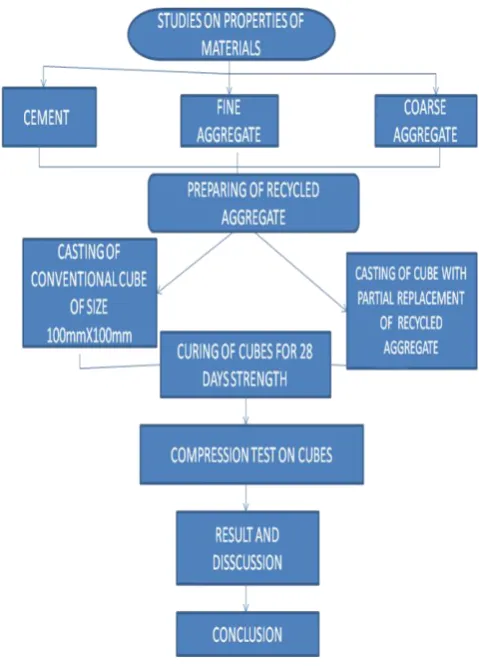
In this project, the optimum usage of recycled aggregate for the partial replacement of fine aggregate was studied. Initially the properties of materials were studied.
Cement –OPC 53 grade Fine aggregate (river sand) Coarse aggregate
Based on the properties of the materials a concrete mix design was designed. The parameters varied in this study are fine aggregate and recycled aggregate content. A concrete cube of size 100mmX100mmX100mm was casted with partial replacement of recycled aggregate. The cubes were tested for compressive strength at 7, 14 and 28 days strength namely RAM7, RAM14 and RAM28.
Specimen preparation and testing are based on Indian Standard BIS 516. The optimum usage of recycled aggregate content will be determined based on the compressive strength of cube at 7, 14 and 28 days.
Specimen preparation and curing
[image:2.595.56.296.223.557.2]A total of 8 mixtures were prepared with different recipes. The recycled aggregate in the amount of 5%. 10%, 15%, 20%, 25%, 30%. 35% and 40 % and the rest of fine aggregate were added as partial replacement. All the mixtures have the same workability with slump value of 100 ±10mm. The main variable in the mixtures was the cementitious content and water content. The mix proportions are listed in following table.
Table 1
mix proportion for control mix for 1m3
Water Cement Fine aggregate
Coarse aggregate
[image:2.595.309.555.385.711.2]140 350 866 1040
Table 2
Mix proportion for recycled aggregate mix for 1m3
Water Cement Fine aggregate
Recycled aggregate
Coarse aggregate
5% replacement
140 350 822.7 43.3 1040
10% replacement
140 350 779.4 86.6 1040
15% replacement
140 350 736.1 129.9 1040
20% replacement
140 350 692.8 173.2 1040
25% replacement
140 350 649.5 216.5 1040
30% replacement
140 350 606.2 259.8 1040
35% replacement
140 350 562.9 303.1 1040
40% replacement
International Journal of Emerging Technology and Advanced Engineering
[image:3.595.51.292.123.477.2]Website: www.ijetae.com (ISSN 2250-2459, ISO 9001:2008 Certified Journal, Volume 6, Issue 8, August 2016)
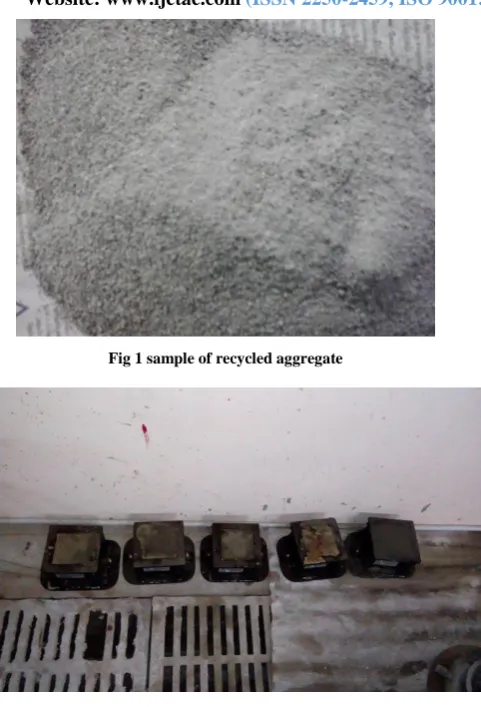
Fig 1 sample of recycled aggregate
Fig. 2 Cast cubes
Testing
[image:3.595.319.545.141.818.2]The compression test setup is shown in Fig. 3. The compressive strength of hardened concrete was measured fro100mmX100mmX100mm cubes. The cast cubes are cured for 28 days. The cubes are tested for compressive strength at the age of 28 days. The specimens were taken and tested at room temperature. The test results are given in the table. The load is applied gradually. The observations were made for first crack load, ultimate load.
Table 1
Compressive strength of comtrol mix
Test day Area of cube Load (kN)
Compressi ve strength (N/mm2)
7 days 100mmX100mm 132.8 13.28
7 days 100mmX100mm 145.2 14.52
7 days 100mmX100mm 139.4 13.94
14 days 100mmX100mm 294.3 29.43
14 days 100mmX100mm 301.4 30.14
14 days 100mmX100mm 299.4 29.94
28 days 100mmX100mm 416.8 41.68
28 days 100mmX100mm 421.8 42.18
28 days 100mmX100mm 413.2 41.32
Table 2
compressive strength at 7 day age RAM7.
Test day
%replaceme nt
Load (kN)
Compressi ve strength (N/mm2)
7 days 5 131.5 13.15
7 days 10 134.1 13.41
7 days 15 139.3 13.93
7 days 20 141.9 14.19
7 days 25 145.2 14.52
7 days 30 142.1 14.21
7 days 35 134.9 13.49
7 days 40 134.1 13.41
Table 3
compressive strength at 14 days RAM14.
Test day %replac ement
Load (kN)
Compressi ve strength (N/mm2)
14 days 5 291.2 29.12
14 days 10 296.4 29.64
14 days 15 301.3 30.13
14 days 20 309.4 30.94
14 days 25 312.6 31.26
[image:3.595.55.273.614.766.2]International Journal of Emerging Technology and Advanced Engineering
Website: www.ijetae.com (ISSN 2250-2459, ISO 9001:2008 Certified Journal, Volume 6, Issue 8, August 2016)
[image:4.595.328.550.135.326.2]207
Table 4
compressive strength at 28 days RAM28
Test day %replac ement
Load (kN)
Compressi ve strength (N/mm2)
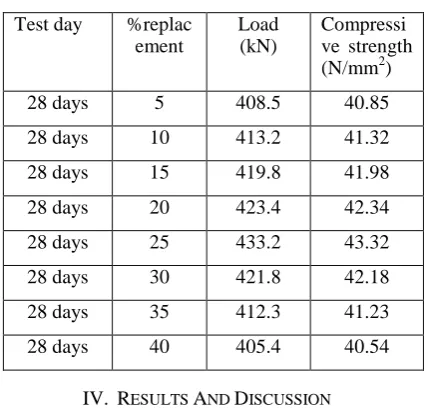
28 days 5 408.5 40.85
28 days 10 413.2 41.32
28 days 15 419.8 41.98
28 days 20 423.4 42.34
28 days 25 433.2 43.32
28 days 30 421.8 42.18
28 days 35 412.3 41.23
28 days 40 405.4 40.54
IV. RESULTS AND DISCUSSION
The compressive strength of concrete made with recycled aggregate was determined at 7, 14 and 28 days of curing period. The values are taken from the average of 3 specimens. The compressive strength values were given in table1, table2, table3, table4.
It was observed that the compressive strength increases with the percentage increase of recycled aggregate more than the control mix. It was seen that after optimum value the compressive strength starts decreasing beyond the value of control mix. The results were shown in following figures
[image:4.595.57.272.151.355.2]Fig.4 Compressive strength at 7 day RAM7
[image:4.595.325.548.351.511.2]Fig.5 Compressive strength at 14 days RAM14
Fig.6 Compressive strength at 28 days RAM28
From the above results it was clear that the compressive strength of concrete with replacement of recycled aggregate has been increased when compared to control mix.
It is seen that the compressive strength increases with increase in percentage of replacement of recycled aggregate up to 30% beyond which it starts to decrease and goes below the strength of control mix.
[image:4.595.52.263.493.660.2]International Journal of Emerging Technology and Advanced Engineering
Website: www.ijetae.com (ISSN 2250-2459, ISO 9001:2008 Certified Journal, Volume 6, Issue 8, August 2016)
V. CONCLUSION
From the experimental study on optimum usage on recycled aggregate for compressive strength, the following observations were made,
1.By addition of recycled aggregate for the replacement of sand, the compressive increases which delays the first crack.
2.Mechanical properties such as load carrying capacity, energy absorption are increased for the cube
3.The compressive strength increases till 30% of replacement of recycled aggregate.
4.Hence, the optimum usage of recycled aggregate as partial replacement of fine aggregate for compressive strength of concrete is about 20% to 30%.
REFERENCES
[1] Sreekrishna perumal and suburamani prateepkumar,”Use furnace slag and welding slag as replacement for sand in concrete” International journal of energy and environmental engineering 2013
[2] A. Oner and S.Akyuz “An experimental study on optimum usage of GGBS for compressive strength of concrete”in Elsevier journal on cement and concrete composites 29(2007) pp505-514 [3] A. Oner and S.Akyuz “An experimental study on optimum usage
of Fly ash for compressive strength of concrete”in Elsevier journal on cement and concrete composites 35(2005) pp1165-1171
[4] K. Ganesh babu and V. Sree Rama Kumar “Efficiency of Ground Granulated Blast furnace Slag in concrete” international journal of cement and concrete research 30(2000) pp 1031-1036
[5] Fernando S.Fonseca, Kurt Siggard “compressive strength of masonry grout with class F fly ash and ground granulated blast furnace slag” International journal of constructions and building materials 94(2015) pp719-727
[6] Azizul Islam, U. Johnson Alengaram , Mohd Zamin Jumaat, Iftekhair Ibnul Bashar “The development of compressive strength of ground granulated blast furnace slag-palm oil fuel ash-fly ash based geopolymer mortar”materials and design 53(2014) 833-841 [7] P.J. Wainwright , N. Rey ” The influence of ground granulated
blastfurnace slag (GGBS)additions and time delay on the bleeding of concrete” cement and concrete composites 22(2000) 253-257 [8] Sha W, Pereira GB. Differential scanning calorimetry study of
Hydrated ground granulated blast-furnace slag Cement Concrete Res2001; 31:327–9.
[9] Domone PL, Soutsos MN. Properties of high-strength concrete mixescontaining PFA and GGBS. Mag Concr Res 1995;47:355– 67.
[10] Papadakis VG, Tsimas S. Supplementary cementing materials in concrete Part I: efficiency and design. Cement Concrete Res 2002;32:1525–32.
[11] Roy DM, Idorn GM. Hydration, structure, and properties of blastfurnaceslag cements, mortars, and concrete. J Am Concrete Inst1982;79:445–57.
[12] Hogan FJ, Meusel JW. Evaluation for durability and strength development of a ground granulated blast furnace slag. Cement Concrete Aggr 1981;3:40–52.
[13] Ganesh Babu K, Sree Rama Kumar V. Efficiency of GGBS in concrete. Cement Concrete Res 2000;30:1031–6.
[14] Hwang CL, Lin CY. Strength development of blended blast-furnace slag cement mortars. SP 91. ACI; 1986. p. 1323–40. [15] Papadakis VG, Antiohos S, Tsimas S. Supplementary cementing
materials in concrete Part II: a fundamental estimation of the efficiency factor. Cement Concrete Res 2002;32:1533–8. [16] Pekmezci BY, Akyuz S. Optimum usage of a natural pozzolanfor
themaximum compressive strength of concrete. Cement Concrete Res2004;34:2175–9.