PatEdit: An Information Extraction Pattern Editor for Fast System
Customization
Dimitra Farmakiotou, Vangelis Karkaletsis, Ioannis Koutsias,
George Petasis and Constantine D. Spyropoulos
Software and Knowledge Engineering Laboratory, Institute of Informatics and Telecommunications, National Centre for Scientific Research (N.C.S.R.) “Demokritos”,
P.O. BOX 60228, Aghia Paraskevi, GR-153 10, Athens, Greece.
{dfarmak, vangelis, jkoutsi, petasis, costass}@iit.demokritos.gr
Abstract
This paper addresses the problem of Information Extraction (IE) system customization to new domains and extraction needs with the use of PatEdit, an IE Pattern Editor. PatEdit is a human-assisted knowledge engineering tool, that facilitates the production of IE patterns. First, we present the problem of IE system customisation and the use of human assisted knowledge engineering tools. Then, we describe PatEdit with respect to the IE pattern language used and discuss its characteristics that facilitate rapid pattern writing. Finally, the exploitation of PatEdit in two information extraction projects is presented along with our plans for future work.
1.
Introduction
Information Extraction (IE) systems fill in predefined data structures (e.g. relational databases) involving a particular event (e.g. company acquisitions) with information they extract from unstructured natural language texts that refer to a particular domain (e.g. financial news). They do not attempt to “comprehend” the texts they process in their entirety, but they simply try to extract from them all the information that is needed to fill in predefined data structures.
Within the Message Understanding Conferences1 (MUCs), IE is decomposed into the following sub-tasks: Named Entity (involving the recognition of specific semantic types of proper names and expressions), Coreference (detection of coreferential expressions), Template Element (identification of descriptions referring to specific types of entities), Template Relations (discovery of semantic relations holding between entities) and the Scenario Template a task that uses the results of the preceding sub-tasks for the generation of a template that describes an entire event.
IE systems involve general purpose linguistic processing (e.g. sentence splitting, part of speech tagging) as well as task specific processing for the identification of the elements (phrases, names, expressions) that fill the slots of an event template. Linguistic processing relies on general-purpose resources that do not require painstaking adaptation to new domains or new types of events within a given domain. Task specific processing, on the other hand, involves extraction patterns (or rules or concept nodes depending on the system) and resources (domain specific gazetteers) that must be written anew whenever a new event or domain is dealt with. The creation of extraction patterns for a new domain or event requires domain expertise and awareness of the underlying IE system structure. This renders the customization of IE systems an expensive and time-consuming process.
One of the ways in which researchers have attempted to address the customization bottleneck of existing IE
1
http://www.itl.nist.gov/iaui/894.02/related_projects/muc/
systems is tools that allow domain experts to create extraction patterns fast and easily without requiring knowledge of linguistics or language engineering, as well as tools that facilitate the work of the knowledge engineer in adapting a system to different domains. Section 2 provides more details on these tools and explains the motivation behind the development of PatEdit.
Section 3 presents the Pattern Representation language used by PatEdit, whereas Section 4 presents the main functionalities of PatEdit. Section 5 discusses the use of PatEdit in two different IE projects. Finally, in Section 6 we present our concluding remarks and our plans for future work.
2.
Related Work
Tools that allow the customization of IE to new domains can be distinguished in two broad categories depending on the user they address. The first category addresses domain experts, while the second one addresses knowledge engineers and IE system developers.
2.1.
Tools for domain experts
Tools for domain experts may require different degrees of user involvement in the system customization task.
Figure1. A screenshot of the main GUI
4.1.1. PatEdit: the Main GUI
The Main GUI (Figure 1) is the one used for the creation of the extraction patterns. It presents the user with three menus, and two frames: one for the creation of simple phrase rules and one for the creation and storage of final rules.
From the menus the user can perform the following actions:
• Create a new file for saving the rules
• Open existing rule files
• Save an open rule file
• Terminate the application
• Open a rule file for viewing and selecting existing rules for editing
• Add new rules to an existing rules file
• Open the Resources GUI that allows the configuration of the tool to handle new types of events
The first frame named "Create simple rules” presents the user with all the building blocks required for the construction/creation of a phrase pattern, a viewer that allows them to see the pattern under construction and buttons that allow them to accept, reset or edit it.
The selection lists appearing at the top of the frame embody the types of information required for the creation of simple phrase patterns. The first one is the Event selection list, exhibiting all the events the tool can be used to write extraction rules for. Whenever an event is selected from this list, the event slots or roles associated with it appear in the next selection list. If the Acquisition event is selected, for instance, the relevant event slots “Buyer”, “Acquired”, “Past”, “Present”, “Future”, “Percentage” and “Amount” appear in the next selection list. Six more selection lists appear after the first two presenting types of information required for the creation of patterns:
• Phrases
• Grammatical Relations
• Lexical Information
• Named Entity Types
• Expression Types
• System Operators
For the creation of a simple phrase pattern, the user can select one or more types of phrases from the phrase selection list and any type of features that are not mutually exclusive from the next selection lists. A mutually exclusive pair is the subject and object in the Grammatical Relations list, since the same phrase cannot be subject and object of the same verb phrase. The Lexical Information list contains features like “lemma”, “voice”, “stem” for which, when selected, specific sets of required or alternative values must be typed by the user in the values text entry box. For instance, if the user selects “voice”, a value for voice, e.g. “active” must be typed in the value text entry box. From the Named Entity Types list (e.g. Organization, Location) selection of only one named entity type is allowed, whereas the Expression Types list allows the selection of more than one expression types (e.g. temporal expression, monetary expression). The System Operators list is comprised of only one operator for the time being, the ALLENTS operator employed whenever we want to specify that all the entities within a phrase that can act as slot fillers for a specific event slot must fill that slot.
select from these lists which characteristics the phrase pattern should not have.
The second frame titled “Create and Store final rules” consists of a text entry box for the addition of comments to the rule, a final rule viewer that shows the updated final pattern whenever a new simple phrase rule has been created, and a set of buttons for viewing previous patterns, accepting a final rule, resetting a final rule, and saving a file with extraction patterns.
4.1.2. Handling Existing Rule Files
PatEdit enables the handling of rule files comprised of several patterns by giving the user the chance to open the file in a separate viewer (Figure 2). In this viewer all patterns in the file appear and the user can select the pattern they wish to modify. When a pattern is selected from the viewer it is loaded to the main GUI and can be edited. Using this option the user has a complete picture of their work and can spot and load easily the patterns they wish to revise.
Figure 2. A screenshot of the Edit Rules Function
4.1.3. The Edit Resources GUI
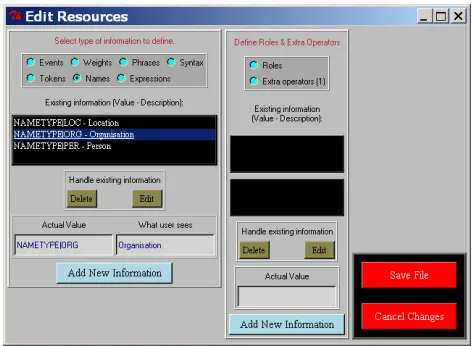
In the Edit Resources GUI (Figure 3), the user can configure the tool to handle new types of events, and manage the main GUI. From the first frame of Edit Resources, the user can handle the information types appearing in the selection lists (e.g. Events, Phrases) of the main GUI. Thus information types and their associated values in the main GUI and the Pattern Representation Language can be modified or discarded and new types can be added. In the second frame of Edit Resources names of roles (i.e. names of slot fillers for specific events) and operators can be added or modified. When the user saves the file by pressing the “Save File” button, they are warned that the application will terminate and must be restarted for changes to take effect.
Figure3. The Edit Resources GUI
5.
Exploitation of PatEdit
In the context of the MITOS-IE system, PatEdit has been used to include new financial events for Greek texts. It has contributed to the rapid development of valid extraction patterns by users familiar with the Pattern Representation Language as well as users who were unfamiliar with it. Extraction rule files have been constructed for 10 financial event templates in total (Acquisitions, Merges, Split, Capital Stock Increase, Introduction to the Athens Stock Exchange Market, Profits, Sales, Free Share Distribution, Turnover, and Dividend Yield). Extraction patterns have been written without the use of PatEdit for the first five events over a period of 4 months, whereas development of extraction patterns for the next 5 events with the use of PatEdit took only 1 month.
Moreover, PatEdit is currently being used in the CROSSMARC4 project, which develops IE technology for multilingual e-retail product comparison. The type of text we deal with in this project is hypertext, which is quite different from flat text news items, and the first domain is Computer Goods. Given the Edit Resources GUI we are able to configure the tool for the new domain and text type with the addition of new events (e.g. Laptop Offer), new slot names associated with them (e.g. IS_MODEL) and new types of information (e.g. title, paragraph, list item).
6.
Concluding Remarks and Future
Development
We have presented PatEdit, an IE system adaptation tool that allows fast construction and editing of information extraction pattern files conforming to a certain Pattern Representation Language.
PatEdit forms a component of the IE technology workbench we are developing in our laboratory over the Ellogon text engineering platform. This workbench involves general purpose language processing tools, annotation tools (for the creation of the necessary training and testing corpus), machine learning tools, facilities for creating training vectors for machine learning, named entity recognition tools (gazetteer lookup, parser), a pattern representation language for the creation of IE patterns, a pattern matcher, as well as
4
the PatEdit. We exploited these tools and facilities for the development of the MITOS-IE system (extraction of information from financial news), which is currently being customized in a different application domain (extraction of products characteristics from web pages) in the context of the CROSSMARC project.
PatEdit can be easily configured for new event templates as well as for variations (presentation of new types of information and new operators) in the Pattern Representation Language. It has been used successfully for adapting MITOS-IE system to new financial events and it is being used in CROSSMARC for the construction of extraction patterns for descriptions of computer goods from Web pages.
The provision of a facility for testing a single extraction pattern against a corpus would be very useful for the patterns author. We intend to incorporate this facility in PatEdit since inspection of results in a large corpus of several texts facilitates the construction of patterns that do not overgenerate, promoting system accuracy. Moreover, comparison of system extraction results to results provided by manual annotation facilitates the construction of general patterns that promote system recall. Currently the user can view and compare extraction results using Ellogon built-in tools but the results come from all the patterns present in a file for a specific event and detecting patterns that have produced erroneous results can be a time consuming process depending on the size of the pattern file.
The incorporation of domain specific resources like term dictionaries and thesauri is also a desired feature that we plan to incorporate in PatEdit. Allowing the user to specify the type of dictionary to use and insert synonyms easily in extraction patterns is our second aim for further development.
References
Català, N., Castell, N., Martín, M. (2000) ESSENCE: a Portable Methodology for Acquiring Information Extraction Patterns. In Proceedings of 14th European Conference on Artificial Intelligence (ECAI-2000) (pp. 411--415). Berlin: IOS Press.
Ciravegna, F., Petrelli, D. (2001) User Involvement in Customizing Adaptive Information Extraction: Position Paper. In Proceedings of the IJCAI-2001 Workshop on Adaptive Text Extraction and Mining held in conjunction with the 17th International Conference on Artificial Intelligence (IJCAI-01), (http://www.smi.ucd.ie/ATEM2001/proceedings/cira vegna-position-atem2001.pdf).
Ciravegna, F., Lavelli, A., Satta, G. (2000) Bringing Information Extraction out of the Labs: the Pinocchio Environment. In Proceedings of the 14th European Conference on Artificial Intelligence (pp. 416--420). Berlin: IOS Press.
Costantino, M. (1997) Financial Information Extraction Using Pre-defined and User-definable templates in the LOLITA System. Phd Thesis, University of Durham.
Doran, C., Niv, M., Baldwin, B., Reynar, J.C. and B. Srinivas (1997). Mother of PERL: A Multi-tier Pattern Description Language. In Proceedings of the Lexically-Driven Information Extraction Workshop
(pp. 13--22). Universita di Roma: Dept. of Computer Science.
Kopanaki, E., Karkaletsis, V., Spyropoulos, C.D., Avradinis, N., Fakotakis, N., Kalamboukis, Th., Kladis, B., Lazarou, Y., Panayiotopoulos, Th.., Spinellis, D. (2001). MITOS: An Integrated Web-based System for Information Management. In Proceedings of the 8th Panhellenic Conference on Informatics, (pp. 328--337). Nicosia, Cyprus: Livanis.
Lehnert, W., McCarthy, J., Soderland, S., Riloff, E., Cardie, C., Peterson, J., Feng, F., Dolan, C., Goldman, S. (1993). UMASS/HUGHES: Description of the Circus System Used for MUC-5. In Proceedings of the Fifth Message Understanding Conference (pp. 277--291). Baltimore: Morgan Kaufmann.
Petasis, G., Karkaletsis, V., Paliouras, G., Androutsopoulos, I., and Spyropoulos, C.D. (2002) “Ellogon: A New Text Engineering Platform”. In Proceedings of the Language Resources and Evaluation Conference (LREC-2002). Las Palmas, Spain.