The Characterization and Study of Physical Parameters of
Ge Modified Se-Sn-Pb Chalcogenide System
Prashant Kumar1,2*, Vivek Modgil2, V. S. Rangra2
1Government Senior Secondary Boys School Lalpani, Shimla, India; 2Department of Physics, H. P. University, Summer Hill, Shimla,
India.
Email: *[email protected], [email protected]
Received March 14th, 2013; revised April 14th, 2013; accepted April 21st, 2013
Copyright © 2013 Prashant Kumar et al. This is an open access article distributed under the Creative Commons Attribution License, which permits unrestricted use, distribution, and reproduction in any medium, provided the original work is properly cited.
ABSTRACT
In the present paper, we have studied the effect of Ge addition on the physical properties of Se-Sn-Pb chalcogenide ma- terial. The necessary physical parameters which have important role in determining the structure and strength of the material viz. constraints, coordination number etc. have been calculated. The increasing trend has been found in cohe-sive energy, heat of atomization and mean bond energy. The glass transition has been studied using the Tichy-Ticha and Lankhorst approaches, which also increases with the increasing Ge contents. The increase in these physical parameters is due to the increasing covalent character in the material.
Keywords: Quaternary Chalcogenide Glasses; Heat of Atomisation; Mean Bond Energy; Glass Transition Temperature; SEM
1. Introduction
Material science investigates the relationship between the structures of material at atomic or molecular scales and their macroscopic properties. Nowadays, in the field of chalcogenide glasses a lot of attention has been devoted to the characterization and improvement of the properties of chalcogenide glasses, especially for those materials which are used in the switching memories. The glass transition temperature and the related nature of the chemical bond are important parameters for characteriza- tion of chalcogenide glasses. These materials can be re- versibly switched between the amorphous and crystalline state and find applications in rewritable optical recording and in electrically programmable non-volatile memories [1-3].
Chalcogenide glasses possess properties intermediate between organic polymers and oxide glasses. These gla- sses are less robust, more weakly bonded materials than oxides [4].The amorphous semiconductor like chalco- genide glasses are basically insensitive to doping and behave as p-type semiconductor because of pinning of Fermi level near the middle of band gap. A long standing and important problem in Se-Ge-Pb based chalcogenide glasses has been Carrier Type Reversal (CTR). However,
it has been realized by Mott that charged additives could change the ratio of valence-alternation pairs to such an extent that the Fermi energy could become unpinned, which causes carrier type reversal in certain chalcogenide systems. Metallic additives such as Bi and Pb in chalco- genide glasses enter the network as charged species, al- tering the concentration of valence-alternation pairs, which is located closely above the loan pair band of sele- nium. This feature makes Pb unique in the contest to p to n transition of chalcogenide glasses [5-9].
2. Experimental Details
Bulk samples of Se74Sn8Pb18−xGex (x = 3, 7, 8, 9, 10, 11)
have been prepared by conventional melt quenching technique. High purity (99.999%) elements Ge, Se, Sn and Pb in the appropriate weight proportion are weighed and vacuum sealed (10−6 Pa) in quartz ampoules and heated up to 980˚C in a rocking furnace at a heating rate of 3˚C - 4˚C/min. The ampoules are frequently rocked at the highest temperature for 8 hrs. The quenching is done in ice-cold water immediately after taking out the am- poules from the furnace. The ampoules are then dipped in HF + H2O2 solution in order to remove the sticky ma- terial from the quartz tube.
The bulk material is finally grinded to powder, then
the diffraction patterns of the material are taken with Philips Xpert-Pro diffractometer PW3050/60 having step size 0.034 using Cu-Kα radiation (λ = 1.54837 Å) as shown in Figure 1. The absence of any sharp peaks in X- ray difractrograms shows the amorphous nature of mate-rial Se74Sn8Pb18−x Gex (x = 7, 8, 9, 10, 11 at %). But at x =
3 the sample becomes crystalline as shown in inset of XRD difractrograms in Figure1.
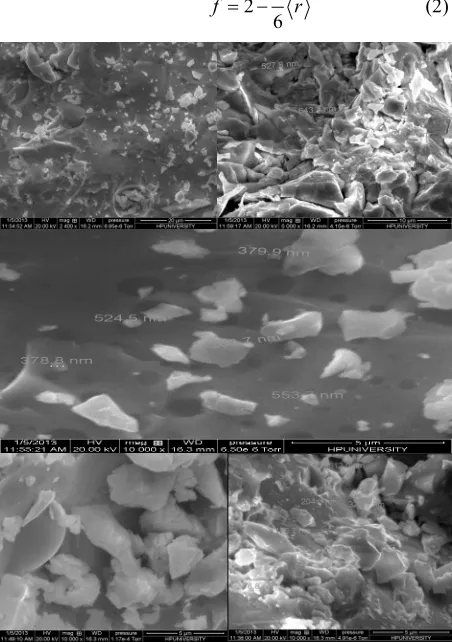
Scanning electron microscope is the technique which is used to know the surface morphology and structure of the material. We are observing some structural inhomo- genieties in material which are due to partial nano phase separation, as is clear in the SEM micrographs as shown in Figure 2. The phase separation in the material is also confirmed from the presence of halos in the X-ray dif- fractograms.
3. Theoretical Study and Discussion
The various parameters viz. coordination number, frac- tion of floppy modes, loan pairs, heat of atomization, bond energy, cohesive energy and glass transition tem- perature are calculated for our Se-Sn-Ge-Pb quaternary chalcogenide glassy system.
3.1. Coordination Number and Constraints Phillips, Thorpe and Tanaka have introduced in the con- straint theories that there exist two topological thresholds 2.4 and 2.67 known as mechanical and chemical thresh- olds. The Chalcogenide glasses with coordination number
r less than 2.4 are under constrained or loosely con- nected (polymeric glasses) and glasses with r greater than 2.4 are over constrained or rigidly connected (amor- phous solids) [10]. The chemical threshold at r = 2.67 corresponds to a structural transition from a two-dimen- sional to a three-dimensional network. It has also been predicted that there exists a critical composition corre- sponding to an average coordination number r = 2.4,
10 20 30 40 50 60 70 80 50
100 150 200 250
10 20 30 40 50 60 70 0
1000 2000 3000 4000 5000
In
tens
it
y
(
a
rb
.uni
t)
Angle(2) x=3
In
tensi
ty
(
a
rb
.uni
t)
Angle(2)
[image:2.595.310.536.388.709.2]x=5 x=7 x=8 x=9 x=10 x=11
Figure 1. X-Ray Diffactograms of the chalcogenide compo- sitions Se74Sn8Pb18−xGex (3 ≤x≤ 11).
at which the number of constraints are balanced by the number of degrees of freedom (Nd) available in the net- work i.e. (Nco = Nd). At this stage the tendency of glass formation is maximum and is known as rigidity percola- tion threshold. For mechanical constraints there exist two constraints Nα = r/2 is known as bond stretching con-
straints per atom and Nβ = 2r− 3 is known as bond bend-
ing constraints per atom on the network.
The total number of constraints are given by Nco = Nα
+ Nβ. In our quarternary system the value of r varies
from 2.30 to 2.38 and approaches mechanical threshold. The total number of constraints (Nco) plays an important role in structural determination. The average coordina- tion number r has been calculated using the relation
Se Ge Pb Sn
100
N N N N
r (1)
where α, β, γ and δ are the at % of Se, Ge, Pb and Sn respectively and NGe = 4, NSe = 2, NPb = 2 and NSn = 4 are coordination numbers. M. F. Thorpe [11] has pointed out that under coordinated networks would possess a finite fraction of zero frequency normal vibrational modes, floppy modes. The fraction, f of zero frequency modes is given as
5 2
6
f r (2)
[image:2.595.62.284.554.707.2]Here r is the average coordination number. In our system the number of floppy modes are approaching zero with the addition of Ge. So system is passing from floppy network to rigid network [12-14]. The average coordina- tion number r , bond stretching constraints (Nα), bond
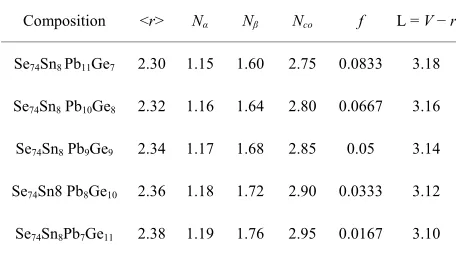
bending constraints (Nβ), average number of constraints Nco = Nα+Nβ, fraction of floppy modes (f) and loan pair
(L) for various compositions with Ge are listed in Table 1.
3.2. Role of Lone Pair Electrons in the Glass Forming Ability
The number of lone pairs of a chalcogenide glass system has been calculated by the method proposed by Phillips
L V r (3)
Here L and V are lone pair electrons and valence elec- trons respectively. For the glassy system Se74Sn8Pb18−xGex
(x = 7, 8, 9, 10, 11 at%) the number of lone pair electrons are obtained by using equation (3) and are listed in Table 1. It is inferred from the Table 1 and Figure 3 that with the increase in content of Ge the number of lone pair of electrons decreases continuously for the Se74Sn8Pb18−xGex
(x = 7, 8, 9, 10, 11) glassy system. This result is caused by the interaction between the Ge ion and the lone pair elec- trons of a bridging Se atom. The interaction decreases the number of lone-pair electrons in the glassy system. Ac- cording to Zhenhua, lone pair electrons are necessary for obtaining the system in its vitreous state [15,16].
3.3. Deviation from the Stoichiometry of Composition
The parameter R which determines the deviation from stoichiometry is expressed by the ratio of covalent bond- ing possibilities of chalcogen atom to that of non-chalco- gen atoms. For the SeαGeβPbγSnδ system, the quantity R
[image:3.595.311.538.89.228.2]is defined by
Table 1. The average coordination number <r>, bond bend- ing constraints Nα, bond bending constraints Nβ, average
number of constraints Nco = Nα + Nβ fraction of floppy
modes (f) and loan pair (L) for various compositions.
Composition <r> Nα Nβ Nco f L = V−r
Se74Sn8 Pb11Ge7 2.30 1.15 1.60 2.75 0.0833 3.18
Se74Sn8 Pb10Ge8 2.32 1.16 1.64 2.80 0.0667 3.16
Se74Sn8 Pb9Ge9 2.34 1.17 1.68 2.85 0.05 3.14
Se74Sn8 Pb8Ge10 2.36 1.18 1.72 2.90 0.0333 3.12
Se74Sn8Pb7Ge11 2.38 1.19 1.76 2.95 0.0167 3.10
2.30 2.32 2.34 2.36 2.38
2.7 2.8 2.9 3.0 3.1 3.2
Loa
n P
a
ir
s
/
N
um
b
er
of
C
o
ns
tr
ai
n
ts
Coordination number<r> Loan Pairs
[image:3.595.57.285.607.734.2]No.of Constraints
Figure 3.Variation of loan pairs and number of constraints with coordination number of Se74Sn8Pb18−xGex (x = 7, 8, 9,
10, 11) glassy system.
Se
Ge Pb Sn
Z R
Z Z Z
(4) where α, β, γ and δ are the atomic fractions of Ge, Se, Pb, and Sn respectively. The threshold at R = 1 the point of existence of only heteropolar bonds marks the minimum selenium content For R > 1, system is chalcogen rich. In our composition Se74Sn8Pb18−xGex the deviation from the
stoichimetry is R > 1, which shows chalcogen rich sys- tem [17,18].
3.4. Bond Energy and Cohesive Energy
In chalcogenide system Se74Sn8Pb18−xGex (x = 7, 8, 9, 10,
11), there is comparatively more probability of bonds formation of the heteropolar bonds as compare to ho- mopolar bonds. The chemically ordered network (CON) [19] model has suggested that heteropolar bonds are pre- ferred over homopolar bonds and they are formed in the order of their decreasing bond energy. The Ge-Se glassy system is a covalent chalcogenide system. From Raman scattering studies, it has been realized that the local structure of Ge-Se glasses consists of chain segments of edge-sharing GeSe2 and corner-sharing GeSe4 tetrahe- dral structure which produces more attracting sites for impurities atoms when added to the material. These have a pronounced effect on the structure of amorphous mate- rial. In selenium based chalcogenide glasses the metallic atoms play a dual role as network modifiers in Se rich side and network formers in Se deficient side and chan- ges the properties considerably [19].
The bond energy of heteropolar bonds can be calcu- lated by the method suggested by Pauling using the bond energy of homopolar bonds and the electronegativity of the atoms involved. The bond energy of heteronuclear bond is given by
1
-
-2 2
- 30 A B
A B A A B B
D D D
(5)and D(B-B) are the bond energies of homonuclear bonds
The bond energies of the bonds are taken as Se-Se = 44.00 Kcal/mol, Ge-Ge = 37.60 Kcal/mol Sn-Sn = 34.20 Kcal/mol, Pb-Pb = 20.48 Kcal/mol Se-Ge = 49.41 Kcal/mol, Se-Sn = 49.23 Kcal/mol, Se-Pb = 31.47 Kcal/mol respectably [12]. χA and χB are the electronega- tivity values of A and B respectively. The electronegati- vities for Se, Ge, Sn and Pb according to pauling scale are 2.55, 2.01, 1.96 and 2.33 respectively [20,21].
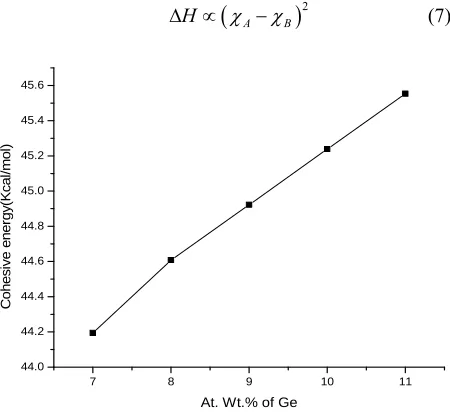
The Ge-Se bonds have higher bond energy than Pb-Se bonds. In the present Se-Sn-Ge-Pb system, the substitu- tion of Ge with Pb atom results in the increase of Ge-Se bonds and a reduction in Pb-Se bonds. The nature of the Pb-Se bond is ionocovalent and that of Ge-Se bond has covalent character. Thus increasing concentration of Ge- Se bonds causes the increasing covalent character in the material hence strengthening the network [22,23]. So the addition of Ge results in an increase in the cohesive en-ergy of Se74Sn8Pb18−xGex (where x = 7, 8, 9, 10, 11)
sys-tem as shown in Figure 4.
The cohesive energies of the compositions are tabulated in Table 2.3.5. Average Heat of Atomization
According to Pauling the heat of atomization HS (A-B) at standard temperature and pressure of a binary semicon- ductor formed from atoms A and B is the sum of the heat of formation ΔH and the average of the heats of atomiza- tion of A
S
H and B
S
H that corresponds to the average non polar bond energy of the two atoms [18,19].
-
1
2
A B
S S
H A B H H HS
(6)
The first term in the Equation (9) is proportional to the square of the difference between the electronegativities
χA and χB of the two atoms
2A B
H
(7)
7 8 9 10 11
44.0 44.2 44.4 44.6 44.8 45.0 45.2 45.4 45.6
C
ohesi
v
e e
ner
gy
(K
cal
/m
ol
)
[image:4.595.311.533.402.559.2]At. Wt.% of Ge
Figure 4. Variation of cohesive energy with Ge content.
The average heat of atomization Hs is defined for a quaternary compound. AαBβCγDδ, as [24]
A B C
S S S
S
D S
H H H H
H
(8) where α, β, γ and δ are the atomic percentages of A, B, C
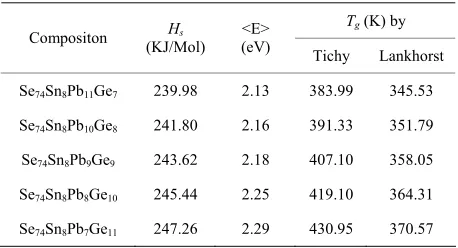
and D respectively. In case of chalcogenide glasses the heat of formation contributes very little towards the ave- rage heat of atomization because the electro negativities of the constituent elements are very similar and in most of the cases of chalcogenide glasses the heat of formation is unknown. In the few materials for which heat of for- mation is known it accounts only 10% for the heat of atomization and is therefore neglected. The heat of ato- mization are as, Hs (Pb) = 195 KJ/mol, Hs (Sn) = 302 KJ/mol, Hs (Se) = 227 KJ/mol, Hs (Ge) = 377 KJ/mol [25-27]. The values of heat of atomization for chalco- genide glasses are given in Table 3.
The variation of the heat of the atomization with in- creasing the Ge content is shown in Figure 5. It is evi- dent from the Figure 5 that with increasing the concen- tration of the Ge (or decreasing the concentration of Pb) there is an increase in the heat of the atomization, this is due to the fact that heat of atomization of Ge is greater than that of Pb, that is why there is an increase in the heat
7 8 9 10 11
239 240 241 242 243 244 245 246 247 248
hea
t of
at
o
m
iz
at
ion
[image:4.595.62.287.515.721.2]Ge At.%age
[image:4.595.310.538.613.734.2]Figure 5. Variation of heat of atomization with Ge content.
Table 2. The Distribution of various possible bonds in Se74Sn8Pb18−xGex glasses and cohesive energy.
Bonds formed
x
Se-Pb Se-Ge Sn-Se Se-Se Cohesive
energy (Kcal/mol)
x = 7 0.1486 0.1892 0.2162 0.4460 44.19
x = 8 0.1351 0.2162 0.2162 0.4325 44.61
x = 9 0.1216 0.2432 0.2162 0.4190 44.92
x = 10 0.1081 0.2703 0.2162 0.4054 45.24
of the atomization of the material with increasing Ge content. As a result of which network of the material strengthen and heat of atomization of the material increa- ses.
3.6. Mean Bond Energy and Glass Transition Temperature
Considerable attention has been devoted to the prediction of glass transition temperature (Tg) of chalcogenide based glasses. Thorpe and Tichy [28] were first to recognize that in a chemically ordered system, there should be an excellent empirical correlation between the glass transi- tion temperature (Tg) and overall mean bond energy. There is one another model proposed by Lankhorst [29] in order to estimate the glass transition temperature (Tg) especially for phase change materials. In this approach the glass transition temperature (Tg) is estimated using enthalpy of atomization.
The covalent bond approach of Tichy and Ticha [17,18] may be considered as a first approximation in the case of chalcogenide glasses. The glass transition temperature is considered to be proportional to the mean bond energy
E , which depends on factors like average coordination number, degree of cross linking, bond energy and the nature of the bonds. The overall mean bond energy for the system SeaGebSncPbd is given by
cl rm
E E E (9)
where Ecl is the mean bond energy of average cross link- ing per atom and Erm is the average bond energy per atom of the remaining matrix of bonds using a set of 186 glasses.
cl r hb
E P D (10) Here Pr is the degree of cross linking and Dhb is the average heteropolar bond energy, Tichy and Ticha illu- strated an impressive correlation of Tg with mean bond energy in the form
311 0.9
g
T E (11)
Lankhorst [28] found an empirical relation between Tg
(Kelvin) and enthalpy of atomization Hs (kJ/g atom) which is given by
3.44 480
g s
T H (12) The slope of 3.44 is in reasonable agreement with the value of 311 K/eV or 3.23 K/(kJ/g atom) found by Tichy and Ticha who used a slightly different set of bond ener- gies. The compositional variations of glass transition temperature studied by Tichy Ticha and Lankhorst ap- proaches are shown in Figure 6, the embedded inset shows the variation of bond energy with Ge content.
And respective values of Tg and E are tabulated in the Table 3.
7 8 9 10 11
340 350 360 370 380 390 400 410 420 430 440 450
7 8 9 10 11 2.12
2.14 2.16 2.18 2.20 2.22 2.24 2.26 2.28 2.30
M
ean bo
nd E
ner
gy
(ev
)
At. Wt.% of Ge
Tg
(K
el
v
in)
At.Wt.% of Ge
[image:5.595.311.536.86.243.2]Tichy Lankhorst
Figure 6.Variation of glass transition temperature (Tg) with
Ge content.
Table 3.Values of average heat of atomization (Hs), mean
bond energy <E> and glass transition temperature Tg (K) of
chalcogenide system.
Tg (K) by
Compositon Hs
(KJ/Mol)
<E>
(eV) Tichy Lankhorst
Se74Sn8Pb11Ge7 239.98 2.13 383.99 345.53
Se74Sn8Pb10Ge8 241.80 2.16 391.33 351.79
Se74Sn8Pb9Ge9 243.62 2.18 407.10 358.05
Se74Sn8Pb8Ge10 245.44 2.25 419.10 364.31
Se74Sn8Pb7Ge11 247.26 2.29 430.95 370.57
4. Conclusion
The material Se74Sn8Pb18−xGex (x = 7, 8, 9, 10, 11)
formed is amorphous in natures as confirmed through XRD. The sample at x = 3 is crystalline in nature that might be due to under constrained network having low coordination number. There are some structural inhomo- geneities in the material which might be due to partial phase separation as it is obvious in the XRD diffracto- grams and SEM micrographs also. Increasing Ge content increases the degree of cross linking and produces the condition for good glass formation. The physical para- meters such as heat of atomization, cohesive energy and mean bond energy have monotonic increasing trend as a consequent of increased degree of cross linking in glassy matrix and hence glass transition temperature of the ma- terial also increases.
REFERENCES
[1] S. R. Ovshinsky, “Reversible Electrical Switching Phe- nomena in Disordered Structures,” Physical Review Let- ters, Vol. 21, No. 20, 1968, pp. 1450-1453.
[image:5.595.309.538.319.443.2][2] S. Ovshinsky, “Amorphous Materials—The Key to New Devices,” IEEE Proceedings of Circuits and Systems, Vol. 1, 1998, p. 33.
[3] J. Feinleib, J. de Neufville, S. C. Moss and S. R. Ovshin- sky, “Rapid Reversible Light-Induced Crystallization of Amorphous Semiconductors,” Applied Physics Letters, Vol. 18, No. 6, 1971, pp. 254-257.
http://dx.doi.org/10.1063/1.1653653
[4] A. B. Seddon, “Chalcogenide Glasses: A Review of Their Preparation, Properties and Applications,” Journal of Non-Crystalline Solids, Vol. 184, 1995, pp. 44-50.
http://dx.doi.org/10.1016/0022-3093(94)00686-5
[5] B. Vaidhyanathan, S. Murugavel, S. Asokan and K. J. Rao, “Origin of Carrier-Type Reversal in Pb-Ge-Se Glasses: A Detailed Thermal, Electrical, and Structural Study,” The Journal of Physical Chemistry B, Vol. 101, No. 47, 1997, pp. 9717-9726.
http://dx.doi.org/10.1021/jp972129+
[6] S. Murugavel and S. Asokan, “Carrier-Type Reversal in Pb-Modified Chalcogenide Glasses,” Physical Review B, Vol. 58, No. 8, 1998, pp. 4449-4453.
http://dx.doi.org/10.1103/PhysRevB.58.4449
[7] R. Ganesan, B. Thangaraju, K. S. Sangunni and E. S. R. Gopal, “Carrier Type Reversal in PbxGe42−xSe58 and
Pb20GeySe80−y Glasses Exhibited in Thermal Diffusivity Measurements,” Journal of Optoelectronics and Advan- ced Materials, Vol. 3, No. 2, 2001, pp. 467-472.
[8] S. Jayakumar, P. Predeep and C. Harikuttan Unnithan, “Topology of Chemical Ordering in Sb-S-Ge System,”
Physica Scripta, Vol. 66, No. 2, 2002, pp. 180-182.
http://dx.doi.org/10.1238/Physica.Regular.066a00180 [9] N. F. Mott and E. A. Davis, “Electronic Processes in
Non-Crystalline Materials,” Clarendon Press, Oxford, 1979.
[10] G. G. Naumis, “Contribution of Floppy Modes to the Heat Capacity Jump and Fragility in Chalcogenide Gla- sses,” Physical Review B, Vol. 61, No. 14, 2000, pp. R9205-R9208.
[11] M. F. Thorpe, “Continuous Deformations in Random Networks,” Journal of Non-Crystalline Solids, Vol. 57, 1983, pp. 355-370.
http://dx.doi.org/10.1016/0022-3093(83)90424-6 [12] V. Modgil and V. S. Rangra, “The Study of the
Theoreti-cal Parameters of Ge Sn Substituted Pb Based Quaternary Chalcogenide Glasses at Their Rigidity Percolation Thres- hold,” Journal of Optoelectronic and Advanced Materials, Vol. 13, No. 2, 2011, pp. 158-164.
[13] P. Boolchand, D. G. Georgiev and B. Goodman, “Dis- covery of the Intermediate Phase in Chalcogenide Gla- sses,” Journal of Optoelectronics and Advanced Materials, Vol. 3, No. 3, 2001, pp. 703-720.
[14] P. K. Gupta and J. C. Mauro, “Composition Dependence of Glass Transition Temperature and Fragility. l. A Topo- logical Model Incorporating Temperature-Dependent Con-
straints,” The Journal of Chemical Physics, Vol. 130, No. 9, 2009, Article ID: 094503.
http://dx.doi.org/10.1063/1.3077168
[15] A. George, D. Sushamma and P. Predeep, “Effect of In- dium Content on the Optical and Other Physical Charac- terstics of As-Te Glass System,” Chalcogenide Letters, Vol. 3, No. 4, 2006, pp. 33-39.
[16] Z. H. Liang, “Chemical Bond Approach to the Chalco- genide Glass Forming Tendency,” Journal of Non-Cry- stalline Solids,Vol. 127, No. 6, 1991, pp. 298-305.
http://dx.doi.org/10.1016/0022-3093(91)90482-L
[17] L. Tichy and H. Ticha, “On the Chemical Threshold in Chalcogenide Glasses,” Materials Letters, Vol. 21, No. 3-4, 1994, pp. 313-319.
http://dx.doi.org/10.1016/0167-577X(94)90196-1
[18] L. Tichy and H. Ticha, “Covalent Bond Approach to the Glass-Transition Temperature of Chalcogenide Glasses,”
Journal of Non-Crystalline Solids, Vol. 189, No. 1-2, 1995, pp. 141-146.
[19] S. R Elliot, “Physics of Amorphous Solids,” Longman Inc., New York, 1984.
[20] L. Pauling, “The Nature of the Chemical Bond,” Cornell University Press, New York, 1960.
[21] A. K. Pattanaik and A. Srinivasan, “Electrical and Optical Studies on Pb-Modified Amorphous Ge-Se-Te Films,”
Semiconductor Science and Technology, Vol. 19, No. 2, 2004, p. 157.
[22] I. Haruvi-Busnach, “Chalcogenide Glasses Ge-Sn-Se, Ge-Se-Te, and Ge-Sn-Se-Te for Infrared Optical Fibers,”
Journal of Materials Research, Vol. 5, No. 6, 1990, pp. 1215-1223.
[23] S. A. Fayek and S. S. Fouad, “Topological Consideration of Thallium on Glassy Arsenous Selenide,” Vacuum, Vol. 52, No. 3, 1998, pp. 359-363.
http://dx.doi.org/10.1016/S0042-207X(98)00322-4 [24] A. Dahshan and K. A. Aly, “Characterization of New
Quaternary Chalcogenide As-Ge-Se-Sb Thin Films,” Phi- losophical Magazine, Vol. 88, No. 3, 2008, pp. 361-372. [25] H. Ellis, “Nuffield Advanced Science Book of Data,”
Longman, London, 1972.
[26] A. M. James and M. P. Lord, “Macmillan’s Chemical and Physical Data,” Macmillan, London, 1992.
[27] J. D. Cox, D. D. Wagman and V. A. Medvedev, “CO- DATA Key Values for Thermodynamics,” Hemisphere Publishing Corp., New York, 1989.
[28] M. F. Thorpe and L. Tichy, “Properties and Applications of Amorphous Materials,” Kluwer Academic Press, Dor- drecht, 2001.