Make any warranty or representation, express or implied, with respect to the accuracy, completeness, or usefulness of the information contained in this document, or that the use of any information, apparatus, method, or process disclosed in this document may not infringe privately owned rights; or
EUR 3559 e
A N A P A C H E " S U B R O U T I N E " F O R G E N E R A T I N G P A D E S CIRCUITS by C. B O N A
European Atomic Energy Community - E U R A T O M Joint Nuclear Research Center - Ispra Establishment (Italy) Scientific Information Processing Center - CET1S
Brussels, August 1967 - 22 Pages - 8 Figures - FB 40
W i t h A P A C H E it is possible to write programs corresponding to analog circuits of common use which can be considered as the " Subroutines " or " Functions " in digital programs.
In fact, when a problem requires a circuit for which a subroutine has been written one can avoid to write the corresponding equations just
EUR 3559 e
A N A P A C H E " S U B R O U T I N E " F O R G E N E R A T I N G P A D E S CIRCUITS by C. B O N A
European Atomic Energy Community - E U R A T O M Joint Nuclear Research Center - Ispra Establishment (Italy) Scientific Information Processing Center - CETIS
Brussels, August 1967 - 22 Pages - 8 Figures - FB 40
W i t h A P A C H E it is possible to write programs corresponding to analog circuits of common use which can be considered as the " Subroutines " or " Functions " in digital programs.
by adding the deck constituting the subroutine to the A P A C H E deck representing the problem.
In the following, two subroutines for generating any number of Pade's circuits for fixed and variable time delays are described.
by adding tbe deck constituting the subroutine to the A P A C H E deck representing tbe problem.
EUR 3559 e
EUROPEAN ATOMIC ENERGY COMMUNITY - EURATOM
AN APACHE "SUBROUTINE" FOR GENERATING PADE'S CIRCUITS
by
C. BONA
1 9 6 7
Joint Nuclear Research Center Ispra Establishment - Italy
SUMMARY
Witb APACHE it is possible to write programs corresponding to analog circuits of · common use wbich can be considered as tbe " Subroutines " or " Functions " in digital programs.
In fact, when a problem requires a circuit for whicb a subroutine bas been written one can avoid to write tbe corresponding equations just by adding tbe deck constituting tbe subroutine to tbe APACHE deck representing tbe problem.
In tbe following, two subroutines for generating any number of Pade s circuits for fixed and variable time delays are described.
KEYWORDS
PROGRAMMING, COMPUTERS,
ANALOG SYSTEMS, DIGITAL SYSTEMS, CIRCUITS.
An APACHE "Subroutine" for Generating Pade's circuits ^
INTRODUCTION
When, in the framework of a larger job, a circuit to
simulate a fixed or variable delay is needed, a lot of tedious work has to be done to implement one of the many circuits which approximate the delay operator (Pade approximation, Bode
approximation, etc.)
In fact there are no conceptual difficulties, as these circuits are well defined and very efficient formulas are provided to calculate the order of approximation needed based on the maximum frequency to be delayed and on the length of the delay.
The only difficulty which may arise is the choice of the scale factors to be given to each intermediate variable, the other things that one has to do being routine works like
computing the pot setting values and drawing the circuit etc. With APACHE (foot note 1) all these routine works are avoided, being automatically done by the compiler, while a new problem arises: the given transfer functions must be
transformed in a system of differential equations of first order; besides an estimate must be given of the maximum values of all variables.
On the other side with APACHE the program corresponding to a given circuit can be written once for ever, punched on cards and kept for every time it is needed.
But there is still something more, with APACHE one need not to write for each order of approximation the
appropriate program, it is possible to write the program in such a way to generate as many different delay circuits as
needed , and each of them of the desired order.
This has been done for the Pade circuit both for fixed and variable time delays,.
The aim of this work is to present these two APACHE "Subroutines" (foot note 1) and to give an idea of how they have been written.
How to use the programs
The procedure for using these programs, which consist of two decks of approximately 50 cards each, is very simple: 1) Add the deck (or the decks) to the deck of cards
representing your problem
2) Add the following statements: (only those requested by the type of delay you need in your problem)
a) For fixed time delays
EQUATIONS
FF(i) = name of the i variable to be delayed Name of the i variable delayed = GF(i)
PARAMETERS
NRITF = number of delay circuits requested
ORITF(i) = order of the i delay circuit (up to 20)
• · ° th TRFIX(i) = value (in sec.) of the i delay
0 · ° th
FFINZ(i) = value of the i variable to be delayed at t=0
5.
b) Por variable time delays
EQUATIONS
FV(i) = name of the i variable to be delayed
Name of the it h variable delayed = GV(i)
• · ·
PARAMETERS
NRITV = number of delay circuits requested
o o . .fïi
ORITV(i) = order of the i delay circuit (up to 20)
• ° ° th
TVINZ(i) = length of the i delay at t=0
• » · th
TVMIN(i) = maximum length of the i delay
• · * th
TVMAX(i) n maximum length of the i delay
e o o -I- u
TVINZ(i) = value of the i variable to be delayed at t=0
• · o th
FVMAX(i) = maximum value of the i variable to be delayed
Pade's approximation of e"I>'t
As ie well known, the transfer function of a pure time
delay can be approximated as follows (n order Pade's approximation):
1) G ( S ) / F ( S ) = β"8τ " Pn/ Qn
where G(s) = £(F(t-t)) and F(s) =<£(F(t)) and
Pn = ho - h1.(s-v) + ... + (-l)i.hi.(8T)i+...f(-l)n.hn.(8't)n
Qn = ho + ^ . ( β τ ) + +h1(8ir)i+ + \ ( β τ )η
h , Λ h _ */n h - .η(η-ΐ)·«»(η-1+ΐ)
no - 1' ni - 1'2»··· ni - 2n(2n-1)...(2n-i+1).i! »*··
Note that Ρ is quite the same as Q except for the sign
τ Vi
of the i terms for odd values of i.
h h , H )1. ! ! , * ■
2) 9 " . (P-G) V T . ( F + G ) + . . . + -r-r* ( F - ( - 1 )1. G ) + . . .+
( S T )1 1 ( S T )1 1"1 ( S T )1 1"1
( H )n. h
+ — — ^ . ( P - ( - l )n. G ) = O
( S T )
VI I
and s u b s t i t u t i n g k ^ * lon) ι t o ni
3)
o'
A
T s i
1
[
C_1 )n
"
ÌeP
"
G
]
=
°
k
°
= 1
' ' " * '
k? =
l^
which is the classical expression from which the Pade's circuit
is deduced.
APACHE equations for the Pade's circuit
The easiest way to deduce from eq.3 the Pade's circuit is
to rewrite it as follows
3') G = (-l)
n.F
+Q, ; Q =
Ì
±-ïi-j f(-1
J ^ . F - G I1 Ί
1
(ST)1L J
Thus G can be obtained by adding to Q. + F or -F depending on the order (n) of the Pade desired.
Q in its turn is made up by integrating several times terms like (-F-G) and (+F-G) and by summing them up.
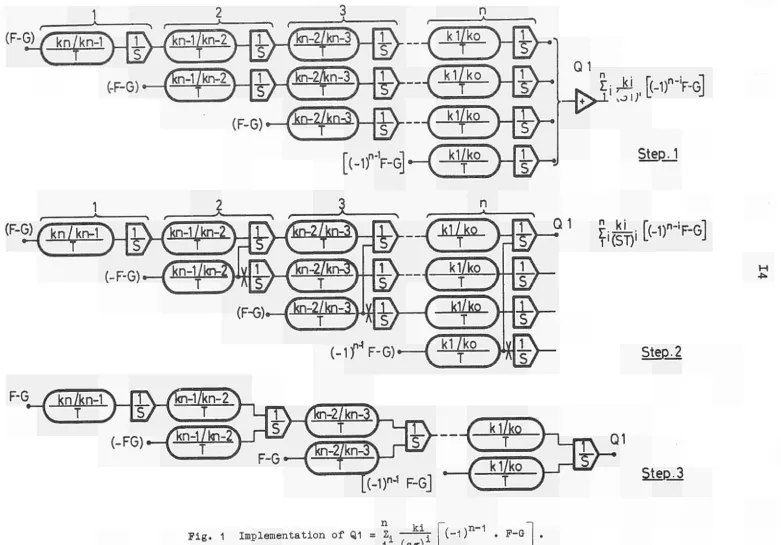
Fig.1 shows, in three steps, for clearness' sake, how Q. can be obtained by a simple chain of amplifiers, (no sign inversion is considered here)
Note how the gains have been split between stages; this
kJ (n+i)(n-i+l)
Ki-1 1
Having Q., G is immediately obtained by combining it with F and the circuit completed by feeding back F±G.
In fig. 2 both schemes for n odd and even are reported. The circuit for variable time delays can be deduced in the same way, but it must be remembered that eq.2 is no more rigorous, as well as the splitting of the term -*- between the
τ different integration stageso
However, experience shows that the circuits in figo3 give a rather good approximation of a variable time delay provided that the delay (τ) is slowly varying with respect to F.
The APACHE equations for the Pade circuit for fixed and variable delays are easily deduced from fig. 2 and 3 where the circuits for an even and an odd Pade order (N) are reportedo (no sign inversion is considered there)
The names between square brackets are the names used in the APACHE program.
Note that, for reasons which will be explained later, the variables which are output from integrators may have two
different names depending on the I.C. value of the function to be delayed.
In fig. k and 5 the complete listing of the APACHE programs for fixed and variable Pade circuits are reported.
We leave to the readers to go through the equations in
8
Note how, by means of the APACHE "DO" statement and of the option "NULL", it has been possible to write one program for generating whatever number of Pade circuits of any desired order (up to 20). (Foot note 2)
Variables scaling
No problem arises for scaling variables like GF(k) and GV(k) (fig. 2 and 3) whose maximum value is obviously equal to the maximum value of the variables FF(k) and FV(k) to be delayed, (these values, called FFMAX(k) and FVMAX(k), must be given by the user).
FQFIX(k), GQFIX(k), QNFIX(k,l) which, according to the
Pade's order are equal to ±FF(k), -GF(k), ±FF(k)+GF(k), have been scaled assuming a maximum equal to 2 * FFMAX(k), which is
conservative.
To scale the intermediate variables QNFIX(k,i) (QNVAR(k,i) and SNVAR(k,i) for variable delays), whose maximum values are not easily predictable, the transfer function between each of them and FF(k) has been calculated and then, looking at their Bode diagrams, it has been found that, for any value of k and i, their amplitude never exceeds the value of 2.2, thus even for these variables a maximum value equal to 2 * FFMAX(k) has been taken·
As an example, the amplitude vs. frequency diagrams of JÊ,(QNFIX(k,i))/2(FF(k)) for a Pade of the fourth order have
Set of INITIAL CONDITION values for static check
The IC values of the variables of a Pade circuit depend on
the values of the function to be delayed and its derivatives τ
seconds earlier; we supposed that our Pade circuits will always
be used in connection with systems being stationary for t < 0,
(foot note 3) thus the IC value for the Pade can be easily deduced
imposing that all derivative be zero; we have : (fig. 2)
C 2.F(t=0) for 1 EVEN
Ν EVEN
L 0 for 1 ODD
Q (t=0) «
r 0 for i EVEN
Ν ODD
I 2.F(t=0) for 1 ODD
(N = Pade*β circuit order)
In order to be able to make a complete static check of
the circuit, the I.Co conditions which are zero must be
changed into some new fictive IC conditions to be taken from
the TEST reference.
The problem, which is well known by analogists, is to choose
some fictive IC condition which causes the voltages all over the
circuit to be different from zero but not greater then 100V and
at the same time to minimize the number of potentiometers
requested for it·
In fig. 8 the schemes in fig. 2 are repeated writing
beside each element the corresponding IC condition for both
cases F(t=0)¿0 and F(t=0)=0«
(This figure corresponds to the analog schemes as deduced from
IO
Note the additional terms from the TEST reference which have been added to the summers which compute GF(k), FQFIX(k) and GQFIX(k) to have a complete set of IC ¿ 0 and 100V with only two potentiometers. (Foot note 3)
As it is impossible to use the NULL option in connection with the variable list (i.e<> to introduce the comment TEST in a variable definition depending on the value of its IC), to cover all possible cases we have been obliged to write three sets of equations, which hold respectively for:
1) F(t=0) = 0
2) F(t=0) jé 0 N EVEN 3) F(t=0) ¿ 0 N ODD
These three sets of equations are all included in the deck, the appropriate set being selected by deleting the other two by means of the NULL option (see fig. k and 5 and
coefficient CXF(j), GXF(j) and the DO statement DO, j=0RIFT(k),..0)
CONCLUSIONS
Our experience has shown that to the computer user a lot of thinking and of tedious work is avoided by means of these routines, therefore we are looking forward to see if it is possible to write APACHE subroutines for other circuits of
common use. (e.g. for blocks whose transfer function is assigned)
II
some sort of IF statement (or NULL option) at Parameter and Variable level, which oblige to use fixed names, indexed variables etc. (see above).
Therefore, in the new APACHE version, which is being written now, all these points will be considered.
12
Foot note 1
APACHE is a digital program which, starting from a set of equations written in a very intuitive language, performs all the necessary operations to implement them on an analog computer i.e.
a) Reduces the equation in a Standard form corresponding to the characteristic of the analogue elements which will compute them.
b) Performs the scaling of the equations and computes the setting values of potentiometers.
c) Computes the static check value of every element in the circuits.
For further details see : Simulation March I965 and January 1966 and item 1 in the enclosed bibliography.
An attempt of writing two Apache subroutines like those presented in this paper was done since I963 by J. Gamp
(Bibliography 3 and 1+) but only with the last version of the code (July 1965) it has been possible to write them in a really general and usable way.
Obviously, due to the parallel nature of the Apache
language, the similarity between APACHE and Fortran subroutines is only formal and consists in the fact that both represent a part of the program that is written once for all.
Thus the user will not find neither CALL or RETURN or
13
Foot note 2
The APACHE "DO" statement is formally similar to the
FORTRAN DO statement but has a different meaning. The APACHE DO is only a means to get greater compactness when many similar equations have to be written (ex. partial differential equations implemented by finite difference method); it does not mean:
perform the computation within the DO range for all the indicated values of the indexes, but : consider the equation within the DO range as being written for all the indicated values of the
indexes and generate the corresponding circuits.
The NULL option is a means to delete some equations or some part of them: any equation or term which is multiplied by a parameter whose value in the parameter list is 0, NULL is automatically deleted from the problem.
The aim of this option is to give the possibility to include in the range of a DO equations which differ between each other depending on the value of the index.
Foot note 3
The terms +TREF, which in the Apache listing will appear as an "external" variables, correspond to the test reference voltage; the elements which have an input fed by this variable must be
n
(F
(-F-G)
[(-irV-o]-(SH£H
CM
SteeJ
A
n
(
.FG, _ ^ g ) J j ( | ^ - ^ g )
(F-G)^D^D^
φ-£59
© - ( Æ )
H
StepJ?
F-G
Akn/kn-ΐΛ [TV ( C T ^
n-1/kn-2A
TT-D"·
1F-Gj Λ Τ /
Step.3 [image:18.842.25.806.25.570.2]η
Fig. 1 Implementation of Q1 = 2¿ k i
11 (s^)1 L
S
M
|QNFÍX(K,N)I
ÍQNFIX(K,N-1)
LQDFIX(K,N)J LQDFIX(K,N-1)
-FF(K)-GF(K
I
T [ F F ( K ) ]
FQFIX(K)]
SKzfe,
GF(K)]
[GQFIX(Kr
lFF(K)-GF(K)
GF(K)
QNFIX(K,:
QPFIX(K;
ΓθΝΠΧ(Κ,Ι)
LQPFIXCK.1)
N EVEN
Y[FF(K)]
- FF(K) -GPCKL/i , Γ
κ .
•FF(K)-GF(K
[GQFIX(K
[FQFIX(K)]
-[¿FW]
^}
Γθ'ΝΠΧ(Κ
LQDFIX(K
S/FF(K)
+GF(K)
f2j|rONFIX(K,lJl
2)J LQDFIX(K,1)J
Ν ODD
H
ΚΤί
-FV(K)
GV(K)
QNVAR(K,1) QPVARÍKJ) |-FV(K)+GV(K)
QN VAR (K,A)
PPVAR (K,4) _QPVAR(K,3) QNVAR(K,3) IQNVARÍK^) PPVAR(K,2)
H3~
tTVM,TV(K) TVMIN(K) >FV(K)
N = 4
T
+f- | IS^GV(K)
QNVAR(K,1) QDVARiK,!) FV(K)+GV(K)
QNVAR(K,3)
_QDVAR(K,3) fàNVÁR(K,2) [QDVAR(K,2)
TV(K)
TVMIN (K) N = 3
M
17
PARAMETERS RFOOl
DO,9999.1=1,20,2 RF002
CDISP(I)=1 RF003
9999 CPARIt I )=0,NULL RF004
DO,9990,1=2,20,2 RF005
CDISP(I )=0,NULL RF006
9998 CPARH I ) = 1 RF007
CXF(0)=1 RF008
CXFI1)=0,NULL RF009
GXF(0)=0,NULL RF010
GXF<1)=1 RF011
D0,9997,K=1,NRITF RF012
MXMF(K)=0RITF(K)+1 RF013
MXF<K)=0RITF(K)-1 R F O U
LXF(K)=<FFINZ(K)-0)/(FFINZ(K)-0) RFÖ15
PCF(K,1)=0RITF(K)*(0RITF(K)+1) RF016
00,9996,1=2,ORITF(K) RF017
9996 PCFIK,I)=(ORITF(K)+I)« I OR ITF(K)-I + 1)/I RF018
9997 QFMAX(K)=2*FFMAX(K) RF019
VARIABLES RF020
TREFF=1,1,TEST RF020 1
D0,9995,K=1,NRITF RF021
FF(K)=FFINZ(K),FFMAX(K).EXACT RF022
GF(K)=,FFMAX(K),EXACT RF023
QNFIX(K,1)=0 ,QFMAX(K).EXACT RF02U
00,9994,1=2,ORITF(K) RF025
999U QNFIX(K, I )=-QFMAX(K) .QFMAXtK.) .EXACT,TEST RF026
QPFIXIK,1)= 0 ,QFMAX(K) »EXACT RF027
QPFIX(K,2)=-2»FFINZ(K),QFMAX(K).EXACT RF028
D0,9993,I=4,MXMF(K) ,2 RF029
QPFIXIK,I-1)=-QFMAX(K),QFMAX(K).EXACT,TES Τ RF030 9993 QPFIX(K,I)=-2»FFINZ(Κ),QFMAX(Κ).EXACT RF031
QDFIX(K,1)=-2*FFINZ(K),QFMAX(K).EXACT RF032
00,9992,1=3,MXMF(K),2 RFÖ33
QOriX(K,I-l )=-QFMAX(K) , QFf'AX(K) .EXACT, TES Τ RF0 31+ 9992 QÜFIXIK.I) =-2*FFINZ(Κ),QFMAX(Κ).EXACT RF035
GGFIX(K)=,QFMAX(K),EXACT RF035 1
9995 FCFIX(K) = ,2*FFMAX(K) .EXACT RF036
EQUATIONS RF037
DO,9991,K=1.NRITF RF038
00,990 1 ,'J = ORITF(K),ORITF(K) RF039
DO,9991,S=LXF(K),LXF(K) RF04Ù
FCFIX(K)=2*FF(K)+CXF( S ) » ( CC F Ι Χ < Κ ) + 1. 8»QFMAX ( Κ ) »TREFF ) +GXF ( S ) »CPAR I RFO*+1 '1 1(J)»(0QFIX(K)+0.9«QFMAX(K)» TREFF)+GXF(S) »CD I SP(J)»<SwFIX(Κ)+0.9»QFRF041 2
2MAX(K)*TREFF) RF041 3
GQFIX(K )=CXF(S)*(QNFIX(K,1)-0.9«GFMAX(Κ)»TREFF>+GXP(S)«CPARI(J)*(QRF0U1 k
1PFIX(K,1)-0.9*2FMAX(K)»TREFF)+GXF(S)*CDISP(J)*QDFIX(K,1) RF041 5 GF(K)=CXF(S)»CPARI(J)»(GQFIX(K)+0.5»QFMAX(K)»TREFF+FF(K))-CXF(S)«CRF042 1 1DISP(J)*(GQFIX(K)+0.5*QFMAX(K)*TREFF+FF(K)1+GXF(S)*CPARI(J)*(GQFIXRF0 42 ? 2(K)+C.9»QFMAX(K)*TPEFF+FF(K))-GXF(S)*CDISP(J)»(GQFIX(K)+FF(K)) RF042 3
00,9990,1=1,MXF(K) RF043
9 9 9 0 C X F I S ) * T F ( K ) » D E R 1 ( Q N F I X ( K , I ) ) = P C F ( K , I ) * ( - Q N F I X ( K , I + 1 ) + G Q F I X ( K ) RFQU4 1 * C P A R I ( I ) - F Q F I X ( K ) * C D I S P ( I ) i RFÖ4U C X F ( S ) * C P A R I ( J ) * T F ( K ) » D E R l ( C N F I X I K , J ) ) = P C T ( K , J ) » G Q F I X < K ) RFÛU5 C X F ( S ) » C D I S P ( J ) * T F ( K ) » D E R H Q N F Ι Χ ( K , J ) ) = - P C F ( K , J ) » F Q F I Χ ( K ) RF0U6
D O , 9 9 8 9 , 1 = 1 , M X F ( K ) RF0U7
9 9 8 9 G X R S ) * C P A R I < J ) » TF ( K ) »DLR 1 ( Q P F I X I K , I ) ) = - P C F ( K , I ) » ( Q P F I X ( K , I + 1 ) + F R F Ü 4 8 Î Q F I X ( K ) * C D I S P ( I ) - G Q F I X ( K ) «CPART ( Π ) RFOi+€
G X F ( S ) » C P A R I ( J ) * T F ( K ) * D E R I ( Q P F I X I K , J ) ) = P C F ( K , J ) » G Q F I X ( K ) RF049
0 0 , 9 9 8 8 , 1 = 1 , M X F ( K ) RF050
9 9 8 8 G X F ( S ) * C D I S P ( J ) * T F ( K ) * D E R 1 ( Q D F I X ( K , I ) ) = - P C F ( K , I ) * ( Q D F I X ( K , 1 + 1 J - G R F 0 5 1 l Q F I X ( K ) » C P A R I ( I ) + F Q F I X ( K)»CD I SP ( I ) ) RF051 9 9 9 1 G X F ( S ) * C D I S P ( J ) * T F ( K ) « D E R ! ( Q D F I X ( K , J ) ) = - P C F ( K , J ) » F Q F I X ( K ) RF052
PARAMETERS RVOOO
DO,9980,1=1,20,2 VDISPÍI)=1
9980 VPARI(I )=0,NULL 00,9979,1=2.20,2 VDISP(I )=0,NULL 9979 VPARI(I ) = 1
CXV(0)=1 CXV(1)=0,NULL GXV(0)=0,NÜLL GXV< 1 )=1
D0,9978,K=1,NRITV MXMV(K)=0RITV(K)-1 MXVM(K)=0RITV(K)+1 LXV(K)=<FVINZ<K)-0)/<FVINZ(K)-0) PCOVtK,1)=0RITV(K)»(0RITV(K)+1) DO,9977,I=2,0RITV(K)
99 77 PC0V(K, I ) = ( OR I TV( K ) + I ) * ( ORI TV ( K )■ QVMAX(K)=2*FVMAX(K)
99 78 SVMAX(K)=2*FVMAX(K)/TVMIN(K)
I + D / I
RV001 RV002 RV003 RV004 RV005 RV006 RV007 RV008 RV009 RV010 RVO 11 RV012 RV013 RV014 RVO 15 RV016 RV017 RV018 RVO 19 VARIABLES TREFV=1 , l.T D0,9976,K=1 FV(K)=FVINZ GV(K)=,FVMA TV(K)=TVINZ MINRV(K)=,T UDTXV(K ) = , 1 FQVAR(K)=,2 GCVAR(K)=,Q QNVAR(K,1)= SNVAR(K,1)= 00,9975, 1 = 2 QNVARIK, I ) = 9975 SNVAR(K,I)=
QPVAR(K,1 ) SPVAR(K,1)= DO,9974, 1 = 3 QPVAR(K,I-1 SPVAR(K,I-1 Q P V A R ( K , I ) = 9974 SPVAR(K.I)=
00,9976,1=2 QDVARtK,1-1 SDVAR(K,1-1 QDVAR(K,I)= 9976 SDVAR(K,I)= EST .NRITV (K).FVMAX(K).EXACT X(K) »EXACT (K).TVMAX(K).EXACT VMAX(K).EXACT ♦FVMAX(K).EXACT VMAX(K).EXACT
O ,QVMAX(K).EXACT,TEST ,SVMAX(K).EXACT
,ORITV(K)
QVMAX(K),QVMAX(K).EXACT,TEST .SVMAX(K)»EXACT
=0 ,QVMAX(K),EXACT,TEST ,SVMAX(K).EXACT ,MXVM(K),2 )=2»FVINZ(K),QVMAX(K)»EXACT )=,SVMAX(K).EXACT QVMAX(K),QVMAX(K).EXACT,TEST .SVMAX(K).EXACT .MXVMIK),2 )=2»FVINZ(K),QVMAX(K)»EXACT )=,SVMAX(K)»EXACT QVMAX(K),QVMAX(K)»EXACT,TEST »SVMAX(K)»EXACT RV020 RV020 RV021 RV022 RV023 RV024 RV025 RV026 RV027 RV027 RV028 RV029 RV030 RV031 RV032 RV033 RV034 RV035 RV036 RV037 RVÛ38 RVÜ39 RV040 K V W 1 RV042 RV043 RV044 EGUATIONS DO, DO, DO, GV( 1K)-2SP( FQV 1REF 2K) + GQV 1PVA MIN UDT DO, C XV GXV GXV CXV 1*GQ 2TVM GXV 1 »C^ 9972 GXV 1*FQ CXV 1TXV GXV 1TXV ¡XV I V ( K 9973 9973 9973 9973 K)=C 0.9* J)*F AR(K. V)-G VOIS AR (K RIK, RV(K XV(K 9972 ( S ) * ( S ) * ( S ) * (S)» VARI IN(K (S)* VARI (S)» VAR( (S )» (K) + (S) » (Κ) (S)» ) ,K=1,Ν ,J=0RI , S=LX XV(S ) * QVMAX( V(K)
)=-CXV X V ( S ) * P(J)«2 )=CXVi 11+0.9 )=TVMI )=MINR ,1 = 1 ,.M DERI (Q V P A R K VDISP( SNVARl K) +v )«FQVA V P A R K K) +V VDISPl K)-VPA CERI (Q VDISP! VPARI I RITV TV(K) ,0 V(K) ,LX (GQVAR( K)»TRFF (S)*GQV VDISPlJ *FV(K) S)*(QNV »QVMAXt N(K) V(K)/TV XMV(K) NVAR(K, J)*DER1 J)*DER1 Κ,I )=CN DISPl I ) R(K)-VP J)»SPVA UISP ( I ) J)»SDVA RI ( I )/T MVARIK, J)»PC0V J)»DEP1 RITV(K) V(K) K)-0.5*QVMAX(K)*TREFV)+GXV(S)*VPARI(J)*(GQVAR( V)+GXV(S)»VDISP(J)*GQVAR(K)+VPARI(J)»FV(K)-VDI AR(K)-GXV(S)»VPARI(J)*(GQVAR(K) )»(GQVAR(K)+0.9*QVMAX(K)«TREFV> 0.9*QVMAX(K)*T V P A R K J)»2*FV(
AR(K,1)+0.9*QVMAX(K)*TREFV)+GXV(S)»VPARI(J)*(Q K)»TREFV)+GXV(S)»VDISPlJ)»QDVARIK.l)
(K)
I ) )=P (QPVA (QDVA V A R ( K » V O I S ARI ( I R ( K , I /TVMI R ( K , I V M I N ( J ) ) =
-(K, J) (QPVA
C O V ( K R ( K , I R ( K . I ,1 + 1 ) P( J ) /
)*VDI )=QPV Ν ( K ) *
)=QDV K)»GQ VPARI /TVMI R(K, J VDISPlJ)»DERI(QDVAR(K,J)) RV045 RV046 RV047 RV048 RV049 RV050 RV050 RV051 RV051 RVÖ51 RV052 RV052 RV053 RV054 RV055 RV356 RV057 RV058 RV059 RV060 RV061 RV062 RV063 RV064 RV065 RV066 RV067 RV068 RV069 RV070 RV071
2.00 r
tr
1.60-
1.200.80
-
0.40-r.(QNFIX(K.1)) _
-1680-AO S
3£(FF(K))
1680+8A0S+180S
2+20S
3+S
4OMEGA
df(QFNIX(K.2))
3360+276 S
2£(FF(K))
1680
+840S+180S
2+20S
3+S
AOMEGA
Fig. 6 Amplitude vs frequency diagram of ^ ^ ( Κ ι Ο ^¿, Q N F I X ( K . 2 )
20
2.40
Γcc
¿(QNF1X(K,3))
¿(FF(K))
-1306.6 S -9.33 S
31680+840 S+180 S
2+20 S
3+S*
OMEGA-cn
2.00r
1.60
-
1.20-
0.80-
0.40-.f(QNFIX(K,4))
3360+80 S
2<f(FF(K))
1680+840 S+180 S
2+20 S
3+S
AOMEGA·
^ x L
%t . 9 0 0 0
¿IN £_FF(K)
B t — Í800x10! /T~L9000x1aA
GF(K) OUT
É +TEST
^æi-w
-FQFIX(K)
i IN I+FF(K)
^ 1
rnScm)
< > — - ^ T R E F F
É+TEST
ro
OUT
L-QNFIX(K^) L -QDFIX(K,5)
FFINZ(K) = i.c.of FF(K)
-QNFIX(K,4)L
-QDFIX(KA) •QNFIXrø QDFIX(K,3) -QNFIXrøL :QDFIX(K2)
-QNFIX(K,1) :QDFIX(K,1)
22
Bibliography
1) EUR 2l+37.e (Euratom Report) I965
APACHE : Analog Programming And CHEcking programmers manual.
2) EUR 3052.e (Euratom Report) I966
APACHE : Analog Programming And CHEcking system programmers* guide.
3) EUR 2i+0of (Euratom R e p o r t ) I 9 6 3
J.GAMP "Etude systématique de la génération de retards au moyen d'unités analogiques classiques".
1+) EUR 3¿i7.f (Euratom Report) 1963
J. GAMP "Sous-routine APACHE pour 1'introduction automatique des fonctions-retard fixes et variables dans les problèmes analogiques'Ό
5) CoBONA How to use:"Two APACHE programs for the computation of circuits approximating a fixed or variable time delay according to the Padé scheme".
Fri
Iiii
WSSi
«fl?
"■»Jill?
'we«.
1
!!
■Il ■
f {tf f l ■■■'"!
NOTICE TO THE READER
All Euratom reports are announced, as and when they are issued, in the monthly periodical EURATOM INFORMATION, edited by the Centre for Information and Documentation (CID). For subscription (1 year : US$ 15, £ 5.7) or free specimen copies please write to :
Handelsblatt GmbH "Euratom Information" Postfach 1102
D-4 Düsseldorf (Germany)
ilpsiiiiillil
Office central de v< des Comm
l i f i P i 111 f
W®w
m mm;
;.J i
K-mm. :Ü^il»i-4É
central de vente des publications Communautés européennes 2, Place de Metz Luxembourg
Swift*»*?- L^kS 'T U - ; . »Ili JM ^Λ:
ÆmmL·
llíiiiiilIliiSi
;:
mmm Wmiw&ßm
2¿a ; » ■M3Ü!',1Í'*HÍí*ftflTí - if·;**;'*{»? ■
kJSi irta ;;!!ftlril "
:''
:
ySiai||;i'íj
Λ$*Μ
*ti¡<f'''¡ J «pH*
Sptø -j.^: v
: : : : : : : : : : : : : : : : : > ....;::::::::::::::::::.
I:::::::::::! :::::::::::::::::::::::::.
wM
To disseminate knowledge is to disseminate prosperity — I mean
general prosperity and not individual riches — and with prosperity
¡Mojí, ,f
.
prospenty
Ppplpppppp disappears the greater part of the evil which is our heritage from
. darker times.
■ ■ ' ■ ::..-■:'
Alfred Nobel
gWj'·»:««!1.;'··'!
mm
il
m
Ü Í É B
UP
tm
m
SALES OFFICES
"km*
k
PS
Ώ5Swîîiîîil ii;.Bí^iftjf*'i
m
All Euratom reports are on sale at the offices listed below, at the prices given on the back
front cover (when ordering, specify clearly the EUR number and the title of the report, which are shown on the front cover).
». 0?*W.*.-i1.iiJ
m
OFFICE CENTRAL DE VENTE DES PUBLICATIONS DES COMMUNAUTES EUROPEENNES
2, place de Metz, Luxembourg (Compte chèque postal N° 191-90)
BELGIQUE — BELGIË
MONITEUR BELGE
40-42, rue de Louvain - Bruxelles BELGISCH STAATSBLAD Leuvense weg 40
LUXEMBOURG
OFFICE CENTRAL DE VENTE DES PUBLICATIONS DES COMMUNAUTES EUROPEENNES
iiii
DEUTSCHLAND
BUNDESANZEIGER Postfach - Köl
PRANCE
SERVICE DE VENTE EN FRANCE DES PUBLICATIONS DES
COMMUNAUTES EUROPEENNES 26, rue Desaix - Paris 15e
STAATSDRUKKERIJ
ITALIA
L I B R E R I A D E L L O Piazza G. Verdi
Den Haag
U N I T E D K I N G D O M
H . M. S T A T I O N E R Y O F F I C E r> r\ Ώ « « Ken τ Λ«Λ^™ c τ? ι
rij-τΓΓ·
EURATOM - C . I . D
51-53, rue Belliard Bruxelles ('Belgique'»