A study of statistical growth models and growth database.
VEKKATESWARLU, P.
Available from Sheffield Hallam University Research Archive (SHURA) at:
http://shura.shu.ac.uk/20476/
This document is the author deposited version. You are advised to consult the publisher's version if you wish to cite from it.
Published version
VEKKATESWARLU, P. (1993). A study of statistical growth models and growth database. Masters, Sheffield Hallam University (United Kingdom)..
Copyright and re-use policy
J S & ^ I Sheffield Hallam University Hallamshire Business Park Libra 100 Napier Street
ProQuest Number: 10701123
All rights reserved
INFORMATION TO ALL USERS
The quality of this reproduction is dependent upon the quality of the copy submitted.
In the unlikely event that the author did not send a com plete manuscript and there are missing pages, these will be noted. Also, if material had to be removed,
a note will indicate the deletion.
uest
ProQuest 10701123
Published by ProQuest LLC(2017). Copyright of the Dissertation is held by the Author.
All rights reserved.
This work is protected against unauthorized copying under Title 17, United States C ode Microform Edition © ProQuest LLC.
ProQuest LLC.
789 East Eisenhower Parkway P.O. Box 1346
A STUDY OF STATISTICAL GROWTH MODELS
AND GROWTH DATABASE
P VENKA TESWARL U
A thesis submitted to Sheffield Hallam University
in fulfillment of the requirements for the degree of
Master of Philosophy
Sponsoring Establishment
International Crops Research Institute for the Semi-Arid Tropics, Patancheru
Andhra Pradesh 502 324, India
Chapter 1 Chapter 2
Chapter 3
Chapter 4
Chapter 5
Chapter 6 Chapter 7
CONTENTS
Page
Introduction 1
Statistical Modeling 3
2.1 Introduction 3
2.2 Purpose and Types of models 4
2.3 Criteria for models 6
2.4 Methodologies for modeling 8
Plant Growth Models 13
3.1 Introduction 13
3.2 Polynomial growth models 13
3.3 Growth Data 15
3.4 Fitting Growth Models 27
Application of Growth Models 29
4.1 Introduction 29
4.2 Analysis of Variance 34
4.3 Fitting Growth Models 43
4.3.1 Exponential curves over genotype and cutting 44 combinations in EXPT1.
4.3.2 Exponential growth models for genotypes and 53 cutting in EXPT2.
4.3.3 Logistic growth models for genotypes 61 A Growth Database - GROWDAT 64.
5.1 Purpose of Growth Database 64
5.2 Structure of Growth Database 64
5.3 Future Plan of Work 65
Conclusion 66
References 68
A STUDY OF STATISTICAL GROWTH MODELS AND GROWTH DATABASE
P Venkateswarlu
Plant Physiologists and crop modelers in general are keen to use non-linear models for their work. However, usual practice remains restricted to the use of linear form of growth curves due to lack of proper methodology for the application of non-linear models.
This study is undertaken to review the statistical literature available on non-linear models, comparison of these models with data sets available.
ACKNOWLEDGEMENTS
I would like to express my sincere thanks to Dr G K Kanji, my first supervisor for his encouragement to undertake the work and for all his invaluable help during this study.
My sincere thanks and profound gratitude are due to Dr. Murari Singh, my second supervisor for his full support and guidance during my study.
I also thank several physiologists at the International Crops Research Institute for the Semi-Arid Tropics, Patancheru, India, who have extended their valuable suggestions for the development of growth database.
1. Introduction
A clear idea of development behaviour of plants is essential for human endeavour
to improve them. Often plant scientists are interested in selecting an ideotype or a
genotype with a desired growth behaviour, to cope up with various stress factors
anticipated over a specific time interval and yet maintaining acceptable yield levels.
In order to study the plant growth, experiments are conducted on desired genotypes
of the plant and with a set of treatments applied on them, a sequence of response
(such as height, diameter, drymatter etc.) are recorded over the growth period.
Using the record of the response over time points, a functional form of the growth
is evaluated. The parameters of the function are interpreted from biological or
physiological points of view. These parameters are the characteristics of the plant
genotype and the treatment (if any) applied on these genotypes. The selection of the
genotype and the treatments is then done on the basis of the estimates of the
parameters of the growth functions or the curves.
A number of models or functional forms for the plant growth will be reviewed in
chapter 3 and the philosophy behind statistical modelling in chapter 2. It is quite
essential to realize that in practice, we generate responses based on experiments
conducted in field, green houses, plastic house, laboratories or incubators. These
responses therefore have a component of experimental error. In order to make a
.to follow principles of experimental designs advocated by Sir R. A.Fisher. Once the
responses have been obtained they are better explained by models which incorporate
stochastic components. Such models are called ’Statistical Models'. When the
stochastic component is ignored, we have the deterministic models. The statistical
models are relatively more realistic and if a suitable procedure for estimation of
model parameters is followed, one can assess the reliability of the estimates.
A set of eight experiments from humid sub-humid trials of Forest/Fuelwood
Research and Development Project, Bangkok, were conducted on Acacia auriculiformis, A. mangium and Leucaena trees. Summary of the growth behaviour of the genotypes and cutting management treatments on height, diameter at breast
height and survival percentage are presented in Chapter 4.
The study of plant growth is an essential component of research in physiology. The \
data sets for such research are in the form of time series and differ from the data
sets of those plant disciplines which require one time observations on experimental
units (generally at final stage, e.g. yield of a crop at maturity). Due to this
specialized nature of data set, an appropriate software for the data storage, editing,
retrieval and analysis becomes necessary. In Chapter 5, Growth database developed
in dBase III is presented. The instructions for using GROWDAT are presented in
2 Statistical Modelling
2.1 Introduction
It is an approach and more than just a collection of techniques and models.
As noted by Meadows (1980): " Statistical modelling should be considered a
paradigm in understanding in a similar way to that in which systems dynamics
or econometrics can be considered"
The following elements may be considered as essential to the statistical modelling
approach
1. The inherent randomness of systems and in consequence all data will contain variability.
2. Importance is attached to data, and data should be handled consistently.
3. A wide range of modelling skills will be required in addition to statistical skills.
4. The main objective is gaining insight into the situation being studied.
5. Statistical techniques will be prominent in the above.
Statistical modelling is an approach that can be applied to any area. Although it is
most readily applied to ’hard’ scientific studies and it can also be applied to ’softer’
2.2 Purpose and Types of Models
It is essential to understand the precise meaning of the following questions
Do I need a model?
What type of model do I need
What approach to modelling shall I take? What are the steps in modelling?
in order to model any behaviour.
Models come in many different forms. These can be considered as a subset of
symbolic models in Ackoff and Sasceni (1968) categories of Conceptual models,
Iconic Models, Analogue models, and Symbolic models
A list of reasons for using models could be that they communicate fact and ideas;
generate new ideas; predict behaviour; provide insight into the behaviour; clarify
thinking etc.
Jeffers (1982) gives various reasons for using ecological models including an orderly
and logical representation of the underlying relationships; a means of communication
between different research works; and a synthesis of available information. Thus
there are three main themes in the purposes of models
The emphasis placed on the three aspects will depend on the particular situation.
A contrast between (i) and (ii) and (iii) is often set up.
Gilchrist (1984) describes a contrast between conceptual and empirical aspects. The
conceptual approach uses "logical reasoning, ’known theory’, to obtain a model".
Whereas the empirical uses only the empirical evidence, the data. In practice a
mixture of the two approaches is used, what Gilchrist calls the eclectric approach.
In relation to the two aspects ie.,descriptive and explanatory models, is the idea of
’biologically meaningful parameters’. That is the parameters involved in a model
should have some biological interpretation. The problem with these parameters is
that the statistical estimates of such parameters often do not have ’nice’ statistical
properties, they are often complex non-linear functions of the natural mathematical
parameterization of the model (Causton and Venus (1981)). Hunt (1982) argues
caution on rejecting a model simply because its parameters cannot be given any
general biological significance. Information is often not supplied by the parameters
but through their derivatives. As Hunt states ’parameters are messengers of reality,
not reality itself. Gilchrist also considers the problem of reality, ’a model is only a
limited, and possibly distorted, picture of reality’. " A model can be seen as truth
insofar as it makes ’unhidden’ aspects of the situation being modelled that were
previously hidden". He goes on to say that the important aspect is the adequacy of
.When one looks at a flexible function such as the Richards function the empirical-
mechanistic divide seem even fuzzier. It is a mechanistic model because it comes
from a certain differential equation model with possible mechanistic interpretations?
Or is it just a useful empirical model? Obviously the fit of the model alone does not
necessarily imply the underlying mechanism. There has to be an interpretation of
the mechanism, but how satisfactory does it need to be? There are general ideas
about growth behind the models considered but are these ideas good enough for any
situation?
There is a second problem with flexible models, that of falsification. The concept
of a hypothesis or model being falsifiable is central to the standard scientific
approach. If a model is very flexible then it becomes difficult to falsify it, so it is
always right. For some model such as splines this is not a problem because no
interpretation is placed on them, they are purely smoothing functions. For some of
the generalized logistic models there is an implicit mechanism behind them. How
useful are these ’always right’ models. This brings us to the next subject to examine,
criteria for models.
2.3 Criteria for Models
What makes a good model? Randers (1980) listed the following desirable
a. Insight generating capacity b. Descriptive realism
c. Mode reproduction ability d. Transparency
e. Relevance
f. Ease of enrichment
g- Fertility (or new ideas, experiments etc) h. Formal correspondence with data
i. Point predictive ability
These criteria were primarily set up from a systems dynamics viewpoint. The above
can be used to set up some general criteria which may be more in sympathy with
statistical modelling.
A. Data Correspondence
Does the model make use of all the available data? Is its use of data
consistent, making use of pre selected criteria to judge closeness of fit.
Have regions of inadequate data fit been shown to have no substantial
effect on the overall model?
B. Justifiability
Is the complexity of the model required? Can the model be falsified
given the quantity of information available? If not, is the model
C. Applicability
Can model predict behaviour if required? Is it relevant to the end
user?
D. Insight
Does the model increase understanding of the modelled system? Does
it indicate areas of inadequate understanding?
2.4 Methodologies for Modelling
The idea of statistical modelling as a subject has grown considerably in the last few
years. Following are the steps to be considered for statistical modelling as suggested
by Gilchrist (1984):
1. Identification
Selecting the most suitable model. The identification may be based on ideas
about the situation (conceptual), the data (empirical) or a combination of
both.
2. Estimation and Fitting
The parameters of the model are estimated using suitable criteria and the
3. Validation
The validity of the model is considered, this can take place at various stages
in model development.
4. Application
The use of the model, this will effect all stages of the modelling process.
5. Iteration
The above stages are not linear but the modeler will pass back and forth
between them.
This approach works well in areas such as linear regression modelling and time series
modelling in which you are dealing with a well defined family of models and
selecting the best from that family. If a broader view is taken and the subjective
nature of the modelling process is to be fully considered then a modified
methodology is required.
Several problem solving methodologies have been developed for soft systems ie
systems involving qualitative variables and subjective judgement. One such
methodology is due to Checkland (1972). The essential stages are
(a) Analysis
(d) Comparison of definitions of possible changes (e) Selections
(f) Design and implementation (g) Appraisal
These stages can be seen as (i) obtaining information about current systems; (ii)
reducing the system to its basic purposes; (iii) constructing models; (iv) comparing
results of models with the situation to suggest changes which can then be selected
and applied.
Using the ideas of this methodology a new methodology for statistical modelling can
be developed.
(1) Conceptual Analysis
The object of this phase is to produce a conceptual or ’ideas’ model of the
situation to be examined. It will contain all possible relationships and their
forms and the data available. The use of diagrams such as system maps and
influence diagram are an important tool at this stage.
(2) Model Type Generation
Using the insight gained from (1) a number of possible types of model to be
used are considered (eg stochastic differential equation models, linear
(3) Model Building
At this stage the models for each type are constructed. Within this stage
Gilchrist’s methodology (1-3) can be used for each model type. A single
model need not emerge from each type as there may be several competing
models with little objective distinction between them.
(4) Comparison of Models
The models from (3) will be compared with respect to both direct application
and generated insight. This comparison will primarily be a subjective
comparison.
(5) Generation of Further Model Types
As a result of (4) improved models may be suggested.
(6) Application and Appraisal
The results of the above model will be used and critically evaluated.
The above methodology can be placed within the modelling-data collection circle and
one of the applications may be data generation. It is hoped that such a methodology
will lead to a more flexible approach to statistical modelling.
criteria guiding the models and conceptual steps in identifying the models. In the
following chapter, emphasis is given on the models specific to the study of plant
3. Plant Growth Models
3.1 Introduction
Linear models have dominated the statistical methods for investigating relationships
not because such models are always the most appropriate but because the theory of
fitting such models to data is very simple. The calculations involved in obtaining
estimates of the parameters in linear models requires only the solution of a set of
simple simultaneous equations.
In contrast more realistic forms of models which involve parameters in a non-linear
fashion cannot be so simply fitted without the use of a computer. Some forms of
nonlinear models were investigated before the development of modem computers,
and the complicated methods of fitting them were devised later. However these
models inevitably had little appeal to research workers and were not widely used in
the past because of their complexity. With the availability of high speed computers
the fitting of non-linear models should be no longer difficult than that of linear
models. It is therefore important that the research biologist should be aware that
there would be no difficulties in fitting these models.
3.2 Polynomial Growth Models
why linear models are inadequate to biological situations. If we are considering a
relationship between a stimulus variable, X, and a resulting yield variable, Y,
then the three simplest forms of linear models are the straight line Y = a
+ bx, the quadratic form Y = a + bx + cx2, and the cubic form Y = a + bx
+ cx2 + dx3. These are special cases of polynomial curves.
The straight line is obviously a very restricted relationship. Very few biological
relationships are even approximately straight for a reasonable range of x values. The
most common form of straight line relationship being, perhaps, the allometric
relationship between the logarithm of weight of a plant or animal part and the
logarithm of the whole plant or whole animal weight.
The quadratic model allows for curvature but is restricted in two critical ways. First,
it is symmetric, the size of Y with increasing x to a maximum being of exactly the
same form as the subsequent decline of Y with further increase in x. The symmetry
can be avoided by considering not x but a power of x. Y = a+b(x°)+c(x°)2
which is often a useful form of model, but is now a nonlinear parameter. The second
disadvantage of a quadratic model is that the value of Y must become negative when
xis either large or small and this will usually be biologically unreasonable. The cubic
polynomial, and polynomials of yet higher degree overcome the disadvantage of
symmetry but not those of producing unrealistically negative or very large values of
.maximum and minimum values.
None of the curves in the polynomial family of models allows for a relationship
which tends to an asymptotic level of Y as X becomes large, or relationships where
Y is necessarily positive. In contrast, most of the nonlinear models in common use
do allow such biologically realistic forms of behaviour. In addition, many of the
commonly used nonlinear models can be derived from simple biological concepts
which to the extent that they are appropriate, justify the use of the non-linear models.
3.3 Growth Data
Data on the growth of part, whole or groups of organism are collected in many areas
of biological sciences. In agriculture or forestry the growth of crops/trees and
animals is studied, in medicine it is the growth of individuals or the growth of tumors,
and in botany the whole plant can be looked at or one can look at a particular part,
for example a leaf or tiller.
Many biological investigations are also concerned with the growth or organisms with
time. Extensive studies have been made of the growth of whole plants, or of the
growth of the individual leaves, or of the growth of the animals. Qualitatively the
growth of a biological organism can be thought of in four stages. Early growth,
quantitatively by saying that the rate of growth is proportional to the size of the
organism. This form of growth is often called ’exponential growth’. If the rate of
growth is exactly proportional to size then the size of the organism is described by
the exponential function. The second stage is relatively less rapid, as more the
energy of the organism is devoted to maintaining the current size. During this stage
the growth of the organisms may well be approximated by the linear relationship.
The third stage, the organism’s growth diminishes further as a balance between the
energy of the organism and the maintenance requirements is approached. The fourth
and final stage of the growth is the antithesis of growth.
These above names were first used by Causton (1967); Rodford (1967) used the term
’dynamic’ for what we call the ’functional’ approach but terminology is relatively
unimportant provided it is realized that one approach necessarily involves the use of
fitted curves and the other does not. The classical approach in which the course of
events is followed through a series of relatively infrequent, large harvests with much
replication of measurements, the functional approach in which harvests, supplying
data for curve fitting are smaller (less replication of measurements) but more
frequent.
The data collection can be classified into two groups. The first is when a single
entity is studied through time and measurements are taken at various times. The
•in order to study the growth of the population as a whole. This is common in the
study of crop growth when for example, in studying grass growth over a season a
sample of grass given by a randomly placed quadrant would be harvested and
weighted every week. One of the particular difficulties with the type of data,
especially with the first type of collection, is that the observation will, in general, not
be independent but correlated (Morgan, 1986 ). Glasbey (1979) considers five
contributions to the errors of a model of the growth Ayrshire steel calves.
a. Variations in grid fill between weightings.
b. Seasonal variations and changes in diet
c. Illness
d. Errors in measuring procedure
e. Choice of wrong biometric form of the curve.
Of these b, c and e result in correlated errors.
In the case of sampling from a experimental population changes in the environment
which would be common to the samples would also lead to the correlated error
structure. Thus while standard regression modeling procedure involve the
assumption of independent errors this will rarely be valid in the case of growth data.
.standard shape being that of a sigmoid curve, thus the most natural model form is
a not linear model.
There are three basic approaches to this problem. One is to consider functions of
the observations, usually some form of differences, and assure that these are,
approximately independent. Some form of analysis is then carried out on these
functions of data (Radford, 1967); Hunt, 1978,1982).
Alternatively, a second approach which will be called the statistical approach, relies
on approximating the growth curve by a low order polynomial. The advantage of
using a polynomial is that it is statistically simpler to deal with and a procedure
involving a general error structure can be arrived at which only involves linear
computations. However, it is rarely possible to assign a biological meaning to the
parameters of the fitted model thus making interpretation difficult.
The third approach is to fit non-linear models whose parameters have a reasonable
biological interpretation. Being non-linear these models involve greater problems in
estimating the parameters than do the linear models. Numerical techniques have to
be employed in order to minimize the resulting non-linear sums of squares function
required by least squares procedure. Also little work has been done on fitting non
3.4 Fitting Growth Models
The following asymptotic functions were also examined with the data sets in addition
to fitting exponential equations. In an asymptotic function, whatever its other
properties, the form of its progression is governed by one characteristic feature: the
value of the dependent variate more and more gradually ascends (or descends) to a
plateau which it never quite meets. This plateau in the value of Y is known as the
asymptote, or asymptotic value, and is the value predicted for Y when X is at infinity.
Though this property of asymptotic functions is universal, it is not necessarily obvious
in the form of every fitted progression. Unlike the polynomial functions, the
asymptotic functions are statistically non-linear.
1. Monomolecular function
2. Logistic
3. Gompertz
4. Richards Function
3.4.1. Monomolecular function. The monomolecular function is described
mathematically as
.where a is the asymptote, b a measure of the starting size of the system ari c i s
rate constant. The above equation is the basic function fitted to untransfonriec^
primary data. In asymptotic functions as in case of polynomials, asymptotic finctio^
can also be subjected to logarithm transformation for the mathematical puipose
linearizing or simplifying the function to secure an easier method of fitting
Transforming both sides to logarithm produces
logeW = logea + loge(l-b e'cT) . . 1.2
Here the parameter retain their original relationships vis-a-vis with
untransformed data and the growth function iteself becomes simpler with
changed properties (Causton, 1977). Transforming the left hand side only
logew = a(l-be*cT) . . 1.3
an equation which following the terminology adopted for polynomials by Causton
(1970) may be termed the monomolecular exponential. This may be done in c^ses
where the logarithms of primary data are homoscedastic and lie in a progression, ^
general shape of which corresponds broadly to that of the function. The structJre
and properties of the function are not altered by this transformation. It is me;ejy
applied to the logarithm of data instead of to their arithmetic values,
•reason to perform subsequent comparisons on an untransformed basis. Values of
logew may require the addition of constant to remove negatively and this must also
be allowed for in a. There is an important difference between this procedure as that
in which the whole function is transformed to logarithms as in equation 1.2. In this
former case, if the experimenter is prepared to estimate and iterate around the
asymptotic values, a, the basic monomolecular function written in the form of
equation 1.2, a, may be linearized and fitted to data in the form
loge[l-(W/a)] = lo g eb-cT .. i , 4
and the same may be done for the monomolecular exponential equation 1.3
loge[l-(loge W/a)] = logeb-cT •• 1*5
Linearisation by logarithmic transformation is in equation 1.4 and 1.5, a
mathematical device which brings the non-linear function within the bounds of simple
regression methodology. But it also alters the statistical properties of the primary
data.
The monomolecular function is one of the simplest of asymptotic functions. It has
no point of inflection and its scope has a progression which is convex to the time
axis, being proportional T the amount of growth yet to be made, a‘w. In this respect
.polynomials though it differs from that function in that being genuinely asymptotic,
it is unable to proceed into negative slope.
3.4.2. Logistic function. This function is, like the monomolecular, a three parameter
function, is also known as the autocatalytic function and takes the form
W(or logeW) = a/(l+be ‘cT) .. i.e
where the bracketed term on the lefthand side refers to the dependent variate of the
logistic exponential. The value of W (or logeW) at T= 0 is a/(l+b) and the function
has a symmetrically placid point of inflection at T = (logeb)/c and W for logeW =
a/2. After linearisation the functions may be fitted in the forms
l°ge[(a/W)-l] = logeb-cT . . 1. 7
or
loge[(a/ logeW)-l] = lo g eb-cT . . 1 . 8
For the logistic the slope are
dW
and
1 dW
. ---= bce'cT/(l +be -cT)
W dT
and for the logistic exponential
dW abce[a/(l +be cT)-cT]
dT (1 + be-01)2
and
1 dW abce ‘cT
W dT (l+be*cT)2
The logistic equation has been used very extensively in the field of animal ecology
for the modeling of change in numbers of individuals within a population (Solomon,
1976).
3.4.3. Gompertz Function. This function devised by Benjamin Gompertz in 1825,
also has three parameters but these are arranged as a double exponent.
W(or logeW) = ae‘be 'ct . . 1.13
The value of W(or logeW) at T = 0 is ae'b. Like the logistic the Gompertz’s point
of inflection occurs at T = (logeb)/C but in the W (or logeW) dimension the curve
.. 1.10
.. 1.11
.is asymmetrical with an inflection at a/e. The linear arrangements for the purposes
of fitting are, for the Gompertz.
loge[loge(a/W)] = logeb-cT .. 1.14
and for the Gompertz exponential
. 1.15 V V ■■ • 1 IV I l«l . ■
j e * - t o e
I0ge[l0ge(a/l0g eW)] = l0geb-cT
In both cases, the double logarithmic transformation is necessary to eliminate the
double exponentiation present inequation in 1.13. The derivatives of the Gompertz
are
dW
= abce'cT'be .. i .i6
dT
and
dW
= b c e'cT •• 1-17
W dT
and for the Gompertz exponential
dW
and
1 dW
= abce . . 1.19
w
dTLengthy comparative discussions of the properties of the Gompertz curve, especially
in relation to those of logistic, have been given by Winson (1932) and Richards
(1969). The former warned that there seemed to be "no particular reason to expect
that the Gompertz curve will show any wider range of fitting power than any other
three constant S-shaped curve. The degree of skewness in the Gompertz curve is just
as fixed as in the logistic and it is clear that to introduce a variable degree of
skewness into a growth curve will require at least four constants. Of the Gompertz
and logistic functions the latter wrote "since many (asymptotic) growth data are
characterized by maximal rates somewhere within the range of a/3 to a/2, these can
usually be fairly well accommodated by one or other of the two. Though this opinion
did not prevent Richards from devising himself (in 1959) what has since come to be
the most important of four parameter functions.
The majority of applications of the Gompertz function in plant growth analysis have
been connected with the modeling of the growth of individual organs, particularly
that of leaves.
•F.J. Richards in 1959, has four parameters:
W(or logeW) = a(l .. 1.20
and the second exponent, -1/d, involves the additional parameter, d. The term
is a more modem rearrangement of be‘cT, which was formerly used in this function
in the same way as in the monomolecular, logistic and Gompertz.
Derivatives of the Richards function are
dW aceb'cT
__________ = . (1+ e b-cTyi(l/d +1) . . 1 . 2 1
dT
and
dW ceb'cT
= .. 1.22
W dT d (l+ ebcT)
and for the Richards exponential
dW aceb'cT
= ^ ( l + e b-cTy(l/d+l)
dT d “ 1,23
etaC l+ e^7)-1^]
1 dW aceb-cT
. (1 +_ e ),b-cT\-(l/d+l)
. . 1.24
W dT d
The previous three functions such as Monomolecular, logistic and Gompertz, have
had linear forms which may be fitted if a value of a is first sought by trial and error.
In the case of the Richards function, the originator’s (1959) method of fitting was to
select both a and b by this method. Subsequently, a long sequence of improvements
on this approach has evolved (Nelder, 1961; Causton, 1969; Davies and Ku, 1977;
Hadley, 1978) culminating into most modem medthod of fitting which enjoys
automatically computed starting values, a separate treatment of a and d, stability of
the method over wide variety of curve types. The Richards function represent a
much wider class of growth phenomenon than over by some of the previous models
which are its special cases.
Above curves can be easily fitted using a general statistical software, such as
GENSTAT (A General Statistical Program) or SAS (Statistical Analytical Systems).
For example, GENSTAT’s FITCURVE commands has options for fitting ten
standard non-linear curves. Some of these are the models discussed in this chapter.
This chapter presented various forms (linear, polynomial and non-linear including a
major class of function known as ’Richards’ function) for modeling plant growth. In
reality, for a given plant genotype, many forms of the growth models discussed may
•presented the functions fitting well to the growth behaviour of the trees selected
4. Application of Growth Models
4.1 Introduction
Data from seven Humid and Sub-humid Zone Network Trials conducted by the
Forestry/Fuelwood Research Development Project, Bangkok, have been used for the
application of growth models. Experiments are coded as EXPT1 to EXPT7 for
convenience.
Experimental Design
The experimental design is a randomized complete block in 3 replications, using a
factorial arrangement of six genotypes or provenances x 3 management treatments.
The two factors are labelled as Genotype and Cutting management treatments.
Management treatment on each plot is applied to all live trees including trees in
buffer rows. The total number of treatment combinations are 18. The genotypes
considered in the experiment are nitrogen fixing forest trees. The characteristics of
these forest trees are presented in Annexure 1 for the interest of the readers. They
at breast height and survival percentage are recorded at an intervals of 6 months
starting from 6 months upto 36 months. The procedure of recording various tree
measurements are presented below.
Height
Measure the total height (Figure 1). If there are multiple stems, measure the tree
from ground level to the top of its highest apical bud. If the site slopes significantly,
measure the principal stem from the uphill of the tree. If the trees are bent over,
straighten them if possible, so that the actual length of the stem is measured. Use
a height stick or some type of marked, rigid pole to take height measurement.
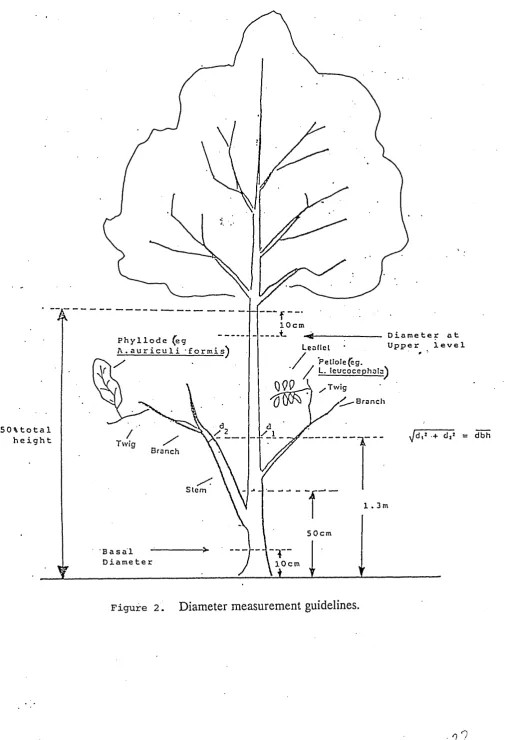
Basal Diameter
Basal diameter is defined here as the diameter at 10cm above ground level (Figure
2). Take measurements on the principal stem (and other stems originating below
10cm). Mark with paint the point of measurement to ensure that the same point is
measured subsequently. The measurement should be made with a metric diameter
tape or vernier caliper. For multiple stemmed trees, the average diameter is
calculated using the following formula:
da = SQRT(dl 2 + d22 + ...dn2)
branching bole is considered a stem if its diameter is equal to or greater than 50%
of the diameter of the principal bole at the same height.
Measurement should be made on the same trees used for height measurements at
the ages of 6, 12, 18, 24, 30 and 36 months.
Diameter breast height (dbh)
Take dbh measurement at 1.3 meters above ground level (figure 2). For forking
trees or trees with multiple leaders, take the dbh measurement on all stems if forking
or multiple leaders originate less than 50cm above the ground. Mark with paint all
the points of measurements. If there is an abnormality in the tree at 1.3 meters,
measure the tree diameter at the point nearest this height which is representative of
the stem’s diameter.
Survival
Survival is the number of live trees at the time of observation.
The common objective of the experiment was to assess the differences in the growth
behaviour of various genotypes and pruning treatments for above four characters.
In this chapter, we first study the variability due to genotype, cutting method and
their interaction with time, explained as polynomial contrast. In many cases simple
(a) Height measurement on a sloping site. •
S te m Height
[image:40.612.43.542.60.730.2]' ' A
5 0 % to ta 1 height
T
10 cm
■
-Leaflet
/ PetIole(eg.
^ L. leucoccphala^
/Twig
/) (jSjTM I Branch
Diameter at Upper level Phyllode (eg
A .auricu1i •formis^
dbh
Twig
Branch
Stem
1.3m
5 0 cm Basal
[image:41.620.36.545.24.765.2]Diameter [“T “ 10cm
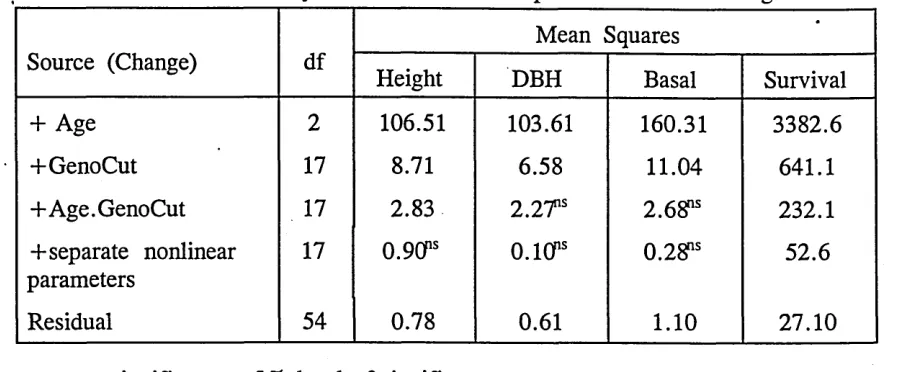
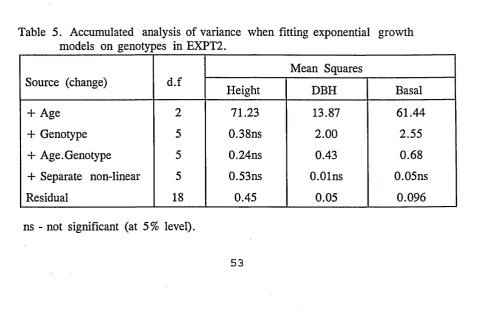
attempt to fit growth curves was made and compared the related parameters of the
growth models. For illustration, results from EXPT1 and EXPT2 are presented in
the tables.
4.2 Analysis of Variance
The various induced sources were separated from the inherent sources of variation
such as replication and experimental units (experimental error or residual) using the
analysis of variance (skeleton anova shown in Table 1).
The ANOVA is of split block structure where genotype-cutting (main effects of
genotypes, main effects of cuttings, interaction effects of genotypes and cutting)
combinations are compared with an error different from that for interaction of
genotype-cutting with time. The main effects of time (age) can not be tested for
statistical significance since time can not be randomized in these experiments, but the
interactions of genotype and cutting with time have valid test due to the (restricted)
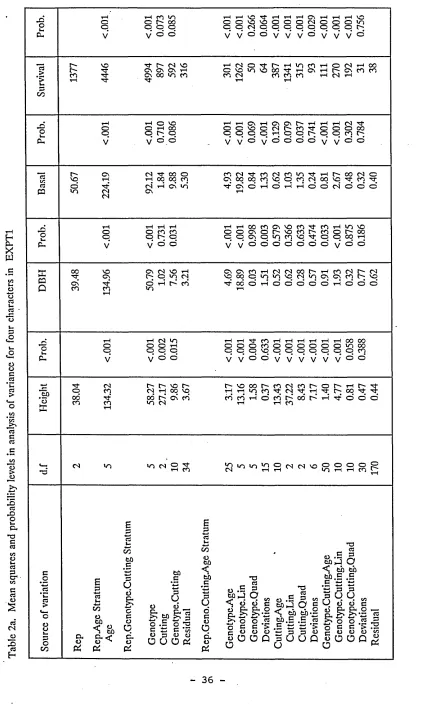
randomization of genotypes and cuttings. Summary of Analysis of variance for all
the seven experiments are presented in table (Table 2a to 2g).
Significant interactions were noticed for genotype x cutting x age for all characters
inEXPTl. Genotypic behaviour overtime was also different. Cutting methods have
Table 1. Skeleton of Analysis of Variance
Source of Variation df SS MSS
Rep r-1
Rep.Age Stratum
Age t-1
Linear 1
Quadratic 1
Cubic 1
Deviation t-4
Residual (a) (r-D(t-l)
Rep.Genotype.Cutting Stratum
Genotype g-1
Cutting c-1
Genotype. Cutting (g-D(c-l)
Residual (b) (r-l)(gc-l)
Rep.Geno.Cutting.Age Stratum
Genotype.Age (g-l)(t-l)
Genotype. Lin g-1
Genotype. Quad . g-1
Genotype. Cubic g-i
Deviations (g-l)(g-4)
Cutting. Age (c-l)(t-l)
Cutting.Lin c-1
Cutting.Quad c-1
Cutting. Cubic c-1
Deviations (c-l)(t-4)
Genotype. Cutting. Age (g-l)(c-l)(t-l)
Genotype. Cutting. Lin (g-D(c-l)
Genotype. Cutting. Quad (g-D(c-l)
Genotype. Cutting. Cubic (g-l)(c-l)
Deviations (g-l)(c-l)(t-4)
Residual (r-l)(gc-l)(t-l)
[image:43.613.43.515.54.499.2]bl e 2a . M ea n sq ua re s an d pr ob ab ili ty lev els in an al ys is of va ria nc e for fou r ch ar ac te rs in E X PT 1
.oo oo h co m
C > 00
o o o c op p
V V
VO Tf
VO VO o o o c3 p p o o v v v
ON T—l _ _ cm o o o o o o
V V V
T-I VO O to o t> o
t"-CO rf r- CM VOCV ON CV r-t CN 00 WO CO Tf H N O rth H i^ rO C V O V O V O O O T f r H C v
CO CM CO CO CO O M H oo h- C\ CO CO CM t—I 00
o oo 1—I O VO OHM 0 0 - 0
V o o'
H t-H CN t—I CN CN O- T—l T—l T—l CM Tt- OOvoOCNt^COrt-OOOOO C 0_ p p rH p p 0-_ 0_ O CO 0^ O v/O O O O v/ v/OO
V V
C3 pa
r - C N CM 0 0 o c o CM T }- C O v q T—1 T—1 o q 0 0 C O c n 0 0 0 0 C O o T j" CM T—1 C N > d t}-’ C N O T—l v o CM
CM C N tH
T-| O T-I T-I O Oin rf CO CM 00 VC vr CO NTh o- oo cm’ o ocm' oo
o
tH o
c T—lO
O t-H
CO
f -T—lCO o
T—l o
o T—1oo 0 0Cv
Cv
CO
o
o CNovovovoCOCOCO
VO
Tfr
r-TfCOCoOT—loo vor-0 0
vo 0 0
t-H
Pt V V o o V V o o o o o o o V o o
D
B
H 0 0TT VO
CN CvC- CoMVOvoT—1CM CNvoCvOO COo vo CT - I vo CMVOMs t"voT—lCN COCN CCMOr-~f- CVOM CNCO ri-co
T—l
o
votH r- CO 0 0
T—l o tH o o o o o T—l o o o
. T -I T—l CMVO T—l t-H Tf COT—l T—l T—l T—l T—l T—l C O 00
——C o O o t-H O O o COo o o o o o vo 00
l_ p O o o O p o vo p p p p p p o CO
PU V V o o ’ V V o ’ o ’ V V V V V V o o’
Tf CM t~- r- vo r- r- VO 00 r-~ CO CM CO p r- rH C>
*tb O CO CMT—100 vq tH t-H vq co Tt CM Tf T—l cq 00 tJ-
•d-oc5 Tt 00 iS CN cd COcd tH o cd S 00 T—l t}- o o* o ’
o
*—« CO COT—l vo CM T -I T—1 CO
CM VO VO CMO Tf tH CO CM CM VO O O OVO H T—l COo
o-oto o
CO Pia.<D
^5 toCW <L> ^
Pi CO to c V cc o c cL o pi u
& to c to c P
uai p- « O' P o .2 o ’a c t; c •« O o o o a u o pi
6 p wrt I-w o to «;to c p u o c o
a
d. o Pi *o T- 03 *> .£ 3 to J Oo o c
03
T - 3
o .S 3 a j o « & &.2 <; tb tb .2
o o 60.5 .5 p O 3 3 .5 5Z *2 C Ot)t)T_.ppt> o O O Q p U U Q
O CJ
•O r - 3
o -S 3 to_j O < to to
to.3 .5
.3£J p po o
p U C> U O d a
i § § i i § § ° ’5 2r - fl) O O W
[image:44.614.69.496.25.740.2]Ta bl e 2b . M ea n sq ua re s an d pr ob ab ili ty lev els in an al ys is of va ria nc e for fou r ch ar ac te rs in E X PT 2.
.oo o
o
r-! W O rH © © © © p p V V
y—* H IT1 O n t-H H t"' t'-' I’"* r o o r o m o o o n - T j - o o p p p p p p p c o c o p p p
O O V V O O V V V ©
V V
«
>
P co
Cn
Cn CcoOn
CO
WO vo wo CN O t o
■vt CO CN oo©wooocor-»oocNTt-cNwooot-' CtOVOtTfM(OMhNOtOH(S n ( O H T f r l CN
O OO H Tf tO C C O 00o o V o o
H H C O t O H r l c O H N V O t O O O © rt C" © © O Nf to 00 C Tf P P W O p p p p v o 0 0 rH p c n
o o v V O o o o o o
V V
C3 PQ
CN
00 r-~CNcdc n CN
0 0 CN f" H O O to O CN V O rH rH CN
cNCNt^rrr'coc^oor'Ovnco t o CO H CO O t o N H H CO H H
r - 5 v d 0 0 r H c d r - 5 0 0 0 0 0
. rH rH VO VO rH rH rH rH rH rH rH Cnwo vo Tj-Cn
© o CO CN C O o o o © © rH CO CN ■3-Ht
ou* p p o WO O O p p © O © © C" 00 00 CO
p- V V o © V V V V V V V © cd©■ © cd
tc CN rH rH o CO 3; c VO rH CO CN vo00 rH CN vo vo rH ©
Hh *0 CO P CO CO TT rH CN CN vo© p © CO O © © rH rH
PQ rH cd rH vdrH rH rH CN © o rH rH CN o O* © cd©* cd
Q rH VO CN
o rH©© TJ-CN© rH©© t"8 rH©© rH©© rH©O CN5 rHo© rHO© rH©© ©©rH CNVOwo r~~rH© worHrH C n CN
Cn
Ph V © V o V V V O V V V V © © © ©
H
ei
gh
t Cn
VO COrH OOCO rfCN COrH wovoCrHn©rH worH OrH § t"CnCNCN CCOn CNCN VO Tj-rH rH rHHf 00
rH ©t"-CN CO WOHt rH rH rH Hj-CN © CNCN wovo C" CNrH © © © © ©
CN Wo Wo <N O £ O c N v o O O O O P l H H C O
p o 00 E p C3 I* CO C) to <; CL CL <D O d oto E p 03 l_ 00 to •E p u ci u O d o d to •E \s p U o eS § g > § §
o .S 0 * 0
c S c 'C5
t) 3 O O
O U O p {
E p +-» C3t-. CO o to <;to .E 4-f P o oc u o d u d
o.E 5.
toj O
o O c o
O .E to _l < to
to.E c ~ "5 ^
p U (J d
•cC3 P O to c p
p f l f g > P p i J - | ,2* o o .52 5P*S .S .2 r? o o .52 ^ ~ c e S C *-**■> *g ** e e 5 ISt) Q WJ
O Q °
c c ’£ .S' 'B ’5 *£
0 0 0 * - > 3 3 0 o O O G g U U P
o ^ o
f go o
Ta bl e 2c . M ea n sq ua re s an d pr o ba bi li ty lev els in an al ys is of va ria nc e for fou r ch ar ac te rs in E X PT 3.
O oc H c hO vo 00
O CO Cv V o o '
o o
V V
v o H r t ^ H i n H r o N H T f Q H t n C \ H l O 0 0 T ) - O C q O j N r | M h O N C \ O V o o ' o ' o ' o* o ' o ' o ’
cv oVO00 vn
3 00
00 v f o
vo CO O 04
r " tj- r - TI CS
t—I CS O Tt" f-» t-“I VO CO O V O V O V O O O T j- H C V CO CS CO CO CO
O N H CO t CV CO CO CS tH
o o
o
T f C\ CO
o c s r - o cv o ' o o '
tNC\NiOHC\C\ . . T f W O C O W O f '- t H O C S C S
H H tv
O O CS . . . . . . _ O p T f C q v o C S V O V O C S O
V V O O O o ' O O O o ' C3 o t—I Cv
C3 « vo vo cs’ CVcs voTf CO
wo O CO rH O VO CO 00 Cv o T t vo 04
W O O O V O O O O V O C ^ O O T f T t tH O 00 VO VO CN CO WO O tH c s c d o o o
wo vo r " CO VO 00 t H O O t H C S t H O O
o o
o
04 VO 00 04 vo H O cv vo
tH r—I O t—l t—I C'- Ttf- tH VO t~- VO O O O CN O tH Tt" t Tt" O CO O Cv O P CO p wo wo T t CO O p p tH
V y O O O O O O O O
X CQ o 00 00 CO wo
Cv O CO t " o c s wo wo
K o' vt
rH
T T O O O O O C S W O C O V O T J -p -p vq c s wo cq tt vo p cs' cd o cs' o ’ o ’ o ' o tH
ti-
r-~-t~- wo c s wo tH O o '
Xio o
o
H t f h O 00 00 o o cs
v o o '
tH tH V/0 VO tH tH tH Tj- tH tH tH CS
O O C v t ' - O O O V O O O O O Op p c s . c q p p p p p p p c v
v v o o v v V V V V
,£P *5 oo o CO cq Cv c s c s
tH t ' ' r f tH wq cq wq p cs* wd cs' cs'
vpf'CvMOttvtf' C q v q w q w q o o C v t H C v tH vo O o ’ cd tH* r t o
WO CO wo 00 O Cv wo CS r f t H cs* tH o ' o '
cs wo wo <N O ^ £ wo «o 2 O c s c s vo wo H H CO f 'O O O O O
o 00 00 o to cw o Pi
^ oto c. <
O ^
Pi oo toc u d g: C c o o cL o pi o
& to
o .5 c p
O 3 o u
to .5
p ud
i §o JO
c *J75
Q (D
O Pi
00 oto <;top p o o' co o do Pi •c
#*\ ^ s
<, O O G K. & & . 2 § S o |o C C ?
c u o o o O O Q o
03 _« C3 O.S P tp_j Q < to to M.S .£ C « j j
p p p p u u u
oa _ C3 o •£ 5, t p j o <J to to W).S .£ . E s sp p p
p u u
U ti o'
O O o C c P <U O « o o
p o — • p C3
a p
•5Q C/5: IS
Ta bl e 2d . M ea n sq ua re s an d pr o ba bi li ty lev els in an al ys is of va ria nc e for fou r ch ar ac te rs in E X PT 4.
.OO oo rH CO voo r- oo
o o o r-l CO VO M H H 00O O O rH o O OO O O O O O O V o O O V y O
rH TtrH rH CO rHM >0 Tf
O O O CS
o' o o' o*
P CO
co CO
Tt r-Tt
to CS 00 Tt 0 0 O CO O '
CO C\ CS CO tovOTf'OO'Cx'OOO O l O t O V O t O ' O I >C ScO C StH O ' C O C O C Ocs
Cv Tt Cv rH Tf
t- O C\ o
rOo oo vo Tt Cv 8 0 O'O vo
o' o' o ooV V
OOOOrHrHrHrj-VOrHUOO
t - ' o o o o o c v c o o c s v o O to O O P rH o P 00 vq
O O y" y" O o o v O o
«a
CQ cs
CO
Tt csCO
CO
CO Tt 00 rH O o Cv P
vd vd cs’ TtrH CS r-'Ti-vovocovooor''t''-c\ococs CO TT O rH rf rH o vd to" cd cd cd cs' o’ o' o«S4 O > f ' , cs H CO v t V)
oo rH 00 00O O toO O vo
V o’ o'
H C S v l - C O H H H r ' T t C O H V O O O V O C S O O O C v c O r H O v O O P O O O P p p CS CS tp rH
Y O O O y V
X CQ Q t" p cs’ toCv 8
to rH rt o
Cv to 00 cd cs. cd cs a
00 CS Cv rH VO rH t'" to Tt
ptor-oor^cocst^'d- cd r? cd o* vd cs’ cdrH rH
Cv VO C t>cs Tt cq
cd o’ cd o ’ cd
rH cs rH t" rH rH Tt Tt rH rH rH rH rH cs CO cv
O o O vo O o CO CS O O O O Cv o Tt Cv
oUh O o O 00 O p cs rH O O O p rH o o Cv
Ph V o V o ’ V V cd cd V V V V cd o ’ o cd
4_> Tt rH 00 Cv cs 00 o vo Cv to CO rH cs Tt oo cs vo Tt tO
rC
W) ocCO PrH to torH vd rH cs’cs cq p [>cs’Cv cd o s cd Tt rH cd rH rH cd cdp Cv to CO Tt vq t-* Cv cs CS VO
o rH CO rH 00 CO rH CO rH
ffi Tt rH
cs to to CS O T t
CO */"ttototOOrocSVOOOOO{5 N H H l N n ^ l o H H C<1
:> Cl~l o u c_> V-po oo E p C3 u 00 o to <; CL, c. o o Pi Pi o to oo to u cc o o c. o Pi to .5 p u
o d
§ § Jo .S O p C a c W
o p o o
OUOC^ E p « t-l w o to <;to .5 p u oc <u o d<u Pi T3
r- W
o •£ J?, to „j O
<, O O p ° to J O'H ri
<, g> m-s C3 tO.S .5 C3
*5 .E s a ?“ *H p P O
o o o c; e . c o O ID o o O Q
o p U U Q
*o r - a o .E 3
to_j o < to to
to.g .g
C *j ts '5 p p
p u o ^ U d 6 c
o’ P- P-.9 p
p. ■£» & -g 2 § c c *S IHc o c c yi
Ta bl e 2e . M ea n sq ua re s an d pr o ba bi li ty lev els in an al ys is of va ria nc e for fou r ch ar ac te rs in E X PT 5.
X)o h n o r- ooo o o10
V o o
On tH VO
§ S 8 8 8 £
v O v v v O
00
t"
r-a £
r' n vo
C\ 0\ H
oo in co
CN
CO to COrH C n C O rH
O O l O v i O O r t H C i
C O CN
O CO rH 0 0 t'-- CN CO CO CN tH
o rH o o r> no to o
v o o V V
00\0\00rt<0c00\l0l0 t^r-CNh-CNlOCONfCNOO N O V O O n C O C n C \ o o r H c n O n
o o o o o o o o o o
3 « o o Cn c n 00 c n rH
T t 0 0 O CS CO rH VO rH c o <o i n cn CN
C n C O r H O C N T t O r H rH o c n c n o o o o
r H C O O O O O O O
cn i n c n o o c n cn in o o c o o o o o o
x>o oo oo HHMlOOlOrj-fNNrtrt Cl OOCnrHCNrHCnOr^-CN'OON oovqcovqcncncncnocNCN v* v o o o o o o o o o o
Q 3tH
VO
rH
T t rH c n CN Cn 0 0 t"; CN 0 0 rH CO rH
TtTtooNCNc^CNioincnTtvooN C n t ^ C O C n c O C O C N C O T t r H r H O T t r H c O O O O O O O O r H O O O
Xo o
o VO CN CNo o vo ono oo o d d
T t VOCNCOOCNVOCOCNl OCNOO
T t r H O O C N C n C N C N C N C N C N C N C N O O O I > l n r H r ^ C N C N V O C N C N
O O O O O O O O O O O O
.to *5 X T t Cn CN CO c q Tt a
Tt o cq o Cn Cn T t CN Cn O T t CN
Cn Cn T t CO Cn VO Cn rH Cn rH CO CO rH Cn CN VO rH CN vq p p O CN O O CO o o o o o o o o o o o o o
CN c n cn O T t rH CO N C N i f i O O O O P
n n v i n h h to ^
c CO 00 o to a, o
Pi Pi
6
P
4cs—*
l_ to p u d o->» o c o o do Pi to .5 P u
d _
3
- C . H ^ - 3 O "O
e p e 0 3 0 0 OUOPJ
to
c
e
p
43_»
Wh 4—I 00 o to <;to p u o c o o d o & _ « o .£ 3 to 3 O
d d
u a & co
>? o
o CC 0 0 0 » - J P 3 0
o O O Q p U U Q
O U
3
w o .5 w
3 to hJ O' 3
ft o > • • o<J to to
'o p to .H .S 3
C
•> .s
S3=S *>
o .£ to
< to to .5
.S a
*5 3 p u U d d
P-o
O 3
e ° o a o
•p3P
o
to.£ p U «,O c
a o «
>N 'ZZ 3