http://dx.doi.org/10.4236/mnsms.2016.62002
Development of the Orbital-Free Density
Functional Approach: The Problem of
Angles between Covalent Bonds
Victor G. Zavodinsky1, Olga A. Gorkusha2
1Institute for Material Science, Khabarovsk, Russia 2Institute of Applied Mathematics, Khabarovsk, Russia
Received 4 January 2016; accepted 25 March 2016; published 28 March 2016
Copyright © 2016 by authors and Scientific Research Publishing Inc.
This work is licensed under the Creative Commons Attribution International License (CC BY).
http://creativecommons.org/licenses/by/4.0/
Abstract
The Paulie’s principle is used for development of the orbital-free (OF) version of the density func-tional theory. On the example of the three-atomic clusters, Al3, Si3, and C3, it is shown that the OF approach may lead to equilibrium configurations of atomic systems with both the metallic and covalent bonding. The equilibrium interatomic distances, interbonding angles and binding ener-gies are found in good accordance with the known data. Results will be useful for developing of theoretical study of huge molecules and nanoparticles.
Keywords
Orbital-Free, Density Functional, Covalent Bonding, Angular Bond Dependence
1. Introduction
A number of works (for instance [1]-[9]) devoted to development of the orbital-free (OF) version of the density functional theory (DFT) [10] [11] appeared last years. This approach, in contrary to the Kohn-Sham (KS) me-thod, does not use the wave functions (orbitals) and operates with the only electron density. The OF approach is a consecutive development of the idea of Hohenberg-Kohn [11] that the basic state of a quantum system can be completely described by means of electronic density.
An essential trouble is the fact that the electronic density of a single (isolated) atom is spherical, i.e. the “or-bital-free” atom has a shape of a ball, but balls form the close packed structures. For example, three identical atoms are obliged to form an equilateral triangle with corners of 60 degrees. At the same time, it is known that three atoms of silicon form an isosceles triangle with the main corner of about 80 degrees [13], atoms of carbon build a linear chain [14], and atoms of aluminum really behave like balls—they form a correct equilateral trian-gle [15]. Obviously, if an approach can describe the angular properties of trimers, it can solve the same problem for more complicated atomic systems too.
In our recent papers [16] [17], we have showed how it is possible, using single-atoms calculations by the Kohn-Sham DFT method (KS-DFT), to find the kinetic functions for single atoms and to use them for orbit-al-free modeling of atomic dimers. The present work is an attempt to develop (on example of Al, Si, and C tri-mers) a technique which would allow to describe an adequate geometry of interatomic bonds in polyatomic sys-tems in the framework of the OF approach.
2. A Principal Point and Results
As in our recent works we used here the pseudopotential approach with the FHI98pp package [18] as a generator of pseudo-potentials and equilibrium partial electron densities for single atoms. The general way of calculations is the same as described in [18]. Studied atoms were located in a cubic cell of the L size (L = 52 a.u.; 1 a.u. = 0.529 Å). The cell was divided on 128 × 128 × 128 elementary sub-cells for the integration with the step ΔL of 0.406 a.u. Results of calculations were compared with published data.
Transfer from dimers to trimers is a principal point because trimers characterized by some angles between atomic bonds.
To describe the angular dependence of interatomic bonding in the framework of the OF approach we must analyze the reasons of this dependence in the standard quantum-mechanical approach, which uses wave func-tions and electronic states. For example, it is specified in the work [19] that the angular peculiarities of a cluster Si3 are defined by the Yang-Teller effect caused by existence of the energy gap between occupied and empty states. In other words, the difference of structures of semiconductor and metal small clusters is connected with the difference of their electronic states and bond wave functions. Namely, covalent atoms have full occupied bonding states corresponded to localized functions orientated between nearest atoms; these states are separated by the energy gap from above lied non-occupied states. Metallic atoms have dispersed functions without orien-tation in the space and without energy gaps between them.
In our case wave functions are absent, electronic states are absent too, and, therefore, we cannot speak about any energy gap. In the OF approach we deal only with the electronic density which defines all energy and struc-ture of the polyatomic system. However the main quantum-mechanical rules remain fair and in this case. We have not to forget that quantum mechanics is not only a set of wave functions and electron states. We have not to forget the Paulie’s principle specifying that in one quantum state there can be only two electrons (without taking into account a spin). In our case this principle may be paraphrased by a following way: a covalent bond is formed by two electrons, the common wave function of which is localized in the space between two nearest atoms. It is obvious that the quantity of the electrons which are responsible for this bond doesn’t change as the distance between atoms changes (if, of course, the bond isn’t broken at all and the electronic structure isn’t re-constructed completely). In case of the metals the states are close each other and electrons can easily “flow” from one state to another during the changing of the atomic geometry.
The above mentions may be reformulated in the language of the electronic density: the density integral (nint) between atoms with covalent bonding, has to remain its value at change of distance between atoms; in case of metal bonding the value of the integral nint can be any possible. Certainly, there is a question: on what space we have to provide integration? And what have we to do with intermediate cases, with atoms of different types? We will leave these questions for the future, and now we will try to explain the difference in structure of covalent and metal systems on the example of homogeneous clusters Al3, Si3 and C3.
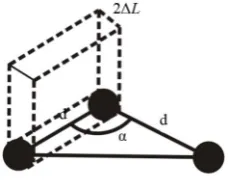
Figure 1. The scheme of an arrangement of atoms in a trimer. Dashed lines show the space on which the electronic density is integrated for
definition the number of the electrons involved in the covalent bond; α
is a corner between bonds with identical lengths of d.
As it was said above the integral of electron density between the nearest atoms is the critical parameter for covalent bonding. It cannot be larger than some value that is a characteristic of a so called saturated bond. Let us
take the interatomic bond in a dimer as a standard saturated bond. Let us call the value
trimer int dimer int
n P
n
= (the relation
of nint of a trimer to nint of a dimer) as “the bonding strength” and accept that for covalent bonds the value of P shouldn’t exceed 1.0 at change of the distance between atoms. For metallic bonds the value of P can be any possible.
Calculated values P for clusters Al3, Si3, and C3 are presented in Figure 2 as functions of the angle between interatomic bonds in the case when restrictions on these values are absent. For each angle we found the values of interatomic distances, which corresponded to the minimum of the total energy of the cluster. One can see that P is equal approximately 1.0 at α = 180˚ and increases when α approaches to 60˚. The maximum value (P = 1.40) is observed for carbon, that has the smallest interatomic distances. Interatomic distances in aluminum and silicon are approximately the same, therefore no wonder, as the “bonding strengths” for the Al3 and Si3 trimers are ap-proximately equal.
In order to check reliability of our results we repeated the calculations using thicker slabs (4ΔL and 8ΔL) for integration of values nint (dimer) and nint (trimer) between atoms in dimers and trimers and we found that results have changed no more than by 2 per cent.
In Figure 3 (curve A) we present results of calculations of binding energy for the Al3, Si3 and C3 trimers without restriction of the “bonding strengths”. From these curves it is clear that in all three cases the minimums of the binding energy correspond to triangular clusters, “bonding strengths “in which significantly exceed the corresponding values, characteristic for linear chains. This result looks natural for aluminum as its states have the metallic, not localized character; but for the clusters of Si3 and C3 having covalent bonds it is necessary to introduce the restrictions on values of P stipulated above. We have taken into account this condition (P = 1) and found dependences of the binding energy on the angle between bonds in the Si3 and C3 clusters (Figure 3, curve B). One can see that atoms of carbon seek to form linear chains, while for silicon neither a linear chain, nor an equilateral triangle is energetically favorable: atoms of silicon prefer to form an isosceles triangle with the angle α of 80 degrees.
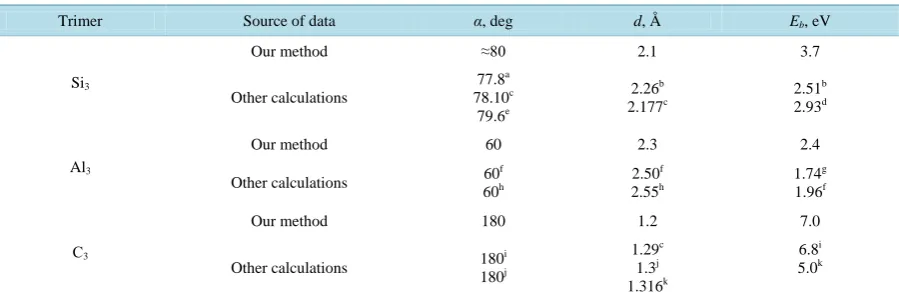
Equilibrium values of interatomic distances d, angles α, and binding energies Eb (absolute values) for the
tri-mers Al3, Si3, and C3 are collected in Table 1 (calculated for the condition P = 1) in comparison with known da-ta. One can see that comparison is good. Thus, we showed that orbital-free approach is capable to describe cor-rectly orientations of interatomic bonds in atomic clusters, as well as values of interatomic distances and binding energies.
It is interesting to compare our results for interatomic densities with results of standard KS-DFT calculations. For this purpose we calculated “bonding strengths” P for Si3 and Al3 using the popular KS-DFT code FHI96md [28] for the same triangles as were studied above. We have found that P was equal 1.0 (±0.02) for all cases for Si3, but it increased up to 1.3 for the Al3 equilateral triangle. These results are in excellent agreement with our OF ones.
3. Conclusions
Figure 2. “The bonding strengths” in the Al3, Si3 and C3 trimers as functions
[image:4.595.180.453.299.477.2]of the corner between interatomic bonds in the case when restrictions on the interatomic electron density is absent.
Figure 3. Calculated dependence of binding energy (on atom) for the Al3, Si3
and C3 trimers on the angle between interatomic bonds. A) Values are obtained
without restrictions on electronic density in interatomic bonds; B) Values
calculated with the condition P = 1.0.
Table 1. Equilibrium distances d, angles α and binding energies Eb (absolute values, per atom) for Si3, Al3 and C3 in
comparison with known calculated data.
Trimer Source of data α, deg d, Å Eb,eV
Si3
Our method ≈80 2.1 3.7
Other calculations
77.8a 78.10c
79.6e
2.26b 2.177c
2.51b 2.93d
Al3
Our method 60 2.3 2.4
Other calculations 60 f
60h
2.50f 2.55h
1.74g 1.96f
С3
Our method 180 1.2 7.0
Other calculations 180 i
180j
1.29c 1.3j 1.316k
6.8i 5.0k
[image:4.595.89.539.559.708.2]principle) allowed us to describe correctly angular dependences of the interatomic bonding in polyatomic clus-ters in the framework of the orbital-free version of the density functional theory. In particular, it is possible to show that for the Al3 cluster, the equilateral triangle is favorable; the Si3 trimer is characterized by the isosceles triangle with angles of 80 and 50 degrees, and three atoms of carbon built the linear chain. Calculated equili-brium interatomic distances and the values of binding energy are well compared with the known data.
As the problem of the correct description of angles between interatomic bonds is a key point in modeling of polyatomic systems, it is possible to consider that our work opens a direct way to design an effective method of modeling of big nanosystems and supermolecules.
We have to note that the consideration which is carried out above is directly applicable only to the systems consisting of identical atoms and requires a special development for application to more complicated systems.
References
[1] Wang Y.A. and Carter E.A. (2001) Orbital-Free Kinetic-Energy Density Functional Theory. In: Schwartz, S.D., Ed.,
Progress in Theoretical Chemistry and Physics, Kluwer, Dordrecht, 117 p.
[2] Chen, H.J. and. Zhou, A.H. (2008) Orbital-Free Density Functional Theory for Molecular Structure Calculations.
Nu-merical Mathematics: Theory, Methods and Applications, 1, 1-28.
[3] Zhou, B.J., Ligneres, V.L. and Carter, E.A. (2005) Improving the Orbital-Free Density Functional Theory Description
of Covalent Materials. Journal Chemical Physics, 122, Article ID: 044103. http://dx.doi.org/10.1063/1.1834563
[4] Karasiev, V.V. and Trickey, S.B. (2012) Issues and Challenges in Orbital-Free Density Functional Calculations.
Com-putational Physics Communications, 183, 2519-2527. http://dx.doi.org/10.1016/j.cpc.2012.06.016
[5] Karasiev, V.V., Chakraborty, D., Shukruto, O.A. and Trickey, S.B. (2013) Nonempirical Generalized Gradient
Ap-proximation Free-Energy Functional for Orbital-Free Simulations. Physical Review B, 88, 161108-161113(R).
http://dx.doi.org/10.1103/PhysRevB.88.161108
[6] Wesolowski, T.A. (2005) Approximating the Kinetic Energy Functional Ts[ρ]: Lessons from Four-Electron Systems.
Molecular Physics, 103, 1165-1167. http://dx.doi.org/10.1080/00268970512331339341
[7] Hung, L. and Carter, E.A. (2009) Accurate Simulations of Metals at the Mesoscale: Explicit Treatment of 1 Million
Atoms with Quantum Mechanics. Chemical Physics Letters, 475, 163-170.
http://dx.doi.org/10.1016/j.cplett.2009.04.059
[8] Xia, J.C., Huang, C., Shin, I. and Carter, E.A. (2012) Can Orbital-Free Density Functional Theory Simulate Molecules?
The Journal of Chemical Physics, 136, Article ID: 084102(13).
[9] Lehtomäki, J., Makkonen, I., Caro, M.A., Harju, A. and Lopez-Acevedo, O. (2014) Orbital-Free Density Functional
Theory Implementation with the Projector Augmented Wave Method. Journal Chemical Physics, 141, Article ID:
234102(7).
[10] Kohn, W. and Sham, J.L. (1965) Self-Consistent Equations including Exchange and Correlation Effects. Physical
Re-view, 140, A1133-A1138. http://dx.doi.org/10.1103/physrev.140.a1133
[11] Hohenbeg, H. and Kohn, W. (1964) Inhomogeneous Electron Gas. Physical Review, 136, B864-B871.
http://dx.doi.org/10.1103/PhysRev.136.B864
[12] Carling, K.M. and Carter, E.A. (2003) Orbital-Free Density Functional Theory Calculations of the Properties of Al, Mg
and Al-Mg Crystalline Phases. Modeling and Simulation in Materials Science and Engineering, 11, 339-348.
http://dx.doi.org/10.1088/0965-0393/11/3/307
[13] Raghavachari, K. and Logovinsky, V. (1985) Structure and Bonding in Small Silicon Clusters. Physical Review Letters,
55, 2853-2856. http://dx.doi.org/10.1103/PhysRevLett.55.2853
[14] Van Orden, A. and Saykally, R.J. (1998) Small Carbon Clusters: Spectroscopy, Structure, and Energetics. Chemical
Review, 98, 2313-2357. http://dx.doi.org/10.1021/cr970086n
[15] Chuang, F.-C., Wang, C.Z. and Ho, K.H. (2006) Structure of Neutral Aluminum Clusters Aln (2 ≤ n ≤ 23): Genetic
Algorithm Tight-Binding Calculations. Physical Review B, 73, Article ID: 125431(7).
[16] Zavodinsky, V.G. and Gorkusha, O.A. (2014) Quantum-Mechanical Modeling without Wave Functions. Physics of the
Solid States, 56, 2329-2335. http://dx.doi.org/10.1134/S1063783414110316
[17] Zavodinsky, V.G. and Gorkusha, O.A. (2015) New Orbital-Free Approach for Density Functional Modeling of Large
Molecules and Nanoparticles. Modeling and Numerical Simulation of Material Science, 5, 39-46.
http://dx.doi.org/10.4236/mnsms.2015.52004
[18] Fuchs, M. and Scheffler, M. (1999) Ab Initio Pseudopotentials for Electronic Structure Calculations of Poly-Atomic
http://dx.doi.org/10.1016/S0010-4655(98)00201-X
[19] Tomanek, D. and Schluter, M.A. (1987) Structure and Bonding of Small Semiconductor Clusters. Physical Review B,
36, 1208-1217. http://dx.doi.org/10.1103/PhysRevB.36.1208
[20] Mukhtarov, A.P., Normurodov, A.B., Sulaymonov, N.T. and Umarova, F.T. (2015) Charge States of Bare Silicon
Clusters up to Si8 by Non-Conventional Tight-Binding Method. Journal of Nano- and Electronic Physics, 7, Article ID:
01012(7).
[21] McCarthy, M.C. and Thaddeus, P. (2003) Rotational Spectrum and Structure of Si3. Physical Review Letters, 90,
Ar-ticle ID: 213003(4).
[22] Liu, B., Lu, Z.Y., Pan, B., Wang, C.Z., Ho, K.M., Shvartsburg, A.A. and Jarrold, M.F. (1998) Ionization of
Me-dium-Sized Silicon Clusters and the geometries of the Cations. Journal of Chemical Physics, 109, 9401-9409.
http://dx.doi.org/10.1063/1.477601
[23] Raghavachari, K. and Rohlfing, C.M. (1988) Bonding and Stabilities of Small Silicon Clusters: A Theoretical Study of
Si7-Si10. Journal of Chemical Physics, 89, 2219-2234. http://dx.doi.org/10.1063/1.455065
[24] Matrínez, A. and Vela, A. (1994) Stability of Charged Aluminum Clusters. Physical Review B, 49, Article ID:
17464(4).
[25] Tse, J.S. (1988) Electronic Structure of the Dimer and Trimer of Aluminium. Theoretical Chemistry (Journal of
Mole-cular Structures), 165, 21-24.
[26] Karton, A., Tarnopolsky, A. and Martin, J.M.L. (2009) Atomization Energies of the Carbon Clusters Cn (n = 2 - 10)
Revisited by Means of W4 Theory as Well as Density Functional, Gn, and CBS Methods. International Journal of
In-terface between Chemistry and Physics, 107, 977-1003. http://dx.doi.org/10.1080/00268970802708959
[27] Afshar, M., Babaei, M. and Kordbacheh, A.H. (2014) First Principles Study on Structural and Magnetic Properties of
Small and Pure Carbon Clusters (Cn, n = 2 - 12). Journal of Theoretical and Applied Physics, 8, 103-108.
http://dx.doi.org/10.1007/s40094-014-0136-6
[28] Beckstedte, M., Kley, A., Neugebauer, J. and Scheffler, M. (1997) Density Functional Theory Calculation for
Poly-Atomic Systems: Electronic Structure, Static and Elastic Properties and ab Initio Molecular Dynamics.