R E S E A R C H
Open Access
Transcriptomic analysis reveals tomato genes
whose expression is induced specifically during
effector-triggered immunity and identifies the
Epk1 protein kinase which is required for the host
response to three bacterial effector proteins
Marina A Pombo
1, Yi Zheng
1, Noe Fernandez-Pozo
1, Diane M Dunham
1, Zhangjun Fei
1and Gregory B Martin
1,2*Abstract
Background:Plants have two related immune systems to defend themselves against pathogen attack. Initially, pattern-triggered immunity is activated upon recognition of microbe-associated molecular patterns by pattern recognition receptors. Pathogenic bacteria deliver effector proteins into the plant cell that interfere with this immune response and promote disease. However, some plants express resistance proteins that detect the presence of specific effectors leading to a robust defense response referred to as effector-triggered immunity. The interaction of tomato withPseudomonas syringaepv.tomatois an established model system for understanding the molecular basis of these plant immune responses.
Results:We apply high-throughput RNA sequencing to this pathosystem to identify genes whose expression changes specifically during pattern-triggered or effector-triggered immunity. We then develop reporter genes for each of these responses that will enable characterization of the host response to the large collection ofP. s.pv.tomatostrains that express different combinations of effectors. Virus-induced gene silencing of 30 of the effector-triggered immunity-specific genes identifiesEpk1which encodes a predicted protein kinase from a family previously unknown to be involved in immunity. Knocked-down expression ofEpk1compromises effector-triggered immunity triggered by three bacterial effectors but not by effectors from non-bacterial pathogens. Epistasis experiments indicate that Epk1 acts upstream of effector-triggered immunity-associated MAP kinase signaling.
Conclusions:Using RNA-seq technology we identify genes involved in specific immune responses. A functional genomics screen led to the discovery of Epk1, a novel predicted protein kinase required for plant defense activation upon recognition of three different bacterial effectors.
Background
Plants are vulnerable to attack by many pathogenic mi-croorganisms. To respond to these assaults, plants have evolved two interlinked layers of immunity. Plants initially use pattern recognition receptors to recognize microor-ganisms by detecting certain conserved features referred to as microbe- or pathogen-associated molecular patterns
(MAMPs or PAMPs) [1,2]. Such pattern-triggered immun-ity (PTI) leads to production of reactive oxygen species, activation of mitogen-activated protein kinase (MAPK) cascades, changes in the intracellular calcium concentra-tion and transcripconcentra-tional reprogramming [3-5]. However, pathogens such as Pseudomonas syringae undermine PTI by delivering virulence proteins (effectors) into the plant cell using a type III secretion system [3]. In a further evolutionary step, some plants acquired intracellular pro-teins that detect, either directly or indirectly, the presence of specific effectors. This layer of defense, termed effector-triggered immunity (ETI), is often associated with localized * Correspondence:[email protected]
1Boyce Thompson Institute for Plant Research, 533 Tower Road, Ithaca, NY
14853-1801, USA
2Section of Plant Pathology and Plant-Microbe Biology, School of Integrative
Plant Science, Cornell University, Ithaca, NY 14853-1801, USA
programmed cell death (PCD) called the hypersensitive response that may limit pathogen spread [3,6,7].
The interaction between tomato (Solanum lycopersicum) and Pseudomonas syringae pv. tomato(Pst), the causative agent of bacterial speck disease, has been extensively used to study the molecular basis of host responses to bacterial infection [8,9]. Among the bacterial MAMPs perceived by tomato, the best characterized derive from the flagellin protein encoded by the fliC gene. This protein, which forms the flagellum and therefore plays a key role in motility, possesses two MAMPs that can be detected by tomato: flg22 perceived by the FLS2 receptor [10,11]; and flgII-28, which is recognized by an unidentified recep-tor referred to as FLS3 [12]. We have recently reported that flagellin-derived MAMPs in Pst are the primary elicitors of PTI in tomato, resulting in extensive tran-scriptional changes [13].Pststrain DC3000 translocates approximately 30 effectors into plant cells and two of these, AvrPto and AvrPtoB, act early in the tomato-Pst interaction by interfering with pattern recognition recep-tor functions and thereby suppressing PTI and promoting bacterial virulence [13-15].
Certain wild relatives of tomato have evolved a specific ETI mechanism to recognize and respond to the presence of AvrPto or AvrPtoB in the plant cell. This mechanism involves members of the Pto kinase family which physic-ally interact with these effectors and act with the nucleo-tide binding-leucine-rich repeat (NB-LRR) protein Prf to activate ETI [8,16,17].Prfis embedded within thePto family gene cluster on chromosome 5 and this region has been introgressed into many tomato cultivars to con-fer resistance to bacterial speck disease [8,18]. Changes in gene expression that occur during Pto/Prf-mediated ETI in response to AvrPto were previously analyzed using GeneCalling, an mRNA profiling technology [19]. This study was limited by the lack of a tomato genome se-quence and gene annotation, but nevertheless identified 432 ETI-induced genes, including members of 11 transcrip-tion factor gene families. The experimental design used in this study did not allow the determination of whether any of these genes were also induced during PTI.
Several recent reports have used microarrays and a series of Arabidopsis mutants to analyze changes that occur during ETI and PTI [20,21]. Although PTI involves recognition of MAMPs and ETI recognition of effectors, these studies found that a majority of genes whose expres-sion changes during the defense response are affected by both ETI and PTI [22-25]. Analysis of transcriptome changes also indicated that the PTI response was transi-ent and more vulnerable to being undermined by the pathogen, whereas the ETI response was more prolonged and robust [20]. These differences appeared to be due to how ETI and PTI use the same signaling networks rather than to their use of distinct signaling networks [25]. In the
case of PTI, gene expression changes were characterized as being synergistic and for this reason more vulnerable to pathogen suppression. ETI, however, uses the same signal-ing network in a compensatory way, maksignal-ing it difficult for the pathogen to interfere with this response [25]. Overall, these studies have provided important insights into the dynamics and temporal aspects of plant immunity.
RNA-Seq is a powerful high-throughput technology that is being broadly used for transcriptome studies in different cells and treatments [26-29]. The RNA-Seq approach has recently been applied to the analysis of PTI in the tomato-Pstsystem, where it allowed the identifica-tion of a subset of genes whose expression is induced by flagellin-derived MAMPs but reduced by the activity of AvrPto and AvrPtoB effectors, referred to asFIRE (flagel-lin-induced, repressed by effectors) genes [13]. TheseFIRE genes were screened by a virus-induced gene silencing (VIGS) approach which identified a cell wall-associated kinase, SlWAK1, that is required for an effective PTI re-sponse [13].
Here we describe the use of the tomato-Pst system in an experimental design that allowed the identification of host genes whose expression changes specifically in ETI or PTI. We developed reporter genes for each of these responses which will be useful for analyzing the response of tomato toPstmutants that lack combinations of effec-tors, other virulence faceffec-tors, or MAMPs. We then focused on a subset of 30 genes whose expression was induced specifically during ETI and used these in a VIGS screen to determine if they play a demonstrable role in ETI against Pst. This approach identified a predicted protein kinase, Epk1, that has not previously been implicated in the plant immune response and which may act in a pathway unique to the immune response triggered by bacterial effectors.
Results
Analysis of transcriptome modifications during Pto/Prf-mediated effector-triggered immunity in tomato
In order to study the transcriptome changes in tomato during Pto/Prf-mediated ETI, we infiltrated tomato Rio Grande (RG)-PtoR resistant plants (plants that have a functional Pto/Prf signaling pathway, Pto/Pto,Prf/Prf) and two different susceptible plants: RG-prf3 and RG-prf19(Pto/Pto,prf/prf), withPseudomonas syringaepv.
tomato DC3000 (DC3000) (Figure S1A in Additional
whereas the RG-prfplants did (Figure S1B in Additional file 1).
For the data analysis, we considered a gene to be
‘expressed’ if it had three or more RPKMs (reads per kilobase per million of mapped reads) in at least one of the treatments analyzed. The cutoff used for the compari-sons wasP<0.05 and≥2-fold expression change [13]. We compared the transcriptome changes observed in resistant (RG-PtoR) and susceptible (RG-prf3 or RG-prf19) plants and found that the number of differentially expressed genes increased from 4 to 6 h (Figure S1C in Additional file 1). We considered a gene to be induced during ETI when its expression was higher in RG-PtoR than in RG-prf3or RG-prf19plants. On the other hand, a gene was considered to have reduced expression during ETI when it was expressed higher in RG-prf3 or RG-prf19 than in RG-PtoR plants after DC3000 inoculation. The number of genes with reduced expression was higher than those with induced expression in both PtoR/prf3 and PtoR/prf19combinations. As expected, the overall gene expression differences of the two susceptible lines were very small, with only 27 differentially expressed genes between RG-prf3and RG-prf19.
Taking just the ETI-induced genes from this experiment at 6 h, we compared them with PTI-induced genes re-ported previously [13]. For this purpose we considered as PTI-induced genes those increased by flgII-28, DC3000
ΔhrcQ-U, Pseudomonas fluorescens or the Pseudomonas
putida treatments [13]. This comparison revealed that
essentially the same number of genes was induced only in ETI, only in PTI, or in both responses (Figure S1D in Additional file 1). Thus, although there was overlap in the ETI- and PTI-associated transcriptomes, there also ap-peared to be unique gene expression changes associated with each of these immune responses.
Transcriptome changes associated with Pto/Prf-mediated ETI and flagellin-activated PTI revealed a set of genes specifically induced in each immune response
The above comparison included data from independent experiments that used different bacterial strains and titers. We therefore designed an experiment to assess ETI and PTI in RG-PtoR using a series of Pst DC3000 strains which have different mutations that allow dissection of the plant immune response (Table 1). We collected
samples at 6 hai and monitored the development of disease in these plants. Plants infiltrated with DC3000
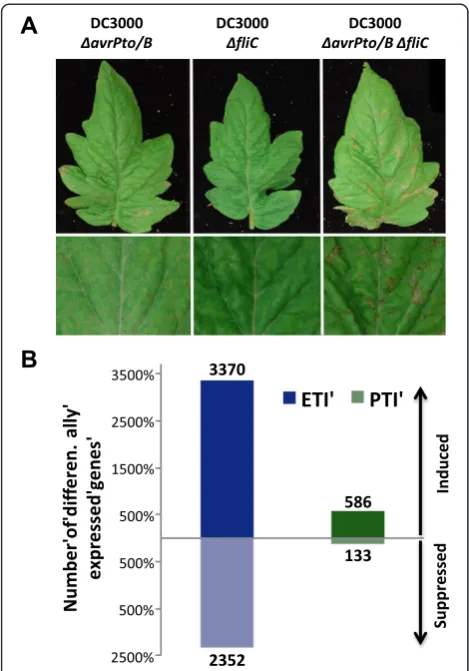
ΔfliChad no disease symptoms due to the recognition of AvrPto and AvrPtoB effectors by Pto [8] (Figure 1A). In contrast, when these two effectors were absent, the plants developed speck disease (DC3000ΔavrPtoΔavrPtoB and DC3000ΔavrPtoΔavrPtoBΔfliCstrains). Plants in-filtrated with the triple mutant showed the greatest disease severity due to the absence of ETI and flagellin-activated PTI induction (Figure 1A). This experimental design allowed us to identify gene expression changes associated with flagellin-activated PTI (DC3000 ΔavrPto ΔavrPtoB versus DC3000ΔavrPtoΔavrPtoBΔfliC) and Pto/Prf-me-diated ETI (DC3000ΔfliCversus DC3000ΔavrPtoΔ avrP-toBΔfliC).
We observed a larger number of ETI- than PTI-associated gene expression changes and, in both cases, more genes were induced (higher expression in the plants infiltrated with DC3000ΔfliCor DC3000ΔavrPto
ΔavrPtoB than with the triple mutant) than suppressed
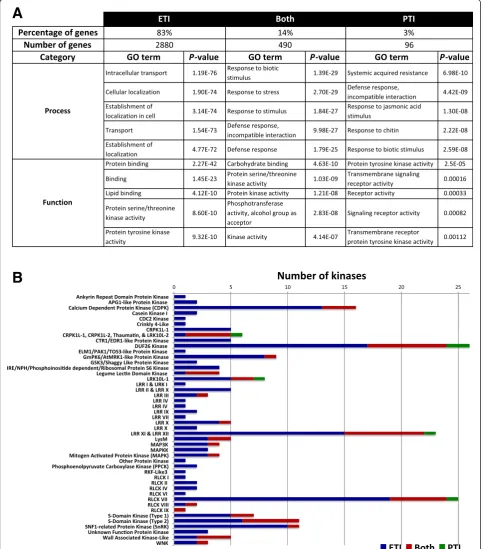
(higher expression in the triple mutant compared with the other two strains used) (Figure 1B). No differences in bacterial populations were observed at the sampling time (6 hai), indicating that the changes in gene expres-sion are not due to differences in virulence between the DC3000 strains at this time point (Additional file 2). For this study we focused on genes with induced expression and classified them into three categories: ETI-specific, PTI-specific or induced during both immune responses. From the total number of induced genes, 83% were ETI-specific, 14% were shared between both immune re-sponses and 3% were PTI-specific (Figure 2A). Details of the genes in each category are provided in Additional file 3. We examined the induced genes for their transcript abundance (maximum and average RPKM) and fold change (Additional file 4). Although we did not observe differences in gene induction levels between ETI and PTI (fold-change; Figure S3C in Additional file 4), we found that the majority of PTI-specific genes had a maximum of 10 RPKM, whereas the majority of ETI-specific genes had a max-imum of 50 RPKM (Figure S3A in Additional file 4), indi-cating that transcript levels of ETI-specific genes are generally higher than those of PTI-specific ones.
[image:3.595.60.544.660.715.2]We performed a bibliographic search to identify genes in the three categories that have been described
Table 1 Summary of the experiments performed for the RNA-Seq analysis
Plant Strain Concentration Time point
Tomato DC3000ΔfliCa
5 × 10⁶cfu/ml 6 h
RG-PtoRb DC3000ΔavrPtoΔavrPtoBc
DC3000ΔavrPtoΔavrPtoBΔfliCd
a
Pseudomonas syringaepv.tomato(Pst) DC3000 mutant, lacking flagellin.b
Tomato Rio Grande-PtoR plants (Pto/Pto,Prf/Prf).c
previously as being implicated in plant-pathogen inter-actions (Additional file 3). Approximately 25% of the genes had at least one publication associating them with plant immunity (Additional file 3). In the ETI-specific category, we found 10 genes that had been previously con-firmed to be involved in ETI mediated by the Pto kinase using a loss of function approach [9].
Gene Ontology term analysis supports the central importance of protein kinase activity in plant immunity We performed a Gene Ontology (GO) term analysis using the tomato genome sequence as a reference (Figure 2A; Additional file 5). The‘Process’GO terms of ‘defense’or
‘response to stimulus’ or ‘stress’ were the most common for the PTI-specific and the shared PTI/ETI genes,
whereas‘transport’and‘cellular localization’had the high-est enrichment for the ETI-specific genes. Additional Process GO terms associated with ETI were ‘response to stress’, ‘response to stimulus’, ‘signal transduction’ and
‘regulation of cell death’(Additional file 5). In the‘ Func-tion’ category of GO terms all three groups of genes showed similar results with ‘protein kinase activity’ and
‘lipid-binding’, ‘carbohydrate-binding’, or ‘protein-binding‘ being most prominent. Among the ETI-specific genes, 176 of them are kinases representing 27% of the total expressed kinases in our analysis (657 expressed kinases out of 1,150 total predicted in tomato [31]), supporting the relevance of protein kinases in plant immunity.
We categorized the protein kinase-encoding genes whose expression was induced by our treatments (Figure 2B). Of the 64 protein kinase families present in tomato [31], 46 (72%) had a member that was induced in at least one of the categories (ETI-specific, both, or PTI-specific). PTI-specific kinases occurred in just five families and all of them also contained ETI-specific kinases. A total of 20 kinase families have genes induced during both PTI and ETI. The remaining 26 are families that possess only ETI-specific induced kinases and many of these have low numbers of induced kinase genes (from 1 to 5).
We also categorized induced transcription factor genes and found that a total of 249 occurred in all three groups, with 190 being induced specifically during ETI (Figure S4A in Additional file 6). Analysis of the transcrip-tion factor families indicated that those with the largest number of induced genes (AP2-EREBP,C2H2,MYB,NAC and WRKY) contain genes from all the three categories (ETI-specific, common genes and PTI-specific). However, most of the families have only ETI-specific induced tran-scription factors (Figure S4B in Additional file 6).
Development of Pto/Prf-mediated ETI and flagellin-activated PTI reporter genes
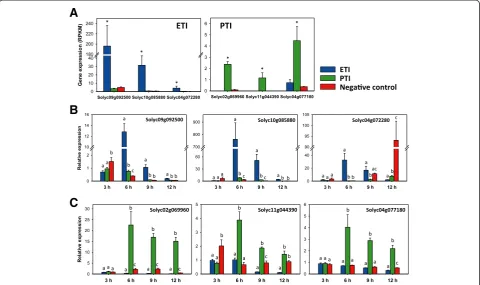
We identified and tested genes that are specifically induced during either ETI or PTI with the objective of developing reporters that will allow distinguishing be-tween cell death and other responses associated with dis-ease or ETI, which can be phenotypically similar. To achieve this, we selected three ETI- and three PTI-specific genes from our RNA-Seq data. Genes encoding a UDP-glucosyltransferase (Solyc09g092500, Solyc10g085880) or a laccase (Solyc04g072280) were chosen because they showed high induction only during ETI (Figure 3A). Genes encoding a NAC domain protein (Solyc02g069960), an osmotin-like protein (Solyc11g044390) and a potential lipid particle serine esterase (Solyc04g077180) were se-lected as PTI-specific markers (Figure 3A).
[image:4.595.56.291.88.424.2]RG-PtoR plants were again infiltrated with different DC3000 strains to assess the response of the reporter genes to ETI and PTI, but in this case we took leaf Figure 1Transcriptome changes associated with Pto/Prf-mediated
A
[image:5.595.57.541.91.641.2]B
samples at 3, 6, 9 and 12 hai to determine the temporal pattern of their induction. By using qRT-PCR we confirmed each gene to be ETI- or PTI-specific at 6 hai as found from the RNA-Seq data (Figure 3B,C). In the case of the ETI-induced genes, the two UDP-glucosyltransferase genes were shown to be good reporters at 6, 9, and 12 hai. The lac-case gene was ETI-specific only at 6 h after treatment (Figure 3B). All three PTI-specific genes were induced at each time point only during this immune response starting at 6 hai (Figure 3C). None of the six genes proved to be effective at distinguishing the two immune responses at 3 hai, which is likely before translocation of the effectors into the plant cell.
Identification of a novel kinase involved in plant immunity using a virus-induced gene silencing screen
To determine if the ETI-specific genes play a demonstrable role in this immune response we selected a subset of 30 genes that encode predicted protein kinases and transcription factors and performed a loss-of-function screen using VIGS inNicotiana benthamiana(Additional file 3). Leaves of silenced plants were infiltrated with a mix
of Agrobacterium tumefaciensstrains carrying 35S:Ptoor 35S:avrPto. Three genes with known roles in ETI were in-cluded as positive controls (SlMAPKKKα, SlMEK2 and SlPrf; Additional file 7) [18,32,33]. Negative controls were a fragment of the green fluorescent protein (GFP) gene and an Escherichia coli-derived DNA fragment (Ec1) (Additional file 7).
From this screen, we identified a predicted protein kinase-encoding gene whose silencing delayed PCD elicited by Pto/AvrPto (Figure S5A in Additional file 8). This protein is annotated as a serine/threonine tyrosine protein kinase (Solyc12g009340) that belongs to the GmPK6/AtMRK1-like protein kinase family [31]. SlEpk1 is a small protein (401 amino acids) that has a predicted protein kinase domain between residues 120 and 382. No other motifs or localization signals were found outside the kinase domain. The gene is induced specifically during ETI in both of the RNA-Seq experiments that we per-formed (Figure 4A,B) and plants silenced with the same construct were not reduced in flg22-induced reactive oxy-gen species (ROS) production (Figure S5B in Additional file 8). Therefore, we refer to it as SlEpk1, for Solanum
A
B
[image:6.595.58.539.90.375.2]C
lycopersicumETI-specific protein kinase 1. The GmPK6/ AtMRK1-like protein kinase family consists of 20 mem-bers inArabidopsis, 30 in tomato and 42 inN. benthami-ana [31]. A phylogenetic analysis using proteins from these three species revealed that SlEpk1 has two orthologs in tetraploid N. benthamiana (NbS00051202g0009.1 and NbS00020954g0005.1) (Additional file 9).
Silencing effectiveness of theSlEpk1virus-induced gene silencing construct inN. benthamiana
A VIGS construct using a 260 bp fragment of the tomato Epk1gene was used for silencingN. benthamianaplants
(Additional file 7). To analyze the specificity of the silen-cing, we first identified genes in N. benthamiana that have 100% nucleotide identity to theEpk1fragment over a stretch of ≥17 nucleotides. Twelve such genes were identified, although six were not considered further due to low or no expression (based onN. benthamianaRNA-Seq data) or because they appeared to derive from a sequence encoding a non-functional protein (Additional file 10). We performed qRT-PCR using Ec1- and SlEpk1-silenced
N. benthamiana plants on the six remaining genes
(Additional file 10). Of these six genes, transcript abun-dance for four was reduced in theSlEpk1-silenced plants, with the degree ranging from 20 to 80% (Figure S5C in Additional file 8). It was notable that the more similar the N. benthamianagene sequence is toSlEpk1, the better it was silenced (Figure S5C in Additional file 8; Additional file 11). All four of the silenced genes are in the same clade withSlEpk1(Additional file 11, clade A); the two un-affected genes belong to another clade (Additional file 11, clade B). These results indicate that one or more genes in
N. benthamianaare Epk1-related genes and one or more
of them could contribute to ETI.
Silencing ofSlEpk1compromises resistance to
Pseudomonas syringaepv.tabaci(AvrPto)
To further investigate the role ofSlEpk1in Pto/Prf-medi-ated ETI, we silenced the gene inN. benthamiana plants that expressPto(Nb-35S:Pto) and included control plants silenced for Ec1 or SlPrf. Leaves of the silenced plants were infiltrated with a low titer (5 × 10⁴cfu/ml) of P. s.
tabaci strains expressing AvrPto or an empty vector
[34]. As expected, all of the plants infiltrated withP. s.
tabaci carrying the empty vector developed disease
(Figure 5A,B). TheEc1plants infiltrated withP. s. tabaci carrying AvrPto did not develop disease due to the recog-nition of AvrPto by Pto and activation of ETI. Plants silenced forSlEpk1, or the positive controlSlPrf, developed disease upon infiltration withP. s. tabaciexpressing AvrPto (Figure 5A,B). As a further test, we vacuum-infiltrated si-lenced plants withP. s. tabaciAvrPto to measure bacterial populations. Bacteria reached higher numbers in plants si-lenced for SlEpk1orSlPrf compared with theEc1control (Figure 5C). Additionally, plants silenced forSlEpk1orSlPrf developed more severe disease symptoms (Figure 5D). These results indicate that SlEpk1 participates in the Pto/Prf pathway inN. benthamiana.
SlEpk1also plays a role in effector-triggered immunity activated by the bacterial effector HopQ1-1
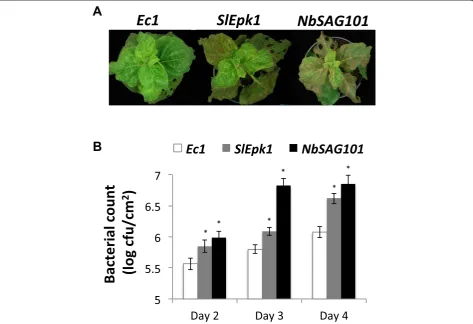
To investigate whether or not SlEpk1 plays a role exclu-sively in ETI activated by AvrPto recognition, we silenced
the Ec1, SlEpk1 or NbSAG101 gene in N. benthamiana
plants (Additional file 7) and vacuum-infiltrated them with P. s. tabaciexpressing HopQ1-1, a strain that activates ETI
A
[image:7.595.56.291.88.488.2]B
inN. benthamiana[35].NbSAG101was found in previous VIGS experiments to delay the development of PCD caused by DC3000 or P. s. tabaci HopQ1-1 (H Rosli and M Pombo, unpublished). The VIGS construct was designed based on two orthologs of the tomato
SAG101 in N. benthamiana (NbS00037653g0001.1 and
NbS00039736g0001.1). SlEpk1- and NbSAG101-silenced plants developed more disease symptoms thanEc1plants, supporting a role forEpk1in ETI activated by HopQ1-1 (Figure 6A). Consistent with the enhanced disease, P. s.
tabaci (HopQ1-1) reached higher population levels in
plants silenced with SlEpk1 and NbSAG101 (Figure 6B) compared with the Ec1 control, confirming that these plants are compromised in the ETI response triggered by HopQ1-1 recognition.
SlEpk1does not contribute to ETI activated by several non-bacterial effectors
To further characterize SlEpk1 involvement in PCD asso-ciated with ETI, we tested effector/R gene pairs derived
from diverse plant-pathogen interactions. We silenced
Ec1, SlEpk1 and MAPKKKα in N. benthamiana and
syringe-infiltrated leaves with different ETI activators: AvrPtoB1–387, a truncated bacterial effector [36]; potato
(Solanum tuberosum) Rx2/coat protein of PVX [37];
Ara-bidopsis RPP13/ATR13Emco5_Δ41aa from the oomycete
Hyalosperonospora arabidopsidis [38]; and potato Gpa2/
RBP-1 from the potato cyst nematode [39]. Bax, a murine Bcl-2-associated X protein, was also included as it triggers cell death in plants [40], and Pto without an effector was included as a negative control. With the exception of AvrPtoB1–387, PCD associated with each of these elicitors
was unaffected in SlEpk1-silenced plants (Figure 7), sug-gesting that SlEpk1 may play a role only in bacterial immunity-associated PCD inN. benthamiana.
SlEpk1 appears to act upstream of effector-triggered immunity-associated MAPK signaling
To investigate the position at which SlEpk1 might act in the signaling pathway activated upon AvrPto recognition
C
A
[image:8.595.57.539.90.405.2]D
B
by Pto, we performed an epistasis experiment that in-volved silencing and transiently expressing genes known to be involved in ETI [32]. N. benthamianaplants were silenced forSlEpk1,MAPKKKα,MEK2orSlPrf, withEc1 as a negative control. MAPKKKα and MEK2DD, both of which cause ETI-associated PCD, were then transiently expressed under an estradiol inducible promoter in the silenced leaves. If a silenced gene acts downstream or directly with MAPKKKαor MEK2, we expect to see com-promised PCD in these experiments.
As expected, expression of MAPKKKα or MEK2 in Ec1-silenced plants resulted in full PCD (Figure 8). The same result was obtained for the silenced genes using MEK2DD, indicating that none of these genes act downstream or directly with MEK2 in the signaling cascade (Figure 8). PCD induced by MAPKKKα was delayed in MAPKKKα-silenced plants as expected and was abolished by silencing of the downstream factor MEK2. Silencing of SlEpk1 or SlPrf had no effect on the PCD induced by MAPKKKα or MEK2DD, indicating that
SlEpk1 acts upstream of this MAPK cascade or that it func-tions independently of this MAPK pathway (Figure 8).
Discussion
[image:9.595.63.537.90.414.2]between ETI and PTI [22-25]. The discovery of ETI- and PTI-specific genes raises the possibility that these distinct classes are enriched for genes that play a role in these specific immune responses and our bibliographic search supported this hypothesis. In agreement with this, our
screening of just 30 ETI-specific genes successfully identi-fied a predicted protein kinase from a family previously unknown to have a role in the plant immune response.
[image:10.595.58.539.89.306.2]Our GO term analysis revealed characteristics about the ETI- and PTI-specific gene sets that distinguish them Figure 7SlEpk1contributes to programmed cell death associated with bacterial effector-plant R protein interaction.N. benthamiana silenced plants were syringe-infiltrated withA. tumefacienscarrying different effector/R gene pairs to elicit PCD. PCD percentage was calculated as described in the Materials and methods using 12 plants per construct. Asterisks indicate significant differences compared withEc1-silenced plants using Fisher’s exact test (P<0.01).Ec1,Escherichia colifragment 1; Pto, resistance toPseudomonas syringaepv.tomato; Bax, Bcl-2-associated X protein; AvrPtoB1–387, AvrPtoB lacking the E3-ligase domain; Rx2, resistance to potato virus X (PVX); CP, coat protein of PVX; RPP13, recognition of Hyaloperonospora parasitica13; ATR13Δ41,Arabidopsis thaliana-recognized 13 with 41 amino acids of the signal peptide deleted; Gpa2,Globodera pallida2; RBP-1, Ran-binding protein 1.
[image:10.595.55.540.465.678.2]from each other. For example, the PTI-specific group is enriched in secondary metabolite biosynthetic processes mainly related to the phenylpropanoid pathway known to be important in plant defense. Although it is not exclusive to PTI, membrane receptor kinase activity seems to have a primary role in this form of plant immunity. As expected, only in the ETI-specific gene group is there an enrichment in processes related to the hypersensitive response [42,43], such as programmed cell death, ion homeostasis, regulation of apoptotic process, response to hydrogen peroxide and other ROS, membrane organization and vesicle-mediated transport. A number of genes described previously as in-volved in incompatible plant-pathogen interactions were found to be specifically induced during ETI, supporting the idea that gene expression differences are a useful way to distinguish the two immune responses [9].
Several previous studies have used reporter genes as a readout for activation of PTI and its subsequent suppres-sion by pathogen effectors [44-47]. Reporter genes for PTI have also been developed for tomato andN. benthamiana [5,48,49]. However, these reporters have typically not been shown to be specific for PTI and may also be induced during ETI. In fact, using our RNA-Seq data we found that three tomato PTI reporter genes developed previ-ously [5] are also induced during ETI. In addition, the tomato genes most closely related to FRK1, a commonly used PTI reporter gene inArabidopsis, are not expressed or not induced during ETI or PTI, highlighting the im-portance of plant genera- or species-specific reporter genes. Plant-pathogen interactions can result in host cell death due to ETI or disease that is associated with activa-tion and subsequent suppression of PTI. Reporter genes that distinguish between these two immune responses will be a valuable tool to characterize the plant response toPst strains that have mutations affecting specific effectors, other virulence factors or MAMPs. Our RNA-Seq data and subsequent qRT-PCR analyses identified six such re-porter genes for tomato that can be used as specific plant defense markers in a biologically relevant time frame after bacterial inoculation (from 6 to 12 hai). In the future, de-velopment of specific reporter genes forN. benthamiana will be useful for understanding the contribution of SlEpk1 to ETI.
Our loss-of-function approach to screening a set of 30 ETI-specific genes identified a novel predicted pro-tein kinase, SlEpk1. This propro-tein is most closely related to the GmPK6/AtMRK1-like protein kinase family. In
Arabidopsis, this family of kinases is in the MAPKKK
group of proteins [50]. However, in tomato it is consid-ered as an independent family with around 51 mem-bers [31]. In bothArabidopsisand tomato, the genes in this family are known only from genomic analysis without any reports about their role in a specific bio-logical process.
There are many examples of proteins that play a role in ETI against diverse pathogens. For example, RAR1 has been shown to act in an ETI pathway triggered by many coiled-coil NB-LRR proteins and EDS1 acts in pathways triggered by many different TIR-NB-LRR R proteins [51,52]. Similarly, silencing of the genes encoding MAPKKKα, MEK2 or TFT7, a 14-3-3 protein, compro-mises ETI elicited by R proteins directed at diverse patho-gens [32,33,53,54]. In contrast, our experiments with five different R protein/effector pairs indicate that SlEpk1 may act in a pathway that responds specifically toPsteffectors. If future experiments confirm this specificity, it suggests that Epk1 may act early in these ETI pathways. Consistent with the apparent specificity of SlEpk1 for bacterial ETI, we discovered that this kinase likely acts upstream of MAPKKKα. It is possible that Epk1 participates in a complex directly with Pto/Prf and in a protein complex involved in HopQ1-1 recognition. Alternatively, SlEpk1 might act downstream of these recognition complexes at a juncture shared by bacterial resistance pathways, possibly even interacting with MAPKKKα.
Further experiments are needed to understand the function of SlEpk1 in plant immunity. For example, it will be important to determine if SlEpk1 is an active kinase and if its kinase activity is required for its function in plant defense triggered by bacterial effectors. If SlEpk1 is an ac-tive kinase, it will be important to determine its possible substrates. SlEpk1 and its closest tobacco andArabidopsis genes are described as serine/threonine tyrosine protein kinases [55,56]. In the case of tobacco, DSK1 was con-firmed to be phosphorylated on all three of these amino acids [55]. Lately, tyrosine phosphorylation of EF-TU RECEPTOR (EFR) upon MAMP recognition was shown to play an important role in innate immunity [57]. Conse-quently, if Epk1 is an active kinase, it will be interesting to determine which amino acids in its kinase domain are phosphorylated. An Epk1-like protein has been reported to localize to the chloroplast in tobacco and to the plasma membrane in Arabidopsis [55,58]. Determining the sub-cellular localization of the tomato SlEpk1 protein may also provide insights into the role of SlEpk1 in plant immunity.
Conclusions
a unique resource for further dissection of the plant immune responses.
Materials and methods
Bacterial strains and growth conditions
Pseudomonas strains were grown on King’s B medium
at 30°C. A. tumefaciens and E. coli were grown on Luria-Bertani (LB) medium at 30°C and 37°C, respect-ively. Antibiotics used were: ampicillin (100 μg/ml), kanamycin (50μg/ml), rifampicin (10μg/ml), spectino-mycin (50μg/ml) and gentamycin (10μg/ml). Bacterial strains are listed in Additional file 12.
Plant material and bacterial infiltrations
To analyze changes in transcript abundance during ETI, 4-week old resistant Rio Grande-PtoR (RG-PtoR), sus-ceptible Rio Grande-prf3(RG-prf3) or Rio Grande-prf19
(RG-prf19) plants were vacuum-infiltrated with a
sus-pension of 2 × 10⁷ cfu/ml of Pseudomonas syringae pv.
tomato (Pst) DC3000. The experiment was repeated in
three successive weeks (three biological replicates) and leaf samples were collected in each experiment at 4 and 6 hai, frozen in liquid N2 and stored at -80°C until processed.
For comparisons between ETI and PTI, RG-PtoR plants were vacuum-infiltrated with 5 × 10⁶ cfu/ml of different DC3000 mutants (DC3000 ΔhopQ1-1 ΔfliC, DC3000 ΔhopQ1-1 ΔavrPto ΔavrPtoB and DC3000
ΔhopQ1-1 ΔavrPto ΔavrPtoB ΔfliC) (Table 1). Leaf
samples from infiltrations performed in three succes-sive weeks (three biological replicates) were taken at 6 hai and manipulated as described above. For all experi-ments, after the samples were collected plants were maintained in the same conditions to observe disease symptoms (3 to 4 days after infiltration).
RNA-Seq library preparation and analysis
Total RNA was isolated with the Plant RNA isolation reagent (Life Technologies, Grand Island, NY, USA) ac-cording to the manufacturer’s instructions. Libraries for sequencing were constructed as described in [59] except that barcode sequences were in the reverse PCR primer. Barcoded libraries were multiplexed by 12 or 15 in each lane and sequenced on an Illumina HiSeq 2000 system using the single-end mode. The length of the reads was around 51 bp. Detailed information about the quality of reads in each replicate is provided in Additional file 13. Analysis of the RNA-Seq data was performed as described in [13]. Genes were considered to be induced when the expression was higher in RG-PtoR than in RG-prf3 or RG-prf19plants infiltrated with DC3000; or when the ex-pression was higher in RG-PtoR plants inoculated with DC3000 ΔfliC or DC3000 ΔavrPto ΔavrPtoB compared with DC3000 ΔavrPto ΔavrPtoB ΔfliC. In the opposite
situation the genes were considered to be suppressed. Se-quence reads have been deposited in the NCBI SeSe-quence Read Archive (SRA) under accession number SRP043126 and SRP043127. Processed data are available from the Tomato Functional Genomics Database [60] (accessions D010 and D011).
Development of effector-triggered and pattern-triggered immunity reporter genes
RG-PtoR plants were vacuum-infiltrated with the DC3000 strains as shown in Table 1. Leaf tissue was collected from four biological replicates at 3, 6, 9 and 12 hai. Total RNA was isolated using the Plant RNA isolation reagent (Life Technologies) following the manufacturer’s instructions. Total RNA (8μg) was processed with TURBO DNA-free kit (Life Technologies) for 60 minutes at 37°C. After DNase treatment, 4μg RNA was used to prepare cDNA using SuperScript III First-Strand Synthesis System (Life Technologies) with oligo(dT)20. qRT-PCR was performed as described previously [5]. The sequences of the primers used were: Solyc09g092500 F: 5′-TTGGACAGATCA
AGGGACTAATG -3′, R: 5′-CACTCTCAACCACACC
ATCTT-3′; Solyc10g085880 F: 5′-CCTGGATTGTTCG ACAAGAT-3′, R: 5′-CTCCTCCGCTTTCTTCATTT-3′; Solyc04g072280 F: 5′-AACGTCCCGATCGTAGAA-3′, R: 5′-GGATGATCAACTCCACCTAATAA-3′; Solyc02g069960 F: 5′-AGCCAACAAAGCTCAGGAA-3′, R: 5′-CATCCC AGTTGCCATGTTCTA-3′; Solyc11g044390 F: 5′- TCCT
AATGACTTGTCCGGATTT-3′, R: 5′-AGTATCACTAG
GGCAAGCAAATA-3′; Solyc04g077180 F: 5′-CAGCA
TTCTGTGGGCTATAC-3′, R: 5′- CCGAAGAAGAAGA
GGTTTCC-3′. Data were normalized using: SlATPase
(Solyc04g081090) F: 5′-TTGCTGAAGCCTTGGCTCT
TTACG-3′, R: 5′-ACCAGCGCGAGAAGAAAGGATG
AT-3′; SlEF1α (Solyc06g005060) F: 5′-TCCAAAGATGG
TCAGACCCGTGAA-3′, R: 5′-ATACCTAGCCTTGG
AGTACTTGGG-3′andSlCBL1(Solyc12g015870) F: 5′-C
CATCCAAATGCTCCGATCGATGA-3′, R: 5′-TGCCTC
TCAATGAAGCCTTGTTGC-3′. Cycling conditions dur-ing qRT-PCR were 50°C for 2 minutes, 95°C for 10 mi-nutes, and 40 cycles of 95°C for 30 s, 55°C for 30 s and 72°C for 30 s. A Tukey’s HSD test (P <0.01) was used for statistical analysis of the results.
Virus-induced gene silencing
Tomato genes for which a clear ortholog could be iden-tified in N. benthamiana were selected for designing VIGS constructs. Fragments of 280 to 350 bp were chosen using a VIGS tool [61]. Primers were designed inside this region using Primer3 [62]. PCR amplification was per-formed using cDNA obtained from RG-PtoR leaves tissue infiltrated with 2 × 10⁷cfu/ml DC3000 orN. benthamiana 35S:Pto plants infiltrated with 2 × 10⁷ cfu/ml DC3000
vector (Life Technologies) and recombined into a Gateway compatible TRV2 vector [63]. After sequence confirm-ation, plasmids were transformed into A. tumefaciens GV2260 and gene silencing was performed as described previously [64].
Screening of effector-triggered immunity-specific genes using programmed cell death assays
A. tumefaciens GV2260 strains carrying pBTEX:Pto or
pBTEX:avrPtowere grown overnight on solid LB medium (rifampicin and kanamycin). The following day the strains were incubated for 5 h in induction medium (0.05 M MES, 0.5% D-glucose, 0.0272% NaH2PO4, pH 5.6) supple-mented with 20× AB salts (2% NH4Cl, 0.6% MgSO4.7H2O, 0.3% KCl, 0.005% FeSO4.7H2O, 0.2% CaCl2.2H2O) and 200 μM acetosyringone. Induced cultures were washed with 10 mM MES, 10 mM MgCl2and combined in a 1:1 ratio with a final OD600= 0.15 and 200 μM acetosyrin-gone. The resulting suspensions were syringe-infiltrated into leaves of the silenced plants. Scoring was performed visually during several days as follows: PCD = more than 20% of the infiltrated area (within a marked circle) showed cell death; no PCD = less than 20% of the infiltrated area showed cell death. The number of infiltrated areas in each category was then used to calculate the PCD percentage. Plants silenced for GFP and an E. coli gene-based fragment (Ec1, which contains a 56% GC and not a single≥17 bp-long 100% identical stretch inN. benthami-ana) were used as negative controls. MAPKKKα, MEK2 and Prf were used as positive controls. The gene frag-ments used for silencing are provided in Additional file 7.
Measurement of reactive oxygen species production Discs from young leaves of Ec1-,SlEpk1- and NbFls2 -si-lenced plants were excised with a 4-mm-diameter cork borer. Leaf disks were floated adaxial side up in a 96-well black plate (Greiner Bio-one, Kremsmuenster, Austria) containing 180 μl of water per well, and left at room temperature overnight. The next day, the water was re-moved, and 100 μl of a solution containing the follow-ing was added: 500 nM flg22 (GenScript, Piscataway, NJ USA), luminol at 34μg/ml, and horseradish perox-idase at 20μg/ml (Sigma, St Louis, MO, USA) in water. Luminescence was measured using the Synergy HT plate reader (Biotek, Winooski, VT, USA). Four leaf disks per plant were taken, and six plants silenced for each gene were considered in each experiment.
Disease assays usingPseudomonas syringaepv.tabaci
N. benthamiana(Nb) or Nb-35S:PtoVIGS-silenced plants
were syringe- or vacuum-infiltrated with 5 × 10⁴cfu/ml
P. s. tabaci expressing HopQ1-1, AvrPto or carrying an
empty vector. The plants were scored as described in the PCD assay above for the presence of disease-associated
cell-death and used for bacterial growth assays. Fisher’s exact test (P <0.05) was used to determine significant differences.
Bacterial population assays
Seven-week-old VIGS-silenced plants were vacuum-infiltrated with a suspension of 5 × 10⁴cfu/mlP. s. tabaci (HopQ1-1) or 6 × 10⁴ cfu/ml P. s. tabaci (AvrPto) in 10 mM MgCl2and 0.002% Silwet L-77. To measure bac-terial populations, three 0.43 cm2disks were taken from the oldest expanding leaves and processed twice in a Tissue Lyser (Qiagen, Germantown, MD, USA) for 30 s at 25/s frequency with 0.25 ml of 10 mM MgCl2. The volume was adjusted to 1 ml and serial dilutions were plated on solid LB medium with antibiotics. In each ex-periment, six biological replicates per construct were used. A Student’st-test (P<0.05) was used to determine signifi-cant differences.
Agrobacterium-mediated transient assays
ETI elicitors were transiently expressed in VIGS-silenced N. benthamiana plants to induce PCD. Pto, AvrPto1–387, Rx2/CP, RPP13/ATR13Δ41 and Gpa2/
RBP-1 were expressed under the 35S promoter (pBTEX), SlMAPKKKαfull-length, SlMAPKKKαKD-, MEK2DDand MEK2 WT were expressed using an estradiol-inducible system (pER8), and Bax was expressed using a dexametha-sone-inducible system (pTA7002). Expression was induced 48 hai with 2μM estradiol or 10μM dexamethasone mixed with 0.02% Tween 20.
SlEpk1-silencing efficiency
Total RNA isolation, DNAse treatment, cDNA synthesis and qRT-PCR were performed as described above, using N. benthamianaleaf tissue fromEc1- andEpk1-silenced plants. The genes chosen for the analysis are shown in Additional file 10. Primers used for each gene analyzed were: Nb00051202g0009.1 F: 5′-TGTTGGGTCAAATG
ATTCTCACA-3′, R: 5′- GCTCAACCCATTAGAAAC
TCTGA-3′; Nb00020954g0005.1 F: 5′-TGTCGGGTC
AAATGATTCTC-3′, R: 5′-CAACCCGTTAGAAACTC
TCC-3′; Nb00014536g0001.1 F: 5′-AGGCTACCTAATG
ATGATGAAA-3′, R: 5′-GGTGGAGTTGAGACAATAG
AG-3′; Nb00003176g0019.1 F: 5′-ACCATGAACATT ATGGACTGT-3′, R: 5′-CAACAGAACCTCCACCATT-3′;
Nb00029791g0013.1 F: 5′-AGAGGCTCCAAAGTTCGC
A-3′, R: 5′-AACCGAACCTCCACCAAT-3′; Nb00042373 g0002.1 F: 5′-ATGATAAGACTACCTGATGATGAC-3′,
R: 5′-GGTGGAGTTGAGATAAGAGAATAA-3′. Data
Gene Ontology term analysis
Genes with expression levels ≥3 RPKM in at least one treatment, >2-fold induction and P <0.05 were used for the GO term analysis using the GO::Term Finder module [66].
Phylogenetic analysis
The SeaView program [67] was used to perform the phyl-ogeny analysis with the default parameters for the GTR model (nucleotides) and the JTT model (proteins). PhyML with one hundred bootstraps was used for each analysis. The tree figure was created using FigTree [68].
Bibliographic search associated with effector-triggered and pattern-triggered immunity-induced genes
SwissProt and TrEMBL protein databases [69], and EMBL-EBI plant EST and STD nucleotides databases [70] were downloaded and filtered using Ruby custom scripts to obtain plant sequences with PUBMED publi-cations [71]. These sequences were compared with the tomato gene models (ITAG2.3) using BLAST [72] to find putative orthologs to the tomato genes. Custom Ruby and BioRuby [73] scripts, available upon request, were used to filter the bibliography to obtain publications related to plant immunity associated with these genes.
Data access
The RNA-Seq data are available from the NCBI (accessions SRP043126 and SRP043127) and the Tomato Functional Genomics Database [60] (accessions D010 and D011).
Additional files
Additional file 1: Figure S1.Transcriptome analysis of Pto/Prf-mediated ETI in tomato.(A)Summary of the experimental strategy. RG-PtoR (resistant), RG-prf3and RG-prf19(susceptible) tomato plants were vacuum-infiltrated withP. syringaepv.tomatoDC3000. Leaf tissue was collected after 4 and 6 hai and used to develop RNA-Seq libraries.(B)Comparison of disease symptoms between treatments. Photographs were taken 3 dai.(C)Total number of genes differentially expressed during ETI (calculated as the ratio between the expression in RG-PtoR and RG-prf3or RG-prf19plants). The number of genes in each category is shown.(D)Percentage and number (in parentheses) of induced genes in each category (ETI, PTI, or both). The comparison was performed using previously published data for PTI-induced genes [13]. A≥2-fold difference andP<0.05 were used as cutoff. RG, Rio Grande; hai, hours after infiltration; dai, days after infiltration.
Additional file 2: Figure S2.Populations of DC3000 mutant strains in tomato leaves 6 hai.PstDC3000ΔfliC,PstDC3000ΔavrPtoΔavrPtoBand PstDC3000ΔavrPtoΔavrPtoBΔfliCpopulations were measured in leaves. Leaves of tomato RG-PtoR plants were infiltrated with 5 × 10⁶cfu/ml DC3000 mutant strains and sampled to measure bacterial populations at 6 hai. Bars represent the mean of four plants per strain with their corresponding standard error. Different letters indicate significant differences at 6 h using Tukey’s HSD test (P<0.05).
Additional file 3: Table S1.ETI-, PTI- and common-induced gene expression data. Reference column shows information about genes previously described to participate in plant immunity (see Materials and methods for detailed information).
Additional file 4: Figure S3.Distribution of induced genes in each category of plant immune response (ETI, PTI or both).(A)Analysis using maximum RPKM,(B)average RPKM and(C)fold change. A≥2-fold difference andP<0.05 were used as cutoff.
Additional file 5: Table S2.GO term analysis of ETI-, PTI- and common induced genes. Terms are grouped based on process (P), component (C) and function (F).
Additional file 6: Figure S4.Summary of transcription factors (TFs) whose transcript abundance is increased during ETI, PTI or both.(A) Percentage and number (in parentheses) of induced TF genes present in each category.(B)Number of genes in each TF family induced in ETI, PTI or both. A≥2-fold difference andP<0.05 were used as cutoff.
Additional file 7: Table S5.Nucleotide sequences of fragments used for VIGS.
Additional file 8: Figure S5.Identification ofSlEpk1in a screen using Pto/AvrPto inN. benthamiana.(A)Leaves ofN. benthamianaplants silenced for the genes shown were syringe-infiltrated withAgrobacterium carrying Pto/AvrPto to elicit programmed cell death (PCD). The degree of PCD was monitored visually (see Materials and methods).(B)Production of flg22-induced reactive oxygen species (ROS). Leaf disks from silenced plants were treated with 500 nM flg22 and ROS production was measured. The level of ROS at different time points is shown as relative light units (R.L.U.), and the names of the genes silenced are indicated. Six silenced plants were tested for each gene, and the average R.L.U. with standard error is shown.(C)Percentage of silencing inEc1-andSlEpk1-silenced plants using qRT-PCR. Silencing efficiency is shown as relative expression compared with theEc1control.NbPP2awas used as the reference gene and similar results were obtained usingNbEF1α. Asterisks indicate significant differences compared withEc1-silenced plants using a Student’st-test (P<0.05). A, NbS00020954g0005.1; B, NbS00051202g0009.1; C, NbS00029791g0013.1; D, NbS00003176g0019.1; E, NbS00042373g0002.1; F, NbS00014536g0001.1; G, NbEF1α.
Additional file 9: Figure S6.Phylogenetic analysis of the GmPK6/ AtMRK1-like protein kinase family using amino acid sequences. Green, black and red font and lines indicateArabidopsis,N. benthamianaand tomato proteins, respectively. SlEpk1 is labeled next to the
corresponding accession number and marked with a red star. Details of the SlEpk1 clade are shown in the upper-right corner. The PhyML method with a bootstrap of 100 replicates was used for the analysis (SeaView software [67]).
Additional file 10: Table S3.Analysis ofSlEpk1silencing inN. benthamiana. The length of perfect-match stretches of≥17 nucleotides is shown. Possible target genes inN. benthamianaare shown in bold font. N. C., not considered due to low/no expression or short sequence encoding a likely non-functional protein.
Additional file 11: Figure S7.Phylogenetic analysis of GmPK6/AtMRK1-like kinase nucleotide sequences inNicotiana benthamiana. Accession numbers in black show the possible targets of the tomato VIGS construct in N. benthamiana(see Additional file 10: Table S3). TomatoEpk1was added to the analysis (red) and clades A and B are marked with a black square. The PhyML method with a bootstrap of 100 replicates was used for the analysis (SeaView software, [67]).
Additional file 12: Table S4.Bacterial strains used in this study.
Additional file 13: Table S6.Summary of the sequencing data for each of the libraries generated in this work.
Abbreviations
Competing interests
The authors declare that they have no competing interests.
Authors’contributions
MAP and GBM designed the research, MAP and DMD performed the research, MAP, YZ, NFP, ZF and GBM analyzed the data, MAP and GBM wrote the paper. All authors read and approved the manuscript.
Acknowledgments
We thank Paige Reeves for her assistance in the greenhouse, Hailei Wei and Alan Collmer for providing advice and bacterial strains, and Hernan Rosli and Simon Schwizer for helpful comments on the manuscript. This research was supported by National Science Foundation Plant Genome Research Program grant IOS-1025642 (GBM, Alan Collmer, PI) and by Israel-USA Binational Agriculture Research and Development Fund grant IS-4510-12C (GBM).
Received: 2 July 2014 Accepted: 9 October 2014
References
1. Schwessinger B, Ronald PC:Plant innate immunity: perception of conserved microbial signatures.Annu Rev Plant Biol2012,63:451–482. 2. Boller T, He SY:Innate immunity in plants: an arms race between pattern
recognition receptors in plants and effectors in microbial pathogens. Science2009,324:742–744.
3. Dodds PN, Rathjen JP:Plant immunity: towards an integrated view of plant-pathogen interactions.Nat Rev Genet2010,11:539–548.
4. Segonzac C, Zipfel C:Activation of plant pattern-recognition receptors by bacteria.Curr Opin Microbiol2011,14:54–61.
5. Nguyen HP, Chakravarthy S, Velásquez AC, McLane HS, Zeng L, Park D-W, Collmer A, Martin GB:Methods to study PAMP-triggered immunity using tomato and
Nicotiana benthamiana.Mol Plant Microbe Interact2010,23:991–999. 6. Maekawa T, Kufer TA, Schulze-Lefert P:NLR functions in plant and animal
immune systems: so far and yet so close.Nat Immunol2011,12:817–826. 7. Jones JD, Dangl JL:The plant immune system.Nature2006,444:323–329. 8. Pedley KF, Martin GB:Molecular basis of Pto-mediated resistance to bacterial
speck disease in tomato.Annu Rev Phytopathol2003,41:215–243. 9. Oh CS, Martin GB:Effector-triggered immunity mediated by the Pto
kinase.Trends Plant Sci2011,16:132–140.
10. Gomez-Gomez L, Boller T:FLS2: an LRR receptor-like kinase involved in the perception of the bacterial elicitor flagellin inArabidopsis.Mol Cell 2000,5:1003–1011.
11. Zeng W, He SY:A prominent role of the flagellin receptor FLAGELLIN-SENSING2 in mediating stomatal response toPseudomonas syringae
pvtomatoDC3000 inArabidopsis.Plant Physiol2010,153:1188–1198. 12. Clarke CR, Chinchilla D, Hind SR, Taguchi F, Miki R, Ichinose Y, Martin GB,
Leman S, Felix G, Vinatzer BA:Allelic variation in two distinctPseudomonas syringaeflagellin epitopes modulates the strength of plant immune responses but not bacterial motility.New Phytol2013,200:847–860. 13. Rosli H, Zheng Y, Pombo M, Zhong S, Bombarely A, Fei Z, Collmer A, Martin
G:Transcriptomics-based screen for genes induced by flagellin and repressed by pathogen effectors identifies a cell wall-associated kinase involved in plant immunity.Genome Biol2013,14:R139.
14. Martin GB:Suppression and activation of the plant immune system by
Pseudomonas syringaeeffectors AvrPto and AvrPtoB.InEffectors in Plant-Microbe Interactions.Edited by Martin F, Kamoun S. London: Wiley-Blackwell, John Wiley and Sons; 2012:123–154.
15. Cunnac S, Chakravarthy S, Kvitko BH, Russell AB, Martin GB, Collmer A: Genetic disassembly and combinatorial reassembly identify a minimal functional repertoire of type III effectors inPseudomonas syringae.Proc Natl Acad Sci U S A2011,108:2975–2980.
16. Martin GB, Brommonschenkel SH, Chunwongse J, Frary A, Ganal MW, Spivey R, Wu T, Earle ED, Tanksley SD:Map-based cloning of a protein kinase gene conferring disease resistance in tomato.Science1993,262:1432–1436. 17. Tang X, Frederick RD, Zhou J, Halterman DA, Jia Y, Martin GB:Initiation of
plant disease resistance by physical interaction of AvrPto and Pto kinase. Science1996,274:2060–2063.
18. Salmeron JM, Oldroyd GED, Rommens CMT, Scofield SR, Kim HS, Lavelle DT, Dahlbeck D, Staskawicz BJ:Tomato Prf is a member of the leucine-rich repeat class of plant disease resistance genes and lies embedded within the Pto kinase gene cluster.Cell1996,86:123–133.
19. Mysore KS, Crasta OR, Tuori RP, Folkerts O, Swirsky PB, Martin GB:Comprehensive transcript profiling ofPto- andPrf-mediated host defense responses to infection byPseudomonas syringaepv.tomato.Plant J2002,32:299–315. 20. Tsuda K, Katagiri F:Comparing signaling mechanisms engaged in
pattern-triggered and effector-triggered immunity.Curr Opin Plant Biol 2010,13:459–465.
21. Katagiri F, Tsuda K:Understanding the plant immune system.Mol Plant Microbe Interact2010,23:1531–1536.
22. Tao Y, Xie Z, Chen W, Glazebrook J, Chang HS, Han B, Zhu T, Zou G, Katagiri F:Quantitative nature ofArabidopsisresponses during compatible and incompatible interactions with the bacterial pathogenPseudomonas syringae.Plant Cell2003,15:317–330.
23. Navarro L, Zipfel C, Rowland O, Keller I, Robatzek S, Boller T, Jones JD:The transcriptional innate immune response to flg22. Interplay and overlap with Avr gene-dependent defense responses and bacterial pathogenesis. Plant Physiol2004,135:1113–1128.
24. Tsuda K, Sato M, Glazebrook J, Cohen JD, Katagiri F:Interplay between MAMP-triggered and SA-mediated defense responses.Plant J2008, 53:763–775.
25. Tsuda K, Sato M, Stoddard T, Glazebrook J, Katagiri F:Network properties of robust immunity in plants.PLoS Genet2009,5:e1000772.
26. Wang Z, Gerstein M, Snyder M:RNA-Seq: a revolutionary tool for transcriptomics.Nat Rev2009,10:57–63.
27. Ansorge WJ:Next generation DNA sequencing techniques.Nat Biotechnol 2009,25:195–203.
28. Haas BJ, Zody MC:Advancing RNA-Seq analysis.Nat Biotechnol2010, 28:421–423.
29. Wang L, Li P, Brutnell TP:Exploring plant transcriptome using ultra high-throughput sequencing.Brief Funct Genomics2010,9:118–128. 30. Salmeron JM, Barker SJ, Carland FM, Mehta AY, Staskawicz BJ:Tomato
mutants altered in bacterial disease resistance provide evidence for a new controlling pathogen recognition.Plant Cell1994,6:511–520. 31. iTAK - Plant Transcription factor and Protein Kinase Identifier and Classifier
[http://bioinfo.bti.cornell.edu/cgi-bin/itak/index.cgi]
32. del Pozo O, Pedley KF, Martin GB:MAPKKKa is a positive regulator of cell death associated with both plant immunity and disease.EMBO J2004, 23:3072–3082.
33. Ekengren SK, Liu Y, Schiff M, Dinesh-Kumar SP, Martin GB:Two MAPK cascades, NPR1, and TGA transcription factors play a role in Pto-mediated disease resistance in tomato.Plant J2003,36:905–917.
34. Wulf J, Pascuzzi PE, Fahmy A, Martin GB, Nicholson LK:The solution structure of type III effector protein AvrPto reveals conformational and dynamic features important for plant pathogenesis.Structure2004, 12:1257–1268.
35. Wei CF, Kvitko BH, Shimizu R, Crabill E, Alfano JR, Lin NC, Martin GB, Huang HC, Collmer A:APseudomonas syringaepv.tomatoDC3000 mutant lacking the type III effector HopQ1-1 is able to cause disease in the model plantNicotiana benthamiana.Plant J2007,51:32–46. 36. Rosebrock TR, Zeng L, Brady JJ, Abramovitch RB, Xiao F, Martin GB:A
bacterial E3 ubiquitin ligase targets a host protein kinase to disrupt plant immunity.Nature2007,448:370–374.
37. Bendahmane A, Querci M, Kanyuka K, Baulcombe DC:Agrobacterium transient expression system as a tool for the isolation of disease resistance genes: application to the Rx2 locus in potato.Plant J2000, 21:73–81.
38. Rentel MC, Leonelli L, Dahlbeck D, Zhao B, Staskawicz BJ:Recognition of theHyaloperonospora parasiticaeffector ATR13 triggers resistance against oomycete, bacterial, and viral pathogens.Proc Natl Acad Sci U S A 2008,105:1091–1096.
39. Sacco MA, Koropacka K, Grenier E, Jaubert MJ, Blanchard A, Goverse A, Smant G, Moffett P:The cyst nematode SPRYSEC protein RBP-1 elicits Gpa2- and RanGAP2-dependent plant cell death.PLoS Pathog2009, 5:e1000564.
40. Lacomme C, Santa Cruz S:Bax-induced cell death in tobacco is similar to the hypersensitive response.Proc Natl Acad Sci U S A1999,96:7956–7961. 41. Xin X-F, He SY:Pseudomonas syringae pv. tomato DC3000: a model
pathogen for probing disease susceptibility and hormone signaling in plants.Annu Rev Phytopathol2013,51:473–498.
43. Coll NS, Epple P, Dangl JL:Programmed cell death in the plant immune system.Cell Death Differ2011,18:1247–1256.
44. Kang L, Li J, Zhao T, Xiao F, Tang X, Thilmony R, He S, Zhou J-M:Interplay of theArabidopsisnonhost resistance gene NHO1 with bacterial virulence.Proc Natl Acad Sci U S A2003,100:3519–3524.
45. Li X, Lin H, Zhang W, Zou Y, Zhang J, Tang X, Zhou J-M:Flagellin induces innate immunity in nonhost interactions that is suppressed by
Pseudomonas syringaepv.tomatoeffectors.Proc Natl Acad Sci U S A 2005,102:12990–12995.
46. He P, Shan L, Lin NC, Martin GB, Kemmerling B, Nurnberger T, Sheen J: Specific bacterial suppressors of MAMP signaling upstream of MAPKKK inArabidopsisinnate immunity.Cell2006,125:563–575.
47. Schulze S, Kay S, Buttner D, Egler M, Eschen-Lippold L, Hause G, Kruger A, Lee J, Muller O, Scheel D, Szczesny R, Thieme F, Bonas U:Analysis of new type III effectors from Xanthomonas uncovers XopB and XopS as suppressors of plant immunity.New Phytol2012,195:894–911. 48. Kim JG, Li X, Roden JA, Taylor KW, Aakre CD, Su B, Lalonde S, Kirik A, Chen
Y, Baranage G, McLane H, Martin GB, Mudgett MB:XanthomonasT3S effector XopN suppresses PAMP-triggered immunity and interacts with a tomato atypical receptor-like kinase and TFT1.Plant Cell2009,
21:1305–1323.
49. Zheng X, McLellan H, Fraiture M, Liu X, Boevink PC, Gilroy EM, Chen Y, Kandel K, Sessa G, Birch PR, Brunner F:Functionally redundant RXLR effectors fromPhytophthora infestansact at different steps to suppress early flg22-triggered immunity.PLoS Pathog2014,10:e1004057. 50. Ichimura K, Shinozaki K, Tena G, Sheen J, Henry Y, Champion A, Kreis M,
Zhang SQ, Hirt H, Wilson C, Heberle-Bors E, Ellis BE, Morris PC, Innes RW, Ecker JR, Scheel D, Klessig DF, Machida Y, Mundy J, Ohashi Y, Walker JC, Grp M: Mitogen-activated protein kinase cascades in plants: a new nomenclature. Trends Plant Sci2002,7:301–308.
51. Martin GB, Bogdanove AJ, Sessa G:Understanding the functions of plant disease resistance proteins.Annu Rev Plant Biol2003,54:23–61. 52. Bernoux M, Ellis JG, Dodds PN:New insights in plant immunity signaling
activation.Curr Opin Plant Biol2011,14:512–518.
53. Jin H, Liu Y, Yang KY, Kim CY, Baker B, Zhang S:Function of a mitogen-activated protein kinase pathway in N gene-mediated resistance in tobacco.Plant J 2003,33:719–731.
54. Oh CS, Pedley KF, Martin GB:Tomato 14-3-3 protein 7 positively regulates immunity-associated programmed cell death by enhancing protein abundance and signaling ability of MAPKKK alpha.Plant Cell2010, 22:260–272.
55. Cho HS, Yoon GM, Lee SS, Kim YA, Hwang I, Choi D, Pai H-S:A novel dual-specificity protein kinase targeted to the chloroplast in tobacco. FEBS Lett2001,497:124–130.
56. Rudrabhatla P, Reddy MM, Rajasekharan R:Genome-wide analysis and experimentation of plant serine/ threonine/tyrosine-specific protein kinases.Plant Mol Biol2006,60:293–319.
57. Macho AP, Schwessinger B, Ntoukakis V, Brutus A, Segonzac C, Roy S, Kadota Y, Oh MH, Sklenar J, Derbyshire P, Lozano-Duran R, Malinovsky FG, Monaghan J, Menke FL, Huber SC, He SY, Zipfel C:A bacterial tyrosine phosphatase inhibits plant pattern recognition receptor activation. Science2014,343:1509–1512.
58. Bayer RG, Stael S, Rocha AG, Mair A, Vothknecht UC, Teige M: Chloroplast-localized protein kinases: a step forward towards a complete inventory. J Exp Bot2012,63:1713–1723.
59. Zhong S, Joung JG, Zheng Y, Chen YR, Liu B, Shao Y, Xiang JZ, Fei Z, Giovannoni JJ:High-throughput illumina strand-specific RNA sequencing library preparation.Cold Spring Harb Protoc2011,2011:940–949. 60. Tomato Functional Genomics Database[http://ted.bti.cornell.edu/] 61. VIGS Tool[http://solgenomics.net/tools/vigs]
62. Untergasser A, Cutcutache I, Koressaar T, Ye J, Faircloth BC, Remm M, Rozen SG:Primer3–new capabilities and interfaces.Nucleic Acids Res2012, 40:e115.
63. Liu Y, Schiff M, Dinesh-Kumar SP:Virus-induced gene silencing in tomato. Plant J2002,31:777–786.
64. Velasquez AC, Chakravarthy S, Martin GB:Virus-induced gene silencing (VIGS) inNicotiana benthamianaand tomato.J Vis Exp2009, 28:1292–1299.
65. Liu D, Shi L, Han C, Yu J, Li D, Zhang Y:Validation of reference genes for gene expression studies in virus-infectedNicotiana benthamianausing quantitative real-time PCR.PLoS One2012,7:e46451.
66. Boyle EI, Weng S, Gollub J, Jin H, Botstein D, Cherry JM, Sherlock G:GO:: TermFinder–open source software for accessing Gene Ontology information and finding significantly enriched Gene Ontology terms associated with a list of genes.Bioinformatics2004,20:3710–3715. 67. Gouy M, Guindon S, Gascuel O:SeaView version 4: a multiplatform
graphical user interface for sequence alignment and phylogenetic tree building.Mol Biol Evol2010,27:221–224.
68. FigTree[http://tree.bio.ed.ac.uk/software/figtree]
69. Consortium TU:Activities at the Universal Protein Resource (UniProt). Nucleic Acids Res2014,42:D191–D198.
70. Stoesser G, Baker W, van den Broek A, Camon E, Garcia-Pastor M, Kanz C, Kulikova T, Lombard V, Lopez R, Parkinson H, Redaschi N, Sterk P, Stoehr P, Tuli MA:The EMBL nucleotide sequence database.Nucleic Acids Res2001, 29:17–21.
71. PUBMED[http://www.ncbi.nlm.nih.gov/pubmed/]
72. Camacho C, Coulouris G, Avagyan V, Ma N, Papadopoulos J, Bealer K, Madden T:BLAST+: architecture and applications.BMC Bioinformatics 2009,10:421.
73. Goto N, Prins P, Nakao M, Bonnal R, Aerts J, Katayama T:BioRuby: bioinformatics software for the Ruby programming language. Bioinformatics2010,26:2617–2619.
doi:10.1186/s13059-014-0492-1
Cite this article as:Pomboet al.:Transcriptomic analysis reveals tomato genes whose expression is induced specifically during effector-triggered immunity and identifies the Epk1 protein kinase which is required for the host response to three bacterial effector proteins.
Genome Biology201415:492.
Submit your next manuscript to BioMed Central and take full advantage of:
• Convenient online submission
• Thorough peer review
• No space constraints or color figure charges
• Immediate publication on acceptance
• Inclusion in PubMed, CAS, Scopus and Google Scholar
• Research which is freely available for redistribution