Prospective Evaluation of ResistancePlus
MG, a New Multiplex Quantitative PCR
Assay for Detection of
Mycoplasma
genitalium
and Macrolide Resistance
S. N. Tabrizi,a,b,cJ. Su,a,bC. S. Bradshaw,d,eC. K. Fairley,d,eS. Walker,fL. Y. Tan,f E. Mokany,fS. M. Garlanda,b,c
Department of Microbiology and Infectious Diseases, The Royal Women's Hospital, Parkville, Victoria, Australiaa; Department of Obstetrics and Gynaecology, University of Melbourne, Victoria, Australiab; Murdoch Childrens Research Institute, Parkville, Victoria, Australiac; Melbourne Sexual Health Centre, Carlton, Victoria, Australiad; Central Clinical School, Monash University, Frankston, Victoria, Australiae; SpeeDx Pty Ltd., Sydney, NSW, Australiaf
ABSTRACT Mycoplasma genitalium is a significant pathogen for which first-line
treatment is becoming less effective due to increased resistance to macrolides. As conventional culture and antimicrobial susceptibility testing is not feasible for rou-tine detection of this pathogen, molecular markers such as detection of mutations in the 23S rRNA gene have been described to predict resistance. Recently, a novel mul-tiplex quantitative PCR (qPCR) assay, ResistancePlus MG, has been described for the simultaneous detection of Mycoplasma genitalium and macrolide resistance. In the current study, the clinical performance of the assay was evaluated on 1,089 consecu-tive urine and anogenital swab samples in symptomatic and asymptomatic male and female patients. Overall, 6.0% were positive for M. genitalium, with 63.1% having macrolide resistance-associated mutations. Compared to the laboratory-validated qPCR method targeting the 16S rRNA gene and Sanger sequencing to determine 23S rRNA mutations, the sensitivity and specificity of M. genitalium detection were 98.5% and 100% and for detection of macrolide resistance mutations were 100.0% and 96.2%, respectively. This assay offers a considerable advantage in clinical set-tings for M. genitalium testing by making the results of macrolide resistance and mutation analyses simultaneously available, which is increasingly important with es-calating macrolide resistance.
KEYWORDS Mycoplasma genitalium, macrolide resistance, 23S rRNA, multiplex assay, NAAT, qPCR, diagnostic, sensitivity and specificity
M
ycoplasma genitaliumis a significant pathogen in the etiology of nongonococcal urethritis (NGU) in men (1, 2) and of cervicitis, pelvic inflammatory disease (PID), and infertility in women (3–7). Infections and syndromes associated withM. genitalium such as NGU are often treated with the macrolide antibiotic azithromycin (8, 9). However, over the past decade, there have been increasing reports of declining cure rates, which in some settings are now as low as 50% in genitalM. genitaliuminfections in symptomatic men and women (10–13). Azithromycin treatment failure is strongly associated with the presence of mutations in binding region V of theM. genitalium23S rRNA gene (equivalent toEscherichia colinucleotide positions 2058 and 2059) (11, 14). M. genitalium is a fastidious, slow-growing organism and is challenging to culture. Therefore, traditional culture-based methods are not possible for routine diagnosis; hence, detection requires nucleic acid amplification tests (NAATs). Con-ventional culture-based antibiotic susceptibility tests are therefore also not feasible.Received18 November 2016Returned for modification16 December 2016Accepted2 April 2017
Accepted manuscript posted online5 April 2017
CitationTabrizi SN, Su J, Bradshaw CS, Fairley CK, Walker S, Tan LY, Mokany E, Garland SM. 2017. Prospective evaluation of ResistancePlus MG, a new multiplex quantitative PCR assay for detection ofMycoplasma genitaliumand macrolide resistance. J Clin Microbiol 55:1915– 1919.https://doi.org/10.1128/JCM.02312-16.
EditorSandra S. Richter, Cleveland Clinic
Copyright© 2017 Tabrizi et al. This is an open-access article distributed under the terms of theCreative Commons Attribution 4.0 International license.
Address correspondence to S. N. Tabrizi, [email protected].
crossm
on May 16, 2020 by guest
http://jcm.asm.org/
However, prediction of resistance can be inferred from the detection of the macrolide resistance-mediating mutations in the 23S rRNA gene (13, 14).
Different NAATs have been utilized for the detection of macrolide resistance muta-tions. DNA sequencing has been used to detect mutations in cases of treatment failure and is also the gold standard method for mutant determination (14). Sequencing, however, is generally not feasible for routine diagnosis due to the higher cost and longer turnaround time to results, delaying the reporting of macrolide resistance and hence treatment with second-line antimicrobials. Alternatively, other real-time quanti-tative PCR (qPCR)-based approaches have been utilized such as high-resolution melt assay (HRMA)-based methods (15, 16), a 5= nuclease assay, and the use of mutation-specific primers (17, 18). These methods were limited in their ability to detect the macrolide resistance mutations in allM. genitalium-positive samples or were restricted in sensitivity and the ability to multiplex. These methods have been demonstrated only onM. genitalium-positive samples, with the exception of the fluorescence resonance energy transfer (FRET) method; however, this was limited in sensitivity forM. genitalium detection (19).
ResistancePlus MG is a new multiplex qPCR assay employing novel PlexZyme and PlexPrime technology (SpeeDx Pty Ltd., Sydney, Australia) that has recently been developed (20) and that allows simultaneous detection of M. genitalium and the common mutations associated with macrolide resistance (including A2058G, A2059G, A2058T, A2058C, and A2059C) in one well (21). The previous evaluation assessed clinical performance in an infected population and also analytical performance (21). In this study, a prospective clinical evaluation of this assay was conducted in a routine clinical setting, thereby reflecting the prevalence of M. genitaliumand mutations associated with macrolide resistance in this population. The performance of the assay for bothM. genitaliumdetection and determination of mutation status was compared to that of a laboratory-validated qPCR method targeting the 16S rRNA gene and Sanger sequenc-ing of the 23S rRNA gene.
RESULTS AND DISCUSSION
The specimens included 388 samples comprising 354 urine/urethral swabs and 34 anal swabs from men and 701 samples comprising 203 urine and 497 cervical/vaginal swabs and 1 rectal swab from women (Table 1).
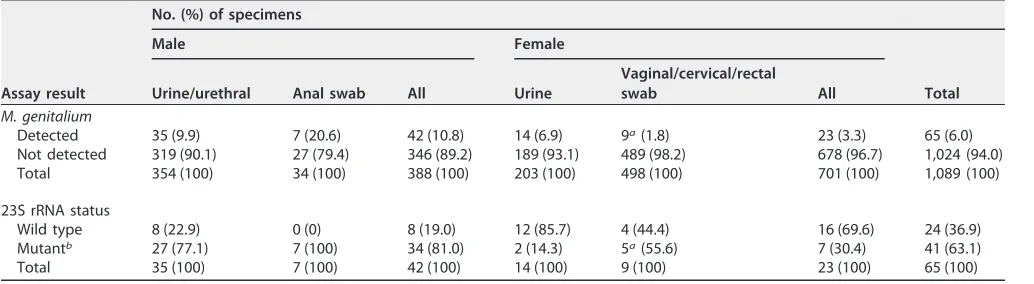
[image:2.585.41.558.83.225.2]Overall, 6.0% (65/1,089) of the samples were positive for M. genitalium by the reference 16S rRNA gene assay, with 10.8% of male and 3.3% of female samples being positive. A 23S rRNA mutation was detected in 63.1% (41/65) of the positive samples by Sanger sequencing (Table 1). A total of 34 (81.0%) samples from males had macrolide resistance mutations compared to 7 (30.4%) samples from females (P⬍0.0001). Overall, the prevalence of M. genitalium and macrolide-resistant mutations was significantly higher in men (P⬍0.0001), as they were primarily from symptomatic patients at the
TABLE 1Specimen types and reference assay results
Assay result
No. (%) of specimens
Male Female
Total Urine/urethral Anal swab All Urine
Vaginal/cervical/rectal
swab All
M. genitalium
Detected 35 (9.9) 7 (20.6) 42 (10.8) 14 (6.9) 9a(1.8) 23 (3.3) 65 (6.0)
Not detected 319 (90.1) 27 (79.4) 346 (89.2) 189 (93.1) 489 (98.2) 678 (96.7) 1,024 (94.0) Total 354 (100) 34 (100) 388 (100) 203 (100) 498 (100) 701 (100) 1,089 (100)
23S rRNA status
Wild type 8 (22.9) 0 (0) 8 (19.0) 12 (85.7) 4 (44.4) 16 (69.6) 24 (36.9) Mutantb 27 (77.1) 7 (100) 34 (81.0) 2 (14.3) 5a(55.6) 7 (30.4) 41 (63.1)
Total 35 (100) 7 (100) 42 (100) 14 (100) 9 (100) 23 (100) 65 (100)
aIncludes one rectal sample from a female.
bMutations included 23 A2058G, 13 A2059G, 4 A2058T, and 1 A2058C.
on May 16, 2020 by guest
http://jcm.asm.org/
Melbourne Sexual Health Centre (MSHC), Victoria, Australia. It is noteworthy that macrolide resistance mutations were detected in allM. genitalium-positive rectal swabs, highlighting a particularly challenging issue in treatment of rectal infections.
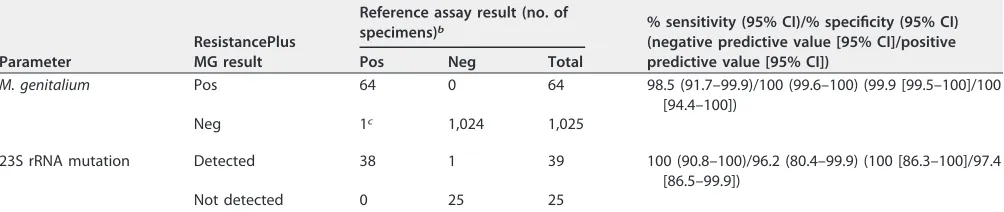
The level of concordance of the ResistancePlus MG assay with the reference method for detection ofM. genitaliumwas 99.9%, with a Kappa value of 0.99 (95% confidence interval [CI], 0.98 to 1.00) and sensitivity and specificity of 98.5% and 100.0%, respec-tively. In this routine clinical setting, the positive and negative predictive values for detection of M. genitalium were 100% and 99.9% and the positive and negative predictive values for detection of 23S rRNA mutations were 97.4% and 100%, respec-tively (Table 2). Overall, only 1 discordantM. genitaliumresult was obtained: a positive female urine sample referred from an external laboratory, which had aM. genitalium load of less than 100 copies in the sample. This was detected by the reference assay; however, the value was near the cutoff, and the ResistancePlus MG assay returned a negative result. When this sample was retested in duplicate by the reference method, it resulted in a negative result and a positive result reflective of a sample with low bacterial load and at the threshold of the detection limit.
Among the 64 specimens positive forM. genitaliumby the ResistancePlus MG assay, 63 (98.4%) were concordant with sequencing for 23S rRNA mutant detection, with a Kappa value of 0.97 (95% CI, 0.90 to 1.00) and sensitivity and specificity of 100% and 96.2%, respectively (Table 2).
Overall, 88% of the mutations represented in this cohort, as detected by Sanger sequencing, were A2058G or A2059G. Among the 5 mutation types detectable by the ResistancePlus MG assay, all except A2059C were present in this patient population and results corresponded to the Sanger sequencing result. Previously, it was shown that all 5 mutations are detectable with similar analytical sensitivities (21); however, detection of all these mutations and the clinical performance of the analyses would need to be determined with further studies and also in other populations. This study did not collect detailed symptoms from each patient, and, as such, further studies would need to be performed to evaluate the utility ofM. genitaliumand macrolide testing in asymptom-atic patients. The data presented indicate that 63.1% of the specimens had macrolide resistance-associated mutations; however, these single nucleotide mutations confer high-level resistance to azithromycin and have been consistently associated with clinical failure of this drug (10, 24). Comparison to phenotypic resistance assay results was not possible in this study due to the well-established difficulty in culturing M. genitalium; however, phenotypic data have been correlated with resistance mutations (14).
[image:3.585.42.544.84.190.2]The ResistancePlus MG assay performed extremely well against the reference meth-ods utilized in our laboratory, and, unlike the sequencing method, this assay does not require specialized instrumentation and can be performed by routine diagnostic lab-oratories. It also offers the unique capability of simultaneousM. genitaliumdetection
TABLE 2Evaluation of the ResistancePlus MG assay for the detection ofM. genitaliumand 23S rRNA gene mutationsa
Parameter
ResistancePlus MG result
Reference assay result (no. of
specimens)b % sensitivity (95% CI)/% specificity (95% CI)
(negative predictive value [95% CI]/positive predictive value [95% CI])
Pos Neg Total
M. genitalium Pos 64 0 64 98.5 (91.7–99.9)/100 (99.6–100) (99.9 [99.5–100]/100 [94.4–100])
Neg 1c 1,024 1,025
23S rRNA mutation Detected 38 1 39 100 (90.8–100)/96.2 (80.4–99.9) (100 [86.3–100]/97.4 [86.5–99.9])
Not detected 0 25 25
aPos, positive; Neg, negative.
bThe reference assay used forM. genitaliumdetection was a standard assay in use in the laboratory (22, 23), and the assays used for 23S rRNA mutation status
detection were Sanger sequencing and HRMA (14, 16). In the comparison of mutation detection results, Pos by the reference assay represents detection of a mutant strain and Neg represents detection of the wild-type strain.
cFewer than 100 copies ofM. genitaliumwere detected in the sample.
on May 16, 2020 by guest
http://jcm.asm.org/
and assessment of macrolide resistance. Patients infected withM. genitalium23S rRNA mutants are predicted to fail treatment. This study aimed to evaluate the assay with consecutive samples sent to the laboratory and included a mixture of specimens from symptomatic and asymptomatic patients that had been sent to the laboratory for testing. Although the details of the individual patient symptoms were not available, the alarmingly higher prevalence ofM. genitaliumand resistance mutations detected in the male population, which consisted primarily of men from a sexual health clinic who were symptomatic with urethritis, highlights the importance of utilizing this assay for detec-tion of M. genitalium and resistance testing to inform management of disease. This assay offers a considerable advantage for the rapid detection of macrolide-resistant strains and can be incorporated into diagnostic algorithms which can individualize antimicrobial therapy to ensure rapid delivery of agents to which the organism is susceptible. Where azithromycin is used as the first-line therapy, simultaneous avail-ability of M. genitalium detection and detection of macrolide resistance mutations would allow clinicians to rapidly recall patients to provide a more appropriate second-line treatment in comparison to waiting for up to 4 weeks for test of cure or treatment failure. Where doxycycline rather than azithromycin is used as first-line therapy for sexually transmitted infection (STI) syndromes, patients withM. genitaliuminfection can be recalled for treatment with an antimicrobial based on the macrolide resistance profile. Macrolide-susceptible strains can be treated with azithromycin and macrolide-resistant strains with a quinolone such as moxifloxacin. Future assays that provide quinolone resistance data would assist in further refining clinical algorithms by iden-tifying patients with dual-class resistance. Of note, 9% of M. genitalium strains at Melbourne Sexual Health Centre in Melbourne, Australia, currently have dual-class resistance (macrolide and quinolone), resulting in the need to use antimicrobials such as pristinamycin which have very limited availability outside Europe (25). Clinical algorithms such as this that incorporate resistance testing and individualize care have the potential to greatly improve microbial cure, to promote antimicrobial stewardship, and to reduce clinic visits and, ultimately, the spread of antibiotic-resistant bacteria in populations.
MATERIALS AND METHODS
Patient populations and sample types.Overall, 1,089 samples consecutively received over the course of 2 months (November to December 2015) were utilized for this evaluation. Specimens included 469 (344 from men and 125 from women) from the Melbourne Sexual Health Centre (MSHC), Victoria, Australia; 511 (12 from men and 499 from women) from the Royal Women’s Hospital (RWH), Victoria, Australia; and 109 (32 from men and 77 from women) referred from external laboratories. The patient population from MSHC consisted primarily of symptomatic patients with NGU, cervicitis, and proctitis and/or PID, as well as of sexual contacts ofM. genitalium-infected partners. The RWH samples were primarily from nonsymptomatic female patients presenting for contraceptive advice or for insertion of an intrauterine contraceptive device or referrals for medical and/or surgical termination of pregnancy, plus a small number of male partners referred for testing. Other samples were referred by external labora-tories for diagnostic testing. Ethical approval for this study was granted by the Royal Women’s Hospital Research Ethics Committee.
Sample processing, amplification, sequencing, and detection.Urine and flocked swab (Copan Diagnostic, Brescia, Italy) samples were processed and specimens extracted as described previously (10). Detection ofM. genitaliumby the ResistancePlus MG assay was performed in a blind manner with respect to the other results, and the data obtained were compared to the results of the laboratory-validated qPCR method targeting the 16S rRNA gene. Detection of macrolide resistance by the ResistancePlus MG assay was compared to detection of 23S rRNA mutations using Sanger sequenc-ing (14). The ResistancePlus MG assay was performed simultaneously with the same extracted nucleic acid as was utilized for the reference method, according to the manufacturer’s protocol (using the Beta version as previously described [21]). Briefly, an aliquot of 5 l extracted DNA (equivalent to 50l of urine and 1/40 of the total swab specimen) was amplified for detection in a 20-l reaction volume; targets are selected across three fluorescent channels on a LightCycler 480 II real-time instrument (Roche Diagnostic, Indianapolis, IN, USA) forM. genitaliumdetection using the MgPa gene, 5 stacked 23S rRNA mutations, including A2058G, A2059G, A2058T, A2058C, and A2059C, and an internal control target; and data were analyzed using an analysis algorithm provided with the assay, as described previously (21).
Fisher’s exact test was utilized to compare the data with respect to positivity and resistance between variables.
on May 16, 2020 by guest
http://jcm.asm.org/
ACKNOWLEDGMENT
SpeeDx are the developer and manufacturer of the ResistancePlus MG assay eval-uated and supplied the detection kits utilized for this study.
REFERENCES
1. Horner PJ, Taylor-Robinson D. 2011. Association of Mycoplasma genita-lium with balanoposthitis in men with non-gonococcal urethritis. Sex Transm Infect 87:38 – 40.https://doi.org/10.1136/sti.2010.044487. 2. Tully JG, Taylor-Robinson D, Cole RM, Rose DL. 1981. A newly discovered
mycoplasma in the human urogenital tract. Lancet i:1288 –1291. 3. Cohen CR, Manhart LE, Bukusi EA, Astete S, Brunham RC, Holmes KK,
Sinei SK, Bwayo JJ, Totten PA. 2002. Association between Mycoplasma genitalium and acute endometritis. Lancet 359:765–766.https://doi.org/ 10.1016/S0140-6736(02)07848-0.
4. Deguchi T, Maeda S. 2002. Mycoplasma genitalium: another important pathogen of nongonococcal urethritis. J Urol 167:1210 –1217.https:// doi.org/10.1016/S0022-5347(05)65268-8.
5. Jensen JS. 2004. Mycoplasma genitalium: the aetiological agent of ure-thritis and other sexually transmitted diseases. J Eur Acad Dermatol Venereol 18:1–11.https://doi.org/10.1111/j.1468-3083.2004.00923.x. 6. Taylor-Robinson D. 2002. Mycoplasma genitalium–an up-date. Int J STD
AIDS 13:145–151.https://doi.org/10.1258/0956462021924776. 7. Uusküla A, Kohl PK. 2002. Genital mycoplasmas, including Mycoplasma
genitalium, as sexually transmitted agents. Int J STD AIDS 13:79 – 85.
https://doi.org/10.1258/0956462021924695.
8. Shahmanesh M, Moi H, Lassau F, Janier M; IUSTI/WHO. 2009. 2009 European guideline on the management of male non-gonococcal ure-thritis. Int J STD AIDS 20:458 – 464. https://doi.org/10.1258/ijsa.2009 .009143.
9. Workowski KA, Bolan GA; Centers for Disease Control and Prevention. 2015. Sexually transmitted diseases treatment guidelines, 2015. MMWR Recomm Rep 64:1–137.https://doi.org/10.15585/mmwr.rr6404a1. 10. Bissessor M, Tabrizi SN, Twin J, Abdo H, Fairley CK, Chen MY, Vodstrcil LA,
Jensen JS, Hocking JS, Garland SM, Bradshaw CS. 2015. Macrolide resis-tance and azithromycin failure in a Mycoplasma genitalium-infected cohort and response of azithromycin failures to alternative antibiotic regimens. Clin Infect Dis 60:1228 –1236.https://doi.org/10.1093/cid/ ciu1162.
11. Bradshaw CS, Jensen JS, Tabrizi SN, Read TR, Garland SM, Hopkins CA, Moss LM, Fairley CK. 2006. Azithromycin failure in Mycoplasma genita-lium urethritis. Emerg Infect Dis 12:1149 –1152.https://doi.org/10.3201/ eid1207.051558.
12. Manhart LE, Gillespie CW, Lowens MS, Khosropour CM, Colombara DV, Golden MR, Hakhu NR, Thomas KK, Hughes JP, Jensen NL, Totten PA. 2013. Standard treatment regimens for nongonococcal urethritis have similar but declining cure rates: a randomized controlled trial. Clin Infect Dis 56:934 –942.https://doi.org/10.1093/cid/cis1022.
13. Bradshaw CS, Chen MY, Fairley CK. 2008. Persistence of Mycoplasma genitalium following azithromycin therapy. PLoS One 3:e3618.https:// doi.org/10.1371/journal.pone.0003618.
14. Jensen JS, Bradshaw CS, Tabrizi SN, Fairley CK, Hamasuna R. 2008. Azithromycin treatment failure in Mycoplasma genitalium-positive pa-tients with nongonococcal urethritis is associated with induced
macro-lide resistance. Clin Infect Dis 47:1546 –1553.https://doi.org/10.1086/ 593188.
15. Gossé M, Lysvand H, Pukstad B, Nordbø SA. 2016. A novel SimpleProbe PCR assay for detection of mutations in the 23S rRNA gene associated with macrolide resistance in Mycoplasma genitalium in clinical samples. J Clin Microbiol 54:2563–2567.https://doi.org/10.1128/JCM.01233-16. 16. Twin J, Jensen JS, Bradshaw CS, Garland SM, Fairley CK, Min LY, Tabrizi
SN. 2012. Transmission and selection of macrolide resistant Mycoplasma genitalium infections detected by rapid high resolution melt analysis. PLoS One 7:e35593.https://doi.org/10.1371/journal.pone.0035593. 17. Kristiansen GQ, Lisby JG, Schonning K. 2016. A 5=nuclease genotyping
assay for identification of macrolide-resistant Mycoplasma genitalium in clinical specimens. J Clin Microbiol 54:1593–1597. https://doi.org/10 .1128/JCM.00012-16.
18. Wold C, Sorthe J, Hartgill U, Olsen AO, Moghaddam A, Reinton N. 2015. Identification of macrolide-resistant Mycoplasma genitalium using real-time PCR. J Eur Acad Dermatol Venereol 29:1616 –1620.https://doi.org/ 10.1111/jdv.12963.
19. Touati A, Peuchant O, Jensen JS, Bebear C, Pereyre S. 2014. Direct detection of macrolide resistance in Mycoplasma genitalium isolates from clinical specimens from France by use of real-time PCR and melting curve analysis. J Clin Microbiol 52:1549 –1555.https://doi.org/10.1128/ JCM.03318-13.
20. Tan LY, Walker SM, Lonergan T, Lima NE, Todd AV, Mokany E. 2017. Superior multiplexing capacity of PlexPrimers enables sensitive and specific detection of SNPs and clustered mutations in qPCR. PLoS One 12:e0170087.https://doi.org/10.1371/journal.pone.0170087.
21. Tabrizi SN, Tan LY, Walker S, Twin J, Poljak M, Bradshaw CS, Fairley CK, Bissessor M, Mokany E, Todd AV, Garland SM. 2016. Multiplex assay for simultaneous detection of Mycoplasma genitalium and macrolide resis-tance using PlexZyme and PlexPrime technology. PLoS One 11: e0156740.https://doi.org/10.1371/journal.pone.0156740.
22. Twin J, Taylor N, Garland SM, Hocking JS, Walker J, Bradshaw CS, Fairley CK, Tabrizi SN. 2011. Comparison of two Mycoplasma genitalium real-time PCR detection methodologies. J Clin Microbiol 49:1140 –1142.
https://doi.org/10.1128/JCM.02328-10.
23. Yoshida T, Deguchi T, Ito M, Maeda S, Tamaki M, Ishiko H. 2002. Quan-titative detection of Mycoplasma genitalium from first-pass urine of men with urethritis and asymptomatic men by real-time PCR. J Clin Microbiol 40:1451–1455.https://doi.org/10.1128/JCM.40.4.1451-1455.2002. 24. Read TR, Fairley CK, Tabrizi SN, Bissessor M, Vodstrcil L, Chow EP, Grant
M, Danielewski J, Garland SM, Hocking JS, Chen MY, Bradshaw CS. 2017. Azithromycin 1.5g over 5 days compared to 1g single dose in urethral Mycoplasma genitalium: impact on treatment outcome and resistance. Clin Infect Dis 64:250 –256.https://doi.org/10.1093/cid/ciw719. 25. Murray GL, Bradshaw CS, Bissessor M, Danielewski J, Garland SM, Jensen
JS, Fairley CK, Tabrizi SN. Increasing macrolide and fluoroquinolone resistance inMycoplasma genitalium. Emerg Infect Dis, in press.