Technology (IJRASET)
Ozone detection by DFB QCL absorption
technique using Multipass cell
S.S. Yenaganti1, S.S.Kulkarni2, A.J.Verma3, N.Sreevalsen4, V.Rathore5
1
Department of Electronics and Telecommunications Engineering, KJSCE Mumbai, India
3,4,5Society for applied Microwave Electronics Engineering & Research (SAMEER), IIT Bombay Campus Powai, Mumbai India
Abstract— An ultra-sensitive and selective Direct Absorption based Distributed Feed Back Quantum Cascade Laser (DFB-QCL) sensor platform was demonstrated for detection of ozone traces. This sensor system used a wavelength tuned, high power, continuous wave (CW), DFB-QCL as the excitation source. For the ozone absorption line, located at 4.5676 µm, Pike (163-16XX1–16vm) Glass Gas cell is used to introduce long optical path length thus to achieve very high sensitivity. The system is capable of detecting ozone traces generated out of vehicle exhaust at PPM level.
Keywords— Quantum cascade laser; laser driver; Temperature controller; Lock-In amplifier; Multi-pass cell; MCT detector.
I. INTRODUCTION
Ozone is a colorless gas with a sharp odor. Although ozone is found and is naturally produced in the atmosphere, it is also a main part of air pollution called smog. In the Stratospheric of the atmosphere, ozone is helpful in protecting us from harmful UV rays of the sun. However, when exists in the Troposphere, close to the earth (outdoors and in our homes), It can be harmful, if we inhaled. However, breathing high levels of ozone over a long period of time may have more damage and long lasting effects.
Ozone is a respiratory irritant produced by equipment that uses high voltage electricity such as Photocopiers and ion generator. Air cleaners can also release ozone into the indoor environment. So it recommends that ozone levels should not exceed 0.08 ppmv. Inhaling fairly amounts of ozone can result in signs and symptoms such as coughing, congestion, wheezing and shortness of breath and chest pain in otherwise healthy people. People with already existing asthma, bronchitis, heart disease, and emphysema may find their conditions worsen while inhaling ozone. Ozone can be released into the air from some office equipment such as laser printers and copiers, from ‘air cleaners’ such as electric or ion generators and from certain industrial processes such as ozone treatment of bottled water [2]-[3].
In many applications of mid-IR QCL is used for detection of trace gases using absorption spectroscopy. Earlier FTIR, mass-spectroscopy and photo-thermal micro-mass-spectroscopy systems etc. were used for the detection of trace gas elements. But these systems were bulky and had slower response time. As QCLs require relatively low power and small, the sensor systems can be compact for the use in both lab and field work, thus can be replaced larger and slower sensor systems. Absorption spectroscopy mostly depends upon the wavelength at which maximum molecular absorption takes place.
II. WAVELENGTHSELECTION
Fig 1. Absorption spectra of Ozone (O3) within 4.56- 4.57 µm wavelength
III.EXPERIMENTALSETUP
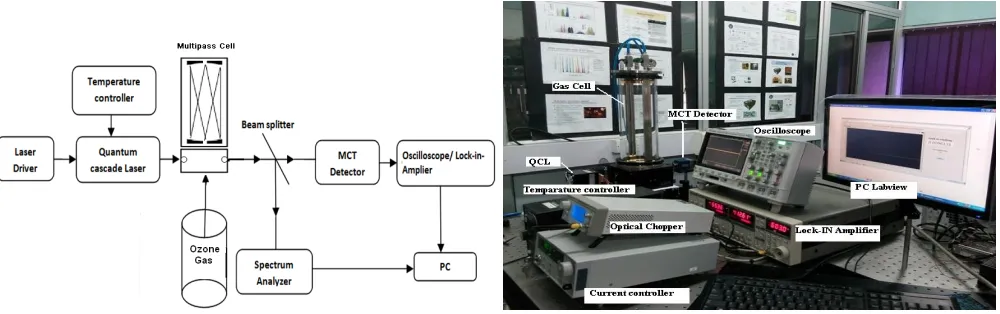
Figure 2 shows the experimental setup of IR absorption of ozone gas detection using QCL absorption method. The thermoelectrically cooled CW-QCL (L12004-2190H-C Hamamatsu Lasers), operating at 4.57 µm, generates an average output power of 20 mW and it is capable of providing a tuning wavelength from 4.561 to 4.57 µm. National Instrument (NI USB 6351 multifunction) DAQ Card is used to interface Temperature and Current controllers with PC through Lab VIEW programming. Bristol 771 Series Laser Spectrum Analyzer is capable of characterizing the laser from visible to infrared; thus it is used to observe laser wavelength and power on PC [5].
The QCL beam is modulated at 700Hz and was focused, where no significant baseline drift is to be observed. Data is acquired only at one selected laser frequency corresponding to the peak of the investigated exhaled O3 absorption line. Lab VIEW is used to develop an efficient, real time Data acquisition (DAQ) system. [6].
[image:3.612.61.561.471.628.2]Experiments are carrying out in a multipass gas cell. In the experiment nitrogen gas at 1atm and vehicle exhaust gas at 1 atm where introduced and corresponding data where recorded.
Fig.2 Experimental setup of QCL based Ozone Gas detector
Technology (IJRASET)
Fig.3 QCL Wavelength tuning at constant temperature
Fig.4 QCL Wavelength tuning at constant current
B. HITRAN Simulation
As per HITRAN database, Ozone (O3) absorption bands are located in the spectral region from 4.56762 µm to 4.5676 µm. Fig. 5 gives the HITRAN-2012 simulated interference free Absorption spectra of pure (O3) at 4.5676µm (2189.3224 cm-1) wavelength.
Fig.5 Precise absorption peak of Ozone (O3) at 4.5676 µm (2189.3224 cm-1)
IV.RESULTANDDISCUSSIONS
clearly indicates the presence of ozone gas.
Fig.6 Absorption peak of O3 obtained from Bristol spectrum analyzer
Fig.7 Detector reading at vacuum in gas cell
Technology (IJRASET)
V. CONCLUSION
The QCL is used because of their wavelength tuneability over a wide spectral range in the mid-infrared increasing output powers and operation at room temperature and great potential for compact design. Moreover the ozone gas sensor technology is a robust technology for the development of sensitive, compact sensor systems. Thus the development of a QCL based ozone detection using IR absorption technique; the O3 can be obtained in the keeping temperature 200C and constant current 800.8mA. The wavelength 4.5676 µm is tuned for the detection of Ozone traces. The referencing is done by filling up the pure Nitrogen gas inside the gas cell and the background noise was minimized by evacuating cell trough pump. The automobile exhaust was inserted in the cell for detecting trace ozone. The sensor system is capable of detecting Ozone gas at ppm level. The calibration is under process.
VI.ACKNOWLEDGMENT
Authors would like to thank Director, Society for Applied Microwave Electronics Engineering and Research (SAMEER), IIT-Bombay Campus, for allowing and pursuing this project.
REFERENCES
[1] European Commission Joint Research Centre Institute for Environment and Sustainability. [2] Vermont department of health “effect of ozone”.
[3] http://healthvermont.gov/enviro/indoor_air/Ozone.aspx
[4] M. Young, The Technical Writer’s Handbook. Mill Valley, CA: University Science, 1989.
[5] G. Eason, B. Noble, and I.N. Sneddon, “On certain integrals of Lipschitz-Hankel type involving products of Bessel functions,” Phil. Trans. Roy. Soc. London, vol. A247, pp. 529-551, April 1955.