
5
X
October 2017
Maximally Stable External Regions Based Object
Recognition Technique Using Fuzzy Logic
Sanjay Arora 1, Dr. Vikash Pandey 2,
1
Research Scholar, SSSUTMS, Sehore, 2Research Guide, SSSUTMS, Sehore,
Abstract: In this proposed method used maximally stable based method for scene text recognition from detected text regions which is compatible with mobile applications. It detects text regions from natural scene image/video, and recognizes text information from the detected text regions. In scene text detection, layout analysis of color decomposition and horizontal alignment is performed to search for image regions of text strings. In scene text recognition, two schemes, text understanding and text retrieval, are respectively proposed to extract text information from surrounding environment. Our proposed character descriptor is effective to extract representative and discriminative text features for both recognition schemes.
Keywords: Object recognition, Object detection, Text Recognition
I. INTRODUCTION
Automatic reading of text in natural scenes and it is on the recognition of individual characters in such scenes. Highlight why this can be a hard task. Even if the problems of clutter and text segmentation were to be ignored for the moment, the following sources of variability still need to be accounted for: (a) font style and thickness; (b) background as well as foreground color and texture; (c) camera position which can introduce geometric distortions; (d) illumination and (e) image resolution. All these factors combine to give the problem a flavor of object recognition rather than optical character recognition or handwriting recognition.
In fact, OCR techniques cannot be applied out of the box precisely due to these factors. Furthermore, viable OCR systems have been developed for only a few languages and most Indic languages are still beyond the pale of current OCR techniques. Many problems need to be solved in order to read text in natural images including text localization, character and word segmentation, recognition, integration of language models and context, etc. Our focus, in this paper, is on the basic character recognition aspect of the problem. We introduce a database of images containing English and Kannada text. In order to assess the feasibility of posing the problem as an object recognition task, we benchmark the performance of various features based on a bag-of-visual-words representation. Figure 1 show the black diagram of proposed system, which starting from input to final processed output.
Figure: 1.Block Diagram
A. Segmentation
Scene text recognition, which aims to recognize text in natural scenes, remains a challenging problem. Compared to scanned documents, which are usually taken under uniform lighting with sharp focus, scene text images often contain undesirable lighting effects, such as specular highlights, glossy reflections, and shadows; and the camera’s focal and motion blur add additional difficulty to the recognition task.
The use of higher order potentials not only deals with weak character detections but also allows us to recognize non-dictionary words. Another issue with many of the previously published works is that they were evaluated on datasets containing a few hundred words. For a comprehensive evaluation of methods, we need a large dataset with diversity. Thus, we introduce a dataset with 5000 word images referred to as the IIIT 5K-word dataset. The dataset contains words from both street scene texts and born-digital images. Note that automatically extracting text from born-digital images has many applications such as improved indexing and retrieval of web content, enhanced content accessibility, content filtering.
B. Detecting Characters
The first step in our approach is to detect potential locations of characters in a word image. We apply a sliding window based approach to achieve this. Sliding window based detectors has been very successful for challenging tasks, such as face and pedestrian detection. Although character detection is similar to such problems, it has its unique challenges. Firstly, there is the issue of dealing with a large number of categories (62 in all). Secondly, often, parts of a character or a part of two consecutive characters are similar in appearance to another character.
II. RELATEDWORK
In general, scene text characters are composed of cross-cutting stroke components in uniform colors and multiple orientations, but they are usually influenced by some font distortions and background outliers. We observe that text characters from different categories are distinguished by boundary shape and skeleton structure, which plays an important role in designing character recognition algorithm. Current optical character recognition (OCR) systems can achieve almost perfect recognition rate on printed text in scanned documents. In the existing system the inner character structure is modelled by defining a dictionary of basic shape codes to perform character and word retrieval without OCR on scanned documents. Figure 2 represents the overview of our feature extraction and object detetion.
The effects of various implementation choices on detector performance, taking “pedestrian detection” (the detection of mostly visible people in more or less upright poses) as a test case. For simplicity and speed, we use linear SVM as a baseline classifier throughout the study. The new detectors give essentially perfect results on the MIT pedestrian test set so we have created a more challenging set containing over 1800 pedestrian images with a large range of poses and backgrounds. Ongoing work suggests that our feature set performs equally well for other shape-based object classes.
Figure: 2 Overview of our feature extraction and object detection chain
C. Learning shape prior models for object matching
III. PROPOSEDMETHOD
In a presented method of scene text recognition from detected text regions which is compatible with mobile applications. It detects text regions from natural scene image/video, and recognizes text information from the detected text regions. In scene text detection, layout analysis of color decomposition and horizontal alignment is performed to search for image regions of text strings. In scene text recognition, two schemes, text understanding and text retrieval, are respectively proposed to extract text information from surrounding environment. Our proposed character descriptor is effective to extract representative and discriminative text features for both recognition schemes.
The fuzzy system provides objective results because they contain information from statistical sources and several human experts in contrast to manual analysis that is bias and can vary depending on the knowledge and experience of the expert. The following suggestions are provided for future work: Integration of the fuzzy system with the popular java compiler ant, to obtain instant results at compilation time. Include a neural network prediction system to forecast the reliability of the applications using statistical and historical information of the fuzzy reports. Integrate the fuzzy system with a continuous monitoring system (Hudson dashboard, etc) so historic and current reports are available to developers, project leaders, architects, managers and clients in order to increase productivity.
A. Advantages:
1) Text understanding and text retrieval are used to extract text from the surroundings 2) It produce more efficiency
B. Description of Proposed Work:
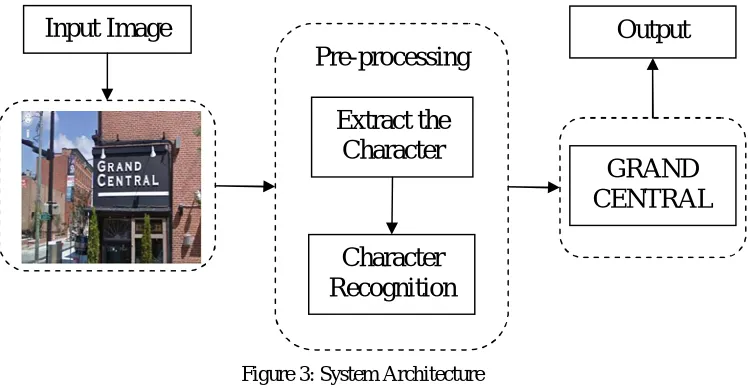
[image:4.612.125.500.452.648.2]In this proposed work consists of following modules like MSER, HOG and Retrieve Data. In which MSER detector (MD) to extract key points from stroke components, second module is HOG: At each of the extracted key points, the HOG feature is calculated as an observed feature vector x in feature space.HOG is selected as local features descriptor because of its compatibility with key point detectors and third module is RETRIEVE DATA: In text retrieval application, the query character class is considered as an object with fixed structure, and we generate its binary classifier according to structure modeling. Character structure consists of multiple oriented strokes, which serve as basic elements of a text character. From the pixel-level perspective, a stroke of printed text is defined as a region bounded by two parallel boundary segments. Their orientation is regarded as stroke orientation and the distance between them is regarded as stroke width the Figure 3 represents the system architecture of the system
Figure 3: System Architecture
IV. RESULTANDDISCUSSION
MATLAB (matrix laboratory) is a numerical computing environment and fourth-generation programming language. Developed by Math Works, MATLAB allows matrix manipulations, plotting of functions and data, implementation of algorithms, creation of user interfaces, and interfacing with programs written in other languages, including C, C++, Java and FORTRAN. MATLAB contains mathematical, statistical, and engineering functions to support all common engineering and science operations. These functions, developed by experts in mathematics, are the foundation of the MATLAB language.
The core math functions use the LAPACK and BLAS linear algebra subroutine libraries and the FFTW Discrete Fourier Transform library. Because these processor-dependent libraries are optimized to the different platforms that MATLAB supports, they execute faster than the equivalent C or C++ code.
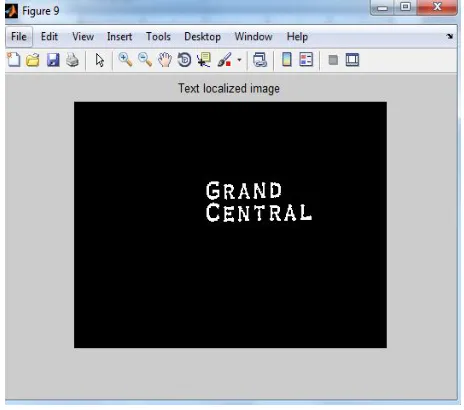
In Scale Invariant Feature Transform (SIFT) feature matching was adopted to recognize text characters in different languages, and a voting and geometric verification algorithm was presented to filter out false positive matches. Dictionary of words to be spot is built to improve the accuracy of detection and recognition. Character structure was modeled by HOG features and cross correlation analysis of character similarity for text recognition and detection. In, Random Ferns algorithm was used to perform character detection and constructed a system for query-based word detection in scene images. The figure 4 show the initial phase of image and figure 5 represents final detected text from that initial picture.
[image:5.612.199.426.204.388.2]
Figure 4: Initial Stage of Image
Figure 5: Final Text Object Identification
V. CONCLUSION
[image:5.612.193.425.427.632.2]accuracy rate and system will extend the analysis to include dictionary Word-level recognition. To improve accuracy and display text extraction procedure and also represent one of the structural model have the discriminatory aspects of the text to be formatted.
REFERENCES
[1] X. Bai, L. J. Latecki, and W.-Y. Liu, “Skeleton pruning by contour partitioning with discrete curve evolution,”IEEE Trans. Pattern Anal. Mach. Intell., vol. 29, no. 3, pp. 449–462, Mar. 2007.
[2] R. Beaufort and C. Mancas-Thillou, “A weighted finite-state framework for correcting errors in natural scene OCR,” in Proc. 9th Int. Conf. Document Anal. Recognit., Sep. 2007, pp. 889–893.
[3] X. Chen, J. Yang, J. Zhang, and A. Waibel, “Automatic detection and recognition of signs from natural scenes,” IEEE Trans. Image Process., vol. 13, no. 1, pp. 87–99, Jan. 2004.
[4] A. Coates et al., “Text detection and character recognition in scene images with unsupervised feature learning,” in Proc. ICDAR, Sep. 2011, pp. 440–445. [5] N. Dalal and B. Triggs, “Histograms of oriented gradients for human detection,” in Proc. IEEE Conf. Comput. Vis. Pattern Recognit., Jun. 2005, pp. 886–893. [6] Vengatesan K., and S. Selvarajan: Improved T-Cluster based scheme for combination gene scale expression data. International Conference
on Radar, Communication and Computing (ICRCC), pp. 131-136. IEEE (2012).
[7] Kalaivanan M., and K. Vengatesan.: Recommendation system based on statistical analysis of ranking from user. International Conference on Information Communication and Embedded Systems (ICICES), pp.479-484, IEEE, (2013).
[8] K. Vengatesan, S. Selvarajan: The performance Analysis of Microarray Data using Occurrence Clustering. International Journal of Mathematical Science and Engineering, Vol.3 (2) ,pp 69-75 (2014).
[9] T. de Campos, B. Babu, and M. Varma, “Character recognition in natural images,” in Proc. VISAPP, 2009.
[10] B. Epshtein, E. Ofek, and Y. Wexler, “Detecting text in natural scenes with stroke width transform,” inProc. CVPR, Jun. 2010, pp. 2963–2970.
[11] P. F. Felzenszwalb, R. B. Girshick, D. McAllester, and D. Ramanan, “Object detection with discriminatively trained part-based models,” IEEE Trans. Pattern Anal. Mach. Intell., vol. 32, no. 9, pp. 1627–1645, Sep. 2010.
[12] T. Jiang, F. Jurie, and C. Schmid, “Learning shape prior models for object matching,” inProc. CVPR, Jun. 2009, pp. 848–855.
[13] S. Kumar, R. Gupta, N. Khanna, S. Chaudhury, and S. D. Johsi, “Text extraction and document image segmentation using matched wavelets and MRF model,”IEEE Trans. Image Process., vol. 16, no. 8, pp. 2117–2128, Aug. 2007.
[14] L. J. Latecki and R. Lakamper, “Convexity rule for shape decomposition based on discrete contour evolution,”Comput. Vis. Image Understand., vol. 73, no. 3, pp. 441–454, 1999.
[15] Y. Liu, J. Yang, and M. Liu, “Recognition of QR code with mobile phones,” inProc. CCDC, Jul. 2008, pp. 203–206.
[16] S. Lu, L. Li, and C. L. Tan, “Document image retrieval through wor shape coding,”IEEE Trans. Pattern Anal. Mach. Intell., vol. 30, no. 11, pp. 1913–1918, Nov. 2008.
[17] S. M. Lucas, A. Panaretos, L. Sosa, A. Tang, S. Wong, and R. Young, “ICDAR 2003 robust reading competitions,” in Proc. Int. Conf. Document Anal. Recognit., Aug. 2003, pp. 682–687. 2982 IEEE TRANSACTIONS ON IMAGE PROCESSING, VOL. 23, NO. 7, JULY 2014.
[18] A. Mishra, K. Alahari, and C. V. Jawahar, “Top-down and bottom-up cues for scene text recognition,” inProc. IEEE Conf. Comput. Vis. Pattern Recognit., Jun. 2012, pp. 1063–6919.
[19] N. Nikolaou and N. Papamarkos, “Color reduction for complex document images,”Int. J. Imag. Syst. Technol., vol. 19, no. 1, pp. 14–26, 2009.
[20] L. Neumann and J. Matas, “Real-time scene text localization and recognition,” in Proc. IEEE Conf. Comput. Vis. Pattern Recognit., Jun. 2012, pp. 3538–3545. [21] E. Ohbuchi, H. Hanaizumi, and L. A. Hock, “Barcode readers using the camera device in mobile phones,” in Proc. Int. Conf. Cyberworlds, Nov. 2004, pp.
![(18 Crown 6)potassium [(1,2,5,6 η) cycloocta 1,5 diene][(1,2,3,4 η) naphthalene]ferrate(−I)](data:image/gif;base64,R0lGODlhAQABAIAAAP///wAAACH5BAEAAAAALAAAAAABAAEAAAICRAEAOw==)