LEABHARLANN CHOLAISTE NA TRIONOIDE, BAILE ATHA CLIATH TRINITY COLLEGE LIBRARY DUBLIN OUscoil Atha Cliath The University of Dublin
Terms and Conditions of Use of Digitised Theses from Trinity College Library Dublin
Copyright statement
All material supplied by Trinity College Library is protected by copyright (under the Copyright and Related Rights Act, 2000 as amended) and other relevant Intellectual Property Rights. By accessing and using a Digitised Thesis from Trinity College Library you acknowledge that all Intellectual Property Rights in any Works supplied are the sole and exclusive property of the copyright and/or other I PR holder. Specific copyright holders may not be explicitly identified. Use of materials from other sources within a thesis should not be construed as a claim over them.
A non-exclusive, non-transferable licence is hereby granted to those using or reproducing, in whole or in part, the material for valid purposes, providing the copyright owners are acknowledged using the normal conventions. Where specific permission to use material is required, this is identified and such permission must be sought from the copyright holder or agency cited.
Liability statement
By using a Digitised Thesis, I accept that Trinity College Dublin bears no legal responsibility for the accuracy, legality or comprehensiveness of materials contained within the thesis, and that Trinity College Dublin accepts no liability for indirect, consequential, or incidental, damages or losses arising from use of the thesis for whatever reason. Information located in a thesis may be subject to specific use constraints, details of which may not be explicitly described. It is the responsibility of potential and actual users to be aware of such constraints and to abide by them. By making use of material from a digitised thesis, you accept these copyright and disclaimer provisions. Where it is brought to the attention of Trinity College Library that there may be a breach of copyright or other restraint, it is the policy to withdraw or take down access to a thesis while the issue is being resolved.
Access Agreement
By using a Digitised Thesis from Trinity College Library you are bound by the following Terms & Conditions. Please read them carefully.
T h eo retica l S tu d y o f T op ological
Insulators: M o d els and M aterials
A w ad h esh N arayan
A tliesis subm itted for the degree of
Doctor of Philosophy
School of Physics
Trinity College Dublin
Declaration
I. Awadhesli N arayan, hereby declare th a t this d issertation ha,s ncjt been s u b m itte d as an exercise for a degree a t this or any other Uni\'crsity.
It comprises work perform ed entirely by myself during th e course of my P h.D . studies at Trinity College Dublin. I was involved in a numl)er of collabora tions. and where it is a p p ro p ria te my collaborators arc acknowledg('d for the ir contributions.
A coi)y of this thesis m ay be lended or copied by th e Trinity College Library upon recjuest by a th ird j^arty provided it spans single copies m ade for stu d y I)uri)oses only. sui)ject to norm al conditions of acknowledgement.
"Like fn in t g lim m e rs o f light in the dark, we have em erged f o r a m o m e n t fro m the nothingness o f dark unconsciousness o f m a te r ia l existence. We m u st m ake good the d e m a n d s o f reason and create a life worthy o f ourselves and o f the goals we only dim ly perceive. "
A b stract
Topological insulators arc a fascinating new class of m aterials, which have signalk'd a revival in exploration of topological a.si)ects of condensecl m a tte r l)hvsics. Like usual insulators th e y have an energy gaj) s e p a ra tin g valence an d conduction bands, however, their svufaccs host metallic s ta te s which c an not be ga])ped out unless one breaks th e sym m e try pro tec tin g such surface states. C'rucially. a n um ber of m aterials have been identified as tim e reversal synun etric topok)gical insulators a n d their surface s ta te s ig n atu re has been verified by m eans of a n u m ber of experim ental techniques. In th is thesis we s tu d y different aspects of topological s ta te s in two and th re e dim ensions, em ploying b o th model H am iltonians as well as m aterial specific first-princi])les density functional theory calculations.
all electrical nieans.
T h e n , we p resen t ab in itio tra n s p o rt stu d ie s of sc a tte rin g of to])ological s ta te s . W e in v estig ate electro n tran sm issio n across surface step s on S ) ) ( lll ) , w lu n e we find a good ag reem en t w ith scan ning tu n n e lin g m icroscoin' ex p er im en ts, in p a rtic u la r concerning lifetim e of q u a n tu m well sta te s an d allowed s c a tte rin g wave vectors. We also stu d y effect of b arriers on B i2 S e 3 (lll) sur- fac(' a n d com p are o ur first-prin cip les resu lts w ith th e often used D irac-tyjic low -eiiergy m odel. T h en , we re p o rt ou r finding of a single ato m anisotro])ic m a g en to resista n ce on topological in su la to r surface, w hich stem s from an in- ter])lay betw een th e helical surface s ta te s a n d sj^in anisotrop y of th e m agnetic ad ato n i. O u r ab in itio calcu latio n s for M n a d a to n i on Bi^Se.-i elu cid ate th e und erlyin g m echanism an d also reveal th e real space spin te x tm e aro u n d th e m ag n etic im purity.
A cknow ledgm ents
D uring th e course of niy P h D stucHes I have received help and s u p p o rt from a n u m b e r of people and this work would not have been possible w ith o u t them .
First of all I would like to th a n k Prof. Stefano Sanvito. who has been a rem arkable m entor over th e ])(ist four years. He in troduced me to this wonderful field of Topological Insulators, and has suggested nuniero\is in teresting problem s for me to work on. Im portantly, he gave me com plete freedom an d encouragem ent to choose my own problem s, while offering valu able advice on tackling them . His s tro n g work ethic a n d an intuitive ability to reduce com plicated problem s to simple essentials have inspired me greatly.
Next. I must th a n k Dr. Ivan Rungger. who ha.s p atien tly ta u g h t me th e i^ractical aspects of density functional and tr a n s p o r t calculations. I am deeply grateful for his help an d advice over th e course of my studies. T h e n I would like to acknowledge Dr. A aron Hurley, w ith w hom I studied inelastic electron tunneling spectroscopy and who ta u g h t me th e m s and outs of m any b o d y i)ertu rb atio n theory. I nnist th e n acknowledge Dr. A ndrea Droghetti who hel])ed me d u ring th e first few m o n th s of my studies, and we have also worked to g ether on oth e r topics since then. I nnist th e n th a n k Dr. M auro M antega and Dr. Igor Popov, w ith w hom I worked on interfacing grai)hene
w ith topological insulators. Next. I m ust th a n k Dr. K apildeh Dolui. who kept me informed ab o u t th e developm ents in th e field of two dhnensional m aterials, an d together we explored m agnetoresistance in Fe/MoS2 junctions. Finally, I would like to specially th a n k Dr. T h o m as Archer for his constant help ab o u t all m a tte r s related to com puting.
A special th a n k s must go to Ms. Stefania Negro, who took care of all th e a d m in istrativ e a.sj>ects and to Ms. J e a n e t te C unnnins, who jHovided countless le tters for visa applications.
N ext, I would like to th a n k our external collaborators. First of all I nnist acknowledge Domenico Di S ante and Prof. Silvia Picozzi a t U n i\e rs ity of L'Acjuila. w ith w hom I am working on exotic m aterials GeTe (which is a ferroelectric w ith a large R ashba splitting) and Na:jBi (which ha.s a sy n u n e try pro tected three-dim ensional Dirac cone). I would th e n like to th a u k Dr. G ra h a m Kells at Dublin In s titu te of A dvanced Studies, who ha.s ta u g h t me m any things al)out M ajo ran a fermions. Next, I would like to acknowledge Dr. Mirko C iuchetti and oth e r exi)erimentalists at T U K aiserslautern, witli w hom I a m exploring th e effect of organic molecular layers on topological surface states.
It would not have been })0ssil)le to u n d e rta k e research such as this w ithout financial s upport. I am grateful to th e Irish Research Coimcil (E M B A R K initiative) for providing funding d u ring my studies. C o m p u ta tio n a l resources for this work were provided by Trinity C en tre for High P erform ance C o m p u t ing ( T C H P C ) and Irish C entre for High E n d C o m p u tin g (IC H EC ). I would also like to th a n k Dr. Alin Elena for useful discussions an d s u p p o r t in using th e IC H E C clusters.
C on ten ts
A b s tr a c t iii
A c k n o w le d g m e n ts v
1 G en era l I n tr o d u c tio n 1
1.1 D i s s e r ta tio n l a y o u t ... 7
2 B a sic n o tio n s o f to p o lo g y in b a n d th e o r y 11 2.1 B a n d t h e o r y ... 12
2.2 B e rry pha.se, p o t e n t ia l a n d c u r v a t u r e ... 13
2.2.1 C o n d u c t iv i ty of a n i n s u l a t o r ... 16
2.3 Topology in one-dinien.sional solid: Su-Schrielfer-H eeger m o d el 18 2.4 E le ctric a n d tim e reversal ])olarization ... 22
2.4.1 T i m e reversal s y n n n e tr y a n d Z2 i n v a r i a n t ... 22
2.5 K an e -M e le m o d e l ... 28
2.6 G e n e r a liz a tio n to t h r e e d im e n s io n s ... 33
3 D e n sity fu n c tio n a l th e o r y an d G r e e n ’s fu n c tio n s for tr a n s p o rt 37 3.1 D e n sity fu n c tio n a l t h e o r y ... 38
3.1.1 P s e u d o p o t e n t i a l s ... 45
3.1.2 R e la tiv is tic effects in s o l i d s ... 48
3.2 G reen ’s functions for tra n s p o rt ... 55
4 A n d r e e v reflec tio n in tw o d im e n sio n a l to p o lo g ic a l in su la to r s 65 4.1 A ndreev reflection at to pological in su la to r su])erc(jn{luctor ju n c tio n ... G6 4.1.1 M odels an d C o m p u ta tio n a l D e t a i l s ... 67
4.1.2 R e s u lt s ... G9 4.1.3 S un iniary an d C o n c lu s io n s ... 76
5 S p in -p u m p in g at a q u a n tu m sp in H a ll e d g e 77 5.1 Si)in-])unii)ing an d inelastic electro n tu n n e lin g spectrosco py . . 78
5.1.1 M odel a n d C o m p u ta tio n a l D e t a i l s ... 79
5.1.2 R e s u lt s ... 81
5.1.3 G a te controlled spin p u m p i n g ... 88
5.1.4 S u n n n ary and C o n c lu s io n s ... 92
6 F irst p rin cip les tr a n sp o r t s tu d y o f to p o lo g ic a l su face s ta te s s c a tte r in g 93 6.1 Tojjological sm'face s ta te s s c a tte rin g in A n t i m o n y ... 94
6.1.1 C o m p u ta tio n a l D e t a i l s ... 95
6.1.2 R e s u lt s ... 96
6.1.3 S u n n n ary an d C o n c lu s io n s ... 105
6.2 Al) initio tra n s jjo rt across B i2Se3 surface b arriers ... 106
6.2.1 C o m p u ta tio n a l D e t a i l s ... 107
6.2.2 R e s u lt s ...108
6.2.3 S um m ary an d C o n c lu s io n s ... 123
7 S in g le a to m m a g n e to r e sista n c e on to p o lo g ic a l in su la to r su r
7.1 A nisotropic m agnetoresistance on tojiological insulator surface 127
7.1.1 C o m p u ta tio n a l D e t a i l s ... 127
7.1.2 R e s u l t s ... 127
7.1.3 S u m m a ry and C o n c l u s i o n s ... 134
8 T o p o lo g ica l tu n in g o f tw o and th re e d im en sio n a l D irac s e m im e t als 137 8.1 Proxim ity induced topological s ta te in g r a p h e n e ...139
8.1.1 C om i)utational D e t a i l s ... 139
8.1.2 R e s u l t s ... 141
8.1.3 S u n n n ary and C o n c l u s i o n s ... 148
8.2 Topological phase transition in three dimensional Dirac sem im et als ... 148
8.2.1 C o m p u ta tio n a l D e t a i l s ... 149
8.2.2 R e s u l t s ... 151
8.2.3 S u n n n ary an d C o n c l u s i o n s ... 154
9 C o n c lu sio n s and o u tlo o k 157
A Q u a n tiz a tio n o f th e C h ern n u m b er 161
B A b r ie f n o te on PfafR ans 165
C B lo n d er -T in k h a m -K la p w ijk m o d el and A n d r e e v reflectio n 167
D P e r tu r b a tio n e x p a n sio n in e le c tr o n -sp in co u p lin g 173
E A b r ie f n o te on th e C o h eren t P o te n tia l A p p r o x im a tio n 179
List o f Figures
1.1 (a) S dieiiiatio baud d iagram for HgTc and C dTe n ear tlu* F point show
ing the inverted Ijand s tru c tu re for HgTe. (b) Q u an tized edge s ta te con
d u ctan ce ex h ib ited by C’d T e/H g T e/C ’dT e h e te ro stru c tu re in th e inverted
regim e (curves III and IV). F igure adai)t(‘d from Refs. [7, 8]...
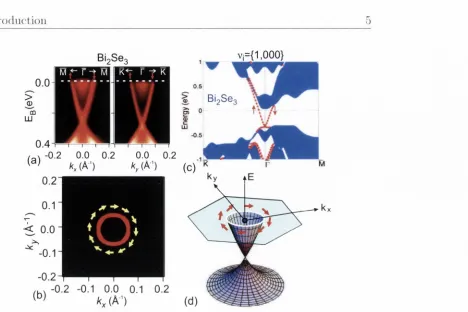
1.2 (a) Surface b and s tru c tu re for BiaSe;; (111) from A R P E S siiowing a single
D irac couo. (b) T h e fermi surface reveals th e spin polarizatio n of the
b au d s (c) T he b an d s tru c tu re o b tain ed from ah-initio calculations w here th e n 'd d o ts in d icate th e surface sta te s, (d) S chem atic jiictu re of the
single spin-m onientum locked D irac cone on Bi^Seu surface. T h e arrow s
indicate th e directio n of electron spin. F igure from Ref. [3]...
1.3 (a) Topogi'aphic im age of a one bilayer terrace on S b ( l l l ) surface, (b)
S p atially resolved d l / d V plots in th e terrace and atljacent fiat region as a
function of energ\'. (c) Fourier tran sfo rm of th e oscillations showing two
prom inent sc a tte rin g vectors, (d) A schem atic of th e co n to u r of surface
s ta te s at Ferm i energy w ith th e arrow s d en o tin g th e spin of th e sta te . T he allowed sc a tte rin g wave vectors q \ and are m arked. F igure ad a p te d
from Ref. [17]...
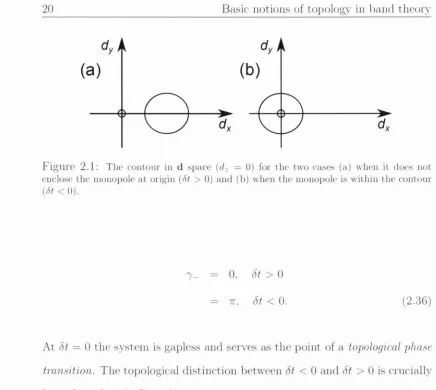
2.1 T he co n to u r in d space (<•/; = 0) for th e two cases (a) w hen it does not
2 .2 A .schciiiatic of gcnoric I)hik1 s tru c tu re for a oue-diniensioiial system w ith only tim e reversal sy m m etry ... 2 3
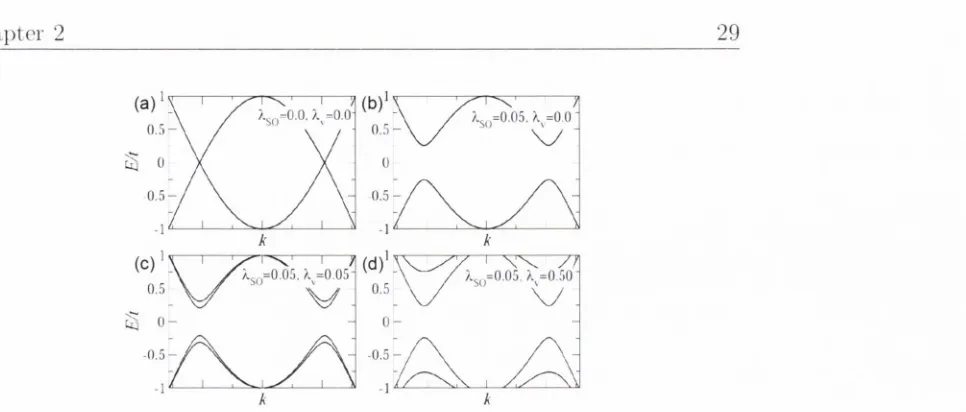
2 .3 T h e hulk h an d s tru c tu re of th e K ane-M ele m odel for different values of X s o siiowing different phases (a) p ristin e graphene, (h) to p o logical in.sulator w ith inversion synunetry, (c) to])ological in su lato r w ith broken inversion synnnetry. and (d) triv ial in su lato r w ith l)roken inver
sion sy m m etry ... 29
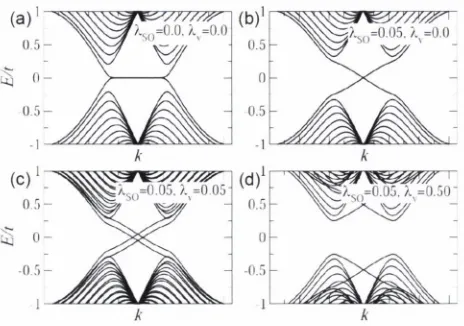
2 .4 T h e b an d s tru c tu re of th e K ane-M cle m odel for 42 sites w ide ribbon geom etry for different values of X s o illu stra tin g (a) ])ristine grap h en e, (b) toi)ological in su lato r w ith inversion sy nnnetry. (c) topolog ical in su lato r w ith broken inversion synnnetry, and (d) trivial in su lato r w ith broken inversion sy n n n etry ... 3 0
2 .5 T h e bulk B rillouin zone for a tw o-dim ensional system . T h e tim e reversal invariant m om enta are m arked. T h e right panel shows th e p ro jectio n to th e edge B rillouin zone... 33
2 .6 S chem atic edge b an d .structiire for a tw o-dim ensional (a) triv ial and (h) topological insulator. T he sh ad ed regions rep resen t th e bulk bands. T h ere exist an even num ljer of edge b an d s crossing th e Fermi level for th e triv ial case, while for a to])ological insiilator an odd num ber of sy n n n e try p ro te c te d edge b an d s connect th e bulk valence and co n d u ctio n bands. T h e b an d s are necessarily d eg en erate at T R IM owing to K ram ers theorem . 3 4
2 . 8 A coiiiparison l)et\veoii (a) trivial insulator, (b) stron g to])ological
in.sii-lator, and (c) weak top ological in sulator. T h e panels below show’ th e
])rojection on to a tw o-d im ensional surface Brillouin zone w here th e tilled
circles in d icate a surface s ta te th a t crosses th e Fermi en ergy... 3 5
3 .1 S c h e m a tic o f th e tw o -te r m in a l transj^ort se tu ]) w ith th e s c a t te r in g region
and th e left and th e right kvwls... 5 8
4 .1 S etu p for calcu latin g th e tw o-term in al transmi.ssion. R egion SC is
])rox-im ity coui)led to a su ])ercon du ctin g electrod e w hile region T I is th e to p o
logical insulator descrilied by th e tw o chosen .single-particle m odels. T h e
rectan gle m arks th e region at th e T I /S C interface where di.sorder is in
tro d u ced ... 6 8
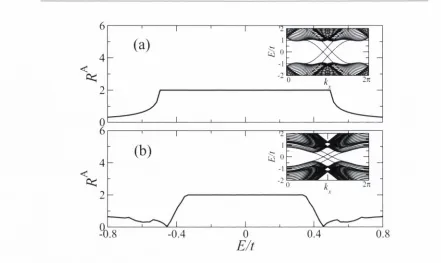
4 . 2 A n d n 'e v re fle c tio n co efficien t for (a ) Z2 a n d (1)) C h ern in s u la to r s s h o w in g |)erfect A n d r e e v reflectio n for e le c tr o n en e r g ie s sm a ller th a n th e s u p e r
c o n d u c tin g gaj). T h e ins(>ts sh o w th e l)and s tr u c tu r e for th e tw o m o d e ls
s o lv e d in a rib b o n g eo m e tr y . H ere w e c h o o s e ^2 = 0 .3 3 . A/ ^ 2 = 2 .0 ,
7 = 0 .2 0 , = —0.11 a n d A = 0 .5 0 . T h e Ferm i level E y is .set at zero . . . 7 0
4 . 3 Effect o f o n site disorder on th e A nd reev reflection coefficient for (a) Z2 and (b) C hern in sulators. T h e A nd reev process is highly robust again st
on site disonk'r and th e crossover to diffusive tr;uisi)ort occurs for IT «
3 .Of for th e Z2 in s iila to r a n d U ’ w 2 .0 / for th e C h ern in su la to r . H ere a g a in w e set t-2 = 0 .3 3 . X/t-y = 2.0. 7 = 0.2 0. — —0 . 1 1 a n d A = 0 .5 0 . a n d th e Ferm i k'vc'l E y is ta k e n at zero . T h e curv(>s a re a v era g ed o v er
4 .4 A n d r e e v re fie c tio n c o e ffic ie n t in p r e se n c e o f m a g n e tic im p u r itie s locatc'd a t th e e d g e o f a T I rib b on ; (a) Z2 in s u la to r (h ) C h ern in su la to r . T h e su ])i)ressio n o f o n e o f th e e d g e c h a n n e ls in th e tim e -r e v e r s a l s y n n n e tr ic c a se ])ro d u ces a d ro p in from 2 to f . M a g n e tic in i|)u r itie s have no effect o n th e A n d r e e v r e fie c tio n for a tim e -r e v e r s a l sv n u n e tr v l)roken in s u la to r . H ere w e h a v e c h o se n = ./|| = 0 .5 0 an d |S’| = 2. T h e o th e r ])a ra m eters are th e sa m e a s b e fo r e ...74
4 .5 A n d re('v re fle c tio n c o efficien t in th e i)resen ce o f m a g n e tic im p u r itie s for t h e Z2 in s u la to r ;us a fu n c tio n o f th e sp in in c lin a tio n a n g le 0 for v a rio u s v a lu e s o f th e e x c h a n g e c o u iilin g . T h e r e la x a tio n o f th e s])in s le a d s to R ' ^ r e v e r tin g b a ck to w a rd s u n ity ... 75
5 .1 S c h e m a tic re])r e se n ta tio n o f th e d e v ic e c o n sid e r e d c o m p r isin g a T I w ith h o n e y c o m b la t tic e s tr u c tu r e a n d a m a g n e tic im p u r ity a d so r b e d at o n e o f th e tw o e<iges. T h e sh a d e d a r e a c o r r e sp o n d s t o t h e in te r fa c e reg io n w h e r e a g a t e v o lta g e is in t r o d u c e d ... 79
5 .2 Spin-polarized lETS conductance spectrum for a TI (11, 6) ribbon with a S' = 1 m agnetic impurity attached at the u])i)er edge. N ote that the conductance step at the voltage characteristic of the inelastic excitation gets sui)i)ressed as the t2 parameter is increased, i.e., as the ribbon is
brought well inside the topological region of the jiha^e diagram ... 8 4
5 .4 Si)iii-polarized lE T S coiKhic’taiicc sp e c tru m for a T I (11, 6) ril)hon w ith a S' = 1 m agnetic im p u rity atta c lu 'd a t tlie upp('r edge. In th is case the c u rren t is intense anti drives th e im p u rity spin away from th e uniaxial a n iso tro p y axis. N otably now th e re is a ste p in th e differential conduc
ta n c e at th e voltage corresi)onding to th e inelastic tra n sitio n |± 1 ) —> |0). T h e m ag n itu d e an d sign of such ste p d epends on th e bias polarity. In the inset the inelastic contribution to the c o n d u c ta n c e ... 8G
5 .5 Spin-]!olarized lE T S cond u ctan ce s])cctrum for a T I (11. 6) ribbon incor p o ra tin g a m agnetic im p u rity w ith various sj)in ( 5 = 1 . ;3/2. 2 .'.]) attach ed at th e u])p(“r edge, in th e intense cu rren t regime. T h e stej) in the differ en tial co n d u ctan ce increa-ses in m ag n itu d e w ith increasing th e spin value of th e ad ato n i. N ote th a t th e sj)ectra have been aligned vertically for clarity in com parison. T h e inset shows th e average m agnetizatit)u of th e im p u rity for different values of S. N ote th a t .spin pum p in g persi.sts for th e larger values of th e im i)urity .spin...
5 .6 Normalized conductance trace as a function of th e s o u rc e /d ra in voltage at different values of the applied g a te voltage for a S’ = 1 im purity s])in. N ote th a t increasing th e g ate voltage beyond Vg — O.Gfi allows us to cross(jver to a regim e w here th e cu rren t is reduced to a point at which th e cond u ctan ce stc])s are supprt'ssed. T h e curves have been aligned vertically for ease of conij^arison...
5 .7 A verage m ag n etization, along th e direction perpc-ndicular to th e ribbon ])lane. as a function of bias voltage. C urves at different voltages are p lo ttt'd show ing g a te control over th e m ag n etizatio n of th e im p u rity spin.
In th e in.set we rep o rt th e m ag n etizatio n as a function <jf g ate voltage for a s o u rc e /d ra in voltage of I ' = 1..'3 \ D \ / e... 9 0
88
6.1 (a) S tr u c tu r e o f a n tim o n y in th e h ex a g o n a l s e ttin g . T h e a to m s form a hilay o r s tr u c t u r e w ith th e in tra la y e r d is ta n c e as 1..'31 A a n d th e in te rla y e r
d is ta n c e a s 2.25 A. B a n d s tr u c t u r e for (b) six b ila y ers a n d (c) tw elve b ila y ers th ic k sla b s alo n g A' — F — AI d ire c tio n s , (d) S in n ila te d .^.R PES fro m a se m i-in fin ite sla b . H ere a n d h e n c e fo rth w a rm e r co lo rs rei>resent h ig h e r P D O S (re d re p re s e n ts la rg e st v alu es, b lu e low est o n es, w ith th e co lo r scale in b e tw e e n b e in g lin e a r). S p in -reso lv ed .A.RPES alo n g (e) r — M a n d (f) f — K d ire c tio n s sh o w in g th e o p p o s ite sp in s o f th e tw o s u rfa c e b a n d s alo n g th e d ire c tio n s in d ic a te d by a rro w s in th e in s e t o f th e figures, in th is case, red a n d b lu e colors in d ic a te u p a n d d ow n sj>ins. r e s p e c tiv e ly ... 97
6.2 (a) P D O S for s u rfa c e a to m s w ith a sin g le ste j) a d ja c e n t to a flat region
for th e finst se tu j) a t = 0. (b) T ra n sm issio n a t k ± = 0 w ith a n d w 'ith o u t th e s te p in d ic a tin g fin ite s c a tte r in g d u e to th e ste p . A v erag e o f tr a n s m is s io n over all A '^-points is also sh o w n , (c) P D O S for su rfa c e a to m s a v e ra g e d over all kj_. (d ) F o u rie r tra n s f o r m o f P D O S d a t a in (c) over th e fiat reg io n rev e als th e ilifferent allow ed s c a tte r in g w ave v ec to rs.
T h e m o st p ro m in e n t fe a tu re s, a n d q b- a re n e a rly lin e a r w ith slo])es e q u a l to 1.1 e V A ... 101
6.4 (a) PDOS at k± = 0 for surface atom s with a single step tuljacent to a flat region, with the step extending along the f — K direction. There is an energy region from -GO to 20 nieV with no scattering and hence no standing wave states, (b) Transmission at kj_ = 0, indicating the perfect transm ission aromid E y even in presence of a surface harrier. Total transm ission also shows minimal scattering in that energy range. . 105
6 .5 (a) Unit cell of the 3-QL slab leads used in the transport calculations. The yellow and purple spheres represent .selenium and bisnm th atoms, respectively, (b) The band structure' along direction of trans])ort (2) is shown at A'r = 0. The surface bands in the energy window of -0.05 to 0.30 eV have a helical spin textur(>... 108
6 .6 Transjiort setup for the scattering problem is shown for (a) single barrier and (b) double harrier. In both ca.s<>s we add an extra single (juintuple layer high barrier on the 3-QL thick slab. Note that same self-energies for semi-infinite 3-CJL leads are attached on the left and right sides of the scatt('ring region in (b). while different k'ft and right ('lectrodes cor responding to 4-QL and 3-QL slabs are needed in (1))...109
6 .7 (a) Transmission across the surface barrier as a fmiction of energy at different values of the ,r component of the wave-veetor. orthogonal to the transport direction. D iffe r e n t curves correspond to different kx. Note the perfect transmission at Av = 0. At other incidence angles T is re duced. (b) The total transmission integrated over kj. in the presence (black ctu've) and absc'nce (n'd curve) of the harrier, (c) The transmi.s-
sion as a functiois of Av. at different constant energy cuts in the energy region of the surface states. Non-zero reflection at the barrier can be
6 .8 T h e DOS p ro jected on th e surface atom s along th e sc a tte rin g region at (a) A’j: = 0. (h) k j . = 0.032 an d (c) in te g ra te d over all k j - . At k j - = 0 th ere are no oscillations. T hese s ta rt to em erge at k j - = 0.032 A “ * hut are not visible in th e average. T h e second cohm ni of panels show the
Fourier tran sfo rm of th e p ro jected DOS in th e Hat region adjacent to th e b a rrier, at th e corresponding k j - . T h e sc a tte rin g vector resulting from b a ck scatterin g at non-norm al incick'uce is clearly seen in (1>). T he average, however, reveals no .scattering. T h e th ird colunm shows th e tran sm issio n as a function of energy for th e th ree cases. F(jr k j . = 0 and
k j - = 0.032 A ~ '. we aLso iikjt th(' h an d s tru c tu re along trans])ort direction for co m p ariso n ...
6 .9 T h e en erg \' dispersion along k j - (p erjien d icu lar to th e tra n sp o rt direc tion) for (a) perfect j)eriodic system com prising of 4-QL slab, (b) energy dispersion at th e single b arrier, and (c) 50 A away from th e single b a r rier. In (1>), (c) and (d) color j)lots show th e p ro jected density of sta te s on th e ato m present at th e b arrier, an ato m 50 A away from th e b arrier an d th e P D O S on th e a to m a t th e double b arrier. In (b) and (d) note th e a d d itio n a l pair of interface s ta te s o utside th e D irac cone which m erge w ith it aro u n d 0.2 e V ...
6 .1 0 T h e DOS ])rojected on th e b o tto m surface ato m s along th e sc atterin g region a t (a) norm al incidencc A:,,. = 0. an d (b) an oblique incidence k j - =
G . l l T h e spiii-re.solved lo c al d e n s ity o f s ta te s in c o m in g fro m th e left le ad at 0.175 eV w ith th e sp in p ro je c tio n alo n g (a) j', (b) y a n d (c) 2 d ire c tio n s a t Aj = 0. O n th e r ig h t h a n d sid e (d ). (e) a n d (f) a re c o rre s p o n d in g p lo ts for kj. = 0.032 A “ *. H ere re d re])resen ts p o sitiv e v alu es w hile b lu e s ta n d s for n e g a tiv e values. S c a tte r in g a t th e s te p ed g e even a t A-j. = 0 allow s th e sp in to r o ta t e o u t o f th e p la n e o f th e sla b re s u ltin g in a fin ite y a n d 2 c o m p o n e n ts , in c o n tra s t to th e u n p e r tu r l) e d b o tto m su rfa c e w h ere th e s e a re n egligible. A t n o n -n o rm a l in c id e n c e (Av = 0.032 A “ *) 2 com jione-nt o f sp in -reso lv e d L D O S b e c o m e s fin ite w hile th e s te p ed g e in tro d u c e s a n o n -ze ro y c o m p o n e n t. T h e in s e ts a re zo o m s a r o u n d th e s te p ed g e. . .
G. 12 (a) P o te n tia l profile for th e D ira c m o d el. W c u.sc V'l = V 4 = 0. I2 = —1.17 cV . () = 20 A a n d L = 6() A. T h e t ra n sm issio n as a fu n c tio n o f e n e rg y is show n ch o o sin g (1)) V3 = —0.02 eV a n d (c) V-j = 0.0 eV . DitTerent o u 'v e s c o rre s p o n d to th e s a m e kj. [io in ts as F ig. 6 .7 ( a ) ...
G .1 3 (a) T ransnii.ssion acro ss th e d o u l)le b a rrie r on th e su rfa c e a t different A'j.. N o te th e r'a b ry -P e ro t ty p e o sc illa tio n s in tra n s m is s io n in (X)ntrast to F"ig. 6 .7 (a ). D ifferent c u rv e s c o rre sp o n d to th e sa m e Av i)oiiits as F ig. 6 .7 (a ). I n te g r a te d tra n s m is s io n w ith (black cu rv e) a n d w ith o u t ( n 'd cu rv e) th e b a rrie rs is p lo tte d in th e in set. T ra n sm issio n a,s a fu n c tio n o f A’j a t d ifferen t c o n s ta n t en e rg y c u ts is show n in ( b ) ...
G.15 P D O S o n th e s u ifa c o a to m s for a d o u b le b arrier o f le n g th 1 4 9 .IG A at (a ) kj. = 0 a n d (b ) kj. = 0 .0 3 2 A “ '. N o te t h e a b se n c e o f ((u a n tu n i w ell s t a t e s in (a ). In (b ) cju an tu n i w e ll s t a t e s in tera ct w ith th e b o tu id s t a t e a t th e tw o b arriers le a d in g to e n e r g \' s p lit t in g o f th e b o u n d s t a t e ... 1 2 2
7.1 T ra n sp o rt se tu j) w ith M n a to m ad st)rb ed on 3 ciu in tu p le layer B i2S e;5 sla b , (a ) v iew ed in th e ])la n e p e r p e n d ic u la r to a n d (b ) a lo n g th e tr a n s p ort d ir e c tio n (2). T h e s c a t t e r in g r eg io n su p e r c e ll c o n s is ts o f 8 p r im itiv e \m it c e lls o f B i2Se;j in th e x y p la n e a n d 16 m iit c e lls a lo n g g iv in g a c o n c e n tr a tio n o f 1 M n a to m in 19 2 0 b is n n ith s e le n id e a to m s (w 0.05% ) a llo w in g u s to reach d ilu te c o n c e n tr a t io n s c o m p a r a b le to ex ])o r im e u ts. . . 128
7 .2 T r a n sm issio n a n d p r o je c te d d e n s ity o f s t a t e s on M n for d ifferen t M n s])in d ir e c tio n s (a ) an d (b ) at k^- = 0. an d (c) an d (cl) a v era g ed over a ll in c id e n c e a n g le s . For M n sjiin a lo n g x. tr a n s m is s io n is u n p e r tu r b e d , w h ile red u ced tr a n s m is s io n o c c u r s for o th e r d ir e c tio n s, r e s u ltin g in a
s in g le a to m a n is o tr o p ic n u ig n e t o r e s is ta n c e ...128
7 .3 S c a tt e r h ig v e c to r s (q) a« a fu n c tio n o f th e in c id e n t w a v e v e c to r [kj.) for M n s]iin a lo n g (a ) x , (b ) y, a n d (c ) 2 d ir e c tio n s . T h e siz e o f circ les is p r o p o r tio n a l to th e r e fle c tio n a m p litu d e . T h e c u r v e s are p lo t te d at
7 . 4 (a) T ransm ission and (b) ad aton i ])rojected d en sity o f s ta te s for th e two-d im en sion al m otwo-del, w ith atwo-d atom spin i)oin tiiig parallel antwo-d ])er])entwo-dicular to electron spin, (c) T ransm ission and (d) average projected d en sity o f s ta te s for m agn etic clu ster in th e tw o s[)in con figurations. T h e in sets are sch em atic of th e tw o setu p s and dashed lines in d ica te transm ission o f on e from th e un])erturbcd ('dge. Here we set ad atom on site energy to 0.1, h opp ing elem en ts to ribbon a,s 0.3. hopjiing b etw een m agn etic atom s to 0.5 (in im its o f th e nearest neighbor h opp ing) and other ])aram eters are sam e as chosen in Ref. [72]. (e) S ch em atic o f four-probe g(>onietry to m easure th e an isotrop ic m a g n eto resista n ce... 1 3 1
7 . 5 A c o m b in a tio n o f p r o je c te d a n d lo c a l d e n s ity o f s t a t e s s h o w in g real sp a c e sp in te x t u r e a r o u n d th e m a g n e tic a d a to m w ith it s s])in p o in tin g a lo n g (a ) .r. (b ) I), a n d (c) 2 d ir e c tio n s , at th e e n e r g y o f [)eak in M n d e n s ity o f s t a t e s . T h e arrow s d e n o te th e in -p la n e sp in c o m p o n e n t s o b ta in e d from a to m -p r o je c te d d e n s ity o f s t a te s . T h e isostu ’fa c e s co r r e si)o n d to th e lo ca l d e n s ity o f s t a t e s p r o je c te d a lo n g th e d ir e c tio n n o rm a l t o th e p la n e , w ith red d e n o tin g p o s itiv e v a lu e s a n d b lu e r e p r e se n tin g n e g a tiv e v a lu es. T h e e ffect (jf a d a to m sp in in n ot lim ite d to th e to]) su r fa c e S e a to m s , bu t is d is tr ib u t e d o ver th e fir.st q u in tu ])le la y e r ...1 3 2
8 .2 E volu tion o f band structuix' o f th e g r a p lie n e /B i2Se;j conipo.site as a func tion o f th e separation <1 betw een th e two con stitu en ts. In p anels (a), (b). (c) and (d) we present th e band stru ctu re for d = 3.0 A. 2.6 A. 2.3 A and 2.2 A respectively. Black and green l)ands are bulk and surface sta te s o f B i2.S('3, blue bands are graphene bands, w hile th e rc'd on es rejiresent hybrid sta te s. T h e inset in th e panel (d) illu strates th e s])in-textu re o f th e m ixed sta te at 0.0.5eV above Ej. . N o te th e different A’-point .sampling for d = 3.0 A ... 1 4 2
8 . 3 C harge d en sity a ssociated to th e Bi-2Se:j su rface o p p o site to th e g r a p h e n e /B i2S e3 interface (a) and th e m ixed interface s ta te (b) ob tain ed for d = 2.2 A at r . Panel (c) sh ow s th e sum o f th e tw o charge d en sities averaged over a p lane ])arallel to th e in terface... 1 4 4
8 . 4 (a) C on d u ctan ce o f a B i2Se,j-contacted grap h en e sheet w hen eith er 17% or 33% C vacancies are introduced in graphene a.s com pared to th e co n d u cta n ce o f a d efect-free layer, (b) S ch em atic o\-erview o f a ])roi)osed exp erim en tal .setu]). w hich m ay [)rove th e transfer of a top o lo g ica lly pro tec te d sta te from B i2Se;j to g rap h en e... 1 4 6
8 .5 (a) H exagonal m iit coll for A3B com p oun ds, w ith A = N a . K. Rb and B = B i, SI), (b) Bulk and surface p rojected Brillouin zone for the stru cture w ith the high sym m etry p oin ts m arked. T h e thre('-diniensional Dirac cro.ssing occurs along tlie F — .4 d irectio n ...1 4 9
8 .7 B an d s tru c tu re s for Na.jBi th in Hhns of thickness (a) 2-4 layers, (h) 5 layers, (c) 20 layers and (d) 100 layers. Inset in (a)-(h ) shows th e energy g ap a t th e center of th e B rillouin zone for slabs of thickness 1 to 5 layers. In (b)-(d) D irac crossings are highlighted in re d ...151 8 .8 S p ectral functions for p ristin e (a) Na.-jBi an d (b) N asS b. (c) Spectral
functions for th e aUoy N a;iBii_j.Sbj. w ith increasing Sb co n cen tratio n [x = 0.25. 0.50. 0.7-5 from top to b o tto m ). T he color scale sliows the
C hapter 1
G eneral In trod u ction
O n e of tlie p r i m a r y goals of c o n d e n s e d m a t t e r j^hysics is t o discover a n d cla.s- sify different p h a s e s of m a t t e r . T h e f u n d a m e n ta l b u ild in g blocks o f m a t t e r c a n c o m e t o g e t h e r t o form a m y ria d of different s t a t e s , r a n g i n g from c ry s t a llin e solids t o m a g n e t s a n d sii])erconductors. All th e s e c a n b e classified on t h e ba sis o f L a n d a u 's p rin c ip le of s p o n t a n e o u s s y m m e t r y lire ak in g [f]. C r y s t a llin e solids l)reak t r a n s l a t i o n a l s y n n n e tr y , while a m a g n e t b re a k s r o ta t io n a l s y n n n e tr y . A s u i) e r c o n d u c to r b r e a k s t h e m o re m y s te rio u s g a u g e s y n n n e tr y . T h e first s t a t e of m a t t e r w hich d id n ot fit in to th is p a r a d i g m was t h e in te g e r ( ju a n t u m Hall ])hase discovered in 1980 [2]. Von K litz in g ef al. to o k a tw o - d im e n s io n a l e le c tr o n gas sam i)le a n d p a s se d a c u rr e n t ac ro ss o n e of t h e d ire c tio n s , while t h e y a p p lie d a p e r jie n d ic u la r m a g n e t ic field, hi t h e tr a n s v e r s e d ire c tio n a v o lta g e was g e n e r a te d , a conseciueuce of t h e u s u a l Hall effect. B u t a t sufficiently low t e m p e r a t u r e s a n d sufficiently high m a g n e tic fields, t h e y saw ] )la te a u s in th e t r a n s v e r s e c o n d u c tiv ity . In th is s ta t e , th e b u lk o f a tw o - d im e n s io n a l s a m p l e is a n in s u la to r , w hile a d is s ip a tio n le s s c u r ren t Hows on ly a t t h e e d g e s of t h e samj)le. E v e n m o re s u rp r is in g was t h e fact t h a t t h e ( ju a n tiz a tio n of c o n d u c ti v it y was e x tr e m e ly j)recise. o f t h e o rd e r of one j)art in a billion. F u r t h e r m o r e it was indei^endent o f t h e s a m p le m a te ria l.
2 G eiieial In tro d u ctio n
CdTe
G = 0.01 e2/h
T = 3 0 mK ,6 1 0 '
1 0 '
0.0 0 5 1 0 1 5 2 0
•1.0 -0 .5
( V g - V , h f ) / V
F igure 1.1: (a ) S c h e m a tic b a u d d ia g r a iii for H gT c a n d C d T c near th e F p o in t .sliow ing th e in v e r te d b a n d str>icture for H gT e. (b ) Q u a n tiz e d e d g e s t a t e c o n d u c ta n c e e x h ib ite d b y C d T e /H g T e /C d T e h e te r o s tr u c tu r e in t h e in v e r te d r e g im e (c u r v e s III a n d I V) . F ig u re a d a p te d from R efs. [7. 8].
I n t r o d u c t i o n 3
A tim e reversal in v a ria n t toj^ological in s u la tin g p h a s e was jir e d ic te d t h e o r e tic a lly by B ernevig, H u g h e s a n d Z h a n g (B H Z ) in C d T e / H g T e / C d T e q u a n t u m wells [7]. B o t h C d T e a n d H gT e exist in z in c b le n d e - ty p e la t ti c e s t r u c t u r e a n d for l)oth t h e m a t e r i a ls t h e relevant l^ands n e a r F e rm i level a r e a t th e F {Joint in t h e B rillouin zone, as sh o w n in Fig. 1.1(a). T h e y a re a n s -ty p e h a n d (Ftj), a n d a p - t y p e h a n d split by s p in -o rh it coui^ling in to a J — 3 / 2 h a n d (F^) a n d a J = 1 / 2 l)and ( F7). C d T e h a s a n o r d e r i n g of b a n d s s im ila r t o c o n v e n tio n al s e m ic o n d u c to rs , for i n s t a n c e G a A s, w h e re t h e s-ty])e c o n d u c t i o n b a n d (Fg) is well s e i) a ra te d from t h e p - ty p e valence l)ands ( F ^ .F r ) l)y a large e n e rg y g a p . o f t h e o r d e r of 1 eV. However, in HgTe, t h e usual h a n d o rd e r is reversed, l)ecause of t h e large sp in -o rb it couj)ling c a rrie d by t h e h eavy e le m en t m erc u ry . In t h is case, th e F« b a n d , w hich u su a lly form s t h e valence b a n d , is now h ig h er in e n e rg y t h a n t h e Ffj l)and. T h e light hole Fj< b a n d form s t h e c o n d u c ti o n b a u d , while t h e h e a v y hole Fj< h a n d form s t h e first valence b a n d . T h e s - t y p e b a n d (F^) is i)ushed d o w n in e n e rg y a n d form s t h e second valence b a n d . T h e d e g e n e r a c y a t t h e F p o in t b e tw e e n t h e h e a v y a n d th e light-hole b a n d s m a k e s H gT e a zero-gai) s e m ic o n d u c to r.
4 G e n e r a l I n tr o d u c ti o n
were p e rf o r m e d , sliowing t h e first s ig n a t u r e of th e Q S H i n s u l a to r [8]. In t h e s e exj^erinients t h e ele c trica l c o n d u c t a n c e d u e to t h e t'dge s t a t e s w as m ea s u red . A n a n a ly s is u sin g t h e L a n d a u e r - B i it ti k e r schem e, yields a (ju a u tiz e d c o n d u c ta n c e of e^/1) for e a ch p a ir of edge s ta t e s . Fig. 1.1(1>) show s t h e re s is ta n c e m e a s u r e m e n ts for a n u m b e r o f s a m p le s a.s a f u n c tio n o f g a t e v o lta g e which allows t h e Ferm i e n e rg y t o b e t r a v e r s e d a c ro ss t h e b u lk ga p. Sanij^le I h a s a n a rr o w w i d t h a n d a larg e r e s is ta n c e in t h e gaj). S a m p le s III a n d IV, ou t h e o t h e r h a n d a re ( ju a n t u m wells h a v in g th ic k n e s s g r e a t e r t h a n t h e critical th ic k n e ss, dc- T h e s e show a cjuantized c o n d u c ta n c e of j h a s s o c ia te d w ith t h e tw o edge s ta t e s . S a m p le s III a n d IV ha v e t h e s a m e le n g th a n d different w id th s, w hile b o t h show t h e s a m e c o n d u c ta n c e , in d ic a ti n g t h a t t h e t r a n s p o r t is a t t h e edge.
Ai)art from ( ju a n t m n well h e te r o s tr u c t i u 'e s . t h e r e have also b e e n recent p ro p o s a ls for silicene a n d its g e r m a n i u m anak)g t o host a ( ju a n t u m s p in Hall p h a s e, w i t h s p in -o rl)it-d riv e n b a n d g a p s of 2.9 nieV a n d 23.9 nieV , r e s p e c tively [9]. T w o -d im e n s io n a l S n h h n s have also b e e n p r e d i c te d t o have a spin- o r b it g a p of 300 m eV , w hich is c o m p a r a b l e t o t h a t of t h e t h re e -d im e n s io n a l to p o lo g ic a l in s u la to r s c u r r e n t l y k n o w n [10]. T h e s e m a t e r i a ls e x h ib it a low- e n e rg y i^hysics, which is well d e s c r ib e d by t h e K a n e -M e le m odel, which will be disc u s s e d in d e ta il in C h a p t e r 2. In light o f t h e s e p r o m is in g d e v e lo p m e n ts , we will p re s e n t o u r s t u d y of A n d r e e v reflection in tw o - d im e n s io n a l to p o lo g ical i n s u l a t o r - s u p e r c o n d u c t o r j u n c t i o n s in C h a p t e r 4. In C h a j jt e r 5, w'e will also e x a m i n e t h e p o s s ib ility t o m a n i jj u l a t e i m p u r it y s p in s u sin g t h e c iua ntum s p in Hall c u rr e n t.
In tro d u c tio n
Figure 1.2: (a ) S u rfa ce b a n d str u c tu r e for B i2Se;j (1 1 1 ) from A R P E S sh o w in g a sin g le D irac c o n e . (1)) T h e fernii su rfa ce rev ea ls th e sp in p o la r iz a tio n o f th e h a n d s (c) T h e b a n d str u c tu r e o b ta in e d from a h - i n i t i o c a lc u la tio n s w h e r e th e rc'd d o ts in d ic a te th e su rfa ce s t a te s , (d ) .S ch em atic picttu'c o f th e s in g le sp in -n io n ie n t(u n lockc'd D irac c o n e on BioSe;} su rfa ce. T h e arrow s in d ic a te th e d ir e c tio n o f e le c tr o n sp in . F ig u r e from R ef. [3].
distrib u tio n of th e p hotoe niittod electrons, one is able to ex tra ct th e l)and s tru c tu re of th e m aterial. Since this is a surface sensitive techni(iue. it is i)ar- ticularly suited to s tu d y of j^rotected s ta te s on stuface of three-dim ensional topological insulators. F u rtherm ore, spin resolved A R P E S makes it possible to determ in e th e sj)in polarization of these s ta te s a n d m easure th eir si)in te x t m e in the m o m e n tu m space. In fact. Bi-Sb alloy was th e first three- dim ensional to])ological insulator to be discovered ex])erimentally [11], by employing A R P E S experim ents, after an earlier theoretical prediction by Fti and K an e [12], However, th e alloy has a com plicated b a n d structiu'e having
five surface bands, w ith a tiny l)ulk b a n d gap and since th e m aterial is not stoichiometric, it makes p re p a ra tio n of j)m e samples more difficult.
[image:34.533.47.515.70.382.2]D istance (A) D istance (A)
F ig u re 1.3: (a) T o p o g ra p h ic im ago o f a o n e h ila y c r te rr a c e on S b ( l l l ) su rfa ce , (h) S p a tia lly resolved d l / d V p lo ts in th e te rr a c e a n d a d ja c e n t flat reg io n as a ftn ic tio n o f energy, (c) F o u rie r tra n s fo rm o f th e o sc illa tio n s sh o w in g tw o p ro m in e n t s c a tte r in g v ecto rs, (d) A sc lie n ia tic o f th e c o n to u r o f su rfa c e s t a t e s a t F erm i e n e rg y w ith th e a rro w s d e n o tin g th e s])in o f th e s ta te . T h e allow ed s c a tte r in g w ave v e c to rs q_\ a n d q s ^ire m a rk e d . F ig u re ad a i^ te d from Ref. [17].
Bi^Se.j. Ab initio c a lc u la tio n s also p re d ic te d a s iin ila r jih ase in B i2Te;j a n d Sl)2Te;j. T h e s iu fa c e s ta t e of B i2Sc3 m e a s u re d by A R P E S a n d p re d ic te d by tirs t-p rin c ip le s th e o re tic a l c a lc u la tio n s is sh o w n in P'ig. 1.2. It h a s a n ideal sin g le D ira c cone a n d a re la tiv e ly la rg e r b a n d g a p o f ~ 0.3 eV . m a k in g B i2Se,s a jn o to ty p ic a l to p o lo g ic a l in s u la to r. T h e helical n a ttu 'e of siu’face s ta te s , w hich is a n e sse n tia l fe a tu re of to p o lo g ic a l in s u la to rs , h a s b e e n sh o w n u sin g si)in reso lv ed A R P E S , a lo n g w ith a B e rry p h a s e of tt a« one goes a ro u n d th e D irac n o d e. In C h a p te r 6, u sin g th is c a n o n ic a l to])ological in s u la to r we will s tu d y th e effect of b a rrie rs on t h e s c a tte r in g p ro p e rtie s of su rfa c e s ta te s . W e will also d e m o n s tr a te a single a to m a n iso tro j)ic m a g n e to re s is ta n c e effect on th e su rfa c e o f B i2Se3 ( C h a p te r 7).
[image:35.533.64.457.78.278.2]pro-In tro d u ctio n
portional to tlie density of sta te s (DOS) of th e sample, which allows prol)ing th e energy d istrib u tio n of these s ta te s w ith a high resolution over large sp a tial regions. F urtherm ore, Fourier transform of th e DOS allows ex tra ctin g inform ation ab o u t th e scatterin g processes. T h e helical n a t u r e of topological states, w ith opposite spin electrons moving in opposite directions, forlnds ('xact b acksca ttering a.s long a.s tim e reversal sy n n n e try is preserved. This crucial proj^erty has been d e m o n stra te d for Bi-Sb alloy w ith a ran d o m dis trib u tio n of defects l)v analyzing (iua.siparticle interference p a tte r n s imaged using th e S T M [IG]. A n o th er im p o rta n t i)ro])erty of synm ietrv-i)rotected su r face s ta te s is an enhanced transm ission across strong surface disorder. This has also l>een shown in a toi)ological seniinietal Sb by using STM d a t a to niaj) onto a pote n tial barrier model [17]. Transmission acro.ss a liarrier. in the form of surface steps on th e S l ) ( l l l ) surface, was inferred l)v analysing the interference p a t te r n of th e surface sta te s (Fig. 1.3). It was found th a t th e surface s ta te s are likely to l>e tra n s m itte d even in th e presence of strong surface disorder. Fourier transform of th e DOS gave th e allowed scatt(>r- ing vectors, which were consistent w ith prohibited .s])in-Hij) backscattering. In Chai)ter 6 we will s tu d y this system and its s c atterin g ])roperties using first-principles tra n s p o rt calculations and will coni])are our findings with the experim ents re p o rte d in Reference [17],
1.1
D isserta tio n layout
8
G e n e r a l I n tr o d u c ti o ntwo-dinieuKional layered m a t e r i a l M0S2 a.s a sp a ce r. In a n ong o in g stu d y , in c o ll a b o r a t io n w it h ex])e rinie nta lists. we a re in v e s tig a tin g t h e effect of o rg an ic m o le c u la r layers on to jw lo g ica l s u rfa c e s ta t e s . T h e references to th e s e works is p r o v id e d in t h e list of jm b lic a tio n s in A p p e n d i x F.
Following a g e n e ra l i n tr o d u c t i o n in th is c hai)ter, t h e layout for t h e rest of t h e th esis is as follows.
In C h a p t e r 2 we discuss t h e b a sic n o tio n s of to p o lo g y w ith in t h e p a r a d i g m of l)and th eo ry . A l)rief i n tr o d u c t i o n t o B e r r y ph a se, ele c tric a n d tim e reversal p o l a r i z a t io n is prov id e d . T h i s s e ts t h e s ta g e to define a Z2 in v a ria n t for t im e reversal s y n n n e t r i c to p o lo g ic a l in s u la to rs . W e also in tr o d u c e t h e K a ne - M ele m o d el, w hich is t h e i)rototy])ical m o d e l for tw o -d im e n sio n a l toj)ological in su la to rs . F in a lly we discuss t h e e x te n s io n to t h r e e d im e n sio n s.
In C h a ] )te r 3 we o u tlin e t h e tw o m a in n i e t h o d s u sed in t h is thesis; d e n s ity fim c tio n a l th eo ry , w hich p ro v id e s a s o lu tio n t o t h e e le c tro n ic s t r u c t u r e m a n y - b o d y p r o b le m , a n d t h e G r e e n 's f u n c tio n m e t h o d , w hich allows t a c k ling ( ju a n tu m t r a n s j) o r t jn’oblem s. A d isc u ssio n of re la tiv is tic effects in solids, w hic h a re e sse n tia l t o c o rr e c tly d e s c r ib e t h e e le c tro n ic s t a t e s in tojiological in s u la to r s , is i)rovided.
C h a p t e r 4 p r e s e n ts o u r r e s u l ts for A n d r e e v reflection in tw o -d im e n sio n a l to p o lo g ica l in s u la to r s ( w ith e it h e r c o n s erv e d or b r o k e n t im e reve rsal s y m m e t r y ) w h e n t h e y form a n in te rfa c e w i t h a s u p e r c o n d u c to r . W e And a perfect A n d r e e v reflection for b o t h t h e cases, w hic h is r o b u s t t o d iso rd e r. For t h e t i m e reve rsal s y n n n e tr ic case we show t h a t ini])lanting one of t h e edges w ith m a g n e t ic i m p u r itie s s u p p re s s e s o n e of t h e c h a n n e ls for A n d r e e v reflection, while no s u c h s u p p re s s io n is seen for s y m m e t r y b r o k e n s it u a ti o n .
I n t r o d u c t i o n 9
topcjlogical in s u la to rs . W e d e m o n s t r a t e t h a t t h e m a g n e tic im i)u ritv c a n be m a n i p u l a t e d u sin g t h e helical ed g e s ta te s . W’e also i)ropose a four t e r m i na l device, which is d e s ig n e d t o m a n i p u l a t e t h e sp in of t h e a d a t o m by all e le c tric a l m ea n s.
F ro m m o d e l H a m il to n i a n in v es tig a tio n s , we m ove on t o m a t e r i a l s p e cific d e n s ity fu n c tio n a l t h e o r y l)aseci s tu d ie s. Cliajoter G p r e s e n t s o u r h r s t- p rin c ip le s t r a n s p o r t c a lc u la tio n s for .scattering of to p o lo g ica l surface s ta te s . M o ti v a te d by t h e e x p e r i m e n t a l s t u d y of Ref. [17], we c o n s id e r t r a n s m is s io n ac ro ss su rfa c e stei)s on S l ) ( l l l ) . W e h n d a g o o d a g r e e m e n t w ith s c a n n in g t u n n e l i n g m ic ro sc o p y e x ])e rim e n t. in p a r t i c u l a r for lifetim es of q u a n t u m well s t a t e s a n d allowed s c a t t e r i n g wave vectors. L arge scale ah in itio c a lc u la tio n s on a n a lo g o u s s te p s on Bi2Se3( l l l ) s u rfa c e reveal t h a t b a c k s c a tt e r i n g is c o m p lete ly sup])re.ssed for n o r m a l incidence, while b a c k s c a tt e r i n g is allowed at all o t h e r in cid e n c e angles. W e also c o n s tr u c t a p o t e n t ia l b a r r i e r m o d el l)ased on t h e often u sed D ira c H a m il to n i a n . A c o m p a r is o n w ith firs t-p rin c ip le s r e s u lts reveals t h e s h o r t c o m i n g s of s u c h a m odel.
In C h a i ) t e r 7 we d e m o n s t r a t e a single m a g n e t ic a t o m anisotro])ic m ag- n e to r e s is t a n c e on to p o lo g ic a l in s u l a to r surfaces, a ris in g from t h e in te r p la y b e tw e e n helical s p in - n io m e n tu m - lo c k e d s u rfa c e e le c tro n ic s t r u c t u r e a n d th e h y b r id i z a t io n of t h e m a g n e t ic a d a t o m s ta te s . O u r ah in itio c a lc u la tio n s for M n a d a t o m on Bi2Sea e lu c i d a t e t h e u n d e rly in g m e c h a n is m a n d also reveal t h e real s p a c e s]:iin t e x t u r e a r o u n d t h e m a g n e t ic im in u ity . W e c o m p le m e n t o u r findings w ith a tw o - d im e n s io n a l m o d el valid for b o t h single a d a t o m s a n d m a g n e t ic c lu ste rs, w hich lea d s t o a i)ro]KJsed device s e t u p for e x i)e rim e n ta l re a liz a tio n .
10 G eneral In tro d u ctio n
a b ack scatterin g-free h ybrid s ta te in g rap h en e by pro xim ity w ith a th ree- dim ensional topological in su lato r. T h is h ybrid s ta te a t th e interface has a D irac-cone-like dis])ersion a n d a w ell-defined helical spin te x tu re . U sing tra n s p o rt calculatio ns, we fu rth e r confirm th e ro b u stn ess of th is s ta te to disorder. We investigate th e inter])lay of bulk a n d surface D irac s ta te s in th e th ree-dim ensio nal D irac sem inietal N asBi. By em ploying density functional th e o ry in co n ju n ctio n w ith coherent p o te n tia l ap p ro x im atio n , we also reveal a to])ological ])hase tra n s itio n in alloy Na3Bii_3.Sbj..
C hapter 2
B asic n otions o f to p o lo g y in
band th eory
111 this chai)ter we suniniarize th e l)asic concepts of topology in th e l)aii(l theoretical jMcture. W'e begin w ith an in troduction to b a n d theory and the concept of Berry i)ha.se. pote n tial and curvature. W’e th e n discuss th e conduc tivity of an insulator using th e Kul)o formula and relate it to th e C hern n u m ber and th e quantized Hall response. T h e Su-Schrieffer-Heeger model, which provides an illustrative exam ple of topological effects in a one-dim ensional solid, is subsequently introduced. We th e n form ulate th e concejit of electric p olarization as a Berry i:>hase and introduce th e notion of a tim e reversal polarization. This is used to define a Z2 invariant for tim e reversal s y m m e t ric topological insulators. We th e n discuss th e Kane-M ele model, which is a prototypical model for Z2 tojxjlogical insulators in two dim ensions and is one of th e models u.sed in this work. Finally we end w ith a generalization to three-dim ensional topological insulators. This brief overview is based on th e review by H asan and K ane [3] and th e books by Bernevig and Hughes [18] and by Sheii [19].
12 Baisic notions of toj)ology in b a n d theory
2.1
B a n d th e o r y
Consider a system of n o n-interaeting electrons moving in th e periodic p o te n
tial produced l)v ions in a crystal. T h e H am iltonian reads
H = ^ + V{r).
(2.1)Ziu
w here \ ' ( r + R) = V'(r) a nd R is a Bravais lattice vector. From Bloch's the ore m it follows th a t th e solution of th e jjrohlem is given l)v
H\4!„{r. k)) = kj). (2.2)
|(/;„(r,k)) = e*'" ''|u„(r, k)), (2.3)
w here | u„(r, k)) is th e Bloch s ta t e and k is th e crystal m o m e n tu m restricted to th e first Brillouin zone (BZ). T h e subscript i) denotes th e b a n d index. T ranslational sy n n n e try yields
|a„(r, k)) = | » , ( r + R. k)). £ ’„(k) = £'„(k + G). (2.4)
Here G is th e set of reciprocal la ttice vectors such th a t G - R = 2 w n {rn G Z). Since k an d k + G are equivalent, th e space of crystal m o m e n tu m is a
Chai)tpr 2 13
2.2
B erry phase, p o ten tia l and curvature
L('t us consider a system with a Hamihonian which depends on a param eter
R (f), which is a function of time. In the adiabatic ai)i)roximation, where R (f) varies slowly in time comparerl to the smallest energy scale of the sys tem, the instantaneous eigenvalues and eigenfunctions satisfy the Schrodinger ecjuation
H( R{ f ) ) = |/;(R(f))) = E„( R{t ) }\ n{R( t ) ) ) . (2.5)
From adial)aticity we have that the eigenstate |n(R (0))) remains the instan taneous eigenstate of H{Ti(t)) up to a phase 6. as R (f) is varied along some path C.
K’(0)) = |»(R (0))), \ m ) = e‘^^<^\u(R(t))). (2.6)
H ( R ( t ) ) \ m ) = (2.7)
Using the al)ove two ecjuations and the state normalization {{n{R{f ))\ i i {R(t )))
1). we obtain
E„{R( t ) ) - i h { n { R m j ^ \ n ( R { t ) ) ) = (2.8)
which yields
f^(f) = ^ j | ^ ' £ ’„ ( R ( f ') ) f / f j ^ V '( R ( ^ ') ) |; ^ l » ( R . ( ^ ') ) > ^ / ^ '- (2.9)
14 Ba.sic notions of toj)ology in band theory
evohition. while the second term is called Berry phase [20],
I n
= ' f
(2-lU)
Jo
One can then dehne a vector j)otential or Berry connection as
A „ (R ) = / ( / ? ( R ) | - ^ | » ( R ) ) . (2.11) f / K ,
such that
y ^ A „ ( R ) - r / R , ( 2. 12)
Under a gauge transformation
|» (R )) ^ e'^"^>|/^(R)), A , ( R ) ^ A „ (R ) - (2.13)
while the Berry phase transforms as
% ^ - I - V{R(7^))- (2.14)
where T is the time taken to traverse C. Prior to Berry’s work it wa« believed th a t with a suitable gauge choice the phase 7,, can b(> cancelled so th a t to be physically irrelevant. We consider closed paths C, such th a t R (T ) = R(0). From the single-valuedness of the waveftmction
\ n{ R{T) ) ) = |/7( R = ())). (2.15)
C'hai)ter 2
15
^u(R(r))|,^^(R(j.))) ^ _ Q^y (2.1G)
T h e aV)Ove two coiuhtioiis im ply th a t
\ ( R ( 7 ’)) — \ ( R ( 0 ) ) = 2/»7t, m E Z. (2-17)
T h e sini])le analysis above shows t h a t for a closed p a th th e Berry phase can n o t he cancelled in general, unless it is a m ultiple of 27t. Furtherm ore, when C is a closed p a th th e Berry phase is gauge-in\'ariant, nam ely
^ A „ ( R ) • ( / R ^ ^ A „ ( R ) ) ■ds = j /■ (R) • (Is. (2.18)
w here J^(R ) = Vr x A „ ( R ) is th e Berry c m v a tm e .
An a ltern ativ e exjjression for th e Berry ])hase, which is more convenient for num erical co m p u ta tio n reads [18]
/■ ( , M R ) | ^ | m ( R ) ) X ( m ( R ) | 2 ^ | » ( R ) >
■ ■ '
i s
(£„, (R)-£„(R))^
■T h e C hern nunil)er is defined as
C = — T „ ( R ) - d s . (2.20)
7(.lo.so(i
16 Basic notions of topology in band theory
The above concepts can he transferred to an electron in a crystal by identifying the crystal nionientuni k as the jiaranieter R . Analogously, it is possible to dehue a vector |)otential
^ ( ^ ^ n k 17 ^ h ^ r i k ) 5 ( 2 - 2 1 )
ok
which is the Berry connection in a periodic solid and the Berry curvature and phase read
7-„(k) = Vk X A „ (k ), 7„ = [ J-„(k) ■ d k , (2.22)
J B Z
in a crystal.
2 .2.1
C o n d u c t iv it y o f an in s u la to r
The Kubo formula for the linear response electrical conductivity of a two- dim ensional .sample reads
le^h ^ ^ ( n k | t ’^ | ? ? 7 k ) ( ? 7 i k | ( ; ^ | / ; k )
— 2. Z. ---(«3)
n m . n ^ r n k
where A is the area of the sample, Va is the velocity operator along direction
a. /„k = Ferrni-Dirac function and a . / i G The
current density flowing in linear response to an electric held, E p , is then exjiressed as
C hapter 2 17
If the energy gap of the insulating sample is much larger than the teuiperature
scale, then the Kubo fornmla can be further simplified to yield
2e^r?. ^ ^ Ini((?;k|ra| r/;k)(mk|(’^|r)k))
= 2 . 2 . ^ _ £ , ) 2 ■
k
neoccn^m
^wliere the second suunnation is now over only the occu])ied bands. From
the above expression it is clear th a t the longitudinal conductivity
a^x =
0. since the quantity (/)k|(’j.|/?;k)(n?k|jij.|Hk) = |(?ik|(;j.|?/(k)|'^ is real. Now the velocity operator is defined a.s1
O H
'' = 7,I k
-The Hall conductivity
cfj-y is
k n e o c c
\
, , / n , )By identifying the (juantity in the parentheses a.s the Berry curvature and by rej^lacing the suunnation over k points with an integral —>
A
J ^ n - d s ) .
(2.28)we obtain
=2
h ^ —' V 2yT J o y
tl£occ '
18 Basic notions of topology in l)and theory
this coiiesp o n d s to th e n u m b e r of tilled L an d a u levels.
2.3
T o p o lo g y in o n e -d im e n sio n a l solid: Su-
SchriefFer-H eeger m o d el
C'onsider a one-dim ensional chain of dimerized ato m s described by th e Hamil tonian [21]
H = ' ^ { t + + h e. (2.29)
i i
Here creates (destroys) a n electron at th e site .4 of th e /-th unit cell. T h e underlying j)hysical reason for this dim erization (Peierls d isto r tion) is a lowering of th e electron kinetic energy at half-filling. T h e above H am iltonian was pro])osed a.s a model for polyacetylene, and in general is a p plied. with m odihcatious d ue to th e details of th e l)and hlling, to augm ented one-dim ensional systems. Fourier tra n s fo rm a tio n to th e m o m e n tu m s]:>ace yields
. (2.30)
k n d
w here h{k) — d{ k ) a w ith
dj.{k) = {f + St) + {t — S t ) c o s k a . dy{k) — { t — St) nin ka, dz{k) = 0. (2.31)
C h a p te r 2 19
E ± { k ) = ± | d | = ± / 2 ( f 2 + (Sty^) + 2(f2 - (()7)2) cos ka, (2.32)
w here a is th e la ttic e co nsta nt. T h e s p e c tru m at h a lf- fillin g is th a t o f an in s u la to r a t fin ite St. w h ile fo r St = 0 th e system is a sem i-m etal. A t th e edge o f th e B Z , tlu ' low energy e x c ita tio n s are D ira c fe rn iio n s and not usual S ch ro d in g e r ferniion s. B y e x p a n d in g a ro u n d th e edge o f B Z . k = ^ — q { qo < 1)
E ± ( j'' = ~ ~ ^/) ~ ±2v^(ff/r/)2 -h (St)'^. (2.33)
T h is is a lin e a r d ispersion o f a D ira c fe rn iio n w ith v e lo c ity tn and mass St. For St = I) we recover a massless D ira c fe n iiio n w ith lin e a r gapless bands. T h e ('igenstates o f th e fu ll H a m ilto n ia n are given by
l^’+ ) —
^ cos 0 / 2 ^ sin
0 / 2j
|A-)
^ — sin 6^/2 ^ e''* cos
(2.34)
w here 0 — cos ^ and 6 = ta n ' T lie B e rry
0/2J
o f th e occupied band
IS [18. 19]
I - (2.35)
![Figure 1.3: (a) Topographic imago of a one hilaycr terrace on S b ( l l l ) surface, energy, (c) Fourier transform of the oscillations showing two prom inent scattering vectors, Spatially resolved the s])in of the state](https://thumb-us.123doks.com/thumbv2/123dok_us/8809943.918087/35.533.64.457.78.278/figure-topographic-fourier-transform-oscillations-scattering-spatially-resolved.webp)