Journal of Criminal Law and Criminology
Volume 49 | Issue 2
Article 2
1958
Sane and Insane Homicide
T. C. N. Gibbens
Follow this and additional works at:
https://scholarlycommons.law.northwestern.edu/jclc
Part of the
Criminal Law Commons
,
Criminology Commons
, and the
Criminology and Criminal
Justice Commons
This Article is brought to you for free and open access by Northwestern University School of Law Scholarly Commons. It has been accepted for inclusion in Journal of Criminal Law and Criminology by an authorized editor of Northwestern University School of Law Scholarly Commons.
Recommended Citation
SANE AND INSANE HOMICIDE
T. C. N. GIBENS
Dr. T. C. N. Gibbens is Senior Lecturer in Forensic Psychiatry at the Institute of Psychiatry of London University, Honorary Consultant Psychiatrist to the Maudsley and Bethlem Royal Hospitals and Psychiatrist to the London County Council Remand Homes.
The data given here were collected during the tenure of a Nuffield Fellowship in Psychological Medicine in 1950.
The author wishes to express his thanks to Mr. Sanford Bates, Mr. Bixby, and Mr. Franckel of the Department of Institutes and Agencies of New Jersey, and to the Directors of the State Prison and State Hospital for their kindness and hospitality.-EDiroR.
Studies of homicide and murder have usually been limited to two sorts of enquiry, statistical studies of large numbers of homicides (1) which necessarily ignore differences in personality and mental state, and detailed psychiatric observa-tions of selected groups of murderers (2), (3), (4) whose relationship to the total number committing murder remains doubtful. Little attempt has been made to combine these methods, and little in-formation is available about the criminological aspects of sane and insane homicide.
The author had the opportunity, through the kindness of Mr. Sanford Bates and Mr. Lowell Bixby, of comparing the records of an unselected group of sane homicides with a similar group of insane homicides. The State of New Jersey is par-ticularly suitable for a study of this sort since all homicides come either to the State prison at Trenton or the criminal wing of the State hospital, and both are under the control of the Department of Institutes and Agencies.
Homicide was chosen rather than murder be-cause the main legal divisions of first and second degree murder and manslaughter often do not have much significance in terms of the personality and mental state of the offender.
The sane group comprised all those who had been convicted of first or second degree murder or manslaughter in 1947-1949-one hundred and twenty cases. The records of fifteen cases who had been sentenced to death were not available. In five cases the murderers had been executed-they included one man with a previous conviction for premeditated murder and one who had carried out a series of rape-murders. The remaining ten were still waiting the results of appeals; four were involved together in a murder in a bar and six were together involved in the robbery-murder of an old woman.
The records of these one hundred and twenty cases were very full. There was not only the usual social history, details of the offence and psycholo-gists' findings, but the transcript of an interview with the prison psychiatrist. Moreover, many cases came from Essex County, where the proba-tion department is justly famous, and these records included photostat copies of statements to the police and statements of principle witnesses, as well as a probation study.
The second group-one hundrdd and fifteen cases-comprised all those guilty of homicide who were recorded as having been admitted to the New Jersey State hospital at any time before 1950. They fell into two groups; a consecutive series of all, whether dead, discharged, or still patients, who had been admitted from 1938 onwards; and, secondly, a few survivors from previous times, the oldest being a man who had committed murder in 1921. Nine cases had been admitted after com-mitting homicide in 1947-1949. All these records contained not only the usual full psychiatric his-tory, examination, progress notes and interviews with relatives, but a valuable transcript of the staff meetings, in which alternative diagnosis was discussed.
THE RESULTS
SANE AND INSANE HOMICIDE
are regarded as irrelevant or incomprehensible: one cannot impute to him the sort of motives-of provocation or self defence-which one perceives in the sane man, though these are frequently pres-ent. If he kills unlawfully, it is murder.
The insane murderers were therefore divided in another way-into those who became insane before and after the offence. One tends to overlook the frequency with which the murderer develops a psychosis weeks, months or years after the offence. They included not only cases of clinical schizo-phrenia but also a number of reactive "psychosis with psychopathic personality" of a serious type. Sixty-one were psychotic at the time of the crime and fifty-seven afterwards. The number of those insane at the time was probably greater than this, but the legal process does not help to solve the clinical problem of whether a man is insane before he commits a murder, provided he is insane by the time his guilt is established, which may be some months afterwards. It was thought best to assume that the murderer was sane at the time, unless there was definite evidence to the contrary. The sane, of course, are not necessarily free from mental illness. The charge is fairly often reduced to second degree murder or manslaughter because of evidence of mental illness less than psychosis.
Table I shows the age of the offenders in the groups described. The main interest is in the upper and lower extremes of age. The normal homicide groups include a few who were just over sixty-five, but those insane at the time of the offence include five who were in their late seventies or even eight-ies. Only one homicide under twenty was insane or convicted of manslaughter, but the sane mur-derers who gradually developed a psychosis are well represented at this age. It is this age group which presents the greatest clinical difficulty and anxiety. It includes two clinical groups. First, the well-motivated young robbers: these usually remain sane but some are psychopaths who de-velop reactive psychoses, and the presence of a normal motive, including robbery, at this age does not exclude some cases in which violence is the first symptom of a true schizophrenia. The second group is composed of those with puzzling or very poor motivation. The pattern of the crime suggests a possible incipient schizophrenia, but though they are "schizoid," lacking in any remorse or interest in their fate and the conduct of their trial, they do not appear to develop schizophrenia later but remain aloof and indifferent and a puzzle to those
TABLE I
Under 20 20-24 25-29 30-34 35-39 40-44 45-49 50-54 55-59 60-64 65 Plus Sane Homicide Man-slaughter 0 4 6 15 4 0 2 4 3 0 2 Murder 8 11 12 13 10 5 6 5 6 2 2
Insane Homicide Before the
Crime 3 12 13 6 6 7 3
1 4 1
5
After the Crime 6 5 14 8 7 6 3 2 1 0 2
White 17 >40 35>8 5161 25154
Coloured 23 45 if 29
in charge of them. Stafford Clark and Taylor (5) showed that this group of "motiveless" murderers has an exceptionally high rate of abnormal elec-troencephalogram. There was no important difference in the means used by the sane and insane to commit homicide. In Table II, however, some of the characteristics of the crime are shown. Lay-men often suppose that murderers who use excep-tional violence or several methods of killing, each of which would have caused death, must neces-sarily be insane. The defence has sometimes raised the argument. Sir Norwood East (6) pointed out many years ago that this was as common in the sane as in the insane, and the present study con-firms this. Exceptional violence, nevertheless, requires careful investigation. A multiplicity of victims, however, is much more often found in insane murder, especially by depressed murderers who liquidate their whole family. The insane represent a considerable threat to the police; five of them were among the victims.
The innocent victims were those who did not contribute in any significant way to their murder. They are much commoner in insane homicide. Among the sane, murder is to a surprising extent a question of dog eating dog, and the murderer is much more often the underdog than is usually
believed. The "ego-uninvolved," a term used by Berg and Fox (7), are those who have no personal relationship with the murderer, as in the case of the victim of robbery: they are rarest in the vic-tims of the insane.
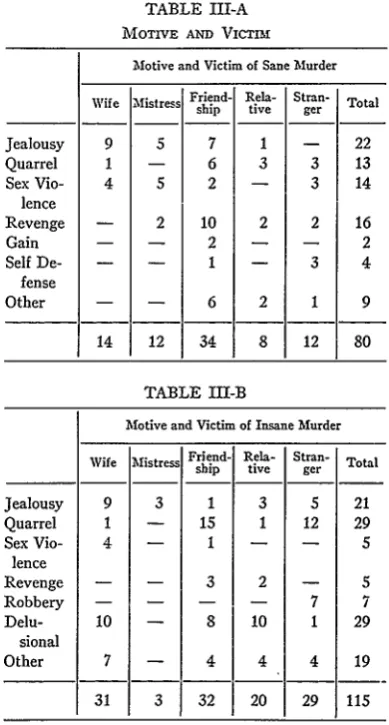
Motive and victim are most meaningfully
T. C. N. GIBBENS
TABLE II
TAE METHOD
Sane Insane
Man- B Before After slaugh- Murder the the
ter Crime Crime
1. Repeated blows ... 8 , 22 22 15
2. Special Violence ... 0 16 8 4 3. Multiple Methods.... - 3 5 1 4. Multiple Victims ... 0 1 9 2 5. Innocent Victims .... 9 40 50 21 6. Ego Uninvolved.. .. 8 19 22 9
25 1101 116 52
sidered together and Table III, A and B show the motive and victim of sane and insane murderers respectively. The motives of manslaughter were here excluded in order to make the tables more closely comparable. More than half of the man-slaughter victims were friends and acquaintances and the crimes consisted of jealous or ordinary drunken fights in which considerable provocation was offered. In fourteen cases self defence was con-sidered to be the main motive: in four cases wives used such physical provocation that a verdict of manslaughter was given.
The large group of "friends and acquaintances" among the victims refer to those drunken fights with knife or revolver which form the main group of second degree murder, usually by those between twenty to forty years of age. They are fairly well represented also among the insane, especially among chronic alcoholics who later developed a psychosis.
Sexual violence referred to those cases who showed strong sexual and even sadist motives, and where jealousy or other causes for quarrels were absent, and it included rape-murders. These sex murders were rather rare. There were only two rape-murders by the sane and one other man had, as we saw, been executed for such an offence. There were, bhwever, two homosexual murders by the sane and one by the insane.
It may be a matter of surprise that anyone
should attempt to allot motives to the insane. Some of these became insane after the crime, but even the majority of those who are insane have intelli-gible motives, the psychosis acting like any other precipitating factor in weakening the resistance of the individual to a rational impulse. Infidelity in a
TABLE III-A MOTIVE AND VICTIM
Motive and Victim of Sane Murder
Wife Mistress Friend- Rela- Stran- Total
ship tive ger
Jealousy 9 5 7 1 - 22
Quarrel 1 - 6 3 3 13
Sex Vio- 4 5 2 - 3 14
lence
Revenge - 2 10 2 2 16
Gain - - 2 - - 2
Self De- - - 1 - 3 4
fense
Other - - 6 2 1 9
14 12 34 8 12 80
TABLE III-B
Motive and Victim of Insane Murder Wife Miatress Friend- Rela- ship tive Stran- ger Total
Jealousy 9 3 1 3 5 21
Quarrel 1 - 15 1 12 29
Sex Vio- 4 - 1 - - 5
lence
Revenge - - 3 2 - 5
Robbery - - - - 7 7
Delu- 10 - 8 10 1 29
sional
Other 7 - 4 4 4 19
31 3 32 20 29 115
wife may be a fact or a delusion, and no doubt jealousy is the motive with the widest range from normal to pathological in both the sane and insane. It will be seen however that almost a third of the insane had well-structured delusional motives for the crime: and another group of unclassified motives included many instances of unexplained and sudden violence. Fear of being returned to a mental hospital is not an uncommon motive.
[image:4.454.228.423.55.418.2]SANE AND INSANE HO-MI1CIDE
half, the robbery is symptomatic of early schizo-phrenia. This has not been sufficiently emphasized in the literature. It is possible to compute from the three important German papers (8), (9) and
(10) on murder in the early stages of schizophrenia
that nine of the fifty examples quoted had com-mitted robbery-murder.
Conversely, it must not be assumed that the sane murderers were mentally normal. In eleven cases there was considerable doubt about the mental state of the offenders. Five were fairly clearly pathologically depressed cases who recov-ered quickly; and the recorded views of the court and a sentence more characteristic of manslaughter than murder added some confirmation. Six others were "motiveless," bizarre crimes. Four of the manslaughter cases were also probably pathologi-cal and evidence of this sort had led to a reduction from murder to manslaughter. In four murder cases the manslaughter-type sentence suggested that a strong element of self-defence was accepted. Drunkenness played a large part in the crimes of the sane and insane. Usually, of course, the effect of alcohol in turning a simple quarrel into a violent murder is quite intelligible; but drunkenness can never be a motive in itself and there were eight murders by drunken men in which ordinary mo-tives were lacking.
Table IV shows the criminal records of the two groups. Those with a record of violence are well-represented among those who later developed a psychosis. These were often aggressive psycho-paths who later became psychotic. Only four in the insane groups had the record of a previous sex offence.
Among the many factors in the past history and environment of the sane murderers which were
TABLE IV
CRIMlIAL REcORD
Sane Insane
Man- Before After slaugh- furder the the
ter Crime Crime
First Offender ... 17 39 43 19 Minor drink or larceny.. 9 17 7 13 Minor violence ... 5 12 9 8 Prison, etc. for larceny.. 5 4 1 5 Prison, etc. for violence. 4 8 1 9
1
40 80 61 , 54analysed, the majority were found to correspond with previous results in the literature, and they need not be considered here. There were two features which were surprising, however, and should perhaps be mentioned briefly.
First, nearly half of the sane murderers came from homes which had been broken by separation or death before the age of twelve: in thirty-six cases the home was broken before the age of six, and in eighteen before the age of twelve. This would need to be compared with the general incidence of broken homes in the population of New Jersey, but it seems exceptionally high. The insane had been much more fortunate in this respect.
Secondly, no less than twenty of the one hun-dred and twenty sane homicides suffered from a fairly marked physical defect-heart disease, diabetes, epilepsy, cancer, severe head injury, etc. Another curiosity was that eight were recorded as being only five feet one inch in height, or less. Quite a number of murderers are timid, resentful and embittered men turning upon their tormentors and killing stronger men-a feature which hardly accords with Horton's (11) description of the average homicide as being taller and stronger than other offenders. Abrahamsen (2), in his well-known classification of types of murderer, includes "murder due to physical inferiority." There was ample evidence that it existed. Similarly, Hill (12) found in England that thirteen of one hundred and five English murderers sent for electroencephal-ographic examination had physical deformities-deafness, lameness, paralysis of face and arms, etc.
All cases were interviewed by a psychiatrist and tested by a psychologist. Table V gives the diag-nosis and the level of intelligence.
Table VI shows the diagnosis of those cases sent to the State Hospital. As found elsewhere, schizo-phrenia is the psychosis which most often leads to homicide. The psychoses with psychopathic per-sonality were mainly contributed by those who became insane after the crime, but it is important to note that the majority of subsequent psychoses were true schizophrenia and not by any means mild reactions to prison life which psychopaths are apt to show. Transitory nervous breakdowns in unstable prisoners can usually be dealt with in the prison hospital.
The table almost certainly underestimates the part played by depression in the genesis of murder. Five of the sane murderers were almost certainly depressed to an important degree, although the
[image:5.454.27.219.477.626.2]T. C. N. GIBBENS
TABLE V PRISON DIAGNOSIS
Diagnosis Neurosis ... Periodic Drinker .... Chronic Alcoholic.... Constitutional Defect. Psychopathic ... Level of Intelligence
Mentally Defective... Borderline ...
Inferior ...
Average ...
High Average ... Doubtful ...
Man-
slaugh-ter
2 7 8 3
0 6 21 11 2
Murder
7 9 22 8 8
3 26 22 20 9
Before the
Crime
(19)
5
7 21 14
14
After
the Crime
2
14 9 7
4 14 20 9
7
-1
801 86TABLE VI HOSPITAL DIAGNOSIS
Before After the the Total Crime Crime
Schizophrenia-Paranoid ... 19 13 32 Schizophrenia-Other
(Hebe-phrenic 2, Catatonic 7,
Simple 5) ... 8 6 14 Depression (Involutional 4)... 9 7 16 Psychosis with Psychopathic
Personality ... 2 12 14 Psychosis with Mental
De-ficiency ... 1 2 3 "Paranoid Condition"... 6 4 10 Organic States-Epileptic 6,
GPI 2, Senile 5, Arteriosel
4, Alcoholic 5 ... 19 3 22 Other ... 4 - 4
68 47 115
extent of this naturally could not be assessed by a study of records only. It is nowadays recognised that an attempt at suicide, or murder, may have a carthartic effect upon depression so that partial recovery occurs in a few weeks. Where there has been evidence of previous depression, and the murder is accompanied by a serious attempt at suicide, the offender may still soon show nothing but a reluctance to defend himself and a feeling that he deserves the death penalty. If recovery is
rapid enough for them to stand trial, such cases may be more appropriately dealt with by reduction of the sentence.
There is a remarkable difference between the United States and England in the incidence of suicide with murder. In England about twenty-five percent of murderers successfully commit suicide at the time of the crime. Enquiries at the public health authorities of Essex County, how-ever, revealed that there had been only three cases of suicide accompanied by homicide in the three years under consideration. Among the sane mur-derers seven attempted suicide, four seriously, and among the insane thirty-two made attempts, fourteen at the time of the crime.
There was a noticeable difference in the inci-dence of a family history or a past history of nervous breakdown. Thirteen of the sane mur-derers had such a family history and only six had a history of past breakdown. Of those who became psychotic after conviction, eleven had a family history and nine a personal history, but in those psychotic at the time, these histories were present in sixteen and twenty-six cases respectively.
It has already been noted that the layman's view that an insane man commits a murder as he is becoming psychotic, and that the sane murderer stays sane, does not conform to real life. Table VII shows the time of onset of the psychosis before or after the crime. It will be seen that about a third (thirty-three) begin so near the crime that it is quite arbitrary to make a division into before and after. An important number commit murder dur-ing a relapse after a remission of a psychosis, and a similar number develop psychosis soon enough after the crime to suggest that the crime was a very early manifestation.
TABLE VII ONSET OF PSYCHOSIS
Ten Years Five Years T ears Six Months lor fonth
~
Yers Sx Moths or LessBefore
9 9 15 11 10
After I Month
I Month Six Months Two Years Five Years Ten Years
or Less 9 1
23 5 9 15 9
[image:6.454.227.419.471.617.2]SANE AND INSANE HOMICIDE
DELUSION ABOUT SENTENCE
At the time of the Royal Commission on Capital Punishment in England much attention was given to the question of the insane offender standing trial. It was argued, especially by Sir Norwood East, that it was an advantage for the insane to stand trial since this gave them the opportunity to plead their innocence, and it also demonstrated to the offender that he had been found guilty and was being detained by order of a court of law. It was said that the murderer who was found "insane on arraignment" and was therefore not tried, subsequently complained that he was detained illegally, was apt to protest his innocence, and that recovery from his psychosis was retarded. It was hoped that these New Jersey murderers would throw some light on this controversy. The usual practice there is for an insane murderer to be detained until fit for trial, with the important difference that he is indicted before a grand jury, who no doubt have a responsibility for examining the evidence that the accused really committed the offence. In contrast with them, we have seen that there are a number of murderers who are found guilty and are sentenced in the usual way, but later develop psychosis.
The "prison psychoses," or, as they are now called, "psychoses with psychopathic personality," were exhaustively described in the earlier German literature. It is probably true to say that the many varieties are now regarded as only slightly different responses to environmental stress, in prison or elsewhere, and that there is only one form of psy-chosis which is at all characteristic of prison life-the "delusions of pardon or discharge" originally described by Rudin (13). The State hospital mur-derers showed that these delusions were common in the content of both the schizophrenic and reactive psychoses. Moreover, these delusions were just as common in those who had been duly convicted as in those whose trial had been held up at the stage of indictment. The content of these delusions was as follows:
that the victim was still alive: nine (four convicted) is or will soon be pardoned:
four (all convicted) was really found not guilty:
two (both convicted)
that the sentence has been reduced: two (both convicted)
that he was innocent: nine (six convicted)
It does not appear, therefore, that a full trial does anything to reduce misunderstandings in the minds of these sufferers.
MURDER AT BREAKFAST-TINR
Finally, the circumstances of these insane mur-derers were subjected to the sort of detailed anal-ysis of time and place that is made in studying the criminology of murder. In general, the insane do not differ from the sane in many of these respects; passions are aroused in the same way for similar reasons. In both, Saturdays and Sundays are the main times for murder, and public holidays em-phasise the misery of their lot-no less than nine of the insane committed murder on Christmas Day, Boxing Day, or New Year's Day. One inter-esting relationship did emerge, however. The sane and most of the insane commit murder most often between six p.m. and one a.m. But depressed murderers, especially if we take into account those "sane" murderers who are clearly depressed and attempt suicide but who recover quickly, have a noticeable tendency to murder between six a.m. and eight a.m. If one excludes such obvious ex-ceptions as a burglar who meets a policeman on his way home from a night's work, or a man who has been drunk and quarrelling all night, one can say that murder at breakfast-time is nearly always the act of the insane or by a man so weighed down by circumstances that he is seriously ill.
BIBLIOGRAPHY
(1) FRANeEL, One Thousand Murderers in New
Jersey. J. Cim. LAiw AND CRMINOL. 1939. 29:
672.
(2) ABRAHAMSEN, CRuIE AND THE HUMAN MIND. London, 1945.
(3) McDPmAID AND XVINELER, J. CuN. PSYCHOPATH.
1950. XI. No. 3 July.
(4) CRUVANT AND WALDROP, ANNu. AM. ACAD. POL. Soc. Sci. November, 1952.
(5) STAFFoPD CLat AND TAYLOR, J. NEUROL., NEuROSURG. AND PSYCH. 1949. 12: 325. (6) EAST MEDICAL ASPECTS oF CRIME, London, 1936. (7) BERG AND Fox, Factors in Two Huindred Male
Homicides. J. Soc. PsYcHoL 1947. 26. 109.
(8) GLASER, ZTsc.P .D.G. NEuR. v PsYcH. 1934. 150:
1.
(9) SCHIU'EAWENSKY, SCHIZOPHRENE U. MORD.
Berker, 1938.
(10) Wi uANs, ZTSCH. P.D.G. NEuR. u. PSYCH. 1941. (11) HOTON, THE AMERICAN CaimNAL
(12) HILL AND POND, J. MENT. SCL 1952. 98. 23.