Vectorization for Accelerated Gather/Scatter and
Multibyte Data Formats
by
Andrew Anderson
Dissertation
Submitted to the School of Computer Science and Statistics
in partial fulfillment of the requirements for the degree of
Doctor of Philosophy
(Computer Science)
School of Computer Science and Statistics
TRINITY COLLEGE DUBLIN
Declaration
I, the undersigned, declare that this work has not previously been submitted
to this or any other University, and that unless otherwise stated, it is entirely
my own work.
. . . .
Andrew Anderson
Permission to Lend and/or Copy
I, the undersigned, agree that Trinity College Library may lend or copy this
Dissertation upon request.
. . . .
Andrew Anderson
Abstract
SIMD extensions to the instruction sets of general purpose processors have
be-come widespread, and SIMD width and the capabilities provided by the
hard-ware are steadily increasing with newer processor generations.
This thesis tackles two challenges faced by compilers when generating code
for modern SIMD extensions: SIMD code generation for interleaved memory
access patterns, and SIMD code generation for custom types not provided by
hardware.
On the topic of SIMD code generation for interleaved memory access, we
address strided array access specifically, and propose and evaluate a technique
for the generation of SIMD code to gather and scatter data elements between
memory and SIMD registers. Our technique extends a prior state of the art
technique to support a wider class of interleaved memory access.
On the topic of SIMD code generation for custom datatypes, we propose
and evaluate a vectorized code generation approach which supports
reduced-precision floating point number formats along a continuum between native
types.
We demonstrate that compilers can generate efficient SIMD code for both
challenges using modern SIMD extensions, without requiring special hardware
support beyond the general-purpose data movement and reorganization
fea-tures already present in a variety of modern SIMD-enhanced general purpose
Acknowledgements
Many thanks are due first to family and friends for their support and
encour-agement during my studies.
While working on my PhD I spent much time on several very fulfilling
teaching positions, which I enjoyed greatly. Thanks are due in particular to
David, Andrew, Jonathan, and Glenn for making this possible.
Thanks are especially due to my colleagues who made the lab both an
en-tertaining and an intellectually stimulating environment in which to work:
Servesh, Aravind, Martin, Mircea, Shixiong, and others.
Much of the research and investigation I carried out during the first two
years of my PhD was in collaboration with Avinash, who was never hesitant to
discuss ridiculous ideas which couldn’t possibly be made to work.
Finally, it is my great pleasure to thank David, my supervisor, without
whose guidance this thesis would not have been possible. David was always
available to discuss hare-brained schemes and divine which components were
actually useful and interesting, in addition to being a boundless source of
ad-vice and knowledge on many topics, both research related and not. Thanks to
his patience and understanding, my journey to PhD was smoother than it had
Contents
1 Introduction 17
1.1 Challenges . . . 18
1.2 Thesis Structure . . . 18
1.3 Contributions . . . 19
1.4 Collaborations and Published Work . . . 20
2 Background & Literature Review 21 2.1 Review of Features of SIMD Hardware . . . 22
2.1.1 SIMD-Enhanced GPPs versus Traditional Vector Machines 23 2.1.2 SIMD versus Out-of-Order Superscalar Execution . . . 24
2.2 Automatic Vectorization on General Purpose Processors . . . 25
2.2.1 Capabilities of Vectorizing Compilers . . . 25
2.2.2 Trends in SIMD Width and Memory Access . . . 26
2.2.3 The Problem of Non-Consecutive Memory Access . . . 27
2.3 Overview of Automatic Vectorization . . . 28
2.3.1 Loop Vectorization . . . 29
2.3.2 Superword Level Parallelism . . . 29
2.3.3 Analysis and Program Transformation . . . 30
2.3.4 Vectorization of Control Flow . . . 31
2.3.5 Domain-Specific SIMD Languages and Compilers . . . 31
2.4 Memory Access with Multimedia Extensions . . . 32
2.4.1 Spatial Locality of Access . . . 32
2.4.2 Alignment . . . 33
2.5.1 Floating Point Programs with Reduced Accuracy . . . 34
2.5.2 Customized Data Storage Formats . . . 34
2.5.3 Multibyte Floating Point . . . 35
2.6 Summary and Directions for Improvement . . . 36
3 Vectorization of Static Affine Interleaving 37 3.1 Modelling Arrays and Array Access . . . 38
3.1.1 Notation and Presentation . . . 40
3.2 Technique . . . 42
3.2.1 Enabling Interleaved Access: Automatically Vectorizing a Single Strided Access . . . 42
3.2.2 Exploiting Spatial Locality: Grouping Multiple Interleaved Accesses . . . 44
3.2.3 Dealing with Store-Side Gaps . . . 48
3.3 Optimization . . . 49
3.3.1 Eliminating Permutations I: Executing Original Loop Iterations Out-Of-Order . . . 50
3.3.2 Eliminating Permutations II: Simultaneously Resolving Collisions for Multiple Accesses 52 3.3.3 Statically Determining Lane Collisions . . . 54
3.3.4 Reassociation of Blend Instructions . . . 55
3.3.5 Eliminating Blends: Merging Multiple Blend Instructions . 58 3.4 Evaluation . . . 58
3.4.1 Time Complexity of Generated Code . . . 60
3.4.2 Simple Canonical Technique (Algorithms 1 and 2) . . . 61
3.4.3 Out-of-Order Technique (Algorithms 3 and 4) . . . 61
3.4.4 Collision Resolving Technique (Algorithms 5 and 6) . . . 61
3.4.5 Comparison with Nuzman et al. . . 63
3.4.6 Native Code Generation . . . 64
3.4.7 Experimental Evaluation . . . 65
3.5 Discussion of Results . . . 66
3.5.2 Effect of Reordering . . . 67
3.5.3 Relation of Speedup to Stride . . . 72
3.5.4 Variability of Scalar Code . . . 72
3.5.5 Real-World Benchmarking (SSE) . . . 73
3.5.6 Real-World Benchmarking (AVX2) . . . 75
3.5.7 Comparison with Hand-Tuned and Reference BLAS . . . . 76
3.6 Related Work . . . 77
3.6.1 Superword Level Parallelism . . . 78
3.6.2 Alignment . . . 79
3.6.3 SPIRAL . . . 80
4 Vectorization of Multibyte Floating Point Data Formats 85 4.1 IEEE-754 Floating Point . . . 86
4.2 Thought Experiment: 24-bitfloat . . . 86
4.3 A Scheme for Reduced-Precision Floating Point Representation . 88 4.3.1 Practical Multibyte Representations for IEEE-754 . . . 89
4.3.2 Simple Scalar Code Approach . . . 90
4.4 Reading from Reduced-Precision Representations . . . 91
4.5 Writing to Reduced-Precision Representations . . . 92
4.5.1 Vectorized I/O with Multibyte Representations . . . 92
4.5.2 Rounding . . . 94
4.5.3 Treatment of Special Values . . . 96
4.6 Performance Evaluation . . . 97
4.6.1 BLAS Level 1 Evaluation . . . 98
4.6.2 BLAS Level 2 Evaluation . . . 100
4.7 Related Work . . . 102
4.7.1 The Approach of Jenkins et al. . . 102
4.8 Conclusion . . . 103
5 Conclusion and Final Thoughts 105 5.1 Future Work . . . 105
5.1.2 Runtime Code Generation . . . 106
5.1.3 Finer Granularity of Storage Formats . . . 106
5.2 Final Thoughts . . . 107
Appendices 108 A Identities for Rounding 109 A.0.1 Arithmetic Rounding I . . . 109
A.0.2 Arithmetic Rounding II . . . 110
A.0.3 Arithmetic Rounding III . . . 111
List of Figures
3-1 The target intermediate representation for code generation. . . 41
3-2 Vectorizing interleaved access using mapped register sets. . . 42
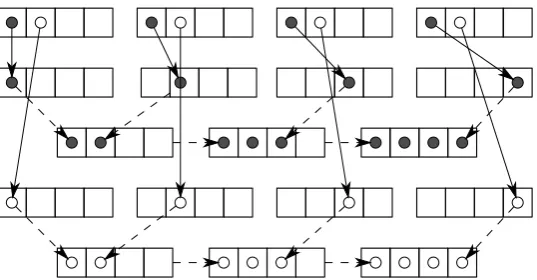
3-3 Sharing load-mapped/store-mapped register sets to exploit
spa-tial locality. . . 46
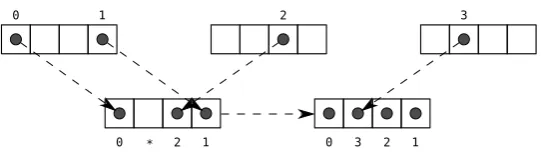
3-4 Effect of reordering original loop iterations to match data layout. 50
3-5 Algorithm 5. Our transformation enables vertical composition
with the blend instruction of colliding memory accesses with
a single transformation of the mapped register set. One access
is out-of-order under vertical composition withblendafter data
layout transformation (left side). However, the vectorization can
be legalized with a singlepermuteas shown, to ensure the order
of elements in each register is the same. . . 54
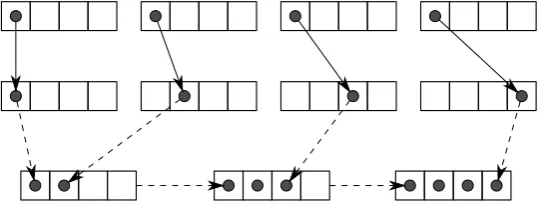
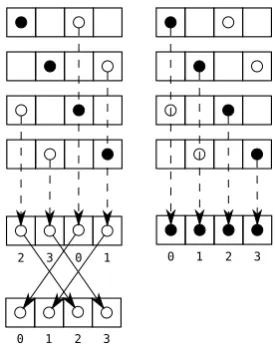
3-6 Algorithm 6. Accessesa[4*i+2](light dots),a[4*i](patterned dots), and a[4*i+1] (black dots). Desired store order at top with rotated store order underneath. Required permutation of
each access to obtain rotated store order indicated with permute
masks. Heavy arrows at bottom show the evolution of the
mapped register set as each access is interleaved in. Final
store-mapped register set before inverse rotation is shown at bottom
right. . . 55
3-7 Rewrite rule for reassociation ofblendinstruction sequences. . . 57
3-8 Graphical depiction of data flow before and after mergingblend
instructions. . . 59
3-10 Primitive operations of Nuzman et al. . . 64
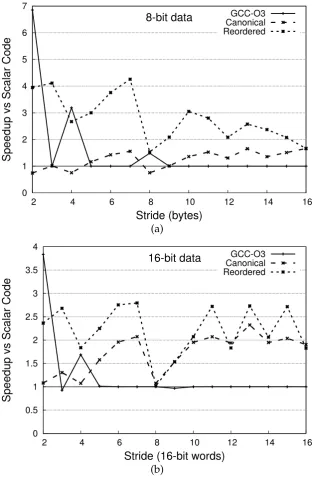
3-11 Synthetic benchmark results: 8-bit and 16-bit gathering operations 68 3-12 Synthetic benchmark results: 32-bit and 64-bit gathering opera-tions . . . 69
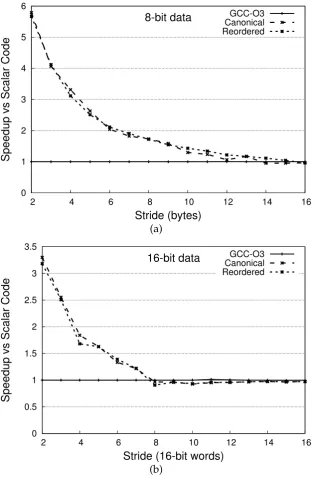
3-13 Synthetic benchmark results: 8-bit and 16-bit scattering operations 70 3-14 Synthetic benchmark results: 32-bit and 64-bit scattering opera-tions . . . 71
3-15 Real-World Benchmarks (SSE) . . . 81
3-16 Real-World Benchmarks (AVX2) . . . 82
3-17 Reference BLAS/Intel MKL Comparison . . . 83
4-1 Unused bit positions in reduced-accuracy results . . . 87
4-2 Layout of alternative multibyte floating point formats . . . 89
4-3 Simple implementation offlyte24in C++ . . . 91
4-4 Layout of data inSSEvector registers before format conversion (top), after rounding to the desired size (center) and the desired layout in memory (bottom). . . 93
4-5 Rounding to nearest even. Marked bit positions correspond to Preguard,Guard,Round, andSticky bits. . . 94
List of Tables
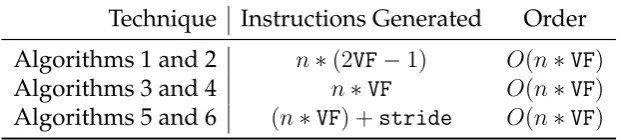
3.1 Time complexity of SIMD interleaving and deinterleaving code. . 62
3.2 Summary of dimensions, strides, underlying C types, and
vec-torization realized in benchmarking . . . 73
Chapter 1
Introduction
SIMD (Single Instruction Multiple Data) execution is a mode of parallel
execu-tion where a processor executes a single instrucexecu-tion that operates on multiple
values at once. These values are held in wide registers (often referred to as
vec-tor registers), with each value notionally occupying a specificlane, representing
the location of the value within the register. Using SIMD instructions, all the
values stored in a register can be operated on simultaneously. SIMD
instruc-tions are often referred to asvectorinstructions, and in this thesis, the two terms
are used interchangably.
For example, on a 4-way SIMD machine, a single SIMD add instruction will
simultaneously perform four additions, adding together pairs of values which
occupy the same lane in their respective registers to produce four results. SIMD
execution is an efficient way to exploit fine-grained parallelism at the
instruc-tion level to speed up the execuinstruc-tion of programs. The degree of parallelism
exploited by a program using vector instructions is known as thevectorization
factor, writtenVFfor short.
Both x86 and ARM [66] processor families provide extensions with a set
of instructions supporting short vector parallelism. Intel’s Streaming SIMD
Extensions (SSE) for x86 and the ARM NEON instruction set both operate on 128-bit vector registers which can be treated as a number of 8-, 16-, 32-, or
over SSE. Intel’s forthcoming AVX-512 extensions will support even longer
512-bit vector registers.
1.1
Challenges
This thesis tackles two challenges faced by compilers when generating code for
modern SIMD extensions. First, in Chapter 3, we address the problem of SIMD
code generation for interleaved memory access patterns with strides other than
powers of two. Second, in Chapter 4, we address the problem of SIMD code
generation for datatypes whose width is not a power of two. Chapter 2 explores
some motivation and background for supporting these memory access patterns
in vectorized code.
1.2
Thesis Structure
The remainder of this thesis is structured as follows.
In Chapter 2, we present an overview of the capabilities of present-day
SIMD hardware, and discuss the area of automatic vectorization in compilers.
We are particularly interested in the generation of code for vector memory
ac-cess. We also explore the relationship between SIMD and approximate
comput-ing, with a particular focus on memory access in variable-accuracy algorithms.
In Chapter 3, we propose a new approach to automatic vectorization for
non-consecutive memory access patterns. Our approach extends the state of
the art, and we achieve significant performance gains on two widespread
mod-ern SIMD architectures.
In Chapter 4, we propose a novel, vectorized approach to reduced-precision
representation of floating point data. We propose a set of low-precision storage
formats, and show that they can be implemented using current SIMD
exten-sions, without requiring specific hardware support. Several formats do not
correspond to any available machine type, but we demonstrate that they can be
eval-uation, we find that these formats can be supported with little to no overhead
compared to native formats, and in some cases can even result in performance
gain. We conclude in Chapter 5, discuss our findings at a more general level,
and present some interesting directions for future work.
1.3
Contributions
The principal contributions of this thesis are as follows. We propose a general
scheme for the generation of vectorized code for a class of non-contiguous data
access which we term Static Affine Interleaving. This class of non-contiguous
data access encompasses all dense array accesses which have a compile-time
constant stride and offset. The state-of-the-art prior work of Nuzman et al.
developed a method for the vectorization of the subset of accesses where the
stride of access is a power of two [53]. We extend and generalize their approach
to support the case of arbitrary compile-time constant strides.
We demonstrate that significant speedup can be obtained from automatic
vectorization of interleaved accesses at a variety of strides, many of which have
previously been considered to require irregular or hand-tailored solutions.
We also propose a scheme for the vectorized implementation of customized
multibyte data formats for storage of results with reduced accuracy. Our scheme
performs computation using native data formats, and inserts format
conver-sion operations during loading and storing of data. Recent work in the area
of reduced-precision representations [33] identified a low-level vectorized
ap-proach as likely to have significant value.
We show that efficient vectorized code can be generated to accelerate the
conversion between natively supported datatypes and custom multibyte data
formats which lack native support. Although conversion of data between
for-mats has significant overheads, we demonstrate that a vectorized
implementa-tion of reduced-precision floating point storage formats can achieve speedup
even at small scales well outside the supercomputing context where previous
1.4
Collaborations and Published Work
A modified version of Chapter 3 has been accepted for publication in ACM
Transactions on Architecture and Code Optimization.
Andrew Anderson, Avinash Malik, and David Gregg. “Automatic
Vectoriza-tion of Interleaved Data Revisited”. In: ACM Transactions on Architecture and
Code Optimization (TACO)12.4 (2015), p. 50
This work arose out of a collaboration with Dr. Avinash Malik on a
domain-specific language and compiler designed to support image processing
appli-cations. As part of that work, we realized that there was no all-purpose
solu-tion to the problem of generating vectorized code for strided memory access.
Avinash provided many helpful comments and lent his expertise in analysis
and program transformation to initial discussions of the approach. In addition,
he incorporated an early implementation of the techniques into a compiler he
was developing, and provided feedback on their operation. We also
collabo-rated on the text of the paper accepted by ACM TACO. However, the structure
of the techniques and the associated optimizations presented in Chapter 3 are
Chapter 2
Background & Literature Review
Automatic vectorization is a family of compiler techniques within the more
general field of automatic parallelization. An auto-vectorizing compiler
at-tempts to identify statements or operations in a program which can be executed
in parallel using SIMD instructions, and then to transform the program so that
those statements or operations are actually performed in parallel using SIMD
hardware.
Automatic vectorization in one form or another has been incorporated in
compilers for many years, beginning with compilers for vector
supercomput-ers [3, 4, 90]. Starting with the Hewlett-Packard PA-RISC processor family [46],
and Sun Microsystems UltraSPARC [36], commodity computer hardware
be-gan to include some SIMD capabilities, by extending existing instruction sets
with SIMD instructions. Wider availability of SIMD capabilities in commodity
hardware [60, 61] has made automatic vectorization an important concern for
optimizing compilers.
Many of the challenges of generating vector code stem from the design and
implementation of SIMD extensions in general-purpose processors. With this
in mind, we have structured this chapter as follows. We first review some
liter-ature describing important feliter-atures and limitations of SIMD hardware, and the
context in which SIMD extensions were developed. We then discuss a selection
influ-enced the work presented in this thesis. Finally, we summarize and discuss the
specific challenges tackled by this thesis in the context of prior work.
2.1
Review of Features of SIMD Hardware
Many microarchitectures in widespread use today provide short vector
instruc-tions as an extension of the scalar instruction set to support applicainstruc-tions with
fine-grained data parallelism [25]. Typically, short vector extensions are
im-plemented in separate functional units, with their own pipeline and register
files. They provide parallel versions of scalar arithmetic, data movement, and
miscellaneous other functions.
SIMD extensions to the instruction sets of general purpose processors (GPPs)
were first developed in response to the evolving need for acceleration of rich
multimedia applications, which incorporated computationally heavy tasks such
as audio and video decoding [46] and computer vision [22]. As general purpose
processors have become faster and more capable, new application areas which
benefit from acceleration with SIMD continue to develop. A good example of
such an area is computational photography [65].
Diefendorff and Dubey give an early overview of the challenges posed by
these multimedia applications, and describe how they were expected to
influ-ence processor design [23]. Though almost two decades have passed since the
publication of their review, their predictions have largely been borne out.
Mul-timedia applications remain widespread, and general purpose processors have
had more and more SIMD capabilities included with each processor
genera-tion. Many of the challenges they discuss, such as data reorganization, still
pose problems for vectorizing compilers today.
More recently, Talla et al. discuss the design of SIMD extensions and
ar-chitectural enhancements [79]. They discuss the overheads associated with the
implementation SIMD extensions in general purpose processors, and
access patterns in programs are one of the primary impediments to efficient
utilization of SIMD hardware. From Talla et al.:
[...] even though GPPs are enhanced with SIMD extensions to
ex-tract DLP in multimedia programs, there is a mismatch between
the requirements of media applications (for address generation and
nested loops) and the ability of GPPs with SIMD extensions.
2.1.1
SIMD-Enhanced GPPs versus Traditional Vector Machines
Arguably the most important practical difference between SIMD-enhanced
gen-eral purpose processors and traditional vector machines is in the functionality
provided by the memory subsystem.
Traditional vector processors provided rich data access instructions for gather,
scatter, and strided memory operations. However, modern SIMD extensions
typically provide very poor support for non-consecutive memory access. SIMD
instructions on GPPs work best on data that is contiguous in memory, and
oper-ating on non-contiguous data requires the generation of additional instructions
to performdata layout transformation — packing and unpacking data elements
between memory and vector registers.
However, real-world programs often manipulate data stored non-consecutively
in memory, and have nested loops [79]. To parallelize these programs
us-ing SIMD extensions, the compiler must be able to transform the program to
map these structures on to the restricted capabilities provided by the hardware.
Nuzman and Henderson describe the challenges of multi-platform automatic
vectorization in the GCC compiler [52].
Additionally, the length of vector registers in a general purpose processor is
typically fixed at a short size. For example, the size of a vector register is 128
2.1.2
SIMD versus Out-of-Order Superscalar Execution
Out-of-order superscalar processors dynamically exploit parallelism in the
pro-gram while it is executing, by finding independent instructions in the propro-gram
and executing them in parallel. The parallelization is accomplished entirely in
hardware, using complex logic which inspects instructions which are about to
be executed, and finds those which can execute in parallel, using the
differ-ent functional units within the processor. This is in contrast to SIMD execution,
where the compiler is responsible for transforming the input program to extract
parallelism by mapping multiple scalar operations to a single SIMD operation.
Lee and DeVries, and later, Lee and Stoodley, investigated the merits of
SIMD parallel execution compared to out-of-order superscalar execution [44,
45]. As the degree of parallelism present in a program increases, they found
that SIMD execution is able to exploit the parallelism more efficiently than
out-of-order superscalar execution, while not requiring any more silicon area. From
Lee and DeVries [[44]]:
There are two reasons why vector processors are no more area-intensive
than superscalar processors. One is that partitioning the register
file into vector registers and lanes provides tremendous bandwidth
without incurring a large area penalty. The second reason is that
the control logic for issuing vector instructions is only slightly more
complex than the control logic for scalar issue. In contrast,
instruc-tion control in superscalar processors is significantly more complex
and thus requires substantially more area to implement.
Kozyrakis and Patterson additionally compare a SIMD architecture with both
superscalar and VLIW architectures [37]. They find that for multimedia
appli-cations on embedded systems, a SIMD architecture has advantages in
perfor-mance and power consumption, and has reduced design complexity versus
su-perscalar and VLIW machines. They also found that applications parallelized
with SIMD instructions typically have reduced code size compared to
2.2
Automatic Vectorization on General Purpose
Pro-cessors
While a fully comprehensive overview of published work on SIMD is
impos-sible, several review works have been published concerning automatic
vector-ization using short vector extensions specifically. In an early work,
Cheong and Lam describe the design and implementation of an optimizer
which targets the UltraSPARC VIS instruction set [20], and provide a general
review of the challenges faced by automatic vectorization.
Krall and Lelait give a high-level overview of compilation techniques for
so-called multimedia processors(processors incorporating SIMD extensions for
the purpose of accelerating multimedia applications) [38].
Ren et al. also discuss the vectorization of applications using SIMD
exten-sions targeted at multimedia applications [67]. Many techniques applied to
vectorize programs using short vector extensions were initially developed for
traditional long-vector machines [4].
2.2.1
Capabilities of Vectorizing Compilers
Maleki et al. describe an evaluation of production compilers which perform
automatic vectorization, aiming to investigate what sorts of programs are
dif-ficult for compilers to automatically vectorize, and what the reasons for these
difficulties are [49].
Their evaluation covers the open-source GCC compiler, as well as Intel’s
ICC, and IBM’s XLC. They provide a thorough review of the issues that limit
automatic vectorization by these compilers in a range of programs drawn from
different benchmark suites. A key issue is that of memory access patterns, in
particular, programs with non-unit stride memory access.
From Maleki et al.:
Our results show that after 40 years of studies in auto vectorization,
synthetic benchmark and only 18-30% in our collection of
applica-tions.
Bik et al. provide a detailed overview of the automatic vectorization methods
used in the Intel C++/Fortran compiler [12]. They also note that vectorization
of non-unit-stride memory references poses significant challenges. According
to Bik et al. elaborate instruction sequences may be used to implement
non-unit stride memory references, but this method usually does not yield much
speedup.
Two reviews have been published which specifically discuss the automatic
vectorization capabilities of the GCC compiler: first in 2004 [51] and again in
2006 [54]. Again, non-consecutive memory access patterns are noted as a
con-cern. The initial review notes that non-unit stride memory references incur
considerable overhead, and, because of this, the access patterns supported by
the vectorizer are limited to consecutive access only. The later review was
per-formed just after the publication of a technique by the same authors which
generates efficient code for power-of-two strided access [53]. This technique
has remained the state-of-the-art for many years, and at the time of writing is
the default method of vectorization for non-consecutive memory accesses in
GCC. The work of Nuzman et al. is particularly relevant to this thesis, and is
discussed in detail in Chapter 3.
2.2.2
Trends in SIMD Width and Memory Access
There is a global trend towards increasing SIMD width on general purpose
processors, exemplified by the introduction of progressively wider vector units
in successive generations of processors in the x86 family [25].
Schaub et al. recently investigated the impact of increasing SIMD width on
control flow and memory divergence in vectorized code [72]. They find that as
SIMD width increases, across a wide range of representative benchmark
pro-grams, memory access becomes less uniform and less consecutive. If
actual performance gain, one of the key challenges is efficient, flexible SIMD
code generation for non-consecutive memory access.
2.2.3
The Problem of Non-Consecutive Memory Access
SIMD instructions on modern processors operate on data packed consecutively
into vector registers, and typically only provide instructions to load and store
data from consecutive memory locations. However, a common data access
pat-tern is where data items that are processed in consecutive operations in a
pro-gram are stored non-consecutively in memory. Strided array access is a
com-mon example of non-consecutive data access.
When automatic vectorization techniques group together operations which
use data that is not consecutive in memory, and the processor does not support
SIMD operation on non-consecutive data, the compiler must generate code to
gather different data elements together into a vector register for reads, or scatter
the contents of a vector register over memory, for writes. We refer to this as the
problem of non-consecutive memory access.
Due to the difficulty of dealing with memory access in the generation of
vectorized code, Chang and Sung propose augmenting processors with special
hardware to support irregular, misaligned, and strided memory access [17].
However, until robust hardware support for non-consecutive access with SIMD
extensions becomes widespread, the task of generating fast code for non-consecutive
memory access falls to the compiler.
While some automatic vectorization techniques have been proposed which
can deal with non-consecutive data access, they typically work by attempting
to circumvent the lack of hardware support for non-consecutive data access.
Some techniques attempt to reorganize the program so that access becomes
consecutive [42], but this is not always possible.
Other techniques insert extra instructions in the program to rearrange data
in memory so that the data elements operated on by SIMD instructions are
Because of the widespread lack of hardware gather/scatter support, many
vectorization techniques operate with the assumption that all data access is
consecutive. A broad selection of these techniques are discussed in Section 2.3.
If a region of the program contains non-consecutive data access, these
tech-niques are unable to vectorize that region. A paper at the 2004 GCC Developers
Summit [51] describes the status of automatic vectorization in the open-source
GCC compiler. At that time, the compiler would only vectorize regions with
consecutive data access.
In 2006, Nuzman et al. described a technique by which the compiler could
generate efficient SIMD instructions to perform strided array access, without
requiring hardware support for gathering or scattering operations. The
tech-nique has been the state-of-the-art approach for loop vectorization, and is the
default method for vectorization of strided array access in GCC at present.
However, the technique can only generate SIMD code for power-of-two strided
access [53].
2.3
Overview of Automatic Vectorization
Automatic vectorization relies on many pieces of compiler technology in
ad-dition to the techniques which actually perform the translation of programs
to vector form. In this section, we review the literature on supporting
tech-nologies for vectorization. These include program analysis, theoretical models
of computation, and code and data restructuring techniques. We also discuss
some optimization challenges which are particularly important for vectorized
programs, such as optimization of data permutations and locality of data
ac-cess.
Over the years, many approaches to automatic vectorization have been
pro-posed. So many, in fact, that recent work has applied machine learning
tech-niques to the problem of simply choosing which vectorization techniques to
auto-matic vectorization which are implemented in compilers for general-purpose
programming languages such as C and C++ belong to one of two families.
2.3.1
Loop Vectorization
One family of approaches deals with cyclic control structures which
repeat-edly iterate a set of operations. Multiple instances of the same operation are
grouped together from successive iterations of the control structure to form a
single SIMD operation. We refer to this family of approaches as loop
vectoriza-tion.
Loop vectorization targets loops specifically, with the aim of performing
multiple loop iterations in parallel by transforming the instructions in the loop
into vectorized form. Early vectorizers focused exclusively on vectorizing loops [3],
and the area is still the subject of much work.
For nested loops, the innermost loop is the usual target for vectorization, but
vectorization of outer loops can sometimes yield better results [85]. The topic
of vectorization of outer loops is revisited by Nuzman and Zaks for modern
short vector extensions [55].
Karrenberg and Hack propose a holistic approach to vectorization of whole
functions, encompassing control and data flow [35]. Their approach can be
seen as an evolution of loop vectorization. However, their approach, like each
of the others cited, assumes consecutive memory access.
2.3.2
Superword Level Parallelism
Another family of approaches deals with straight-line code, which performs
a set of operations only once. Multiple isomorphic operations in a subgraph
of the program, which perform the same computation but work on different
data elements, are selected. These are grouped together into a single SIMD
operation. We refer to this family of approaches assuperword level parallelismor
Vectorization techniques based on SLP [42] incorporate a tactic which can
handle a restricted case of non-consecutive memory access. SLP attempts to
transform programs so that memory accessesbecomeconsecutive, for example,
by searching for an unrolling factor for scalar loops which results in a dense
memory access pattern in the vectorized loop. It is not always possible to
trans-form the program in such a way.
For loops, for example, an unrolling factor that makes strided access
consec-tive can only be found if the scalar version of the loop touches every element
of each accessed array region withinVFloop iterations [42].
Park et al. [59] propose a “SIMD Defragmentation” approach which tries to
extract parallelism at the level of subgraphs of operations within the program,
similar to SLP. However, their approach does not address non-consecutive
mem-ory access beyond what was proposed in Larsen and Amarasinghe’s original
SLP paper.
Very recently, Porpodas et al. introduced a flexible version of SLP which can
parallelize subgraphs which are not perfectly isomorphic by introducing extra
operations to make them so [64]. However, like Park et al., they do not address
non-consecutive memory access beyond what was proposed in the original SLP
paper.
2.3.3
Analysis and Program Transformation
Automatic vectorization usually proceeds from the structure of data
depen-dences within the program. A dependence analysis is used to detect operations
or regions in the program which can run in parallel [57]. Many classical code
optimization and reorganization techniques can applied before vectorization to
make the program easier to vectorize [50, 5]
The polyhedral model is an important framework for this kind of
analy-sis [21]. In the polyhedral model, data dependences between statments in loops
are modeled as a dependence polyhedron, that is, by relations between sets of
points in an integer vector space where each point represents a loop iteration
reorganize loops so that parallelism is exposed and locality is improved.
Opti-mizers based on the polyhedral model are used in LLVM [30] and in GCC [63,
77, 81]. Vectorization can be represented in the polyhedral model, and
Tri-funovic et al. apply the model to generate vectorized code for loop nests [80].
However, the focus of their work is high-level optimization of the control
struc-ture, and the generation of code for the data access in the reorganized loops is
not addressed.
2.3.4
Vectorization of Control Flow
Auto-vectorization approaches can also be applied to vectorize control flow,
such as conditional branches generated by if-statements, within a program.
Previous work extends SLP [75] to enable it to vectorize control flow by
con-verting conditional expressions in the scalar code into predicated vector
ex-pressions (if-conversion).
Later work by Shin et al. introduced an approach which takes advantage
of a particular type of SIMD instruction called BOSCC (Branch On Superword
Condition Code) to represent control flow in vectorized programs [76].
2.3.5
Domain-Specific SIMD Languages and Compilers
A common tactic to ease the task of producing SIMD code is to use
domain-specific languages which either provide explicit-SIMD programming constructs,
or programming constructs that can be mapped to efficient SIMD code by the
compiler.
SPL [89] is a domain-specific language for describing transformations used
in digital signal processing. The associated compiler system, SPIRAL [27],
gen-erates fast SIMD code to implement the transformations. Research on the
SPI-RAL system has resulted in several advances in SIMD code generation,
partic-ularly in the area of SIMD permutations [28].
Some approaches propose to extend C and similar languages with explicit
and compiler system for SIMD [62] that also extends C with SIMD language
features. The IVL language and compiler is another explicit-SIMD
program-ming system based onispc[47].
The Halide language [65] is a project that differs from other approaches by
decoupling the specification of algorithms from their schedule. Halide allows
programmers to explicitly request vectorized execution of regions of their
pro-gram, in addition to other methods of parallelization.
All of these approaches aim to improve the performance of SIMD programs
by giving the programmer more ways to structure their code to explictly take
advantage of SIMD hardware.
2.4
Memory Access with Multimedia Extensions
There are several concerns specifically with memory access in programs which
make use of multimedia extensions. In this section we review some approaches
to concerns such as alignment, locality of access, and data layout
transforma-tion.
2.4.1
Spatial Locality of Access
Spatial locality of access is a major concern in optimized code generation,
par-ticularly on microarchitectures with an extensive cache. When an access causes
data to be fetched into the cache, subsequent accesses very close to the first are
likely to result in cache hits, speeding up the program by eliminating costly
main memory accesses. To exploit this arrangement, compilers optimize for
spatial locality by rearranging the program so that data frequently accessed
together in the program are stored closer together in memory.
Shin et al. discuss optimizing for spatial locality in vectorized code
specifi-cally [73], and propose some techniques to optimize locality using vector
regis-ters [74]. The polyhedral model also deals very comprehensively with locality
2.4.2
Alignment
A common restriction of SIMD load and store instructions on modern
proces-sors is that access to data which is not aligned with vector registers is subject to
a performance penalty compared to accessing aligned data.
Several works have addressed the issue of aligned access with vectorization.
Eichenberger et al. and Wu et al. propose several heuristics which can deal with
alignment issues while vectorizing, either statically [24] or at runtime [87].
Sub-sequently Fireman et al. present two algorithms which are optimal for special
cases of the alignment problem [26]. However, all three assume that memory
access, though it may be misaligned, is still consecutive.
2.5
Approximate Computing
Approximate computing is an emerging area of research [31]. The general idea
is to design applications and hardware so that they can tolerate a loss of quality
or accuracy in their results to improve performance or energy efficiency.
Some existing work has integrated approximate computing concepts into
compilation systems. Petabricks is a language and compiler which supports
variable accuracy algorithms [7]. Programmers provide multiple
implementa-tions of algorithms, and with the use of benchmarking and auto-tuning, the
sys-tem selects the appropriate implementation for a new platform. Programmers
can also provide accuracy constraints for the implementation of an algorithm
using annotations, which the compiler can incorporate into the code generation
process, producing faster but less accurate code. Green is another compiler
sys-tem which supports approximate computing, which is targeted specifically at
reducing the energy used by programs [9].
Chapter 4 introduces a method of generating low-level vectorized code to
implement customized data storage formats, which are designed to represent
reduced-accuracy results produced by approximate algorithms. The idea is
to save space in memory (and reduce memory bandwidth) by using formats
2.5.1
Floating Point Programs with Reduced Accuracy
Exploiting reduced accuracy requirements in floating point computations to
ac-celerate applications is the topic of several related works. Some, like Buttari et
al. [16], choose to reduce precision in increments of the available native types
on the platform. In the case of Buttari et al., their approach performs
com-putationally expensive portions of numerical algorithms using single precision
arithmetic, and less expensive portions using double precision arithmetic. They
note that the choice of single precision arithmetic leads to speedups of up to 2x
versus double precision for applications which are memory bound, due to the
2x reduction in the amount of data transferred through the memory bus.
This approach is also used by Rubio-Gonzalez et al. [71] who present an
au-tomated system which finds a compile-time instantiation of the types of
float-ing point variables in the program which improves performance. Their
ap-proach is subject to accuracy constraints which are specified by the
program-mer via annotations in the source code. Like Buttari et al. [16] they consider
only the available native machine types.
Lam et al. [41] also pursue this approach, by using binary instrumentation
and translation to modify existing binaries and automatically find a
satisfac-tory mixed-precision version of a program. Input programs are constrained
to use double precision arithmetic only, and the system searches for program
variables which can have their precision lowered without adversely affecting
the computed results. Again, only natively supported types are considered for
replacement.
2.5.2
Customized Data Storage Formats
Programs which produce approximate results with reduced accuracy often do
not require the full precision of native types to represent those results. In this
situation, the use of full precision native formats can lead to inflated storage
requirements and excess memory traffic. Using a specialized data storage
for-mat can reduce the amount of memory traffic created by the program, with
Using vectorization to support specialized storage formats is particularly
attractive. Vectorized execution provides a low-cost means of accelerating data
reorganization and conversion by exploiting fine-grained data parallelism across
multiple accesses. Vectorized implementations of specialized storage formats
can make use of special vector reorganization instructions provided by modern
processors, which are not available for scalar registers. In addition, vectorized
execution is already the norm for many numerical applications.
2.5.3
Multibyte Floating Point
Jenkins et al. [33], propose to accelerate I/O performance of applications by
reducing the resolution of the data. However, although the goal of that work is
similar, there are several important differences with the approach we propose.
In terms of practical differences, an important distinction between the two
pieces of work is that our approach parallelizes at the level of loop iterations,
using vector memory access and vector reorganization to achieve a parallel
speedup. Jenkins et al. evaluate their low-resolution scheme at extreme scale
using thread-level parallelism via MPI, and using MPI to perform the data
lay-out transformations. They note that a low-level vectorized approach appears to
be promising future work given that data reorganization using MPI incurs
sig-nificant overhead. In addition, the work of Jenkins et al. only deals with reads,
whereas we propose an end-to-end approach which can deal with writes of
reduced precision data in addition to reads.
Another important refinement over the work of Jenkins et al. is the topic of
rounding, which is not addressed by that work. Jenkins et al. use simple
trun-cation to obtain low-resolution data. This approach causes a measure of
avoid-able error which can be reduced significantly by performing correct rounding
to select the nearest representable value in the target format for a given input
value. In Chapter 4 we present a scheme for supporting custom floating point
2.6
Summary and Directions for Improvement
Chapters 3 and 4 propose methods which generate SIMD code to efficiently
implement memory access patterns which lack good hardware support – either
by virtue of accessing data non-consecutively, or by accessing data stored in a
format which does not correspond to native machine types.
In Chapter 3 we propose a generalization of the technique of Nuzman et
al. [53] which removes the power-of-two constraint allowing vectorized code
to be generated for a gathering or scattering operation with any compile-time
constant stride.
Since difficult memory access patterns are often an impediment to
vector-ization [49], there appears to be significant value in a more general approach
which can effectively vectorize a wider class of non-consecutive data access.
Direct performance improvements aside, such an approach could act as an
en-abling technique for many of the vectorization tactics reviewed, allowing them
to be applied to a wider range of programs by providing a way to generate
SIMD code for more cases of non-consecutive memory access.
Previous work [48] has demonstrated some performance gains from
trans-forming the layout of data in memory with scalar code just before the execution
of vectorized code which accesses that data. However, being able to synthesize
vectorized code to perform interleaved reads and writes directly in a
vector-ized loop or basic block means that instruction-level parallelism between data
movement and computation can offset the overhead of memory access. This
on-the-fly transformation of data layouts is the recommended mode of
opera-tion to achieve good performance using Intel’s SIMD extensions [1].
In addition to our work on non-consecutive memory access, in Chapter 4,
we propose a novel, low-level vectorized approach to supporting custom data
formats. This is intended as a supporting technique for the area of approximate
computing, reviewed in Section 2.5. We aim to reduce storage requirements
and improve memory transfer times for programs with reduced-accuracy
Chapter 3
Vectorization of Static Affine
Interleaving
Automatically exploiting short vector instructions sets is a critically important
task for optimizing compilers. Vectorizing compilers identify program regions
with fine-grained data parallelism and attempt to exploit this parallelism by
transforming the program to use vectorized execution. Automatic
vectoriza-tion is employed by many compilers, including those from the GNU
Com-piler Collection, LLVM, ICC, and more. Vectorized execution offers parallel
speedups without the complexity of executing multiple independent
instruc-tions in parallel, and is therefore usually efficient in the use of hardware
re-sources and energy.
However, automatic vectorization presents many problems in dependence
analysis, code restructuring and data access patterns [8, 86]. A common data
access pattern is where data items that are processed in different ways are
in-terleaved together in memory. Unlike traditional vector processors which
pro-vided rich data access instructions for gather, scatter, and strided memory
oper-ations, modern short vector extensions typically provide very poor support for
non-consecutive memory access. Short vector instructions work best on data
that is contiguous in memory and operating on non-contiguous data requires
the generation of additional instructions to performdata layout transformation—
The need to reorganize data in vector registers has led to the inclusion of
many specialized instructions for data layout transformation in vector
instruc-tion sets. For example, processors supporting Intel’s SSE instrucinstruc-tion set have
the special shufps instruction, which selects even or odd indexed lanes
(de-pending on the instruction mask) from two registers, and combines them in
one register. ARM’s NEON instruction set contains a similarvld2instruction,
as does the Altivec instruction set (vperm). Such instructions typically include
permutation of vector registers where the order of the items in the lanes of
the register is changed, and combination of registers where a selection of lanes
from different register are interleaved together. The presence of these
instruc-tions means that vectorization is well positioned as a supporting technique for
other approaches which need to perform data layout transformations.
3.1
Modelling Arrays and Array Access
A dense array can be modelled as an indexed set of elements, where any two
consecutive indices specify consecutive array elements. Similarly, an iterated
access to such an array can be modelled as an indexed set, where any two
con-secutive indices specify array elements accessed by concon-secutive loop iterations.
However, consecutive elements of the access are consecutive in the temporal
sense, and are not required to be stored consecutively in the underlying array.
When this is the case, we say that the access is non-contiguous. When
multi-ple non-contiguous accesses share an underlying array, we say that the access
pattern (i.e. the union of all accessed elements) isinterleaved.
The relationship betweenarrays andaccesses is captured by the access
func-tion for each access. The access function translates a loop iteration variable
(which indexes elements of an access) so that it selects elements of an array.
The access function can be any function of the loop iteration variable and
po-tentially many more parameters. Many audio and video processing
applica-tions have access funcapplica-tions which are nonlinear and are implemented using
the fast Fourier transform often use exotic nonlinear access functions, such as
bit-reversed ordering. Implementations of file systems, databases, and
com-pression algorithms frequently use space-filling curves as access functions.
In this work we focus on the class of access functions which result in Static
Affine Interleaving. This class encompasses all functions which are strictly affine
transformations of the loop induction variable with respect to the arrays being
accessed, where the values of all other parameters is statically known. Such
functions have the following general form.
Definition 1 (Access) We represent a strided access with iteration variable 𝑖 as a function𝑎of the form
𝑎(𝑖) =𝑏+𝑢*(stride*𝑖+offset)
where𝑏is the base address of the array, and𝑢the unit size in bytes of an array element.
The access is consecutive when|stride|is1, and nonconsecutive otherwise. Note that the sign of the stride or offset may be negative.
For example, if the same array element is accessed in every loop iteration,
stride may be instantiated to zero, and offset to the index of the accessed
element in the underlying array. To visit every array element in order,stride
may be instantiated to 1. To visit the elements of the array in reversed order,
stridemay be instantiated to -1, andoffset to the length of the array, and so
on.
Our approach to vectorizing such accesses follows a simple, general scheme:
we cover the memory range accessed with non-overlapping vector loads or
stores, and map individual accessed elements to loaded or stored lanes. The
problem of vectorizing a strided access then becomes the problem of
compos-ing an ordered subset of loaded or stored lanes to or from a scompos-ingle vector
reg-ister. In this chapter, we develop our approach by first showing how to create
a vectorized code sequence in a simple, canonical form, and by application of
While our approach does not require aligned access, it may be desirable for
performance reasons. Any implementation may apply a wide variety of
possi-ble techniques to ensure aligned access [24, 26]. One approach is to load extra
lanes and discard those unused, treating the vector register file as a
compiler-controlled cache [73]. However, this tactic has some corner cases: when the
base address of the array is misaligned or the array does not contain enough
data, an implementation using this tactic may have to apply array padding, or
rely on masked vector loads or stores. Similarly, when loop trip counts are not a
multiple of the vectorization factor (VF), extra iterations may need to be peeled
and performed as scalar iterations.
3.1.1
Notation and Presentation
We specify our code generation in terms of a simple abstract instruction set.
Similar to Wu et al., we use a representation withvirtualvectors, and rely on a
later native code generation phase to map these to the actual hardware [88].There
are several motivations for this choice of instructions. Many architectures
pro-vide a large number of distinct specialized data reorganization instructions.
Were we to state our code generation in terms of specialized instructions, it
would restrict the applicability of our techniques to architectures with support
for those instructions. The choice of a simple, generic form of permute and
blend instructions ensures our approach is more widely applicable.
Second, the program transformations we propose in this chapter are quite
succinct when expressed in terms of these simple instructions. Including many
specialized data reorganization instructions would significantly complicate the
presentation of our techniques.
Finally, it is important to note that on architectures which do have highly
specialized data reorganization instructions, they do not go unused. Many
multimedia architectures such as Intel SSE, AVX, AVX2, and ARM NEON
pro-vide such instructions in addition to generic instructions corresponding to those
we include. However, many of the highly specialized native instructions for
generic permutes and blends. In this scenario, traditional tree-parsing
instruc-tion selecinstruc-tion techniques [2] are very effective at selecting highly-specialized
native instructions to cover the sequences of simplified operations which we
generate. We detail our approach to native code generation in Section 3.4.6.
Instruction Arguments
load (Vector target, Pointer source)
store (Vector source, Pointer target)
permute (Vector source, Vector mask, Vector target)
blend (Vector left, Vector right, Vector mask, Vector target)
Figure 3-1: The target intermediate representation for code generation.
We assume the following informal semantics for the instructions in Figure
3-1. loadandstore are packed vector load and store instructions. permuteand
blendare masked permutation and blending instructions. permutemoves the
𝑖th lane of the source to the lane of the target given in the𝑖th lane of the mask.
blendselects the 𝑖th lane of the target from the left source if the𝑖th mask lane
isL, or from the right source if it isR.
Presentation
We write mask literals as a list of lane values enclosed in angled brackets.
Vec-tors described by these masks have a common element size and type. Lanes
containing the special*mask element indicate a don’t-care output in the lane.
For example, the instruction permute a, ⟨*,0,*,1⟩, b moves lanes 0 and 1 of
vector ato lanes 1 and 3 of vectorb, and leaves lanes 0 and 2 in an undefined
state. In addition to the*element, masks for theblendinstruction may contain
only the two special values L and R, indicating left and right source register,
respectively. In graphical figures where data movement is indicated with
ar-rows, an arrow with a solid line represents data movement using thepermute
instruction, and an arrow with a dashed line represents data movement using
3.2
Technique
(a) Algorithm 1. Nonconsecutive read of the form a[4*i] with VF=4. First we
permutethe load-mapped register set so that selected lanes will not collide under ver-tical composition withblend. We thenblendthe permuted registers together to form the packed vector corresponding to the access.
[image:42.595.163.435.120.222.2](b) Algorithm 2. Nonconsecutive write of the forma[4*i]withVF=4. We expand the register to be stored into a register set which shadows the array region to be written. This store-mapped register set is then written over the shadowed array region with predicated writes, or using a read-modify-write sequence.
Figure 3-2: Vectorizing interleaved access using mapped register sets.
3.2.1
Enabling Interleaved Access: Automatically Vectorizing
a Single Strided Access
We vectorize a nonconsecutive read by first mapping the memory range
ac-cessed end-to-end into vector registers (the load-mapped register set). By
per-muting and blending this register set together, we can extract any subset of up
to VF lanes into a single packed vector register. We vectorize nonconsecutive
writes similarly, by first mapping a store-mapped register set to the memory
region being written. A non-consecutive write of data in a packed vector
regis-ter is performed by expanding the regisregis-ter into a regisregis-ter set with items at the
correct locations, and then combining this register set into the store-mapped
register set using theblendinstruction. It is important to stress that these
the generation of a memory operation only if one or more lanes in the register
are active.
Any vectorized strided access may touch elements in the range of(stride* VF)consecutive memory locations in one memory operation. Since this mem-ory region is mapped by registers of lengthVF elements, it follows that a
max-imum of stride mapped registers are required for a single vectorized access.
Figures 3-2a and 3-2b show graphically the action of this simple canonical
tech-nique, and Algorithms 1 and 2 contain the logic required to generate the
de-picted instruction sequences.
Our approach has two phases: one phase permutes the mapped register set
to eliminate lane collision when interleaving or deinterleaving, and the other
phase takes a collision-free register set and combines registers using theblend
instruction to form a packed result. To see why lane collision is a problem,
consider Figure 3-2a: we cannot directly blend the initial mapped registers
together, because multiple elements occupy the same lane in their respective
registers, and collide when using theblendinstruction.
ALGORITHM 1:Generate code to vectorize a read access (canonical) Input:A strided accessa, load-mapped register setp
Output: s[VF−1]containsVFpacked consecutive elements ofa
𝑠←allocateVFtemporary registers; for𝑖= 0toVF−1do
mask← ⟨VF× *⟩;
mask[i]←((stride*𝑖) +offset) modVF;
r←p[((stride*𝑖) +offset)/VF]; generate:permute r, mask, s[i]; end
for 𝑗= 1toVF−1do
left←𝑗,right←VF−𝑗;
ALGORITHM 2:Generate code to vectorize a write access (canonical) Input:VFconsecutive elements of a strided accessapacked in registerr
Output: Store-mapped register setpcontains theVFelements ofain store order
pmask← ⟨VF× *⟩;
bmask← ⟨VF×L⟩;
pmasks←stridecopies ofpmask;
bmasks←stridecopies ofbmask;
𝑠←allocatestridetemporary registers; for𝑖= 0toVF−1do
register←(stride*𝑖)/VF;
lane←(stride*𝑖) modVF;
pmasks[register][lane]←𝑖;
bmasks[register][lane]←R;
generate:permute r, pmasks[register], s[register];
generate:blend p[register], s[register], bmasks[register], p[register]; end
3.2.2
Exploiting Spatial Locality:
Grouping Multiple Interleaved Accesses
Multiple accesses to the same source or destination array can require
overlap-ping vector loads or stores in a vectorized loop iteration if they share the same
stride of access (shared-stride accesses). When this is the case, the accesses
often exhibit spatial locality which can be exploited to reduce the number of
memory operations in the vectorized program. Using the simple canonical
ap-proach from Section 3.2.1, we might generate loads and stores of the same data
more than once. Similar to Nuzman et al. [53], we exploit this spatial locality
by allowing multiple accesses to share mapped register sets when
interleav-ing/deinterleaving, reducing the number of memory operations in the
vector-ized loop.
The degree of spatial locality present between any two shared-stride read or
write accesses to the same array in vectorized loop iteration(𝑖/VF)depends on the distance between accessed array elements in scalar loop iteration𝑖, that is,
the absolute difference between theoffsetof the two access functions. For any
(1) No locality — When the distance between offsets is greater than or equal
to (stride * VF), the accesses do not overlap vector loads or stores in a
vectorized loop iteration.
(2) Partial locality— When the distance is strictly less than (stride *VF)and greater than or equal tostride, there is partial reuse — some elements of
the first access will map to the same loaded or stored registers as elements
of the second.
(3) Full locality — When the distance is strictly less than stride, there is full
reuse in a vectorized loop iteration — allVFelements of each access map to
the same set of vector loads or stores.
Note that our definition does not take into account temporal locality found
along the backedge of the vectorized loop. Rather, we focus exclusively on
exploiting spatial locality withinVFiterations of the original loop.
Consider the pair of shared-stride memory accesses a[4*i] and a[4*i+1], from Figure 3-3a or 3-3b. This pair of accesses require the same vector
mem-ory operations in every vectorized loop iteration — the grouping exhibits full
localityas we have defined it. However, when we include an accessa[4*i+5], it will require an extra memory operation in every vectorized loop iteration,
because the underlying memory regions do not completely overlap (partial
lo-cality). Including another access, a[4*i+7], that access would exhibit full lo-cality with accessa[4*i+5], but only partial locality with accessesa[4*i]and
a[4*i+1].
In order to minimize the number of vector memory operations for any
num-ber of shared-stride accesses, it is sufficient to consider only groups of maximal
size, and load or store each resulting mapped register exactly once. However,
minimizing the number of memory operations does not guarantee the
gener-ation of optimal vectorized code for a loop containing such accesses, which
is a difficult optimization problem. Considerations include not only repeated
memory operations, but also vector register spills and reloads due to register
interleav-(a) Algorithm 1. Two nonconsecutive reads of the form a[4*i] (dark dots) and
a[4*i+1](light dots) withVF=4, with shared spatial locality can be serviced from the same load-mapped register set usingpermuteandblendsequences.
(b) Algorithm 2. Two nonconsecutive writes of the form a[4*i] (dark dots) and
[image:46.595.165.434.169.309.2]a[4*i+1](light dots) withVF=4are composed into a single store-mapped register set, reducing the number of stores required.
ing/deinterleaving, which can exhibit significant instruction-level parallelism
with the computation present in the loop. Barik et al. [11] demonstrate that
good solutions to such problems require tight integration between
vectoriza-tion, register allocavectoriza-tion, and instruction scheduling during compilation.
We do not attempt to solve this optimization problem, but use the same
simple, practical grouping heuristic for accesses with locality as Nuzman et
al. [53] — group only those accesses which exhibit full localityas we have
de-fined it. This approach yields significant speedup in practice, and does not
require much engineering effort on the part of the compiler implementor.
In order to decide at compile time which shared-stride accesses can be
ser-viced from a shared mapped register set, we introduce the analytic concept of
an access group, which generalizes the similar concept of Nuzman et al. [53].
Definition 2 (Access Group) Accesses to the same array with the same direction (read or write) may be grouped by mapping each access offset to some interval [𝑘, 𝑘+
(stride−1)], for𝑘 ∈ N, where 𝑘 ≡ 0 mod stride. Each such interval, for any
particular stride, defines a distinct access group at that stride. The size of an access
group (written 𝑛) is bounded above by the shared stride of access of the group, and
below by zero.
Let us assume we are considering two accesses𝑎0(𝑖) = 𝑏0+𝑢0*(stride0 *𝑖+
offset0)and𝑎1(𝑖) =𝑏1+𝑢1*(stride1*𝑖+offset1). These accesses can share
the same load or store mapped register set iff
stride0 =stride1
𝑢0 =𝑢1
⌊(𝑏0+𝑢0 *offset0)/(𝑢0*stride0)⌋=⌊(𝑏1+𝑢1*offset1)/(𝑢1*stride1)⌋
This formulation groups accesses where stride of access and unit size are equal,
and the accesses are relatively aligned within stride elements of the shared
unit size of access. These criteria are sufficient to ensure that grouped accesses
![Figure 3-6: Algorithm 6. Accesses a[4 * i + 2] (light dots), a[4 * i] (patterned dots), anda[4 * i + 1] (black dots)](https://thumb-us.123doks.com/thumbv2/123dok_us/8812692.919146/55.595.168.428.67.305/figure-algorithm-accesses-light-dots-patterned-dots-black.webp)