AFFLUENT CONTEXT AWARE SYSTEMS BASED ON THE
USER BEHAVIOR IN MOBILE-PERVASIVE COMPUTING
ENVIRONMENT
1H.SHAHEEN, 2Dr.S.KARTHIK
1Assistant Professor , Department of Computer science & Engineering, Nehru Institute of Engineering and
Technology,Coimbatore
2Dean , Department of Computer science & Engineering ,SNS College of Technology,Coimbatore.
E-mail: [email protected], [email protected]
ABSTRACT
A huge number of embedded devices offer their services to the end users in pervasive environments. Context-aware discovery is a rich and very dynamic system extensively applied for combining the different mobile devices, sensors, actuators and software functions. Existing knowledge-based system using the Common KADS (CKADS) system represent contextual information but algorithm are not effective in predicting the user behavior. Current Location-aware Private Service Discovery (LPSD) considers the discovery path for reducing the distributed topology and flooding operations. LPSD in pervasive environment is not effective in accurately locating the required service by searching method. To present an architecture principle for accurately predicting the user behavior in mobile-pervasive computing environment, Affluent Context Aware Systems based on the User Behavior (ACAS-UB) is proposed in this paper. ACAS-UB mechanism contains the class of mobile devices that can sense (i.e.,) search the physical pervasive environment. Affluent means effectively engaged mobile devices in ACAS-UB mechanism which uses the context information. The ACAS-UB context information contains the judgment of the similar users and also the response from the other users for improving the effectiveness in pervasive environment user behavior prediction. Master-slave concept is used in the ACAS-UB mechanism for the easy collection of response information from the different users. ACAS-UB mechanism construct the user profile initially from the context information, then performs the similarity measure and finally work is to predict the user behavior. ACAS-UB mechanism provides the hints which are necessary to explore different options, rather than just limiting the options in mobile-pervasive computing environment. ACAS-UB mechanism is experimented on the factors such as message overhead in pervasive environment, scalability and approximately 10 % lesser processing time.
Keywords: Pervasive Environment, Affluent Context Aware Systems, User Behavior, Context Information, Master-Slave, Response Information
1. INTRODUCTION
Pervasive systems always offer an open and wide portfolio of the system which combines the sensor information with the varied range of devices. The major development of pervasive environment is to present a suitable and reliable adaptive behavior for these services with huge volumes of sensor information. Sensor information exhibits the varying degrees of accuracy, exactness and energy. Pervasive specification based technique as described in [3] is dependable for knowledge demonstration and distribution. The distribution with the learning-based technique is responsible for derive new information. The information deals with uncertainty in sensor. Then the next phase of
research, researchers examine real-world complexities, and a compute is based in the future assessment.
the resident’s lifestyle and method does not perform seeding the clusters based on smart environment information and for incrementally modifying the patterns.
Method of relocating the information of learned activities in various physical spaces as presented in [17] fails to address the multi-resident issues by using entity detection methods. Relocating sequential patterns are discontinuous and are disrupted by unrelated sensor events and fail to detect changes in patterns over time. Sensors in pervasive computing are positioned somewhere and on any objects or human bodies. They gather data counting a user’s location, movement, biomedical information, surroundings hotness, moisture, and ambient noise level.
Applications offer customized services to customer which are based on the sensor information. However, sensor information demonstrates high difficulty with dissimilar modalities, vast quantity, and inter-dependency relationships between sources, dynamism real-time update and critical ageing. A pervasive computing system consequently not unease itself with the individual pieces of sensor information.
The information should be understood into a senior, domain-relevant notion, such as whether the user is suffering from a heart attack or exercising. The higher-level thought is called a situation, which is a theoretical state of affairs interested to the applications. The power of using situations lies in the capability to offer an easy, human understandable illustration of sensor information to applications. The defending applications from the complexity of sensor readings provide sensor information with noise and inferences behavior. The inference concurrently leverages the configuration which implicit in the behavior being observed.
Vampire attacks as illustrated in [6] are very hard to sense and simply carry out the malevolent pervasive environment which was send during the protocol amenable messages. At the time of topology discovery phase, vampire attack recommended some perception about injure confines with added adjustment. Derivation of damage bounds and defenses for topology discovery in pervasive environment is not handled effectively.MAC in Motion as described in [12] is yet a precise investigative model to evaluate the throughput of Distributed Coordinated Function (DCF) in the large scale drive-thru Internet situation. IEEE 802.11 DCF in the highly mobile vehicular networks evaluates the throughput in the huge level drive through Internet scenario. IEEE
802.11 DCF incorporates the high node mobility with the modeling DCF and reveal the collision of mobility.
The movement pattern (i.e.,) mobility of mobile nodes and approximate semi-Markov process in [19] is based on dissimilar components of the fundamental service delay. The access point uses a multicast policy to reduce the queuing delay component. Context-aware ubiquitous learning system (CAULS) is based on Radio Frequency Identification (RFID) in pervasive mobile devices [8]. The mobile embedded handheld device and record machinery detect and inspect real-world knowledge behaviors of learners. Questionnaire based on the Unified Theory of Acceptance and Use of Technology (UTAUT) theory calculate the result with eagerness for adoption of the system. The observation survey included to enhance the explanatory capacity and comprehensiveness of the study which is not worth in attempting to apply the learning activities of other courses.
MD-STAR protocol as demonstrated in [13] with context aware aims at improving the capabilities of synchronization in which a mobile interacts. An unparalleled precision and elasticity of sensing without excessively affecting the setup latency achieves a reduction rate in energy consumption. The classification framework as developed in [16] is based on the structural design of context-aware systems in which classification framework consists of the subsequent five layers. The instantaneous outlook of context-aware application and services is gradually more on everyday life. Fuzzy Logic as illustrated in [20] robotically distinguish the context and to consequently find the right set of healthcare services among the available ones. Semantic formalisms enable the context and a service modeling in terms of domain ontology concepts but maturity of semantic web services is not developed. Context-aware discovery is a rich and very dynamic web system extensively applied for combining the different mobile devices, sensors, actuators and software functions. The heterogeneous nature of the information sources and the number of modules are suspiciously designed and developed to manage the pervasive services. Existing knowledge-based system using the Common KADS (CKADS) system as described in [1] symbolize the contextual information but algorithm is not effective in predicting the user behavior.
environment takes the sensor events for the context information. ACAS-UB context information is an important feature in the mobile pervasive environment for the consideration of user context and their equipment devices based on the similar users and different users. The similar user information is measured based on the location, time, date and terminal. Master-slave concept is used in the ACAS-UB mechanism for the easy collection of response information from the different users. Construction of profile takes place in the ACAS-UB mechanism for the similarity measurement and to predict the user behavior effectively.
2. AFFLUENT CONTEXT AWARE
SYSTEMS IN PERVASIVE COMPUTING ENVIRONMENT
The rapid advancement of wireless (i.e.,) mobile and portable computing technology in ACAS-UB mechanism has been the research focuses on pervasive data access. With mobile connections, users access information at any place and at any time. Pervasive computing generally considers a mobile environment for implementing ACAS-UB mechanism with the densely enriched sensor events. The sensor events are exploited for the provisioning of context aware information in ACAS-UB mechanism which is adaptable for the better user interacting with the mobile-pervasive systems.
Affluent Context aware system main objective is to develop the general architecture principles based on the user behavior. ACAS-UB mechanism construction is depended based on the location of the mobile devices and amount of mobile devices. The amount of mobile devices is examined based on the count of devices (i.e.,) under the active condition. ACAS-UB uses the mobile devices with sensors for easy prediction of the user behavior in pervasive environment. The client (i.e.,) slave system gathers the desired information directly from the sensors for easy acquisition of the response information.
ACAS-UB mechanism next logical step is to permit the multiple slaves (i.e.,) clients to access the remote data sources. The accessing of data sources is able to provide the response information using the master slave concept. The user’s preference is not only predict from opinions of similar users, but also from response (i.e.,) feedback of other users. In ACAS-UB mechanism, context provides the hints required to explore different options, rather than just limiting the set of
options in mobile-pervasive zone. Architecture Diagram of ACAS-UB mechanism is described in Fig 1.
Figure 1 Architecture Diagram of ACAS-UB mechanism
As illustrated in Fig 1, ACAS-UB context information provides the opinion about the ACAS-UB mechanism initially carries out the construction work with the user profile. The user profile is constructed through fuzzy inference in ACAS-UB mechanism. The Fuzzy inference reflects the rate of recurrence and distributed status of a keyword from the users for the construction of a profile. Similarity of the profiles is measured using the Pearson Product-moment Correlation Coefficient (PPCC) form in mobile pervasive environment. PPCC measures the linear correlation (i.e.,) similarity between the clients in the mobile pervasive environment. Final work is concentrated on predict the user behavior in ACAS-UB mechanism based on the ‘load’ of each user. The load is used to predict the rating of the active users.
2.1 Context Information
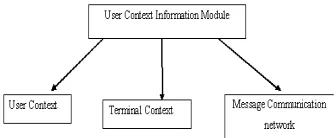
[image:3.595.311.479.648.717.2]Context information is an important feature in the mobile pervasive environment for the consideration of user context and their equipment devices. The separating of similar and the different users are carried out using the user context, terminal context and message communication network context.
Figure 2 User Context Information Module
The user context comprises of user-actions, which demonstrates what the user thinks, says and what he is currently doing. The terminal context holds objective data about the user position, direction, time, date. The message communication network provides the information about the type of devices then used to communication in pervasive environment. The similar users with the similar communication network, location, time, date and terminal are grouped together for the processing in ACAS-UB mechanism.
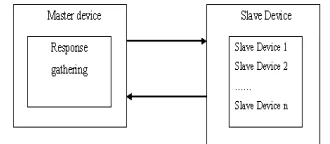
[image:4.595.104.269.347.419.2]The response from the different users in ACAS-UB mechanism is carried out using the master-slave concept. The different users upload their information in the master devices and the corresponding mobile pervasive devices act as slave devices
Figure 3 Master-Slave Concept on different users
The master device is designed to support multiple slave device responses in ACAS-UB mechanism as described in Fig 3. Master-Slave Concept analyzes user context and response information are all gathered and then sent to the master devices in the mobile pervasive environment. The response information is collected through any devices at anytime and anywhere in ACAS-UB mechanism by improving the scalability ratio. In a pervasive computing environment, the working spot of a device are used by different slave devices to communicate with master device in affluent context aware discovery.
2.2 Utilization of User Information in ACAS
The user information is taken predicting the user behavior in the mobile-pervasive environment. The mobile pervasive environment with ACAS-UB mechanism, comprises these numerical ratings assigned to individual devices for user profile construction, similarity measurement and user prediction.
2.2.1Construction of User Profile
………. Eqn (1)
is the rate of recurrence terms when constructing the user profile in mobile-pervasive environment. It is the number of active users in pervasive zone. The fuzzy inference rule in ACAS-UB mechanism is described as follows,
The primary difference is that the users with different profile are not matched to obtain the effective result. Fuzzy inference gives a value between 0 and 1, where ‘0’ means that these two users have the different user profiles and ‘1’means that they have the similar user profile. The user profile with the resultant action in mobile-pervasive environment is next stepped up into similarity measurement
.
2.2.2 Similarity Measurement
Similarity of the profiles is measured using the Pearson Product-moment Correlation Coefficient (PPCC) form in mobile pervasive environment. PPCC measures the linear correlation (i.e.,) similarity between the clients in the mobile pervasive environment.The similarity between the active user u as defined by PPCC is formularized as,
Begin
Step 1: Each inference is the keywords by the user
Step 2: Makes the construction of profile based on the input
Step 3: Membership function construct based on the fuzzy value ‘0’ or ‘1’ mobile-
pervasive environment.
The ‘cov’ co-variance of the two users ‘a’ and ‘b’ is computed to measure the similarity. The ‘ρ’ referred to as the correlation coefficient (i.e.,) similarity measurement in ACAS-UB mechanism using Pearson Product-moment. Eqn (2) shows the similarity between the ratings given by users ‘u’ on the same and different sensors in mobile-pervasive environment.
2.2.3 User Prediction
ACAS-UB mechanism performs the user prediction based on the ‘load’ of each user. The load is calculated based on the active users in the pervasive zone. ACAS-UB combines all the neighbors’ ratings into a prediction by computing a loaded average of the ratings. The user prediction is performed using,
[image:5.595.81.286.474.564.2]
---Eqn(3) where ‘n’ is the number of users and k is a normalizing factor. The normalizing factor summed up the similar and different users together to predict the user with lesser processing time. ACAS-UB mechanism uses Pearson Product Moment in the user prediction to still easily generate the output membership function. ACAS-UB mechanism output membership function is summarized as,
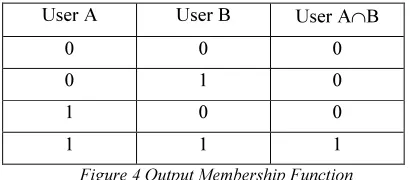
Figure 4 Output Membership Function
Fig 4 describes the output member function after the construction of the user profile. The user profile with different user context, terminal context and communication network are marked as the ‘0’ in the output membership function. The similar profile group is marked as ‘1’ and reduces the message overhead factor in the ACAS-UB mobile-pervasive environment.
3.EXPERIMENTAL EVALUATION OF
ACAS-UB
Affluent Context Aware Systems based on the User Behavior (ACAS-UB) in mobile pervasive environment uses JAVA platform. The Java
platform with master slave machines is used to experiment the ACAS-UB mechanism with other existing system. OPPORTUNITY Activity Recognition Data Set from UCI repository is used in the experimental work. OPPORTUNITY Activity Recognition Data Set devised a benchmark for the user prediction and motion sensors are used for recording while users executed daily activities. OPPORTUNITY Activity Recognition Data Set contains the Body-worn sensors, Object sensors, ambient sensors and Recordings. The 4 users are initially taken for the experimental work and with the total 242 attributes. The experiment is conducted on the factors such as message overhead in pervasive environment, scalability, processing time, precision ratio, response information retrieval rate and user profile construction efficiency. Precision ratio in the class of mobile devices is defined as the amount of relevant information retrieved based on the user behavior. The user behavior in pervasive environment is used effectively for improving the precision ratio and measured in terms of success ratio.
…………. Eqn (4)
Message overhead is the combination of excess messages requested by the users to perform the operation in pervasive environment. The message overhead attains an effective goal and measured in terms of the fractional percent. Scalability is the ability of the pervasive environment to handle the user behavior in a capable manner. The improved capability of the pervasive environment improves the total output percentage on the increased load. The processing time is defined as the amount of time it takes to complete the prescribed procedure. The prescribed procedure is computed based on the first response byte at a time to the last response byte at a time, measured in terms if seconds (sec).
………. Eqn (5) PT1 – First response time byte sent PT2 – Last response time byte sent The effective response information while retrieving the user query result is called as response information retrieval rate, measured in terms of User A User B User A∩B
0 0 0
0 1 0
1 0 0
response percentage. The user profile construction is defined as the sum of user requests with the Normalized Distributed Rate of Recurrence (NDRR). The user profile construction efficiency is computed as,
………. Eqn (6)
The no. of user requests in ACAS-UB mechanism is taken as ‘30’ and the inference rule is used in ACAS-UB mechanism for profile construction. Rate of recurrence terms is taken as ‘200’ when constructing the user profile in mobile-pervasive environment.
4. RESULT ANALYSIS
[image:6.595.307.536.274.638.2]In section 4, ACAS-UB mechanism results are analyzed on the existing Common KADS (CKADS) system, and Current Location-aware Private Service Discovery (LPSD). ACAS-UB mechanism is compared using the OPPORTUNITY Activity Recognition Data Set with experimental values through table and graph.
Table 1 Tabulation of Precision Ratio
Figure 5 Performance of Precision Ratio
Table 1 and Fig 5 illustrate the precision ratio based on the relevant information. The context holds objective data about the user position, direction, time, and date, so that the precision rate is improved. The precision rate is improved by 12- 20 % when compared with the CKADS System [1] and 5 – 10 % when compared with the LPSD [2]. The message communication provides the information about the type of devices used for the mode of communication in pervasive environment.
Table 2 Tabulation of Message Overhead
Figure 6 Measure of Message Overhead
Table 1 and Fig 5 illustrate the precision ratio based on the relevant information. The context holds objective data about the user position, direction, time, and date, so that the precision rate is improved. The precision rate is improved by 12- 20 % when compared with the CKADS System [1] and 5 – 10 % when compared with the LPSD [2].
No. of messages
Message Overhead (Fractional Percent)
CKADS System
LPSD ACAS-UB mechanism 10 0.30 0.28 0.26 20 0.31 0.29 0.27 30 0.35 0.33 0.31 40 0.37 0.35 0.33 50 0.38 0.39 0.33 60 0.42 0.40 0.35 70 0.45 0.41 0.37
Relevant Information
Precision Ratio (Success % )
CKADS System
LPSD ACAS-UB mechanism 50 85 90 96
100 80 87 95
150 80 89 96
200 82 90 95
250 83 91 97
300 84 91 98
[image:6.595.84.295.449.707.2]The message communication provides the information about the type of devices used for the mode of communication in pervasive environment. Fig 6 illustrates the message overhead based on the count of messages. Fuzzy inference gives a value between 0 and 1, where ‘0’ means that these two users have the different user profiles and ‘1’ means that they have the similar user profile. The message overhead is reduced by 10 – 17 % when compared with the CKADS System [1] and 5 – 15 % reduced when compared with the LPSD [2]. The user profile with the resultant action in mobile-pervasive environment reduces the message overhead.
Table 3 and Fig 7 describe the scalability percentage on the ACAS-UB mechanism when compared with the CKADS System [1] and LPSD [2]. ACAS-UB mechanism performs the user prediction based on the ‘load’ of each user and improves the scalability result. The load is calculated based on the active users in the pervasive zone and 8 % improved when compared with the LPSD [2]. ACAS-UB combines all the neighbors’ ratings into a prediction by computing a loaded average of the ratings and 5 % improved when compared with the CKADS System [1].
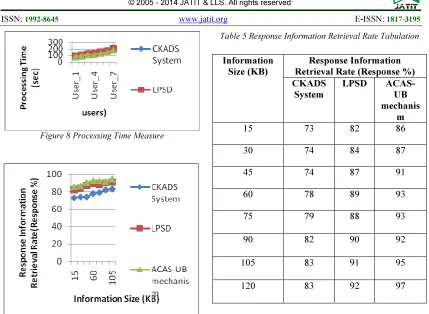
The above table (table 4) describes the processing time based on the users. The each users processing time is measured to compare the result percentage.
Fig 8 describes the processing time based on the user. The co-variance of the two users ‘a’ and ‘b’ is computed to measure the similarity. The ‘ρ’ referred as the correlation coefficient using Pearson Product-moment reduces the processing time by 13 - 20 % when compared with the CKADS System
Fig 9 illustrates the response information retrieval rate based on the information size. The response information is collected through any devices at anytime and anywhere in ACAS-UB mechanism and the retrieval rate is improved. In a pervasive computing environment, the working spot of a device are used by slave devices to communicate with master device for effective response between the user and the system. The retrieval rate is 12 – 22 % higher when compared with the CKADS System [1] and 2 – 5 % when compared with the LPSD [2].
Table 3 Tabulation of Scalability Technique Scalability (%)
CKADS System 90
LPSD 87
[image:7.595.299.509.102.436.2]ACAS-UB mechanism 95
Figure 7 Measure of Scalability
Table 4 Tabulation of Processing Time
Users Processing Time (sec)
CKADS System
LPSD ACAS-UB mechanism
User_1 92 89 80
User_2 110 104 92
User_3 139 121 111
User_4 137 128 115
User_5 156 149 134
User_6 179 165 150
[image:7.595.303.515.473.679.2]Figure 8 Processing Time Measure
[image:8.595.87.516.96.410.2]Figure 9 Response Information Retrieval Rate Measure
Figure. 10 User Profile Construction Efficiency Measure
Table 5 Response Information Retrieval Rate Tabulation
[image:8.595.218.504.433.604.2]
Table 6 Tabulation for User Profile Construction
Fig 10 describes the user profile construction efficiency based on the active users. ACAS-UB mechanism construction is depended based on the location of the mobile devices. The amount of mobile devices is examined based on the count of devices. The client gathers the desired information directly from the sensors for easy construction with 11 – 21 % improved when compared with the CKADS System. ACAS-UB uses the mobile devices with sensors for easy prediction of the user behavior in pervasive environment. ACAS-UB mechanism user profile construction is 4 – 10 %
Information Size (KB)
Response Information Retrieval Rate (Response %) CKADS
System
LPSD ACAS-UB mechanis
m
15 73 82 86
30 74 84 87
45 74 87 91
60 78 89 93
75 79 88 93
90 82 90 92
105 83 91 95
120 83 92 97
No. of Active users
User Profile Construction Efficiency (%)
CKADS System
LPSD ACAS-UB mechanism
[image:8.595.90.289.438.584.2]when compared with the LPSD [2]. Finally, ACAS-UB context information is an important feature in the mobile pervasive environment for the consideration of user context. The user context equipped the devices based on the similar users and different users. The similar user information is measured based on the location, time, date and terminal.
5. RELATED WORK
The progress of the pervasive environment offers the average level of standards for the users. The smart pervasive application architecture in [18] is based on the Service oriented Architecture (SOA) principles. The SOA standard usage is constructed for providing the widespread terms for achieving the applicability on various domain, scalability and development capabilities. Tula is decentralized as described in [5] have a fair and mechanically adapts transversely on different mobility patterns.
Tula senses and distributes information in a most favorable approach in which the oracular system totally replicates the information. The information has broad considerate about the energy consumption. Tula using mobility and energy traces from TurtleNet but does not resolve the ideal window size. User Module authorizes the end-users in [9] to recover network performance with window size and improve the end-user Quality of Experience (QoE) based on their interaction activities. User interface and the user model subsystem are not attempt to detain the end-user individual cognitive capacity and fails to approximately forecast the processing time, then the system discovery performance are not improved.
Private Service Discovery (LPSD) as illustrated in [2] considers the discovery path for reducing the distributed topology and flooding operations. The polar coordinate description is able to competently make overlay networks which offer location based searching, and improve traffic congestion system. LPSD in pervasive environment is not effective in precisely locating the required service by searching method. Fuzzy-cryptography scheme as presented in [7] facilitate the adaptation of an exact value for the tolerated noise in the middle of fingerprints based on service environmental conditions. The environmental condition alters the parameters of the error alteration and the length of the audio samples which are utilized. Identical and non-identical audio-contexts as observed indoor with low
background noise and a single prevailing audio resource
Partially Observable Markov Decision Processes (POMDP) as illustrated in [4] yields almost high-quality results which assure the quality of the approximation without noise. To control and actuate a large scale camera network so as to capitalize on the amount and type of captured events. POMDP fails to deal with the hybrid push and pull approach that are available with the advantages computation at the sensors while meeting the deadlines of a real-time system and supports the dynamic nature of a surveillance task. Probabilistic Delta Consistency (PDC) as demonstrated in [15] provide the flexibility system when compared with the existing reliability models covering all type of extraordinary case. PDC fails to satisfy heterogeneous consistency requirements of different users and enable cooperation in the midst of caching nodes for cost successfully broadcast data updates.
Distributed k-directory based Service Discovery Protocol (SDP) as expressed in [11] elect the top K-directory nodes believing the rich pervasive resources. Resource based election make sure high reliability for the directory nodes. SDP does not have a test result consisting of handheld devices for assessing the applicability of protocol in an active and mobile environment. SDP infrastructure fails to offer faultless service migration function across mobile nodes.
6. CONCLUSION
percent and 9.314 % lesser processing time. ACAS-UB provides the effective response information while retrieving the user query result.
REFRENCES
:
[1] Nayat Sánchez-Pi., Javier Carbo., Jose Manuel Molina., “A knowledge-based system approach
for a context-aware system,” Knowledge-Based
Systems., Elsevier Journal., 2012
[2] Chen Yu., Dezhong Yao., Xi Li., Yan Zhang., Laurence T. Yang., Naixue Xiong., Hai Jin.,
“Location-aware private service discovery in
pervasive computing environment,” Information
Sciences., Elsevier Journal., 2012
[3] Juan Yea., Simon Dobson., Susan McKeever.,
“Situation identification techniques in pervasive
computing: A review,” Pervasive and Mobile
Computing., Elsevier Journal., 2011
[4] Ronen Vaisenberg., Alessio Della Motta., Sharad Mehrotra., Deva Ramanan., “Scheduling sensors for monitoring sentient spaces using an
approximate POMDP policy,” Pervasive and
Mobile Computing., Elsevier journal., 2013 [5] Jacob Sorber., Aruna Balasubramanian., Mark D.
Corner., Joshua Ennen., Carl Qualls., “Tula:
Balancing Energy for Sensing and
Communication in a Perpetual Mobile System,”
IEEE Transactions on Mobile Computing, (Volume: 12, Issue: 4), 2013
[6] Eugene Y. Vasserman., and Nicholas Hopper.,
“Vampire attacks: Draining life from wireless
ad-hoc sensor networks,” IEEE Transactions on
(Volume:12 , Issue: 2 ) Mobile Computing, 2013
[7] Dominik Schurmann., and Stephan Sigg.,
“Secure communication based on ambient audio,”
IEEE Transactions on (Volume:12 , Issue: 2 ), Mobile Computing, 2013
[8] Chia-Chen Chen., Tien-Chi Huang., “Learning in a u-Museum: Developing a context-aware
ubiquitous learning environment,” Computers
& Education., Elsevier journal., 2012
[9] Yu Lu., Mehul Motani., Wai-Choong Wong.,
“When Ambient Intelligence meets the Internet: User Module framework and its applications,”
Computer Networks., Elsevier journal., 2012 [10] Anthony Harrington., Vinny Cahill., “
Model-driven engineering of planning and optimisation
algorithms for pervasive computing
environments,” Pervasive and Mobile
Computing., Elsevier journal., 2011
[11] Vaskar Raychoudhurya., Jiannong Caoa., Weigang Wub., Yi Lai., Canfeng Chenc., Jian Mac., “K-directory community: Reliable service
discovery in MANET,” Pervasive and Mobile
Computing., Elevier journal., 2011
[12] Tom H. Luan., Xinhua Ling., and Xuemin (Sherman) Shen., “MAC in Motion: Impact of Mobility on the MAC of Drive-Thru Internet,”
IEEE TRANSACTIONS ON MOBILE COMPUTING, VOL. X, NO. X, XXX 2011 [13] Francesco Chiti., Romano Fantacci., Francesco
Archetti., Enza Messina, and Daniele Toscani.,
“An Integrated Communications Framework for Context Aware Continuous Monitoring with
Body Sensor Networks,” IEEE JOURNAL ON
SELECTED AREAS IN COMMUNICATIONS, VOL. 27, NO. 4, MAY 2009
[14] Parisa Rashidi., Diane J. Cook., Lawrence B. Holder., and Maureen Schmitter-Edgecombe.,
“Discovering Activities to Recognize and Track
in a Smart Environment,” IEEE
TRANSACTIONS ON KNOWLEDGE AND DATA ENGINEERING, VOL. 23, NO. 4, APRIL 2011
[15] Yu Huang., Jiannong Cao., Beihong Jin., Xianping Tao., Jian Lu., and Yulin Feng.,
“Flexible Cache Consistency Maintenance over
Wireless Ad Hoc Networks,” IEEE
TRANSACTIONS ON PARALLEL AND DISTRIBUTED SYSTEMS, VOL. 21, NO. 8, AUGUST 2010
[16] Jong-yi Hong., Eui-ho Suh., Sung-Jin Kim.,
“Context-aware systems: A literature review
and classification,” Expert Systems with
Applications., Elsevier journal., 2009
[17] Parisa Rashidi., Diane J. Cook., “Activity knowledge transfer in smart environments,”
Pervasive and Mobile Computing, Elsevier journal., 2011
[18] Viktoriya Degeler., Luis I. Lopera Gonzalezy., Mariano Levaz., Paul Shrubsolex., Silvia Bonomiz., Oliver Amfty., and Alexander Lazovik., “Service-Oriented Architecture for
Smart Environments,”
International Conference Information Visualisation, 2009
[19] Yu Zhang, Zhibin Wu., Wade Trappe.,
“Adaptive Location-oriented Content Delivery in Delay-Sensitive Pervasive Applications,”
IEEE TRANSACTIONS ON MOBILE COMPUTING., 2010
[20] G. Fenza., D. Furno., V. Loia ., “Hybrid approach for context-aware service discovery in
healthcare domain,” Journal of Computer and