444
DIGITAL REFERENCE SERVICES USING WEB SERVICES:
OVERVIEW, DESIGN AND SPECIFICATIONS
1MAGAJI ZAINAB MUSA, 2M NORDIN A RAHMAN, 3JULAILY AIDA JUSOH
1
Master Student, Faculty of Informatics and Computing, University Sultan Zainal Abidin Tembila Campus, 22200 Besut, Terengganu, Malaysia
2
Assoc. Prof, Faculty of Informatics and Computing, University Sultan Zainal Abidin Tembila Campus, 22200 Besut, Terengganu, Malaysia
3
Lecturer, Faculty of Informatics and Computing, University Sultan Zainal Abidin Tembila Campus, 22200 Besut, Terengganu, Malaysia
1
[email protected], [email protected],[email protected]
ABSTRACT
Digital reference service (DRS) is an emerging trend of traditional reference service. Easily accessible digital reference service that providesreal time service to the patrons has become one of the necessities of the library information systems. Implementing a networked synchronous digital reference service by most libraries has become a difficult task. Web services on the other hand allow interoperability between heterogeneous devices and applications provided that they have conformed to the web services protocols. This paper gives an overview of digital reference service and web services applications. It uses questionnaires to make a survey in some university libraries so as to find out the actual problems faced by patrons while using DRS and also to know the specific requirements of the patrons. It provides a means of eradicating the present problem of digital referencing in the libraries by proposing a model for using web services technology in developing networked synchronous digital reference services. The functional informal specifications of the proposed model are also provided.
Keywords: - Digital, Reference, Web Services, Design, Specification, Library, Information System.
1 INTRODUCTION
Digital reference service is an important component of the library information system (LIS), and plays a key role in its success. This is because the main aim of the LIS is to offer a variety of services to its patrons to meet their various information requirements without time wastage and digital reference service help in achieving this aim [1].
Web services allow communication between two or more programs irrespective of operating system, database, location, hardware or programming language compatibility. The only thing is that each application must follow a set of standardized protocols for sharing and accessing data [7]. Web Services technology is a platform on which we can develop applications taking advantage of the internet infrastructure[8].
This paper gives a statistical result of the level of satisfaction of DRS users, the problems they faced while using DRS and their requirements on it. It also presents a model whereby digital reference service is implemented using web service
technology. It also presents the informal specifications of the designed model.
2 DIGITAL REFERENCE SERVICE
Digital reference service is a network that placed expertise or skill, human intermediation and resources at the disposal of users in an online environment, employs automated tools and allows human experts to concentrate or focus on difficult questions. It is viewed that digital reference service occurs when a question is received and responded electronically [3].
445 services from the physical reference desk to a virtual reference desk where the patron could be writing from home or other locations [3] and [4].
Virtual reference includes the use of both synchronous and asynchronous communication. Synchronous virtual reference refers to any real-time computer-mediated communication between patron and information professional. Asynchronous refers to communication between users and librarians with a time delay and the two oldest forms are reference via email and web form which is known as Ask A Librarian, which requires a librarian to respond reference query within time that is already stated in the library client charter. Some users are not really satisfied with email reference due to problem of response; as no reply on accurate and complete answers to the email questions is sent or no reply is sent at all or only a thank you reply is sent to them [3] and [6].
Traditional reference is carried out face to face or by telephone or fax from within library which means that when the library is closed their will be no help for users. However, using digital reference makes it possible for users to access reference services despite time and distance. It is clear that digital reference provides more alternatives and flexibility to users, especially those operating within a virtual learning environment [6] and [21].
3 WEB SERVICES
A new breed of web applications called web services are independent application components which are published on to the web in such a way that other web applications can find and use them. They take the web to its next stage of evolution, in which software components can discover other software components and conduct business transactions [7]. They provide information consumable by software rather than humans. One can use them while retrieving information about books from amazon.com or when submitting an order to amazon.com. A company can create a web service to allow outside applications to find out information about its products or to allow outside applications to submit orders to it. Examples of web services include a credit card service that processes credit card transactions for a given account number, a market data service that provides stock market data associated with a specified stock symbol, and an airline service that provides flight schedule, availability, and reservation functionalities. Major vendors like IBM, Microsoft, Hewlett-Packard, and Sun, among others, are investing heavily in Web services technology [7].
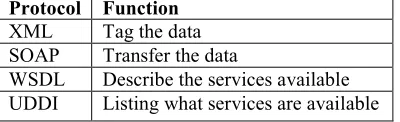
[image:2.612.309.509.324.385.2]Web services are software systems designed to support interoperable integration and interaction between different devices over a network [8]. They are meant to overcome the integration problem for heterogeneous distributed applications because they allow communication between two programs irrespective of operating system, database, location, hardware or programming language compatibility [9] and [10]. They are modular software components with interface descriptions that can be published, located and invoked across the web. They provide a form of remote procedure call (RPC) over the internet based on existing protocols and using widely accepted standards [11]. They bring about a standard way of integrating web– based applications using some standard protocols over the internet [12]. Table 1 below describes the protocols for this integration and their functions.
Table 1: Web Services Protocols And Their Functions Protocol Function
XML Tag the data SOAP Transfer the data
WSDL Describe the services available UDDI Listing what services are available
Web services architecture consists of 3 roles, 3 operations and 2 objects. These roles are service provider, service requestor and service registry. The operations are publish, find and bind, while the objects acted upon are service and service description [7], [8] and [10].
A service provider creates a web service and its service definition and then publishes the service with a service registry based on a standard called the Universal Description, Discovery, and Integration (UDDI) specification. Once a Web service is published, a service requester may find the service via the UDDI interface. The UDDI registry provides the service requester with a WSDL (Web Service Description Language) service description and a URL (uniform resource locator) pointing to the service itself. The service requester may then use this information to directly bind and invoke the service [7], [8] and [10].
446 or in conjunction with other web services to carry out a complex aggregation or a business transaction [8].
4 PROBLEM STATEMENT
Future and present users of libraries (students, teachers, others) are more dependent on online resources and services, they tap the required information at home or at a place far from the library by means of computer. Due to this reference service is needed to be provided online and preferably in real time.
Most libraries today do not offer synchronous digital reference service. A justification to this statement is the finding of National Information Standard Organization (NISO) development committee that worked on networked digital reference service. They find out that digital reference service has not evolved to the expected level because most libraries are still focusing on local non-networked implementations. They however decided to no longer pursue a consensus standard on the area.
We made a random sampling of some libraries in 5 Nigerian and 5 Malaysian universities and discovered the following result: In Nigeria the libraries of BUK, ABU, KUST, NWU and FUD do not offer a synchronous digital reference service to their patrons. In Malaysia the libraries of UMT, UTM, UNISZA, university Malaya, and IIUM do not offer a synchronous digital reference service to their patrons.
A few of the libraries that managed to have digital reference service offer asynchronous service through email or web forms which involves delay and as such becomes boring to the patrons.
We have observed that most online users of libraries make complaints over the problem they have encountered. Several online discussions demonstrate the challenges faced by these users. Some patrons’ feedback include:
“I couldn’t get the material I need in the OPAC and I don’t know whom to complain to”
“I sent a reference question to the online reference service but there was no response”
“When I sent a reference question through their mail, they responded late, I was kept waiting for long time.”
“Only a thank you message was sent to me as a reply to my question”
“Ohhhhh I am tired of sending questions to their mail through the web form, with all the advancement of technology they cannot respond to their patrons in time! Hmmm…. Outdated library”
In our expectation, the use of web services technology will eradicate these problems. A supportive point to this prediction is that since web services allow interoperability between different devices, then the digital reference service can be built on web services platform so that whenever a library implement it, then the library will have an independent reference service and at the same time the library will be on a networked digital reference service that offers real time service to its patrons.
It is in line with this that we have strongly decided to develop a model of web services applications for digital reference service of library information system (LIS) and the specifications of the model. The said specifications will prove useful and helpful by coming up with the exact, correct and proper requirements of the said web services. It will serve as a reliable reference point for those who investigate the user’s needs, those who implement the web services to satisfy those needs, those who test the results, and those who write instruction materials for the system [22].
5 RELATED WORKS
Digital reference services are complex entities, with which a number of issues are associated [6]. Despite their complexity, they are highly needed and have been an important area of research. Many researchers have reviewed their usefulness as well as the methodology and collaborations that are currently been used to extend assistance to patrons in learning to use virtual resources and in finding the information they need [15].
Some research projects aimed at providing reference and information services as part of the digital library services have been done and some are still under development. The most prominent is the Collaborative Digital Reference Service (CDRS) project launched by the Library of Congress. The mission of which is to provide professional reference service to users, anywhere any time, through an international, digital network of libraries. The CDRS is a library to library network for asking and answering reference questions [15].
447 An additional example is the SIFTER which is interdisciplinary research collaboration among students in the Computer and Information Science Department and the School of Library and Information Science at Indiana University. The broad aim of the project is to develop information agents that would perform a number of functions such as calling information from complex resources residing in diverse locations, and conducting analysis, synthesis and customizations according to the requirements of the user [15].
Another project in this category is the Virtual Reference Desk (VRD). It is sponsored by the US Department of Education, and its objective is the advancement of digital reference and the successful creation and operation of human-mediated internet-based information services. VRD defines a digital reference service as Internet-based question-and-answer services that connect users with experts. The basic idea of VRD is that when a given user asks a question that cannot be answered by a participating center, it will then be forwarded to the VRD network for assistance [15].
Another important work in this area was conducted by the National Information Standards Organization (NISO) America. They sponsored a workshop on networked digital reference services in Washington DC. The aim was to explore potential areas of standardization to facilitate the development and implementation of services in the new arena. Following the workshop, NISO convened a standards committee that was tasked to develop a question processing transaction protocol for the interchange of messages between digital reference domains to support processing and routing of questions and responses and packaging of other information to be exchanged. The committee was also tasked to develop Meta data elements sets to identify and describe key components of both question and answer data and institutional and personal data. The Committee comes up with a specification titled “networked reference services: question and answer transaction protocol”. The work serves as a standard for networked digital reference services [13].
Despite all these works, digital reference service had yet not developed to the expected level because most of the techniques used by these projects are either expensive or complex to be adopted by other libraries. Our proposed model was designed in a simple way such that any library can adapt and adopt. Secondly, they only provide asynchronous service to user and chat service as the only form of synchronous service. Unlike theirs, ours will provide a synchronous digital reference
service and also, using it will lead to the development of an independent digital reference service and at the same time a networked digital reference service.
6 ANALYSIS OF THE PROBLEMS
ASSOCIATED WITH DRS OF LIBRARY INFORMATION SYSTEM
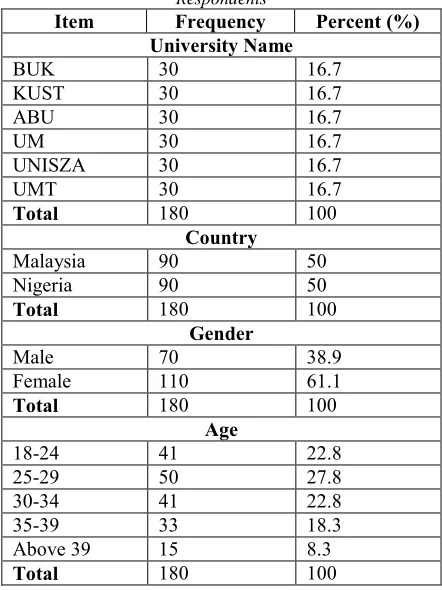
In order to find out the specific requirements of users from DRS and the level of satisfaction of these requirements, we made a survey of some libraries of 3 universities in Nigeria and another 3 universities in Malaysia. A total of 180 questionnaires with a response rate of 100% (n=180) were evenly distributed to some students of these universities. A questionnaire is given to a student only if he/she is aware of his/her school library’s DRS and had once make use of it.
[image:4.612.307.528.362.657.2]6.1 Analysis Of Socio Demographic Information
Table 2: Socio Demographic Information of the Respondents
Item Frequency Percent (%)
University Name
BUK 30 16.7 KUST 30 16.7 ABU 30 16.7 UM 30 16.7 UNISZA 30 16.7 UMT 30 16.7
Total 180 100
Country
Malaysia 90 50 Nigeria 90 50
Total 180 100
Gender
Male 70 38.9 Female 110 61.1
Total 180 100
Age
18-24 41 22.8 25-29 50 27.8 30-34 41 22.8 35-39 33 18.3 Above 39 15 8.3
Total 180 100
448 27.8% of them are within the age range 25-29, and those within the age range of 30-34 have the same percentage with the first group. 18.3% of the respondents fall within the age range of 35-39 while 8.3% are more than 39 years of age.
6.2 Analysis Of Users Satisfaction With Drs
Table 3: Users Satisfaction Information
Option Frequency Percent (%)
My school library’s DRS responds to users’ requests without delay
Strongly Disagree 71 39.4 Disagree 106 58.9 Agree 03 1.7 Strongly Agree 00 0.0
Total 180 100
I got a useful and relevant information through the DRS
Strongly Disagree 15 8.3 Disagree 43 23.9 Agree 106 58.9 Strongly Agree 16 8.9
Total 180 100
I will be glad to use DRS whenever the need arises
Strongly Disagree 30 16.7 Disagree 39 21.7 Agree 80 44.4 Strongly Agree 31 17.2
Total 180 100
Traditional digital reference service provides better service than DRS
Strongly Disagree 06 3.3 Disagree 82 45.6 Agree 84 46.7 Strongly Agree 08 4.4
Total 180 100
DRS is helpful to library users
Strongly Disagree 00 0.0 Disagree 20 11.1 Agree 103 57.2 Strongly Agree 57 31.0
Total 180 100
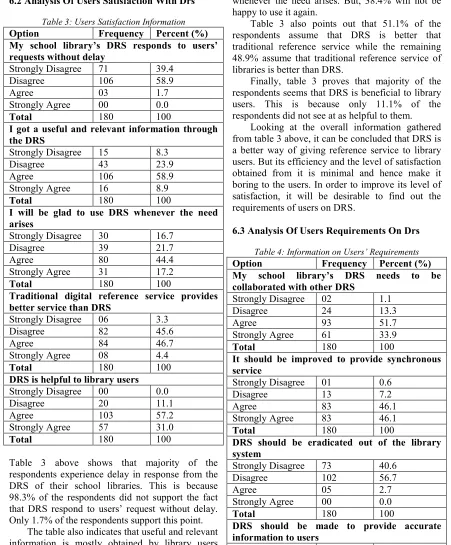
Table 3 above shows that majority of the respondents experience delay in response from the DRS of their school libraries. This is because 98.3% of the respondents did not support the fact that DRS respond to users’ request without delay. Only 1.7% of the respondents support this point.
The table also indicates that useful and relevant information is mostly obtained by library users through the DRS. The reason being that 67.8% of
the respondents approved the statement which says that “I got a useful and relevant information through the DRS” even though 32.2% of the respondents did not approve it.
Furthermore, the table proves that majority of the respondents (61.6%) will be glad to use a DRS whenever the need arises. But, 38.4% will not be happy to use it again.
Table 3 also points out that 51.1% of the respondents assume that DRS is better that traditional reference service while the remaining 48.9% assume that traditional reference service of libraries is better than DRS.
Finally, table 3 proves that majority of the respondents seems that DRS is beneficial to library users. This is because only 11.1% of the respondents did not see at as helpful to them.
Looking at the overall information gathered from table 3 above, it can be concluded that DRS is a better way of giving reference service to library users. But its efficiency and the level of satisfaction obtained from it is minimal and hence make it boring to the users. In order to improve its level of satisfaction, it will be desirable to find out the requirements of users on DRS.
[image:5.612.81.532.168.713.2]6.3 Analysis Of Users Requirements On Drs
Table 4: Information on Users’ Requirements
Option Frequency Percent (%)
My school library’s DRS needs to be collaborated with other DRS
Strongly Disagree 02 1.1 Disagree 24 13.3 Agree 93 51.7 Strongly Agree 61 33.9
Total 180 100
It should be improved to provide synchronous service
Strongly Disagree 01 0.6 Disagree 13 7.2 Agree 83 46.1 Strongly Agree 83 46.1
Total 180 100
DRS should be eradicated out of the library system
Strongly Disagree 73 40.6 Disagree 102 56.7 Agree 05 2.7 Strongly Agree 00 0.0
Total 180 100
DRS should be made to provide accurate information to users
[image:5.612.285.527.392.744.2]449 Agree 99 55.0
Strongly Agree 71 39.4
Total 180 100
DRS should be automatic with little or no librarian’s intervention
Strongly Disagree 00 0.0 Disagree 04 2.2 Agree 90 50.0 Strongly Agree 86 47.8
Total 180 100
Most of the respondents suggest that DRS should not be an independent one, rather, a multiple libraries collaborated one. This information is obtained from table which shows that 85.6% of the respondents support the statement “My school library’s DRS needs to be collaborated with other DRS “. While only 14.4% of the respondents dis-agreed with it.
Table 4 also shows that 92.2% of the respondents suggest that DRS should provide synchronous service not asynchronous. Only 7% of the respondents did not make such suggestion.
The table also proves that library users need DRS because 97.3% of the respondents did not support eradication of DRS entirely from the library system. A few of the respondents that made this suggestion constitute only 2.7%.
Additionally, the table points out that majority of the respondents suggest that DRS should provide accurate information to users. It also shows that 97.8% of the respondents wishes DRS to be fully automatic with little or no librarian’s intervention.
The information obtained in table 4 gives the requirements and expectations of users from DRS. The authors give their contribution to the satisfaction of the said requirements by developing a model for implementing DRS using web services applications. It will serve as a standard design which web service developers will use to develop web services applications for DRS of LIS so as to have a synchronous collaborated digital reference service for all libraries across the globe.
7 ELEMENTS OF THE PROPOSED
MODEL
The proposed model was developed using three elements viz WS-Specifications, Lifeng and Anne reference service model and the networked reference service: question and answer transaction protocol model (QATP).
7.1 Ws-Specifications
Web services are associated with a variety of specifications of different level of maturity and
maintained by various standards. These specifications are the basic web services framework represented by WSDL, SOAP, UDDI built on top of XML standard. Specifications may complement, overlap and compete with each other. Web services specifications are collectively referred to as “WS-“. These specifications are compose together to provide interoperable protocols for security, reliable messaging and transactions. WS- includes messaging specifications, metadata specifications, security specifications, reliability specifications, resource specification, management specifications, business process specifications, transaction specifications, presentation specifications and xml specifications (IBM, 2014), (InnoQ, 2014), (MSDN, 2014), (OASIS, 2014) and (W3C, 2002).
The detailed description of the WS-specifications can be found at:
1. IBM developer Work: Standard and Web Service (http://www.ibm.com/us/en/) 2. innoQ's WS-Standard Overview
(https://www.innoq.com/resources/ws-standards-poster/)
3. MSDN Developer Centre: Web Service Specification Index Page
(http://msdn.microsoft.com/en-us/library/ms951274.aspx)
4. OASIS Standards (https://www.oasis-open.org/standards)
5. W3C's Web Services Activity (http://www.w3.org/2002/ws/)
WS-Specifications are to govern communication and interoperability of the web services applications.
7.2 Han And Goulding Reference Services Model
Two library scientists viz Lifeng Han and Anne Goulding developed a model for categorizing the practices of reference services based on Bopp and Bunge work and Green’s ideas. Their model categorizes reference services into three groups:
1. Information services that take the forms of ready reference questions, bibliographic verification, interlibrary loan and document delivery, information and referral services, research questions and fee-based services and information brokering
2. Guidance, including readers’ advisory services, bibliotherapy, term-paper counseling, selective dissemination of information (SDI, also called current awareness service);
450 The authors of this paper use this model to categorize the individual web services applications which will be composed together to provide interoperable digital reference services in the LIS. They are categorized based on the type of service they offer in order to comply with the number one factor of best practices for designing web services in library context by the national information standard organization (NISO) America. They said that in order to create an interoperable ecology for digital library systems, simplicity and small interfaces are desired in the design of web services. This is because small and simple interfaces are easier to document, test, maintain and understand. They also proved to be more robust and they have reduced length and time frame of implementation.
7.3 Networked Reference Services: Question/Answer Transaction Protocol (Qatp) Model
The authors adopt the logic of this model while making necessary modifications so as to fit web services applications. The model as written in the NISO report is as follows:-
Suppose A and B are digital reference domains (DRDs). A itself may include logically distinct components that communicate among one another to process a question. For example, suppose A includes the logical components A1 and A2, where A1 receives questions and determines either
1. A itself is capable of answering the question, or
2. External communication with B is necessary
In the first case, A1 sends the question to A2 who processes it and sends the answer to A1. In that situation, from the point of view of the world outside of A, none of the communication among A’s components is externally visible or subject to standardization.
The second case requires communication betwezen A and B which is not possible unless governed by some agreed-upon protocol. However, protocol may indeed be necessary even in the first case A1 and A2 might be distinct DRDs from each other’s point of view (for example, they may be from different vendors).
When two DRD’s communicate via QATP, the communication is described in the context of a transaction. QATP is a client/server protocol; the client is the questioner and the server is the answerer. Any system may play either of the roles, though not in the same transaction. A system may
be a client in one transaction and a server in another.
A protocol operation is the transfer of protocol message from client to server or from server to client. An operation is an instance of an operation type, and a message is an instance of a message type. A transaction includes one or more operations.
Example: A client sends a question message (which includes a question) to the server. Question is both a message type and operation type. The act of sending a message is an answer operation. This concludes the exchange (the question operation followed by the answer operation), for this particular question; the question operation and the answer operation comprise a transaction.
All operations for this protocol are one-way; that is, the operation type defines a single, message type. (For example, although a request clarification message from the server is normally followed by a clarification message from the client, these are modeled as separate operations. There are other protocols that define operations in terms of more than a single message, for example a request followed by a response. Each operation type is given the same name as the message type it defines.
8 THE PROPOSED MODEL
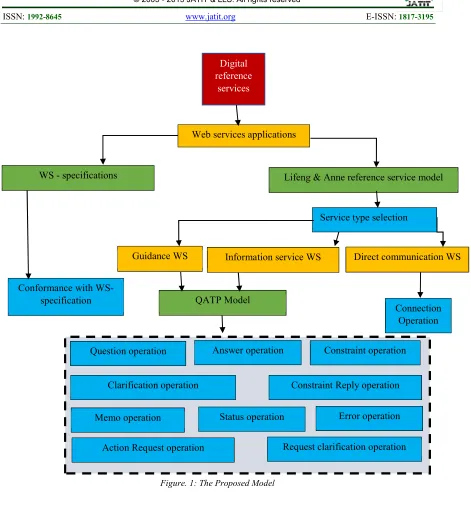
The model developed from the 3 elements described above is illustrated in fig. 1 at the end of this paper.
According to the proposed model, the web services must conform to the WS-specifications so as to maintain interoperability. The web services are divided into three based on their functions. The end user is expected to select the type of service he/she wishes to get. The selection of the user will determine the web service that will be invoked. If the guidance web service or the information service web service is invoked, then the operations adapted from the QATP model will be carried out. The operations will be between end user and the web service, or web service and web services. Otherwise if direct communication service is selected by the user, then the connection operation will be carried out whereby the user will be connected to a librarian for direct communication. Direct communication will be in the form of chat, or voice call, or video call, it all depends on the user’s interest.
451 questions that would be asked by the patrons are stored in the system database together with their answers. When a question is submitted by a user, then the web service application will search the data base for answer. If the answer exist, then it will be displayed to the user, otherwise, the web service will communicate with other web service applications of other digital reference services and send the question to them. When the answer is found, then the web service that finds the answer will send it to the web service that sends the question, which will then display it to the user and update its system database with the answer. Direct communication is expected to be used as a last option to the user when he/she is not satisfied with the answer provided by the system.
The model also handles the issue of misunderstanding of the user’s question by the web service applications. Misunderstanding in this context refers to a situation whereby by the user sends a question to web services and the web service finds out that it did not have the answer to the question in its database, so it then forwards it to other web services of other digital reference services that provide similar service to the patrons; and just like the initial web service, all the other web services do not have the answer to the question in their databases. The model handles this situation by making the web services to request for a clarification message from the initial web service which will in turn request it from the user. The user will provide a clarification message by changing the original form of the question.
The issue of constraints is also fingered in this model in order to ensure full satisfaction of the user. Both the web service and the user can send a constraint message to one another and a corresponding constraint reply message. The constraint message can be attached to the question message, and it can also be sent after the question message in case the user is the sender. But when the sender is a web service, then it can be attached to the answer message.
The user is also given the ability to control the action of the web services after a transaction was initiated. This can be done by sending an action request message to the web service. Through this the user can suspend the transaction until he/she sent another request for resumption, or suspend the transaction until a specified time, or resume processing of a suspended transaction, or set the transaction’s activity timer, or close the transaction. The details of the input, output and processes of the proposed model are described in paragraph 8.
9 THE INFORMAL SPECIFICATIONS OF THE PROPOSED MODEL
Our concern is mainly on the functional informal specifications of the web services applications for DRS described in the proposed model above. The operations involved in the model as seen in paragraph 7 are:
1. Conformance with WS-specifications 2. Selection of service type operation 3. Question operation
4. Answer operation
5. Request clarification operation 6. Clarification operation 7. Constraint operation 8. Constraint reply operation 9. Action request operation 10. Status operation
11. Error operation 12. Connection operation
The details of input, output, and processing activities of each operation are as follows:
1. Conformance with WS-specifications Input: Web services applications
Processing: If the web services applications have conform to the standard WS-specifications as provided by standard organizations, report ‘valid’
Elsereport ‘invalid’
Output: report
2. Selection of service type operation Input: user’s selection
Processing: If the patron selects guidance option,
report ‘invoke guidance web service’
Else if the patron selects information service option
report ‘invoke information service web service’
Else report ‘invoke direct communication web
service’
Output: report
3. Question Operation Input: user’s question
Processing: The service requestor invoke a service provider by sending a question.
If the service provider needs clarification over the question report, ‘initiate request clarification operation’
Else
452
Else report ‘invoke and send the question to
other services’
Output: report
4. Answer Operation Input: user’s question
Processing: The service provider sends the answer to the service requestor.
If the question is directly from the patron, report
‘display the answer’
Else report ‘send the answer to the web service that
sends the question’
If the answer is provided by another web service,
report ‘update system database with the answer’
Elsereport ‘invalid’
Output: report
5. Request Clarification Operation Input: Request Clarification Message
Processing: The service provider processes the question and finds out that it needs clarification.
If the question is directly from the patron, report
‘request for a clarification message from the patron’
Else report ‘request for a clarification message from the service that sends the question and the service will in turn request it from the patron’
Output: report
6. Clarification Operation Input: Request Clarification Message
Processing: The patron sends the clarification message.
If the clarification message was requested by the web service, report ‘process the clarification message’
Elsereport ’supply the clarification message to the
web service that requested for it’
Output: report
7. Constraint Operation Input: user’s question
Processing: Either the patron sends a constraint message to the service provider or the service provider sends a constraint message to the user.
If the constraint message requires compulsory response, report ‘initiate a constraint reply operation’
Elsereport ‘either ignore the constraint message or
initiate a constraint reply operation ’
Output: report
8. Constraint Reply Operation Input: constraint message
Processing: The patron or the service provider responds to a constraint message.
If the peer accept the constraint, report ‘set acceptance flag to true’
Elsereport ‘set acceptance flag to false’
Output: report
9. Action Request Operation Input: action request message
Processing: The user initiates an action request operation.
If the action request message requires the server to suspend processing of the transaction until another request to resume
Or suspend until a specified time Or resume processing
Or reset the activity timer
Or close the transaction, report ‘initiate a status operation’
Output: report
10. Status Operation Input: action request message
Processing: If action request can be carried out,
report ‘success’
Elsereport ‘failure’
Output: report
11. Error Operation Input: user’s question
Processing: The service requestor or service provider initiates the error operation.
If error occurs, report ‘send error message to the right destination’
Output: report
12. Connection Operation Input: user’s selection
Processing: The web service connects the user with a reference librarian for real time communication.
If voice call is selected, report ‘connect with a librarian using voice call service’
Else if video call is selected, report ‘connect with a librarian using a video call service’
Elsereport ‘connect with a librarian using chat
service’
Output: report
10 CONCLUSION
453 services. We proposed a model that will lead to the development of synchronous networked reference services using web services technology and also provide the specifications of the proposed model. The proposed model has new technological capabilities and is expected to resolve the problems associated with DRS of LIS. When implemented, the proposed model will lead to a DRS with the following properties:
1. Both synchronous and asynchronous. 2. Reference librarians are needed at
minimal level whenever the patron wants to communicate with one at his/her own interest.
3. Both independent DRS and networked DRS.
The proposed model is easy to adapt by both large and small libraries as web services technology is easy to incorporate in this era.
11 FUTURE WORK
The future work of this research is to prove that the proposed model is correct, complete and unambiguous. This shall be done by converting the informal specifications into Z formal specifications. Verification and Validation of the said Z specification shall also be done using Z/EVES theorem prover.
ACKNOWLEDGEMENTS
The authors would like to extend their appreciation to the Kano State government and University Sultan Zainal Abidin for their support.
REFERENCES:
[1] A. Chandwani, An overview of digital reference services,
Eprints.rclis.org/14295/1/DIGITAL_REFER
ENCE_SERVICES.pdf, 2014
[2] J. M. Spivey, the Z Notation: a Reference
Manual, 1998, pp 1-17
[3] S. K. Nordin, N. A. Kassim and K. Baharaddin, Evaluating digital reference service in university libraries, IEEE Symposium on Business, Engineering and
Industrial Applications, 2012, pp. 202-206
[4] C. Penzhorn, Virtual reference best practices: Tailoring services to your library,
Library Hi Tech. Vol.2, 2010, pp. 330-332
[5] L. Eakin and Z. Pomerantz, Virtual reference, real money: modelling costs in virtual reference services, Libraries and the
Academy, Vol.9, 2009, pp.133-164,
http://muse.jhu.edu/login?auth=0&type=su mmary&url=/journals/portal_libraries_and _the_academy/v009/9.1.eakin.html
[6] L. Han and A. Goulding, Information and reference services in the digital library,
Information Services and Use, No.23, 2003,
pp. 251-262
[7] J. Roy and A. Ramanujan, Understanding web services, IEEE Journal and Magazines, Vol. 3, 2001, pp. 69-73
[8] W3C, Web services architecture requirements, 2004,
http://www.w3c.org/TR/2004/NOTE_wsa_re
qs_20040211/#id2604831/accessed on
26/05/2014,
[9] P. Rudo, The importance of web services, 2010,
http://www.enterprisefeatures.com/2010/07/t he_importance_of_web_services/accessed on 25/05/2014
[10] K. Gottschalk, S. Graham , H. Kreger and J. Snell, Introduction to web service architecture, IBM Systems Journal, No.41, 2002, pp.170-177
[11] I. S. Moustafa, Formal specification and verification of data centric services, PhD Thesis, Virginia Polytechnic Institute and State University, 2012
[12] Webopedia, Web services, 2014,
http://www.webopedia.com/TERM/w/web-services.html/accessed on 27/05/2014
[13] NISO, Networked reference services: Question/Answer transaction protocol, A
Technical Report by the National
Information Standard Organization,
America, 2006
[14] Encyclopedia, Theorem prover,
Encyclopedia of Mathematics, 2014,
http://www.encyclopediaofmath.org/index.ph p/theorem_prover/accessed on 04/07/2014
[15] G. G. Chowdhury, Digital libraries and reference services: present and future,
Journal
Of Documentation, No.58, 2002, pp.258-283
[16] IBM, Web services, 2014,
specifications.http://www.ibm.com/Search/? q=web+services+specifications&v=17&en= utf&lang=en&cc=us/accessed on
25/10/2014
[17] InnoQ, Web Services Standards, 2014,
https://www.innoq.com/resources/ws-standards-poster/ accessed on 25/10/2014
454
http://msdn.microsoft.com/en-us/library/ms951274.aspx/accessed on
25/10/2014
[19] OASIS, Oasis Standards, 2014,
https://www.oasis-open.org/standards/accessed on 25/10/2014
[20] W3C, W3C's Web Services Activity, 2002,
http://www.w3.org/2002/ws/ accessed on 25/10/2014
[21] R. E. Bopp and L.C. Smith, 2011. History and functions of reference service, Reference
and Information Services, an Introduction,
4th Edition, pp. 3-28
[22] NASA, Formal methods specification and verification guide book for software and computer systems. Volume: planning and technology insertion, 1995.
[image:12.612.88.559.65.586.2]
455
Figure. 1: The Proposed Model Digital reference
services
Web services applications
WS - specifications Lifeng & Anne reference service model
Service type selection
Guidance WS Information service WS Direct communication WS
QATP Model
Question operation Answer operation
Request clarification operation Clarification operation
Constraint operation
Constraint Reply operation
Action Request operation
Status operation Error operation Memo operation
Conformance with WS-specification