A NOVEL STEERABLE FILTERS BASED FUZZY UNSHARP
MASKING SCHEME FOR DOCUMENT IMAGES
ENHANCEMENT
E. BALAMURUGAN1, DR. P. SENGOTTUVELAN2, K. SANGEETHA3
1,3
Assistant Professor(s), Department of CA, BIT, Sathyamangalam, TamilNadu, India
2
Associate Professor, Department of IT, BIT, Sathyamangalam, TamilNadu, India E-mail: [email protected]
ABSTRACT
Document image sweetening is to focus on the texts, handwritten characters and images in the Document. Problem with most of the document image analysis system is images with low contrast not able to produced optimal results. In this paper, a steerable filters based fuzzy unsharp masking algorithmic rule is given to improve the contrast of the document image. In this method we introduce the fuzzy set theory into the unsharp masking scheme. Moreover, in this proposed model includes the new methods to replace a high pass filter with manageable filters in unsharp masking scheme. Contrast enhancement is achieved through the open membership performance is projected to rework the output of steerable filters into fuzzy domain. The experimental results clearly show that the proposed methodology not slowly improves the image quality however will get a far better recognition performance.
Keywords:- Document Image Enhancement, Steerable Filters, Unsharp Masking, And Fuzzy Set Theory,
Unsharp Masking (UM)
1. INTRODUCTION
Recognition of Document Analysis aims to the automatic extraction of information presented on paper and initially addressed to human comprehension. The desired output of Document analysis and recognition systems is usually in a suitable symbolic representation that can subsequently be processed by computers. The most widely known applications of Document analysis and recognition are related to the processing of office documents (such as invoices, bank documents, business letters, and checks) and to the automatic mail sorting. With the current availability of inexpensive high-resolution scanning devices, combined with powerful computers, OCR packages can solve simple recognition tasks for most users. Recent research directions are widening the use of the recognition of document techniques, significant examples are the processing of ancient/historical documents in digital libraries, the information extraction from “digital born” documents, such as PDF and HTML, and the analysis of natural images (acquired with mobile phones and digital cameras) containing textual information.
Several Preprocessing methods are proposed and tested by various researchers and also available for Document analysis and recognition system such as Binarization, image restoration, noise
reduction, Skew detection etc [1]. In this paper our approach is to enhance the document image using steerable filters. In the literature survey various methods results are considered and we tend to found Negishi’s several automatic thresholding algorithms [2] in extracting character bodies from the noisy background. In this algorithm it produces negative result for significantly large pictures and cases wherever the grey levels of the character elements overlap there with of the background. We later found in [3] morphological approach to extract text strings from regular periodic overlapping text/background images. [4] [5] proposed two binarization algorithms to victimization histogram-based edge detection and thin line modeling, severally. Finally [6] used the noise attribute options supported a simple noise model to beat the problem that some objects don't type outstanding peaks within the histogram.
low-resolution instances of constant symbol to get a better resolution of it. Binarization of historical documents supported adaptive threshold segmentation and varied pre and post-processing steps is represented by [8] during this approach, a background surface is computable and same may be adapted in the image. An iterative approach for segmenting degraded document pictures is represented by [9] there a world thresholding technique is employed to get an initial segmentation. Areas with doubtless incorrect segmentation are detected, and a neighbourhood thresholding is applied in them. This approach is efficient therein native thresholds are computed slowly at chosen locations. It is also noted that general segmentation techniques provided higher performance on historical documents as compared with document-specific segmentation techniques.
2. STEERABLE FILTER
Steerable filters, introduced by Freeman and Adelson, 1991, are spatial oriented filters that have received a great interest in image analysis. The basic idea is to generate a rotated filter from a linear combination of a fixed set of basis filters (Simoncelli, E.P et al,1995).
The steerability condition is not restricted to derivative filters and could be expressed for any signal f as:
fx, y ∑ kθfx, y
(1)
Where fx, y is the rotated version of f by an arbitrary angleθ, kθ are the interpolation functions, fx, y are the basis functions and M
the number of basic functions required to steer the functionfx, y.
To determine the conditions under which a given function satisfies the steering condition in equation 1, let us work in popular coordinates
r x yand ∅ arg x, y. The function
f could be expressed as Fourier series in polar angle, ∅ :
fr, ∅ ∑are∅ (2)
Where j √1 and N is the discrete length of coefficients.
It has been demonstrated in the steering condition in Equation (1), is satisfied for functions expandable in the form of Equation (2) if and only if the interpolation function kθ are solution of:
cθ ∑kθcθ (3)
Where cθ e, and n 0, … . , N!
From equation 3, fr, ∅ is expressed as:
fr, ∅ ∑kθgr, ∅
(4)
Where gr, ∅ can be any set of functions. It has also been demonstrated that the minimum number M of basic functions required to steerfr, ∅ is equal to the number of non-zero Fourier coefficients ar.
3. 3. DESIGNING STEERABLE FILTERS
All functions which are band limited in angular frequency are steerable, given enough basis filters. But in practice the most useful functions are those which require a small number of basis filters.
As an example, we will design a steerable quadrature pair based on the frequency response of the second derivative of a Gaussian,". A pair of filters is said to be in quadrature if they have the same frequency response but differ in phase by 90 (i.e. are Hilbert transforms of each other [12]). Such pairs allow for analyzing spectral strength independent of phase, and allow for synthesizing filters of a given frequency response with arbitrary phase. They have application in motion, texture, shape, and orientation analysis [13]. Gaussian derivatives are useful functions for image analysis [14] and a steerable quadrature pair of them would be useful for many vision tasks.
First, we design a steerable basis set for the second derivative of a Gaussian,
#$, % "
4$ 2(
. For interpolation function, )*,
+ 1(, + 1(
1
(
1
(,
-)*
)*
)*
.
(5)
Requiring that both the real and imaginary parts of Equation 5 agree gives a system of three equations. Solving the system, using *
0, * 60, * 120, yields
)* 01 2cos 2* *3
(6) And we have
" )*" ^
)*" ^
)*" ^
(7)
satisfactory level of approximation (total error power was 1% of total signal power) using a 3rd order, odd parity polynomial, which is steerable by four basic functions. We refer to this approximation as 4. Its steering formula is given with that for several other polynomial orders in [2].
4. UNSHARP MASKING TECHNIQUE
The popular unsharp masking (UM) technique is a simple and effective method, both computationally and conceptually, for emphasizing high frequency contents to enhance edges and other details in an image. Its basic idea is that a high-pass filtered and scaled version of an input image is added to itself and the enhanced image %5, 6is obtained from the input image
$5, 6 as
%5, 6 $5, 6 7 895, 6 (8) Where zm, nthe output of a linear high pass filter, λ is is a positive scaling factor that controls the gray level of the output image. If the centre coefficient of the high pass filter operator is positive, the operator sign is plus in Equation 8. Contrarily, it is subtraction sign.
The linear unsharp masking technique is used and works well in many applications. However, the linear high-pass filter is extremely sensitive to noise. In order to reduce the noise sensitivity of the UM technique, in [15] used an order statistic (OS) Laplacian operator in the UM. They demonstrated that UMOS filter could amplify much less noise than the conventional UM filter. In addition, different nonlinear filters have been proposed to reduce the noise. In [16] replaced the Laplacian filter with a simple second-order Volterra filter. In [17] introduced a modified version of unsharp masking, in which they used a quadratic filter. A cubic unsharp masking (CUM) technique was presented by [18] to suppress the effect of noise amplification. In [19] introduced a variation of the basic UM scheme that contain an adaptive filter in the correction path. Still, all previous unsharp masking method suffer from another common drawback and they are not effective for low-contrast images.
5. FUZZY SET THEORY
Fuzzy set theory is a useful mathematical tool for handling ambiguous situations, particularly for the vagueness in human languages and reasoning.
It has advanced in a variety of way and applied in many disciplines. The application of the theory can be found, for example, in artificial intelligence, computer science, control engineering, decision theory, expert systems, logic, management science, operations research, pattern recognition, and robotics [20]. While many branches of mathematics are dichotomous regarding truth and falsehood, the fuzzy set theory provides a systematic way to study human factors with all its vagueness of perception, subjectivity, attitudes, goals and conceptions.
The fuzzy set theory is an extension of the conventional set theory. By introducing vagueness and linguistics, fuzzy set theory becomes more robust and flexible than the classical dichotomous set theory.
A membership function describes the fuzziness of a fuzzy set. Determining a suitable membership function is a basic task [21].
Let the inverse beX x, x, … … . , x!. A fuzzy set A on X is set defined by a membership function μ representing a mapping, μ: X →
@0,1A, here the value of μx for the fuzzy set A is called membership value or the membership degree of xϵX. The membership value represents the degree of x belonging to the fuzzy set A. The membership value of a fuzzy set can be an arbitrary real value between 0 and 1. The closer the value of μx to 1 is, the higher the membership degree of the element x in fuzzy set A. Ifμx 1, the element x completely belongs to the fuzzy set A. If μx 0, the element x does not belong to A at all. According to the shape of a membership function, commonly used membership functions are classified into three classes: downtrend, central limit and uptrend.
A. Fuzzy Membership Function
The fuzzy set theory has been successfully applied in image enhancement [22-26].Image fuzzification is an important and necessary process for fuzzy enhancement. It uses a member function to map all the gray levels of an image into real numbers in [0, 1]. The most commonly used membership function for gray levels is the standard function. For example, a standard S-function is used to transform a S-function image from the intensity domain into the fuzzy domain in [22]. In [23] extended the standard S-function by combining S-function and the Z-function.
C
D E F E
G 0, $ H I
0.5 0.5KL6 M
N , IO $ O I
. ,!!
.. ,!!
(9)
Where x is a variable in the real domain, and
a, a, aand a" are the parameters which determine the shape of the half open membership function. These parameters can be determined by some statistic values of x.
6. STEERABLE FILTERS BASED
FUZZY UNSHARP MASKING
ALGORITHM
A. Basic Idea
By analysing document images, the following characters are identified:
• The intensity values of texts are lower than document background surface.
• The gray levels of handwritten texts are higher than other lines. Furthermore, images are blurry, even some of them cannot be made out.
• Texts in the document are irregular and have various directions and depths.
• Because the recessed part in the document image deviates from its original because of the image acquisition source which can cause a shadow effect.
In the document image, texts are very important information, and they are just what we want. The UM method uses a high pass filter, such as Laplacian filter, to obtain the high frequency components and effectively highlight them. But it is extremely sensitive to noise. Thus, to decrease noise, in our method, the high frequency components in original image are obtained by steerable filters at different directions not by a Laplacian filter.
Here the negative values of the responses of both the filters of Laplacian and steerable are ignored. That the output of the Laplacian filter contains a great amount of noise, and part of high frequency components are faded away in the
noise. In comparison with the result of the Laplacian filter, there is only relatively little noise in the output of steerable filters, and the high frequency components are still clear. Thus using steerable filters to obtain high frequency information is a better choice in the UM method.
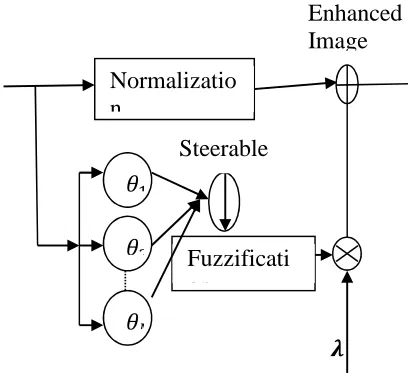
Though the noise can be reduced, the degree of enhancement is far from satisfactory. It is because the degree of enhancement varies with the response of filters. Thus, to a certain extent, we can distinguish them and control their degree of enhancement. To increase the degree of enhancement of image, a half open fuzzy membership function is designed for fuzzification of the response of steerable filters. By the fuzzy membership function, the medial response, that is the response of steerable filters, are mapped into the maximum value, and the stronger responses are weakened. In the way, the degree of enhancement of image is increased and the degrees of enhancement are balanced .After the process of fuzzification, the scheme of the unsharp masking is generalized into fuzzy field. The enhancement performed in the fuzzy field can be described as:
gm, n γm, n λwm, n (10)
Where gm, nthe enhanced image in fuzz domain is, γm, n is the normalized input image,
[image:4.612.331.535.513.705.2]wm, n is the fuzzification of the response of steerable filters, is the positive scaling factor. The block diagram of steerable filters based fuzzy unsharp masking approach is shown in Fig. 1
Figure 1. The Block Diagram Of Steerable Filters Based Fuzzy UM.
Normalizatio
n
ߠ
ଵߠ
ଶߠ
ேFuzzificati
on
Steerable
Filters
Enhanced
Image
ࣅ
B. Implementation of the Proposed Method
Suppose that xm, n is the intensity values of the pixel at (m, n) the input image. In order to implement Equation 10, the value of
wm, nshould be calculated first. The steerable filters based fuzzy unsharp masking algorithm consists of the following steps:
Step 1: Use steerable filters, like Equation 7, to get the high frequency components of the original image.
We chose five synthesized filters Galong
θ# ,here θ# 20 i∗40, i 1,2, . . ,5 . The response of every filter isZ# G
∗ x. The final output of steerable filters is Zm, n
∑ Z# #m, n.
The output of steerable filters Zm, n consists of positive and negative values. If Zm, n is positive, the pixel at m, n in the original image maybe is a high frequency component; otherwise, the pixel at m, n does not belong to high frequency component. In addition, the larger the absolute value of Z(m, n) is, the higher the probability that the pixel at (m, n) has a high frequency component. Since we are only interested in texts and their intensity values are lower than other areas, we modify the result of Z to z to make the images stand out:
Zm, n WZm, n Zm, n0 otherwise (10)
Step 2: Fuzzification.
Using Equation 9 maps the final output of steerable filters Z5, 6 into fuzzy field and gets
[5, 6.The parameters of the membership
function directly affect the result of fuzzification. In our algorithm, the parameters depend on the mean and variance of the final output of steerable filters
\I 5
%
I 5 5]/2
I 5 % I" Z&
(11)
Where m and δ are the mean and standard deviation of the final output of steerable filters, z, respectively.Z'(is the maximum value of z.
Step 3: Normalization.
Because the output of fuzzification is mapped
into [0, 1], we normalize the original image by the following function:
`
(12)
Where x is the gray level of the original document image, x#and x'( are the minimum and maximum gray levels of the document image. If the function γ is considered as a fuzzy membership function, the normalized image can also be seen a fuzzification image
Step 4: Calculate the values of gm, n
Using Equation10 calculates the value
gm, nand implements the image enhancement in
the fuzzy domain
Step 5: Map into the image filed.
The enhanced image in fuzzy field should be mapped to gray levels
ym, n )*,*
**
(13)
Whereym, nthe enhanced image pixel is gray level, g'( and g# are the maximum and minimum values ofgx, y, respectively. L is the maximum gray level of the enhanced image, and it means that the dynamic range of the enhanced image is in [0, L].
7. EXPERIMENTAL RESULTS
For this image enhancement database are collected from the IAM Handwriting Database. This contains forms of handwritten and Printed English text which can be used to train and test handwritten text recognizers and to perform writer identification and verification experiments. The database contains forms of unconstrained handwritten text, which were scanned at a resolution of 300dpi and saved as PNG images with 256 gray levels.
That the figure 2 contain the input image, it is collected from IAM handwritten database. And figure 3 gives or produce the output of enhanced image by using Steerable Filters based Fuzzy Unsharp Masking approach.
8. CONCLUSIONS
designed to highlight the intermediate frequency components of the output of steerable filters so as to enhance the contrast of texts , which is significantly propitious for extracting character features. The result images demonstrate that the proposed approach can enhance the contrast of printed and handwritten text in the document image visually in figure2, 3. In summary, the steerable filters based fuzzy unsharp masking method is simple and effective enhancement approach of the document images for document analysis and recognition.
Figure 2 : Input Image
Figure 3 : Enhanced Image Using Steerable Filters
REFERENCES
[1] Marinai S, Gori M, Soda G "Artificial neural networks for document analysis and recognition," Pattern Analysis and Machine Intelligence, IEEE Transactions on, vol.27, no.1, pp.23,35, Jan. 2005
[2] H. Negishi, J. Kato, H. Hase and T. Watanabe, Character extraction from noisy background for an automatic reference system, Proc. of 5th International Conference on Document Analysis &Recognition, India, 1999, pp. 143-146. [3] S.Liang, M. Ahmadi, A morphological
approach to text string extraction from regular periodic overlapping text/ background images, Graphical Models and Image Table 1. Evaluation of image restoration results Processing. CVGIP, Vol. 56, No. 5, Sep.1994, pp. 402-413.
[4] M. S. Chang, S. M. Kang, W. S. Rho, H. G. Kim and D. J. Kim, Improved binarization algorithm for document image by histogram and edge detection, Proc. of 3rd International Conference on Document Analysis and Recognition, Canada, 1995, pp. 636-639.
[5] J. H. Jang and K. S. Hong, Binarization of noisy gray-scale character images by thin line modeling, Pattern Recognition, 32, 1999, pp. 743-752.
[6] H. S. Don, A noise attribute thresholding method for document image binarization, Proc. of 3rd International Conference on Document Analysis and Recognition, Canada, 1995, pp. 231-234.
[7] J. Hobby and T. K. Ho, “Enhancing degraded document images via bitmap clustering and averaging," in Proc. Int'l Conf. Document Analysis and Recognition (ICDAR), 1, pp. 394{400, (Ulm, Germany), 1997.
[8] B. Gatos, I. Pratikakis, and S. J. Perantonis, \An adaptive binarization technique for low quality historical documents," in Proc. Int'l Workshop Document Analysis Systems (DAS), pp. 102{113, (Florence, Italy), 2004. [9] E. Kavallieratou and E. Stamatatos, “Improving the quality of degraded document images," in Proc. Int'l Conf. Document Image Analysis for Libraries (DIAL), (Lyon, France), 2006.
[11] Simoncelli, E.P., Freeman, and W.T.: The steerable pyramid: a flexible architecture for multi-scale derivative computation. In: Second Int’l Conf on Image Proc, vol. 3, pp. 444–447, Washington, DC, October 1995 [12] R. N. Bracewell. The Fourier Transform and
its Applications. McGraw-Hill, 1978. [13] A. C. Bovik. Multichannel texture analysis
using localized spatial filters. IEEE Pat. Anal. Mach. Intel l., 12(1):55-73, 1990 [14] J. J. Koenderink and A. J. van Doorn.
Representation of local geometry in the visual system. Biol. Cybern., 55:367375, 1987.
[15] Y. H. Lee and S. Y. Park, “A study of convex/concave edges and edge-enhancing operators based on the Laplacian,” IEEE Transactions on Circuits and Systems, Vol. 37, 1990, pp. 940-946.
[16] S. K. Mitra, H. Li, I. S. Lin, and T. H. Yu, “A new class of nonlinear filters for image enhancement,” in Proceedings of International Conference on Acoustics, Speech, and Signal Processing, Vol. 4, 1991, pp. 2525-2528.
[17] N. Strobel and S. K. Mitra, “Quadratic filters for image contrast enhancement,” in Proceedings of the 28th Asilomar Conference on Signals, Systems and Computers, Vol. 1, 1994, pp. 208-212. [18] G. Ramponi, “A cubic unsharp masking
technique for contrast enhancement,” Signal Processing, Vol. 67, 1998, pp. 211-222. [19] A. Polesel, G. V. Ramponi, and J. Mathews,
“Image enhancement via adaptive unsharp masking,” IEEE Transactions on Image Processing, Vol. 9, 2000, pp. 505-510. [20] H. J. Zimmermann, Fuzzy Set Theory and
Its Applications, 4th ed., Kluwer Academic Publishers, Boston/Dordrecht/London, 2001. [21] Y. J. Lai and C. L. Hwang, Fuzzy
Mathematical Programming: Methods and Applications, Springer-Verlag, Berlin Heidelberg, 1992.
[22] H. D. Cheng, Y. H. Chen, and Y. Sun, “A novel fuzzy entropy approach to image enhancement and thresholding,” Signal Processing, Vol. 75, 1999, pp. 277-301. [23] J. Hsieh, “Image enhancement with a fuzzy
logic approach,” Electronics Letters, Vol. 31, 1995, pp. 708-710.
[24] Y. S. Choi and R. Krishnapuram, “A robust approach to image enhancement based on fuzzy logic,” IEEE Transactions on Image Processing, Vol. 6, 1997, pp. 808-825.
[25] F. Farbiz, M. B. Menhaj, S. A. Motamedi, and M. T. Hagan, “A new fuzzy logic filter for image enhancement,” IEEE Transactions on Systems, Man and Cybernetics Part B, Vol. 30, 2000, pp. 110-119.