S T U D Y P R O T O C O L
Open Access
Randomized controlled trial of
transcutaneous electrical nerve stimulation
for pain relief during transvaginal oocyte
retrieval using conscious sedation: study
protocol for a randomized controlled trial
Queenie Ho Yan Wong
1,2*, Man Wa Lui
1, Sofie Shuk Fei Yung
1, Jennifer Ka Yee Ko
1, Raymond Hang Wun Li
1and
Ernest Hung Yu Ng
1Abstract
Background:Transvaginal oocytes retrieval is an essential step in in-vitro fertilization treatment. There are different pain relief methods, but none has been shown to be superior than the others. Transcutaneous electrical nerve stimulation (TENS) is a non-pharmacological and non-invasive pain relief method. This study aims to compare the pain levels experienced by the women using the conscious sedation and those who had TENS in addition to conscious sedation.
Methods and analysis:This is a double-blinded randomized trial that will be carried out in a university-assisted conception unit. Women who will undergo oocyte retrieval under conscious sedation will be recruited. After randomization, women will be allocated to either the active TENS group or placebo TENS group (the TENS machine will not emit active impulse), in addition to the paracervical block and conscious sedation. The primary outcome is pain levels of women during the retrieval assessed by the visual analog scale. Secondary outcomes include satisfaction of women and postoperative side effects.
Discussion:TENS is an effective non-pharmacological and non-invasive method for pain relief in a number of clinical conditions. Both women and assisted conception unit can benefit if the addition of non-invasive, simple, and low-cost TENS application is proven to be superior than using conscious sedation and paracervical block alone.
Trial registration:ClinicalTrials.gov,NCT03472430. Registered on 3 May 2018.
Keywords:Transcutaneous electrical nerve stimulation, Pain relief, Transvaginal oocyte retrieval, Conscious sedation
Background
Oocyte retrieval under transvaginal ultrasound guidance is an essential part of in-vitro fertilization (IVF). It involves passing an aspiration needle into the pelvic cavity through the vaginal mucosa and puncturing the ovarian cortex to reach the ovarian follicles. Despite being less invasive
when compared with retrieval through laparoscopy in the old days, it is still a painful procedure. Different methods of pain relief have been used. The most commonly used modalities are conscious sedation with analgesia with or without paracervical block [1–3], patient-controlled con-scious sedation, and analgesia [4], spinal anesthesia, and general anesthesia.
The best type of analgesia has not been established. A Cochrane review in 2013 [5] on pain relief for women undergoing oocyte retrieval for assisted reproduction concluded that the current evidence from 21 random-ized controlled trials (RCTs) did not support one
* Correspondence:[email protected]
1
Department of Obstetrics and Gynaecology, The University of Hong Kong Queen Mary Hospital, 6/F, Professorial Block, Hong Kong, People’s Republic of China
2Department of Obstetrics and Gynaecology, Princess Margaret Hospital, Hong Kong, People’s Republic of China
particular method over another. The concurrent use of more than one method of sedation and pain relief re-sulted in better pain relief than a single modality.
The pain relief method used should be safe, effective, and with minimal side effects. Transcutaneous elec-trical nerve stimulation is a non-pharmacological and non-invasive pain relief for nociceptive, neuropathic, and musculoskeletal pain involving delivering pulsed electric current across skin [6]. It reduces labor pain and postpones the use of pharmacological analgesics in laboring women [7]. It has also been reported as redu-cing pain and increasing patients’ satisfaction when used in office hysteroscopy without sedation [8]. It has not been studied as a pain relief method for oocyte re-trieval in assisted reproduction.
Objectives and hypothesis
This trial aims to compare the pain levels experienced by the women using the conscious sedation and those who had TENS in addition to conscious sedation. The hypothesis is that there will be less pain in women who receive both conscious sedation and TENS during the retrieval procedure.
Methods Trial design
This is a double-blinded RCT that will be carried out in the assisted reproductive unit in Queen Mary Hospital in
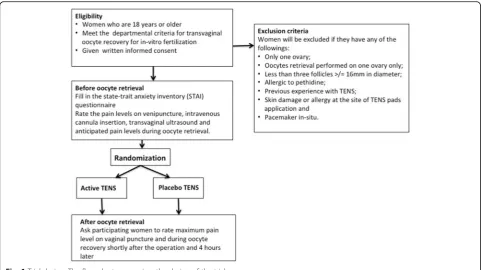
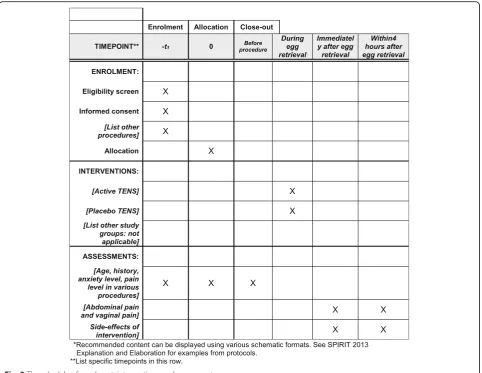
Hong Kong. Queen Mary Hospital is affiliated to the Uni-versity of Hong Kong. The study has been approved by the Institutional Review Broad of the University of Hong Kong/Hospital Authority Hong Kong West Cluster and has been registered under Clinical Trials Registry (trial number NCT03472430). Written consent will be obtained from women at the time of recruitment by medical staff. The clinical trial protocol follows the Additional file 1. Figures1and2summarize the trial design with the details of the trial as described below.
Selection and withdrawal of participants
Women undergoing ovarian stimulation for IVF in the unit will be informed of the study. Women aged ≥18 years, who have met the criteria for transvaginal oocyte recovery for IVF according to departmental protocol (a dominant follicle of at least 18 mm and three more folli-cles of at least 16 mm in diameter) will be recruited. Women will be excluded if they have any of the follow-ings: (1) only one ovary; (2) oocyte retrieval performed on one ovary only; (3) less than three follicles ≥16 mm in diameter; (4) allergy to pethidine; (5) previous experi-ence with TENS; (6) skin damage or allergy at the site of TENS pads application; and (7) pacemaker in situ.
The participation in the study is entirely voluntary. Consented women can withdraw their consent at any time and they will receive standard medical care accord-ing to the departmental protocol.
[image:2.595.57.539.451.721.2]Randomization and masking
Randomization is carried out in blocks by a computer-generated randomization list computer-generated by a research nurse not involved in the women’s clinical management. Women will be randomized into one of the two groups on the day of the oocyte retrieval: (1) Treatment group: active TENS; and (2) Placebo group: placebo TENS.
The clinicians, nurses involved in the clinical manage-ment of women, and the women will all be blinded to the treatment allocation. Checking of blinding for the women, surgeons, and scrub nurses will be assessed.
Procedure
Written consent will be obtained on the day of ovulation trigger. Consent to participate in the study will be con-firmed again on the day of the retrieval. Randomization will be done on the day of oocyte retrieval as described above, according to a computer-generated randomization
code in sealed envelopes prepared by a dedicated research nurse who is not involved in usual clinical care.
Women will then complete the state-trait anxiety in-ventory (STAI) questionnaire [9] before oocyte retrieval to assess their trait and state anxiety. Before the re-trieval procedure, two sets of self-adhesive electrodes will be placed on the women back on each side of the spine at T10 to S4 level.
[image:3.595.58.541.87.460.2]electrodes emitting impulses while those in the placebo group will be given a TENS machine with electrodes that is not emitting any impulses. A nurse responsible for the study who is unaware of the randomization is responsible for ensuring administration of intervention before oocyte retrieval and withdrawal of intervention after the procedure.
The woman will lie on the operative bed in a lithotomy position. In total, 25 mg pethidine and 5 mg diazepam will be given intravenously. The blood pressure and pulse of the woman are checked after the drug administration and the oxygen saturation is monitored continuously through-out the procedure. A total of 10 mL of 1% lignocaine is injected to the paracervical region by the operating sur-geon with a 21-gauge needle after cleansing the vagina and cervix with chlorhexidine. Under transvaginal ultrasound guidance, a 16-gauge ovum aspiration needle is introduced. Aspiration of follicles is performed with a suction pressure of 100 mmHg.
Assessment of pain and sedation levels
Before oocyte retrieval, a nurse who will not be in-volved in the operation and is blinded to the interven-tion will ask the women to rate the pain levels according to a 100-mm linear visual analog scale on venipuncture, intravenous cannula insertion, transvagi-nal ultrasound, and anticipated pain levels during oo-cyte retrieval. The maximum pain level on vaginal puncture and during oocyte recovery will be rated by the women within 5 min after the operation. At 4 h after the operation before discharge, the women will be asked to rate the maximum vaginal and abdominal pain as well as satisfaction level towards pain relief (totally unsatisfactory, not very satisfactory, fair, satisfactory, or excellent). The nurse will document if there are any side effects (nausea, vomiting, dizziness, drowsiness, skin allergy at site of TENS pad application, discomfort due to electrical stimulation) from pain relief.
The surgeon will score the sedation level of the women according to the scale described by Ramsay et al. [10], at the end of the operation: level 1 = patient anxious and agi-tated or restless or both; level 2 = patient cooperative, ori-entated, and tranquil; level 3 = patient responsive to commands only; level 4 = asleep and a brisk response to loud auditory stimulus; level 5 = asleep and a sluggish re-sponse to loud auditory stimulus; and level 6 = asleep and no response to loud auditory stimulus.
Clinical data
Data on the dosage of drug use for conscious sedation, time taken for oocyte retrieval, number of follicles aspi-rated, and number of oocytes obtained will be docu-mented. Clinical information on cause of infertility, previous obstetrics history, smoking status, body mass
index, cycle stimulation, number of embryos trans-ferred, and outcomes of the IVF cycle will be recorded.
Statistics
The primary outcome will be the pain level during oo-cyte retrieval experienced by women. Secondary out-comes include postoperative side effects and satisfaction of women.
According to our previous study [3], the pain level of the retrieval using conscious sedation alone was 23.0 ± 21.0 (mean ± SD) on a 100-point visual analogue scale. Effect size is estimated based on recommendations for a minimum clinically relevant change of 10 mm on a 0–100 mm VAS for pain. Assuming the pain level is re-duced from 23.0 to 13.0 on a 100-point visual analogue scale following TENS, the sample size required would be 70 in each treatment arm to give a test of signifi-cance of 0.05 and a power of 0.8 (Sigmastat, Jandel Scientific, USA). A total of 160 participants or 80 par-ticipants in each treatment group are needed if we an-ticipated a dropout rate of 10%.
Statistical analysis
Statistical analysis will be performed with intention-to-treat and per-protocol analyses. Demographic features, ovarian response parameters, and operative time be-tween the two groups will be compared. The Mann– Whitney test will be used to compare differences in VAS between the two groups for primary outcome, which is usually skewed. Chi-square test will be used to analyze the presence of side effects. Level of sedation and women’s satisfaction will be compared using the χ2test. All statistical analyses will be performed using the tical Program for Social Sciences, SPSS software. Statis-tical significance will be taken asP< 0.05.
Discussion
Many oocyte retrievals are performed in assisted concep-tion units and there are different pain relief methods dur-ing the retrieval procedure. However, there is no evidence that any pain relief method is superior than the others.
Trial status
The trial started recruitment in May 2018 and had re-cruited 45 patients.
Additional file
Additional file 1:SPIRIT 2013. (DOC 121 kb)
Acknowledgements
Not applicable.
Funding
This study is supported by the internal research funding of the Department of Obstetrics and Gynaecology, The University of Hong Kong.
Availability of data and materials
Not applicable.
Authors’contributions
QHYW and EHYN participate in the study design. All authors read and approved the manuscript. MWL and EHYN will coordinate the study. MWL, SSFY, JKYK, and RLHW will be responsible for data collection. QHYW will be responsible for data analysis and drafting the manuscript after study completion.
Ethics approval and consent to participate
Ethics approval was obtained. All participates has signed a written consent before participating in the study.
Consent for publication
Not applicable.
Competing interests
The authors declare that they have no competing interests.
Publisher’s Note
Springer Nature remains neutral with regard to jurisdictional claims in published maps and institutional affiliations.
Received: 10 June 2018 Accepted: 28 January 2019
References
1. Ng EHY, Tang OS, Chui DKC, Ho PC. A prospective, randomized, double blind and placebo controlled study to assess the efficacy of paracervical block in the pain relief during egg collection. Hum Reprod. 1999;14(11): 2783–7.
2. Ng EHY, Tang OS, Chui DKC, Ho PC. Comparison of two different doses of lignocaine used in paracervical block during oocyte collection in an IVF programme. Hum Reprod. 2000;15(10):2148–51.
3. Ng EH, Chui DK, Tang OS, Ho PC. Paracervical block with and without conscious sedation: A comparison of the pain levels during egg collection and the postoperative side effects. Fertil Steril. 2001;75:711–7.
4. Lier MC, Douwenga WM, Yilmaz F, Schats R, Hompes RG, Boer C, et al. Patient-controlled remifentanil analgesia as alternative for pethidine with midazolam during oocyte retrieval in IVF/ICSI procedures: a randomized controlled trial. Pain Pract. 2015;15(5):487–95.
5. Kwan I, Bhattacharya S, Knox F, McNeil A. Pain relief for women undergoing oocyte retrieval for assisted reproduction. Cochrane Database Syst Rev. 2013;1:CD004829.
6. DeSantana JM, Walsh DM, Vance C, Rakel BA, Sluka KA. Effectiveness of transcutaneous electrical nerve stimulation for treatment of hyperalgesia and pain. Curr Rheumatol Rep. 2008;10(6):492–9.
7. Santana LS, Gallo RB, Ferreira CH, Duarte G, Quintana SM, Marcolin AC. Transcutaneous electrical nerve stimulation (TENS) reduces pain and postpones the need for pharmacological analgesia during labour: a randomised trial. J Physiother. 2016;62(1):29–34.
8. Lisón JF, Amer-Cuenca JJ, Piquer-Martí S, Benavent-Caballer V, Bivia-Roig G, Marin-Buck A. Transcutaneous nerve stimulation for pain relief during office hysteroscopy: a randomized controlled trial. Obstet Gynecol. 2017; 129(2):363–70.
9. Shek DT. The Chinese version of the State-Trait Anxiety Inventory: its relationship to different measures of psychological well-being. J Clin Psychol. 1993;49:349–58.