November 16, 2000
SRC
Research
Report
160
Data abstraction and information hiding
K. Rustan M. Leino
and
Greg Nelson
Systems Research Center
130 Lytton Avenue
Compaq Systems Research Center
SRC’s charter is to advance the state of the art in computer systems by doing basic and applied research in support of our company’s business objectives. Our interests and projects span scalable systems (including hardware, networking, dis-tributed systems, and programming-language technology), the Internet (including the Web, e-commerce, and information retrieval), and human/computer interac-tion (including user-interface technology, computer-based appliances, and mobile computing). SRC was established in 1984 by Digital Equipment Corporation. We test the value of our ideas by building hardware and software prototypes and assessing their utility in realistic settings. Interesting systems are too complex to be evaluated solely in the abstract; practical use enables us to investigate their properties in depth. This experience is useful in the short term in refining our designs and invaluable in the long term in advancing our knowledge. Most of the major advances in information systems have come through this approach, includ-ing personal computinclud-ing, distributed systems, and the Internet.
We also perform complementary work of a more mathematical character. Some of that lies in established fields of theoretical computer science, such as the analysis of algorithms, computer-aided geometric design, security and cryptography, and formal specification and verification. Other work explores new ground motivated by problems that arise in our systems research.
Data abstraction and information hiding
K. Rustan M. Leino and Greg Nelson
Publication History
An earlier draft of this note, to which there exist some citations in the literature, had the title “Abstraction and specification revisited” and internal document num-ber KRML 71.
c
Compaq Computer Corporation 2000
Abstract
This paper describes an approach for verifying programs in the presence of data abstraction and information hiding, which are key features of modern program-ming languages with objects and modules. The paper focuses on the property of modular soundness, that is, the property that the separate verifications of the indi-vidual modules of the program suffice to ensure the correctness of the composite program. The paper introduces a new specification language construct, the
ab-straction dependency, and argues that it is needed to achieve modular soundness
Contents
0 Introduction 1
1 On the need for data abstraction 2
2 Validity as an abstract variable 4
3 Definition of notation 5
Modularity . . . 5
Types . . . 6
Abstraction . . . 8
4 Example: Readers 11 Read-only by specification . . . 17
Summary . . . 18
5 Static dependencies 19 5.0 Functionalization . . . 20
Functionalization and pointwise axioms . . . 20
Rep axioms . . . 22
Examples . . . 23
5.1 Modifies list desugaring . . . 25
Modification constraints . . . 25
Closure definition . . . 26
Example . . . 26
6 Soundness of modular verification 27 6.0 Visibility requirement . . . 29
6.1 Top-down requirement . . . 30
6.2 Static placement rule . . . 31
6.3 Residues . . . 31
Individual residues . . . 33
Shared residues . . . 34
6.4 Modular soundness for static dependencies . . . 37
7 Dynamic dependencies 37 7.0 Functionalization . . . 39
The need to close upwards . . . 40
Dynamic closure . . . 43
Examples . . . 44
Dependency segregation . . . 45
7.2 Modularity requirements for dynamic dependencies . . . 46
Pivot visibility requirement . . . 46
Absence of abstract aliasing . . . 47
Disjoint ranges requirement . . . 48
Swinging pivots restriction . . . 49
8 Reasoning about types and allocation 51 8.0 Reasoning about types . . . 52
8.1 Reasoning about allocation . . . 53
9 Further challenges 56 9.0 Cyclic dependencies . . . 56
9.1 Yet more dependencies . . . 59
9.2 Checking initialization order . . . 61
9.3 Invariants . . . 62
10 Implementation status 69 11 Related work 69 12 Conclusions 71 Acknowledgments 72
Appendix: Modular soundness of static dependencies
73
I User input 73 A0 Declarations . . . 73A1 Scopes . . . 75
A2 User expressions . . . 75
A3 Modifies lists . . . 77
II Verification condition generation 78
A5 Verification conditions . . . 78
A6 Functionalization . . . 80
A7 Modification constraints . . . 81
A8 Weakest liberal preconditions . . . 82
A9 Rep axioms . . . 84
A10 Pointwise axioms . . . 84
A11 Background predicate . . . 85
A12 Vanilla expressions . . . 85
III Modular soundness 88 A13 The theorem of soundness of modular verification . . . 88
A14 Proof strategy . . . 90
A15 Type, rep, and method declaration discrepancies . . . 90
A16 Single field-declaration discrepancies . . . 92
A17 Multiple field-declaration discrepancies . . . 102
A18 Proving the Soundness Theorem . . . 104
A19 Consequences of the modularity requirements . . . 104
A20 A property about modification points . . . 107
A21 Properties of liberal preconditions . . . 108
A22 Chain of Equalities Lemma . . . 111
A23 Chain Rewriting Lemma . . . 122
A24 Refunctionalization . . . 132
A25 Properties of X . . . 135
A26 The main proof of Soundness Lemma C . . . 136
A27 X and user expressions . . . 138
A28 X and the background predicate . . . 139
A29 X and rep and pointwise axioms . . . 140
A30 X and modification constraints . . . 140
A31 X and wlp . . . 143
A32 X and VC . . . 146
IV Epilogue 158 Length . . . 158
Limitations of the VC generator . . . 158
Names of adornments . . . 158
The inclusion of Soundness Lemma D . . . 159
Selection on map pairs . . . 159 Use of modularity requirements and residues in the proof . . . 161
The romance of the precise is not the elision Of the tired romance of imprecision. It is the ever-never-changing same, An appearance of Again, the diva-dame.
— Wallace Stevens
0
Introduction
This paper describes an approach for verifying programs in the presence of data abstraction, object types, and information hiding. The genesis of this work was the Extended Static Checking project (ESC) [8], which applies program verification technology to systems programs written in Modula-3. The aim of ESC is not to prove full functional correctness, but to prove the absence of common errors, such as array index errors, nil dereference errors, race conditions, deadlocks, etc.
One of the biggest problems we encountered in the ESC project is that the verification methodology we know from the literature does not seem to apply to the systems programs in the Modula-3 libraries. The problem is not that the programs use low-level tricks or unsafe code; the problem is that the programs use patterns of modularization and data abstraction that are richer than those treated in the verification literature. This is not an artifact of Modula-3, but would apply to any modern object-oriented language.
The data abstraction technology we know from the literature extends and re-fines the seminal paper on data abstraction by C.A.R. Hoare in 1972 [18]. In particular, Hoare and all subsequent treatments that we know impose the require-ment that all of the concrete variables used to represent an abstraction must be declared in the same module. This requirement is too strict: if it were applied to the Modula-3 libraries, many small modules would have to be combined, with a loss of desirable information-hiding. Writing specifications is supposed to im-prove the structure of a program, so it is ironic that standard treatments of data abstraction are incompatible with good modularization. Therefore, in this paper we weaken Hoare’s requirement and allow the concrete variables used to represent an abstraction to be divided among several modules.
does not specify the actual abstraction representation, which can be confined to a more private scope. There are different types of dependencies, and these types produce a useful taxonomy of the patterns of abstraction in modular software.
Abstraction dependencies give the programmer considerable freedom in ar-ranging the declarations of abstract variables, concrete variables, abstraction rep-resentation functions, and dependencies among the modules of a program. Too much freedom: without further restrictions, we would lose the property of modu-lar soundness, that is, the property that the separate verifications of the individual modules of the program suffice to ensure the correctness of the composite pro-gram. We therefore impose several requirements, called modularity requirements, and argue that modular verification is sound for programs that meet the modularity requirements.
1
On the need for data abstraction
Before we get into the details of our generalization, we set the stage by reviewing the rˆole of data abstraction in modular verification.
To check that a large program does what it is supposed to do, we must study it piece by piece. Nobody’s short-term memory is big enough to hold all the details of a large program. If the checking effort (formal or informal) is to be manageable, we cannot afford to re-examine the body of a procedure for every one of its calls. This is the reason for writing specifications, formal or informal. Given specifications, we check that each procedure meets its specification, assuming that the procedures it calls meet theirs.
This checking process is called modular verification, and for simple program-ming languages it has been understood since C.A.R. Hoare’s work on axiomatic semantics in the 1960s. (As long as the bulk of the verification is done modularly, we do not exclude simple link-time checks, such as the check that each proce-dure is implemented somewhere in the program.) The central goal of this paper is to understand modular verification in the presence of two modern programming features: data abstraction and information hiding.
a procedure to have arbitrary side effects on any variable not constrained by the postcondition, which would make the contract useless to the client.
It is possible to view the modifies list as syntactic sugar for extra conjuncts in the postcondition, asserting that every variable not mentioned in the modifies list is unchanged. That is, in a program with three variables x , y , and z , the specification
requires P modifies x ensures Q
could be “desugared” into
requires P ensures Q ∧ y=y ∧ z=z
in which primed variables denote post-values and unprimed variables denote pre-values. We cannot, however, use this desugaring to pretend that each procedure specification consists of a precondition and postcondition only. The reason is that, in modular verification, we never know, when verifying a procedure, what the set of all variables in the final program will be. Perhaps x , y , and z are the only variables visible where the procedure is declared, but more variables may be visible where the procedure is called. Therefore, in this paper we take the view that the modifies list is an integral part of the specification. Although we will rewrite modifies lists, the rewriting is different for different scopes.
Unfortunately, and perhaps surprisingly to those who have used verification more in principle than in practice, the methodology described so far is still inad-equate. In many cases, it would be preposterous to try to list every piece of state that might be modified by a call to a procedure. For example, what would be the list for the putchar procedure from the C standard I/O library? What putchar does is simply write a character to output, but anybody who has implemented an I/O system will be aware that the list of what can be modified during the execution of a call to putchar is very long. It includes, for example, the I/O buffers, the internal state of the device drivers for the disk and network, the device registers in these drivers, and the disk and network themselves. The minor problem is that this list is long; the major problem is that the variables in the list are not visible at the point of declaration of putchar, and to make them visible would be to give up on information hiding, which would be to resign the game before it starts.
Some people see data abstraction as an algorithm design methodology only, as a methodology for deriving an efficient algorithm from a simple algorithm by changing the representation of the state. We have no quarrel with their use of data abstraction, but our point is that data abstraction is also an essential ingredient in any scheme for modular verification of large systems, since it seems to be the only hope for writing a useful modifies list for a procedure whose implementation changes the system state at many levels of abstraction.
Having identified the general idea of the solution to the putchar problem as data abstraction, we would add that the patterns of data abstraction that arise in verifying putchar are beyond the current state of the art of specification: we believe that no semantics or methodology presented in the literature is equal to the task. We hope this paper will be a useful step in this neglected area.
2
Validity as an abstract variable
The generalized data abstraction described in this paper is relevant regardless of whether verification is being used for full functional correctness or for more lim-ited aims, such as the ESC aim of verifying the absence of certain classes of errors only. The examples in this paper will be ESC verifications. These verifications tend to have a typical form, which is described in this section.
In a typical ESC verification, we associate two abstract variables with each type, valid and state . The first of these records whether objects of the type satisfy the internal representation invariant required by the implementation, and the second represents the abstract value of variables of the type.
If we were verifying full functional correctness, we would have to write many specifications about the state variable. But in doing extended static checking, we rarely say anything about the state. We aren’t proving that the program meets its full functional specification, only that it doesn’t crash. The main purpose of the state variable is to account for the side effects in the implementations of the methods, which otherwise would lead to spurious errors reported by the verifier. Indeed, in many ESC verifications, we don’t even bother to provide the concrete representation for state .
In contrast to state , the checking performed by ESC depends critically on
valid . Most operations on an object o will have valid[o] as a precondition. The
In Hoare’s original paper on data abstraction, the notion of a validity invariant was built into the methodology. Initialization was required to establish validity and all other operations were required to preserve it. In contrast, we consider valid to be an abstract variable like any other; the programmer explicitly provides valid as a precondition (and/or postcondition), and the implementation infers the details of validity in terms of the concrete state via the usual process of data abstraction. Our approach has several advantages over Hoare’s, of which we mention one: we allow operations like closing a file, which destroy validity. Such operations are frequently essential in order to deallocate resources.
3
Definition of notation
This section introduces the notation and terminology that we use in the rest of the paper.
Modularity. A program is a collection of declarations. Declarations introduce names for entities (such as types, abstract and concrete variables, and methods) and/or specify properties of named entities (such as subtype relationships, repre-sentations of abstract variables, method specifications, and method implementa-tions). The declarations of a program are partitioned into units (sometimes called interfaces and modules). The declarations in effect in a unit are its own decla-rations and the decladecla-rations in effect in units that it imports. If an entity E is declared in a unit M , it is known as M.E in importers of M and known simply
as E within M . For example:
unit M unit N import M
type T . . . uses of M.T . . .
. . . uses of T . . .
In this paper, we sometimes write E instead of M.E when M is clear from the
context.
A set of units D is called a scope if it is closed under imports, that is, if whenever a unit M in D imports a unit N , then N is also in D . A declaration is visible in a scope if it appears in one of the units in the scope.
methods but not declare implementations, or an implementation unit, which can declare implementations but which cannot be imported. As another example, CLU imposes a correspondence between units and type declarations. We have not imposed such restrictions in this paper, because they seem orthogonal to the modularity issues that we are discussing.
Types. In this paper, we will use primitive types like int and bool , as well as object types and array types. Our objects are like those of Simula and Modula-3: they are implicitly references, and each object type has a uniquely determined direct supertype. More precisely, an object is either nil or a reference to a set of data fields and methods; a method is a procedure that will accept the object as its first parameter. Equality of objects is reference equality. An object type deter-mines the names and types of a prefix of the fields and the names and signatures of a prefix of the methods of its objects.
An object type T is declared
type T <: S
where S is an object type declared elsewhere. This introduces the name T for a new object type whose direct supertype is S , meaning that T contains all the fields and methods of S and possibly includes other fields and methods declared elsewhere. The “<: S ” is optional; if omitted, S defaults to an anonymous object type serving as the root of the subtype hierarchy.
Every object has a dynamic type determined when it is allocated. Every ex-pression has a static type determined at compile time. If v is the dynamic value of an expression E , v has dynamic type D , and E has static type S , then con-ventional static type-checking rules assure that D is a subtype of S .
We consider a data field, abstract or concrete, to be a map from objects to values. Thus, where others write
class T = { . . . f : int . . . }
we write
type T
var f : T →int
Also, we write f [t] where others write t.f to denote the value of the f field of
The class notation forces f to be co-declared with T , whereas our notation al-lows them to be declared independently. This generality is not problematical; in fact, it simplifies the semantics.
If T is a type, we write
array[T]
to denote the type of (references to) arrays with element type T . If a is of type
array[T] and is non- nil , then number(a) denotes the number of elements in a , and a[i] denotes element i of a for 0≤i<number(a). To properly model the fact that arrays are references, we introduce the predeclared map variable elems : the expression elems[a] denotes the sequence of elements referred to by an ar-ray a . For example, a = b means that a and b reference the same sequence,
while elems[a] = elems[b] means that the sequences referenced have the same
elements. In fact, a[i] is shorthand for elems[a][i] .
If T is an object type, new(T) allocates and returns a new object of dynamic type T . For any type T , new(T,n) allocates and returns a new array of dynamic type array[T] and of length n .
A method m for type T is declared by
proc m(t: T, . . . args . . .): R
requires P modifies w ensures Q
where in the signature “(t: T, . . . args . . .): R ”, T is an object type, t is the self parameter, args lists the names and types of any additional parameters, and R is the result type. In this paper, all parameters are in-parameters. In addition to declaring the name and signature of the method, the declaration associates with it as a specification the precondition P , postcondition Q , and modifies list w . A program can contain at most one declaration for a given method for a given type; for example, we don’t allow strengthening a method specification in a subtype (this is a simplification that does not actually limit expressiveness, see p. 348 of [31]). In the postcondition, result denotes the result value, primed variables denote values in the post-state, and unprimed variables denote values in the pre-state. If the precondition or postcondition is omitted, it defaults to true ; if the modifies list is omitted, it defaults to the empty list.
A method m for type T can be implemented differently for each subtype of
T . A method implementation of m for some subtype U of T is declared by
where S is an executable statement, and the implementation signature (u: U, . . . args . . .): R
coincides with the declared signature except (possibly) for the type of the first parameter. Statement S must satisfy (that is, the verifier checks that it satisfies) the specification associated with the m method for T . The ideas in this paper don’t depend on the particular executable statements allowed. The examples in this paper use Algol-like executable statements, whose meaning we hope will be clear to the reader.
A method is called by
t.m(. . . args . . .)
where t is an object (the actual self parameter), m is a method name, and args is a list of any additional actual parameters. The static type of t is used in determin-ing the declaration and specification of m . The declaration is used to type-check the actual parameters and determine the static type of the result, the specification is used to reason about the semantics of the call. The dynamic type of t is used at run-time to determine which implementation of m to invoke. Since all method implementations are proved to meet their specifications, and since the dynamic type of t is a subtype of the static type of t , it is sound to reason about the se-mantics of the dynamic dispatch in this way.
Abstraction. A data field can be declared to be abstract by preceding its decla-ration with spec . For example:
spec var valid: T →bool
An abstract field occupies no memory at run-time; it is a fictitious field whose value (or representation) is defined as a function of other fields. The representa-tion is declared by a syntax like
rep valid[t: T] ≡ f [t] =0 (0)
which means that for any object t of type T , the abstract value of valid[t] is true if and only if f [t] =0 .
type Rat
spec var valid: Rat→bool type Ratio<: Rat
var num,den: Ratio→int rep valid[r: Ratio] ≡ den[r]>0
type CFrac<: Rat
var parquo: CFrac→array[int] rep valid[cf : CFrac] ≡
parquo[cf ] =nil∧
∀i :: 1≤i<number(parquo[cf ]) ⇒ parquo[cf ][i]>0
Figure 0: An example program, illustrating that representation of an abstract vari-able can be subtype-specific.
and CFrac , which represents each rational as a continued fraction (which is a representation of a rational as a sequence of integers), see Figure 0. These dec-larations specify that the concrete representation of valid[q] varies depending on the dynamic type of q : for rationals represented as ratios, validity means that the denominator is positive, whereas for continued fractions, validity means that each partial quotient is positive, except possibly the first.
A rep declaration given for a type T applies to all non- nil objects of type
T , including those whose dynamic type is a subtype of T . One might think
that it would be possible to override a rep declaration for T with another rep declaration for some subtype of T , but this is not allowed. This rule is enforced at link-time.
The variables appearing in the right-hand side of the rep declaration for an abstract variable are called dependencies of the abstract variable. The dependen-cies can themselves be either concrete or abstract. Our notion of dependendependen-cies is not to be confused with use-def dependencies [2].
A major novelty of our approach is to require that dependencies be declared explicitly. For example, the representation (0) would cause an “undeclared de-pendency” error unless f [t] were declared as a dependency of valid[t] , which is done by a declaration of the form
In this paper, we sometimes omit the “ : T ” when T is obvious or unimportant. The depends declaration can be subtype-specific, just like the rep declaration. For example, the representations in Figure 0 might be accompanied by
depends valid[r: Ratio] on den[r]
depends valid[cf : CFrac] on parquo[cf ],elems[parquo[cf ]]
The validity of the continued fraction cf depends both on the array parquo[cf ] and on the contents of the array. These are different dependencies and both must be declared, as shown above. The validity of the ratio r depends only on den[r] . This paper is principally concerned with two forms of dependencies, static and dynamic. A static dependency has the form
depends a[t: T] on c[t] (1)
A dynamic dependency has the form
depends a[t: T] on c[b[t]] (2)
In each case, a is an abstract variable and c is either an abstract or a concrete variable. In the case of the dynamic dependency, b is concrete. A dependency on the contents of an array counts as a dynamic dependency, with elems playing the rˆole of c . Other forms of dependencies will be discussed in Section 9.1, but static and dynamic dependencies are more common and fundamental.
A major goal of this paper is to design a discipline for the placement of depen-dency declarations in a multi-module program. The paper is long, but the main conclusion is short: the static dependency (1) must be visible wherever c is, and the dynamic dependency (2) must be visible wherever b is.
Dependencies affect the verification process in several ways. One way is
mod-ifies list desugaring. For example, in a scope where
depends a[t] on c[t]
is visible, the modifies list
modifies a[t]
is desugared into something like
modifies a[t],c[t]
4
Example: Readers
From our experience with ESC, we have found that dependencies are not just a detail but a key ingredient of the specification language that we used constantly. However, since dependencies are a tool for programming in the large, no small example does them full justice. This section presents the smallest example we know that motivates the essential points: a simplified version of readers, which are the object-oriented buffered input streams used in the standard I/O library of Modula-3. A key point that the example will illustrate is that modern information hiding together with subtyping creates situations where both an abstract variable and one or more of its dependencies are visible, but the associated representation is not visible. In these situations, sound modular verification would be impossible, but dependencies save the day.
Readers (and their output counterparts, writers) were invented by Stoy and Strachey for the OS6 operating system [47]. Although Stoy and Strachey never used the word “object” or “class” in describing them, they are in fact one of the most compelling examples of the engineering utility of object-oriented program-ming. Each reader is an object with a buffer and a method for refilling the buffer. Different subtypes of readers override the refill method with code appropriate to that type of reader; for example, a disk reader fills the buffer from the disk, a network reader from the network.
As part of the ESC project, we have mechanically verified the absence of errors from most of the Modula-3 standard I/O library, including all the standard reader subtypes. In this paper we want to focus on generalized data abstraction, and many of the complexities of the actual I/O system would distract us from this focus, so we will simplify the reader interface rather drastically. (The actual code and specifications that we have used as input to the Extended Static Checker can be found on the Web [13].)
Our simplified interface Rd declares the type T representing a reader, and specifies the two methods getChar and close , see Figure 1. Since our examples show ESC verifications only, we specify the range type of state as any , and we ignore the effects on state in the ensures clauses. We use the convention that
rd.getChar() returns −1 when rd is exhausted, and otherwise returns the next byte of input. The specification of close reflects the design decision that a reader can be closed only once (a second call to close requires validity, which may have been destroyed by the first call).
unit Rd type T
spec var valid: T →bool spec var state: T →any proc getChar(rd: T): int
requires valid[rd] modifies state[rd]
ensures −1≤result< 256
proc close(rd: T) requires valid[rd]
modifies valid[rd],state[rd]
Figure 1: The interface Rd , which declares type T representing readers.
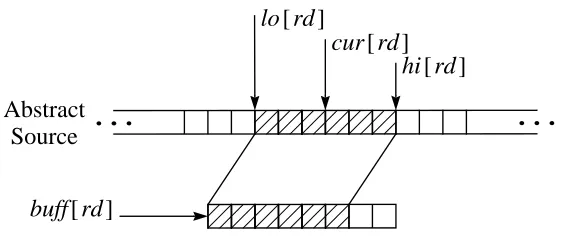
The integer cur[rd] is the index in the abstract stream rd of the next byte to be returned by getChar . The integers lo[rd] and hi[rd] delimit the range of bytes in the abstract stream that are contained in the buffer buff [rd] (see Figure 3).
Interface RdRep declares and specifies the refill method, but leaves its im-plementation to various subtypes. The convention used by refill is that the call
rd.refill() must make at least one new byte available (that is, it must establish
cur[rd] < hi[rd] ), unless rd is exhausted, in which case it must establish the
condition cur[rd]= hi[rd] .
The postconditions of getChar and refill don’t reflect the conventions for signaling that the reader is exhausted (nor does the variable state describe the condition that the reader is exhausted), because our example is an ESC verifica-tion, not a verification of full functional correctness.
The rep declaration reveals the representation of the abstract variable valid in terms of the concrete variables lo , cur , hi , and buff . In addition, because subtypes may have their own validity invariants, the interface declares the ab-stract variable svalid , and adds the conjunct svalid[rd] to the representation of
valid[rd] . The intended meaning of svalid[rd] is that rd satisfies the validity
in-variant of its dynamic type. Each subtype of Rd.T will include a rep declaration
unit RdRep import Rd var lo,cur,hi: Rd.T →int var buff : Rd.T →array[byte] spec var svalid: Rd.T →bool rep valid[rd: Rd.T] ≡
rd =nil∧
0≤lo[rd]≤cur[rd]≤hi[rd]∧
buff [rd] =nil ∧ hi[rd]−lo[rd]≤number(buff [rd])∧ svalid[rd]
proc refill(rd: Rd.T) requires valid[rd] modifies state[rd]
ensures cur[rd]=cur[rd]
depends valid[rd: Rd.T] on lo[rd],cur[rd],hi[rd],buff [rd],svalid[rd] depends state[rd: Rd.T] on lo[rd],cur[rd],hi[rd],buff [rd],
elems[buff [rd]]
[image:23.612.144.426.502.622.2]depends svalid[rd: Rd.T] on lo[rd],hi[rd],buff [rd]
Figure 2: The interface RdRep , which defines the buffer structure common to all objects of type Rd.T .
buff [ rd ]
lo [ rd ]
cur [ rd ] hi [ rd ]
Abstract
Source ... ...
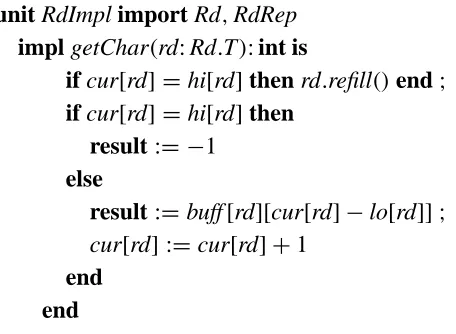
unit RdImpl import Rd,RdRep impl getChar(rd: Rd.T): int is
if cur[rd] =hi[rd] then rd.refill()end; if cur[rd] =hi[rd] then
result := −1
else
result :=buff [rd][cur[rd]−lo[rd]]; cur[rd] :=cur[rd]+1
[image:24.612.166.394.125.292.2]end end
Figure 4: The implementation unit RdImpl , which contains the implementation of the method getChar .
The depends declaration for valid is explained by our requirement that de-pendencies be explicit—without it, the checker would complain that the rep dec-laration for valid contains undeclared dependencies. The depends decdec-larations for state and svalid are more subtle and will be explained later.
Next we present the generic implementation in Figure 4.
To give the flavor of an ESC verification, consider checking that cur[rd]−
lo[rd] is a valid index into buff [rd] in the implementation of getChar . Since valid[rd] is a precondition of getChar , and is preserved by rd.refill(), we con-clude that valid[rd] holds at the first semicolon. Thus, the validity of the index boils down to showing that
0≤cur[rd]−lo[rd] ∧ cur[rd]−lo[rd]<number(buff [rd]) (3)
follows from
valid[rd] ∧ cur[rd] =hi[rd] (4)
Since RdImpl imports RdRep , the representation of valid[rd] is visible. Since this representation contains the conjunct lo[rd] ≤ cur[rd] , the first conjunct of
(3) follows immediately. The proof of the second conjunct is:
cur[rd]−lo[rd]
unit BlankRd import Rd type T <: Rd.T
proc init(brd: T, n: int): T
requires 0≤n
modifies valid[brd],state[brd] ensures valid[brd] ∧ result =brd
Figure 5: Unit BlankRd declares a subtype BlankRd.T of Rd.T , whose readers
deliver streams of blanks.
hi[rd]−lo[rd]
≤ { valid[rd] }
number(buff [rd])
Returning to general comments about rd.getChar(), notice that the imple-mentation modifies cur[rd] , but the modifies clause in the specification of the method getChar does not mention cur[rd] . Why does the checker not com-plain? Because of modifies list desugaring, as mentioned in the previous section. Modifies list desugaring gives getChar the license to modify cur[rd] , because
getChar is specified to modify state[rd] , which is declared in RdRep to depend
on cur[rd] . This explains why cur[rd] was declared a dependency of state[rd] . The object-oriented I/O stream design by Stoy and Strachey illustrates the flex-ibility of subtyping: having carefully designed the central abstraction Rd.T , it can
serve as the blueprint for dozens of useful subtypes. To illustrate the modularity issues that arise when a subtype is defined, we now give the interface (Figure 5) and implementation (6) of a trivial type of reader, a blank reader, which delivers a sequence of blanks whose length is determined at initialization time. More pre-cisely, the expression new(BlankRd.T).init(n) allocates, initializes, and returns a reader that delivers a stream of exactly n blanks. The conjunction “ result=brd ”
in the postcondition specifies that the init method return the object that it initial-izes, a convention we have found useful. The method init stores the argument n in the field num[brd] for later use by the method refill . The method also initial-izes the lo , cur , and hi fields in the obvious way, allocates a buffer of size up to 8192 (that is, up to 8 kilobytes), and fills the buffer with blanks (code 32).
unit BlankRdImpl import Rd,RdRep,BlankRd var num: BlankRd.T →int
rep svalid[brd: BlankRd.T] ≡ hi[brd]≤num[brd] impl init(brd: BlankRd.T, n: int): BlankRd.T is
num[brd] :=n;
buff [brd] :=new(byte,min(8192,n)); lo[brd] :=0;cur[brd] :=0;
hi[brd] :=number(buff [brd]); for i :=0 to hi[brd]−1 do
buff [brd][i] :=32
end;
result :=brd end
impl refill(brd: BlankRd.T)is lo[brd] :=cur[brd];
hi[brd] :=min(lo[brd]+number(buff [brd]),num[brd]) end
depends state[brd: BlankRd.T] on num[brd] depends svalid[brd: BlankRd.T] on num[brd]
strengthening the general reader validity invariant as needed for the particular subtype BlankRd.T .
Notice that brd.refill() must be proved to maintain valid[brd] , because its modifies list does not allow it to modify valid[brd] . Among the proof obligations associated with maintaining valid[brd] is that at exit,
cur[brd]≤hi[brd]
Since the body of refill does not change cur[brd] and makes hi[brd] equal to
min(cur[brd]+number(buff [brd]),num[brd])
proving this postcondition boils down to showing that each argument to min is at least cur[brd] . For the first argument, this follows from the fact that the number of any array is non-negative. The proof for the second argument is:
valid[brd]
⇒ { rep for valid }
cur[brd]≤hi[brd] ∧ svalid[brd]
= { brd is of type BlankRd.T , rep for svalid for this type } cur[brd]≤hi[brd] ∧ hi[brd]≤num[brd]
⇒ { transitivity }
cur[brd]≤num[brd]
We present this calculation in detail to illustrate that the verification of the refill method of even the trivial BlankRd.T requires the subtype-specific validity
con-junct. (The need for the svalid conjunct is more conspicuous in more interesting reader subtypes.)
Read-only by specification. The calculation that cur[brd]≤num[brd] follows
from valid[brd] would be in vain if the generic code could modify hi[brd] . If, for example, the generic implementation of rd.getChar() would sometimes in-crement hi[rd] , then it could destroy svalid[rd] , which could cause all kinds of errors. To prevent this, the Modula-3 interface from which we translated RdRep contains the following English comment:
The generic code modifies cur[rd], but not lo[rd], hi[rd], or buff [rd]. (5)
How do we translate the sentence (5) into a formal specification? Modula-3 does not have any kind of readonly qualifier for field declarations. Java and C++ have qualifiers like private and protected, but these declarations don’t help with the current problem. Both of them allow the implementation to read and write the fields, while limiting the access from subtypes (and from other clients). What we need here is almost the opposite: a declaration that will forbid the generic implementation from writing the fields, while allowing subtypes to write them. We can hardly expect a programming language to have a declaration qualifier that enforces this highly particular access policy, but modular verification will not be sound unless the access policy is formally stated and enforced.
We wrestled with the problem for some time before realizing happily that
depends provides a neat solution. In fact, the third dependency declaration in RdRep , which states that svalid[rd] depends on lo[rd] , hi[rd] , and buff [rd] , is
the desired formalization of (5). For if the generic code were to modify any of these fields, the presence of the dependency would alert the checker to the pos-sibility that svalid , and therefore valid , might be changed. In other words, in a scope where lo[rd] , hi[rd] , and buff [rd] are known to be part of the repre-sentation of svalid[rd] , but the explicit reprerepre-sentation is unknown, the only hope for maintaining svalid[rd] invariant is to avoid modifying lo[rd] , hi[rd] , and
buff [rd] . We call this technique “read-only by specification”.
Summary. To repeat our main conclusion from this example, we see that mod-ular verification with subtyping creates situations where both an abstract variable and one or more of its dependencies are visible, but where the associated repre-sentation is not visible. We have seen two instances of this:
• The dependencies of state are specified in RdRep , but no representation for
state is specified. The dependencies must be visible so that the
implemen-tations of operations that modify the state (for example, getChar ) will have the license to modify the concrete variables that represent the state. The representation declaration cannot be visible, for two reasons. First, because we are doing extended static checking only, we never give a representation for the state. Second, even if we were doing full-scale verification, the rep-resentation would be subtype-specific, but the dependencies must be visible in the generic scope.
operations from modifying the variables that are reserved for the use of subtypes. But it is clearly impossible to present a representation declaration for svalid in the RdRep scope, since the whole point of svalid is to allow subtypes to include their own invariants as part of validity: these invariants can’t be known in the generic scope.
Explicit dependencies may seem verbose, and it would be nice to be able to infer them automatically. But this will not always be possible. For example, of the three depends declarations in RdRep , we can imagine inferring the first (from the rep declaration for valid ), but the second and third could not be automatically inferred since they are used to specify non-trivial design decisions (namely, which fields can be modified by generic code, and which can be modified by subtypes only).
This concludes our example of the rˆole of dependencies in modular verifica-tion. In the remainder of the paper, we investigate different kinds of dependencies and the way they affect the verification process.
5
Static dependencies
In this section, we describe more fully how dependencies affect the verification process. Our guiding principles are:
• Abstract function principle. An abstract variable is a function of the
con-crete variables on which it depends.
• Abstraction modification principle. The license to modify an abstract
vari-able implies the license to modify its concrete representation, but the license to modify a concrete variable does not imply the license to modify an ab-stract variable that depends on it.
Our technique is to rewrite preconditions, postconditions, modifies lists, and rep declarations into equivalent forms that contain concrete variables only. In this section, we will describe the rewriting steps and explain how they follow from the principles.
5.0
Functionalization
Guided by the abstraction function principle, and following in the footsteps of Hoare, we introduce a new function symbol for each abstract variable. In this paper, we write F.a to denote the function symbol introduced for the abstract
variable a . The idea is that F.a gives a ’s value as a function of the concrete state.
Occurrences of a in preconditions and postconditions are replaced by function applications of the form F.a(. . .). For example, a[t]>6 becomes F.a(. . .)[t]> 6 . The arguments to F.a are the variables on which a depends (together with
other arguments that will be introduced later). The process of substituting F.a for a is called functionalization.
The rep declaration for a is rewritten into an appropriate axiom about F.a
(a rep axiom). If a is visible but its representation is not, then F.a occurs in the
rewritten program but its rep axiom does not. In this case, the theorem prover treats F.a as an uninterpreted function.
Functionalization and pointwise axioms. There are more details to be pre-sented about functionalization. We will introduce them with an example. Con-sider
spec var a: T→X var c: T →Y var d: T→Z
depends a[t: T] on c[t],d[t]
(6)
Then occurrences of a are replaced by the expression F.a(c,d). Had c for exam-ple also been abstract, functionalization would continue, producing the expression F.a(F.c(. . .),d).
Notice that c , d , and F.a(c,d) are all maps. In typical functionalized expres-sions, we can expect to encounter expressions like F.a(c,d)[t] . Allowing F.a to
take maps as arguments is technically convenient, but without further restrictions, it would allow F.a(c,d)[t] to depend on the entire maps c and d , which we do not want: our view is that the dependency declaration 6) implies that a[t] is unchanged by a modification to c[s] or d[s] for s = t . We enforce this point of
view by imposing a pointwise axiom on each abstraction function. In the case of
a , c , and d above, this axiom is:
∀t: T, c0, c1, d0, d1 ::
c0[t] =c1[t] ∧ d0[t]=d1[t]
⇒ F.a(c0,d0)[t]=F.a(c1,d1)[t]
We would like to emphasize that in (7), variables c0 , c1 , d0 , and d1 are dum-mies, not program variables. Even if program variables c and d were abstract, there would be no need to functionalize the dummies in (7).
For each abstract variable, there will be a pointwise axiom for each subtype of its index type, since different subtypes may have different dependencies. For example, consider
type T
spec var a: T →X type U <: T
var c: U →Y
depends a[u: U] on c[u] type V <: T
var d: V →Z
depends a[v: V] on d[v]
There will be three pointwise axioms, one for each of the types T , U , and V . The axiom for T is (7), the same as the axiom where c and d had index type T . The axiom for U is
∀u: U, c0, c1, d0, d1 :: c0[u]=c1[u]
⇒ F.a(c0,d0)[u]=F.a(c1,d1)[u] The axiom for V is similar.
When rewriting a postcondition, a post-value a leads to post-values in the ar-guments to F.a . For example, the postcondition of init for blank readers includes
the conjunct
valid[brd] This is rewritten into
F.valid(lo,cur,hi,buff,F.svalid(rd,lo,hi,buff))[rd]
The number of arguments of F.a depends on the number of dependencies of a that are visible in the scope where the rewriting takes place. For example, in the
unit RdRep , F.svalid has four arguments, whereas in BlankRdImpl , F.svalid
has five arguments because of the extra dependency of svalid[brd] on num[brd] . Within the verification of any one unit, all occurrences of F.a have the same
Rep axioms. We now explain how a rep declaration is rewritten into a rep axiom. A rep declaration has the form
rep a[t: T] ≡ R
where the only free variables allowed in R are fields that are dependencies of
a , and each occurrence of such a field must be indexed by the dummy t . For
definitiveness, suppose that these dependencies are
var c: T →X var d: T→Y
depends a[t: T] on c[t],d[t]
This rep declaration is rewritten into the rep axiom
∀t: T, cV, dV :: F.a(cV,dV)[t]=R(c,d :=cV,dV)
in which we use the assignment operator to denote substitution. In this axiom, we have appended V ’s in the names of the dummies to emphasize that they are universally quantified dummies, not the program variables c and d .
The same treatment works with minor alterations to accommodate subtype-specific rep declarations and dependencies. For example, the rep declarations in
type T
spec var a: T→W var c: T →X
depends a[t: T] on c[t]
type T0<: T
var d: T0→Y
depends a[t: T0] on d[t] rep a[t: T0] ≡ R0
type T1<: T
var e: T1→Z
produce the rep axioms
∀t: T0, cV, dV, eV :: F.a(cV,dV,eV)[t]=R0(c,d :=cV,dV)
∀t: T1, cV, dV, eV :: F.a(cV,dV,eV)[t]=R1(c,e :=cV,eV)
Note that different rep axioms are produced for the different rep declarations. Note also that all dependencies of a for any subtype become arguments to F.a ,
and each axiom ignores those arguments that are irrelevant to its subtype.
Examples. In the unit RdRep described previously, the precondition of refill is written
valid[rd]
Using the static dependencies of valid[rd] , this precondition is rewritten into F.valid(lo,cur,hi,buff,svalid)[rd]
Since svalid is itself abstract, the rewriting continues:
F.valid(lo,cur,hi,buff,F.svalid(lo,hi,buff))[rd] (8)
which is the final functionalized form of valid[rd] in the scope RdRep .
As an example of a rep axiom, the rep for valid in RdRep is rewritten into
∀rd: Rd.T, loV, curV, hiV, buffV, svalidV ::
F.valid(loV,curV,hiV,buffV,svalidV)[rd] ≡
rd =nil∧
0≤loV[rd]≤curV[rd]≤hiV[rd]∧ buffV[rd] =nil∧
hiV[rd]−loV[rd]≤number(buffV[rd])∧ svalidV[rd]
(9)
To see how these formulas work together, consider the verification of the method refill . The rewritten precondition (8) together with the rep axiom (9) allow the verifier to conclude that buff [rd] =nil , by instantiating buffV to buff , loV to lo , and so on.
Because RdRep contains no rep declaration for svalid , F.svalid remains an
(In this description, we have glossed over some detailed rules that prevent representations for different subtypes from producing inconsistent values of an abstract variable at nil .)
Our final example illustrates reasoning about the abstraction function as an uninterpreted function symbol. Consider the following generic procedure, which replaces a reader’s buffer, copying the contents of the old buffer into the new:
proc copyBuffer(rd: Rd.T) requires valid[rd] modifies state[rd]
impl copyBuffer(rd: Rd.T)is
var nb :=new(byte,number(buff [rd]))in for i :=0 to number(buff [rd])−1 do
nb[i] :=buff [rd][i] end;
buff [rd] :=nb end
end
The proof that copyBuffer maintains valid[rd] boils down to proving
lo[rd]=lo[rd] ∧ hi[rd]=hi[rd] ∧ elems[buff [rd]]=elems[buff[rd]]
⇒
svalid[rd]=svalid[rd]
which functionalizes into
lo[rd]=lo[rd] ∧ hi[rd]=hi[rd] ∧ elems[buff [rd]]=elems[buff[rd]]
⇒
F.svalid(lo,hi,buff)[rd]=F.svalid(lo,hi,buff)[rd]
An alternative design for readers would have replaced the dependency
depends svalid[rd] on buff [rd]
by
depends svalid[rd] on elems[buff [rd]]
In this design, copyBuffer would be legal, and it would be illegal for subtypes to assume that the buffer pointer remains unchanged by generic code. This happens not to be the approach taken by the Modula-3 I/O library.
So much for rewriting preconditions and postconditions. Now we consider rewriting modifies lists.
5.1
Modifies list desugaring
Guided by the abstraction modification principle (page 19), we introduce a closure operation on modifies lists. The closure operation expands the modifies list as required by the first half of the principle without expanding it so much as to violate the second half of the principle. The rewritten specification allows a method to modify a field f [s] (abstract or concrete) if and only if the closure of the method’s modifies list includes f [s] . Thus the rewriting is parameterized by the definition of closure. In this section, we first define the rewriting from a closed modifies list, and then define the closure operation appropriate for static dependencies. In Section 7.1, we will define the closure operation for dynamic dependencies.
Modification constraints. Closed modifies lists are rewritten into modification
constraints. Consider a specification
modifies M ensures P (10)
occurring in a scope D . We rewrite this specification into
modifies N ensures P ∧ Q
where N is the list of all concrete maps f for which a term of the form f [E] occurs in the closure of M , and Q is a conjunction with one conjunct for each map variable visible in the scope. The conjunct for a particular map f asserts that
the set of terms in the closure of M of the form f [. . .] (that is, the set of terms whose outer map variable is f ), then the conjunct for f is
∀s :: f [s]=f[s] ∨ s=E1 ∨ . . . ∨ s=En
We call this conjunct the modification constraint for f , and we call {E1, . . . ,En}
the set of modification points of f . The modification constraint for a map variable limits the points at which the variable may be modified, that is, it protects the variable from change at other points. In particular, if the dependencies of an abstract variable a are changing at points where a itself is not allowed to be changed, a ’s modification constraint limits the modification of a ’s representation to preserve the values at points where a is not allowed to change. We say that a is protected from changes to its representation.
(When verifying an implementation, ESC does not bother to produce a modi-fication constraint for a map if a syntactic scan of the implementation determines that the map is never changed by the implementation.)
This strengthening of the postcondition occurs before the postcondition is functionalized.
Closure definition. A set of terms M is statically closed in a scope D if
a[E]∈M ∧ “depends a[t] on c[t]”∈D ⇒ c[E]∈ M
(We have intentionally ignored the type of E and the index types of a and c in this definition. Thus, a closed set of terms may include f [E] even if E is not of the index type of f . Actually, ESC does use type information to produce a smaller closure, but in retrospect, we don’t think it makes much difference.)
The static closure of a modifies list is its smallest statically closed superset. For example, in the scope of the unit BlankRdImpl , the static closure of
valid[brd] is
lo[brd],cur[brd],hi[brd],buff [brd],svalid[brd],num[brd]
Example. As an artificial example, suppose that f is a concrete field and con-sider the dependencies
depends g[t] on f [t] depends h[t] on f [t]
g h
and the modifies list
modifies g[u],f [v]
The static closure of this modifies list is
modifies g[u],f [u],f [v]
This produces the rewritten specification
modifies f
ensures ∀s :: g[s]=g[s] ∨ s=u ∧
∀s :: f [s]=f[s] ∨ s=u ∨ s=v ∧
∀s :: h[s]=h[s]
Notice that since there are no modification points for h , the conjunct for h in the rewritten postcondition does not allow it to be changed anywhere. Thus, the second half of the abstraction modification principle is satisfied: the license to modify g[u] does not imply the license to modify h[u] , even though g[u] and
h[u] have the concrete dependency f [u] in common. Also, the license to modify f [v] does not imply the license to modify g[v] or h[v] .
Finally, functionalization produces
modifies f
ensures ∀s :: F.g(f)[s]=F.g(f)[s] ∨ s=u ∧
∀s :: f [s]=f[s] ∨ s=u ∨ s=v ∧
∀s :: F.h(f)[s]=F.h(f)[s]
That is, the specification allows changes to f at indices u and v , provided the changes preserve the value of F.h(f)[s] for all s , and F.g(f)[s] for all s except
u .
6
Soundness of modular verification
We remind the reader that we are interested in modular soundness, that is, the property that the separate verifications of the individual modules of the program suffice to ensure the correctness of the composite program.
the implementation of the procedure. The approach breaks down if the specifi-cation is interpreted differently in the two contexts. But as we have seen, the meaning of a modifies list depends on the scope in which it is used. In particular, it may be desugared differently when reasoning about a call to a procedure than when reasoning about the implementation of the procedure.
To be more precise about modular soundness, we will define scope
mono-tonicity, which means that anything verifiable in a scope is also verifiable in any
larger scope. Then, we will argue that modular soundness is equivalent to scope monotonicity. The notion of scope monotonicity seems to be new.
For a scope D and a procedure implementation P in D , the judgment
DP
means that P meets its specification in D . More precisely, let
requires Pre modifies M ensures Post (11)
be the result of desugaring the specification of P in scope D , as described in Section 5. Let A be the body of P , and let R be the conjunction of pointwise ax-ioms and rep axax-ioms in D , as described in Section 5.0. The requirement is that R implies that A meets the specification (11). In checking this, the verification con-dition generator reasons about method calls within A by using their specifications as desugared in D .
We say that is monotonic with respect to scope if, for any procedure imple-mentation P and scopes D and E ,
if D⊆E , then DP implies E P
If we can prove that is monotonic with respect to scope, then it is reasonable to say that our modular verification system is sound. For, if P has been verified in a scope D , that is, if we have proved D P , it follows by monotonicity that E P , where E is the entire program. Thus, anything that verifies in a limited
scope would also verify had there been no information hiding and all information had been global.
Our notion of modular soundness is different from the soundness of an ax-iomatic semantics with respect to an operational semantics. The consistency of axiomatic and operational semantics is certainly important, but it concerns the conventional control structures of programming in the small, like iteration and conditionals. These are mostly irrelevant to the issues of information hiding in programming in the large, which are the issues of concern in this paper. In this paper, we simply assume that the standard operational semantics is consistent with the axiomatic semantics of a single-module program. Therefore, any discrepancy between the axiomatic and operational semantics is due to unsound modular ver-ification.
6.0
Visibility requirement
Our first modularity requirement is the visibility requirement. A program satisfies the visibility requirement if each of its static dependencies
depends a[t] on c[t]
is visible in every scope in which both a and c are visible.
It is easy to see that this requirement is necessary to have any hope of achieving scope monotonicity. Suppose there were a scope where a and c were visible but the dependency is not. In such a scope, it is provable that a change to c has no effect on a . But this would not be provable in a larger scope where the dependency is visible.
The requirement is necessary for informal as well as formal checking. If a program violated the requirement, it would be impossible to reason about a and
c in the scope where they are visible but the dependency is not. In such a scope,
an assignment to c could change a unexpectedly, and a call to a procedure that modifies a could change c unexpectedly. Nothing in the program text warns of either side effect. Almost all failures of scope monotonicity can be traced to unexpected side effects of this sort.
For example, consider what would happen if the dependency
depends svalid[rd] on hi[rd]
6.1
Top-down requirement
The second modularity requirement is the top-down requirement. A program sat-isfies the top-down requirement if, for each of its static dependencies
depends a[t] on c[t]
variable a is visible in every scope in which c is visible.
Here’s an example of a rather pathological program unit that violates the top-down requirement.
unit U import Rd,RdRep type T <: Rd.T
spec var isEven: T →bool depends isEven[t: T] on cur[t] rep isEven[t: T] ≡ cur[t] mod 2=0
proc P(t: T)
requires Rd.valid[t],isEven[t] modifies Rd.state[t]
impl P(t: T)is
t.getChar();assert cur[t] mod 2=0
end
This pathological unit would verify, since
• the precondition of P requires isEven[t] ,
• isEven[t] does not appear in the modifies list of getChar , and consequently, isEven[t] is formally provable at the exit of the call to t.getChar( ), and • the representation of isEven[t] implies cur[t] mod 2=0 .
But of course the assert would fail at run-time, since getChar will change the parity of cur[t] .
At first, this problem may not seem like a failure of scope monotonicity, but it is. The getChar method verified in the scope RdImpl , where it was presented earlier in the paper. But if the scope RdImpl were expanded by importing the unit
U , then getChar would no longer verify, because it does not preserve the value
To put it another way, the problem is that isEven is not visible in the scope where getChar is implemented, and therefore the desugaring of getChar ’s spec-ification does not strengthen the postcondition to protect isEven from change. The top-down requirement ensures that isEven is visible wherever cur is, and thus any procedure that modifies cur and claims not to modify isEven will be checked appropriately.
Here is an explanation of the name of this requirement. The reader package was designed in a top-down fashion, and cur was introduced as part of the con-crete representation of Rd.state and Rd.valid . To come along later and define a
new unit ( U ) that attempts to use cur for part of the representation of something else ( isEven ) would be a violation of top-down design. We believe that imposing the top-down requirement for static dependencies does not rule out any useful de-signs. As we shall see in Section 7, the situation is more interesting for dynamic dependencies.
6.2
Static placement rule
There is a simple discipline that guarantees that both the visibility and top-down requirements are satisfied, called the static placement rule: simply place each static dependency
depends a[t] on c[t]
in the unit that declares c . We leave it to the reader to show that the visibility and top-down requirements follow from this rule. Furthermore, the converse is almost true: for programs without cyclic imports, if both requirements are satisfied, then the static placement rule is satisfied as well. Thus, if we’d like, we can replace both requirements by the rule. We have stated the requirements separately, because they seem to be separable concerns, and are used in different parts of the soundness proof.
6.3
Residues
and E containing static dependencies only:
DP and D⊆E and E satisfies the two modularity requirements
⇒
EP
Unfortunately, this is false according to the way of functionalizing abstract vari-ables described in Section 5.0. There is one more technicality that must be in-troduced to fix the problem, called residues. Here is an artificial program that demonstrates the problem:
unit A type T
spec var a: T →any var c: T →int
depends a[t: T] on c[t] proc outer(t: T)
proc inner(t: T)modifies a[t] ensures c[t] =c[t]
impl outer(t: T)is t.inner()end
The absence of a modifies list for outer means that a call to outer has no side effects. We will now argue that without residues, unit A verifies. We then argue that it should not verify. Finally, we will define residues and explain how they fix the problem.
As described in Section 5, the modifies list a[t] of the call t.inner() has the static closure a[t],c[t] , so the rewritten specification of t.inner() (before func-tionalization) is
modifies c
ensures c[t]=c[t]∧
∀s :: c[s]=c[s] ∨ s=t ∧
∀s :: a[s]=a[s] ∨ s=t
After functionalization, the specification is
modifies c
ensures c[t]=c[t]∧
∀s :: c[s]=c[s] ∨ s=t ∧
The first two lines imply that c[s] does not change for any s . The third line then implies that a[s] , that is, F.a(c)[s] , also does not change for any s . Therefore, the call t.inner() has no side effects at all, and the body of outer will verify.
But we now argue that outer ’s body should not verify. Consider the following unit B , providing an implementation of inner .
unit B import A var d: A.T →int
depends a[t: A.T] on d[t]
impl inner(t: A.T)is d[t] :=0 end
Unit B reveals another dependency ( d ) of a , which the implementation of inner in fact modifies. Unit B will verify in isolation, because inner modifies only variables in the static closure of its modifies list a[t] .
We are in trouble, because outer ’s side effect on d will be unexpected in a scope that sees d together with outer ’s specification:
unit C import A,B
proc R(t: A.T)modifies a[t] impl R(t: A.T)is
var dd :=d[t] in t.outer();assert dd =d[t] end end
This implementation verifies, because outer ’s modifies list does not include d , but clearly the assert will fail at run-time.
This is a failure of scope monotonicity, because although outer ’s body verifies in the unit A , it would not do so in the larger scope of unit B , where d is visible and the call t.inner() will be desugared to have a side effect on d[t] .
We blame the failure on the body of outer . Here’s an informal explanation of why: Procedure outer , which is specified to be side-effect free, calls inner , which modifies a . Although a depends on c , it should not be inferred that
a depends only on c . Therefore, the call to inner should be inconsistent with outer ’s modifies list.
Individual residues. To change our rewriting so that outer ’s body will not ver-ify, we introduce residues. The residue of an abstract variable a , written res.a ,