Georgia State University
Georgia State University
ScholarWorks @ Georgia State University
ScholarWorks @ Georgia State University
Computer Information Systems Dissertations
Department of Computer Information Systems
Spring 1-6-2011
Examining Scholarly Influence: A Study in Hirsch Metrics and
Examining Scholarly Influence: A Study in Hirsch Metrics and
Social Network Analysis
Social Network Analysis
Hirotoshi Takeda
Georgia State UniversityFollow this and additional works at: https://scholarworks.gsu.edu/cis_diss
Part of the Management Information Systems Commons
Recommended Citation
Recommended Citation
Takeda, Hirotoshi, "Examining Scholarly Influence: A Study in Hirsch Metrics and Social Network Analysis." Dissertation, Georgia State University, 2011.
https://scholarworks.gsu.edu/cis_diss/44
Examining Scholarly Influence: A
Study in Hirsch Metrics and Social
Network Analysis
Dissertation
Hirotoshi Takeda
PERMISSION TO BORROW
In presenting this dissertation as a partial fulfillment of the requirements for an advanced degree from Georgia State University, I agree that the Library of the University shall make it available for inspection and circulation in accordance with its regulations governing materials of this type. I agree that permission to quote from, to copy from, or publish this dissertation may be granted by the author or, in his/her absence, the professor under whose direction it was written or, in his absence, by the Dean of the Robinson College of Business. Such quoting, copying, or publishing must be solely for the scholarly purposes and does not involve potential financial gain. It is understood that any copying from or publication of this dissertation which involves potential gain will not be allowed without written permission of the author.
NOTICE TO BORROWERS
All dissertations deposited in the Georgia State University Library must be used only in accordance with the stipulations prescribed by the author in the preceding statement.
The author of this dissertation is:
Hirotoshi Takeda
J. Mack Robinson College of Business Computer Information Systems P. O. Box 4015
Atlanta, GA 30302-4015
[email protected] [email protected]
Phone: 404-651-3880 Fax: 404-651-3842
The director of this dissertation is:
Dr. Duane Truex CIS Department Room 913 9th Floor 35 Broad Street
Examining Scholarly Influence: A Study in Hirsch Metrics and Social Network Analysis
BY
Hirotoshi Takeda
A Dissertation Submitted in Partial Fulfillment of the Requirements for the Degree
Of
Doctor of Philosophy
In the Robinson College of Business
Of
Georgia State University
GEORGIA STATE UNIVERSITY ROBINSON COLLEGE OF BUSINESS
Copyright by Hirotoshi Takeda
ACCEPTANCE
This dissertation was prepared under the direction of the Hirotoshi Takeda Dissertation Committee. It has been approved and accepted by all members of that committee, and it has been accepted in partial fulfillment of the requirements for the degree of Doctoral of Philosophy in Business Administration in the Robinson College of Business of Georgia State University.
H. Fenwick Huss, Dean
DISSERTATION COMMITTEE
Dr. Duane Truex III
Dr. Michael Gallivan
Dr. Michel Kalika
ABSTRACT
Examining Scholarly Influence: A Study in Hirsch Metrics and Social Network Analysis
BY
Hirotoshi Takeda
January 6, 2011
Committee Chair: Dr. Duane Truex
Major Academic Unit: Computer Information Systems
Acknowledgements
Pursuing a doctoral degree was something that was on the back of my mind since completing my
Masters degree. But deciding to pursue a doctoral degree was something that I was not able to pursue
until I knew I had the support that I needed. While achieving any degree requires support from
colleagues, friends, and family, this was truly the case with my journey to pursue a doctoral degree.
Within academia I would like to thank my committee members Dr. Michel Kalika, Dr. Michael
Gallivan, and Dr. Bala Ramesh. I would also like to thank Dr. Roy Johnson for allowing me the
opportunity to start my Ph.D. career at GSU. I would also like to thank various professors that advised
and taught courses that I took during my studies. I would also like to thank my colleagues and co-authors
of various papers that make up my dissertation. These include Dr. Richard Vidgen and Dr. Brett Young.
I would like to thank my Ph.D. student colleagues at GSU including Dr. Yi Ding, Dr. Alina
Dulipovici, Dr. Jong Woo Kim, Dr. Chongwoo Park, Dr. Robert Sainsbury, Dr. Yide Shen, Dr. Sweta
Sneha, Dr. Anthony Vance, Dr. Jijie Wang, and Dr. Jack Zheng. I would also like to thank my Ph.D.
student colleagues at the University of Paris Dauphine, Dr. Anouck Adrot, Mr. Mathieu Chauvet, Dr.
Christophe Elie-Dit-Cosaque, Dr. Antoine Harfouche, Dr. Gaetan Mourmant, and Dr. Jessie Pallud. I
would also like to thank Quicu who was an unlikely friend during my time in Paris.
I would also like to extend my thanks to my GAP program collegues Dr. Stephen Du and Dr.
Nannette Napier, whom made my transition to GSU much more tolerable. I would also like to extend a
special thanks to Dr. Michael Cuellar, whom has been my colleague as a student, when we first started the
GSU GAP program together, as a co-author, which we have worked on various papers for over 5 years,
and now as colleagues at North Carolina Central University.
Finally I would like to thank my advisor Dr. Duane Truex, whom has been my guide in my
travels through my dissertation process. I would also like to thank his family Dr. Cherie Long,
Sean-Ryan, and Colin for putting up with my busy schedule in the last few months.
The studies of a doctoral student and the writing of a dissertation is an extremely frustrating and
somewhat lonely endeavor. This frustration and loneliness of the dissertation process has caused me to
rely on my personal life to keep me sane most of the time. I would like to thank Coach Lou Solo and
Coach Greg Stathis for their support over the years. I would also like to thank the many referee friends
that have showed concern through my academic process. I also want to thank the many Georgia Tech
Hockey Team players that I have been privileged to have coached and acquainted with. They were the
ones that kept me young at heart. Thank you Rob, Nathan, Barry, Christopher, and Edd.
I would like to especially thank my family, my siblings, Eiji and Miyuki, as well as my
grandparents, uncle Shinichi, and especially my parents Kazuko and Toshihide. My parents have been
patient and understanding of the stresses of the Ph.D. process even when they did not quite fully
understand the academic life. They have been supportive through and beyond the whole process.
I would also like to thank Kitty, Currie, and Nala for keeping me grounded. Finally I would like
to thank Ms. Sara Crabtree who has been my confidant throughout this process. You were the one that
encouraged me to come to GSU and pursue a Ph.D. degree in the first place. You have been my partner in
life, my co-author, and my editor throughout the process. Thank you cannot say enough of what you have
meant to me.
1
Dissertation Introduction ... 16
1.1
Introduction ... 16
1.2
The Journey ... 18
1.3
The Construct ... 19
1.3.1
General Definition of Influence... 20
1.3.2
In the Literature... 20
1.3.2.1
Social Influence... 20
1.3.2.2
Scholarly Influence... 23
1.3.3
Working Definitions ... 24
1.3.3.1
Influence... 24
1.3.3.2
Construct Definitions – Measurable, Actions, and Publications ... 25
1.3.4
Limitations with Current Measures of Influence ... 26
1.3.4.1
Limitations with Raw Citation Counts... 26
1.3.4.2
Limitations and Biases in Past Influence Research ... 28
1.4
Theoretical Framing (and the characteristics of Constructs) ... 31
1.4.1
Operationalizing the Construct... 34
1.4.1.1
The Constructs... 35
1.5
The research program ... 35
1.6
The Papers of the Multi-Paper Model ... 37
1.6.1.1
Research Program ... 37
1.6.1.2
Research Questions... 38
1.7
SNA Artifacts (Measures and SW Tool)... 39
1.8
Conclusion ... 39
2
Assessing Researcher Scholarly Influence using the Hirsch Indices ... 44
2.1
Introduction ... 44
2.2
Critique and Review of Current IS Scholarly Assessment Methods: a Literature Review
47
2.2.1
Survey Methods ... 47
2.2.2
Scientometric Methods ... 49
2.2.3
Other Methods ... 50
2.2.3.1
Regional Biases ... 51
2.2.4
Theory Light vs. Theory Driven Approaches... 52
2.2.5
Limitations to the ‘native’ h-index... 55
2.2.6
Responses to Limitations in the ‘native’ h-index ... 56
2.2.6.1
Time-in-print Limitation Response. ... 56
2.2.7
Relative Citation Frequency limitation Response. ... 57
2.3
Methodology ... 59
2.4
Results ... 62
2.4.1
The Value Added by the Hirsch Family Approach. ... 62
2.5
Discussion... 74
2.5.1
Limitations... 74
2.5.2
Ranking Methodologies ... 75
2.5.3
Comparative Influence ... 77
2.5.3.1
Influence and Quality ... 78
2.5.4
Implications for Research ... 80
2.5.5
Implications for Practice ... 81
2.6
Conclusion ... 81
3
Assessing Journal Influence using the Hirsch Index: The Hirsch family of bibliometric Indices
as an improved measure of IS Academic journal impact... 87
3.1
INTRODUCTION ... 87
3.2
LITERATURE REVIEW ... 90
3.2.1
The Hirsch Index... 91
3.3
METHODOLOGY... 93
3.4
RESULTS ... 96
3.5
DISCUSSION... 97
3.6
Limitations and Future Directions ... 99
3.7
CONCLUSION ... 100
4
The Introduction of the gc-index: Time is Money, More Bang for the Buck: An Introduction of
the gc-index for Assessing Research ... 103
4.2
Journal/researcher ranking history... 103
4.3
Journal/researcher ranking studies in IS... 104
4.4
Bibliometric tools... 106
4.5
H-index... 106
4.6
G-index ... 107
4.7
Hc-index... 109
4.8
Introduction of the Gc index ... 110
4.9
Results ... 111
4.10
Contributions and Limitations... 112
4.11
Conclusion ... 113
5
Evaluating Scholarly Influence Through Social Network Analysis: the Next Step in Evaluating
Scholarly Influence ... 115
5.1
INTRODUCTION ... 115
5.2
LITERATURE REVIEW ... 117
5.3
The Hirsch Indices ... 118
5.4
Social Influence... 119
5.5
REVIEW OF METHODS TO STUDY SOCIAL CONNECTIONS VIA SNA... 120
5.6
RESEARCH DESIGN AND METHOD ... 123
5.7
DATA ... 123
5.8
ANALYSIS, TOOLS, AND FINDINGS ... 124
6
Introducing the Hirsch Index for Assessing Online Community Contributions: All
Contributions are Not Created Equal: Measuring User Relevance in Online Communities with
[Hirsch Indices] [Bibliometric Measures]... 132
6.1
Introduction ... 132
6.2
Literature Review ... 133
6.2.1
Online Communities... 133
6.2.2
Bibliometric Measures... 134
6.3
Research Context ... 136
6.4
Research Model... 137
6.5
Variables of Interest ... 137
6.5.1
Message Board Variables... 137
6.5.2
User Variables ... 138
6.5.3
Online Community Variables ... 138
6.6
Bibliometric Measures... 138
6.6.1
hr-index and hv-index ... 138
6.7
Analysis... 139
6.7.1
Data ... 140
6.7.2
Study 1... 140
6.7.3
Study 2... 141
6.8
Discussion... 142
6.10
Future research... 144
6.11
Conclusion ... 144
7
Conclusion and Reflections ... 149
7.1
Introduction – Chapter Focus, Reflection on the Work Accomplished... 149
7.2
IS Research: How Does this Dissertation Research Fit?... 150
7.3
Defining Scholarship ... 153
7.3.1
Identified Critiques with Current System ... 153
7.3.2
Boyer’s Four Areas of Scholarship ... 155
7.3.3
Integrating Definitions of Scholarship ... 156
7.3.4
Measurement Challenges ... 156
7.4
Scholarly Influence Types... 157
7.4.1
Ideational and Social influence ... 157
7.4.1.1
In the Literature ... 157
7.5
Quality... 158
7.5.1
Other Definitions of Quality ... 158
7.5.2
Philosophy of Human Nature ... 159
7.5.3
Business - Consumption Quality... 160
7.5.4
Business - Specification Quality... 161
7.5.5
Definition of Journal Quality ... 162
7.6
Bibliometric Issues ... 164
7.6.1.1
Self Citations ... 165
7.6.1.2
Citation Swapping and Small Community of Citations ... 166
7.6.1.3
Citation Direction – Positive or Negative... 166
7.6.1.4
Number of Citations – Relative Strength of a Citation ... 167
7.6.2
Authorship Issues ... 168
7.6.2.1
Author Order ... 168
7.6.3
Journal Affiliation Issues ... 169
7.7
The Continuing Research Stream... 169
7.8
Reflections From Research ... 170
7.9
Future Work ... 172
7.10
Conclusion ... 174
1
Dissertation Introduction
1.1 Introduction
This dissertation research is concerned with how we, as researchers, ‘influence’ others. In particular, I am
concerned with the notion of what constitutes the ‘influence’ of a scholar and how ‘influence’ is conferred upon
scholars. This research is concerned with the construct called ‘scholarly influence’ and is both a pragmatic and
intellectual concern. Pragmatically, a need to measure a scholars ‘influence’ exists. The construct is implicitly and
explicitly used by ‘Promotion and Tenure’ (P&T) committees and by academic decision makers allocating resources
to academic units and to individual researchers. Scholarly influence is of interest because a clear “theory of
scholarly influence” does not yet exist. Rather a number of surrogate measures or concepts that are variable are used
to evaluate the value of one’s academic work. So to better understand the nature of the construct and the way that
influence is either earned or is conferred upon scholars is an important practical question that is intuitive to me. In
addition, the matter of how ‘having’ scholarly influence is somehow related to ‘influencing’ or causing change in
others exists.
Form the point of view of the practitioner ‘scholarly influence’ may not be of high interest but the notion of
‘influence’ can be important. For example, project managers need to understand the duality of influence and
influencing. In a project, a manager has to make difficult decisions such as to whom to assign which task in a
project. Some of these tasks may be more desirable than others, and some may be tasks that are detested by the
worker. The project manager must in these situations conduct the difficult task of influencing some of his/her
subordinates to take on these ‘detested’ tasks. As seen in how ‘influence’ is interpreted by the practitioner as
opposed to that in academics, this dissertation is confounded by the fact that while the term ‘influence’ is used in
common parlance, ‘influence’ has many meanings and ways it is referenced.
I provide some simple examples of how, in everyday life one might characterize or determine ‘influence’.
For instance, I might personally thank my high school mathematics teacher for influencing me into studying harder
and doing better in math which in turn helped me achieve my college education and career. I may also thank my
speed skating coach for influencing me to work harder to improve my skating, which in turn allowed me to have a
better skating stride. These are qualitative measures of influence, which are similar to an interview respondents’
Perhaps a score on my SAT math test measured before and after taking the particular teacher that influenced me,
giving a measurable score improvement will show a score of influence. With my speed skating coach, possibly a
before and after best personal time and a time improvement will show a score of influence.
The current research is concerned with influence in quantifiable ways. Influence traditionally can be
thought of as a qualitative measure. For example, one would have a hard time quantifying influence of a writing
teacher. Similarly, a disconnect exists in trying to quantify the influence of an academic. This stream of research is a
journey into the quantifiable measures of academic influence.
Traditionally P&T committees have used ‘journal lists’ to measure the influence of an academic. As
academics we hear about ‘journal lists’ from day one in our Ph.D. training. We hear about the ‘A-journals’ in our
academic area and how the ultimate goal is to be published in these ‘A-journals’. As a Ph.D. student, the immediate
question that comes to mind is ‘How do I get an article published in said A-journal?’ But a secondary question that
came to my mind is ‘Why is so-and-so journal an A-journal? Why isn’t so-and-so journal a B-journal and not an
A-journal?’ While most of the answers that I got were statements like: So-and-so journal is an A-journal because
they have the most rigorous review process, they have the more restrictive acceptance rate, so-and-so journal is the
most reputable journal, the most distinguished authors publish in so-and-so journal, and the most influential papers
are published in so-and-so journal. While the first several answers seemed more in tune with accepted reputation, to
me the most viable answer was the last one. When a journal publishes the most ‘influential’ papers they become an
A-journal. But then one additional question comes to light. How does one measure ‘influence’ in the context of
publication venues? In addition how can one measure the influence of individual scholars or that of collections of
scholars, such as one might have in a research cohort or a department? This research examines each of these
questions in turn.
The core research question is: How does one measure the construct called ‘scholarly influence’? While the
ultimate research question is the quest for defining and measuring scholarly influence, the body of the work will
continue onto scholarly influence measures, social networking, how networks influence scholars, and how these
scholarly influence measures can be extended to knowledge management systems such as forums in an online
1.2 The Journey
The dissertation started when it was learned, late in 2006, that Heinz K. Klein (HKK) was diagnosed with
terminal cancer. Former Klein PhD students and colleagues determined to host a type of Festschrift for Heinz Klein
and I was asked to join the organizing team. Work started in earnest in the beginning of 2007. Not only were we
faced with the logistic necessities of getting a conference venue, location, hotels rooms set up, travel logistics to
coordinate, but we needed to determine a conference theme and the way to organize content. The HKK Festschrift
became a celebration of HKK, and a reflective look at the work of HKK. While working on developing a
presentation for the HKK Festschrift, I started struggling with the notion of ‘scholarly worth’ and how to measure
this construct. There were two goals to the Festschrift. One was to get the works by HKK into a book format that we
could present to Heinz K. Klein as a gift. And the second was to create a presentation to show the impact that HKK
had on the IS field.
As part of the team working on the HKK Festschrift, I was assigned to a group to create the presentation of
HKK’s scholarly work. This task ended up being a two-part study. First the team looked at conducting a co-citation
analysis, and second a co-authorship analysis. My work was tied to the latter. While working on this project my
colleague Michael Cuellar explored the h-index. While this index was new at this time (it was only proposed a year
earlier), the h-index had spawned various studies trying to see if the h-index really had validity behind it. We were
intrigued by this index, it was simple, yet accomplished the measurement of two things, researcher productivity and
the uptake of their ideas.
Despite the short time frame and short notice the Festschrift had over 30 academic attendees who made
various contributions to the event. I presented an analysis of over 130 piece of works that HKK had produced, the
list of people that HKK had worked with in the form of co-authors and PhD students, the frequency of work that
each one had co-authored with HKK, and the social network of co-authors. The works by HKK were put into a
endnote file and copies of the work were put into the HKK book. For the list of people that worked with HKK, I
filtered out the authorship data from the endnote file and created a author frequency list. This identified the most
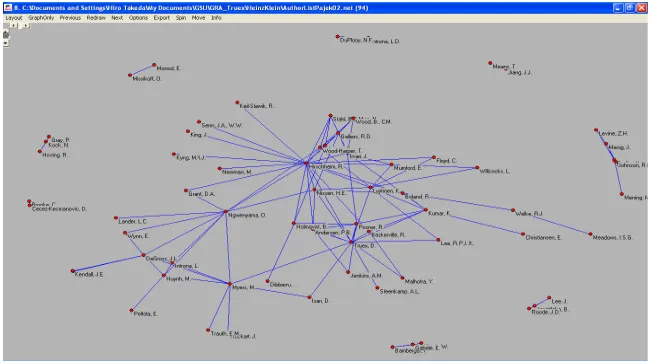
prominent co-authors of HKK. This lead to the creation of the co-author network created using the Pajek tool. The
co-author network showed the center as HKK and the more frequent authors closer to HKK, while the co-authors
Figure 1. Heinz K. Klein Co-Author Network
When the Festschrift had ended, we had collected data which seemed to be some valid research area. We
asked how we might use the methodologies that we used to evaluate HKK’s influence on other IS researchers? This
question became the basis of the papers that make the body of this dissertation. In 2008 we presented this research
expanded to the IS researcher and IS journals at ICIS and AMCIS (Chapter 3) respectively. In the following year the
researcher ranking study was published in JAIS (Chapter 2) in 2009.
One of the items that bothered me while learning more about the Hirsch family of indices was that there
were two indices, the g-index which accounted for the lifetime of work of a researcher (Egghe, 2007) and the
hc-index which accounted for the age of the research (Sidiropoulos & Manolopoulos, 2006), that I felt would be
easy to combine. These two methodologies were combined to come up with a composite index that had the attributes
of both the g and the hc index. I presented this as a paper at the SAIS conference in 2009 (Chapter 4).
I added social network analysis to the bibliometric measures and presented at AMCIS in 2010 (Chapter 5).
An expansion of using the h-index to measure high-level contributors in an online community was studied (Chapter
6). And most recently we have used the example of HKKs work to illustrate and correlate the relationship between
ideational and social influence.
1.3 The Construct
In this section the various constructs will be defined. First the literature will be reviewed for the meaning of
‘influence’. Influence will be examined from social point of view (social influence) and the scholarly point of view
constructs are: what makes some scholarly output measurable, scholarly actions, and scholarly publications.
1.3.1
General Definition of Influence
‘Influence’ is defined as ‘the capacity or power of persons or things to be a compelling force on or produce
effects on the actions, behavior, opinions, etc., of others’ or ‘the action or process of producing effects on the
actions, behavior, opinions, etc., of another or others’ (Dictionary.com, 2010). Yet others define ‘influence’ as ‘the
act or power of producing an effect without apparent exertion of force or direct exercise of command’ and ‘the
power or capacity of causing an effect in indirect or intangible ways’ (Merriam-Webster, 2010). The
Merriam-Webster definition is similar to the free online dictionary that says ‘influence’ is:
A power affecting a person, thing, or course of events, especially one that operates without any direct or apparent effort’ and ‘Power to sway or affect based on prestige, wealth, ability, or position’ (Farlex, 2010).
1.3.2
In the Literature
Currently the measure of ‘influence’ is fraught with problems. P&T committees see a need to assess
scholars in a quick and easy fashion and have defaulted on a list of journal publications that are ranked A, B, C,
premier vs. high-level, and so on. Often P&T committees use these journal lists to assess ‘scholarly influence’ by a
count of the number of articles that were published in these journals (Adams & Johnson, 2008; Wilcocks, Whiley, &
Avgerou, 2008) The content or impact of each of the articles seems to be of little consequence. In addition to using a
‘journal list’, co-authorship in these publications is sometimes seen as a degradation of contribution, as
co-authorship with x authors often translate to a simple division by x to the contribution. While these methods are
‘an evil necessity’ I argue that there is a better way to assess a scholar. While I understand the attraction by P&T
committee members of a simple article count to assess the worth of a scholar, the quest of a ‘holy-grail’ measure of
assessing worth is wrought with problems. In fact, the use of research output solely on publication counts has been
challenged (Bar-Ilan, 2008; Collin, Johansson, Svensson, & Ulvenblad, 1996; Lee & Williams, 1999). Scholarly
output research has identified measures of worth other than a simple publication count.
1.3.2.1 Social Influence
‘Social influence’ according to Wikipedia (2010), “occurs when an individual's thoughts, feelings or actions
are affected by other people.” Herbert Kelman (1958) identified three types of social influence; (1) Compliance is
“when people are influenced by someone who is liked and respected, such as a famous celebrity or a favorite uncle,”
and (3) Internalization is “when people accept a belief or behavior and agree both publicly and privately” (Kelman,
1958). In the definition of scholarly influence, corollaries to Kelman’s three types of social influence can be found.
Examples in the way citations are commonly used and can be seen within all three of Kelmans’ types. For
‘compliance’, Kelman refers to a ‘dissenting opinion’ that is kept private and I acknowledge that in any realm, when
someone keeps her/his opinions private the opinion cannot be observed. But when researching only the public
opinions, ‘compliance’ can be seen when researchers agree with a previous researcher and cite the previous
researcher as such. Typically when researchers do a literature review the authors are required to do a comprehensive
literature review and are expected to cite the ‘big name’ and well-established authors or ‘seminal’ papers in the area
of research. This is similar to ‘Identification’ where a famous paper or author ‘who is liked and respected’ in the
field is influencing the author. And finally ‘Internalization’ happens in citations when authors cite papers and accept
the findings in the cited paper.
The concept of ‘influence’ is also bound up with notions of power. Employers, organizations, governments
or nations may influence by force—physical, economic or legal. Parents, professors and administrators have the
power to withhold privileges and exert influence though the allocation or resources and rewards. And in the
communicative arena the appeal to shared values and truth claims influence the thoughts and behaviors or others. I
will look at three views on power and influence. These will be the views of Parsons, Habermas, and Bourdieu.
Parsons “attempted to conceive of power as a steering medium anchored in the political system and
exhibiting structural analogies to money. He saw this as a successful test of the generalizability of the concept of a
medium. His work on the concept of influence appeared in the same year and was followed a few years later by his
analysis of the concept of value commitment” (Habermas, 1985b). When Parsons talked about value commitment he
analyzed this in a step sequence of money, power, influence, and value commitment. He “analyzed the basic features
of four media, each of which was correlated with one social subsystem: money with the economic system, power
with the political, influence with the system of social integration, and value commitment with that of maintaining
structural patterns” (Habermas, 1985b). While Parsons saw the ‘value commitment’ via four media, which included
‘influence’ and ‘money’ as two of the four media, Habermas saw ‘influence’ different from ‘money’.
Habermas saw that there was a basic difference between influence and money. For one “it is evident that
power” (Habermas, 1985b). Habermas goes on to analyze influence and Parson’s steps, and concludes that influence
initially can have a carte-blanch validity without the need of backing with knowledge or reason. “If we consider the
proposal to apply the media concept to influence and value commitment in the light of our intuitive understanding of
these things, our first reaction is ambivalent. It has a certain prima facie plausibility; persons and institutions can
have a kind of prestige that enables them to exert influence on the convictions of others, even on collective opinion
formation, by their statements-without giving detailed reasons for demonstrating competence” (Habermas, 1985b).
This blind validity notion by Habermas is seen by others. Speakers “make truth claims that may influence the
listeners’ mental images of what may truly, or falsely, exist (knowledge)” (Varey, 2006).
Habermas goes on to state that there is a power differential. When a person of ‘influence’ speaks to an
audience, a power struggle exists between the speaker and the audience. “Influential persons and institutions meet
with a willingness in their audience to take advice. The utterances of the influential are not authorized by an official
position, but they function as authoritative in virtue of a persuasive power that is manifested in the communicative
achievement of consensus” (Habermas, 1985b). The speaker has influence in this situation. Furthermore, Habermas
goes on to recognize that influence has many aliases. “‘Influence’ can be more of less translated as ‘prestige’ or
‘reputation’, ‘value commitment’ as ‘moral authority’” (Habermas, 1985b). Habermas also recognizes that this
power differential is created by society as a whole. The “ascertation that the medium of influence is institutionalized
in the system of social integration, that is, in a public sphere established through the mass media, where the
influence of journalists, party leaders, intellectuals, artists, and the like is of primary importance” (Habermas,
1985b).
Bourdieu first looks to the study of politics for understanding the notion of power. “Politics is the arena par
excellence of officialization strategies” (Bourdieu, 1990b). Politicians are inevitably trying to get their views heard
and their policies to receive attention and funds. “In their endeavours to draw the group’s delegation to themselves
and to withdraw it from their competitors, the agents competing for political power can only implement ritual
strategies and strategic rituals, aimed at the symbolic universalization of private interests or the symbolic
appropriation of official interests” (Bourdieu, 1990b). Bourdieu goes onto identify the language of the politicians is
hotly contested in politics. “To appropriate the ‘sayings of the tribe’ is to appropriate the power to act on the group
by appropriating the power the group exerts over itself through its official language” (Bourdieu, 1990b). While
can be seen in other areas. In particular we see in Information Systems, the use of the ‘official language’ by the
group exerting power over the group. This notion of power can be seen in ‘scholarly influence’.
1.3.2.2 Scholarly Influence
The construct called (scholarly) influence has been assessed/measured in many ways. Extant empirical
measures of influence take both qualitative and quantitative forms. In general, influence measures deal with some
measure of either strength of reputation or by a count of different kinds of either intellectual or creative output. The
qualitative type of influence measure is seen in ranking studies. Some studies try to use survey analysis in order to
‘rank’ prominent journals, scholars, or academic institutions, which would give a measure of qualitative influence.
These surveys measure the notion of the general population in the field by using scholars in the field as respondents
to the questionnaires.
Prominent quantitative measures of ‘influence’ also exist. Citations can be seen as a way that an author
gives credit of some varying degree of influence to another author. The count of these citations is a quantitative
measure of ‘influence’ (Blaise Cronin & Snyder, 1998). Citation counts are the basis to various measures that try to
identify how much ‘influence’ one paper has on another paper (or researcher on researcher, journal on journal,
department on department). The grouping of citation measures, along with grouping of data points such as scholars,
journals, or departments, will start to give a picture of the total influence by that particular data point.
The IS literature typically approaches the notion of influence by examining how often a scholar has been
published, the venues in which s/he has published, and by subject and the type of the work published. Each of these
criteria is weighted differently depending on disciplinary, contextual, and political circumstances. In general terms,
being published more is better than being published less, but the frequency with which others reference an author’s
published works is the principle measure of success and influence. The set of tools and techniques used to measure
the frequency of publication or of reference to concepts and publications is known as “Bibliometrics”.
One key difference between social influence and scholarly influence is the fact that direction of agreement
is not measured in quantitative scholarly influence. Citations do not have a positive or negative aspect to them. I
argue that influence works as an absolute value, a strength that ignores direction. For example if there is someone
that I disagree with, and another person that I agree with, both past researchers will influence me, and the direction
of influence, whether positive or negative, does not matter in measuring the degree of influence. For social influence
to scholarly influence), and ‘internalization’ is a positive influence.
1.3.3
Working Definitions
Several terms will be defined in this section. While there are commonly accepted definitions for
‘influence’, ‘measurable’, ‘actions’, and ‘publications’, the current research requires that these terms be defined and
their scope be identified. The following section will define and bound these terms for the current research stream.
1.3.3.1 Influence
The construct called ‘influence’ extended to the domain of scholarly activities, I term ‘scholarly influence’.
In the academic world the notion is described in many different ways, and seems to be a fluid construct. Thus the
first task one faces is to identify, bind, and define this notion. Once I have a clearer concept of the construct then I
can examine how one might measure the notion.
The dictionary definitions of influence and power are often co-referential (see section 1.3.1) in which
influence is illustrated by if not defined by power differences. The power differential is demonstrated by situations
where influencer and influenced power differences are causing an action by the receiver. The common definition of
influence connotes that having of power to be used to wield over the person ‘influenced’.
The power aspect of influence is evident in the dictionary definitions but in ‘scholarly influence’, power is
harder to find. In the realm of scholarly citations these power differences are either lacking, are of a more subtle
nature, or are often dressed in a subtle veneer of logic and scholarly discourse (Bourdieu, 1990a). When one starts
working on a research project researchers are free to look at any of the vast ocean of research that has or has not
been published. When researchers start their research, they are free to use any of the millions of previous research
publications that are available to them. Researchers that publish are also not trying to influence others, nor do they
wield any power, in the sense of the dictionary definition of ‘influence’. The researchers are not publishing to try to
get others to cite them. Rather in the pure sense of scholarship the researchers want to let the world know of the
conclusions they found after a scholarly journey to find the ‘truth’.
However, there are situations in which power structures do come into play in the use of citations (hereafter
simply called ‘the citation game’); through reference to shared explicit and implicit social norms. For example, often
times a journal reviewer will ‘suggest’ that an author add a few citations to their paper in order to ‘complete’ the
literature review and qualify a paper for acceptance at the journal (Adler & Harzing, 2009). Another situation is
networks where researchers that are familiar with each other cite each other to increase citation scores (Adler &
Harzing, 2009; B. Cronin, Shaw, & La Barre, 2003; Özbilgin, 2009). One can debate whether these additions are
truly needed in order to enhance the paper, or the additions are requested to boost the citation counts of the
requestor. While these are situations where a power structure is seen, regardless of the motives of the requestor, the
number of citations that are added with these situations typically do not take up a majority of the citation lists of a
research paper.
Another aspect of the dictionary definitions of ‘influence’ that exists is the sense of ‘indirectness’ or lack of
‘effort’. For scholarly influence there should be no distinction on ‘directness’. An advisor/student relationship is a
direct relationship that has profound influence. For citations there may or may not be direct contact with the authors
that one cites. One might be citing a researcher that they share an office with. On the other extreme the citer and
cited may not even live in the same era, it is possible that one can cite an author from centuries past. So this
clarification of ‘indirect’ is lacking in our definition of ‘influence’.
In light of these various issues, for the purposes of this work I will define ‘scholarly influence’ simply as:
The capacity of a researcher to produce measurable effects on the actions of another researcher.
From this point forward when the term ‘influence’ is mentioned I am referring to ‘scholarly
influence’ as define above. One interesting characteristic of scholarly influence is that it tends to build over
time and that when scholarly influence decreases, it is with at a slow pace, which can be thought of as a ‘slow
fade’. Using the above definition, once an action has been identified, that action is in the past and will never
disappear, thus the measurable effect (via citations) will never decrease.
Taking the above definition of ‘scholarly influence’ we see constructs of measurable effects and
action. I need to define these constructs in order to congeal the definition of ‘scholarly influence’. In the next
section I define the constructs measurable and actions. I also define publications, which are used to measure
the actions of a researcher.
1.3.3.2 Construct Definitions – Measurable, Actions, and Publications
For the purposes of this research I use the term ‘measurable’ to mean a notion of being able to witness in a
quantitative manner. Scholarly influence happens when one scholars measurable action are affected by measurable
actions of another researchers. Commonly these measurable actions can be seen in the form of citations,
advisor/student relations.
For the purposes of this research I use the term ‘actions’ to be of any type of scholarly activity such as the
creation or delivery of publications, lectures, speeches, attendance at a conference, presentations as well as the
engagement in conducting meetings or participating in conversations, teaching, and mentoring. In short ‘action’ is
any activity in which someone conveys ideas or positions. These ‘actions’ might be considered a form of
participation in an extended discourse.
In this research I am principally concerned with measurable actions by researchers. I am focusing in on the
publications within the different types of actions (such as lectures, speeches, presentations, teaching, and mentoring
mentioned above). So the definition takes a narrower look at scholarly influence where the definition of ‘scholarly
influence’ is further refined to mean:
The capacity of a researcher to produce through the use of their actions, measurable effects on the publication of another researcher.
This may seem like a measure of convenience but current scholar measures takes similar approaches as
citation counts and publication counts are heavily used to evaluate the ‘worth’ of a scholar in academics today. By
having a broader definition of ‘influence’ than using solely citation counts or publication counts, this research tries
to improve incrementally on current methodologies.
1.3.4
Limitations with Current Measures of Influence
1.3.4.1 Limitations with Raw Citation Counts
While commonly used as a measure of faculty productivity, citation measures have failings. As influence
measures they are limited in at least four ways: they are not a quality measure, they do not discriminate against the
varying degrees of influence, questions exist as to whether they are measuring influence, and age skew of citations
(Egghe 2006; Sidiropoulos, Katsaros, & Manolopoulos, 2006). Because of the existence of varying degrees of
influence and the fact that for citation measures one equal citation is given for highly ‘influential’ citations as
opposed to not so ‘influential’ citations, citation counts skew influence. A paper may also ‘influence’ the author of
another paper in the traditional definition of ‘influence’, but unless there is an idea or quote that is used by the
second paper, the ‘influence’ goes un-credited, thus not recording possible ‘influence’. Other than to monitor what
scholars are reading, these types of ‘soft influences’ are impossible to measure. Even with these faults, when using
bibliometric measures, citation analysis is currently the best way to measure ‘influence’.
who can actually gauge the amount of influence. In essence, I argue that only the receiver of the ‘influence’ can
measure the amount of ‘influence’. For the math teacher, I’m sure that all academics are trying to ‘influence’
students in a positive manner, but whether the student receives that ‘influence’ is hard to gauge from the teachers
point of view. Only until some quantitative measure, such as test score improvement, is seen, does the teacher start
to realize the amount of ‘influence’. Even with this knowledge, I’m sure that my high school math teacher probably
doesn’t know how much of an impact she had on my studies after leaving high school. In the scholarly realm,
citations may not even go noticed by the author that is being cited. Only after a search of citation numbers using
some bibliometric database such as Google Scholar or EBSCOhost can the researcher realize the influence of their
work.
Another problem with citation counts is the age of the initial research is a major prerequisite for garnering
citation counts. While a publication that is ‘hot off the presses’ may be very influential, there is a requirement that
some time has to pass before the publication can start to achieve any citation numbers. This requirement rules out
newly publicized articles out of the citation game. The prerequisite also means that older articles tend to have a skew
of having higher citation counts.
Finally the practice of the citation game has also been criticized. There are problems with citation counts as
there are self-citations, co-citation networks, journal self-citations, and bad citation practices. With self-citations an
author will cite their own previous work, even if the previous work does not contribute to the citing research. This
practice is seen as unethical but is used by researchers to gain citation numbers (Adler & Harzing, 2009; Blaise
Cronin & Snyder, 1998; Katsaros, Akritidis, & Bozanis, 2009; Persson, Glänzel, & Danell, 2004). Co-citation
networks happen when researchers that are familiar with each other cite each other in order to improve citation
scores for each other. While this is not self-citation, the practice is similar where cohorts are working together to
increase each other’s citations. The practice is also seen as unethical if done only for the purpose of increasing
citation counts. There is a notion of power also seen here as one researcher might cite another researcher with the
expectation that the favor will be returned (Adler & Harzing, 2009; B. Cronin, et al., 2003; Özbilgin, 2009). The
practice of journals reviewers asking authors to cite previous papers in said journal is also seen as a form of self
citation and is deemed unethical, though the analysis of such behavior is much harder to measure due to the fact that
review process is never published (Adler & Harzing, 2009). Finally bad citation practices such as ‘empty’
original study that makes the claim, misrepresented references, false references, and just erroneous references can be
counted in citations (Harzing, 2002; Nkomo, 2009).
1.3.4.2 Limitations and Biases in Past Influence Research
Qualitative methods are not immune from problems as well. Some of the problems for qualitative methods
are: subject bias, incomplete surveys, inherent reputation of journals, their subjective nature, and the apparent North
American bias in IS journal rankings (Galliers & Whitley, 2007; Gallivan & Benbunan-Fich, 2007; Lyytinen,
Baskerville, Iivari, & Te'eni, 2007; Whitley & Galliers, 2007; Wilcocks, et al., 2008). In survey studies there is an
inherent influencer-influenced bias in surveys. When IS journal surveys are done, the data points or the academic
population that is taking the survey are readers of the journal, but they are also the editors, authors, potential authors,
and reviewers of articles in these journals. So there is inherent bias by the survey takers or subjects, in the fact that
one would try to improve prestige of a journal where the subject is an editor, past author, reviewer, or is inspiring to
publish in said journal. By ranking journals that the subject has ties to higher than journals the subject has no ties to,
they are enhancing, indirectly the apparent influence of their own work. I am taking an Actor Network Theory
(ANT) view on the IS Research Network.
With ANT, science “and technology are dramatic 'stories' in which the identity of the actors is one of the
issues at hand. The observer who disregards these uncertainties risks writing a slanted story which ignores the fact
that the identities of actors are problematic” (Callon, 1987). There exists an exchange with ANT between the actor
and the system (or the agency and structure). “It might be more productive to say that they have alternated between
two types of equally powerful dissatisfactions” (Latour, 1999). A social scientist may struggle with this
dissatisfaction. There is a need to look at the micro (or the face to face) interaction, but they may find that there is
possibly another level. The other level may not even be visible. Furthermore, the need exists to look at all the actors
that make up the system. ANT is simply a way of paying attention to these two dissatisfactions, not again to
overcome them or to solve the problem, but to follow them elsewhere and to try to explore the very conditions that
make these two opposite disappointments possible” (Latour, 1999). By studying these dissatisfactions we see one
contribution of ANT, “when one explores the structures of the social, one is not led away from the local sites”
(Latour, 1999). Callon realized this ability to see the network in the St. Brieuc bay case, and he was able to “see the
simultaneous production of knowledge and construction of a network of relationships In which social and natural
By using ANT, I am able to tell the story about influence in a different light than just a journal rank list.
“ANT does not tell anyone the shape that is to be drawn – circles or cubes or lines – but only how to go about
systematically recording the world-building abilities of the sites to be documented and registered” (Latour, 1999). I
am trying to examine different views about scholarly influence with this dissertation. By doing so, I hope to
‘document and register’ the IS academic world. The use of multiple measures is a different view from other
philosophical standpoints. “The difference between ANT and the masses of reflection on modernity and post-,
hyper-, pre- and anti-modernity, was simply that it took to task all of the components of what could be called the
modernist predicament simultaneously” (Latour, 1999). I am trying to rewrite the use of a single measuring points of
journal ranking lists by looking at more components in the ‘scholarly influence’ arena, While I am not looking at all
of the components, I am adding to the current methodologies. I am trying to contribute a basket of measures, thereby
creating a different view of IS scholarship from past research.
An important aspect of ANT is the actor and their actions. “ANT was simply another way of being faithful
to the insights of ethnomethodology: actors know what they do and we have to learn from them not only what they
do but how and why they do it” (Latour, 1999). With ANT we look at the actors, their actions, and we need a way to
measure these actions. “Instead it [network pole of actor-network] refers to something entirely different which is the
summing up of interactions through various kinds of devices, inscriptions, forms and formulae, into a very local,
very practical, very tiny locus” (Latour, 1999).
In the case of the St. Brieuc bay, the actors included the scallops, which may seem as an unlikely actor for
this network. “For the case of the scallops (like the fishermen and the scientific colleagues) the interessement is
founded on a certain interpretation of what the yet to be enrolled actors are and want as well as what entities these
actors are associated with” (Callon, 1987). Here the term ‘interessement’ “is the group of actions by which an entity
(here the three researchers) attempts to impose and stabilize the identity of the other actors it defines through its
problematization. Different devices are used to implement these actions” (Callon, 1987). For the researchers the goal
was to have the scallops anchor so that the scallops could grow. The researchers imposed the actions on the scallops
through the use of netted bags containing support materials for anchoring, floats, towlines, and boats.
The Actor Network Theory view is a ‘material-semiotic’ method, where all material (humans and things)
and semiotic (concepts) are part of the network. The current view of influence, measured only by journal
researchers represent the ‘humans’ and journals, and databases (Google Scholar, Impact Factors) represent the
‘things’. The semiotic is the ‘concepts’ included in the research publications. I am aligning myself with the ANT
view, which incorporates the researchers, journals, databases, and concepts, while the current journal publication
count method only looks at a narrow view of the material by only focusing on the journal or researcher.
Surveys are also incomplete. Most surveys have A and B level journals, but they do not include all of the
lower level journals. Thus there is inherent bias being installed into the survey itself. The survey self installed bias
has been termed the ‘anchoring effect’. The ‘anchoring effect’ is where, in a journal ranking survey study, there is a
skew towards journals that are listed as opposed to those that are ‘written in’. Studies have shown that there is a bias
towards those journal listed in the survey, even if the surveyed are ‘encouraged’ to write in any journals that might
have been left out of the journal list (Chua, Cao, Cousins, & Straub, 2002). Survey methods have come under
scrutiny for the ‘anchoring effect’ problem.
Finally problems exist with the inherent reputation of the journals. Studies have shown that once a journal
has gotten a certain reputation, they tend to keep that reputation even if the actual worth of the journal has changed.
Reputation in the minds of the survey takers take a bit more time to change compared to the change in the reputation
of the journal. Here we see a ‘slow fade’ of influence of journals that have in the past achieved a certain reputation.
There seems to be a lag time from the change in reputation and for that change to appear in the results of survey
studies that measure the reputation of a journal. The citation measure does not suffer from these biases.
Other more ‘subjective’ and qualitative measures such as non-ranking surveys of expert and lay opinion,
awards, prizes, and patents earned, appear far less frequently in our literature. A third measure, that of the social
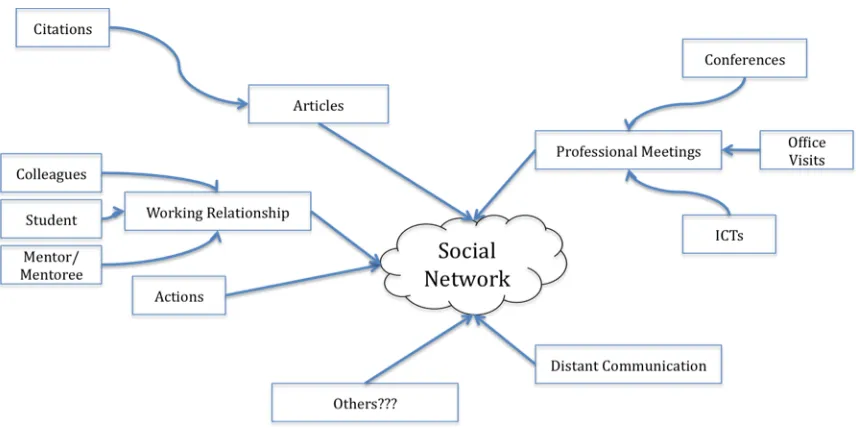
inter-connectedness, or the strength of a scholar’s ‘social network’, (cloud, Figure 2) examines characteristics of the network of people with whom a scholar has published, worked, mentored, or taught. The initial stages of the social
network analysis (SNA) of the current research are the ‘co-authorship network’. The ‘co-authorship network’ will
look at individuals and their co-authors as the social network in a field. The idea behind studying networks is that
social networks are a measure of influence. By working with colleagues a researcher can inflict influence via the
Figure 2. The Social Network and How it is Defined
1.4 Theoretical Framing (and the characteristics of Constructs)
The literature that actually defines ‘influence’ is lacking in specificity and there is an absence of a theory of
influence. There are many scholarly publications that deal with measuring the ‘worth’ of a scholar but the literature
review produced little in ‘influence’ definition or theory (Alexander, Scherer, & Lecoutre, 2007; Clark & Wright,
2007; Ferratt, Gorman, Kanet, & Salisbury, 2007; Geary, Marriott, & Rowlinson, 2004; Hardgrave & Walstrom,
1997; Harzing, 2008; Kodrzycki & Yu, 2005; Korobkin, 1999; Kozar, Larsen, & Straub, 2006; Lowry, Romans, &
Curtis, 2004; Martin, 2007; Mingers & Harzing, 2007; Mylonopoulos & Theoharakis, 2001; Nelson, 2006; Nerur,
Sikora, Mangalaraj, & Balijepally, 2005; Peffers, Avison, Ein-Dor, & Zmud, 2003; Podsakoff, MacKenzie,
Bachrach, & Podsakoff, 2005; Rainer & Miller, 2005; Walstrom & Hardgrave, 2001; Walstrom, Hardgrave, &
Wilson, 1995; Wilcocks, et al., 2008). While ‘influence’ may be lacking in definition and lacking in having a well
articulated and cogent body of theory, the notion of ‘influence’ is tied closely with communication, discourse, and
argumentation. In this section I look at theories of communication and discourse by Habermas and argumentation by
Toulmin to understand the theoretical background on the notions of communication and argumentation.
The notions of scholarly influence as discussed above are essentially forms of communicative action
(Habermas, 1985a) embedded in a context of formal argumentation (Toulmin, 1964). Accordingly this research is
informed by the work of the German sociologist and Critical Social Theorist, Jürgen Habermas, in particular his
Toulmin the nature and pragmatics of communication and of human discourse are central to their work. Habermas’
theory of “communicative reason, …, considers the site of rationality to be the structures of interpersonal linguistic
communication rather than the structure of either the cosmos or the knowing subject…” (Habermas, 1985b) And as
a critical theorist he challenges the Marxist focus on economics (or alienated labor) as the main or sole determining
factor of oppression. Habermas argues that the key to liberation is rather to be found in language and communication
between people.” (Wikipedia.com) Toulmin focuses on the structures and pragmatics of effective argumentation and
the way one must develop and support ‘truth claims’ made in texts. My present research maintains that as academics
we are participating in formal and informal discourse through publications (journals, conferences, books, articles,
lectures, debates, interviews, podcasts, and teaching etc.), which are the structures of the communication and formal
argumentation. We exert influence and assert truth claims about the importance of other measures and of venues
through our various texts1.
“Jürgen Habermas' theory of discourse ethics contains two distinctive characteristics: (i) it puts forth as its
fundamental tenet, a prerequisite of participation in argumentation for testing the validity of a norm and (ii) it
transforms the individual nature of Kant's categorical imperative into a collective imperative by reformulating it to
ensure the expression of a general will and by elevating it to a rule of argumentation” (Hoenisch, 2005).
Communication is the ability to manipulate other peoples thought. In the academic realm, manipulation is done
frequently by articles being published and then influencing the thoughts of those that read the article. Discourse is
the act of argument/counter argument and through this exchange communication is reached. Discourse can be seen
as strategic, in the sense that one party is trying to win over the other party to their point of view.
In sociology, and in very general terms, Critical Social Theory concerns itself with understanding structures
of society and how they may be used instrumentally to reinforce extant power relations and enslave versus
emancipate mankind. One of the principal objectives of many critical social theorists is to uncover, examine, and
critique social structures and to support emancipatory goals. Communication/language/speech are all-powerful tools
and are forms of social action. “Habermas makes a distinction between three forms of action: instrumental action
1 As an important aside, I refer to the notion of a ‘text’ in the post-structuralist sense, not as a mere set of printed words as in a
(oriented to success, nonsocial), strategic action (oriented to success, social) and communicative action (oriented to
reaching understanding, social)” (Wijnia, 2010). Communicative action is where people try to reach an agreement to
a ‘true’ knowledge. “True” in this context constitutes agreements fairly and openly arrived through symmetrical
discourse and is both time and contextually dependent. “A discussion that evolves about certain things (e.g. about
the ethics concerning blogging) is called a discourse” (Wijnia, 2010). According to Habermas there are four levels
of discourse. Flow of ideas and thoughts through the four levels of discourse can only happen when there is
communicative symmetry between the participants of the communication (Wijnia, 2010). When these conditions
are met one approximates what Habermas calls the ‘ideal speech situation’ or one unobstructed by gamesmanship,
power differences and strategic positioning aimed at forcing others to accept one’s view. “These conditions are:
- all people involved must have equal opportunity to start a discourse;
- all people involved must have equal opportunity to participate in a discourse; - there may not be any difference in power between the participants;
- the participants must be truthful to each other” (Wijnia, 2010).
All four conditions are in place to allow exchange of true argumentation; this means that all arguments have to be
regarded by all participants of the discourse for the argument to become ‘truth’. This doesn’t mean that there will
be a consensus between the participants of the discourse. Participants my have a range of views from agreement
to dissensus (Wijnia, 2010). “When a consensus is achieved this doesn't mean that it's a definitive consensus. It
can always be re-discussed in future time”(Wijnia, 2010). Habermas is telling us that there needs to be some
ground rules for argumentation to happen. We see in these rules a notion of power being lifted. Everyone in the
discourse is ‘equal’ and has ‘equal’ rights to participate in the discourse. I have seen less and less of this
‘equality’ in the discourse of our literature. Different outlets have more power to participate in the discourse.
While discourse needs a non-power structure to become a truly fair discussion, influence is still seen in
argumentation.
Influence is indirectly affected by social imperative. According to Stephen Toulmin, there are elements to a
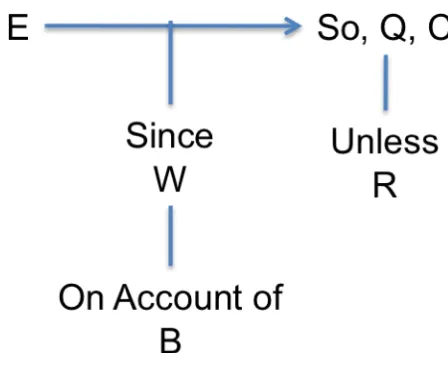
persuasive argument. The elements are: claim (C), evidence (E), warrant (W), backing (B), rebuttal (R), and
qualifier (Q) (Toulmin, 1964). “There must be an initial stage at which the charge or claim is clearly stated, a
subsequent phase in which evidence is set out or testimony given in support of the charge or claim” (Toulmin, 1964,
which our particular argument commits us” (Toulmin, 1964, p. 98). Backing of warrants is “other assurances,
without which the warrants themselves would possess neither authority nor currency” (Toulmin, 1964, p. 103).
Rebuttals are “conditions of exceptions” (Toulmin, 1964, p.101). Finally a qualifier is “some explicit reference to
the degree of force which our data confer on our claim in virtue of our warrant” (Toulmin, 1964, p.101). The
argument model is seen in figure 3. The model argues for a claim C, qualified by some degree of force Q, evidenced
[image:35.612.112.336.235.422.2]by some datum E, due to a warrant W, with some backing B, unless some rebuttal R exists.
Figure 3. Toulmin Argument Model
Finally influence is a power-laden structure. As we saw with the traditional definition of influence by
dictionary.com and Webster (see section 1.3.1) power difference is inherent in the basic definition of ‘influence’.
We also saw (see section 1.3.2.1) that in the publication game, power struggles also are inherent in requests (Adler
& Harzing, 2009).
1.4.1
Operationalizing the Construct
In order to measure ‘influence’ I need to take two measures for the current research, the citation count and
the co-authorship. An essential question is of course “Where do I look for citations?” There are many different areas
of scholarly output. I recognize that scholarly output can come in the form of teaching, journal articles, conference
proceedings, conference presentations, conference attendance, book publication, lectures, speeches, formal
meetings, colloquiums, impromptu meetings, and mentoring. While all these forms of output can have influence, I