How to cite this paper: Wang, F.B., Wang, Y.Q., Hou, B., Wu, J.K. and Li, Y.P. (2015) Study of Process Affected by Electrolyte Concentration through Microarc Oxidation on the TC4 Alloy Surface. Open Access Library Journal, 2: e1199.
http://dx.doi.org/10.4236/oalib.1101199
Study of Process Affected by Electrolyte
Concentration through Microarc Oxidation
on the TC4 Alloy Surface
Fengbiao Wang*, Yongqing Wang, Bo Hou, Jiakun Wu, Yapeng Li
School of Mechanical Engineering, Dalian University of Technology, Dalian, China Email: *[email protected]
Received 3 January 2015; accepted 19 January 2015; published 23 January 2015
Copyright © 2015 by authors and OALib.
This work is licensed under the Creative Commons Attribution International License (CC BY).
http://creativecommons.org/licenses/by/4.0/
Abstract
This paper aims to achieve the prepared functional coatings containing a specific ratio of cal-cium and phosphorus, and guide the rational allocation of chemical reagents. On the medicinal ti-tanium alloy surface the calcium biocoating and phosphorus biocoating were fabricated by micro arc oxidation (MAO) process. The coating morphology and elemental composition were observed by scanning electron microscopy (SEM) and energy dispersive spectrometer (EDS). Wear resistant test on the coating surface was executed. The effect regulars of different concentrations and dif-ferent molar ratio of electrolyte on the calcium and phosphorus content of medical TC4 alloy coating on micro arc oxidation system were researched, and the effects of electrolyte concentration on the molar ratio of calcium and phosphorus in the coating were also studied. The experimental results show that, with the increase of the electrolyte concentration, calcium content and phosphorus content in the coating are all decreased. But the ratio of calcium and phosphorus in the coating is increased, and the concentration of Ca/P molar ratio is higher, while calcium content and phos-phorus content in coating are all lower. Wear resistant test shows that proper electrolyte concen-tration is helpful to improve the surface properties of coating. So if it wants to prepare one certain Ca/P molar ratio biocoating, the ratio can determine the different electrolyte concentrations of Ca/P molar ratio, and at last determine roughly the ratio of the compound reagent.
Keywords
Calcium and Phosphorus Ratio, Micro-Arc Oxidation, Electrolyte Concentration, Wear Resistant
Subject Areas: Biological Materials, Composite Material, Material Experiment
OALibJ | DOI:10.4236/oalib.1101199 2 January 2015 | Volume 2 | e1199
1. Introduction
As a kind of typical biological activity, material calcium phosphate ceramic has the similar chemical composi-tion and structure with the hard tissue of human body, and is the main inorganic component of human bone and teeth. When implanted in the human body, the kind of material can not only lead to bone-formation, but also form synostosis with new bone. With the muscle, ligament or subcutaneous tissue cultivation calcium phosphate ceramic can closely integrate with the organization, at the same time it is no inflammation or irritation reaction
[1]-[4]. Therefore, calcium phosphate ceramic material is often used for artificial bone, artificial joint, artificial tooth and bone filling materials, and it is also used in clinical. Surface modification of biological coating on Ti-tanium alloy is included in electroplating, spraying film and high temperature synthesis, but different level of the film and substrate adhesion is poor shortcoming. So the stripping phenomenon is inevitable after implanted, which leads to implant failure or a shorter implant life.
MAO is an economic, efficient and environmentally friendly technology for surface treatment on lightweight metals (aluminum, magnesium, zirconium, titanium, etc.) or metal alloys [5]-[8]. Many properties of MAO coating including bonding strength with the substrate, thickness of film, micro hardness, anti-wear and corrosion resistance are all relatively excellent [9]-[12]. But the coating outside in general is a loose layer, while the inter-nal one is a dense layer. Usually related to dense layer, the loose layer is thick and loose organization, and mainly consists of anatase phase with relatively low hardness for the Ti alloy MAO coating [13]-[16].
But in the micro arc oxidation process for preparing biocoating of on titanium alloy surface, the composition of formed coating is greatly affected by the electrolyte concentration, while the electrolyte concentration is mainly decided by the content of calcium and phosphorus in chemical reagent solution. When the electrolyte concentra-tion wants to obtain one coating with a certain calcium/phosphorus ratio relaconcentra-tionship, the chemical reagent allo-cation becomes the key factor restricting the success of the experiment. So, we must research the relationship between concentration of solution and coating component of calcium and phosphorus.
2. Experimental Details
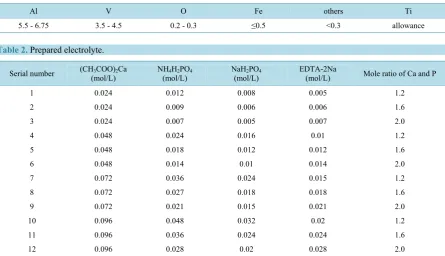
2.1. Experimental MaterialExperiment treated substrate material is TC4 titanium alloy (mass fraction of elements, such asTable 1). TC4 alloy plates were used as specimens whose measurement is 80 mm × 40 mm × 3.5 mm. The plates were ground with 350, 700 and 1000 # abrasive papers, flushed with acetone and distilled water for 20 min, and dried
at 40˚C.
2.2. Prepared Electrolyte
Prepared electrolyte is as shown inTable 2. The concentration of 10% ammonia water was used to regulated pH = 11 - 12.
2.3. Micro Arc Oxidation Equipment and Electrical Parameters
The 20 KW DC/AC micro arc oxidation device of the laboratory developed was used to treat the specimens, the equipment is composed of pulse power supply, electrolytic tank, mixing system and cooling system. The posi-tive pole of the power supply was connected with the specimen clamped by special and as anode, then stainless steel was as cathode electrolytic tank.
The applied voltages (effective values of voltage) of 510 V were used to prepare MAO coatings. The power waveform, frequency and duty cycle were unipolar pulse, 500 Hz and 20%, respectively; it was one specimen for one prepared solution, and the number was NO. 1 - NO. 12.
2.4. Analysis Equipment
OALibJ | DOI:10.4236/oalib.1101199 3 January 2015 | Volume 2 | e1199
Table 1. TC4 composition [wt%].
Al V O Fe others Ti
[image:3.595.92.538.98.354.2]5.5 - 6.75 3.5 - 4.5 0.2 - 0.3 ≤0.5 <0.3 allowance
Table 2. Prepared electrolyte.
Serial number (CH3COO)2Ca
(mol/L) NH(mol/L) 4H2PO4 NaH(mol/L) 2PO4 EDTA-2Na (mol/L) Mole ratio of Ca and P
1 0.024 0.012 0.008 0.005 1.2
2 0.024 0.009 0.006 0.006 1.6
3 0.024 0.007 0.005 0.007 2.0
4 0.048 0.024 0.016 0.01 1.2
5 0.048 0.018 0.012 0.012 1.6
6 0.048 0.014 0.01 0.014 2.0
7 0.072 0.036 0.024 0.015 1.2
8 0.072 0.027 0.018 0.018 1.6
9 0.072 0.021 0.015 0.021 2.0
10 0.096 0.048 0.032 0.02 1.2
11 0.096 0.036 0.024 0.024 1.6
12 0.096 0.028 0.02 0.028 2.0
3. Result and Discussion
3.1. Effect of Solution Concentration on Biocoating Morphology
In the electrolyte molar ratio of Ca and P as to 1.6, surface and section morphology of micro arc oxidation coat-ings prepared with different concentration are shown inFigure 1 andFigure 2. The figure shows the coating surface pore is become larger with electrolyte concentration increased, and coating is become coarse, as well as dense layer thickness increased.
3.2. Effect of Solution Concentration on Biocoating Composition Micro arc oxidation test solution is mainly composed of Na+, Ca2+, OH−,
2 4
H PO−, NH
4+, CH3COO−,
Ca(H2PO4)2, Ca(OH)2, and Ca3(PO4)2 particles. The Ca(OH)2 and Ca3(PO4)2 is insoluble in water, but the
col-loidal particles with negative charge can be formed with negatively in water, in addition calcium and phosphorus element can exist by Ca2+ and 3
4
PO − formation in electrolyte.
Figure 3(a)andFigure 3(b) respectively show the changes of calcium and phosphorus content of biocoating with different electrolyte concentration. InFigure 3 it is can be seen with the same electrolyte concentration, if solution molar ratio of Ca/P in electrolyte is lower, on the contrary, it is higher for the calcium and phosphorus content in the coating. But for the electrolyte of molar ratio of Ca/P determined, with the concentration im-provement of (CH3COO)2Ca and NH4H2PO4, in biocoating the calcium and phosphorus content is not increased
but decreased, as well as for the higher concentration concentration, in the coating the calcium content is de-creased slowly, while the content of phosphorus in the whole concentration range is rapid decline, and the rate of decline is significantly greater than that of calcium, especially for the lower molar ratio Ca/P in electrolyte.
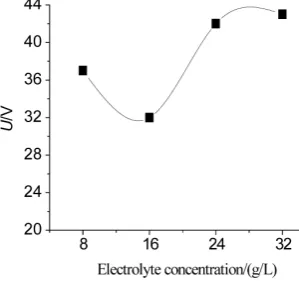
The main reasons of these phenomena are as follows, with electrolyte solution concentration increased, more charged particles of calcium and phosphorus are produced, which is contribute to increase the conductive per-formance of the electrolyte, and the equivalent resistance of the electrolyte is decreases, who lead to the pressure drop reduced, as shown inFigure 4. When the electrolyte concentration is increased from 8 g/L to 32 g/L, at the same time in the electrolyte the content of the colloidal particles of Ca(OH)2 and Ca3(PO4)2 is improved, and
OALibJ | DOI:10.4236/oalib.1101199 4 January 2015 | Volume 2 | e1199 (a) (b) (c) (d)
Figure 1. Surface morphology of biocoating of different electrolyte concentration: (a) 8 g/L; (b) 16 g/L; (c) 24 g/L; (d) 32 g/L.
[image:4.595.88.542.233.360.2](a) (b) (c) (d)
Figure 2. Section morphology of biocoating of different electrolyte concentration: (a) 8 g/L; (b) 16 g/L; (c) 24 g/L; (d) 32 g/L.
(a) (b)
Figure 3. Effect of electrolyte concentration on biocoating: (a) Effect of Ca content; (b) Effect of P content.
Figure 4. Effect of electrolyte concentration on voltage.
Dense layer
[image:4.595.115.518.389.535.2] [image:4.595.236.386.565.706.2]OALibJ | DOI:10.4236/oalib.1101199 5 January 2015 | Volume 2 | e1199
directly affects the gas discharge breakdown state, and indirectly affects the calcium and phosphate ions number into the layer and combined to form calcium phosphate salt opportunity, which leads calcium and phosphorus content in the coating is decreased. But when the electrolyte concentration is increased to a certain extent, and colloidal particles concentration is close to saturation, the voltage drop of electrolyte is tend to the steady state, so the calcium and phosphorus content in the coating is changed slowly. Because the phosphorus than calcium ion is more difficult to get into discharge channel [12], at the same time with the same electrolyte concentration, Compared with the calcium ion concentration is increased, the phosphorus ion content is on the decline, so in the coating the phosphorus ion content is decreased significantly. So in the same concentration, in the electrolyte of lower Ca/P molar ratio the higher phosphorus content should be guaranteed, which will ensure that there are more P ions to get into the discharge channel, and there is more calcium and phosphorus is contained in the coating.
It is also seen inFigure 3, with the increase of the electrolyte concentration, although calcium and phospho-rus content is increased, it cannot guarantee that the calcium and phosphophospho-rus content in the coating is increased at the same time, on the contrary, it is decreased. So the configured electrolyte concentration is too should not be too large, and the same for molar ratio of Ca/P in electrolyte. But because of the calcium in addition to is parti-cipated to be prepared the biocoating, also is fabricated other substances in electrolyte, so as to make the cal-cium content is relatively surplus in the electrolyte.
3.3. Relationship of Ca/P Ratio in Coating and Electrolyte Concentration
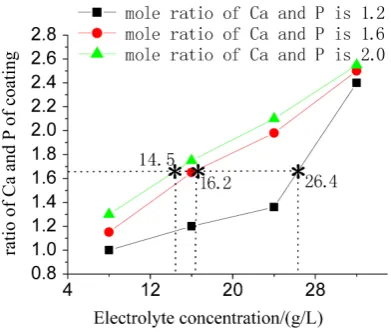
Although calcium and phosphorus compounds concentration is changed compared to the same ratio in electro-lyte, in the biocoating calcium and phosphorus content change is not the same trend, which causes that although Ca/P molar ratio is consistently kept, the mole ratio in the biological coating is in change. Following to electro-lyte concentration of calcium and phosphorus compounds is increased, as well as the Ca/P molar ratio in biolog-ical coating is the same trend, and in the electrolyte of Ca/P molar ratio with bigger value it is more significant changes, as shown inFigure 5. In the electrolyte of Ca/P molar ratio values with 1.2, 1.6 and 2, Ca/P molar ratio of hydroxyapatite (1.67) is as a sign of biocoating Ca/P molar ratio, if wants to obtain the biological coating of ratio of 1.67, the MAO experiment concentration of the electrolyte are about 26.4, 16.2 and 14.5 g/L, respec-tively, as shown inFigure 5 with “*” correspond to the abscissa values shown.
This conclusion can guide the configuration of electrolyte in the process of micro arc oxidation, and then de-termine reasonably proportioning of the calcium and phosphorus compound reagent.
3.4. Effect of Solution Concentration on the Wear Resistance of Biocoating
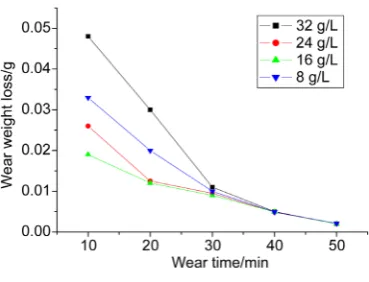
[image:5.595.217.413.529.695.2]From the wear capacity inFigure 6 and wear time curve, it can be seen that for the electrolyte concentration of 16 g/L and 24 g/L, the former wear capacity (in 30 min) are also less than 8 g/L, but the concentration of elec-trolyte is 32 g/L, it is the larger amount of wear and tear at the same time. That is mainly due to the more thick
OALibJ | DOI:10.4236/oalib.1101199 6 January 2015 | Volume 2 | e1199
Figure 6. Relationship of wear time and wear weight loss of the MAO coatings at different electrolyte con-centration of 1.6 mole ratio of Ca and P.
loose layer of biocoating which is prepared in high electrolyte concentration condition, so the wear resistance is poor, and early wear mainly is occurred in the loose layer, ultimately, the wear capacity is larger. To the lower concentration electrolyte level (8 g/L), because of the lower concentration the process of growth of the prepared coating is not sufficient, which does not meet the minimum requirements of micro arc oxidation process for electrolyte concentration. So it is not sufficient for micro arc oxidation discharge in the parts of micro area, and the plasma discharge fully is not unrealized, the prepared coating is mainly in the loose layer with relatively thicker, who affected the effective generation of dense layer, so the wear amount is large in the early stage. This shows that proper concentration is helpful to improve the surface properties of the biocoating, and the coating surface is smooth and dense, as shown inFigure 2. In the later period of wear because of contact of the friction pair and the dense layer (In the early of outer basic is nearly worn off), and because the biological membrane pores can store lubricating oil to improve the lubrication effect, and later the wear volume is gradually reduced and finally tends to zero.
4. Conclusions
1) The effect of calcium and phosphorus molar content in the biocoating with electrolyte concentration is stu-died. With the electrolyte concentration increased, the calcium content and phosphorus content in the coating are all decreased, while the change trend of the content of phosphorus is more obvious;
2) The effect of calcium and phosphorus molar ratio in the biocoating with electrolyte concentration is studied too. With electrolyte concentration increased, the molar ratio of calcium and phosphorus in the coating is in-creased at the same time;
3) The relationship between biological membrane calcium to phosphorus ratio and electrolyte concentration is researched. If we want to prepare a biocoating with one calcium phosphorus ratio, different electrolyte concen-tration of Ca/P ratio can be confirmed by it, and reagent ratio of calcium and phosphorus compounds can be de-termined approximately;
4) The too high or too low electrolyte concentration will all affect wear resistance of the biocoating, but the suitable amount of electrolyte concentrations contributes to improvement of surface properties of the coating.
References
[1] Mcpherson, R., Gane, N. and Bastow, T. (1995) Structural Characterization of Plasma Sprayed Hydroxyapatite Coat-ings. Journal of Materials Science-Materials in Medicine, 6, 327-334. http://dx.doi.org/10.1007/BF00120300
[2] Qiao, J.Q. and Wang, F.B. (2012) Fracture Mechanics of Composite Ceramic Coating Prepared by Micro-Arc Oxida-tion on Biomedical Titanium Alloy. Plating and Finishing, 34, 18-23.
[3] Mendes, S.C., Reis, R.L., Bovell, Y.P., et al. (2001) Biocompatibility Testing of Novel Starch-Based Materials with Potential Application in Orthopaedic Surgery: A Preliminary Study. Biomaterials, 22, 2057-2064.
http://dx.doi.org/10.1016/S0142-9612(00)00395-1
OALibJ | DOI:10.4236/oalib.1101199 7 January 2015 | Volume 2 | e1199 [5] Ishizawa, H. and Ogino, M. (1995) Formation and Characterization of Anodic Titanium Oxide Films Containing Ca
and P. Journal of Biomedical Materials Research, 29, 65-72. http://dx.doi.org/10.1002/jbm.820290110
[6] Yerokhin, A.L., Nie, X., Leyland, A., Matthews, A. and Dowey, S.J. (1999) Plasma Electrolysis for Surface Engineer-ing. Surface & Coatings Technology, 122, 73-93. http://dx.doi.org/10.1016/S0257-8972(99)00441-7
[7] Sul, Y.T. (2003) The Significance of the Surface Properties of Oxidized Titanium to the Bone Response: Special Em-phasis on Potential Biochemical Bonding of Oxidized Titanium Implant. Biomaterials, 24, 3893-3907.
http://dx.doi.org/10.1016/S0142-9612(03)00261-8
[8] Harimkar Sandip, P. and Dahotre Narendra, B. (2008) Microindentation Fracture Behavior of Laser Surface Modified Alumina Ceramic. Scripta Materialia, 58, 545-553.
[9] Khorasanian, M., Dehghan, A., Shariat, M.H., et al. (2011) Microstructure and Wear Resistance of Oxide Coatings on Ti-6Al-4V Produced by Plasma Electrolytic Oxidation in an Inexpensive Electrolyte. Surface and Coatings Technology,
206, 1495-1502.
[10] Son, W.W., Zhu, X., Shin, H.I., Ong, J.L., et al. (2003) In Vivo Histological Response to Anodized and Anodized/ Hydrothermally Treated Titanium Implants. Journal of Biomedical Materials Research Part B: Applied Biomaterials,
66B, 520-525. http://dx.doi.org/10.1002/jbm.b.10042
[11] Li, L.H., Kong, Y.M., et al. (2004) Improved Biological Performance of Ti Implants Due to Surface Modification by Microarc oxidation. Biomaterials, 25, 2867-2875. http://dx.doi.org/10.1016/j.biomaterials.2003.09.048
[12] Wang, F.B., Di, S.C. and Yu, J. (2011) Biocompatibility Research of Medicine Titanium Alloy Coating by Microarc Oxidation. Advanced Materials Research, 189, 222-226.
[13] Harimkar, S. and Dahotre, N.B. (2007) Laser Assisted Densification of Surface Porosity in Structural Alumina Ceram-ic. Physica Status Solidi (A), 204, 1105-1113.
[14] Harimkara Sandip, P. and Dahotre Narendra, B. (2008) Characterization of Microstructure in Laser Surface Modified Alumina Ceramic. Materials Characterization, 59, 700-707.
[15] Mateos, J., Cuetos, J.M., Fernandez, E., et al. (2001) Tribological Properties of Plasma Sprayed and Laser Remelted 75/25 Cr3C2/NiCr Coatings. Tribology International, 34, 345-351.
[16] Yerokhin, A.L., Snizhko, L.O., Gurevina, N.L., et al. (2004) Spatial Characteristics of Discharge Phenomena in Plasma Electrolytic Oxidation of Aluminium Alloy. Surface and Coatings Technology, 177-178, 779-784.