Munich Personal RePEc Archive
Understanding the impact of Cotton
Subsidies on developing countries
Gillson, I and Poulton, Colin and Balcombe, Kelvin and
Page, S
Overseas Development Institute
2004
Online at
https://mpra.ub.uni-muenchen.de/15373/
Understanding the impact of Cotton Subsidies on
developing countries
WORKING PAPER
Ian Gillson, Colin Poulton, Kelvin Balcombe, and Sheila Page
Contents
1. Introduction... 3
2. Background: World Cotton Production and Trade ... 5
2.1 Global production and consumption of cotton ... 5
2.2 Cotton trade ... 6
2.3 World Cotton Prices and the Market for Cotton ... 8
2.4 Conclusion ... 14
3. Cotton Subsidies and their Impact ... 15
3.1 Government support to the cotton sector... 15
3.2 Cotton subsidies under the WTO ... 20
3.3 Challenges to Subsidies ... 21
4. The Impact of Removing Cotton Subsidies on Developing Countries ... 22
4.1 Impact of distortions ... 22
4.2 The structure of the world cotton (lint) market... 25
4.3 Supply Elasticities... 27
4.4 Modelling the effect of the removal of subsidies on export earnings in West and Central Africa ... 27
4.4 The effects of cotton subsidies... 28
4.5 The effects of individual country subsidies ... 34
5. Factors Affecting the Supply of and Demand for Cotton ... 37
5.1 Long-term determinants of supply ... 37
5.2 West and Central Africa... 45
5.3 China... 47
5.4 India ... 50
5.5 Pakistan... 51
5.6 Uzbekistan... 53
5.7 Turkey ... 54
5.8 Brazil... 55
5.9 Argentina... 56
5.10 Tajikistan... 57
6. Cotton, Livelihoods and Poverty Reduction... 59
6.1 Cash crop incomes and poverty reduction... 59
6.2 The case of Benin ... 61
6.3 A note on supply elasticities and livelihood impacts ... 62
7. Conclusions and Policy Implications... 63
List of People Met and Meetings Attended... 67
Glossary ... 68
1. Introduction
Cotton trade and production are highly distorted by policy. More than one-fifth of world cotton producer earnings during 2001/02 came from government support to the sector. Support to cotton producers has been greatest in the US, followed by China and the EU. For 2001/02, US combined support to the cotton sector was US$2.3 billion. The EU’s support (to Greece and Spain) totalled US$700 million and China provided US$1.2 billion. Subsidies encourage surplus cotton production, which is then sold on the world market at subsidised prices. This has depressed world cotton prices, damaging those developing countries which rely on exports of cotton for a substantial component of their foreign exchange earnings. A number of West and Central African countries raised the issue of the abolition of cotton subsidies at the WTO in May 2003. Cotton subsidies also form the basis of a WTO dispute brought by Brazil against the US on 26 April 2004 in which the panel ruled in favour of Brazil. The expansion of cotton cultivation in many developing countries has played an important role in reducing poverty, where scope for replacing cotton by other crops is limited. These gains have been threatened by the fall in world prices for cotton. Cotton is a minor component of economic activity in industrialised countries, accounting for only 0.12% of total merchandise trade, but its production plays a major role in some Least Developed countries in West and Central Africa. In Benin, Burkina Faso, Chad, Mali and Togo cotton accounts for 5-10% of GDP, more than one-third of total export receipts and over two-thirds of the value of agricultural exports. Even in Côte d’Ivoire and Cameroon (both classified as developing, not Least Developed), which are among the largest African cotton producers, cotton production accounts for 1.7% and 1.3% of GDP. Cotton is also a major component of total exports for a number of non-African developing countries. Cotton exports in Uzbekistan, Tajikistan and Turkmenistan account for 45%, 20% and 15% of total merchandise exports and make a significant contribution to GDP in these countries (8% in Uzbekistan and Tajikistan; 4% in Turkmenistan).
In attempting to model the impact of cotton subsidies on production and export earnings in developing countries, the problem is how to determine:
1) the size of the effects of removing subsidies;
2) the distribution of these effects among producer countries; and
3) the distribution of these effects among groups of poor people within these countries.
One way to analyse the first two issues is to assume a single, unitary market for cotton, in which buyers choose among essentially homogeneous consignments of lint from different producing countries primarily on the basis of price. The removal of subsidies reduces the price received for cotton by producers in subsidising countries. As a consequence, world supply of cotton contracts (subject to assumptions regarding the elasticity of cotton supply in subsidising countries) and the world price of cotton increases (subject to assumptions regarding world elasticities of cotton demand) which induces a positive supply response from non-subsidising countries (subject to assumptions regarding the elasticity of cotton supply in non-subsidising countries).
relatively small. Such findings are often used to justify protectionist stances within the EU where support to the cotton sector has a significantly positive impact on EU cotton production, but is argued to have minimal impact on developing-country producers.
There are, however, some uncertainties and difficulties in this approach. In this work we analyse two of these.
First, a key question concerns the structure of the world market for cotton lint. If the assumption of a single, homogeneous global market for cotton is relaxed and, instead, it is assumed that a perfectly fragmented market exists, in which cotton-producing countries can only trade with existing trade partners, countries only benefit from reductions in subsidies if they are already competing in a segment of the market whose production is currently subsidised. This has implications for the impact on cotton price and for the distribution of benefits from the removal on subsidies. In order to investigate where cotton falls on the continuum of a fully fragmented to a unitary market, we discuss the markets for cotton in Chapter 2.
Secondly, the ability of developing countries to benefit from the removal of cotton subsidies in the US, China and the EU depends on how strongly they are able to increase output of (and secure demand for) their cotton in response to a higher price. To understand this more fully, we examine in Chapter 5 demand and supply conditions for cotton in the major producer (developing) countries.
2. Background: World Cotton Production and Trade
2.1 Global production and consumption of cotton
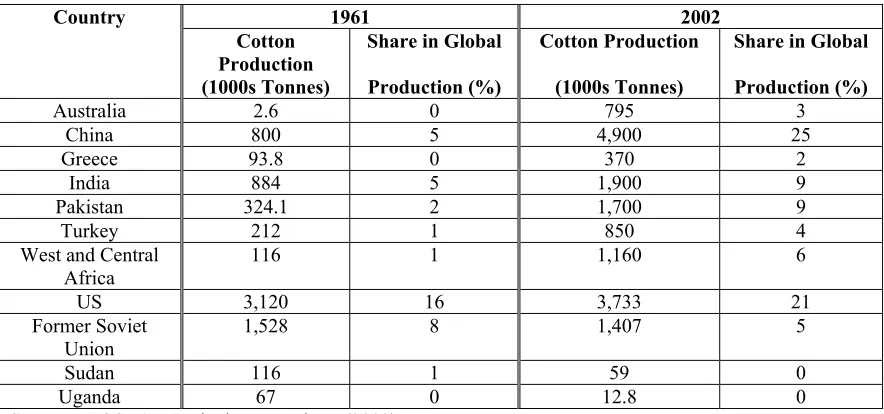
[image:6.612.86.528.306.513.2]More than 70 countries produce and export cotton, while many developed and developing countries depend on imports of cotton lint for their spinning and textile industries. World production in 2001/02 was 18.6 million tonnes, down from 19.6 million tonnes in 1995/96, when cotton prices were 50% higher. Eight countries are responsible for 81% of global output: China; the USA; India; Pakistan; Uzbekistan; Turkey; Brazil; and Australia (see appendix 1). Over the last 40 years cotton production has grown at an annual average rate of two percent, to reach 19.1 million tonnes in 2002/03, from 9.5 million tonnes in 1961/62. Most of this growth has come from new producers (see Table 1). The US and the former Soviet Union, the two largest producers in the 1960s, have broadly retained their cotton production levels. Production in a number of East African countries has declined considerably during this period.
Table 1: Main Producers of Cotton
1961 2002 Country
Cotton Production (1000s Tonnes)
Share in Global
Production (%)
Cotton Production
(1000s Tonnes)
Share in Global
Production (%)
Australia 2.6 0 795 3
China 800 5 4,900 25
Greece 93.8 0 370 2
India 884 5 1,900 9
Pakistan 324.1 2 1,700 9
Turkey 212 1 850 4
West and Central Africa
116 1 1,160 6
US 3,120 16 3,733 21 Former Soviet
Union
1,528 8 1,407 5
Sudan 116 1 59 0
Uganda 67 0 12.8 0
Source: FAOSTAT Agriculture Database (2003)
2.2 Cotton trade
World cotton trade rose by more than 400,000 tonnes during 2002, reaching 6.2 million tonnes. A further increase in world trade to 6.4 million tonnes was projected for 2003 (ICAC, 2002a).
Most traded cotton lint is handled by trading companies. These have a key position between producers (ginning companies) and spinning mills, although it is also common for spinners to source directly from ginning companies in exporting countries. Traders offer purchasing services when producers want to sell, provide bulk cotton supplies to spinning mills, and arrange transport to destination (Heijbroek and Husken, 1996). Although some consolidation in the trading sector has occurred during the last decade, trade is far less concentrated than in the trade of other agricultural commodities, for example cocoa and coffee. According to a survey by ICAC (Guitchounts, 2003), there are at least ‘475 firms engaged, at least in part, in international trade in cotton’. Of these, the largest 19 (most, but not all, of which are private companies) handle around one-third of world production, while the next 49 handle just under 20 percent. The number of the largest cotton-trading companies (handling 200,000 tonnes of cotton a year or more) has remained steady at 19 (private and government owned), handling 39 percent of world production in 2000 (ICAC, 2002b).
Since the mid-1990s, the largest trading companies have expanded their operations significantly in terms of increasing the number of supplying countries from which they purchase. They have also increased investment in ginneries and their involvement with in-country marketing. This has happened in a context where many cotton-producing countries in the southern hemisphere have liberalised their markets, and reflects a reaction to deregulation in those countries. After liberalisation of national cotton sectors, international trading companies have found themselves dependent on multiple and often small- and medium-sized local private companies (as opposed to a few parastatals prior to liberalisation). This has prompted international traders to become more involved in producing countries in order to ensure a constant supply to spinners from a variety of origins and of sufficient volume.
There are a number of reasons why trading companies remain key intermediate agents in cotton trade. First, the geographical and economic fragmentation in global cotton production, in comparison with other (e.g. cocoa and coffee) commodity chains means that cotton producers and consumers are many and dispersed. As such, it would be costly for producers and consumers to oversee the entire market and perform all trade functions themselves. Spinners tend to favour blends of different national origins and qualities in order to obtain the blend demanded by their consumers in the textile industry. Therefore, if spinners were to supply their own needs, they would have to invest considerable resources in obtaining market information and managing the sourcing process directly.
2.2.1 Cotton exports
Around one quarter of world production enters into world trade. Some of the largest cotton producers, such as China, India, Pakistan and Turkey, scarcely export as their production is almost entirely for domestic use. In 2001, exports amounted to 5.4 million tonnes, of which the five largest exporters – the US, Uzbekistan, Australia, Greece and Brazil – contributed 70 percent. West and Central African countries accounted for ten percent of total cotton exports in 2001.
Cotton is a major source of income and export earnings to many developing countries (see Appendix 2). The share of cotton in total exports from a number of West and Central African countries is especially high: 65 percent for Benin; 45 percent for Burkina Faso; 42 percent for Mali; and, 34 percent for Chad. Notably, the share is also high for Uzbekistan (45 percent); Tajikistan (20 percent); Turkmenistan (15 percent); Paraguay (8 percent); Kyrgyzstan (8 percent); and Zimbabwe (7 percent).
There has been significant fluctuation in trade from one year to the next, especially at individual country level (see Appendix 3) but world exports have risen by 18 percent in volume between 1991 and 2001.
2.2.2 Cotton imports
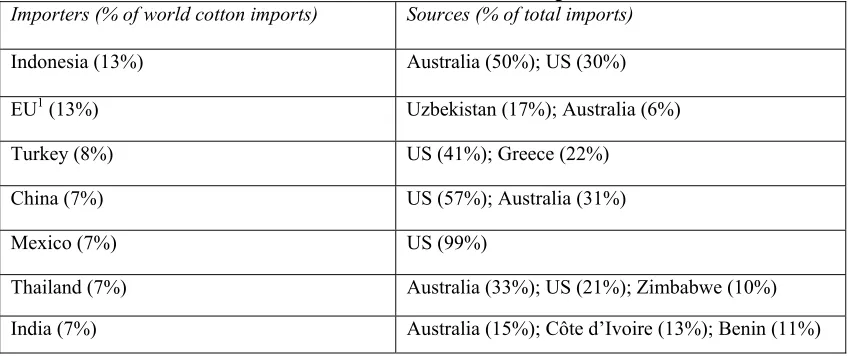
Appendix 4 illustrates world imports of cotton in 2001. The main cotton trade flows are from the major exporters to countries in Asia. The latter region has become the leading importer of cotton in line with its expansion in spinning and textiles. In general, the structure of cotton imports is less concentrated than exports. The largest cotton importers are Indonesia, the EU, Turkey, China, Mexico, Thailand and India (see Table 2 and Appendix 5).
[image:8.612.90.517.527.705.2]The largest increases in cotton demand are taking place in producing countries. In 2002 cotton consumption by China, Turkey, Pakistan and India rose by 670,000 tonnes, contributing to a 500,000 tonne increase in world imports as cotton consumption outpaced domestic production in these countries.
Table 2: Source of Cotton Imports
Importers (% of world cotton imports) Sources (% of total imports)
Indonesia (13%) Australia (50%); US (30%)
EU1 (13%) Uzbekistan (17%); Australia (6%)
Turkey (8%) US (41%); Greece (22%)
China (7%) US (57%); Australia (31%)
Mexico (7%) US (99%)
Thailand (7%) Australia (33%); US (21%); Zimbabwe (10%)
A comparison of changes in the source of imports over time for a number of large importers of cotton shows that in the short term (2000/01-2001/02 – see Appendix 6) market shares exhibit a fair degree of consistency. Taking a slightly longer term perspective (1995/96-2001/02 – see Appendix 7), we still observe consistency in market shares but also the impact of longer-term trends, for example the growth of Australia as a supplier to Asian cotton markets.
Appendix 8 shows cotton import tariffs for all countries. The average world tariff on cotton is 5.3 percent. Cotton tariffs range from 90 percent (for China) to 0 percent (for 64 countries including the EU, Australia and Turkey). Of the other largest cotton-producing countries Brazil imposes a tariff of 9.2 percent, India a tariff of 5 percent, Pakistan 5 percent and Uzbekistan 30 percent. The average tariff for West and Central African countries is 7 percent.
The US charges a specific tariff ranging from 0 cents per kilogram to 31 cents per kilogram on imported cotton (an ad valorem equivalent of 14 percent). For certain types of raw cotton, US imports under NAFTA, the Caribbean Basin Economic Recovery Act, and the US-ANDEAN, US-Israel and US-Jordan trade agreements are duty free within quota limits (see Appendix 9). Although AGOA favours imports of textiles containing African cotton, US imports of raw cotton are excluded under AGOA and its GSP for developing countries.
2.3 World Cotton Prices and the Market for Cotton
2.3.1 Recent trends in world cotton prices
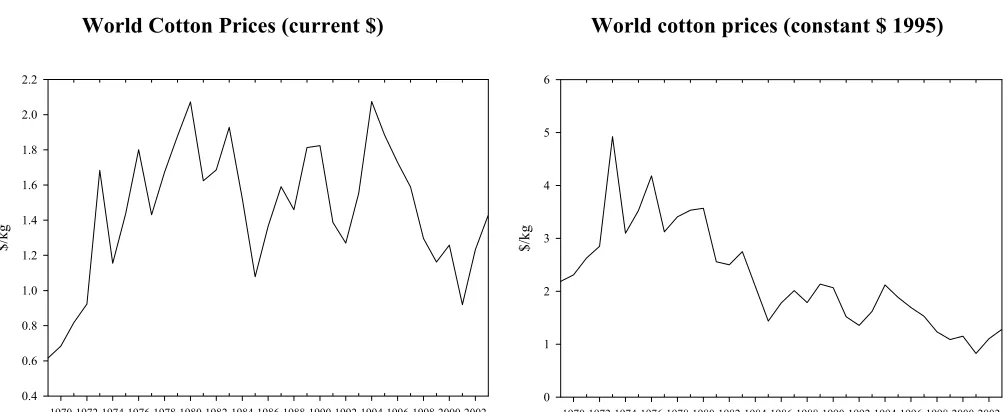
Cotton remains the world’s most important fibre in textile production, with a share of about 40 percent in recent years. World cotton prices have fluctuated since 1990. During the 1960s cotton prices averaged US$2.31 per kilogram. During the 1990s, they averaged US$1.34 per kilogram. The price of cotton expressed in current US dollars fell in the 2001/02 crop year to its lowest annual level in thirty years (see Figure 1).
The low prices in 2001/02 resulted in lower production and higher consumption in the following year. Consumption exceeded production by 1.9 million tonnes in 2002/03 (the surplus being taken from stocks) and the average price for the year was US$1.23 per kilogram (a one-third increase over the previous year) reaching US$1.65 per kilogram by December 2003.
1970 1972 1974 1976 1978 1980 1982 1984 1986 1988 1990 1992 1994 1996 1998 2000 2002
$/
kg
0.4 0.6 0.8 1.0 1.2 1.4 1.6 1.8 2.0 2.2
1970 1972 1974 1976 1978 1980 1982 1984 1986 1988 1990 1992 1994 1996 1998 2000 2002
$/
kg
[image:10.612.49.553.80.286.2]0 1 2 3 4 5 6
Figure 1: Index A
World Cotton Prices (current $) World cotton prices (constant $ 1995)
Source: Data from ICAC and World Bank Development Indicators (2003)
2.3.2 Analysing prices for cotton
There are a variety of ways to analyse cotton prices, but the Cotlook A Index, published by Cotton Outlook, is the most widely used. It is intended to be an ex post record of the level of offering prices on the international raw cotton market and is used by international trading companies, governments and international organisations (e.g. UNCTAD and ICAC) as a measure of the fluctuation of international raw cotton prices. A number of producing countries (e.g. the US) incorporate elements of the A Index into national farm legislation.2
It is possible to obtain premiums and discounts on the world price for cotton: for higher or lower grades; due to characteristics of the fibre (e.g. seed variety); and for market criteria, including timing of shipments and forms of sales.
In addition to the A index there are quotations for coarser qualities of cotton – the B Index, which is the average of the three least expensive of nine styles.3 B-Index quotations move more or less in tandem with the A Index, although price differentials between the A and B Index have widened over the past few years because of individual demand and supply situations in the various quality segments of the markets. Lower demand and higher stocks have placed downward pressure on prices for lower grades of cotton. The Cotlook B Index was two percent below the A Index in 1996, increasing to five percent in 1997, and has averaged ten percent below the A Index since 2000 (Larson, 2003).
2.3.3 Quality characteristics of world cotton
based on staple length, strength and micronaire are closely related to national-origin characteristics of cotton. Some quality factors are readily controlled by individual buyers/ginners, e.g. leaf fragments and uniformity. Other quality factors may require sector-wide efforts, e.g. stickiness, polypropylene, certain spots and stains. This implies that both national origin and firm reputation can be important factors in the price received for cotton.
Staple length
Staple length is essentially a function of seed type although (annual) climatic, atmospheric and soil conditions, ginning practices and storage can affect fibre length.
All cotton producing countries offer a spectrum of different fibre lengths. As such, all cotton produced within a particular country cannot be said to be of a particular staple length per se. However, different national origins can be categorised as belonging to one of four distinct ‘classes’, based on the majority of cotton they produce: extra-fine cotton, fine and high-medium cotton, medium cotton and coarse cotton.
As Figure 2 shows, only a few countries produce and export extra fine (long staple) cotton. US Pima is the leader among the world’s extra fine cotton, not least because US cotton has an international reputation of being contamination-free, relative to the other major producing countries such as Egypt and China (Suh, 2002). A shortage of high-quality cotton has resulted in higher price premiums. The premium for extra fine cotton (represented by American Pima) over the A Index was nearly 100 percent in 2000, compared with an average Pima premium during the 1990s of 70 percent (Townsend, 2000).
The majority of the world’s cotton production tends to fall into the category of medium cotton quality defined by staple length. This includes the majority of cotton produced in Sub-Saharan Africa. As such, it competes not only with cotton within the region, but also with cotton originating from developed countries.
Figure 2: World Cotton Staple Lengths
Extra Fine Cotton (Long Staple) US Pima, Egypt, Sudan, Central Asia
Fine and High-Medium Cotton (Strict Middling, 1-1/8’’) US SJV, Zimbabwe, Australia, West and Central Africa A Index: Medium Cotton (Middling, 1-1/32’’) Saw Ginned Cotton
US California, US Memphis, Australia, Brazil, US Orleans, West and Central Africa, Spain, Uzbekistan, Greece, Mexico, China, Paraguay, Pakistan
Roller Ginned Cotton
Tanzania, Turkey, India, Sudan
B Index: Coarse Cotton (Strict Low Middling)
US Orleans/Texas, Brazil, Uzbekistan, India, Pakistan, Turkey, China, Argentina Source: Larsen (2003).
Strength
Colour
Bleaching and dyeing of cotton cannot fully compensate for cotton which is stained or spotted. There is some influence on colour due to seed type, e.g. West African cotton is ‘creamy’ in appearance but, in general, the whiteness of cotton is determined by (the absence of) spots and stains caused from pests and storage.
Uniformity
Uniformity of cotton concerns sorting and grading processes. Ginners need to ensure that similar fibres are processed. Uniformity is controllable at the primary purchase and ginning stages. Zimbabwean cotton attracts a premium for its reputation of being uniform.
Foreign matter
Contamination, or trash content, is caused by leaf fragments or polypropylene (from sacking) and affects the dyeing properties of cotton. Contamination can spread to large amounts of yarn when cotton from a contaminated source is blended with other bales. At the spinning and dyeing stages it is usually impossible to trace which growth any foreign matter came from and which trader supplied it (hence it is a credence attribute).
In high-speed automated mills there is little opportunity to check for foreign matter, but in countries with low labour costs a team of workers may be employed to visually check cotton bales for contamination. Thus, traditional mills in such countries as India and China will still buy cotton lint with suspected high foreign matter albeit at a heavily discounted price.
Stickiness
Honeydew or stickiness tends to affect whole production areas due to infestation by particular insects. At the spinning stage, sticky lumps may cause entire machines to be shut down in order to be cleaned. Honeydew can be controlled by spraying. Cotton from Cameroon used to have a reputation for stickiness but has overcome this through concerted pest control efforts.
Other factors
2.3.4 Substitutability of cotton from different national origins
Within staple length categories, substitutability between national origins rises as staple lengths fall. This is because (i) fewer countries produce cotton of a longer staple length and (ii) spinners are more concerned at higher staple lengths to maintain blend consistency.
In general, even within staple length categories, there is some cost to switching between similar growths of different national origin. This means principally changing settings on spinning machines and there is some trial and error involved.
However, where a sufficient price differential emerges most spinners will switch the source of their cotton. In this regard, some spinners are perceived as being more conservative than others in their national choices. For example, Thailand is viewed as being conservative as compared with China and India, which are perceived by traders to be more price sensitive.
2.3.5 Cotton quality in Sub-Saharan Africa
Traditionally, cotton lint originating from West and Central Africa has been of either high-medium or medium quality. On average, West and Central African cotton lint commands a 9.3 percent quality premium above the A Index, where part of the premium derives from a very low count of knotted and short fibre content. Further, the region’s lint has a reputation for (relatively) low levels of contamination (Levin, 1999; Goreux and Macrae, 2002).
Roller gins, as opposed to saw gins, are superior in terms of maintaining fibre length during the ginning process, an attribute for which textile producers have been inclined to pay a premium. As such, Uganda and Tanzania have traditionally occupied a unique position as being two of only a handful of countries exporting roller ginned lint (more than 80 percent of traded cotton is saw ginned). Since liberalisation, however, Tanzania (and to a lesser extent Uganda) has lost this unique position. At least half of the new private ginneries in Tanzania are saw gins, which conventionally produce lower-quality cotton, to which no premium is attached per se (Gibbon, 1998). Poor harvesting practices and storage facilities at farm level are also problems in the sector which have caused serious contamination of seed cotton. This has been reflected in lint quality and has influenced the broader reputation of Tanzanian cotton and the premiums and discounts with which it is associated. According to ITMF (2001), Tanzanian lint is now ranked as the twelfth most contaminated out of thirty national origins reported.
On the other hand, Uganda still maintains a niche market position by supplying mainly roller-ginned cotton lint (only four out of approximately 35 operational gins are saw gins) and the quality is still considered relatively high compared to Tanzanian cotton lint (Lundbaek, 2002). Nevertheless, Uganda’s production of cotton lint remains relatively low.
sectors’ ability to maintain higher-quality cotton lint is the nature of competition for seed cotton and composition of ginning companies. The dominant ginning companies in Zimbabwe and Zambia (three companies controlling around 90 percent of the seed cotton market) have made large fixed investments in ginneries and have developed input credit schemes in order to obtain sufficient supply of high-quality seed cotton. In Zambia, the two largest ginning companies (Clark and Dunavant) only compete in one province (and only against each other), while Dunavant has a dominant market position in the other provinces.
Against this background, Zambia and Zimbabwe have the most secure position in relation to crop reputation in Anglophone Sub-Saharan Africa. Ginning companies are able to offer high volumes of a range of standardised and homogeneous cotton lint quality without the risk of contamination. During the last decade, Zimbabwean cotton lint has commanded a premium around ten percent above the A Index. Zambian lint also obtains a significant premium above the A Index. However, the reputation of Zimbabwean lint as being contamination free has recently been questioned by some Asian and South African spinners and the premium has declined. This might be associated with weather-related factors, as the last two seasons have been drought years. It could also indicate that the price differentials between the higher grades have narrowed, which may reduce incentives for farmers to grade properly before selling their produce (Hanyani-Mlambo et al., 2003).
2.3.6 Measuring the quality of cotton
Since the late 1970s spinners have searched for improved consistency of fibre measurement and have imposed higher demands for quality. This has followed on from two distinct developments. First, new technologies in high-speed yarn spinning make detailed measurement of the strengths of fibres more important (Bradow and Davidonis, 2000). Second, increased competition in spinning and textile markets has led to product differentiation (and more sophisticated textiles) as a basis for competition.
This led to the development of a new system of mechanical classification – the so-called High Volume Instrument (HVI) – able to measure virtually all main fibre characteristics giving users more exact descriptions of the relevant properties of the cotton lint. Since 1993, samples from all cotton bales produced in the US have been HVI classified prior to sale. More recently, the entire Australian, Brazilian and Israeli cotton crop has been HVI classified, while HVI machines have been installed in several African countries.4
As a result, two tendencies are predicted. First, a trend towards contractual agreements, based on arrangements between individual companies, stating that cotton lint is supplied according to HVI specifications (Daviron and Gibbon, 2002). In this case, producers/ginners bypass international traders by selling directly to spinners offering detailed HVI assessments of the quality of cotton lint, based on the spinners’ demands for specific qualities.
degree of inter-substitution and flexibility in blend formulas remains lower than for coffee and cocoa, where processors have become decreasingly dependent on national origins. Most spinners normally favour specific blends of different national origin in order to obtain desired yarn properties. Thus, while the HVI system provides a potential means to facilitating a higher degree of substitution between different cotton lint qualities, the reputation of national origins is still an important source of differentiation. This is largely due to uncertainties surrounding the reliability of test results and dependency on testing samples as opposed to assessing entire bales of cotton lint. Reliable test results depend critically on calibration methods and procedures as well as demanding at least accurate control and measurement of atmospheric conditions, in particular relative humidity and temperature.
2.4 Conclusion
3. Cotton Subsidies and their Impact
3.1 Government support to the cotton sector
Cotton prices have been depressed by government support to cotton exporters, notably in the US, China and the EU. Price distortions caused by government interventions in the cotton sector have been declining over time, but they are still significant. In 1999/2000, eight countries had distortionary policies affecting 52 percent of world cotton production. This was down from 1986 when 25 countries had distortionary policies, affecting 69 percent of world production (Valderrama Becerra, 2000). Cotton-producing countries with little or no intervention include: Argentina, Australia, El Salvador, Guatemala, Israel, Nicaragua, Nigeria, Paraguay, Peru and Venezuela.
[image:16.612.89.532.337.502.2]Table 3 summarises government assistance to cotton production. For 1999/2000 the average level of assistance across all subsidising countries was US$0.58 per kilogram (equivalent to 48% of the world price). Interventions by Brazil, Mexico and Egypt have only a minor impact on the world cotton market. They have relatively low levels of assistance and their production amounts to a small proportion of world output.
Table 3: Government Assistance to Cotton Producers*
1999/2000 2001/02 1999/2000 2001/02
US$ per kilogram Assistance US$ million
US 0.75 0.47 2065 2300
China 0.43 0.23 1534 1200 EU
Greece Spain
1.39 1.36 1.50
1.37 1.30 1.67
844 638 206
700 n.a. n.a.
Turkey 0.24 n.a. 198
Brazil 0.07 n.a. 44
Mexico 0.20 n.a. 28
Egypt 0.09 n.a. 20
150
Total 4733 4350
*Direct support to producers
Source: Valderrama (1999); ICAC (2000)
3.1.1 US
The US is the second-largest cotton producer and by far the largest exporter. Consequently, its policies exert a strong influence on the world cotton market. A number of commodity (including cotton) programmes exist in the US. The objectives of these programmes have evolved around two themes: raising farm incomes and preserving small farms. The budgetary outlays for most of these programmes are authorised by Congress every few years through various Acts, more commonly known as Farm Bills.
The 1985 Farm Bill replaced support managed through public stockholding with a price support mechanism known as deficiency payments.
The 1996 Farm Bill marked an important stage in US subsidy policy by introducing direct payments to producers which were decoupled from production. The Act (which encompasses all agriculture including cotton) aimed to spend US$47 billion between 1996 and 2002, with US$35 billion as direct income payments to farmers. Since world prices have been lower than anticipated when the 1996 agricultural law was passed, Congress has had to make additional appropriations to prevent the price received by cotton farmers from falling below the price target of US$1.59 per kilogram retained in the 1996 and 2002 Farm Laws. By the end of 2000 an additional US$22 billion was spent topping up farm incomes. An additional US$11.5 billion was proposed for 2001.
The main channels of support under the 1996 Farm Bill were decoupled payments, market price payments, insurance, export subsidies and emergency payments.
For decoupled payments, by signing a Production Flexibility Contract (PFC) a farmer who produced a quantity of cotton during a reference period ending in 1995 received in 1996, and in each of the five subsequent years, a payment determined by this. These were designed to compensate cotton producers for the loss of some market price support under the 1996 Farm Bill. In 1999/2000 these payments totalled US$623 million.
Market price payments, which consist of market assistance loans and loan deficiency payments, are designed to compensate cotton farmers for the difference between the world price and the loan rate (i.e., a support price) when the latter exceeds the former. Cotton loan rates are determined according to a statutory formula that compares domestic and world prices. The minimum loan rate is US$1.10 per kilogram and the maximum is US$1.14 per kilogram. Producers must have their cotton ginned and placed in a Community Credit Corporation (CCC) approved warehouse. Cotton placed under a marketing assistance loan may be forfeited to the CCC when the loan expires. Terms of the loan are usually for ten months.
An Adjusted World Price (AWP) for cotton is calculated, based on Northern European cotton prices adjusted to US base quality and average location. Eligible farmers will take out a loan with the CCC on their cotton at time of ginning, with the value of the loan based on their level of production valued at the loan rate. When the loan is repaid, the loan repayment rate is the lower of the loan rate or the AWP. This guarantees that farmers receive at least the loan rate for their cotton. If, for example, the AWP is US$0.88 per kilogram at the time the loan is repaid, the farmer need only pay back at the rate of US$0.88 per kilogram, having earlier taken out a loan at the loan rate of US$1.14 per kilogram. The difference is made up by the government programme. Under certain circumstances, interest charges on loans and warehouse charges are also met by the government.
Eligible producers who do not take out the loan can apply for a loan-deficiency payment which, like the marketing loan, is equal to the difference between the AWP and the loan rate when the AWP is below the loan rate.
level of the base loan rate. For export-subsidy payments to be made, the US domestic price must exceed the Northern European cotton price by more than US$0.0275 per kilogram for four consecutive weeks, and, secondly, the AWP must be within 134 percent of the base loan rate. The objective of US export subsidies is to bridge the gap between higher US domestic prices and world prices, so that US exporters maintain their competitiveness.
Spending for export subsidies was capped at US$201 million for the 1996–2002 period, but this level was passed by the end of 1998. In 1999 Congress passed the US Agricultural Appropriateness Bill which provided an additional US$200 million in 2000 and US$430 million through to 2002 for export subsidies.
In 2002, the US introduced the 2002 Farm Bill, which is expected to be in place for the next six years. As a result, government assistance could increase from 32 percent of average farmer income under the 1996 Farm Law to 45 percent under the new law, since the new law modifies the nature of several types of subsidies (Shurley, 2002). The 2002 Farm Bill replaced the PFC payments with a direct payment. Payments are based on historical planted area and yield rather than actual production. It also allows farmers to select the 1998–2001 period instead of the previous one, if they believe that they will gain in changing the base. Consequently, a farmer who has increased production in recent years receives more than one who has reduced it. Direct payments are independent of market prices and are set at US$0.15 per kilogram for 2002/03.
The Farm Bill also introduced anti-cyclical measures, which are implemented when the effective price is below the target price. The effective price is the direct payment, plus the higher of the national average market price paid to producers or the loan rate. In 2002/03 the loan rate was set at US$0.52 and the target price was US$0.724. The 2002 Farm Bill continues to offer the loan deficiency payment – issued when world prices adjusted by quality and location are below the loan rate. It is estimated that total direct income and price support in the US amounted to US$2 billion in 2002/03.
3.1.2 EU
Cotton support in the EU began in 1981 when Greece and Spain joined the EU’s Common Agricultural Policy (CAP), as cotton cultivation is sizeable only in Greece and Spain. Together Spain and Greece accounted for 2.5 percent of world production and 6 percent of world exports in 2001, but they accounted for 16 percent of world cotton subsidies. In 2001/02, subsidies reached US$979 million estimated to decrease to US$957 million in 2002/03. The strengthening of the euro over the last two years has affected EU support expressed in US dollars: while estimated support for 2002/03 represents a 2 percent decline in dollars, in euros support represents a 5.7 percent decline.
Under the CAP, support is given to cotton producers based on the difference between the market price and a support price. Advance payments, which are made to ginners who pass the subsidy to growers in the form of higher prices, are based on estimates of seed-cotton production. The CAP also influences the quantity of seed-cotton produced by setting a maximum guaranteed quantity of seed cotton for which assistance is provided – 782,000 tonnes for Greece and 249,000 tonnes for Spain.
maintained, penalties (i.e., reduction in subsidies) for excess production over the maximum guaranteed quantity have increased. Under the reformed policy, for each 1 percent of excess production, the level of subsidy is lowered by 0.6 percent of the support price as compared with 0.5 percent prior to 1999.
The support price for cotton is set at €1.063 per kilogram. In the last two years, Greece exceeded its quota by a great deal more than Spain and received a price 28 percent lower than Spain because of higher penalties.
In addition to output subsidies, EU cotton producers also receive subsidies on inputs such as credit for machinery purchase, insurance and publicly financed irrigation.
3.1.3 China
China’s intervention in its cotton sector began in 1953 with the introduction of the First Five Year Plan. The central planning policies adopted then were based on those of the Soviet Union and remained in place for the next 35 years. The central government set production targets and procurement quotas through Chinatex, a public agency. A measure to boost cotton production was taken in 1978 by increasing the price of cotton as well as supplying more fertiliser to cotton farmers. A second boost came in 1980 with the partial abolition of the communal production system under the Household Responsibility System which gave land-use rights to individual farmers.
The Chinese government sets a reference price for cotton, but since 1999 has introduced reforms to allow actual prices to be negotiated between buyers and sellers – the price can now go somewhat below the reference price. The reference price for 1999/00 was set at an equivalent of US$1.21 per kilogram, some 30 percent below reference prices for 1997/98. Prior to these recent reforms, state cotton companies were obliged to buy the entire cotton crop at national procurement prices.
Procurement prices are generally set above world prices and provide producers with price support. Total price and income support in 1998/99 in China was estimated at US$2.7 billion.
The Chinese government is attempting to reduce the large stocks of cotton and to broaden marketing distribution to allow state mills to purchase cotton directly from farmers. In some sense the reforms have worked: the level of China’s stocks has fallen from 4.7 million tonnes in 1997 to 1.8 million tonnes by 2001. The stocks-reduction policy of the government of China has resulted in local prices declining more rapidly than international prices, and government expenditures to assist cotton growers are estimated to have declined from US$1.2 billion in 2001/02 to US$750 million in 2002/03.
Cotton exports are subsidised through direct payments made by the central government to exporting agencies. These payments attempt to bridge the gap between higher domestic prices and world prices. In 1999/00 these amounted to US$86 million or US$0.29 per kilogram.
3.1.4 Support in other countries
Brazil
Cotton farmers in Brazil receive a minimum guaranteed price that is slightly above the world price. In 1998 government subsidies amounted to an estimated US$52 million. Cotton growers in Brazil also receive a preferential interest rate and tax rebates.
In 2001/02, Brazilian domestic prices fell below the minimum guaranteed prices, which were set at US$0.81 per kilogram, and the government spent an extra US$9.6 million to cover the difference. For 2002/03, market prices were well above the minimum guaranteed price, set at US$0.77 per kilogram of lint, and no assistance was offered.
Mexico
A small amount of assistance is provided to Mexican cotton farmers, which in 1998/99 was the equivalent to US$15 million or US$0.07 per kilogram. Cotton growers also receive technical assistance, assistance for crop insurance and assistance for price risk management.
With a drop in world cotton prices, additional assistance was offered in 1999/00 equivalent to US$188 per hectare.
In 2001/02, assistance to cotton growers was provided by the government of Mexico at a rate of US$194 per hectare, equivalent to US$18 million. For 2002/03, the government approved legislation to offer a support price mechanism with a target price of US$1.41 per kilogram, worth US$7 million in aggregate support.
Turkey
The challenge for Turkey has been to provide some assistance to cotton farmers without harming the competitiveness of the textile sector. In 1997/98 minimum support prices were set for the major producing areas which averaged US$0.24 above the world price. Since 1998, the government has implemented a procurement price set at the prevailing world market price, but all cotton growers are entitled to a premium payment based on deliveries of seed cotton to cooperatives or private gins.
Government support for cotton farmers in Turkey was estimated to be at US$212 million for 1999/00. Lower prices moved the Turkish government to offer a premium of US$0.07 per kilogram of lint to cotton growers in 2001/02, equivalent to an extra US$59 million.
Egypt
As prices declined during 2000/01, the government of Egypt provided US$23 million of support per year. In 2002/03, the government budgeted US$33 million to help finance the difference between market prices and prices paid to producers.
Côte d’Ivoire
India
Cotton production policies in India have historically been orientated towards promoting and supporting the textile industry. The government offers a minimum support price for each variety of seed cotton on the basis of recommendations from the Commission for Agricultural Costs and Prices. In all states except Maharashtra, where there is state monopoly procurement, the government run Cotton Corporation of India (CCI) is entrusted with market intervention operations in the event that prices fall below the minimum support price. In Maharashtra, cotton growers are prohibited from selling seed cotton to any buyer other than the Maharashtra State Cooperative Marketing Federation. In addition, the Indian government has also supplied inputs to farmers at highly subsidised rates.
3.2 Cotton subsidies under the WTO
During the Uruguay Round negotiators attempted to separate domestic policies judged to have no direct effect on agricultural trade (green box), from those that did have clear trade and production distorting effects (amber box). Policies in the amber box were subject to a reduction of 20% over 6 years. Direct payments could be moved to the green box provided that they were ‘decoupled’ from production. This provided freedom to increase domestic assistance levels. The restructuring of the EU’s Common Agricultural Policy under the 1992 MacSharry and 2003 reforms moved support from the amber into the blue and green boxes. Green-box support, however, has had a major cost-reducing effect, because the support it provided to farmers allowed them to produce and export more cheaply.
In addition to the green box, three other forms of assistance were not affected by the Uruguay Round reduction commitments. These corresponded to (i) developmental objectives in developing countries; (ii) de miminis levels according to which five percent (ten percent in the case of developing countries) of the contributions in the amber box were exempt; and (iii) direct payments for production-limiting programmes or the so-called blue box (mainly used by the EU).
Blue-box measures include payments to farmers for reducing production on the basis of pre-determined areas. Blue box subsidies granted by the EU based on pre-determined quantities of seed cotton have trade-distorting effects, since production in Greece and Spain would fall sharply if the subsidies were eliminated.
3.3 Challenges to Subsidies
In 2003, Brazil was the first country to make a formal complaint under the WTO dispute mechanism about US subsidies, contending that these depressed world prices and were injurious to Brazilian cotton growers, while significantly increasing the US share of the global cotton market. Brazil maintained that the US had doubled the level of subsidies to its farmers since 1992, so that cotton subsidies were not covered by the immunity granted under the ‘peace clause’ of the WTO’s Agreement on Agriculture. This clause protected countries using subsidies from being challenged under other WTO agreements, as long as the level of domestic support for a commodity remained at or below 1992 levels. Central to the legal challenge were direct payments to US farmers under the 1996 and 2002 Farm Bills, as well as payments under emergency supplemental appropriation bills. The US government argued that direct payments are de-coupled (not linked to current production), not trade distorting and should not have been counted when compared to 1992 levels of support.
On 16 May 2003, Burkina Faso, on behalf of Benin, Mali and Chad, presented the WTO’s Trade Negotiations Committee with a new proposal for cotton entitled Poverty
Reduction: Sectoral Initiative in Favour of Cotton. The initiative called for two decisions
to be taken at the Cancún Ministerial meeting in September 2003:
1) The establishment of a ‘mechanism for phasing out support for cotton production with a view to its total elimination’, which would provide for ‘substantial and accelerated reductions in each of the boxes of support for cotton production’; and, 2) The establishment of transitional measures for Least Developed countries: ‘until
cotton production support measures have been completely eliminated, cotton producers in Least Developed countries should be offered financial compensation to offset the income they are losing, as an integral part of the rights and obligations resulting from the Doha Round’.
According to the proposal – supported by 13 other West and Central African countries5 – the elimination of subsidies for cotton production and export is their ‘only specific interest’ in the Doha Round.
4. The Impact of Removing Cotton Subsidies on Developing Countries
4.1 Impact of distortions
Numerous previous studies have attempted to measure the impact of cotton subsidies on world cotton prices and production. It is difficult to draw direct comparisons because most analyses adopt different methodologies, examine the impacts on a different set of countries and use different reference years to estimate the effects of subsidy removal. In addition, simulations assuming that all commodity prices are liberalised, not just cotton, are not directly comparable because of both growth and relative price effects.However, the results do serve to provide an initial insight into the magnitude of likely impacts.
The Centre for International Economics (2002) simulates the effect of full liberalisation of textiles trade, as well as that of eliminating subsidies to cotton production and exports of cotton fibre. They estimate that for 2000/01 the elimination of quotas and tariffs on yarns, textiles and clothing would raise cotton prices by 4.1 percent, while the elimination of subsidies would raise them by 10.7 percent.
Quirke (2001) uses the GTAP model to simulate the economic effects on Australian cotton production of the removal of all production and income assistance to cotton producers in China and the US (not the EU), as well as the removal of all tariffs on cotton. The model uses trade and production data for 1999 and assumes US assistance to the cotton sector equal to US$0.31 per kilogram and US$0.59 per kilogram for China. The effects are found to be:
1) a drop in US (-15.9 percent) and Chinese (-19.5 percent) cotton production; 2) an increase in the world price of cotton (13.4 percent); and,
3) an increase in Australian cotton production of 44 percent and a 53 percent increase in the net income of the cotton industry.
The results do not indicate, however, the impact of cotton support on developing countries, either as a group or individually.
The International Cotton Advisory Committee (2003b) uses a short-run partial-equilibrium analysis to estimate the impact of direct subsidies in the cotton sector. This model makes a number of assumptions. First, given that there is no measurement of the supply response to prices in all subsidising countries, it assumes a US elasticity for all subsidising countries. Secondly, demand response to higher prices resulting from a removal of subsidies is measured by the price demand elasticity provided by the ICAC Textile demand model (-0.05). Thirdly, a measurement of the supply response of other countries to higher prices resulting from the removal of subsidies is assumed to be 0.47. The analysis concludes that average cotton prices in the absence of subsidies would have been 30 percent and 71 percent higher in the 2000/01 and 2001/02 seasons respectively.
Secondly, the model incorporates forecasts of macroeconomic variables, such as gross domestic product, inflation rates, exchange rates and population. The cotton simulation holds these constant. The FAPRI model assumes complete liberalisation of all commodity sectors, i.e., removal of trade barriers and production and export subsidies. For cotton, world prices increase by 15% over the 19 year period of the simulation, as compared with 2002 levels. US cotton production, consumption and net cotton exports decline by 11 percent, 2 percent and 13 percent respectively. EU cotton production falls by about 79 percent and net cotton imports increase by 143.1 percent. As world prices rise, Africa increases its cotton exports by 12.3 percent above the baseline level.
The IMF economist Tokarick (2003) uses a partial equilibrium estimate removing support for cotton and other commodities. Agricultural support is represented by four types of measures in the model: tariffs, export subsidies, production subsidies and input subsidies. The model was used to simulate removal of each type of support. Support measures for cotton were constructed from budget data maintained by the US Department of Agriculture. Four elasticity parameters were used: the domestic price elasticity of demand; the domestic price elasticity of supply; the import demand elasticity in the rest of the world; and the export supply elasticity in the rest of the world. Demand elasticities were assumed to equal -0.75 and supply elasticities were assumed to equal 1.5. Each of the four simulations was performed on a multilateral basis and, as such, all countries were assumed to liberalise at the same time. For cotton, the model predicts that removal of price support would lead to a 0.8 percent increase in world price, and removal of production subsidies would lead to a 2.8 percent increase in world price. No estimates are provided for the effect of removing input subsidies in the cotton sector.
One of the most influential studies is undertaken by Goreux (2003) who uses a partial equilibrium model to estimate the impact of cotton subsidies on export earnings in West and Central Africa. The results from this model were used by Benin, Chad, Burkina Faso and Mali in their submission to the WTO in which they argued that export subsidies in the cotton sector reduced world prices by 15.2 percent and West and Central African export earnings by US$250 million for 2001/02. The model assumes:
1) trade and production data for 1999/00; 2) subsidies for 1999/00;
3) world prices for 1999/00 (US$1.16 per kilogram); 4) a single world market;
5) a price elasticity of supply equal to +0.5 and a price elasticity of demand equal to -0.1; and
6) perfectly free entry and exit of all producers.
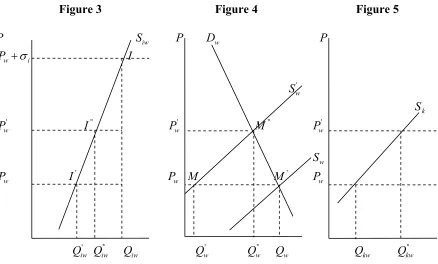
The presentation of the partial equilibrium model used by Goreux (2003) is reproduced below in terms of demand and supply curves. Figure 3 relates to producer country i where cotton is subsidised; Figure 4 represents the world cotton market, w; and Figure 5 relates to producer country k where cotton is not subsidised.
Figure 3, shows the supply curve (Siw) of cotton-subsidising country i to the world
market. With subsidy σi, equilibrium point I corresponds to price Pw+σi and quantity iw
Q . Without subsidy, producers in country i only receive Pw and produce '
iw
[image:25.612.94.532.160.424.2]Q . The equilibrium point moves left from I to I' and production for the world market is reduced by Q Qiw' iw.
Figure 3 Figure 4 Figure 5
P S iw P Dw P
w i
P +σ I
'
w
S
Sk '
w
P I'' Pw'
''
M Pw'
Sw
w
P I' Pw M
'
M Pw
'
iw
Q Qiw'' Qiw '
w
Q ''
w
Q Qw Qkw ''
kw
Q
Moving back to Figure 4, without the subsidy in country i, the supply curve faces the world marketshifts left from equilibrium Qw to
'
w
Q , with the size of MM' corresponding to the quantity of cotton withdrawn from the market due to the removal of subsidies in country i. Since the world demand curve Dw remains unchanged, the new equilibrium
point is ''
M corresponding to price '
w
P and quantity ''
w
Q .
Moving back to Figure 3, the new equilibrium is point ''
I because the new price '
w
P is
higher than Pw but lower than Pw+σi. This leads to an increase in production from
'
iw
Q
to ''
iw
Q . In Figure 5, non-subsidising country production to the world market increases from Qkw to
''
kw
Q . The income increase for the cotton sector of non-subsidising country k
results from two components. First, country k now sells the quantity Qkw at price '
w
P
instead of Pw. Secondly the country now sells
''
kw kw
4.2 The structure of the world cotton (lint) market
Previous attempts to model the impact of subsidy withdrawal on world cotton trade and producer incomes, discussed in the previous section, have assumed a single, unitary market for cotton in which buyers choose between essentially homogeneous consignments of lint from different producing countries on the basis primarily of price. In section 2.3 we presented some information on the cotton market. On the basis of that, here we consider the extent to which this assumption of a unitary lint market fits the evidence.6 As will be shown in the following section, the overall impacts of complete subsidy removal (in terms of world price adjustment) are greater and the distribution of the resulting benefits more favourable to poorer countries in a unitary market than in a fragmented world cotton market. However, the impact of the removal of EU cotton subsidies on producers in poorer countries is greater in a fragmented world cotton market.
Economic models of the world cotton market focus on producing and consuming countries. With widespread liberalisation of cotton sectors, however, there are generally several exporters operating in a given producer country and often a larger number of spinners in consuming countries. In between are a large number of international trading companies (see Section 2.2), whose expertise lies in being able to satisfy the year-round demands of particular spinners for particular types of lint, through well-developed contacts with a range of suppliers (exporters and/or ginners).
As with all commodities, cotton comes in a range of qualities (see Section 2.3.3). Indeed, the number of attributes that can distinguish one consignment from another is high. The highest class of cotton (extra fine/Pima) functions almost as a market apart from the remainder.
Spinners’ decisions on where to source lint are influenced by quality attributes of the lint product. Some of these are largely determined at national level, through the seed varieties developed in a particular country or the agro-climatic conditions prevailing there, or through national factors outside the control of participants in the cotton sector (e.g. port efficiency). Others are under the control of individual ginning and exporting firms (e.g. control of most types of foreign matter). Some are most readily controlled at sectoral level (e.g. the honeydew that causes stickiness or polypropylene contamination). Where a national cotton sector is dominated by one or two firms, their efforts may be sufficient to ensure that these factors are adequately controlled throughout the sector. However, where sectors consist of numerous small players, central coordinating action may be required (Poulton et al., 2004) and that particular quality attribute can be considered effectively out of the control of individual ginners and exporters.
different settings on spinning machines and successfully adjusting a factory to new settings involves a process of trial and error. Hence, spinners tend to be conservative (a description used by traders): once they have hit on a particular blend of different lint types that suits the product that they are making, they like to stay with it if they can. Modifying the blend to incorporate a new national origin is done only if necessary (see section 2.3.4).
This tends to produce ‘stickiness’ in the world cotton market: today’s trade flows are a good initial indicator of tomorrow’s. However, market shares can and do change over time (see section 2.2). Most notable is the recent rise in import penetration by Australian lint, reflecting its rise to prominence during the 1990s as a supplier of Asian markets, based on a superb quality reputation. Central Asia (where water shortages have led to production problems) and Pakistan (a victim of drought in 2001/02) have both lost market share.
Hence, there are limits to the ‘stickiness’ in world markets. Different lint sources are imperfectly substitutable, but not completely so. If a particular cotton sector runs into difficulties (e.g. the quality control problems encountered by various African sectors immediately after liberalisation) or if a new source appears that can supply lint at lower prices than more established competitors (Brazil is the best current example7), then some spinners will eventually decide to modify their blend in response to the change in relative prices.
The world cotton market is best characterised by monopolistic competition. Particular national origins are valued by particular spinners, who have evolved blends incorporating them. Thus, small changes in relative prices will not induce changes in trade flows. However, when a larger margin opens up or when a particular supply source becomes less reliable in either quality or quantity, many spinners will, however reluctantly, decide to switch.
Lack of data means that it is not possible to model this monopolistically competitive market with any accuracy. However, an anecdotal example, provided by one trader, relating to West African and Australian lint, is that Australian lint may be preferred by some Asian spinners with a price premium of up to US$0.13 per kilogram, owing to its impeccable quality and quick supply time to Asia. If the margin exceeds this (due, for example, to recent shortages of Australian lint as a result of a persistent drought), then these spinners may switch to West African lint.
4.3 Supply Elasticities
Most previous models have assumed the same supply elasticities for all countries, but analysis of the principal suppliers (see Chapter 5) suggests that this is wrong. In particular, the West and central African countries may have high supply elasticities. We therefore test the sensitivity of the results to different supply elasticities.
4.4 Modelling the effect of the removal of subsidies on export earnings in West and Central Africa
In this section, we simulate an adapted version of the Goreux (2003) model, assuming a single world market for cotton. We then proceed to test the robustness of the model by relaxing the assumption of a single world market. Instead, we assume that the market for cotton is fragmented into individual-country cotton markets, between which the price of cotton can differ and in which the entry of new and exit of existing producers is prohibited.9 The algebraic formulation of the fragmented market model and the sequence of steps is presented in Appendix 11.
For the purposes of our model, we assume a constant price elasticity of demand equal to -0.110 and estimate a price elasticity of supply for world cotton production, based on ICAC production and price data, equal to 0.5. In addition, however, we also use estimated individual supply responses for a number of developing-country producers (see Section 5.10) and assume supply constraints for Australia,11 Tajikistan, Turkmenistan and Uzbekistan.12
[image:28.612.84.531.514.575.2]Our model uses bilateral trade and production data for 200113 and assumes that the price of cotton in each individual cotton market before the removal of subsidies is US$1.16 per kilogram. We also use subsidy data for 1999/00 (see Table 4).
Table 4: Subsidies ($ per kilogram)
95/96 96/97 97/98 98/99 99/00 00/01 01/02
US 0.0022 0.1694 0.15268 0.4906 0.7458 0.3476 0.4664
China 0.4378 0.5962 0.4268 0.4356 0.2266
Greece 1.936 1.848 1.364 1.276 1.298
4.4 The effects of cotton subsidies
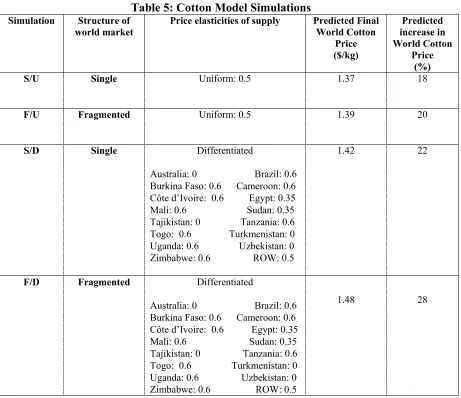
[image:29.612.85.546.141.539.2]Four simulations of the effect of removing subsidies relative to the base year were carried out using different assumptions regarding the structure of the world market and price elasticities of supply (see Table 5). Under all the price of cotton rises substantially by 18-28%.14
Table 5: Cotton Model Simulations
Simulation Structure of
world market
Price elasticities of supply Predicted Final
World Cotton Price ($/kg)
Predicted increase in World Cotton
Price (%)
Uniform: 0.5 1.37 18
Single S/U
Uniform: 0.5 1.39 20
Fragmented F/U
Differentiated 1.42 22
Single
Australia: 0 Brazil: 0.6 Burkina Faso: 0.6 Cameroon: 0.6 Côte d’Ivoire: 0.6 Egypt: 0.35 Mali: 0.6 Sudan: 0.35 Tajikistan: 0 Tanzania: 0.6 Togo: 0.6 Turkmenistan: 0 Uganda: 0.6 Uzbekistan: 0 S/D
Zimbabwe: 0.6 ROW: 0.5
Differentiated Fragmented
Australia: 0 Brazil: 0.6 1.48 28
Burkina Faso: 0.6 Cameroon: 0.6 Côte d’Ivoire: 0.6 Egypt: 0.35 Mali: 0.6 Sudan: 0.35 Tajikistan: 0 Tanzania: 0.6 Togo: 0.6 Turkmenistan: 0 Uganda: 0.6 Uzbekistan: 0 F/D
Zimbabwe: 0.6 ROW: 0.5
Before the elimination of subsidies, world production of cotton is equal to 20.41 million tonnes (see Appendix 14). Of this, only 26 percent is traded. Non-subsidised producers receive US$1161.60 per tonne for cotton sold in all markets, while US, Chinese, Greek and Spanish producers receive US$1907.60, US$1588.40, US$2525.60 and US$2657.60 per tonne respectively, as a result of the subsidies provided by their governments.
Table 6: Production of Cotton in West and Central Africa before the Elimination of Subsidies
Country Cotton Production
(tonnes)
Earnings from cotton production
($ thousands)
Benin 107,334 124,679
Burkina Faso 59,308 68,892
Cameroon 83,865 97,418
Central African Republic 11,100 12,894
Chad 46,087 53,535
Congo 9,315 10,820
Côte d’Ivoire 88,034 102,260
Gambia 100 116
Ghana 7,672 8,912
Guinea 1,330 1,545
Guinea-Bissau 2,949 3,426
Liberia 40 46
Mali 251,748 292,430
Niger 6,889 8,002
Nigeria 149,595 173,770
Togo 3,575 4,153
Total 828,941 962,898
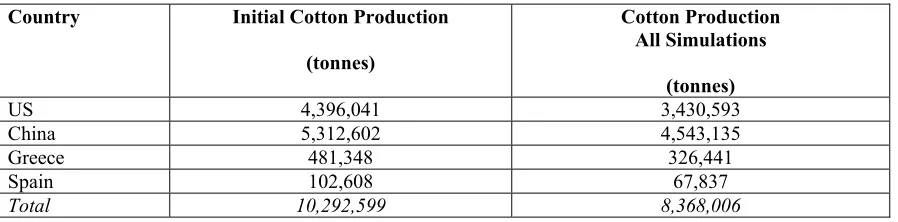
[image:30.612.86.535.487.598.2]The first effect is that without subsidy US, Chinese, Greek and Spanish producers receive only US$1161.60 per tonne of cotton. As a result, US production falls by 22 percent, Chinese production falls by 14 percent, Greek production falls by 32 percent and Spanish production falls by 34 percent. The supply of cotton is reduced for the world market (single market simulations) or for country markets in which subsidised producers sell (fragmented market simulations). The removal of subsidies results in a reduction of cotton supply equal to 1.92 million tonnes (see Table 7).
Table 7: Initial Fall in US, China, Spain and Greece Cotton Production as Subsidies
are Removed15
Country Initial Cotton Production
(tonnes)
Cotton Production All Simulations
(tonnes)
US 4,396,041 3,430,593
China 5,312,602 4,543,135
Greece 481,348 326,441
Spain 102,608 67,837
Total 10,292,599 8,368,006
The reduction in cotton supply from previously subsidised producers leads to price increases in the world market (single market) or country markets (fragmented market) in which these producers operate. For these, price increases are larger for country markets which used to consume high proportions of subsidised production.
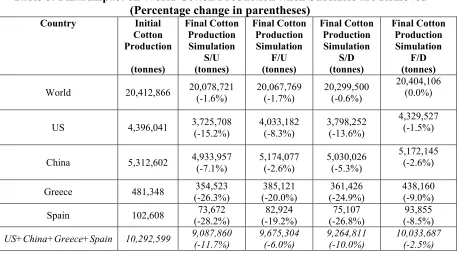
initial level) and 20.40 million tonnes (simulation F/D – similar to the initial level of production).
Table 8: Final Impact on World Cotton Production when Subsidies are Removed (Percentage change in parentheses)
Country Initial Cotton
Production
(tonnes)
Final Cotton Production Simulation
S/U (tonnes)
Final Cotton Production Simulation
F/U (tonnes)
Final Cotton Production Simulation
S/D (tonnes)
Final Cotton Production Simulation
F/D (tonnes)
World 20,412,866 20,078,721
(-1.6%)
20,067,769 (-1.7%)
20,299,500 (-0.6%)
20,404,106 (0.0%)
US 4,396,041 3,725,708
(-15.2%)
4,033,182 (-8.3%)
3,798,252 (-13.6%)
4,329,527 (-1.5%)
China 5,312,602 4,933,957
(-7.1%)
5,174,077 (-2.6%)
5,030,026 (-5.3%)
5,172,145 (-2.6%)
Greece 481,348 354,523
(-26.3%)
385,121 (-20.0%)
361,426 (-24.9%)
438,160 (-9.0%)
Spain 102,608 73,672
(-28.2%)
82,924 (-19.2%)
75,107 (-26.8%)
93,855 (-8.5%)
US+China+Greece+Spain 10,292,599 9,087,860
(-11.7%)
9,675,304 (-6.0%)
9,264,811 (-10.0%)
10,033,687 (-2.5%)
Cotton production in the US, China, Greece and Spain now ranges from 9.09 million tonnes under simulation S/U (45 percent of world production) to 10.03 million tonnes under simulation F/D (49 percent of world production) representing a net decrease of between 1.2 million tonnes and 259 thousand tonnes.
Table 9: Production of Cotton in West and Central Africa after the Elimination of Subsidies
% change in Cotton Production (Tonnes increase in parentheses)
% change in Cotton Production Earnings ($ millions increase in parentheses)
Country Sim S/U Sim F/U Sim S/D Sim F/D Sim S/U Sim F/U Sim S/D Sim F/D
Benin 9% 4% 11% 6% 28% 15% 36% 20%
Burkina Faso 9% 5% 13% 8% 28% 17% 39% 25%
Cameroon 9% 5% 13% 9% 28% 18% 39% 27%
Central African Republic
9% 4% 11% 5% 28% 13% 36% 16%
Chad 9% 4% 11% 6% 28% 15% 36% 25%
Congo 9% 0% 11% 0% 28% 0% 36% 0%
Côte d’Ivoire 9% 5% 13% 7% 28% 15% 39% 21%
Gambia 9% 1% 11% 1% 28% 3% 36% 3%
Ghana 9% 3% 11% 4% 28% 10% 36% 12%
Guinea 9% 0% 11% 0% 28% 0% 36% 0%
Guinea-Bissau 9% 2% 11% 2% 28% 5% 36% 5%
Liberia 9% 8% 11% 10% 28% 27% 36% 34%
Mali 9% 2% 13% 2% 28% 5% 39% 7%
Niger 9% 1% 11% 1% 28% 3% 36% 3%
Nigeria 9% 1% 11% 1% 28% 2% 36% 3%
Togo 9% 11% 11% 18% 28% 37% 39% 57%
Total 9%
(71,310) 3% (24,494) 12% (99,920) 5% (35,836) 28% (271) 10% (94) 37% (360) 14% (134)
Increases in cotton production and earnings arising from the removal of subsidies under the different simulations vary considerably among the other major (non-subsidised) cotton producers (see Appendix 16 and Table 10a).
Table 10a: Production of Cotton in Other Major Producer Countries after the Elimination of Subsidies
Final Cotton Production (Tonnes)
(Percentage increase in parentheses)
Final Cotton Production Earnings ($ millions)
(Percentage increase in parentheses)
Country Sim S/U Sim F/U Sim S/D Sim F/D Sim S/U Sim F/U Sim S/D Sim F/D
[image:32.612.85.565.475.689.2]