Optimum Power Utilization in Wireless Sensor
Network using Partition Technique
T. Sujithra
PG Scholar in Computer science and Engineering, Sasurie College of Engineering,
Vijayamangalam, Tirupur(dt), Tamilnadu, India.
S. Anbarasu
Lecturer in Computer Science and Engineering, Sasurie College of Engineering,
Vijayamangalam, Tirupur(dt), Tamilnadu, India.
ABSTRACT-
We Propose Balanced, Localized, Robust, Dynamic state changing and energy efficient spanning tree approaches for Wireless sensor networks which we call Balanced energy Efficient Spanning Tree with Sleep scheduling(BEESP-SS). In this paper first we construct the spanning tree based on RNG(Relative Neighborhood Graph) after that we find the minimum spanning tree it considers the different parent selection strategies and select the best among them, Our major concern is to balance the load with in the spanning tree, actual spanning tree is constructed based on the transmitter and receiver residual energy. It is done by measuring the energy level of the nodes in the spanning tree, because energy is drain out when large number of messages travelling through the particular node by limiting the messages travelled through the sensor nodes we can improve the lifetime of the spanning tree and reduce the frequency of spanning tree, it is done by partitioning the messages based on the energy level of the node in the spanning tree and redirect the messages to the some other nodes in the spanning tree. The proposed solution also adapted the Sleep Scheduling Algorithm, it wake up the sensor nodes in the network when it is needed. This paper also handles the route maintenance it includes node insertion and node deletion.
Index Terms:
Wireless Sensor network, Partitioning, sleep scheduling algorithm, Localized Minimum spanning tree(LMST),Relative Neighborhood Graph(RNG).
1. INTRODUCTION
Wireless Sensor Network is a collection of nodes organized into cooperative network. Each node consists of processing capability(one or more microcontroller, CPU’s or DSP chips), may contain multiple types of memory(program, data and flash memories),have a RF Transceivers, have a power source(batteries and solar cells) and accommodate various sensors and actuators. The nodes communicate wirelessly and self organize in an adhoc fashion. Most important problem in wireless sensor network is limited battery power.
Wireless sensor network constitutes two states, they are active mode and another one is passive mode. during the data transmission nodes are in active mode otherwise nodes are in passive mode it is achieved through the use of wakeup antenna. The design wireless sensor network depends on the application requirements. Sensor nodes will periodically sense their nearby environment and send the information to a sink which is not energy limited. The collected information can be further processed at the sink for end user queries.
In order to reduce the communication overhead we propose Balanced Energy Efficient Spanning Tree, it improves the sensor nodes lifetime. An important problem studied is to find balanced energy efficient routing tree by partitioning the messages based on the energy level of the node and also improves life time of the sensor nodes in the network by using sleep scheduling algorithm finally route maintenance.
Several requirements for this paper are, First the visibility graph is constructed using relative neighborhood graph(RNG)[5].
Second Localized Energy Efficient spanning tree is constructed based on RNG using Prim’s algorithm. Edge weight assignment based on the transmitter and receiver residual energy, edge weight is changed dynamically based on the energy level correspondingly spanning tree is also updated.
Third Load is balanced with in the resulting spanning tree based on the energy level of the node the message will be partitioned and redirect the packets in some other nodes in spanning tree it distributes communication overhead with in the spanning tree. ie nodes having greater energy level can able to receive the message with maximum size.
Fourth is to Maximize the lifetime of the sensor nodes in the network by using sleep scheduling algorithm. Fifth it handles the route maintenance it includes node insertion and node deletion. Remainder of this paper is organize is as follows Section II discuss about the Literature review, in section III we define the problem statement ,In section IV we discuss about proposed algorithm In section V we discuss about the implementation results finally we conclude our paper with future work.
2. LITERATURE REVIEW
energy. Both protocols are centralized in nature, this is the major disadvantage in that.
In [5], the authors proposed Minimum Spanning Tree based Topology control algorithm called LMST for wireless multi-hop networks, in this algorithm, each node builds its local minimum spanning tree independently and only keeps the on-tree nodes that are one hop away as its neighbors in the final topology.
In [7], the authors proposed Distributed and Dynamic Data Gathering Protocol for sensor networks. It is based on Local minimum spanning tree structure,each node selects as parent the LMST neighbor so that the total energy cost of route to the sink is minimal.it is appropriate for all the nodes are not in the direct communication. It may cause chain effect, the change in shortest path in sensors which are far away from the area where insertion or deletion occurred.
In [11], the authors proposed Minimum Energy Mobile Wireless networks. It solves the minimum energy problem with a single master site simultaneously solves the general peer to peer communication problem. The procedure finds the minimum energy links and dynamically update them. This is suitable only for stationary networks.
In[15], the authors proposed Maximum Lifetime Routing in wireless sensor network. It uses online Maximum lifetime heuristics method, it maximize network lifetime.
In[18], the authors proposed Maximum Lifetime Data Gathering and Aggregation in Wireless sensor network. In this paper data should be collected from all the sensor nodes and transmit to the base station such that the system lifetime is maximized. It suffers from first node failure problem.
Power Efficient Gathering Aggregation in Sensor Information System called PEGASIS is defined in[19]. In this paper they proposed PEGASIS, a near optimal chain based protocol this is an improvement over LEACH. In PEGASIS, each node communicates only with a close neighbor and takes turns transmitting to the base station. This approach is not very efficient, since the transmission distances can be quite long and minimum distance chain is NP complete.
In [24], the authors proposed an algorithm called Energy Efficient Spanning tree algorithm. It constructs the spanning tree based on transmitter and receiver residual energy but it is centralized. This is major disadvantage in this paper.
3. PROBLEM STATEMENT
Consider a network of n sensor nodes, which are randomly placed in a network. Each nodegenerates the data packet and transmits to the base station.
DEFINITION 1:
Before transmitting the data the routing tree is constructed, it spans all nodes in the network without cycle. It is based on the transmitter and receiver residual energy after finding the spanning tree load is balanced based on the energy level of the node with in the spanning tree.
DEFINITION 2:
Frequency of spanning tree is defined as number of rounds a routing tree will be used.
DEFINITION 3:
Wakeup antenna used to activating the sensor nodes from passive mode to active mode while they are sensing information.
DEFINITION 4:
Energy consumption is based on the how many number of packets send and receive and also based on length of the message. Limit the message size based on the energy level of the sensor node by partitioning.
We need to find the energy efficient spanning tree based on transmitter and receiver residual energy in localized manner and balancing the load based on the energy level of the sensor node, and also improve the lifetime of the sensor node in network using sleep scheduling done by wakeup antenna.
4. PROPOSED ALGORITHM
Edge cost assignment:
It is based on the idea of energy efficient spanning tree [24]. To transmit a k bit packet from node i to j the weight assignment is performed as follows
wij(k)=min{Ei-Tij(k),Ej-Rj(k)}
whereEi is the current energy of node i and Tij(k) is the energy
required to transmit a k bit packet from node i to j. the term Rj(k) denotes the energy consumed to receive k bit packet for
node j.
Edge weight assignment is based on both transmitter and receiver residual energy. It avoids the receiving node to become overloaded by receiving too many packets.
Proposed algorithm includes five phases they are
Relative neighborhood graph construction (RNG)
Spanning tree Construction
Load balancing
Maximize network life time by using Sleep scheduling algorithm
Route maintenance
PHASE 1:
In this phase we constructing the visibility graph.
Algorithm 1:
Input: S-> List containing the sensor nodes in the network
Output: Graph G(V,E) containing vertices and edges
Step1: while S is NULL
Step2: for each node n in S
Step3: find the neighbors of n
Step4: select the node having the greater energy and ignore others
Step5: connect the new node with the predecessor
Step6: end for
Step7: end while
PHASE 2:
In this phase spanning tree is constructed using the information from RNG based on transmitter and receiver residual energy.
Algorithm2:
Input: Visibility graph G(V,E)
e-> energy level of the current node e’-> energy level of the other nodes Output: Localized Minimum spanning tree
Step1: while G is NULL
Step2: for each node n in G
Step3: find the neighbors of node n in G
Step4: check the energy level of that node n Step5:if(e>e’)
Step6:select the node as neighbor
Step7: update the node energy level ie reduce energy level of that node
Step8: construct the spanning tree
Step 9: else reject the node
Step10: end for
Step11:end while
In this phase many number of spanning tree is constructed from those minimum spanning tree is chosen.
PHASE3:
In phase 3 we balance the load based on the energy level of the node with in the spanning tree, it improves the lifetime of the sensor nodes in the spanning tree. basic concept is by limiting the messages travel through the sensor node we can able to improve the lifetime but it is not possible but we can able to distribute message to all nodes by partitioning.
Algorithm 3:
Input: Spanning tree S
Output: Balanced Spanning tree S’ e->energy level of the current node e’->energy level of the other nodes Step1:for each node in S
Step2: check the energy level of the node in spanning tree
Step3: if(e>e’)
Step4:acceptmessage with maximum size Step5: else
Step6: Partition the message
Step7: Redirect the message to some other node having greater energy
Step8: end for
It balance the load in LMST by measuring the energy level of the node periodically, it improves the performance and lifetime of the sensor nodes in the spanning tree.
PHASE 4:
In this phase we maximize the network Lifetime by using sleep scheduling algorithm, it uses wake up antenna. Wakeup antenna used for activating the sensor nodes from passive mode to active mode. During the data sensing only we keep the node in active mode otherwise we keep the node in passive mode.
Algorithm 4:
Step1: Initialize all sensor nodes in passive mode
Step2: Collect the sensor nodes that are needed for communication
Step3: sending the wakeup signal for those nodes by using wakeup antenna
Step4: otherwise keep the sensor nodes in passive mode as such
It maximize the sensor nodes lifetime in the network.
PHASE 5:
In this paper we also handles route maintenance it includes node insertion and node deletion based on this spanning tree is updated. Node having the lower energy level is treated as node failure.
Algorithm 5:
Step1: e->energy level of the particular node
Step2: if(e<threshold value)
Step3:remove the particular node and update the spanning tree
Step4: send hello message for new node to all other nodes
Step5: update the spanning tree
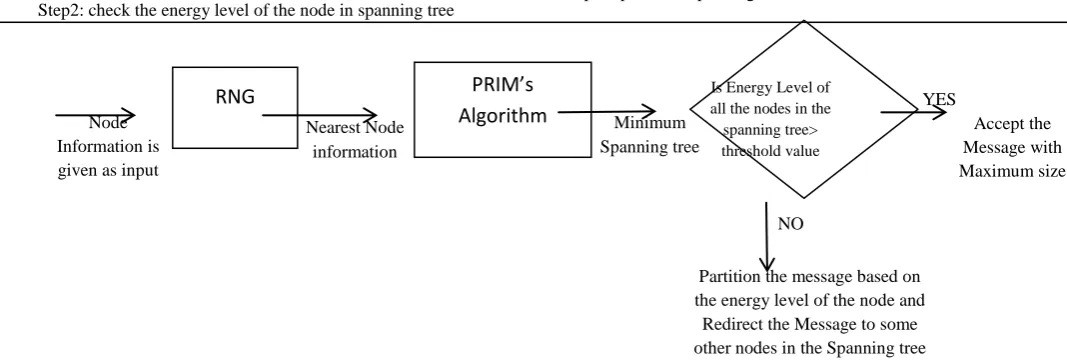
RNG
PRIM’s
Algorithm
NodeInformation is given as input
Nearest Node information
Minimum Spanning tree
Is Energy Level of all the nodes in the spanning tree> threshold value
YES
Accept the Message with Maximum size
NO
Partition the message based on the energy level of the node and
[image:3.595.35.569.564.745.2]Redirect the Message to some other nodes in the Spanning tree
5. IMPLEMENTATION RESULTS
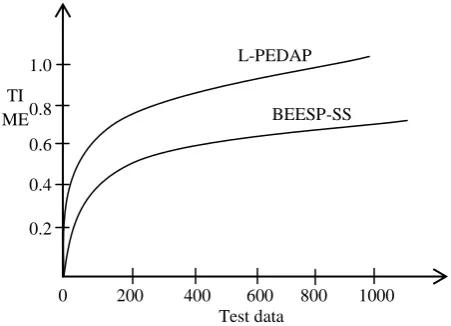
[image:4.595.28.254.280.443.2]In this paper we are concentrating to reduce the Number of Rounds needed for constructing spanning tree as well as the cost is needed for constructing tree and balancing the Load with in the Routing tree it reduces the overhead with in the routing tree and improves the lifetime of the wireless sensor network.In PEDAP they are concentrating only on the construction of routing tree they failed to consider the energy level of the node so lifetime of the sensor node is low. In PEDAP-PA they concentrate only on the transmitter energy level but it is centralized. In L-PEDAP is localized but it failed to balance the load with in the spanning tree here the routing tree is constructed based on the transmitter and receiver residual energy. In PEDAP,EESP,L-PEDAP, energy level of any node in the spanning tree gets lower than the threshold value it requires reconstruction so it needs more number of rounds to transmit the data. In our paper we balance the load with in the spanning tree automatically it reduces the frequency of spanning tree so it improves the lifetime than the existing protocols.
Fig 2 Implementation Results of BEESP-SS
6. CONCLUSION
In this paper, we presented balanced, power Efficient Protocol with Sleep scheduling algorithm. It improves the performance of the existing protocols such as PEDAP-PA,L-PEDAP and EESP. It balances the load in Localized minimum spanning tree, it improves lifetime of the nodes in spanning tree by reducing the frequency of the spanning tree, it is also using sleep scheduling algorithm for improving the nodes lifetime in the network, it is localized, it also handles route maintenance. However it is suitable only for homogeneous networks. In Future we will try to implement for heterogeneous networks.
7. REFERENCES
[1] HuseyinOzgur Tan, Member ,IEEE, Ibrahim Korpeoglu, Member,IEEE and Ivan Stojmenovic,Fellow,IEEE, ”Computing Localized Power Efficient Data Aggregation Trees for sensor networks”,vol 22,March 2011
[2] J. Wuand I. Stojmenovic, “Ad Hoc Networks,” Computer, vol.37, no.2, pp. 29-31, Feb.2004.
[3] H.O¨. Tanand I. Korpeoglu, “Power Efficient Data Gathering and Aggregation in Wireless Sensor Networks,” SIGMOD Record, vol.32, no.4, pp. 66-71, 2003.
[4] R. Prim, “Shortest Connecting Networks and Some Generalizations,” Bell System TechnicalJ.,vol.36,pp.1389-1401,1957.
[5] N. Li, J.C. Hou, and L.Sha, “Design and Analysis of anmst Based Topology Control Algorithm,” Proc. IEEEINFOCOM, 2003.
[6] H.O. Tan, I. Korpeoglu, and I. Stojmenovic, “A Distributed and Dynamic Data Gathering Protocol for Sensor Networks,” Proc. 21st Int’l Conf. Advanced Networking and Applications, pp. 220-227, 2007.
[7] J. Bachrachand C. Taylor, “Localization in Sensor Networks,” Handbook of Sensor Networks: Algorithms and Architectures, I. Stojmenovic, ed.,pp. 277-310,Wiley, 2005.
[8] J. Hightower and G. Borriello, “Location Systems for Ubiquitous Computing,” Computer, vol.34,no.8,pp. 57-66, Aug.2001.
[9] W.R. Heinzelman, A. Chandrakasan, and H. Balakrishnan, “Energy-Efficient Communication Protocol for Wireless Micro sensor Networks,” Proc. 33rd Ann. Hawaii Int’lConf. System Sciences,pp.3005-3014,2000.
[10] V. Rodopluand T. Meng, “Minimum Energy Mobile Wireless Networks,” IEEE J. Selected Areasin Comm., vol.17, no.8, pp.1333-1344, Aug.1999.
[11] S. Singh, M. Woo, and C.S. Raghavendra, “Power-Aware Routing in Mobile Ad Hoc Networks,” Proc. Int’l Conf. Mobile Computing and Networking, pp. 181-190,1998.
[12] S. Singh, M. Woo, and C.S. Raghavendra, “Power-Aware Routing in Mobile Ad Hoc Networks,” Proc. Int’l Conf. Mobile Computing and Networking, pp. 181-190, 1998.
[13] I. Stojmenovic and X. Lin, “Power-Aware Localized Routing in Wireless Networks,” IEEE Trans. Parallel and Distributed Systems, vol. 12, no. 11, pp. 1122-1133, Nov. 2001.
[14] J.-H. Chang and L. Tassiulas, “Energy Conserving Routing in Wireless Ad-Hoc Networks,” Proc. IEEE INFOCOM ’00, pp. 22-31,Mar. 2000.
[15] J. Chang and L. Tassiulas, “Maximum Lifetime Routing in Wireless Sensor Networks,” Proc. Advanced Telecomm. and Information Distribution Research Program Conf., 2000.
[16] C.E. Perkins and E.M. Royer, “Ad-Hoc On-Demand Distance Vector Routing,” Proc. Second IEEE Workshop Mobile Computing Systems and Applications, p. 90, 1999.
[17] C. Intanagonwiwat, R. Govindan, and D. Estrin, “Directed Diffusion: A Scalable and Robust Communication Paradigm forSensor Networks,” Proc. Int’l Conf. Mobile Computing and Networking,pp. 56-67, 2000.
[18] K. Kalpakis, K. Dasgupta, and P. Namjoshi, “Maximum Lifetime Data Gathering and Aggregation in Wireless Sensor Networks,” Proc. 2002 IEEE Int’l Conf. Networking (ICN ’02), pp. 685-696, Aug.2002.
BEESP-SS L-PEDAP
0 200 400 600 800 1000 Test data
1.0
0.8
0.6
0.4
[19] S. Lindsey and C.S. Raghavendra, “Pegasis: Power-Efficient Gathering in Sensor Information Systems,” Proc. IEEE AerospaceConf., Mar. 2002.
[20] C.Hua and T.-S.P. Yum, “Optimal Routing and Data Aggregationfor Maximizing Lifetime of Wireless Sensor Networks,” IEEE/ACM Trans. Networking, vol. 16, no. 4, pp. 892-903, Aug. 2008.
[21] S.Upadhyayula and S.K.S. Gupta, “Spanning Tree BasedAlgorithms for Low Latency and Energy Efficient Data AggregationEnhanced Convergecast (DAC) in Wireless Sensor Networks,”Ad Hoc Networking, vol. 5, no. 5, pp. 626-648, 2007.
[22] I.S.-J. Park and I.-R.Sivakumar, “Energy Efficient Correlated DataAggregation for Wireless Sensor Networks,” Int’l J. DistributedSensor Networks, vol. 4, no. 1, pp. 13-27, 2008.
[23] M.D. Penrose, “The Longest Edge of the Random MinimalSpanning Tree,” The Annals of Applied Probability, vol. 7, no. 2,pp. 340-361, 1997.
[24] S. Hussain and O. Islam, “An Energy Efficient Spanning TreeBased Multi-Hop Routing in Wireless Sensor Networks,” Proc.IEEE Wireless Comm. and Networking Conf. (WCNC ’07), pp. 4383-4388, Mar. 2007.
[25] Y. Wu, S. Fahmy, and N.B. Shroff, “On the Construction of aMaximum-Lifetime Data Gathering Tree in Sensor Networks: Npcompletenessand Approximation Algorithm,” Proc. IEEE INFOCOM,pp. 356-360, 2008.