Cellular Automata based Degree Priority Routing
Algorithm for Irregular Mesh Topology NOCs
Chayan Banerjee
Department of Electronics &Communication Engineering
SRM University Chennai, India
Amol K. Boke
Department of Electronics & Communication Engineering
SRM University Chennai, India
ABSTRACT
Irregular mesh topologies are used nowadays in NOCs due to the variation in the size & shape of IP modules integrated on a SOC. Irregular topology presents problems of routing, as eachnode may differ in their degree. Degree priority routing algorithms have already been proposed, which enables fast and dynamic routing. In this paper an improvement on the existing Degree priority routing (DPR) algorithm is proposed, by introducing Cellular Automata based neighborhood into the picture. The proposed technique enables each node to retain the degree information of its 4 neighbors (in a Cellular automata based Von Neumann neighborhood)and serves as a ‘one node’ hub to decide on the next best node to route the message to. This way a considerable amount of time is saved on DPR algorithms to route the message to the next best node with the optimal degree.
General Terms
Cellular automata, Irregular Mesh Routing algorithm
Keywords
Cellular automata, Von Neumann neighborhood, irregular mesh topology, Degree priority routing, XY routing algorithm.
1.
INTRODUCTION
With the evolution of the VLSI technology more and more predefined components or IP modules are integrated on a single SOC (System on Chip). As number of modules increased, the traditional point to point and shared bus architecture proved inefficient. To bridge this gap, NOC (Network on chip) came into use. NOC is a highly structured and scalable solution to the deal with communication challenges on a SOC [4].
Topologies and switching mechanisms specify the architecture of a NOC. Topologies define the arrangement of IPs and their interconnection relationship. The switching mechanisms, on the other hand coordinates runtime traffic requests between sharing and conflicting resources to avoid deadlock [5]. There are numerous topologies that may apply to a NOC for efficient communication. Among them 2D Mesh is one of the simplest, point to point based topology that is popular nowadays. But with the growing variety of IP cores in shapes and sizes the 2D regular mesh is falling short of expectations. The problem is that with modules varying in dimensions the regular communication fabric is disrupted as
the network will now contain missing links. As a result of which the nodes of the networkwill have heterogeneous node degree, thus turning the 2D regular mesh to an irregular mesh. Now the basic XY or YX routing scheme which was initially meant for regular mesh topologies won’t work on irregular mesh [3]. Thus modifications are made so as to adapt it to the irregular topologies. Degree priority routing is one of such improvements over the XY routing. In this approach the basic routing is dependent on the XY algorithm but also keeps the degree based priority of the nodes in view while deciding on the next hop node. In [3] the degree of a node is already known at that node and dynamic routing of messages are made to the next node with the optimal degree. Once the routing is made, the basic XY routing table is updated with the newly routed optimal paths.
This paper proposes some improvements over this existing approach. In the proposed algorithm the Degree priority routing is kept as it is but a new concept of Cellular Automata based neighborhood, is introduced. According to the algorithm each node will retain the degree values of four of its adjacent neighbors, (see figure 4) and compare and storethem in order of decreasing degree. So each node will serve as a hub for routing to 4 (or less) of its neighbor nodes. In the previous approaches one had to go to each node to enquire about its degree and then take a routing decision. Thus with a one node hub concept proposed in this paper, the network latency is effectively reduced.
2.
CELLULAR AUTOMATA (CA)&
NEIGHBORHOOD.
Fig 1: Basic Cellular Automata.
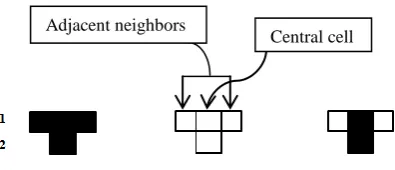
depending on a certain rule. These rules mainly involve the state of the automaton’s neighbors.For the state change in the above diagrams the rule is as follows: A cell should be black in all the cases where it or either of its neighbors was black in the step before [1].This neighborhood can be more complex, with increase in the number of adjacent neighbors. The two most popular CA neighborhoods are: Von Neumann neighborhood and Moore neighborhood.
Fig2: CA Von Neumann& Moore neighborhood[7]
3.
ROUTING ALGORITHM
3.1
XY routing algorithm
Theclassic XY[2] (static XY OR XY) routing algorithm which is a kind of distributed deterministic routing algorithm [6]. The XY routing algorithm compares the source node address (AX,AY) to the destination node address (BX,BY) of the packet, stored in the header information of data packet. Information must be routed to the core port of the node when the (AX,AY) address of the source node is equal to the (BX,BY) address. If this is not the case, the BX address is firstly compared to the AX (horizontal) address. Message will be routed to the East node when AX<BX, to West when AX>BX and if AX=BX the header information is already horizontally aligned. If this last condition is true, the BY(vertical) address is compared to the AY address. Message will be routed to South when Ay<By, to North when AY>BY. If the chosen node is busy, the header information as well as all subsequent information of this packet will be blocked. The routing request for this packet will remain active until a connection is established in some future execution of the procedure in this node.
3.2
Degree Priority routing algorithm
In [3] the term “degree” is defined as the number of output paths of node. This algorithm was proposed mainly for the irregular mesh architecture of NOC. Degree Priority routing algorithm is used to dynamically choose routing path with respect to the output channel of the next node. In this algorithm when source node or any intermediate node on optimal path wants to forward data packet towards the next node, it has to choose one node from number of neighboring nodes. In this mechanism it chooses the node having highest degree (i.e. highest number of available output paths) and forwards the packet. In this routing the routing table is been
maintained and any new optimal path hence generated dynamically are updated to the same.
3.3
Cellular Automata Neighborhood
based Degree Priority Routing algorithm
(CANDPR)
DN: Degree of N th
node.See figure 4.
N: specifies the neighbor of the central node (C), as East (E) or West (W) or North (N) or South(S). Such that the degree of the East neighbor of central node(C) will be denoted as DE , see figure 3.
DN (max): maximum neighborhood degree among the 4 neighbors (East, west, North & South) of the central node. NN: The next hop node, e.g. NE, NW etc.
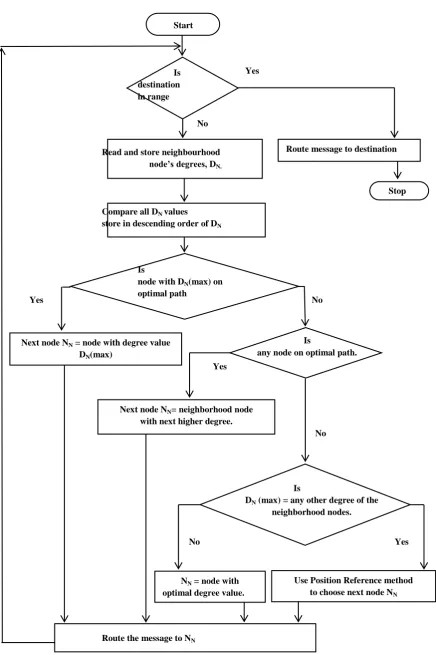
The proposed algorithm assumes that the basic “X-Y” routing algorithm, which is used in the case of regular mesh topology, is already in place. The routing is governed by compressed and constantly updated routing tables [3]. The CAN based DRP starts with the check that whether the destination node is within the scope or range. Range, here means that whether the destination node is among any of the 4 neighbors of the current node or central node(C). So if the destination node is anyone of the immediate neighbors then the message is directly routed to that neighbor and the cycle terminates. In case the destination node is not in range (not in the immediate neighborhood) then the actual algorithm comes into action
Fig3:A central node (C) and its neighborhood (East, West, North & South neighbors)
The central node (C) reads and stores the degrees of the nodes that fall into its Von-Neumann neighborhood, as shown in fig.1. Next the node compares all the degrees and stores them in a list of descending order. The node with the maximum degree is saved as DN(max). Next it is checked that if the DN(max) node is on optimal path.
An optimal path, is defined as [3] the path that belongs to XY or YX routing path, i.e. the best paths between the source and destination as possible in a regular mesh NOC.
So if the DN(max) node is on optimal path then the algorithm directly opts for that node and the message is routed directly to that node. If the condition is not satisfied then another condition check is made. It is checked that if any node of the Von-Neumann neighborhood falls on the optimal path. If condition
Start
Is destination in range
Read and store neighbourhood node’s degrees, DN.
Compare all DN values
store in descending order of DN
Is
node with DN(max) on
optimal path
Route the message to NN
Yes No
Route message to destination Yes
No
Next node NN= neighborhood node
with next higher degree. Next node NN = node with degree value
DN(max)
Is
any node on optimal path.
Yes
Use Position Reference method to choose next node NN
No
Stop
Is
DN (max) = any other degree of the
neighborhood nodes.
Yes
NN = node with
[image:3.595.96.533.88.744.2]optimal degree value.
is satisfied then the node with the next higher degree is selected as the next hop node, and the message is directly routed as previous. If condition is not satisfied then another condition is checked. Here it is checked that if there are any redundant DN (max) values. If the DN (max) value is unique and no other node degree happens to be same to it, then thehighest degree node or the node with degree DN (max) is selected as the next node. Otherwise the “position reference method” is used, to decide on the next possible hop node. Next the message is forwarded as previously. Routing ends a phase of the cycle; then again the control is forwarded to 2nd step where the check is made about the destination.
3.3.1. Position Reference(PR) method.
This method is used when no node of the neighborhood is on the optimal path. In this situation nodes can be randomly selectedfor the next hop node, but it may lead to deadlock and other routing problems.
In this method, the relative positions of candidate nodeand the current node are checked, to see that if this candidate nodeprovides a better position with respect to the destination. Here better position means that if the new node is at a position that is nearer to the destination, else that node (among the set of 4 nodes) whose position is nearer, is selected as the next node. The concept is explained in greater detail in example 4, of next section.
4.
WORKING OF ALGORITHM
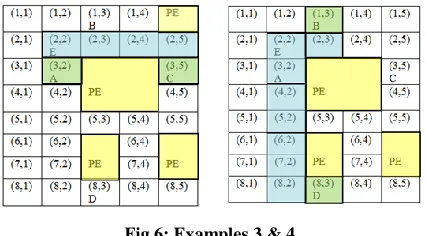
In the following 4 examples the possible routing methodology (that will be taken for routing a certain message from source to destination) is demonstrated.The methodology followed in these examples strongly adheres to the technique put forward in the text and diagrammatically represented in the flowchart. Each cells of the grid block (shown in figure 5& figure 6) represents position of a router or switching node. Each large block in the same grid marked PE (processing element) represents the position of IP module of different size that are integrated on the SOC. The figures are for indicative purpose only and hence neglect the details of router to PE connectivity.
Ex.1, Source A – Destination E
In this case, since the node E is in the immediate neighborhood of A. Hence node A will pass on the packet to destination E directly.
Ex.2, Source A – Destination B
[image:4.612.319.536.88.212.2]Since, node A and B are on optimal path, node A which already knows the node with optimal degree will route
Fig 5: Examples 1 & 2.
message to E.In the next cycle E and B are also on the optimal path. Now, E will find highest degree node which is (2, 3)having degree of 3 and route message to it. Progressing in similar way the destination B(2,4) is reached.
Ex.3, Source A – Destination C
Since there is PE between node A and C creating obstruction on the optimal path, Node A have to dynamically route the message to the destination. Node A having 3 neighboring node of interest i.e. node E (2, 2), (3, 1) and (4, 2). Now node A will calculate and compare the degree of its neighboring nodes and since node E having highest degree of 4, node A will route the packet to E. In the next cycle it is first checked that if E is on the optimal path, and since it is on the optimal path, message is forwarded through (2,3), (2,4) ,(2,5) finally to C(3,5).
Fig 6: Examples 3 & 4.
Ex.4, Source B – Destination D
[image:4.612.326.539.440.558.2]neighboring node i.e. E (2, 2) and will pass on the packet to it. The same thing is repeated with node (2, 2), since it is not on the optimal path. This process will carry on through nodes A, (4, 2), (5, 2). At (5, 2) again two nodes are having same degree and are not on optimal path. Hence it will select the node by PR method comparing Y coordinates of destination D with node (5, 4) and (6, 2). As the Y coordinate distance between (6,2) and D is less, it will select node (6,2) to pass on the packet and this way packet will finally reach to destination D through node (8,2).
5.
EVALUATION
The proposed routing algorithm is evaluated on the basis of its network latency. Network latency is the amount of time taken by a data packet to traverse between the source and destination nodes of a network. Thus it is a very important parameter on which the efficiency of the network depends.
A B C D
E J K
F L M
G N
H O
[image:5.612.66.279.284.509.2]Q Z P S
Fig 7: Comparison of DPR and CANDPR algorithms.
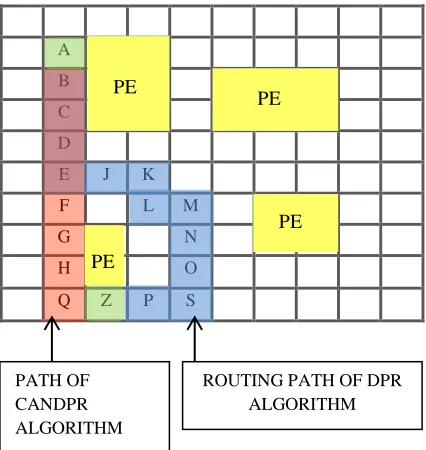
The comparison on network latency has been done on the same indicative grid like plan, representing routers and irregular IP blocks. Here in figure 7, node A is the source and node Z is the destination.
It is also assumed that 1 unit of time is consumed for forwarding a data packed from one node to the next. As far as degree priority routing (DPR) algorithm is concerned, the message will be forwarded to a node whose degree is greater. In case if there are two nodes having same degree then it chooses the node having the highest degree. As shown in figure 7, above node A is the source node and node Z is the destination node for packet. Now according to both the DPR and the CANDPR proposed in
this paper, packet will go smoothly till node E,following the path through A-B-C-D-E.
But after node E, according to the DPRalgorithm the packet will be sent to node J and not F.Though both of these nodes are having the same degree (= 4)but the next node of node J (node K)is having higher degree than the next node of node F (node G).
Hence according to DPR algorithm packet will travel via path A-B-C-D-J-K-L-M-N-O-S-P-Z travelling through 12 nodes and hence taking 12 unit of time. On other hand the proposed routing algorithm i.e. CANDPR will route the packet via A-B-C-D-E-F-G-Z travelling through 8 nodes and hence taking 8 unit of time. This contrast proves that CANDPR algorithm consumes less time to route the packets from source to destination and thus reduces the network latency.
6.
CONCLUSION
The CANDPR algorithm proposed as a modification on DPR algorithm was compared and found to be effective in reducing network latency. This algorithm may work as well as fault tolerant routing algorithm as it can work around faulty nodes and missing links. Besides each node preserves the latest degree information about its neighborhood nodes hence it becomes easy and fast for the routing process to forward messages to the deserving node.
7.
REFERENCES
[1] Stephen Wolfram, A New Kind Of Science, Wolfram Media, Inc.
[2] Wang Zhang, Ligang Hou, Jinhui Wang, Shuqin Geng, Wuchen Wu, 2011, Comparison Research between XY and Odd-Even Routing Algorithm of a 2-Dimension 3X3 Mesh Topology Network-on-Chip. [3] Ling Wang Hui Song, Yingtao Jiang, Degree Priority
Routing Algorithm for Irregular Mesh Topology NoCs, ICESS2008.
[4] Jie Chen and Cheng Li,Paul Gillard, Network-on-Chip(NOC)Topologies and Performance: A Review [5] Yung-Chang Chang, Ching-Te Chiu, A Study of NoC
Topologies and Switching Arbitration Mechanisms, 2012 IEEE 14th International Conference on High Performance.
[6] Shubhangi D Chawade, Mahendra A Gaikwad & Rajendra M Patrikar, Review Of XY Routing Algorithm forNetwork-On-Chip Architecture. [7] www.wikipedia.org
PE PE
PE
PE
ROUTING PATH OF DPR ALGORITHM PATH OF