Volume 2009, Article ID 386547,19pages doi:10.1155/2009/386547
Research Article
Secured Communication over Frequency-Selective Fading
Channels: A Practical Vandermonde Precoding
Mari Kobayashi,
1M´erouane Debbah,
2and Shlomo Shamai (Shitz)
31Department of Telecommunications, SUPELEC, 3 Rue Joliot-Curie, Gif-sur-Yvette, 91192, France 2Alcatel-Lucent Chair on Flexible Radio, SUPELEC, 3 Rue Joliot-Curie, Gif-sur-Yvette, 91192, France 3Department of Electrical Engineering, Technion-Israel Institute of Technology, Haifa 32000, Israel
Correspondence should be addressed to Mari Kobayashi,[email protected]
Received 2 February 2009; Accepted 16 June 2009
Recommended by H. Vincent Poor
We study the frequency-selective broadcast channel with confidential messages (BCC) where the transmitter sends a confidential message to receiver 1 and a common message to receivers 1 and 2. In the case of a block transmission ofN symbols followed by a guard interval ofLsymbols, the frequency-selective channel can be modeled as aN×(N+L) Toeplitz matrix. For this special type of multiple-input multiple-output channels, we propose a practical Vandermonde precoding that projects the confidential messages in the null space of the channel seen by receiver 2 while superposing the common message. For this scheme, we provide the achievable rate region and characterize the optimal covariance for some special cases of interest. Interestingly, the proposed scheme can be applied to other multiuser scenarios such as theK+ 1-user frequency-selective BCC withKconfidential messages and the two-user frequency-selective BCC with two confidential messages. For each scenario, we provide the secrecy degree of freedom (s.d.o.f.) region of the corresponding channel and prove the optimality of the Vandermonde precoding. One of the appealing features of the proposed scheme is that it does not require any specific secrecy encoding technique but can be applied on top of any existing powerful encoding schemes.
Copyright © 2009 Mari Kobayashi et al. This is an open access article distributed under the Creative Commons Attribution License, which permits unrestricted use, distribution, and reproduction in any medium, provided the original work is properly cited.
1. Introduction
We consider a secured medium such that the transmitter wishes to send a confidential message to its receiver while keeping the eavesdropper, tapping the channel, ignorant of the message. Wyner [1] introduced this model named the wiretap channel to model the degraded broadcast channel where the eavesdropper observes a degraded version of the receiver’s signal. In this model, the confidentiality is measured by the equivocation rate, that is, the mutual information between the confidential message and the eavesdropper’s observation. For the discrete memoryless degraded wiretap channel, Wyner characterized the capacity-equivocation region and showed that a nonzero secrecy rate can be achieved [1]. The most important operating point on the capacity-equivocation region is the secrecy capacity, that is, the largest reliable communication rate such that the eavesdropper obtains no information about the confidential message (the equivocation rate is as large as the message
rate). The secrecy capacity of the Gaussian wiretap channel was given in [2]. Csisz´ar and K¨orner considered a more general wiretap channel in which a common message for both receivers is sent in addition to the confidential message [3]. For this model known as the broadcast channel with confidential (BCC) messages, the rate-tuple of the common and confidential messages was characterized.
characterized in [5,11,12,14] and more recently its closed-form expressions under a matrix covariance constraint have been derived in [15]. Furthermore, a large number of recent works have considered the secrecy capacity region for more general broadcast channels. In [16], the authors studied the two-user MIMO Gaussian BCC where the capacity region for the case of one common and one confidential message was characterized. The two-user BCC with two confidential messages, each of which must be kept secret to the unintended receiver, has been studied in [17–20]. In [18], Liu and Poor characterized the secrecy capacity region for the multiple-input single-output (MISO) Gaussian BCC where the optimality of the secret dirty paper coding (S-DPC) scheme was proved. A recent contribution [19] extended the result to the MIMO Gaussian BCC. The multireceiver wiretap channels have been also studied in [21–26] (and reference therein) where the confidential messages to each receiver must be kept secret to an external eavesdropper. It has been proved that the secrecy capacity region of the MIMO Gaussian multireceiver wiretap channels is achieved by S-DPC [24,26].
However, very few work have exploited the frequency selectivity nature of the channel for secrecy purposes [27] where the zeros of the channel provide an opportunity to “hide” information. This paper shows the opportuni-ties provided by the broad-band channel and studies the frequency-selective BCC where the transmitter sends one confidential message to receiver 1 and one common message to both receivers 1 and 2. The channel state information (CSI) is assumed to be known to both the transmitter and the receivers. We consider the quasistatic frequency-selective fading channel with L + 1 paths such that the channel remains fixed during an entire transmission ofnblocks for an arbitrary largen. It should be remarked that in general the secrecy rate cannot scale with signal-to-noise ratio (SNR) over the channel at hand, unless the channel of receiver 2 has a null frequency band of positive Lebesgue measure (on which the transmitter can “hide” the confidential message). In this contribution, we focus on the realistic case where receiver 2 has a full frequency band (without null subbands) but operates in a reduced dimension due to practical complexity issues. This is typical of current orthogonal frequency division multiplexing (OFDM) standards (such as IEEE802.11a/WiMax or LTE [28–30]) where a guard interval of Lsymbols is inserted at the beginning of each block to avoid the interblock interference and both receivers discard theseLsymbols. We assume that both users have the same standard receiver, in particular receiver 2 cannot change its hardware structure. Studying secure communications under this assumption is of interest in general and can be justified since receiver 2 is actually a legitimate receiver which can receive a confidential message in other communication periods. Of course, if receiver 2 is able to access the guard interval symbols, it can extract the confidential message and the secrecy rate falls down to zero. Although we restrict ourselves to the reduced dimension constraint in this paper, other constraints on the limited capability at the unintended receiver such as energy consumption or hardware complexity
might provide a new paradigm to design physical layer secrecy systems.
In the case of a block transmission ofNsymbols followed by a guard interval ofLsymbols discarded at both receivers, the frequency-selective channel can be modeled as anN×
(N +L) MIMO Toeplitz matrix. In this contribution, we aim at designing a practical linear precoding scheme that fully exploits the degrees of freedom (d.o.f.) offered by this special type of MIMO channels to transmit both the common message and the confidential message. To this end, let us start with the following remarks. On one hand, the idea of using OFDM modulation to convert the frequency-selective channel represented by the Toeplitz matrix into a set of parallel fading channel turns out to be useless from a secrecy perspective. Indeed, it is known that the secrecy capacity of the parallel wiretap fading channels does not scale with SNR [7]. On the other hand, recent contributions [5,11,12,14,15] showed that the secrecy capacity of the MIMO wiretap channel grows linearly with SNR, that is,
rlog SNR where r denotes the secrecy degree of freedom (s.d.o.f.) (to be specified). In the high SNR regime, the secrecy capacity of the MISO/MIMO wiretap channel is achieved by sending the confidential message in the null space of the eavesdropper’s channel [10,11,14,15,18,19]. Therefore, OFDM modulation is highly suboptimal in terms of the s.d.o.f.
Inspired by these remarks, we propose a linear Vander-monde precoder that projects the confidential message in the null space of the channel seen by receiver 2 while superposing the common message. Thanks to the orthogonality between the precoder of the confidential message and the channel of receiver 2; receiver 2 obtains no information on the confidential message. This precoder is regarded as a single-antenna frequency beamformer that nulls the signal in certain directions seen by receiver 2. The Vandermonde structure comes from the fact that the frequency beamformer is of the type [1,ai,a2i,. . .,aNi +L]T where ai is one of the roots of the channel seen by receiver 2. Note that Vandermonde matrices [31] have already been considered for cognitive radios [32] and CDMA systems [33] to reduce/null interference but not for secrecy applications. One of the appealing aspects of Vandermonde precoding is that it does not require a specific secrecy encoding technique but can be applied on top of any classical capacity achieving encoding scheme.
W0
Figure1: Frequency-selective broadcast channels with confidential messages.
this region. More specifically, it enables to simultaneously transmit l streams of the confidential message and N −l
streams of the common message forl ≤ Lsimultaneously over a block ofN+Ldimensions. Interestingly, the proposed Vandermonde precoding can be applied to multiuser secure communication scenarios: (a) a K + 1-user frequency-selective BCC with K confidential messages and one com-mon message, (b) a two-user frequency-selective BCC with two confidential messages and one common message. For each scenario, we characterize the achievable s.d.o.f. region of the corresponding frequency-selective BCC and show the optimality of the Vandermonde precoding.
The paper is organized as follows. Section 2 presents the frequency-selective fading BCC. Section 3 introduces the Vandermonde precoding and characterizes its achievable rate region as well as the optimal input covariances for some special cases.Section 4provides the application of the Vandermonde precoding to the multiuser secure communi-cations scenarios.Section 5shows some numerical examples of the proposed scheme in the various settings, and finally Section 6concludes the paper.
Notation.In the following, upper (lower boldface) sym-bols will be used for matrices (column vectors) whereas lower symbols will represent scalar values, (·)T will denote transpose operator, (·) conjugation, and (·)H = ((·)T) hermitian transpose. In, 0n×m represent the n×nidentity matrix,n×mzero matrix.|A|, rank(A), tr(A) denote a deter-minant, rank, trace of a matrixA, respectively.xndenotes the sequence (x[1],. . .,x[n]). w, u, v, x, y, z denote the realization of the random variablesW,U,V,X,Y,Z. Finally, “” denotes less or equal to in the positive semidefinite ordering between positive semidefinite matrices, that is, we haveABifB−Ais positive semidefinite.
2. System Model
We consider the quasistatic frequency-selective fading BCC illustrated inFigure 1. The received signaly[t],z[t]∈CN×1
of receivers 1, 2 at blocktis given by
y[t]=T(h)x[t] +n[t],
NC(0,IN) are mutually independent additive white Gaussian noise (AWGN). The input vector is subject to the power constraint given by
We assume that the channel matricesT(h),T(g) remain constant for the whole duration of the transmission of n
blocks and are known to all terminals. At each blockt, we transmitN+Lsymbols by appending a guard interval of size
LNlarger than the delay spread, which enables to avoid the interference between neighbor blocks.
The transmitter wishes to send a common messageW0to
two receivers and a confidential messageW1to receiver 1. A
(2nR0, 2nR1,n) code consists of the following: (1) two message setsW0 = {1,. . ., 2nR0} andW1 = {1,. . ., 2nR1} with the
messagesW0,W1uniformly distributed over the setsW0,W1,
respectively; (2) a stochastic encoder that maps each message pair (w0,w1)∈(W0,W1) to a codewordxn; (3) one decoder
at receiver 1 that maps a received sequenceynto a message pair (w0(1),w1) ∈ (W0,W1) and another at receiver 2 that
The secrecy level of the confidential message W1 at
receiver 2 is measured by the equivocation rateRe defined as
Re1
nH(W1|Z
which is the normalized entropy of the confidential message conditioned on the received signal at receiver 2 and available CSI.
A rate-equivocation tuple (R0,R1,Re) is said to be achievable if for any >0 there exists a sequence of codes (2nR0, 2nR1,n) such that we have
Pn e ≤, R1−Re≤.
(7)
In this paper, we focus on the perfect secrecy case where receiver 2 obtains no information about the confidential message W1, which is equivalent to Re = R1. In this
setting, an achievable rate region (R0,R1) of the general BCC
(expressed in bit per channel use per dimension) is given by [3]
where the union is over all possible distribution U,V, X
satisfying [20, Lemma 1]
U,V −→X−→Y,Z, (9) whereU might be a deterministic function ofV. Recently, the secrecy capacity regionCsof the two-user MIMO-BCC (1) was characterized in [16] and is given by all possible rate tuples (R0,R1) satisfying
for some 0 K S withS denotes the input covariance satisfying tr(S) ≤ P and H, G denotes the channel matrix of receiver 1, 2, respectively. Obviously, when only the confidential message is transmitted to receiver 1, the frequency-selective BCC (1) reduces to the MIMO flat-fading wiretap channel whose secrecy capacity has been characterized in [10–12,14,15]. In particular, Bustin et al. derived its closed-form expression under a power-covariance constraint [15]. Under a total power (trace) constraint, the secrecy capacity of the MIMO Gaussian wiretap channel is expressed as [19, Theorem 3]
Cs= 1
where{φj}rj=1 are the generalized eigen-values greater than
one of the following pencil:
I+S1/2HHHS1/2,I+S1/2GGHS1/2. (12)
(In [15, 19] the authors consider the real matrices H, G. Nevertheless, it is conjectured that for complex matrices the following expression without 1/2 in the prelog holds.) As explicitly characterized in [15, Theorem 2], the optimal input covariance achieving the above region is chosen such that the confidential message is sent over r subchannels where receiver 1 observes stronger signals than receiver 2. Moreover, in the high SNR regime the optimal strategy converges to beamforming into the null subspace ofG[5,11, 12,14] as for the MISO case [14,18]. In order to characterize the behavior of the secrecy capacity region in the high SNR regime, we define the d.o.f. region as
(r0,r1) lim
wherer1denotes s.d.o.f. which corresponds precisely to the
numberr of the generalized eigenvalues greater than one in the high SNR.
3. Vandermonde Precoding
For the frequency-selective BCC specified in Section 2, we wish to design a practical linear precoding scheme which fully exploits the d.o.f. offered by the frequency-selective channel. We remarked previously that for a special case when only the confidential message is sent to receiver 1 (without a common message), the optimal strategy consists of beamforming the confidential signal into the null subspace of receiver 2. By applying this intuitive result to the special Toeplitz MIMO channels T(h), T(g) while including a common message, we propose a linear precoding strategy namedVandermonde precoding. Prior to the definition of the Vandermonde precoding, we provide some properties of a Vandermonde matrix [31].
Property 1. Given a full-rank Toeplitz matrix T(g) ∈
CN×(N+L), there exists a Vandermonde matrixV
1∈C(N+L)×l
forl≤Lwhose structure is given by
ClearlyV1satisfies the following orthogonal condition:
TgV1=0N×l, (15)
and rank (V1)=lifa1,a2,. . .,alare all different.
It is well known that as the dimension of N and
L increases, the Vandermonde matrix V1 becomes
R1
Rs
R0
Rs A
B C
Figure2: Achievable rate regionRsobtained by the convex hull on
Rs.
words, the elements of each column either grow in energy or tend to zero [31]. Hence, instead of the brut Vandermonde matrix (14), we consider a unitary Vandermonde matrix obtained either by applying the Gram-Schmidt orthogonal-ization or singular value decomposition (SVD) onT(g).
Definition 1. We let V1 be a unitary Vandermonde matrix
obtained by orthogonalizing the columns ofV1. We letV0∈
C(N+L)×(N+L−l)be a unitary matrix in the null space ofV 1such
thatVH0V1 =0. The common messageW0, the confidential
messageW1, is sent alongV0,V1, respectively. We callV =
[V0,V1]∈C(N+L)×(N+L)Vandermonde precoder.
Further, the precoding matrix V1 for the confidential
message satisfies the following property.
Lemma 2. Given two Toeplitz matricesT(h),T(g)whereh,
gare linearly independent, there exists a unitary Vandermonde matrixV1∈C(N+L)×lfor0≤l≤Lsatisfying
TgV1=0N×l, rank(T(h)V1)=l.
(16)
Proof. Appendix A.
In order to send the confidential message intended to receiver 1 as well as the common message to both receivers over the frequency-selective channel (1), we consider the Gaussian superposition coding based on the Vandermonde precoder of Definition 1. Namely, at block t, we form the transmit vector as
x[t]=V0u0[t] +V1u1[t], (17)
where the common message vectoru0[t] and the confidential
message vector u1[t] are mutually independent Gaussian
vectors with zero mean and covariance S0,S1, respectively.
Under this condition, the input covariances subject to
tr(S0) + tr(S1)≤P (18)
satisfy the power constraint (2). We letF denote the feasible set (S0,S1) satisfying (18).
Theorem 3. The Vandermonde precoding achieves the follow-ing secrecy rate region:
Rs=cov
(S0,S1)∈F ⎧ ⎨
⎩(R0,R1) :R0
≤ 1
N+L
×min ⎧ ⎨ ⎩log
IN +H0S0H0H+H1S1HH1
IN+H1S1HH1
,
logIN+G0S0GH0
⎫ ⎬ ⎭,
R1≤ 1 N+Llog
IN+H1S1HH1
⎫ ⎬ ⎭,
(19)
wherecovdenotes the convex hull and we letH0 = T(h)V0,
H1=T(h)V1,G0=T(g)V0.
Proof. Due to the orthogonal property (16) of the unitary Vandermonde matrix, receiver 2 only observes the common message, which yields the received signals given by
y=T(h)V0u0+T(h)V1u1+n,
z=TgV0u0+ν,
(20)
where we drop the block index. We examine the achievable rate regionRsof the Vandermonde precoding. By letting the auxiliary variablesU=V0u0,V =U+V1u1andX=V, we
have
I(U;Y)
= 1
N+L
×log
IN+T(h)V0S0VH0T(h)H+T(h)V1S1VH1T(h)H
IN+T(h)V1S1VH1T(h)H
,
I(U;Z)= 1
N+Llog
IN+T
gV0S0VH0T(g)H,
I(V;Y|U)= 1
N+Llog
IN+T(h)V1S1VH1T(h)H,
I(V;Z|U)=0.
(21)
Plugging these expressions to (8), we obtain (19).
The boundary of the achievable rate region of the Vandermonde precoding can be characterized by solving the weighted sum rate maximization. Any point (R0,R1) on the
boundary of the convex regionRsis obtained by solving
max
(R0,R1)∈Rs
for nonnegative weightsγ0,γ1satisfyingγ0+γ1 =1. When
the regionRs, obtained without convex hull, is nonconvex, the set of the optimal covariances (S0,S1) achieving the
boundary point might not be unique. Figure 2 depicts an example in which the achievable rate regionRsis obtained by the convex hull operation on the region Rs, that is, replacing the non-convex subregion by the line segmentA,
B. For the weight ratio γ1/γ0 corresponding to the slope
of the line segment A, B, there exist two optimal sets of the covariances yielding the pointsAandB(which clearly dominate the point C). These points are the solution to the weighted sum rate maximization (22). In summary, an optimal covariance set achieving (22) (might not be unique) is the solution of
max
(S0,S1)∈F
γ0R0+γ1R1= max (S0,S1)∈F
γ0min{R01,R02}+γ1R1,
(23)
where we let
R01(S0,S1)=
1
N+Llog
IN+H0S0H0H+H1S1HH1
IN+H1S1HH1
,
R02(S0)= 1 N+Llog
IN+G0S0GH0,
R1(S1)=
1
N+Llog
IN+H1S1HH1.
(24)
Following [34, Section II-C] (and also [7, Lemma 2]), we remark that the solution to the max-min problem (23) can be found by hypothesis testing of three cases,R01< R02,R02< R01, andR01=R02. Formally, we have the following lemma.
Lemma 4. The optimal(S0,S1), solution of (23), is given by
one of the three solutions.
Case 1. (S0,S1) maximizes
f1(S0,S1)=γ0log
IN+H1S1H1H+H0S0HH0
IN+H1S1HH1
+γ1logIN+H1S1HH1
(25)
and satisfiesR01(S0,S1)< R02(S1).
Case 2. (S0,S1) maximizes
f2(S0,S1)=γ0logIN+G0S0GH0+γ1logIN+H1S1HH1
(26)
and satisfiesR02(S1)< R01(S0,S1).
Case 3. (S0,S1) maximizes
f3(S0,S1)=γ0
⎡ ⎣θlog
IN +H1S1H1H+H0S0HH0
IN+H1S1HH1
+(1−θ) logIN+G0S0GH0
⎤ ⎦
+γ1logIN+H1S1HH1
(27)
and satisfiesR01(S0,S1)=R02(S1) for some 0< θ <1.
Before considering the weighted sum rate maximization
(23), one applies SVD toH1∈CN×l,G0∈CN×(N+L−l)
H1=Uh1Λh1Vh1H,
G0=Ug0Λg0Vg0H,
(28)
where Uh1,Ug0 ∈ CN×N, Vh1 ∈ Cl×l, and Vg0 ∈
C(N+L−l)×(N+L−l)are unitary,Λ
h1,Λg0contain positive singular
values {!λhi1}li=1, {
!
λgi0}Ni=+1L−l, respectively. Following [7,
Theorem 3], one appliesLemma 4to solve the weighted sum rate maximization.
Theorem 5. The set of the optimal covariances (S0,S1),
achieving the boundary of the achievable rate regionRsof the Vandermonde precoding, corresponds to one of the following three solutions.
Case 1. (S0,S1) = (S1
0,S11), if (S10,S11), solution of the
following KKT conditions, satisfiesR01(S10,S11)< R02(S11)
γ0HH0Γ−1H0+Ψ0=μIN+L−l,
γ0HH1Γ−1H1+
γ1−γ0
HH1(IN+H1S1HH1)
−1
H1+Ψ1=μIl, (29)
where tr(ΨiSi) = 0 with a positive semidefiniteΨi fori = 0, 1,μ≥0 is determined such that tr(S0) + tr(S1)=P, and
we letΓ=IN +H0S0HH0 +H1S1HH1.
Case 2. (S0,S1) = (S02,S21) if the following (S20,S21) fulfills R02(S21)< R01(S20,S21).
We letS2
0=Vg0S0VHg0andS21=Vh1S1VHh1whereS0,S1are
diagonal with theith element given by
p0,i= "
γ0 μ −
1
λgi0 #
+
, i=1,. . .,N+L−l,
p1,i= "
γ1 μ −
1
λh1
i #
+
, i=1,. . .,l,
(30)
whereμ≥0 is determined such thatNi=+1L−lp0,i+ l
Case 3. (S0,S1) = (S03,S31), if (S30,S31), solution of the
following KKT conditions, satisfiesRθ02(S31)=Rθ01(S30,S31) for
some 0< θ <1
θHH
0Γ−1H0+ (1−θ)GH0
IN+G0S0GH0
−1
G0+Ψ0
=μIN+L−l,
γ0θHH1Γ−1H1+
γ1−γ0θ
HH
1
IN +H1S1HH1
−1
H1+ Ψ1
=μIl,
(31)
where tr(ΨiSi) = 0 with a positive semidefiniteΨi fori = 0, 1, μ≥0 is determined such that tr(S0) + tr(S1)=P.
Proof. Appendix B.
Remark 6. Due to the non-concavity of the underlying weighted sum rate functions, it is generally difficult to characterize the boundary of the achievable rate regionRs except for some special cases. The special cases include the corner points, in particular, the secrecy rate for the case of sending only the confidential message (γ1=1), as well as the
maximum sum rate point for the equal weight case (γ0=γ1).
It is worth noticing that under equal weight the objective functions in three cases are all concave inS0,S1since f1 is
concave ifγ1≥γ0andf3is concave ifγ1≥γ0θand 0< θ <1.
The maximum sum rate pointγ0 =γ1can be found by
applying the following greedy search [7].
Greedy Search to Find the Maximum Sum Rate Point. (1) FindS0,S1maximizing f1and checkR02 < R01. If yes stop.
Otherwise go to (2).
(2) FindS0,S1maximizing f2and checkR01< R01. If yes
stop. Otherwise go to (3).
(3) FindS0,S1maximizing f3and checkRθ01 =Rθ01 for
some 0< θ <1.
For the special case of γ1 = 1, Theorem 5 yields the
achievable secrecy rate with the Vandermonde precoding.
Corollary 7. The Vandermonde precoding achieves the secrecy rate
Rvdm
1 = max
S1:tr (S1)≤P 1
N+Llog det
IN+T(h)V1S1VH1T(h)
H
= 1
N+L L
i=1
log (μλhi1)+,
(32)
where the last equality is obtained by applying SVD toH1 =
T(h)V1and plugging the power allocation of(30)withγ0=0, γ1=1,μis determined such that
L
l=1p1i≤P.
Finally, by focusing the behavior of the achievable rate region in the high SNR regime, we characterize the achievable d.o.f. region of the frequency-selective BCC (1).
Theorem 8. The d.o.f. region of the frequency-selective BCC
(1)with(N+L)×LToeplitz matricesT(h), T(g)is given as a union of(r0,r1)=(1/(N+L))(l0,l)satisfying
l≤L, (33)
l0+l≤N, (34)
where l0, l denote non-negative integers. The Vandermonde
precoding achieves the above d.o.f. region.
Proof. The achievability follows rather trivially by applying Theorem 3. By considering equal power allocation over all
N+Lstreams such thatS0 =PIN+L−l,S1 =PIl, we obtain the rate tuple (R0,R1) whereR0≤min(R01,R02)
R01
= 1
N+L
×log
IN+PT(h)V0VH0T(h)H+PT(h)V1VH1T(h)H
IN+PT(h)V1VH1T(h)H
,
R02=
1
N+Llog
IN+PT
gV0VH0T(g)H,
R1≤
1
N+Llog
IN+PT(h)V1VH1T(h)H.
(35)
We first notice that the prelog factor of log|I+PA|asP → ∞
depends only on the rank ofA. FromLemma 2, we obtain
rankT(h)V1VH1T(h)
H
=rank(T(h)V1)=l,
(36)
rankTgV0VH0T(g)
H
=rankTgV0
(a)
=rankTg[V0V1]
(b)
=rankTg=N,
(37)
rankT(h)V0VH0 +V1VH1
T(h)H
=rankT(h)VVHT(h)H
(b)
=rank(T(h))=N,
(38)
where (a) follows from orthogonality betweenT(g) andV1,
(b) follows from the fact thatV=[V0V1] is unitary satisfying
VVH=I. Notice that (36) yieldsr
1=l/(N+L). For the d.o.f. r0=l0/(N+L) of the common message, (36) and (38) yield
l0=rank
T(h)V0VH0 +V1VH1
T(h)H
−rankT(h)V1VH1T(h)H
=N−l
l
L
l0
N
A B
C
N−L
l0+l=N
Figure3: d.o.f. region (l0,l1) of frequency-selective BCC.
which is dominated by the pre-log of R02 in (37). This
establishes the achievability.
The converse follows by noticing that the inequalities (33) and (34) correspond to trivial upper bounds. The first inequality (33) corresponds to the s.d.o.f. of the MIMO wiretap channel with the legitimate channelT(h) and the eavesdropper channel T(g), which is bounded by L. The second inequality (34) follows because the total number of streams for receiver 1 cannot be larger than the d.o.f. ofT(h), that is,N.
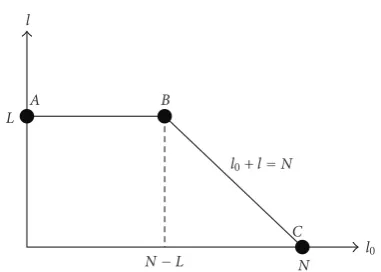
Figure 3 illustrates the region (l,l0) of the
frequency-selective BCC over N +L dimensions. We notice that the s.d.o.f. constraint (33) yields the line segmentA,Bwhile the constraint (34) in terms of the total number of streams for receiver 1 yields the line segmentB,C.
4. Multiuser Secure Communications
In this section, we provide some applications of the Vander-monde precoding in the multi-user secure communication scenarios where the transmitter wishes to send confidential messages to more than one intended receivers. The scenarios that we address are: (a) aK+ 1-user frequency-selective BCC withKconfidential messages and one common message, (b) a two-user frequency-selective BCC with two confidential messages and one common message. For each scenario, by focusing on the behavior in the high SNR regime, we characterize the achievable s.d.o.f. region and show the optimality of the Vandermonde precoding.
4.1. K + 1-User BCC with K Confidential Messages. As an extension ofSection 3, we consider theK+ 1-user frequency-selective BCC where the transmitter sendsK≤Lconfidential messagesW1,. . .,WK to the firstK receivers as well as one common messageW0to all receivers. Each of the confidential
messages must be kept secret to receiverK+ 1. Notice that this model, called multireceiver wiretap channel, has been studied in the literature ([20,22–26] and reference therein). In particular, the secrecy capacity region of the Gaussian MIMO multireceiver wiretap channel has been characterized in [24,26] forK=2, an arbitraryK, respectively, where the optimality of the S-DPC is proved.
The received signalykof receiverkand the received signal zof receiverK+ 1 at any block are given by
yk=T(hk)x+nk, k=1,. . .,K, (40) z=Tgx+ν, (41) where x is the transmit vector satisfying the total power constraint and n1,. . .,nK, ν are mutually independent AWGN with covarianceI. We assume that theK+ 1 vectors h1,. . .,hK,g of length L+ 1 are linearly independent and perfectly known to all the terminals. As an extension of the frequency-selective BCC in Section 2, we say that the rate tuple (R0,R1,. . .,RK) is achievable if for any>0 there exists a sequence of codes (2nR0, 2nR1,. . ., 2nRK,n) such that
Pn e ≤,
k∈K Rk−
1
nH(WK|Z
n)≤, K⊆ {1,. . .,K}, (42)
where we denoteWK= {∀k∈K,Wk}and define
Pne = 1 $K
k=02nRk
×
w0∈W0
· · ·
wK∈WK Pr
⎛ ⎝K
k=1
w(0k),wk
/
=(w0,wk) ⎞ ⎠.
(43)
An achievable secrecy rate region (R1,R2) for the case ofK=
2, when the transmitter sends two confidential messages in the presence of an external eavesdropper, is provided in [25, Theorem 1]. This theorem can be extended to an arbitraryK
while including the common message. Formally we state the following lemma.
Lemma 9. An achievable rate region of the K+1-user BCC, where the transmitter sendsK confidential messages intended to the firstKreceivers as well as a common message to all users, is given as a union of all non-negative rate-tuple satisfying
R0≤min
I(U;Z), min
k I(U;Yk)
,
Rk≤I(Vk;Yk|U)−I(Vk;Z|U), k=1,. . .,K,
k∈K Rk≤
k∈K
I(Vk;Yk|U)
−
|K|
j=2
IVπ(j);Vπ(1),. . .,Vπ(j−1)|U
−I(VK;Z|U), ∀K⊆ {1,. . .,K}, ∀π,
(44)
whereπdenotes a permutation over the subsetK,|K|denotes the cardinality ofK, we letVK = {∀k ∈ K,Vk}, and the random variablesU,V1,. . .,VK,X,Y1,. . .,YK,Z satisfy the Markov chain
l0
N
A2 A1
B2 B1
C
N−L
L L
l2 l1
Figure4: s.d.o.f. region (l0,l1,l2) overN+Ldimensions of three-user frequency-selective BCC.
Proof. Appendix C.
Notice that the second term of the last equation in (44) can be also expressed by
|K|
j=2
IVπ(j);Vπ(1),. . .,Vπ(j−1)|U
=
k∈K
H(Vk|U)−H(VK|U),
∀K⊆ {1,. . .,K}, ∀π.
(46)
It can be easily seen that without the secrecy constraint the above region reduces to the Marton’s achievable region for the generalK-user broadcast channel [35].
In order to focus on the behavior of the region in the high SNR regime, we define the s.d.o.f. region as
r0= lim
P→ ∞
R0
logP, rk=Plim→ ∞
Rk
logP, k=1,. . .,K, (47)
wherer0denotes the d.o.f. of the common message andrk denotes the s.d.o.f. of confidential messagek. As an extension ofTheorem 8, we have the following s.d.o.f. region result.
Theorem 10. The s.d.o.f. region of theK+ 1-user frequency-selective BCC (40) is a union of (r0,r1,. . .,rK) = (1/(N+ L))(l0,l1,. . .,lK)satisfying
K
k=1
lk≤L, (48)
l0+
K
k=1
lk≤N, (49)
where {l0,l1,. . .,lK} are non-negative integers. The Vander-monde precoding achieves this region.
Proof. Appendix D.
Figure 4 illustrates the region (l0,l1,l2) for the case of K = 2 confidential messages. It can be easily seen that
l1+l2=2
N+L=6,N=4
Rx 1
Rx 2
Eavesdropper
Figure 5: Equivalent MIMO interpretation for three-user frequency-selective BCC with two confidential messages.
the constraint (49) in terms of the total number of streams for the virtual receiver yields the subspaceC,B1,B2 while
the s.d.o.f. constraint (48) for the virtual receiver yields the subspaceA1,A2,B2,B1. We remark that for the special case of
one confidential message and one common message (K=1), the region reduces toFigure 3.
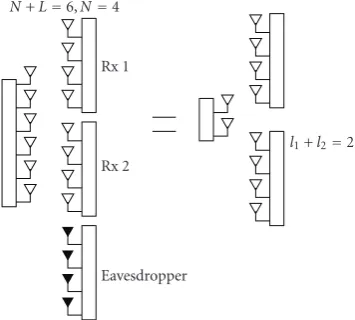
Remark 11. When only the K confidential messages are transmitted to the K intended receivers in the presence of the eavesdropper, the s.d.o.f. region has the equivalent MIMO interpretation [36]. More specifically, the frequency-selective BCC (40) is equivalent to the MIMO-BCC where the transmitter with N +L dimensions (antennas) sends messages toKreceivers withNantennas each in the presence of the eavesdropper withNantennas. The secrecy constraint (orthogonal constraint) consumes N dimensions of the channel seen by the virtual receiver and lets the number of effective transmit antennas be L. The resulting channel is the MIMO-BC without secrecy constraint with Ltransmit antennas and K receivers with N antennas each, whose multiplexing gain is min(L,KN) = L(we assume L < N). Figure 5illustrates the example withK=2,N=4,L=2.
4.2. Two-User BCC with Two Confidential Messages. We consider the two-user BCC where the transmitter sends two confidential messagesW1,W2 as well as one common
message W0. Each of the confidential messages must be
kept secret to the unintended receiver. This model has been studied in [17–19] for the case of two confidential messages and in [20] for the case of two confidential messages and a common message. In [19], the secrecy capacity region of the MIMO Gaussian BCC was characterized. The received signal at receivers 1, 2 at any block is given, respectively, by
y1=T(h1)x+n1,
y2=T(h2)x+n2,
(50)
covariance IN. We assume the channel vectors h1, h2 are
linearly independent.
We say that the rate tuple (R0,R1,R2) is achievable if for
any>0 there exists a sequence of codes (2nR0, 2nR1, 2nR2,n) such that
Pen≤,
R1−1 nH
W1|Y2n
≤, R2−1 nH
W2|Y1n
≤, (51)
where we define the average error probability as
Pne = 1 $2
k=02nRk
×
w0∈W0
w1∈W1
w2∈W2
Prw(1)0 ,w1
/
=(w0,w1)
∪w(2)0 ,w2
/
=(w0,w2)
,
(52)
where (w(1)0 ,w1), (w0(2),w2) is the output of decoders 1, 2,
respectively. A secrecy achievable rate region of the two-user BCC with two confidential messages and a common message is given by [20, Theorem 1]
R0≤min{I(U;Y1),I(U;Y2)},
R1≤I(V1;Y1|U)−I(V1;Y2,V2|U), R2≤I(V2;Y2|U)−I(V2;Y1,V1|U),
(53)
where the random variables satisfy the Markov chain
U,V1,V2−→X−→Y1,Y2. (54)
We extendTheorem 8to the two-user frequency-selective BCC (50) and obtain the following s.d.o.f. result.
Theorem 12. The s.d.o.f. region of the two-user frequency-selective BCC (50) is a union of (r0,r1,r2) = (1/(N + L))(l0,l1,l2)satisfying
lk≤L, k=1, 2, (55)
l0+lk≤N, k=1, 2, (56)
where{l0,l1,l2}are non-negative integers. The Vandermonde
precoding achieves the region.
Proof. Appendix F.
Figure 6represents the s.d.o.f. region (l0,l1,l2) overN+L
dimensions of the two-user frequency-selective BCC. The per-receiver s.d.o.f. constraints (55) yield the subspaceA1, B1,E,Ffor user 1 and the subspaceA2,B2,E,Ffor user 2.
The constraints (56) in terms of the total number of streams per receiver yield the subregionC,B1,Efor user 1 and the
subregion C, B2,E for user 2. For the special case of one
confidential message and one common message, the region reduces toFigure 3.
l0
N
A2 A1
B2 B1
C
N−L
E
F
L L
l2 l1
Figure6: s.d.o.f. region (l0,l1,l2) overN+Ldimensions ofK= 2-user frequency-selective BCC.
l1=2
l2=2
N+L=6,N=4
Figure 7: Equivalent MIMO interpretation for the two-user frequency-selective BCC with two confidential messages.
Remark 13. Comparing Theorems10,12as well as Figures 4,6forK = 2, it clearly appears that the s.d.o.f. ofK + 1-user BCC with K confidential messages is dominated by the s.d.o.f. of K-user BCC with K confidential messages. In other words, the s.d.o.f. region critically depends on the assumption on the eavesdropper(s) to whom each confidential message must be kept secret.
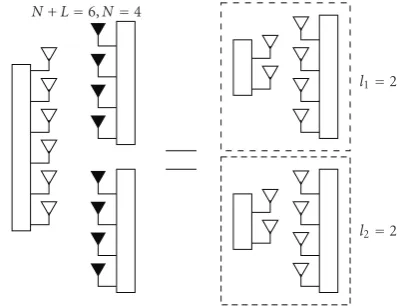
Remark 14. When only two confidential messages are trans-mitted in the two-user frequency-selective BCC, the set of the s.d.o.f. has the equivalent MIMO interpretation [36]. More specifically, the frequency-selective BCC (40) is equivalent to the MIMO-BCC where the transmitter with
diagonalization on the MIMO-BC without secrecy constraint [36]. In other words, the secrecy constraint in the BCC with inner eavesdroppers is equivalent to the orthogonal constraint in the classical MIMO-BC. Figure 7 shows the example with N = 4, L = 2, and K = 2 confidential messages.
5. Numerical Examples
In order to examine the performance of the proposed Van-dermonde precoding, this section provides some numerical results in different settings.
5.1. Secrecy Rate versus SNR. We evaluate the achievable secrecy rate Rvdm1 in (32) when the transmitter sends only
a confidential message to receiver 1 (without a common message) in the presence of receiver 2 (eavesdropper) over the frequency-selective BCC studied inSection 3.
5.1.1. MISO Wiretap Channel. For the sake of comparison (albeit unrealistic), we consider the special case of the frequency-selective wiretap channel when receiver 1 has a scalar observation and the eavesdropper hasNobservations. This is equivalent to the MISO wiretap channel with the receiver 1 channel h ∈ C1×(N+L) and the eavesdropper
channel T(g) ∈ CN×(N+L). Without loss of generality, we
assume that the observation at receiver 1 is the first row of T(h). We consider that all entries of h, g are i.i.d. ∼
NC(0, 1/(L+ 1)) and average the secrecy rate over a large
number of randomly generated channels with N = 64,
L =16. InFigure 8, we compare the optimal beamforming strategy [10,13,14] and the Vandermonde precoding as a function of SNRP. Since only one stream is sent to receiver 1, the s.d.o.f. is 1/(N+L). In fact, the MISO secrecy capacity in the high SNR regime is given by
1
N+Llog
1 + (N+L)P max φ:T(g)φ=0
hφ2
, (57)
where φ ∈ C(N+L)×1 is the beamforming vector. The
Vandermonde precoding achieves
1
N+Llog
)
1 + (N+L)Pmax i=1,...,L
hv1,i2*
, (58)
where v1,i denotes the ith column of V1 ∈ C(N+L)×L
orthogonal to T(g). Clearly, there exists a constant gap between (57) and (58) due to the suboptimal choice of the beamforming vector.
5.1.2. MIMO Wiretap Channel. We consider the frequency-selective wiretap channel withN = 64,L = 16. Although there exists a closed-form expression under a power-covariance constraint [15], the secrecy capacity under a total power constraint in (11) is still difficult to compute (especially for a large dimension of N and L) because it requires a search over all possible power covariances constraints. Therefore, inFigure 9, we compare the averaged secrecy rate achieved by the generalized SVD scheme [5]
0 0.05 0.1 0.15 0.2 0.25
Rat
e
(bps/Hz)
−20 −15 −10 −5 0 5 10 15 20 25 30 SNR (dB)
Secrecy capacity Vandermonde
N=64,L=16
Figure8: Achievable secrecy rate with one observation at receiver 1 andN=64,L=16 (MISO wiretap channel).
and the Vandermonde precoding. We assume that all entries ofh,g are i.i.d.∼ NC(0, 1/(L+ 1)). For the Vandermonde
precoding, we show the achievable rate with waterfilling power allocation (32) and equal power allocation (36) by allocating p =(N+L)P/LtoLstreams. As observed, these two suboptimal schemes achieve the same s.d.o.f. ofL/(N+
L)=1/5 although the generalized SVD incurs a substantial power loss. The result agrees well with Theorem 8. We remark also that the optimal waterfilling power allocation yields a negligible gain.
5.2. The Maximum Sum Rate Point (R0, R1) versus SNR. We
consider the frequency-selective BCC with one confidential message to receiver 1 and one common message to two receivers. In particular, we characterize the maximum sum rate-tuple corresponding to γ0 = γ1 on the boundary of
the achievable rate regionRs.Figure 10shows the averaged maximum sum rate-tuple (R0,R1) of the Vandermonde
precoding both with optimal input covariance computed by the greedy algorithm and with equal power allocation. We remark that there is essentially no loss with the equal power allocation.
5.3. Two-User Secrecy Rate Region in the Frequency-Selective BCC. We consider the two-user frequency-selective BCC where the transmitter sends two confidential messages (no common message) ofSection 4.2. For the sake of comparison (albeit unrealistic), we consider the special case of one observationN = 1 at each receiver. Notice that the two-user frequency-selective BCC is equivalent to the two-two-user MISO BCC withh1,h2 ∈ C1×(L+1) whose secrecy capacity
0 0.5 1 1.5 2
Secr
ecy
rat
e
(bps/Hz)
−10 −5 0 5 10 15 20 25 30
SNR (dB) 0Vandermonde + WF
Vandermonde + equal power Generalized SVD
N=64,L=16
Figure9: Achievable secrecy rate withN = 64,L =16 (MIMO wiretap channel).
0 2 4 6 8 10
C
o
mmon/secr
ecy
rat
e
(bps/Hz)
−10 −5 0 5 10 15 20 25 30
SNR (dB)
R0
R1
Sum rate
Vandermonde + WF Vandermonde + equal power
N=64,L=16
Figure10: Achievable secrecy/common ratesN =64, L=16 in the frequency-selective BCC.
Vandermonde precoding achieves the secrecy rate region given by all possible rate-tuples (R1,R2)
R1≤
1
L+ 1log )
1 +p1max
i=1,...,L
h1v1,i2 *
,
R2≤
1
L+ 1log )
1 +p2max
i=1,...,L
h2v2,i2*
(59)
satisfying p1+p2 =(L+ 1)Pwherev1,i,v2,idenotes theith column ofV1 ∈C(N+L)×Lorthogonal toh2,V2 ∈ C(N+L)×L
orthogonal toh1, respectively.Figure 11compares the
aver-aged secrecy rate region of the Vandermonde precoding,
0 0.2 0.4 0.6 0.8 1 1.2 1.4
Secr
ecy
rat
e
2
(bps/HZ)
0 0.2 0.4 0.6 0.8 1 1.2 1.4 Secrecy rate 1 (bps/HZ)
sDPC Vandermonde ZF
L=5, SNR=10 dB
Figure11: Achievable secrecy rate regionN =1, L =5 (MISO-BCC).
zero-forcing beamforming, and the optimal S-DPC scheme forL=5 where all entries ofh1,h2are i.i.d.∼NC(0, 1/(L+
1)). As observed, the Vandermonde precoding achieves the near-optimal rate region. As the number of pathsLincreases, the gap with respect to the S-DPC becomes smaller since the Vandermonde precoding tends to choose the optimal beamformer matched to the channels.
6. Conclusions
We considered the secured communication over the selective channel by focusing on the frequency-selective BCC. In the case of a block transmission of N
symbols followed by a guard interval ofLsymbols discarded at both receivers, the frequency-selective channel can be modeled as anN×(N+L) Toeplitz matrix. For this special type of MIMO channels, we proposed a practical yet order-optimal Vandermonde precoding which enables to sendl≤
L streams of the confidential messages and N−l streams of the common messages simultaneously over a block of
N+Ldimensions. The key idea here consists of exploiting the frequency dimension to “hide” confidential information in the zeros of the channel seen by the unintended receiver similarly to the spatial beamforming. We also provided some application of the Vandermonde precoding in the multiuser secured communication scenarios and proved the optimality of the proposed scheme in terms of the achievable s.d.o.f. region.
encoding techniques (double binning) remains a formidable challenge, such design is of great interest for the future secrecy systems.
Appendices
A. Proof of
Lemma 2
In this appendix, we consider the rank ofT(h)V1whereV1
satisfies the orthogonalityT(g)V1=0. By lettingv1,idenote theith column of V1 we haveV1 = [v1,1,. . .,v1,L] for the
Notice that allN+L−lrows are linearly independent. By definition ofV1, it is not difficult to see thatGandVH1 form
a complete set of basis for anN+L-dimensional linear space. Indeed forl=Lthe matrixGreduces toT(g), whilel < L, a subset of a projection matrix onto the null space ofT(g) is appended toT(g). HenceT(h) can be expressed as
T(h)=HG+HV =AG+BVH1, (A.2)
whereHGis the projection ofT(h) onto the row vectors of Gwith an N×(N+L−l) coefficient matrixA,HV is the
where (a) follows from the orthogonality GV1 = 0 and
VH1V1 = Il, (b) follows from rank(BBH) = rank(B). The equality (c) is obtained as follows. We notice
rank
where in (d) addingHGdoes not change the rank, (e) follows because any set ofN+Lrows taken fromT(h),Gis linearly independent (from the assumption that h, g are linearly independent). SinceHVis orthogonal toG, (A.4) yields
rank(HV)=N+L−(N+L−l)=l (A.5) which establishes (c).
B. Proof of
Theorem 5
We consider the following three cases given inLemma 4.
Case 1. Supposing R01 < R02, we consider the objective
function f1 in (25). The objective is concave only when γ1 ≥ γ0. Nevertheless, we consider the KKT conditions
which are necessary for the optimality. It can be easily shown that the KKT conditions are given by (29) where Ψi 0 is the Lagrangian dual matrix associated to the positive semidefiniteness constraint ofSifori = 0, 1 andμ ≥ 0 is the Lagrangian dual variable associated to the total power constraint. It clearly appears that forγ1 ≥ γ0the objective
is concave inS0,S1 and the problem at hand is convex. In
this case, any convex optimization algorithm, the gradient-based algorithm [37] for example, can be applied to find the optimal solution while the algorithm converges to a local optimal solution forγ1< γ0.
Case 2. Supposing R02 < R01, we consider the objective
functionf2in (26). Since the problem is convex (f2is concave
and the constraint is linear inS0,S1), the KKT conditions
are necessary and sufficient for optimality. We form the Lagrangian and obtain the following KKT conditions:
γ0GH0
whereΨi 0 is the Lagrangian dual matrix associated to the positive semidefiniteness constraint ofSifori=0, 1 and μ≥0 is the Lagrangian dual variable associated to the total power constraint. By creatingNparallel channels via SVD on G0,H1in (28), we readily obtain the solution (30).
Case 3. For 0< θ <1, we consider the objective functionf3
in (27). In the following we focus onγ0 > 0. Notice that if γ0=0 we haveR01 =R02=0 which yields the corner point
(0,Rvdm1 ) whereRvdm1 denotes the secrecy rate characterized
in (32). The KKT conditions, necessary for the optimality, are given by (31) whereΨi 0 is the Lagrangian dual matrix associated to the positive semidefiniteness constraints for
i=0, 1 andμ≥0 is the Lagrangian dual variable associated to the total power constraint. The gradient-based algorithm [37] can be applied to find the solution satisfying these KKT conditions. Although this algorithm yields the optimal and unique solution forγ1 ≥γ0θ, the algorithm converges to a
local optimal solution forγ1< γ0θ.
C. Proof of
Lemma 9
by taking the union over all possible K! encoding orders followed by the convex hull operation. We extensively use the notation A(εn)(PX,Y) to denote a set of jointly typical sequences x, y of lengthn with respect to the distribution
P(x,y). We letε >0 arbitrary small for a largen.
and we letMπ(1) = 0. the joint distribution factors as The
stochastic encoder randomly generates
(i) i.i.d. codewordsu(w0) accordingP(un)= choose randomly the index w0 and the corresponding
codeword u(w0). Given the common message u(w0), we
choose randomly the codeword vπ(1) within the bin wπ(1),
that is, the index jπ(1), such that (u, vπ(1))∈ Aεn(PU,Vπ(1)). Then successively choose the codeword vπ(k), that is, the
indicesjπ(k),iπ(k), such that
If there are more than one such sequence, it randomly selects one. Finally the encoder selects according toP(x|v1,. . .,vK).
(c) Decoding. The received signals at the K legitimate receivers are yn
1,. . ., ynk, the outputs of the channels
(d) Error Probability Analysis. Without loss of generality, we assume that the message set isw0 = w1 = . . . = wk = 1. We remark that an error is declared if one or more of the following events occur.
From the construction of the codebook above, we have
P(E1)≤ε.
(ii) Decoding step 1 fails; there does not exist a jointly typical sequence for somek, that is,
Ek
(iii) Decoding step 2 fails; there exits other sequences satisfying the joint typicality for somek
Ek
rate secrecy constraint is satisfied by the proposed encoding
where (a) follows because the conditioning decrease the entropy, (b) follows from Fano’s inequality [39] stating that for a sufficiently largenwe have
where Pe(,eavn) denotes the eavesdropper’s error probability
when decoding V1n,. . .,VKn with the knowledge on the (g) follows because the successive encoder yields the sum rate given by
This establishes the achievability.
D. Proof of
Theorem 10
The achievability follows by extending Theorem 8 to the case ofK confidential messages. First we remark that as a straightforward extension ofLemma 2the following lemma holds.
wherelkdenotes the number of columns ofVk
A sketch of proof is given inAppendix E. We let V0 be unitary matrix with N + L −
N+L. Based on the Vandermonde precoder V, we construct the transmit vectorxas
x= (D.1), the received signals become
where receiverkobserves the common message, the intended confidential message, and the interference from other users, while receiverK+ 1 observes only the common message. By lettingU = V0u0,Vk = U+Vkuk fork = 1,. . .,K,X = U+Kk=1Vkand considering the equal power allocation to allN+Lstreams, we readily obtain
I(U;Yk)
In order to find the d.o.f. region, we notice
rankTgV0VH0T(g)H
where (a) follows from orthogonality betweenT(g) andVk fork ≥ 1, (b) follows from the fact thatV = [V0· · ·VK] is unitary satisfying VVH = I, and (c) follows from
Lemma D.15. From (D.11) and (D.12), we readily obtain
The converse follows by a natural extension ofTheorem 8 to the K + 1-user BCC. To obtain the constraint (48), we consider that the first K receivers perfectly cooperate to decode the K confidential messages and one common message. By treating theseK receivers as avirtual receiver withKN antennas, we immediately obtain the bound (48) corresponding to the s.d.o.f. of the MIMO wiretap channel with the virtual receiver channel [T(h1)T,. . .,T(hK)T]Tand the eavesdropper channelT(g). The bound (49) is obtained by noticing that the total number of streams that receiver
k can decode is limited by the d.o.f. of T(hk), that is, N. Namely, we have the followingKinequalities:
l0+lk≤N, k=1,. . .,K (D.14)
which yieldsl0 ≤N−maxklk. Further by lettinglk =Lfor anyk ∈ {1,. . .,K}and andlj =0 for anyj /=k, we obtain l0 ≤ N−L. Adding the last inequality and (48), we obtain
(49). This establishes the converse.
E. Proof of
Lemma D.15
We consider rank(T(hk)
j∈KVjVHjT(hk)H) for a sub-set K ⊆ {1,. . .,K}. First we let vc,1,. . .,vc,L denote L orthonormal columns that form a unitary Vander-monde matrix orthogonal to T(g). For any subset L ⊆ {1,. . .,L}, we let Vc,L be the unitary matrix formed by
|L| columns corresponding to the subset L taken from vc,1,. . .,vc,L. Since a unitary matrix formed by{Vk}k∈K for
any K can be expressed equivalently as Vc,L, we consider
rank(T(hk)Vc,LVHc,LT(hk)H). For a given L, we let Vc,L
denote a unitary matrix composed by L− |L| columns corresponding to the complementary setL such thatL+
same approach asAppendix A. We define the matrixGL ∈
C(N+L−|L|)×(N+L) orthogonal to V
c,L by appending VHc,L to T(g)
GL=
⎡ ⎣T
g
VHc,L ⎤
⎦, (E.1)
where theN+L− |L|rows are linearly independent. Since GLandVHc,L form a complete set of anN+L-dimensional
linear space,T(hk) can be expressed as
T(hk)=Ak,LGL+Bk,LVHc,L, k=1,. . .,K, (E.2)
whereAk,L,Bk,Lis a coefficient matrix with dimensionN×
(N+L− |L|),N× |L|, respectively. By recalling that any set ofN+Lrows taken fromT(hk),T(g) is linearly independent fork=1,. . .,K(from the assumption thatg,h1,. . .,hKare linearly independent), we can repeat the same argument as Appendix Aand obtain
rankT(hk)Vc,LVHc,LT(hk)H
= |L|,
∀L⊆ {1,. . .,L}, k=1,. . .,K
(E.3)
which yields the result.
F. Proof of
Theorem 12
The achievability follows by generalizing Theorem 8 for the case of two confidential messages. We remark that by symmetryLemma 2for one beamforming matrixV1can be
trivially extended to two beamforming matricesV1andV2.
Namely, we have
Lemma F.16. Forl1 ≤ Landl2 ≤ L, there existsVk withlk orthnormal columns fork=1, 2satisfying
T(hk)Vj=0N×lj, k=1, 2, j /=k, (F.1) rank(T(hk)Vk)=lk, k=1, 2. (F.2)
Further, we letV0 be a unitary matrix withM = N+ L− rank([V1V2]) orthonormal columns in the null space of
[V1V2] such thatVH0[V1V2]=0M×(l1+l2). We constructxby Gaussian superposition coding based on the Vandermonde precoderV0,V1, andV2. From (F.1), each user observes the
vector of its confidential message and that of the common message, that is,
y1=T(h1)(V0u0+V1u1) +n1,
y2=T(h2)(V0u0+V2u2) +n2.
(F.3)
By lettingU=V0u0,Vk=U+Vkukfork=1, 2,X=V1+V2
and considering equal power allocation to all streams with
p=(N+L)P/(M+l1+l2), we readily obtain I(U;Yk)
= 1
N+L×log
IN+pT(hk)
V0VH0 +VkVHk
T(hk)H
IN+pT(hk)VkVHkT(hk)H ,
I(Vk;Yk|U)= 1
N+Llog
IN+pT(hk)VkVHkT(hk)H,
I(V1;Y2,V2|U)=I(V2;Y1,V1|U)=0.
(F.4)
We remark
rankT(hk)VkVHkT(hk)H
=rank(T(hk)Vk)=lk, k=1, 2,
rankT(hk)
V0VH0 +VkVHk
T(hk)H
=rank ⎛
⎝T(hk)[V0Vk] ⎡ ⎣VH0
VHk ⎤ ⎦T(hk)H
⎞ ⎠
(a)
=rankT(hk)
V0VkVj
(b)
=rank(T(hk))=N,
(F.5)
where (a) follows from orthogonality betweenT(hk) andVj for j /=k, (b) follows because [V0V1V2] or [V0V2V1] spans
a completeN+L-dimensional space. These equations yield
l0+lk≤Nfork=1, 2. This establishes the achievability. The converse follows by noticing that the constraints (55) and (56) correspond to trivial upper bounds. To obtain (55), we consider the special case when the transmitter sends only one confidential message to one of two receivers in the presence of the eavesdropper. When sending one confidential message to receiver 1, the two-user frequency-selective BCC reduces to the MIMO wiretap channel with the legitimate channelT(h1) and the eavesdropper channelT(h2), whose
s.d.o.f. is upper bounded by L. The same bound holds for receiver 2 when transmitting one confidential message to receiver 2 in the presence the eavesdropper (receiver 1). The upper bounds (56) follow because the total number of streams per receiver is limited by the individual (N+L)×N
MIMO link. This establishes the converse.