Algorithm based Approach for the Connection
Establishment in the Fast Handover in Leo Satellites in
BMBHO
Dipsikha Ganguly
Department of E.T.C.E. B.P. Poddar I.M.T. W.B.U.TDebabrata Sarddar
(Asst. Proff.) Department of E.T.C.E.Kalyani University
Soumya Das
Department of E.T.C.E Bengal Institute of Tech.W.B.U.T
Suman Kumar Sikdar Sougata Chakraborty Kunal Hui
M. Tech in C.S.E M.Tech in C.S.E. M. Tech in C.S.E.Jadavpur University Jadavpur University Jadavpur University
ABSTRACT
Now-a-days LEO satellites have an important role in global communication system. They have some advantages like low power requirement and low end-to-end delay, more efficient frequency spectrum utilization between satellites and spot beams over GEO and MEO. So in future they can be used as a replacement of modern terrestrial wireless networks. But the handover occurrence is more due to the speed of the LEOs. Different protocol has been proposed for a successful handover among which BMBHO is more efficient. But it had a problem during the selection of the mobile node during handover. Here we have proposed an algorithm so that the connection can be established easily with the appropriate satellite. By simulation we have shown that it will reduce the handoff latency as well as efficiency of the communication will be maximum and force call termination probability or call blocking probability will be minimum.
Keywords
Handover latency, LEO satellite, Mobile Node (MN), Billboard Manager (BM)
1.
INTRODUCTION
Modern terrestrial networks are designed as per to give the low cost and best quality service. Mobile networks provide communication to a limited geographical area. The applications of satellite network increases in order to provide the global coverage in a large area.There are different satellites for this communication [1] [2].
1.
Geostationary satellite2.
Medium Earth Orbit satellite3.
Low Earth Orbit satellite.Among which Low Earth Orbit satellite is the best for communication and as the replacement of future terrestrial wireless networks as it has some advantages like
a. Low propagation delay b. Low end to end delay c. Low power requirement
d. More efficient frequency spectrum utilization between satellites and spot-beams.
But the Leo satellite has also some problems. The main problem is that the low earth orbit satellites have a large relative speed than the speed of mobile nodes (MN) & earth. That’s why the handover occurrence is more. So the call blocking probability (Pb) and force call termination
probability (Pf) is also higher. To solve this problem different handover techniques have been proposed.
What is handover?
Handover is the process of transferring satellite control responsibility from one earth station to another earth station without any loss or interruption of the service[3][4].
An unsuccessful handover can degrade the system performance like call quality as well as it call because the forced call termination. To solve these problems different handover technique has been proposed [5] [6]. A handover is done in the following three steps:
i. Scanning ii. Authentication iii. Re-association
Scanning: When a mobile station is moving away from its current satellite, it initiates the handoff process when the received signal strength and signal-to-noise-ratio have decreased below the threshold level. The MN now begins the scanning to find new satellite. It can either go for a passive scan (where it listens for beacon frames periodically sent out by satellites) or choose a faster active scanning mechanism wherein it regularly sends out probe request frames and waits for responses for TMIN (min Channel Time) and continues scanning until TMAX (max Channel Time) if at least one response has been heard within TMIN. Thus, n*TMIN ≤ time to scan n channels ≤ n*TMAX. The information gathered is then processed so that the MN can decide which Satellite to join next. The total time required until this point constitutes 90% of the handoff delay.
Authentication: To associate the link with the new satellite Authentication is necessary. Authentication must either immediately proceed to association or must immediately follow a channel scan cycle. In pre-authentication schemes, the MN authenticates with the new satellite immediately after the scan cycle finishes.
N × Tmin _ Tscan _ N × Tmax
Where N is the total number of channels according to the spectrum released by a country, Tmin is Min Channel Time, Tscan is the total measured scanning delay, and Tmax is Max Channel Time. Here we focus on reducing the scanning delay by minimizing the total number of scans performed.
The paper is organized as follows: In the second section we have described the related works on handover management. In the third section we have described the proposed work which includes the specific algorithm for BMBHO for establishing a connection. In the forth section the simulation results of both our method and standard methods. In the section 5 we conclude the whole paper and finally a future work is mention regarding this paper in section six.
2.
RELATED WORK
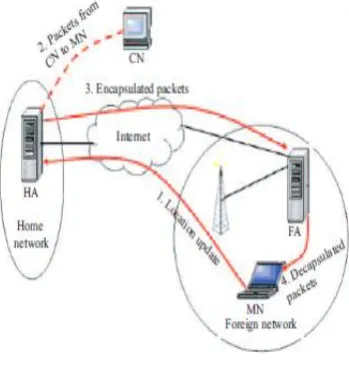
[image:2.595.363.572.78.276.2]To solve the problems of unsuccessful handovers different handover management protocols have been proposed [7] .The most widely used one is MIP i.e. Mobile IP Network [8]. It is proposed by The Internet engineering task force (IETF) to handle mobility of internet hosts for mobile data communications. MIP is based over the concept of Home Agent (HA) and Foreign Agent (FA) for delivering of packets from one MN to CN.
Figure 1: Handover scenario in MIP
It is done in four steps.
a. At the beginning of the handover MN registers itself in FA and waits for the channel allocation in FA and also updates its location in HA directory.
b. Then the packets are sent to HA and HA encapsulate it.
c. After that encapsulated packets are sent to The FA. d. Lastly FA decapsulate those packets and sent it to
MN.
But this protocol also has some drawbacks. The main drawbacks of this protocol are:
It has High handover latency
packet lost rate is also very high
It has insufficient routing path
Conflicts with network security solution
[image:2.595.60.235.347.534.2]So to overcome this drawbacks another protocol have been proposed i.e. Seamless handover management scheme (SEAHO-LEO) [9] [10] [11].
Figure 2: Handover scenario in SeaHO-LEO
This can be done in the following steps: A. Calculate a new IP
B. Send handover preparation request to current satellite
C. Start to use new IP to send data packets D. CN starts to use new satellite
The main advantage of this process is
packet loss is less
It has lower handover latency.
The main disadvantage of this process is
High messaging traffic.
To get over these drawbacks another method to remove high messaging traffic is Pattern based handover management (PatHO-LEO) [8], [9].
Figure 3: Handover scenario in PatHO-LEO
It describes as follows
Satellite register to BM.
[image:2.595.320.489.511.696.2] BM establishes the satellite and user mobility pattern (SMUP) table.
CN and BM establish connection.
CN sends data packets to MN. But the main drawback of PatHO-LEO is that
i) Every user should have a specific mobility pattern in a specific period of time. A user can have more than one mobility pattern. But when it violets its mobility pattern the handover process will be either in SeaHO-LEO or MIP. The no of user who do not have a specific mobility pattern in a week is increasing day by day like salesman, LIC worker who have to go different place at different time in a week.
Now to overcome these existing problems the handover management protocol proposed is named as BMBHO i.e. Billboard Manager Based Handover Technique where BM only stores satellite location signal strength based on QoS parameters[12][13].
In BMBHO we assume that the direction of the signal flow is in one side or both side i.e. from CN to MN (where CN is fixed & MN is movable) or from MN1 to MN2 and vice versa (where both are movable).
If the CN/MN2 is under the footprint of same satellite then the communication will be via one satellite otherwise via different satellite by ISL. So it is not important to know that communication is through CN/MN2, as the method is same for all. This handover process can be done in the following ways
1) BM stores all info about satellites: the entire
satellites resister to BM including their IP address. This information not subjected to change and permanently stored in the BM database.
2) All satellite sends periodic info: All the satellites will send the following info periodically to the BM.
i) Channel capacity: -- How many channels are available in the satellite.
ii) Signal strength: -- What is the strength of the signal at that time because from time to time and area to area due to the different weather condition.
This information is not constant & it updates itself every time it gets a new info. The time period of this update will be set as small as possible because a huge no of MN lies under the footprint of a satellite. So the channel capacity changes very frequent. This time period is inversely proportional to the success of handover.
3) Handover request is send to BM: If a new MN wants to handover i.e. its signal strength decreases under a certain level called threshold level, it sends a HANDOVER_REQUEST (HO_REQ) to BM via its current satellite which contains the following
i) IP addresses of the current satellite (CS),
ii) IP address of adjacent satellite (AS) If MN/MN1 is connected to CN/MN2 through more than one satellite by ISLs.
iii) IP address of MN itself. ii) Position of MN.
ii) The direction of the MN i.e. in which direction it wants to go.
4)BM selects the new satellite: Now BM first makes a list of available satellites in that direction at that time with the help of its stored data & the updates of satellites. Then BM selects best satellites for that MN according to the QoS parameters. A specific algorithm has to be developed for selecting the correct satellite.
5) MNstarts to use new satellite: Once the satellite is selected BM sends the IP address of the new satellite to the MN & CN/MN2/AS. Now CN/MN2/AS makes a connection set up for the new satellite and it communicates to MN via the new satellite.
Advantages of BMBHO are:
i) It is a very fast handover process as the steps involved in it is less complicated than MIP or SeaHO-LEO or PatHO-LEO. The scanning time for searching a new satellite is not required since no scanning is done by MN itself. New satellite is selected according to the QoS parameters. As the new satellite can be found just after the execution of a simple algorithm & MN does not have to scan for the next satellite so this method can be very effective for fast handover.
ii) The messaging traffic of SeaHO-LEO is reduced since only one message HO_REQ is sent to BM for handover.
iii) As this method deals with only the patterns of satellites which is not subjected to change so this method can be used everywhere unlike PatHO-LEO which cannot be used where user does not have any specific mobility pattern.
iv) This method is irrespective of the mobility of CN i.e. CN is fixed or moving. This method can be used for transmitting voice, video or both for video calling as well as for web browsing, file downloading and uploading.
Though it is very much advantageous it has some drawbacks like it has no specific algorithm under which BM will select the appropriate satellite. In this paper in our proposed work we have tried to overcome these drawback .We have developed a new algorithm for BM by which it will be able to choose the best satellite and establish the connection. By simulation results also we have shown that later on.
3.
PROPOSED WORK
In fast handover of Leo satellite we have seen that there are several mobility management protocols to control the handover occurrence efficiently .In the Billboard Manager based handover we have seen that it can reduce the call blocking and forced call termination probability to almost zero, but there is a problem in BMBHO i.e. there is no specific algorithm to choose a new satellite to handover. In our proposed work we have suggested a specific algorithm for the Leo satellite.
4.
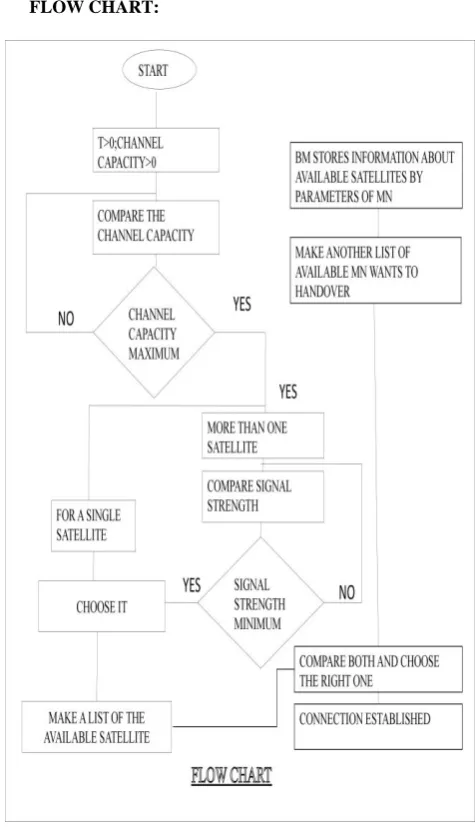
ALGORITHM
1) BM stores all information about satellite like IP addresses of the satellite.
2) All satellite sends periodic information to Billboard Manager.
a) Channel capacity b) Signal strength
3) Now for t=0,compare channel capacity if the channel capacity >0
Continue; Else stop
4) Compare channel capacity, choose the maximum one.
5) If the channel capacity of the two satellite to handover is same,
Compare the signal strength.
Choose the lowest signal strength of same channel capacity.
Else go back to 4
6) Repeat 4-6 every time while choosing a new satellite to handover.
7) Make a list of the available satellites and store it to BM
8) Now, If a new mobile node wants to handover ,signal strength decreases under a certain level i.e. threshold level, it sends a Handover Request to BM via its current satellite containing
a) IP address of the current satellite
b) IP address of the adjacent satellite, If MN/MN1 is connected to CN/MN2 through more than one satellite by ISLs. c) IP address of MN.
d) Position of MN
e) The direction of the MN
9) Now BM again makes a list of available MNs.
10) Now comparing the first list and second list it chooses the best satellite to handover.
11) Once the satellite is selected, BM sends MN the IP address of the new satellite.
12) Now the connection is established.
[image:4.595.319.557.74.488.2]FLOW CHART:
Figure 4: Algorithm for establishing connection
5.
SIMULATION RESULTS
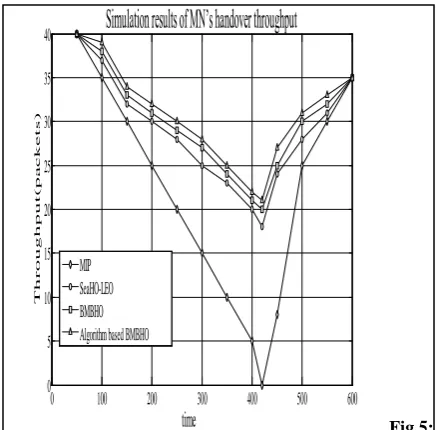
Fig 5:
Simulation results of MN’s handover throughput
In figure 5 we compare the Handover throughput for MIP, SeaHO-LEO & BMBHO and algorithm based BMBHO during a handover. Due to the tunneling between HA and FA in Mobile IP network, throughput of the channel between MN1/CN and MN2/MN converges to zero during handover and the handover model is completed, the throughput reaches a reasonable value. SeaHO-LEO throughput is better than MIP during handover as it does not reach to zero. In BMBHO the throughput is higher than SeaHO-LEO because the handover takes very less time and the packets during handover is sent by the old link. And here we can see that algorithm based BMBHO is far better as it has a specific algorithm to choose the best satellite for establishing connection.
Fig 6: Simulation results of handover latency
In figure 6we have compared the handoff latency between the MIP,SeaHO-LEO,BMBHO and the Algorithm based BMBHO.comparing all the results we can conclude that due to ommiting the scanning process handoff delay is very less in
BMBHO than the other two.Now in the Algorithm Based BMBHO,we have taken the BMBHO with just an algorithm to select the satellite.so for this also handoff latency will be lesser than the MIP and SeaHO-LEO and as this finds the easiest way and lesser time to establish the connection following the specific algorithm its handoff latency is lesser than the normal BMBHO also.
Fig 7: Forced call termination probability of a
handover call
In figure 7 we compare the Forced call termination probability of MIP & SeaHO-LEO, BMBHO with the Algorithm Based BMBHO. Among these management models, BMBHO has the lowest Forced call termination probability. In MIP there is a channel allocation so MN has to wait and if there is no free channel within the handoff time the call will be terminated. In SeaHO-LEO the MN has to wait for the agent advertisement from a new satellite. If it did not received within handoff time the call is being terminated. But in BMBHO the no of channel available in the satellites seen by the MN at the time of handoff is already known to BM so BM selects the new satellite for MN which has a free channel. So the force call termination probability is reduced. Now in our approach since there is a specific algorithm for choosing the satellite. It will choose the best satellite with maximum channel capacity and for that the connection will be efficient and so is the communication and data transfer. That is why there the call termination probability is almost equal to zero. By the above result we can show that for even 2200 calls per minute the forced call termination probability is almost equal to 0.07 where as for MIP it is 0.25, for SeaHO-LEO it is 0.21 and for BMBHO it is 0.17.
6.
CONCLUSION
In this paper we have proposed algorithm based BMBHO management where we have shown that the specific algorithm can reduce handover latency, data loss, scanning time, cost and forced call termination probability as well as can increase the MN’s throughput and the efficiency.
We first described the handover is and handover process. Then we described the standard handover mechanism MIP and also SeaHO-LEO and PatHO-LEO and our BMBHO and their drawbacks. Then we have shown the specific algorithm to reduce the drawback of BMBHO. Relaying on the simulation results we showed that our proposed mechanism
0 100 200 300 400 500 600
0 5 10 15 20 25 30 35 40
time
T h ro u g h p u t (p ack et s )Simulation results of MN’s handover throughput
MIP SeaHO-LEO BMBHO Algorithm based BMBHO
0
20
40
60
80
100
120
140
160
180
0
50
100
150
200
250
Simulation results of handover latency
time spend in overlapping areas
h an d o ff l at en cy
MIP
SeaHO-LEO
BMBHO
Algorithm Based BMBHO
0 200 400 600 800 1000 1200 1400 1600 1800 2000 2200 0 0.05 0.1 0.15 0.2 0.25
call arrival rate(calls/min)
Fo rced cal l t ermi n at i o n p ro b ab i l i t y
Forced call termination probability of a handover call
[image:5.595.60.280.71.286.2] [image:5.595.61.302.469.701.2]help BM to choose the best satellite for handover so that the call quality increases as well as the call dropping probability reduces to zero. Our method is more efficient than the standard one to establish the best connection.
7.
FUTURE WORK
The future work can be framed taking some other drawbacks of the BM under consideration. The success of this method lies on the efficiency of the BM i.e. how many simultaneous HO_REQ it can process. We have to calculate maximum no of HO_REQ can possible at any time under a BM. This will be the ideal efficiency of a BM. so we can try to make BM more efficient for an effective communication.
8.
REFERENCES
[1] S. L. Kota, P. A. Leppanen, and K. Pahlavan, Broadband Satellite Communications For Internet Access, Kluwer Academic Publishers, 2004.
[2] A. Jamalipour, “Satellites in IP networks,” in Wiley Encyclopedia ofTelecommunications, vol. 4, Wiley, 2002, pp. 2111–2122.
[3] Satellite Mobility Pattern Scheme for Centrical and Seamless Handover Management in LEO SatelliteNetworksAys¸eg¨ul T¨uys¨uz and Fatih Alag¨oz
[4] H. Uzunalioglu, I. F. Akyildiz, Y. Yesha, and W. Yen, “Footprint handover
[5] H. Uzunalioglu, I. F. Akyildiz, Y. Yesha, and W. Yen, “Footprint handover Rerouting protocol for low earth orbit satellite networks,” Wireless Networks, vol. 5, no. 5, pp. 327–337, 1999
[6] Systems By Joydeep Banerjee D Sarddar, S.K. Saha, M.K. Naskar, T.Jana, U. Biswas
[7] H. N. Nguyen, S. Lepaja, J. Schuringa, and H. R. Van As, “Handover management in low earth orbit satellite IP networks,” IEEE Global Telecommunications Conference, San Antonio, TX, USA, pp. 2730–2734, 25-29 November 2001
[8] J. T. Malinen and C.Williams, “Micromobility taxonomy,” Internet Draft,IETF, Nov. 2001
[9] T¨uys¨uz and F. Alag¨oz, “Satellite mobility pattern based handover management algorithm in LEO satellites,” in Proc. IEEE ICC 2006, Istanbul,Turkey, June 2006..
[10]Ays¸eg¨ul T¨uys¨uz and Fatih Alag¨oz, “Satellite Mobility Pattern Scheme for centrical and Seamless Handover Management in LEO Satellite Networks”,
JOURNAL OF COMMUNICATIONS AND
NETWORKS, VOL. 8, NO. 4, DECEMBER 2006.
[11]M. Atiquzzaman, S. Fu, and W. Ivancic, “TraSH-SN: A transport layer seamless handoff scheme for space networks,” in Proc. ESTC 2004, Palo Alto, CA, June 2004.
[12]Debabrata Sarddar, Soumya Das,Dipsikha Ganguly,Sougata Chakraborty,M.k.Naskar, A New Method for Fast and Low Cost Handover in Leo Satellites(International Journal of Computer Applications (0975 – 8887) Volume 37– No.7, January 2012)
http://www.ijcaonline.org/archives/volume37/number7/4 622-6631
[13]Debabrata Sarddar, Soumya Das,Dipsikha Ganguly,Sougata
Chakraborty,M.k.http://www.ijcaonline.org/archives/vol ume37/number7/4621-6630
[14]Minimization of Call Blocking Probability using Auxiliary Stations by D.sarddar,shubhajeet chatterjee,mandovi mukherjee,ijcaonline.org, International Journal of Computer Applications (0975 – 8887) Volume 25– No.7, July 2011
[15]P. Bhagwat, C. Perkins, and S. Tripathi, “Network layer mobility: An architecture and survey,” IEEE Pers. Commun., vol. 3, no. 3, pp. 54–64, June1996.
[16] A. T. Campbell, J. Gomez, S. Kim, Z. Turanyi, C.-Y. Wan, and A. Valko, Comparison of IP micro-mobility protocols,” IEEE Wireless Commun. Mag., vol. 9, no. 1, Feb. 2002.
[17]H. Tsunoda, K. Ohta, N. Kato, and Y. Nemoto, “Supporting IP/LEO satellite networks by handover-independent IP mobility management,” IEEE J.Select. Areas Commun., vol. 22, no. 2, pp. 300–307, 2004. [18]Debabrata Sarddar, Arnab Raha, Tapas Jana, Shovan
Maity, Utpal Biswas, and M.K. Naskar, ―Reduction of Error in Handoff Initiation Time Calculation for Next-Generation Wireless Systems‖ (IJCSE) International Journal on Computer Science and Engineering Vol. 02, No. 06, 2010, 2047-2052.
[19]S. Kalyanasundaram, E.K.P Chong, and N.B. Shroff, “An efficient scheme to reduce handoff dropping in LEO satellite systems,” Wireless Networks, vol. 7, no. 1, pp. 75–85, January 2001.
[20]H. N. Nguyen, S. Lepaja, J. Schuringa, and H. R. Van As, “Handover management in low earth orbit satellite IP networks,” IEEE Global Telecommunications Conference, San Antonio, TX, USA, pp. 2730–2734, 25-29 November 2001.
AUTHORS
PROFILE
Dipsikha Ganguly, currently pursuing B.Tech in Electronics
& Communication engineering at B.P.Poddar Institute of Management & Technology under West Bengal University of Technology. Her research interest includes wireless communication & satellite communication.
Debabrata Sarddar is currently pursuing his PhD at Jadavpur
University and Asst. Proff.in Kalyani University. He completed his M.Tech in Computer Science & Engineering from DAVV, Indore in 2006, and his B.Tech in Computer Science & Engineering from Regional Engineering College, Durgapur in 2001. His research interest includes wireless and mobile communication.
Soumya Das, son of Mr. Subrata Das and Mrs. Swapna Das,
currently pursuing his B.Tech in Electronics & Communication Engg. at Bengal Institute of Technology under West Bengal University of Technology. His research interest includes mobile communication & satellite communication.
Suman Kumar Sikdar completed his B.Tech in CSE from
Sougata Chakraborty is presently an employee of IBM (Kolkata). He has completed his B.Tech in IT from Murshidabad College of Engineering and Technology in 2008 and M.Tech in Computer Science & Engineering from Jadavpur University in 2011. His research interest includes wireless sensor networks and wireless communication systems.
Kunal Hui is presently an employee of Cognizant (Kolkata).