OVERSPEED CORRECTION SCHEME FOR DC MOTOR USING ARTIFICAL INTELLIGENT APPROACH
JAVADIUS BOLLAH
A project report submitted in partial
Fulfillment of the requirement for the award of the Degree of Master of Electrical & Electronic Engineering
Faculty of Electrical & Electronic Engineering Universiti Tun Hussien Onn Malaysia
i
ABSTRACT
ii
ABSTRAK
CONTENTS
ABSTRACT (BI) i
ABSTRACT (BM) ii
ACKNOWLEDGEMENTS iii
TABLE OF CONTENTS iv
LIST OF TABLES v
CHAPTER 1 I NT RODUCT IO N 1
1.1 Project background 1
1.2 Problem statements 2
1.3 Objective 2
1.4 Scopes of project 3
CHAPTER 2 L I T ERAT URE RIVIEW 4
2.1 Fuzzy logic theories 4
2.1.1 Fuzzy logic controller 4
2.1.2 Fuzzification 5
2.1.3 Defuzzification 6
2.1.4 Rule base system 7
2.2 Fuzzy inference system 8
2.2.1 Fuzzy inference method 10
2.3 Direct current motor 12
2.3.1 Permanent magnet dc motor 12
2.3.2 DC brush motor 13
2.3.3 DC brushless motor 13
2.3.4 Connection of dc motor 14
2.4 A review of research studies 14
CHAPTER 3 METHODOLOGY 16
3.1 Project methodology 16
3.2 Flowchart of the project 17
3.3 Develop a mathematical model of dc motor 18
3.4 PID controller design 18
3.5 PI controller design 19
3.6 Fuzzy logic controller design 20
3.7 DC motor drives 21
3.8 Performance and result analysis 22
CHAPTER 4 DE S I GN A SIMULINK MODEL OF DC MOTOR 23
4.1 DC motor speed control method 23
4.2 Simulink design of field resistance speed control 23 4.3 Simulink design of armature voltage speed control 23 4.4 Simulink design of armature resistance speed
control 25
4.5 Simulink model of feedback control system 26 4.6 Simulation result of field resistance speed control 28 4.7 Simulation result of armature voltage speed
control 30
4.8 Simulation result of armature resistance speed
control 30
4.11 Develop a simulink circuit of PMDC 36
CHAPTER 5 DESIGN A FUZZY LOGIC SPEED CONTROL
FOR DC MOTOR 38
5.1 Design a fuzzy logic controller of dc motor 38
5.2 Case study 1 39
5.2.1 Design fuzzy logic controller of separted
excited dc motor 39
5.2.2 Simulation of Fuzzy Logic Controller
for DC Motor Speed Control 40
5.2.3 The Fuzzy Inference Logic
System Editor (FIS) 40
5.2.4 Working with matlab command editor 47 5.2.5 Editing the membership function using
Command editor 47
5.2.6 Output response of dc separated excited
Dc motor using FLC 50
5.3 Case study 2 52
5.3.1 Design fuzzy logic controller for PMDC 52 5.3.2 Simulation of Fuzzy Logic Controller
for DC Motor Speed Control 54
5.3.3 Comparative study of speed response of
PMDC 57
5.3.4 Implementing fuzzy logic controller
In real-time system 59
5.4 Case study 3 61
5.4.1 Separated excited dc motor using
H-Bridge as a driver 61
CHAPTER 6 CO NCLUS I O N 66
6.1 Fuzzy logic and conventional controller:
A comparison 66
6.2 Discussion 67
REFERENCES 68
vi
LIST OF FIGURES
2.1 Fuzzy logic Structure 4
2.2 Centroid method 7
2.3 Membership function 8
2.4 Fuzzy Inference System 9
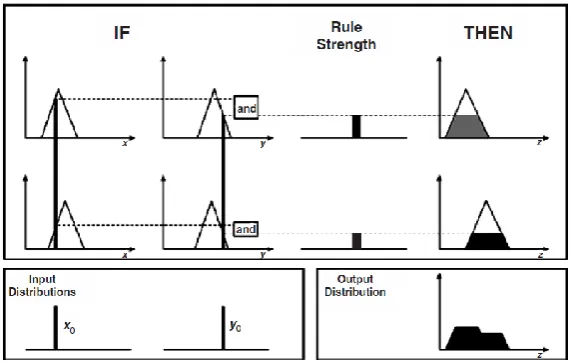
2.5 A two input, two rule Mamdani FIS with crisp inputs 10
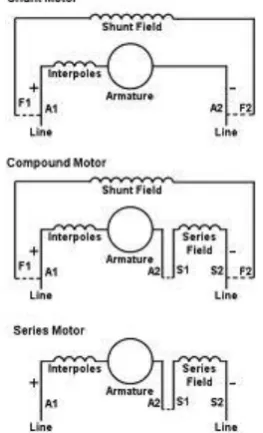
2.6 Connection of dc motor 14
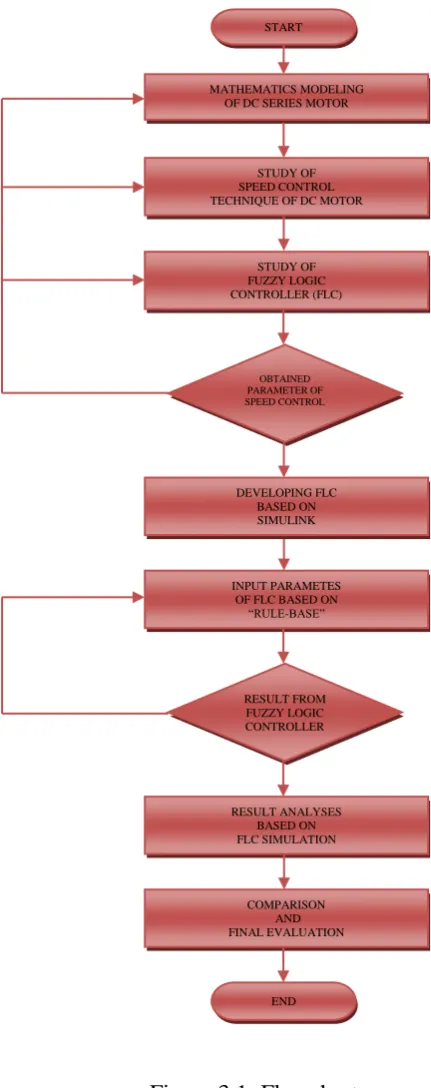
3.1 Flowchart 17
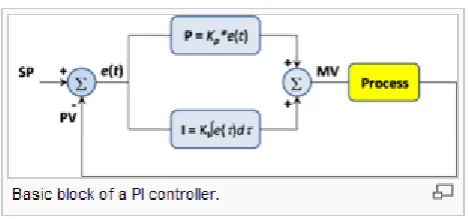
3.2 Basic block of PI controller 19
3.3 DC chopper converter drives of dc motor 21
3.4 DC motor with dc chopper drive 22
4.2 Field Resistance speed control 24
4.3 Armature voltage speed control 25
4.4 Armature resistance speed control 26
4.5 Feedback block diagram of motor speed control 28
4.6 Simulink model of dc motor speed control 28
4.7 Torque-speed curves field resistance control 29
4.8 Torque-speed characteristics for three different armature
voltages 30
4.9 Torque-speed characteristics for three different armature
resistances 30
4.10 Motor speed for different PI gain values 32
4.11 Permanent magnet dc motor (PMDC) 33
4.12 DC motor with load 33
vii
4.14 Closed-Loop or Feedback system of the motor model 36 4.15 Simulink diagram of dc motor model with PI controller 36 4.16 Output response of dc motor using PI controller 37
5.1 DC motor control by PI controller 40
5.2 Input voltage with PI controller 40
5.3 Armature current with PI controller 41
5.4 Speed of dc motor with PI controller 41
5.5 Fuzzy logic editor 42
5.6 Membership function of ‘input of error’ 42
5.7 Membership function of ‘input Change of error’ 43
5.8 Membership function of output 43
5.9 Rule viewer with input ‘error’ and output 44
5.10 Surface view 45
5.11 Separated DC motor with fuzzy logic controller 46 5.12 Sub-system of Separated DC motor with fuzzy logic controller 46
5.13 Input voltage using FLC 51
5.14 Current armature using FLC 51
5.15 Speed response of separated excited dc motor using FLC 52
5.16 Membership function of ‘input’ 53
5.17 Rule viewer with input ‘error’ and output 53
5.18 Simulink circuit controlled by I (integral) and fuzzy logic
controller 54
5.19 Output speed response 54
5.20 Rule Editor 55
5.21 Rules viewer 56
5.22 Surface view 56
5.23 Combination of simulink model of dc motor 57
5.24 PI and Fuzzy Logic Controller 58
5.25 Output response combination of PI, Fuzzy Logic and Wihout
viii
5.26 Simulink circuit of PI and Fuzzy Logic controller in real-time
system 59
5.27 Comparison of PI controller (first 2 cycles) and Fuzzy controller
at set point 50 rad/s. 59
5.28 Comparison of PI controller (first 2 cycles) and Fuzzy controller
at set point 100 rad/s. 60
5.29 Comparison of PI controller (first 2 cycles) and Fuzzy controller
at set point 200 rad/s. 60
5.30 DC motor control using H-Bridge as a driver 61
5.31 DC motor control input voltage 62
5.32 Output speed response 62
5.33 Output armature current 62
5.34 Output armature current 63
5.35 The input signal using fuzzy logic controller 63 5.36 Rules editor for dc motor speed control using H-Bridge 64 5.37 Surface view for dc motor speed control using H-Bridge 64 5.38 Speed output for dc separated dc motor using fuzzy logic and
H-bridge drive 65
5.39 Armature current output for dc separated dc motor using fuzzy
logic and H-bridge drive 65
5.40 Load torque output for dc separated dc motor using fuzzy logic
1
CHAPTER 1
INTRODUCTION
1.1 Project Background
DC motors are used in industrial applications because the speed-torque relationship can be varied to almost any useful form. DC motors are often applied wherethey momentarily deliver three or more times their rated torque. DC motors feature a speed, which can be controlled smoothly down to zero, immediately followed by acceleration in the opposite direction also. DC motors can respond quickly to changes in control signals due to the high ratio of torque to inertia[1].
2
vector comprising the speed error and itsderivative. This is to ensure that the statetrajectory is the most optimal in reducing the controlsensitivity toany excursions in load and plant modelparameters, moreover it also provides optimal tracking withminimum overshoot, undershoot, fast rise andsettling times. The proposed FLC based controller gives betterresults in comparison with classical A.I controller [2].
1.2 Problem Statements
During the start-up, the DC motor normally has high starting current and torque, consequently the speed of motor become very high and sometimes will turn to over speed and unstable especially when it is in no-load or under load condition. At the same time the armature current will increase rapidly and turn the coil to overheat and then burnt.
This project will focus on dc motor which has a poor speed regulation and then try to achieve the speed correction. The fuzzy logic control will be implemented through simulink simulation while the real performance of dc motor will try to conduct, visualize and monitor at Machine Laboratory of Jabatan Kejuruteraan Elektrik, Politeknik Kota Kinabalu.
1.3 Objective
The main objective is to develop speed control of dc motor using fuzzy logic controller (FLC). The objective of this project is as follows:
a) To carry out the dc motor mathematical model
3
1.4 Scopes of the project
The scopes of this project are:
a) To investigate FLC controller which are used as a main control technique in simulation. Three main stages of FLC namely the fuzzifier, rule-base fuzzy set and the defuzzifiction.
b) In the experiment, the test apparatus will be equipped with dc motor 0.3kW contains of multifunction machine, machine test system and control and dc power supply stabilizer.
c) The performance analyses will focus on current armature (Ia) and load torque
(TL) as well as speed (N) of the motor.
4
CHAPTER 2
LITERATURE REVIEW
2.1 Fuzzy Logic Theories
2.1.1 Fuzzy Logic Controller
The Fuzzy Logic tool was introduced in 1965, also by Lotfi Zadeh [3], and is a mathematical tool for dealing with uncertainty. It offers to a soft computing partnership the important concept of computing with words’. It provides a technique to deal with imprecision and information granularity. The fuzzy theory provides a
mechanism for representing linguistic constructs such as “many,” “low,” “medium,” “often,” “few.” In general, the fuzzy logic provides an
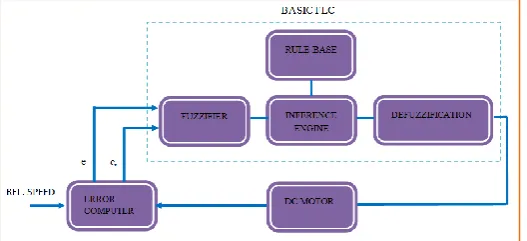
[image:14.595.207.471.598.718.2]inference structure that enables appropriate human reasoning capabilities. Figure 1 shows the proposed fuzzy logic control structure with the modified defuzzifier stage.
5
The FLC involves three stages namely fuzzification, rule-base and defuzzification. There are several method that used in the Mamdani[3,4] applied the fuzzy set theory for developing fuzzy logic controllers (FLCs). In general, a FLC consists of a set of linguistic conditional statements which are derived from human operators and represents the expert’s knowledge about the system being controlled. These statements define a set of control protocol relating the control conditions to control actions by ‘If-Then’ rules.
2.1.2 Fuzzification
In fuzzy logic system the linguistic variables are used instead of numerical variables. Fuzzification is an important concept in the fuzzy logic theory. Fuzzification is the process where the crisp quantities are converted to fuzzy (crisp to fuzzy). By identifying some of the uncertainties present in the crisp values, we form the fuzzy values. The conversion of fuzzy values is represented by the membership. The process of converting a numerical variable (real number or crisp variables) into a linguistic variable (fuzzy number or fuzzy variable) is called fuzzification.
In this project, the motor variables are speed (w) and current (Ia). The speed of dc motor is controlled by FLC. The error e(k) and change in error Δe(k) is given as input to the FLC. The error is found by comparing the actual speed ω(k) with reference speed ωr(k). From the error e(k) and old error eold(k) the change in error
Δe(k) is calculated. In in order to use the same FLC for different reference speed it has to be normalized and finally the error and change in error are fuzzified.
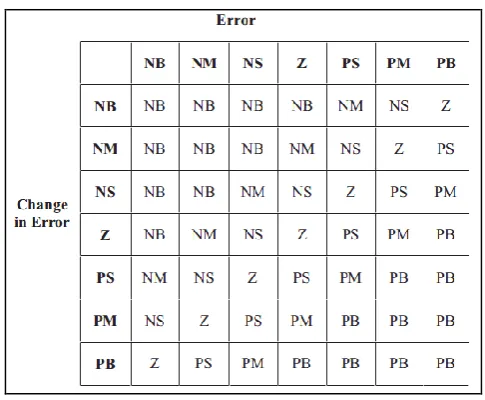
Seven linguistic variables are used for the input variable e(k) and Δe(k). That are negative big (NB),negative medium (NM), negative small (NS), zero (Z), positive small (PS), positive medium (PM) and positive big (PB). The triangular membership function is used for simplicity and also to reduce the calculations.
6
in ‘If-Then’ rules. For example, one of the control rules may process the error (e) and the change in error to synthesize a change in control for improving the system performance.
2.1.3 Defuzzification
Defuzzification means the fuzzy to crisp conversions. The fuzzy results generated cannot be used as such to the applications, hence it is necessary to convert the fuzzy quantities into crisp quantities for further processing. This can be achieved by using defuzzification process. The defuzzification has the capability to reduce a fuzzy to a crisp single-valued quantity or as a set, or converting to the form in which fuzzy quantity is present. Defuzzification can also be called as “rounding off” method. Defuzzification reduces the collection of membership function values in to a single sealer quantity. The output of an entire fuzzy process can be union of two or more fuzzy membership functions. There are seven methods used for defuzzifying the fuzzy output functions. They are:
(1) Max-membership principle, (2) Centroid method,
(3) Weighted average method, (4) Mean–max membership, (5) Centre of sums,
(6) Centre of largest area, and
(7) First of maxima or last of maxima
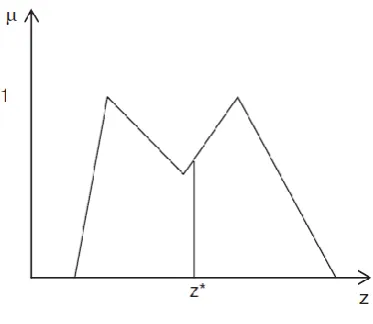
The most widely used method is centroid method. This can be called as center of gravity or center of area method. It can be defined by the algebraic expression
7
Figure 2.2: Centroid method
On this project the defuzzified output is the duty cycle dc(k). The change in duty cycle Δdc (k) can be obtained by adding the old duty cycle old_dc(k) with the duty cycle dc(k) which is given in equation below [5].
2.1.4 Rules Base System
Rules form the basis for the fuzzy logic to obtain the fuzzy output. The rule based system is different from the expert system in the manner that the rules comprising the rule-based system originate from sources other than that of human experts and hence are different from expert systems. The rule-based form uses linguistic variables as its antecedents and consequents. The antecedents express an inference or the inequality, which should be satisfied. The consequents are those, which we can infer, and is the output if the antecedent inequality is satisfied. The fuzzy rule-based system uses IF– THEN rule-based system, given by, IF antecedent, THEN consequent.
The control rules that relate the fuzzy output to thefuzzy inputs are derived from general knowledge of the system behaviour and also the perception and experience.The general rule can be written as
If e(k) is X and Δe (k) is Y, then Δdc(k) is Z where ,
8
[image:18.595.175.495.155.234.2]The rule table for the designed fuzzy set controller isgiven in the Figure 2.3 and Table 21. The element in the first row andfirst column means thatIf error is NB, and change in error is NB then output is NB [5].
Figure 2.3: Membership function
Table 2.2: Set of Fuzzy Logic Control variables structure
2.2 Fuzzy Inference System
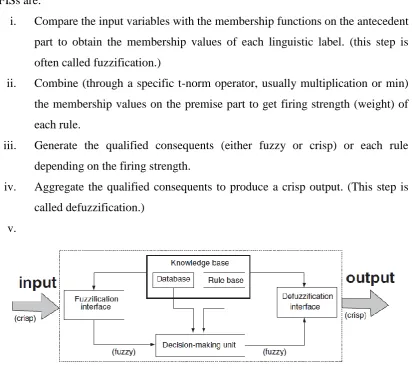
[image:18.595.215.458.297.497.2]9
basic FIS can take either fuzzy inputs or crisp inputs, but the outputs it produces are almost always fuzzy sets. When the FIS is used as a controller, it is necessary to have a crisp output. Therefore in this case defuzzification method is adopted to best extract a crisp value that best represents.
The working of FIS is as follows. The crisp input is converted in to fuzzy by using fuzzification method. After fuzzification the rule base is formed. The rule base and the database are jointly referred to as the knowledge base. Defuzzification is used to convert fuzzy value to the real world value which is the output. The steps of fuzzy reasoning (inference operations upon fuzzy IF–THEN rules) performed by FISs are:
i. Compare the input variables with the membership functions on the antecedent part to obtain the membership values of each linguistic label. (this step is often called fuzzification.)
ii. Combine (through a specific t-norm operator, usually multiplication or min) the membership values on the premise part to get firing strength (weight) of each rule.
iii. Generate the qualified consequents (either fuzzy or crisp) or each rule depending on the firing strength.
iv. Aggregate the qualified consequents to produce a crisp output. (This step is called defuzzification.)
[image:19.595.115.528.264.632.2]v.
10
2.2.1 Fuzzy Inference Methods
The most important two types of fuzzy inference method are Mamdani’s fuzzy inference method, which is the most commonly seen inference method. This method was introduced by Mamdani and Assilian (1975). Another well-known inference method is the so-called Sugeno or Takagi–Sugeno–Kang method of fuzzy inference process. This method was introduced by Sugeno (1985). This method is also called as TS method. The main difference between the two methods lies in the consequent of fuzzy rules. Mamdani fuzzy systems use fuzzy sets as rule consequent whereas TS fuzzy systems employ linear functions of input variables as rule consequent. All the existing results on fuzzy systems as universal approximators deal with Mamdani fuzzy systems only and no result is available for TS fuzzy systems with linear rule consequent.
2.2.2 Mamdani’s Fuzzy Inference Method
[image:20.595.176.465.525.706.2]Mamdani’s fuzzy inference method is the most commonly seen fuzzy methodology. Mamdani’s method was among the first control systems built using fuzzy set theory.
11
To compute the output of this FIS given the inputs, six steps has to be followed; i. Determining a set of fuzzy rules
ii. Fuzzifying the inputs using the input membership functions
iii. Combining the fuzzified inputs according to the fuzzy rules to establish a rule strength
iv. Finding the consequence of the rule by combining the rule strength and the output membership function
v. Combining the consequences to get an output distribution
vi. Defuzzifying the output distribution (this step is only if a crisp output (class) is needed).
2.2.3 Advantages of Sugeno and Mamdani Method
The advantages of the Sugeno Method are; i. It is computationally efficient.
ii. It works well with linear techniques (e.g., PID control). iii. It works well with optimization and adaptive techniques. iv. It has guaranteed continuity of the output surface.
v. It is well suited to mathematical analysis. The advantages of the Mamdani Method are;
i. It is intuitive.
ii. It has widespread acceptance. iii. It is well suited to human input.
12
2.3 Direct current motor
A DC motor is a mechanically commutated electric motor powered from direct current (DC). The stator is stationary in space by definition and therefore so is its current. DC motors have a rotating armature winding but non-rotating armature magnetic field and a static field winding or permanent magnet. Different connections of the field and armature winding provide different inherent speed or torque regulation characteristics. The speed of a DC motor can be controlled by changing the voltage applied to the armature or by changing the field current. The introduction of variable resistance in the armature circuit or field circuit allowed speed control. Modern DC motors are often controlled by power electronics systems called DC drives.
DC motors can operate directly from rechargeable batteries, providing the motive power for the first electric vehicles. Today DC motors are still found in applications as small as toys and disk drives, or in large sizes to operate steel rolling mills and paper machines.
2.3.1 Permanent magnet DC motor
13
field of permanent magnets and a stationary armature winding that is externally commutated by an electronic control.
2.3.2 DC brush motor
The brushed DC electric motor generates torque directly from DC power supplied to the motor by using internal commutation, stationary magnets (permanent) and rotating electrical magnets. Advantages of a brushed DC motor include low initial cost, high reliability, and simple control of motor speed. Disadvantages are high maintenance and low life-span for high intensity uses. Maintenance involves regularly replacing the brushes and springs which carry the electric current, as well as cleaning or replacing the commutator. These components are necessary for transferring electrical power from outside the motor to the spinning wire windings of the rotor inside the motor.
2.3.3 DC brushless motor
14
2.3.4 Connection of DC motor
[image:24.595.253.385.200.417.2]There are three types of electrical connections between the stator and rotor possible for DC electric motors such as series, shunt and compound and each has unique speed or torque characteristics appropriate for different loading torque profiles.
Figure 2.6: Connection of dc motor
2.4 A review of research study
There are several techniques or a study that has been implemented by researchers related to dc motor speed control using PI, PID or FLC.
Table 2.3: Study Research Area
No Authors and year
Title of studies Technique used
Practical Application
Remarks
1. Iracleous, D. P.
Alexandridis, A.
T. (1995)
Fuzzy tuned PI
controllers for
series connected
DC motor drives
Fuzzy Controller using P-I Experiment is done using Fuzzy Logic control
Speed variation of a
compressor for
temperature &
humidity balance but
showed no significant
[image:24.595.107.512.631.762.2]15
efficiency.
2. Soliman, Hussein
F., Mansour, M.
M., Kan&l, S.
A., A.M. Sharaf
A robust tunable
Fuzzy logic Control
scheme control for
speed regulation of
dc series motor
drives
FLC
controller
Simulation is
done using
FLC using
dc-dc converter
The
FLC-defuzzification stage
utilizes a modified
"weighted centre of
area” WCOA switching criterion
based on the speed
error excursion.
3. Perez, C.
Strefezza, M.
(2008)
Speed control of a
DC motor by using
fuzzy variable structure controller Fuzzy Logic Controller & VSC This strategy control combines fuzzy and sliding mode control algorithms
The parameters of the
fuzzy controller are
adjusted by using the
VSC for a better
response and
robustness
4. Tan, H. L. Rahim, N. A.
Hew, W. P.
(2001)
A simplified fuzzy
logic controller for
DC series motor
with improve performance PI type fuzzy controller (FPI) DC series motor
connected to a
single-phase
full-bridge
converter.
Performances of the
proposed model are
compared in terms of
several performance
measures such as peak
overshoot, rise-time,
settling time and
steady-state waveform
5. Muruganandam,
M.
Madheswaran,
M.
(2009)
Performance
analysis of fuzzy
logic controller
based DC-DC
converter fed DC
series motor Fuzzy Logic Controller and DC-DC (chopper) converter This system has been designed to
have two loops
with an inner
ON/OFF
current
controller and
an outer fuzzy
speed
controller
The performance o f
the proposed controller
is compared with the
reported results and
found that the fuzzy
based DC-DC drive
16
CHAPTER 3
METHODOLOGY
3.1 Project Methodology
This project adopt the methods involving developing artificial intelligent controller for dc motor specifically to regulate the over speed that occurs in dc motor. A fuzzy logic control scheme by speed and current error vector(e, er(k), ) as a fuzzy input
vector is used inassociation with a fuzzy ruleassignment table in achieving fast speed regulation.[7]
The research is conducting in phase basis as follows: i. Feasibility or studies areas
ii. Artificial intelligent studies
17
3.2 Flowchart of the project
RESULT ANALYSES BASED ON FLC SIMULATION INPUT PARAMETES
OF FLC BASED ON “RULE-BASE”
RESULT FROM FUZZY LOGIC CONTROLLER
COMPARISON AND FINAL EVALUATION
END START
MATHEMATICS MODELING OF DC SERIES MOTOR
STUDY OF SPEED CONTROL TECHNIQUE OF DC MOTOR
OBTAINED PARAMETER OF SPEED CONTROL
STUDY OF FUZZY LOGIC CONTROLLER (FLC)
[image:27.595.198.414.127.672.2]DEVELOPING FLC BASED ON SIMULINK
18
3.3 Develop a Mathematical model of dc motor
To access to the problem formulation, a mathematical equation of PM DC motor need to be evaluate to identify the parameters of permanent magnet dc motor. However the evaluation of permanent magnet dc motor model is only described in details at chapter 4.
3.4 PID controller design
The next discussion is the proportional-integral-derivative controller. A proportional–integral–derivative controller (PID controller) is a generic control loop feedback mechanism (controller)widely used in industrial control systems – a PID is the most commonly used feedback controller. A PID controller calculates an "error" value as the difference between a measured process variable and a desired setpoint. The controller attempts to minimize the error by adjusting the process control inputs.[8]
The PID controller calculation (algorithm) involves three separate constant parameters, and is accordingly sometimes called three-term control, the proportional, the integral andderivative values, denoted P, I, and D. Heuristically, these values can be interpreted in terms of time: P depends on the present error, I on the accumulation of past errors, and D is a prediction of future errors, based on current rate of change.The weighted sum of these three actions is used to adjust the process via a control element such as the position of a control valve, or the power supplied to a heating element.
19
controller overshoots the setpoint and the degree of system oscillation. Note that the use of the PID algorithm for control does not guarantee optimal control of the system or system stability.[12]
Some applications may require using only one or two actions to provide the appropriate system control. This is achieved by setting the other parameters to zero. A PID controller will be called a PI, PD, P or I controller in the absence of the respective control actions. PI controllers are fairly common, since derivative action is sensitive to measurement noise, whereas the absence of an integral term may prevent the system from reaching its target value due to the control action.
3.5 PI controller design
A PI Controller (proportional-integral controller) is a special case of the PID controller in which the derivative (D) of the error is not used. The controller output is given by [8]
Where is the error or deviation of actual measured value (PV) from the setpoint (SP)
[image:29.595.221.456.626.735.2]The lack of derivative action may make the system steadier in the steady state in the case of noisy data. This is because derivative action is more sensitive to higher-frequency terms in the inputs. Without derivative action, a PI-controlled system is less responsive to real (non-noise) and relatively fast alterations in state and so the system will be slower to reach set point and slower to respond to perturbations than a well-tuned PID system may be.
20
3.6 Fuzzy Logic Controller (FLC)Design
The fuzzy logic foundation is base on the simulation of people's opinions and perceptions to control any system. One of the methods to simplify complex systems is to tolerate to imprecision, vagueness and uncertainty up to some extent [4]. It is not required to know exact system model to design FLC. FLC may not give satisfactory results because it is don’t care the exact value. To defining Input and Output: The goal of designed FLC in this study is to minimize speed error. The bigger speed error the bigger controller input is expected. The proposed strategy minimized error of reference model and response of PMDC motor by combination model reference PID control, PI control and Fuzzy Logic control. We should use proper system for reference model therefore second order critically damped system selected as the reference model. The transfer function is written as:
( ) ( )
( )
t
a a b t
K s
G s
E s L s R Js B K K
21
[image:31.595.225.448.134.298.2]3.7 DC motor drives
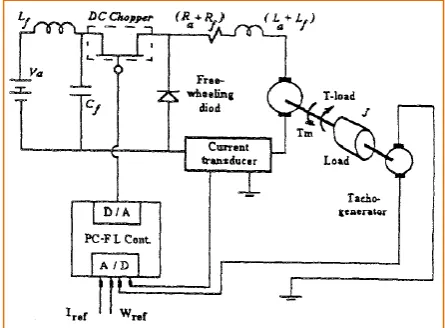
Figure 3.3: DC chopper converter drives of dc motor
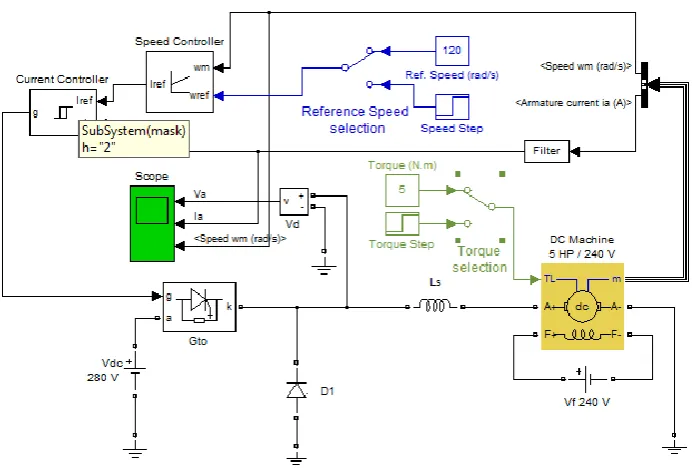
Figure 3.2 and 3.3illustrates the dc motor drive scheme with the PI and dc chopper drives. The DC motor is fed by the DC source through a chopper that consists of GTO thyristor and freewheeling diode D1. The motor drives a mechanical load characterized by inertia J, friction coeficient B, and load torque TL. The hysteresis current controller compares the sensed current with the reference and generates the trigger signal for the GTO thyristor to force the motor current to follow the reference. The speed control loop uses a proportional-integral controller which produces the reference for the current loop. Current and Voltage Measurement blocks provide signals for visualization purpose.[9]
22
Figure 3.4: DC motor with dc chopper drive
3.8 Performance and result analyses
The expected results of this project using fuzzy logic control are: (i) Minimizingthe over speed of motor
(ii) Minimizingthe over shoot current
23
CHAPTER 4
DESIGN A SIMULINK MODEL
OF DC MOTOR
4.1 DC motor speed control method
The speed of a DC motor can be varied by controlling the field flux, the armature resistance or the terminal voltage applied to the armature circuit. The three most common speed control methods are field resistance control, armature voltage control, and armature resistance control [10]. In this section, Simulink models of these three methods and feedback control method for DC motor drives for dynamic analysis are presented [11].
4.2 Simulink design of field resistance control
In the field resistance control method, a series resistance is inserting in the shunt-field circuit of the motor in order to change the flux by controlling the field current. Theoretically when the field resistance increases it will result in an increase in the no-load speed of the motor and in the slope of the torque-speed curve [10].
24
The DC motor block implements a separately excited DC motor. An access is provided to the field connections (F+, F-) so that the motor model can be used as a shunt-connected. The field circuit is represented by an RL circuit (Rf and Lf in series) and is connected between the ports (F+, F-). The armature circuit consists of an inductor La and
resistor Ra in series with an electromotive force EA and is connected between the ports
(A+, A-). The load torque is specified by the input port TL.
The electrical and mechanical parameters of the motor could be specified using its dialog box. Observe that 240 V DC source is applied to the armature and field circuits. An external resistance Rf1 is inserted in series with the field circuit to realize the
[image:34.612.140.512.360.554.2]field resistance speed control. The output port (port m) allows for the measurement of several variables, such as rotor speed, armature and field currents, and electromechanical torque developed by the motor.
Figure 4.2: Field Resistance speed control
[ 7 ] Adel E. El-kholy, A. M. Dabroom, "Adaptive Fuzzy Logic Controllers for ,
DC Drives: A S w e y of the State of the art" Journal of Electrical Systems 2-3
[8] Irving M. Gottlieb, "Electric motors and control techniques" 2nd edition,
McGraw Hill, INC. 1994.
[ 91 Mohan, Undeland, Robbins. "Power Electroni~s, Converters, Applications,
and Design", 2nd edition, John Wiley,INC. 1995.
[lo] S. J. Chapman, Electric machinery hdamentals, 3rd ed., WCBMcGraw-Hill,
New York, 1998.
[ l l ] J. J. D'Azzo and C. H. Houpis, Linear control system analysis and design, McGraw-Hill, New York, 1 995.
[12] Rajani,Nikhil, "A Robust Self-tuning Scheme for PI and PD-Type Fuzzy Controllers", IEEE, 1 998.
[13] Ghazanfar Shahgholian, Pegah Shafaghi, " State space modeling and
eigenvalue analysis of the permanent magnet DC motor drive system", 2nd