International Journal of Emerging Technology and Advanced Engineering
Website: www.ijetae.com (ISSN 2250-2459, Volume 2, Issue 2, February 2012)192
Contemplating Crossover Operators of Genetic Algorithm
for Student Group Formation Problem
1
Devasenathipathi N.,
2Dr. Nilesh K. Modi
1Assistant Professor, Sardar Vallabhbhai Patel Institute of Technology, Vasad, Gujarat
& Ph.D. student, R & D Centre, Bharathiar University, Coimbatore. 2Professor and Head, S.V. Institute of Computer Studies, Kadi, Gujarat
1
2
Abstract — In many industries, major projects are performed in groups. Keeping this in mind, many academic courses are fitted with syllabus that boosts the students’ group learning and group working skills. Unfortunately, optimal group formation among students is a challenging task. Genetic algorithm can be applied to solve this problem which is evident from various literatures. Genetic algorithms are purely search techniques that imitate the process of natural selection. Genetic algorithm comprises of 3 important steps viz. selection, crossover and mutation. To quickly get an optimal value, it is highly essential that a proper combination of effective selection, crossover and mutation technique be used. This paper presents a comparison of three crossover techniques viz. Partially Mixed Crossover, Order Crossover and Edge Recombination Crossover with respect to quickly getting an optimal value, keeping the other two techniques (Selection and Mutation) static. A C program was coded to check the effectiveness of these crossover techniques with respect to optimal search of a feasible solution.
Keywords — Group Learning, Genetic Algorithm,
Constraint Satisfaction, Crossover Operators, Academic Performance Prediction, Student Group Formation Problem.
I. INTRODUCTION
Learning adapts with time, place, circumstances of students, teachers, professionals and others. This is also one of the reasons for global development. People have shifted their strategy from individual learning to group learning. The same is the case in industries with respect to work. Industries have shifted from hierarchical work structures to team based transparent organizations [17]. This, group work style in firms, has given rise to the need for professionals, who can stake knowledge and skills, convey their thoughts successfully and team up with other members of their group [10, 12].
Finally, this has led to the alteration in syllabus by incorporating group learning and group work based projects for students [18].
With this being the scenario, students and teachers are facing a stringent problem of formation of groups among students for group learning or projects based on group work. The factors to be considered and those to be ignored is still a probe. Moreover, when some considerable factors are determined, student group formation by a single individual has hitches, the student group creator (being human) relaxes, forgets or prejudices the considerable factors required for student group creation [8,11].
Literatures favour the fact that group formation by software has been successful as it is quick and easy for teachers/student group creators. In connection to this, the algorithm discussed in this paper helps in student group formation. It takes previous students grades/scores as the input values and suggests the group formation among students with their respective future (predicted/calculated) score. The algorithm takes into consideration the fact (which is also a proved fact) that the performance of any given student in a group learning environment depends on two aspects. Understanding level of the given student forms the first factor and the input level of the other students of that particular group is the second factor. Keeping in mind, these two factors, a formula was found out to predict the academic score of any given student among his/her group members using the previous scores of all the group members.
International Journal of Emerging Technology and Advanced Engineering
Website: www.ijetae.com (ISSN 2250-2459, Volume 2, Issue 2, February 2012)193
In this research work, we have tried to compare the efficiency of three crossover operator viz. Partially Mixed Crossover (PMX), Order Crossover (OX), Edge Recombination Crossover (ERX) with respect to student group formation problem.The technique used for selection (Tournament Selection Method) and mutation (Displacement Mutation Method) are the same for all the three crossover operators. All the three crossover operators have different ways of working to perform the task of crossing over two chromosomes.
The next section of this research paper presents a glance of some of the past work done in connection to benefits of student group formation, application of genetic algorithms in student group formation and comparison of genetic operators. In section three, we explain the way genetic algorithm was utilized to aid in student group formation. The fourth section (implementation section) presents the actual experiment performed and states the attained results. In section five, we present the interpretation of the results followed by its future scope. The last section is conclusion, which gives an overall summary of the research work.
II. BACKGROUND WORK
A large number of literatures have been published which could be related to the current research paper. However, no literature was available mentioning the comparison of the crossover operators with respect to the students group formation problem [5,6,9,15], which was also one of the motivating factors to take up this research work.
In the paper ―Forming Groups to Foster Collaborative Learning in Large Enrolment Courses‖ [13], authors Gwendolyn A. Lawrie, Kelly E. Matthews, Lawrence R. Gahan have focused on the role of team formation from group learning work. The authors developed a mixed-method design which assessed student perceptions from group tasks under similar conditions with separate group formation criteria.
The authors Shin-ike K. and Iima H. in their research paper, ―A Method for Development of Collaborative Learning by using a Neural Network and Genetic Algorithm‖ [16], proposed a method for improving the learning effect of group learning. First they applied a neural network model to predict learning results of pairs of students in group learning. Finally they applied a genetic algorithm with the predicted results got from neural network. Their experimental results (obtained from a college in Japan) confirmed that their proposed method was effective.
In the research paper, ―A Method for Group Formation using Genetic Algorithm‖ [18], the authors Zhamri &
Azman identified that the reason for unsuccessful delivery of students’ software project was lack of programming skills among them. Systematic group formation was considered to guard that every group consisted of students who were good at programming. Finally, they presented a system for group formation among students using genetic algorithm, where the members of each group were generated based on the students’ programming skill.
The authors Gwo-Jen Hwang, Peng-Yeng Yin, Chi-Wei Hwang, Chin-Chung Tsai in their research paper titled, ―An Enhanced Genetic Approach to Composing Cooperative Learning Groups for Multiple Grouping Criteria‖ [4], proposed an enhanced genetic algorithm to construct collaborative learning groups those meet multiple group criteria. Based on that enhanced genetic algorithm they developed an assistant system for constructing collaborative learning groups. Their experimental results showed that enhanced approach was more efficient in organizing cooperative learning groups and fitted more in the instructional objectives which was set by the instructor.
In the research paper, ―A Genetic Algorithm Approach for Group Formation in Collaborative Learning Considering Multiple Student Characteristics‖ [14], the authors Julián Moreno, Demetrio A. Ovalle, Rosa M. Vicari have proposed a method based on genetic algorithm approach for achieving inter-homogenous and intra-heterogeneous groups. This method allowed many student characteristics to be considered for student group formation, which was converted into one multi-objective optimization problem. Their results of experiment involving 135 college students allowed validation from pedagogical view by measuring student outcomes and analyzing them with organized group formation strategies and random group formation strategies in addition to computational view by measuring the algorithmic performance.
International Journal of Emerging Technology and Advanced Engineering
Website: www.ijetae.com (ISSN 2250-2459, Volume 2, Issue 2, February 2012)194
III. GENETIC ALGORITHM &STUDENT GROUP FORMATIONPROBLEM
Genetic algorithms are biologically inspired methods which get motivation from fusing the genetic materials (genes) using the theory of evolution and survival of fittest members of a given population. The process starts form an arbitrary set of valid solutions (called chromosomes) and the process tries to find improved approximations of the optimal chromosomes. In computer science, genetic algorithm is basically a search & optimization method. The population of a genetic algorithm evolves by using genetic operators inspired by Charles Darwin’s theory of evolution. The below seven steps describe the process of a typical genetic algorithm (According to Eric Krevice Prebys, ―The Genetic Algorithm in Computer Science‖, MIT Undergraduate Journal of Mathematics, 2007):
1. Start with a population of n random individuals each with l-bit chromosomes.
2. Calculate the fitness f(x) of each individual.
3. Choose, based on fitness, two individuals and call them parents. Remove the parents from the population.
4. Use a random process to determine whether to perform crossover. If so, refer to the output of the crossover as the children. If not, simply refer to the parents as the children.
5. Mutate the children with probability pm of mutation for each bit.
6. Put the two children into an empty set called the new generation.
[image:3.612.327.578.128.322.2]7. Return to Step 2 until the new generation contains n individuals. Delete one child at random if n is odd. Then replace the old population with the new generation. Return to Step 1.
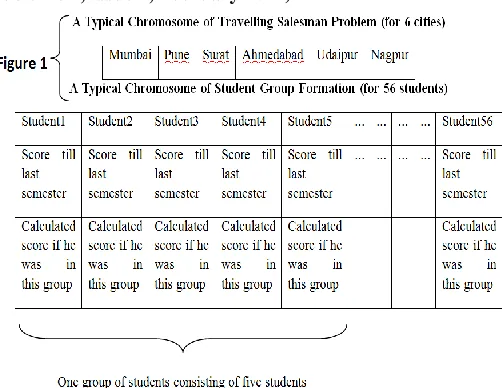
Figure 1: Chromosome of Travelling Salesman Problem and Chromosome of Student Group Formation Problem
Considering the case of Travelling Salesman Problem (TSP), the ordering of cities is important to obtain optimal solutions. Every chromosome is a list of cities that the salesman has to travel in that chromosomal order. The student group formation problem (SGFP) is similar to the travelling salesman problem where the order of group of students is important. Here every chromosome is a list of students with their current scores and calculated (predicted) score (if the student was in that group). Here every student becomes a gene. The only difference between the travelling salesman problem (TSP) and the student group formation problem (SGFP) is that the fitness in TSP is calculated with the help of city-distance/city-cost matrix and less the total distance or cost, more fit is the chromosome. While in case of SGFP, fitness is calculated using the calculated score of each student in that group. More rise in the sum of total calculated (predicted) score means more fit is the chromosome. Figure 1 represents the chromosome of a typical Travelling Salesman Problem and the chromosome of a typical Student Group Formation Problem (for 56 students in our case).
According to the grasping level of the given student and the contribution level of members of the group a formula was formulated to calculate the score of the student (within that group). The formula for that is as follows:
International Journal of Emerging Technology and Advanced Engineering
Website: www.ijetae.com (ISSN 2250-2459, Volume 2, Issue 2, February 2012)195
where y = calculated (predicted) score of student in that group and x = previous score of the students of that group56 students of semester four of post graduate course of computer applications were involved as part of the experiment. A group consisted of 5 students. So we had 10 groups of 5 students each and one group (eleventh group) with six students. A C-program was coded to compute the future marks of students (in accordance to the score of other group members) & calculate its addition.
IV. METHODOLOGY
The main motive of this research was to compare the performance of three crossover operators viz. Partially Mapped Crossover, Order Crossover and Edge Recombination Crossover), with respect to Student Group Formation Problem. Initially we coded functions in C-language for the following activities:
1. Population Initialization (Create Random valid 1000 chromosomes)
2. Calculate fitness value
3. Choosing the top 50% (500) fitter chromosomes 4. Performing Crossover
5. Performing Mutation (Using Displacement Mutation)
Three C-programs were developed with the above functionalities and same input data. The only difference in these three C-programs was the crossover technique. The first C-program used PMX (Partially Mapped Crossover) technique, second program\ used OX (Order Crossover) technique and third C-program used ERX (Edge Recombination Crossover) technique.
The algorithm for performing Partially Mapped Crossover is as follows [Refered from, ―Introduction to Evolutionary Computing, Genetic Algorithms‖ by A.E.Eiben & J.E.Smith]:
1. Choose random segment and copy it from P1
2. Starting from the first crossover point look for elements in that segment of P2 that have not been copied
3. For each of these i look in the offspring to see what element j has been copied in its place from P1
4. Place i into the position occupied by j in P2, since we know that we will not be putting j there (as is already in offspring)
5. If the place occupied by j in P2 has already been filled in the offspring k, put i in the position occupied by k in P2
6. Having dealt with the elements from the crossover segment, the rest of the offspring can be filled from P2.
Second child is created analogously
The algorithm for performing Order Crossover is as follows [Refered from, ―Introduction to Evolutionary Computing, Genetic Algorithms‖ by A.E.Eiben & J.E.Smith]:
1. Choose an arbitrary part from the first parent 2. Copy this part to the first child
3. Copy the numbers that are not in the first part, to the first child:
starting right from cut point of the copied part,
using the order of the second parent
and wrapping around at the end
4. Analogous for the second child, with parent roles reversed
The algorithm for performing Edge Recombination Crossover is as follows [Refered from, ―Introduction to Evolutionary Computing, Genetic Algorithms‖ by A.E.Eiben & J.E.Smith]:
1. Pick an initial element at random and put it in the offspring
2. Set the variable current element = entry
3. Remove all references to current element from the table 4. Examine list for current element:
– If there is a common edge, pick that to be next element
– Otherwise pick the entry in the list which itself has the shortest list
– Ties are split at random
5. In the case of reaching an empty list:
– Examine the other end of the offspring is for extension
– Otherwise a new element is chosen at random
International Journal of Emerging Technology and Advanced Engineering
Website: www.ijetae.com (ISSN 2250-2459, Volume 2, Issue 2, February 2012)196
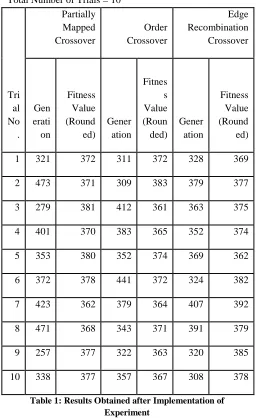
V. RESULT & ITS INTERPRETATIONThe input to all the three C-programs was the students CPI (Cumulative Performance Index) till the third semester of their course. We wanted these programs to help us in the group formation of students with 5 students in each group, with the prediction of their future (next semester) score in the respective learning environment. The total summation of the positive difference of the predicted students score was the fitness value.
Total Number of Generations = 1000 Total Number of Trials = 10
Tri al No
.
Partially Mapped Crossover
Order Crossover
Edge Recombination Crossover
Gen erati on
Fitness Value (Round
ed) Gener
ation Fitnes
s Value (Roun
ded) Gener
ation
Fitness Value (Round
ed)
1 321 372 311 372 328 369
2 473 371 309 383 379 377
3 279 381 412 361 363 375
4 401 370 383 365 352 374
5 353 380 352 374 369 362
6 372 378 441 372 324 382
7 423 362 379 364 407 392
8 471 368 343 371 391 379
9 257 377 322 363 320 385
[image:5.612.41.297.272.690.2]10 338 377 357 367 308 378
Table 1: Results Obtained after Implementation of Experiment
1. Statistically Edge Recombination Crossover operator was found to be more efficient followed by Order Crossover and then by Partially Mapped Crossover. 2. Using the above table we could notice that the
differences among these crossover operators are minimal.
3. In fact, the execution of C-program with Partially Mapped Crossover operator was able to get the maximum value (summation of difference) more quickly than the rest two crossover operators i.e. at the 3rd trial, 279th generation with fitness value = 381 4. Edge Recombination Operator, even if late, was able to find the highest fitness value compared to the remaining two i.e. at the 7th trial, 407th generation with fitness value = 392
5. Order Crossover Operator was in the middle position of the two other operators i.e. 2nd trial, 309th generation with fitness value = 383.
VI. CONCLUSION
We implemented an inimitable way of comparing the crossover operators with respect to the students’ group formation problem. All the three crossover operators had their own potency and limitations. In addition to this, by increasing the number of trials, the execution time increased too. The result of the efficiency of these crossover operators makes us conclude that there is no large difference with the performance level of these operators as far as the students group formation problem is concerned.
References
[1] Abdoun Otman, Abouchabaka Jaafar, ―A Comparative Study of Adaptive Crossover Operators for Genetic Algorithms to Resolve the Travelling Salesman Problem‖, International Journal of Computer Applications, Volume 31– No.11, October 2011, pp. 49–57.
[2] Alison Halstead, Lynn Martin, ―Learning Styles: A Tool for Selecting Students for Group Work‖, International Journal of Electrical Engineering Education 39/3.
[3] Fozia Hanif Khan, Nasiruddin Khan, Syed Inayatullah, Shaikh Tajuddin Nizami, ―Solving Tsp Problem By Using Genetic Algorithm‖, International Journal of Basic & Applied Sciences IJBAS Vol: 9 Issue No: 10, pp. 79-88.
[4] Hwang, G.-J., Yin, P.-Y., Hwang, C.-W., & Tsai, C.-C. (2008). An Enhanced Genetic Approach to Composing Cooperative Learning Groups for Multiple Grouping Criteria. Educational Technology & Society, 11 (1), 148-167. .
International Journal of Emerging Technology and Advanced Engineering
Website: www.ijetae.com (ISSN 2250-2459, Volume 2, Issue 2, February 2012)197
[6] Kusum Deep, Hadush Mebrahtu, ―Combined Mutation Operators of Genetic Algorithm for the Travelling Salesman Problem‖, International Journal of Combinatorial Optimization Problems and Informatics, Vol. 2, No.3, Sep-Dec 2011, pp. 1-23.
[7] P. Larranaga, C.M.H. Kuijpers, R.H. Murga, I. Inza, S. Dizdarevic, ―Genetic Algorithms for the Travelling Salesman Problem: A Review of Representations & Operators‖, in proceedings of Artificial Intelligence Review 13: 129–170, 1999
[8] Rahel Bekele, ―Computer-Assisted Learner Group Formation based on Personality Traits‖, Ph.D. Dissertation, University of Hamburg, October 2005.
[9] Shubhra Sankar Ray, Sanghamitra Bandyopadhyay and Sankar K. Pal, ―New Operators of Genetic Algorithms for Traveling Salesman Problem‖, Proceedings of the 17th International Conference on Pattern Recognition, 2004. (IEEE Explore).
[10] A. Ounnas, H. Davis, and D. Millard, ―A Framework for Semantic Group Formation in Education‖, in Proceedings of the 2008 Eighth IEEE International Conference on Advanced Learning Technologies: IEEE Computer Society, 2008, pp. 34-38.
[11] Dumitrache, I., Svasta, P., Stanescu, A.M., ―Advanced Team Work Education within the Concurrent Engineering Paradigm‖, in proceedings of 24th International Spring Seminar on Electronics Technology, 2001.
[12] Escudeiro, N.; Escudeiro, P.; Barata, A.; Lobo, C.; ―Enhancing Students Team Work and Communication skills in International Settings‖, in IEEE Explore
[13] Gwendolyn A. Lawrie, Kelly E. Matthews, Lawrence R. Gahan, ―Forming Groups to Foster Collaborative Learning in Large Enrolment Courses‖, in Proceedings of the 16th UniServe Science Annual Conference, 2010
[14] Julián Moreno Cadavid, Demetrio Arturo Ovalle, Rosa Maria Vicari, ―A Genetic Algorithm approach for Group Formation in Collaborative Learning Considering Multiple Student Characteristics‖, in Computers & Education International Journal Volume 58, Issue 1, January 2012, pp. 560-569.
[15] László, Illyés, ―Balanced Student Groups Forming for University Projects using Genetic Algorithm‖, In Proceedings of the 8th International Conference on Informatics in Economy, pages 554-559, Academy of Economic Studies, Bucharest, 2007.
[16] Shin-ike, K., Iima, H., ―A method for development of collaborative learning using a neural network and genetic algorithm‖, in proceedings of International Symposium of Autonomous Decentralised Systems, 2009, (IEEE Explore).
[17] Stefan Cronholm, Ulf Melin, ―Project Oriented Student Work: Group Formation and Learning‖ in Information Systems Education Conference (ISECON 2006), November 2-5, 2006, Dallas, Texas, USA