II
II
II
II
II
I!
II
II
A Constructivist Approach to Machine Translation
Michael Carl
Institut ffir Angewandte Informationsforschung, Mattin-Luther-Strafle 14,
66111 Saatbr~cken, Germany, [email protected]
Introduction
Constructivist cognitive theories conceptualize memory as a dynamic process which is directly linked to percep- tion, memories and conclusion/induction (cf. [Sch91]). From this point of view, memory serves to establish structures that ate relevant to the cognitive system in the present context of action. The function of memory is thus to participate in coherent behavior which makes survival of the acting cognitive system easier (or pos- sible). Memories ate similar to perceptions: they ate perceptions without an object. Perception on the other hand is an activity (and not a passive process) that is driven by the memory.
In some situations, for example we perceive solid bod- ies where - - in terms of modern physics - - there ate no bodies at all, but processes of energy exchange; from psychoacoustics it is known that we can heat sounds that physically do not exist. Conversely, psychological exper- iments confirm that perception only takes place ff an interpretation can be assigned to the perceived phenom- enon [Foe86], [Foe73]. In successive steps of abstractions perception destroys parts of the information which can- not be expressed (or ate of no importance) in the agent's model of the situation. This destruction will increase in proportion to the extent new situations cannot be han- dled. Confirmation of old solutions, then, will take place at the expense of new experiences.
In this paper, I present a new approach to Machine 2~auslation (MT) that - - ~rnilas to memory - - does not simply 'remember' known solutions of former prob- lems but creates new solutions for new problems. Like perception it 'perceives' a problem (i.e. a text or a sen- tence) to the degree it can handle it. Both, memory and MT axe successful because they generate useful (e.g. con- sistent) behavior for an agent in a changing environment.
MT has existed since the very beginning of computer science and there are a number of different systems in research and on the market. However, with respect to many other domains, the problems of MT are due to two peculiarities of natural language: compositionality and hierarchical structure. Hieraxchical structuring is we]] known in natural language processing (and MT) and ac- counts for the fact that words can be recursively grouped into constituents.
Composltionality in MT is a more basic phenomenon and refers to the observation that words or groups of words
ate translated identically in a different context. A source text and its translation can thus be considered to con- sist of composed units that ate independently translated. The choice of these units, however, is much discussed in MT literature. If these units ate too small, the system may become unreliable because it may be impossible to produce a correct target language text. If these units ate too large the system may become too inflexible. In this paper I propose a new MT system a~chitecture which can accommodate a number of ditferent transla- tion units and is thus appropriate for a number of dif- ferent user needs. In a constant interaction with the MT system, a user can tune 'her' system in order to ob- tain the results she would have expected. The architec- ture is similar to Example Based Machine Translation 1 (EBMT) and owes alot to Case Based Reasoning (CBR). In the next section I will give a brief introduction to CBR. In order to apply the CBR paradigm to MT, I shall outline the need for a decomposition component and the way decomposition is usually treated in MT. Next, I will give a definition of composltionality. I will then show that the similarity metric - - as it is used in many CBR systems - - is not an appropriate means in MT either for the decomposition of the source text or for retrieval. Similarity, instead, can be based on abstraction: the more abstraction is performed, the more dissimilar two items ate. In order for a MT system to react creatively on nnlrnown input a certain degree of abstraction is required.
These considerations imply a number of constraints on the design of MT systems and offer two degrees of free- dom that cannot analytically be determined. The choice of the translation units, their language corresponden- cies and the degree of creativity (abstraction) to which a MT system may recombine these units is a matter of user needs and depends on the goal of the application. Thus, in a very limited domain a MT system is likely to be different from an all-purpose MT system. The impli- cations of these insights shall be discussed and related to the parameters in a MT system design.
The remainder of the paper is dedicated to an implemen- tation of the outlined architecture which has the capacity to accommodate to a number of different user require- ments. I shaft call this approach Constructivist Machine 1 The paradigm of Example Based Machine Translation has been started only recently, by a number of different au- thors (e.g. [SN90], [Bro96], [CC96]).
Carl 247 A Constructivist Approach to Machine Translation
F i g u r e 1
F i g u r e 2
The proposal will not now be implemented
. ¢
T
~Les propositions ne seront pas raises en application maintenant
The proposel will no~ now be implemented
"Les propositions" ne seront t ~ raises en application maintenant"
T~anslation because similar to memory, the success of a MT outcome - - in this scenario - - is solely validated by and dynamically tuned to the needs of the acting agent fo~ whom the translation is being computed.
C B R - S y s t e m s
CBR systems axe problem-solving systems that heavily rely on old experiences. For this reason they can be seen as a generalization of MT systems, too. CBR systems solve new problems by adapting (modifying) solutions to old problems that are stored in a case base.
According to Richter [Ric95] four knowledge containers axe available in CBR systems:
• In the case base are stored former problems with their solutions (cases).
• A similarity metric makes possible retrieval of cases from the case base that axe similar to new problems. • An adaptation mechanism modifies the solutions of
the retrieved cases according to the requirements of the problem.
• The case vocabulary contains the language in which cases axe written.
Retrieval of the appropriate case(s) is based on a.~m~lar- ity metric which is designed such that the retrieved cases represent an iustantiation of the problem concept. The
problem and the retrieved case(s) axe ~ because
they are different ~ t a n t i s t i o u s of the same concept. In the adaptation step, the solution that is part of the retrieved case is modified where it ditfevs from the prob- lem solution. Adaptation is one of the most difficult parts in CBR systems because it depends on domain specific knowledge and on the outcome of the other CBR components.
In both, retrieval and adaptation, the original problem is thus destroyed in order to compute a solution: while clas- sifying a problem according to the available conceptual classes in the case base, some parts of the problem axe ex- pected to be more important than other parts. In order to dassify the problem appropriatdy, retrieval in CBR
-- like perception - - thus evaluates pasts of the informa-
tion differently. The retrieved (set of) case(s) deviates in a number of properties from the original problem that seem minor to the goal of the agent. In adaptation,
the retrieved solutions axe further modified in order to generate a coherent outcome of the system.
However, in order to apply the CB11 paradigm success- fully to MT, a decomposition component is required that divides a sentence into a sequence of chunks. In the next section I shall explain the need for such a component and outline its importance in MT.
D e c o m p o s i t i o n i n M T
In Machine Translation (MT) compositionality is cru- cial to attain a reasonable coverage. One of the main problems in MT is transfer strategy: how and when to translate a unit of the source language into a unit of the target language.
The underlying hypothesis of all MT systems is that units derived from the source language string can be mapped onto units from which the target language string can be computed. I use the following English-French translation exampleS:
1 The proposal will not now be implemented ~ , Les propositions ne seront pas raises en application mainten~nt
Several possibilities of decomposition shall be considered in this section. The corresponding adaptation knowledge will be discussed.
If this sentence (1) consist of only one chunk i.e. decom- position takes place at a sentence level only as in figure 1, no adaptation is requited. This is typical for translation memories (TM) (e.g. TRADOS [Hey96], TRANSIT) which have only a case base and a retrieval component s. TMs are likely to have quite long cases stored in the case base, but have a well informed distance metric to return slmilar cases from the case base. However, due to lack of adaptation, the less the retrieved cases match the sen- tence, the more incomplete and incorrect the translation is. A major shortcoming is that the increase of coverage does not follow the growth of the case base to the same extent.
2The example is taken from the Hansards-corpus and is discussed in [BCDP+90]. For purpose of illustration I will consider the translation correct and desirable.
~Some TM, however, propose as an extra an interactive MT system or a batch MT system that is based on a different (e.g. 'traditional') paradigm.
m
R
B
m
m
II
II
II
II
II
II
II
II
II
II
II
I!
II
Figure 3
The proposal• will not nou b e
Les propositions "he seront pus
implemented
raises en application ma~ n t enanl~
F i g u r e 4
The proposal
Les propositions
will not now be implemented
ne seront pus raises en application main~enant
In figure 2, the sentence is decomposed into two chunks. Notice, that the English subject (the first chunk) is in singada~, while its French translation is in plural. Be- cause subject and predicate agree in number and per- son, the (anrillary) verbs in the second chunk has to take the same features as in the first chunk. The adap- tation mechanism has therefore to be able to reconstruct these agreement reqni~ements.
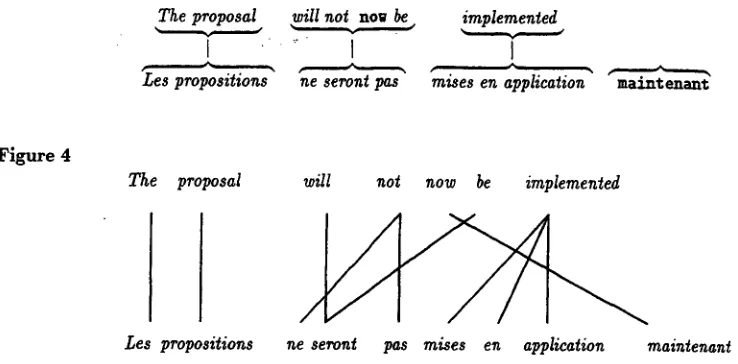
If the sentence is divided into the three chunks/The pro- posal/, ~will not now be/and/implemented/as in figure 3 adaptation turns out to be much more compllcsted. It has to reconstruct agreement between the first and the second chunk (in the l~ench translation for the third chunk too). Further, adaptation must take into account the discontinuity of the second chunk. Thus, although now and maintenant are translations of each other, they are separated by the interposed chunk 3 on the French side. The adaptation mechanism has to be able to inte- grate a continuous chunk into a discontinuous one when translating from English to Fronch and the inverse when translating from French to English.
Example based Machine Translation (EBMT) corre- sponds to a decomposition g~anularity as shown in fig- axes 2 and figure 3. Some systems (d. [SNg0], [CC96]) localize major constituents in the problem sentence by means of linguistic analysis. Adaptation in these sys- tems is essentially a matter of replacing items (words, sequences of words or constituents) in the target lan- guage structure. Linguistic analysis serves to better de- termine the location and the appropriateness of potential items to be replaced in the
target
language.In the Pangloss EBMT ([Bro96], [NBD94]) cases are se- lected from the case base that contain the problem case (or parts of it) as a substring. By means of a thesaurus and a bi-lingual lexicon the translation of the problem case (or its respective pa~t) is extracted from the re- trieved cases. Adaptation of the target language chunks is left to a statistical language model outside the Pan- gloss EBMT system.
Many traditional MT systems have an atomic case base
and have no information about the similarity between a sentence and some cases i.e. only exact matching cases are retrieved from the case base. According to figure 4, sentences are very free-grained and the main translation is carded out by the 'adaptation' mechanism. All three generations of traditional MT systems (cf. ~WK95]) can be described by this schema. The direct approach seeks to map lexical items of the sotuce language onto lexical items of the target language and then tries to rearrange the tazget test. The interlingual approach (cf. [Dor93]) tries to calculate a language independent meaning rep- resentation from which the target text is generated. The transfer approach (cf. [Str96]) is situated in between the two: abstractions of the source language string are com- puted and then transferred (mapped) into target units from which the target language string is computed. T~a- ditional MT systems do not systematically make use of large chnnks that could facilitate the adaptation mecha- nism. They thus fail to account for what computers can most easily do: memorization and retrieval.
The main di~erence, however, between traditional and more recent approaches to MT lies in the fact that the latter systems pedorm monolingual analysis and gener- ation while in former systems the analysis (decomposi- tion) of the source language is not independent from the regeneration possibilities in the target language.
C o m p o s i t i o n a l i t y a n d M T
When decomposing a sentence in a particular way the sentence is dassitied with respect to the context 4. In the French sentence £e boueher sale la tranche the word sale can be classified as a verb (English: to salt) or as an adjective (English: dirty), la can be an article (English: the) or a pronoun (English: she~her) and t~znche can be a verb (English: to chop) or a noun (English: slice).
4This view is of course ot new. E.g. in ~BDW96] morpho- logical analysis (i.e. morphological classification) is defined as a decomposition task.
[image:3.612.86.455.67.249.2]2 French: (Le boncher) sale (la tranche) English: The butcher salts the slice 3 French: (Le botcher sale) (la) tranehe
English: The dirty butcher chops her
If the sentence is decomposed according to (2) the phrase Le boucheris classified as the subject of the sentence and la tranche as the object. In (3) Le boncher saleis the sub- ject while h i s the object. Passing, for instance, classifies the components of a sentence and their relationship by giving it a structure according to a grammar.
However, I will not use a grammar as a basis for de- composition but base the decomposition on examples. This, I shall show, leads to greater flexibility and better maintainability of the system.
In M T different decompositions become particularly cru- cial if they lead to different translations i.e if the source language and the target language express ambiguities in a different way, which is quite often the case. A source sentence S is compositionally translatable into a target sentence T, i f
• it is decomposable into a set of chunks.
A sentence S is d e c o m p o s a b l e , i f it can be divided into a set of chunks C l . . . Cn where the intersection of the chnnlr~' concepts equals the concept of the case:
C(S) = I'k C(~,)
• the case base covers the chunks.
A case base CB covers a set of chunks c G S iff there exists for each c at least one solution case s E C B where both c and s are instantistions of the same con- c e p t : Vc G S 3s E C B : C(c) - C(s)
• the retrieved solutions axe adaptable.
A set of solutions s l . . . s,~ is a d a p t a b l e , i f it can be composed into one target sentence T and the intersec- tion of the solutions' concepts equals the concept of the result: ['k C(s,~) - C(T)
We thus obtain a chain of conceptual equivalences during all processing steps as shown in equation 1.
c(s)_=
(,
A source sentence S is decomposed into a set of chunks c for each of which a solution s is retrieved from the case base. The set of solutions is then composed into a target sentence T,
Similarity and MT
In C B R systems, the similarity metric is a means for clas- sifying the problem according to the empirical data in the case base. In this section I shall investigate whether a similarity metric is appropriate for decomposition and classification in MT.
Similarity metrics in CBR are often based on nearest neighbor (NN) algorithms (e.g. [WD95]). NN algo- rithms make use of a continuous variable w which as- sociates a real value to the attributes ai of a problem a. The similarity between s problem a and a case b is inversely proportional to their distance Ds:
5In a symbolic task, the distance d usually is d(a/, bl) = 0 if al = b,, else 1.
D(a,b) =
i
The nearest neighbor in the hyperspace is then r e t c h e d as the most similar known instantiation to the problem. Other approaches use symbolic distance metrics. One such approach ([Pla95]) uses anti-uuification e that yields for each case in the case base the intersection (i.e. what is common) with the problem. By means of a prede- fined subsumption ordering these intersections are or- dered. The cases that are most similes to a problem are those that field most specific anti-unification results. Other approaches (e.g. [Hut97]) calculate for each case the minimal number of changes that would have to be done to transform it into the problem. The weighted sum of changes then indicates the distance between the case and the problem.
While these metrics may be dynamically adapted in changing environments (the case base and/or the weight w may be dynamically altered), there axe at least two problems when applied to MT.
One problem occurs when decomposing a text of arbi- trary length as was shown above. It is not at all evident how to decompose a text into units such that the adap- tation capacity of the system is respected. Of course, the smaller the units are, the higher the probability of retrieval success will be. But we may not necessarily be sure whether the retrieved solutions lead to a composi- tionally correct translation because it may be impossible for the adaptation mechanism to appropriately recom- pose them.
Apart from the discontinuity of chunks as shown in fig- exe 3, there are other phenomena of lexical cooccuzrence that need to be treated by a MT system. For instance,
if we know that German stark transhtes into English
strong and German Band translates into English vol-
ume we axe likely to translate German starker Band
into English strong volume by simply concatenating the
translated units. This might not always work well be- cause here thick volume would be a better translation. The sequence starker Band should hence be seen as one undividable unit. Suitable decomposition of the problem is thus a prerequisite for valuable retrieval of cases. A related problem is due to the way in which the solu- tion of a case is related to the matching part. Partial similarity of a phrase and a case does not necessarily allow one to conclude that there are comparable sim- ilarities between their translations. For instance if we know that German starke ErkSltnng translates into Eng- lish bad cold and German Rancher translates into English smoker we axe likely to translate the unknown German
phrase starker Rancher into English bad smoker because
the first word of the unknown phrase is just another in- fleeted form of the first word in the known phrase. We thus substitute the second word in the translation of
6While unification yields least upper bound (hb), anti- unification yields the greatest lower bound (glb) with respect to a subsumptlon ordering.
Carl 250 A Constructivist Approach to Machine Translation
II
II
II
II
II
II
II
II
II
II
II
!1
the known phrase (cold) by the translation of the sec- ond word of the unknown phrase (smoker) to obtain the result. However, this might not always be a good solu-
tion because hea~y smoker (and not bad smoker) would
be the appropriate translation. Of course, one can argue that stark has different readings according to the context in which it appears so that starker Raucher and starke Erk~ltung are not similar at all. However, the knowl- edge concerning the appropriateness of words which can be replaced needs to be coded in some way 7. In the proposed architecture exceptions are stored in the case base and knowledge about replacable words is extracted (induced) from the case base. This makes possible a dy- namic graduation between regularities subregnlarities an exceptions as it occurs in natural languages.
Merely similarity of an input text and some cases in the case base does not therefore lead to a satisfactory so- lution because it tells us neither how to decompose a text nor which parts in the retrieved cases are suitable for substitution. Further, from a logical point of view, similarity seems a useless notion because, as Goodman [Goo72] states, it cannot be measured in terms of, or equated with the possession of common characteristics:
Where the number of things in the universe is n, each two things hare in common ezactly T '-z properties out of the total of 2 n - 1 properties; each thing has 2 n - z properties that the other does not, and there are 2 n - z - 1 properties that neither has. [pp. 443-444]
The point here is that if two things have some proper- ties in common this is saying nothing more than that they have these properties in common i.e. that they are equal with respect to the common properties. However, which of the shared properties are more salient is ana- lytically untractable: it remains a matter of who makes the comparison and when. For instance in the examples above, one might find weighty tome to be a better trans- htion for starker Band than thick volume. On the other
hand German starker Punk~ compositionally translates
into English strong point. It is a decision of the present system architecture not to code these decisions into the program or into a grammar, but to leave it in the struc- ture of the case base.
A b s t r a c t i o n a s S i m i l a r i t y
Instead of having a similarity metric to classify a sen- tence (or parts of it) decomposition is used as a method fox classification. In order to determine the similarity of a complex sentence and some cases in the case base abstraction by means of decomposition and reduction seems an appropriate means s.
rI agree with the comment of an anonymous reviewer that a more thorough linguistic analysis may ~ell yield a better performance for direct use of similarity metrics, subverting the needs of post hoe adaptations.
The problem is how cart you know when you have done suf- ficiently linguistic analyses without reference to the data?
SA similar idea can be found in [CC96]. However, in their approach sentences undergo a (rule-drlven) syntactic analysis.
Abstractions are induced from the input sentence based on cases in the case base. The less an input sentence is known to the system, the more abstractions are needed for the sentence to be matched onto the case base. How- ever, the more abstractions are performed, the greater will be the dissimilarity between the sentence and the matching case(us). Accordingly, it is stressed in [BW96] that the significance of similarity between a problem and a set of cases is more important the hss abstract the c a s e s a r e .
In the proposed system architecture a sentence is decom- posed into a set of chunks according to the available cases in the case base. Chunks which share all their proper- ties with a case are reduced and the sequence of reduced and unreduced chunks (i.e. the abstraction of the origi- nal sentence) is, again, decomposed and matched against the case base until no more decomposition and reduction is possible. In a number of steps, a sentence of length m is thus classified according to the available cases in the case base into maximal 2m chunks.
A sentence is regenerated from an abstraction by specify- ing the reduced chunks and their subsequent refinement. This is repeated until the produced sequence contains no more reduced chunks.
Abstraction (i.e. decomposition and reduction) and gen- eration (i.e. specification and refinement) are possible if the following criteria hold for the matching chunks in the abstraction process and the reduced chunks in the generation process:
• Chunks are independentwith respect to some 'fixed' features. The fixed values of one chunk does not affect the fixed values of another chunk.
• Chunks are adaptable with respect to some 'variable' features. The set of variabh features for each chunk reflects its inter-chunk dependencies.
In order to translate the French sentence Le boncher sale la tranche into English The butcher salts the slice accord- ing to the classification 2 above we need the case base to
contain the two concrete cases 4 and 5 and the abstract case 6:
4 le boueher ~ the butcher 5 la tranche ~ the slice 6 X s a l e Y ~ , X s a l t Y
Based on the examples, the French sentence is decom- posed into the three chunks cx: le boucher, cz: sale and cz: la tranche. By reducing the (matching) chunks cl and c3 the abstraction q salt c3 then matches case 6. The adaptation mechanism subsequently re-specifies and refines the solutions sl and s3 of the reduced chunks cl and c3. Specification consists in replacing sl in the ab- straction by the butcher and s3 by the slice. Refinement adapts the variable features such that the main verb salt agrees in number and person with the chunk inserted in position X. Note that the required adaptation complex- ity corresponds to figure 2 above.
In this translation the number of decompositions is 3. Another chunking is possible if the case base allows it.
For the case base 7 below, the number of decompositions
equals I: the granularity of decomposition thus relies on the structure of the case base.
7 le boueher sale la tranche, .~
the butcher salts the slice
Note that by means of case 4, 5 and 7, the abstract case 6 can be induced.
Undesirable abstraction is possible and is on the one hand an expression of the creativity of the system but on the other hand avoidable by adding further cases to the case base. Thus, abstraction 10 can be generated based on the cases 8 and 9. As outlined in the previous section, abstraction 10 has the potential to (wrongly) translate
starker Punkt into heavy point. However, by adding case 11 to the case base this is no longer possible.
8 Raucher ~ ~ smoker
9 starker Raucher 4. , heavy smoker
10 starker X ~ heavy X
11 starker Punkt ~ . , strong point
F r e e d o m i n M T s y s t e m d e s i g n
In the equivalence (1) w here reproduced as (2) - - the decomposition granularity, the structure of the case base and the adaptation mechanism depend on each other.
c(s) - fqc( .) =_ N C ( s . ) - c(T) (2)
To preserve the conceptual equivalence between a source sentence S and its translation T, all three components need to be synchronized: a certain type of decomposition requires an adequate case base which covers the decom- posed chunks and an appropriate adaptation mechanism which is able to re-combine the retrieved solutions into a target translation. However, the above equivalence con- rains two degrees of freedom: one degree is related to the number n of chunks the other is due to the definition of the conceptual equivalence C. Neither can analytically be determined because they axe closely related to the re- quirements of a user and his expectations with regard to a MT outcome.
. The coverage of the case base increases while the length of the cases gets shorter. The coverage of the system depends on one hand on the coverage of the case base and on the other hand on the level of abstrac- tion on which the chunks are matched. The coverage of the system thus increases with finer decomposition granularity and a high degree of abstraction.
• The reliability of the results is likely to increase while the length of the chunks gets longer and the system turns into a mere retrieval system of known solutions.
Rehability thus increases with coarse decomposition granularity and low degree of abstraction.
• The creativity of the system combines both, coverage and reliability. A high degree of creativity can thus be reached with coarse decomposition granularity and
high degree of abstraction.
Figure 5 shows possible realisations for MT systems. The horizontal axis represents the decomposition granu- larity; the vertical axis represents the degree of abstrac- tion.
As the granularity of the decomposition becomes coarser, the system loses coverage but the translation result will become more reliable. The adaptation mechanism be very simple. Conversely, finer grmlula~ity implies bet- ter coverage but requires a more complex adaptation mechanism. Orthogonal to decomposition granularity is the degree of abstraction that a system performs. The more abstractions are performed, the less reliable will be the outcome 9.
Creativity is necessary for a MT system unless the do- main is restricted such that retrieval of already known translations is sufficient for the coverage. To attain a certain degree of creativity, the system needs to dispose of an appropriate degree of abstraction capacity joined with an appropriate decomposition granularity.
F i g u r e 5
Degree of abstraction C
high
low
coverage creativity
reliability
~ne coarse
Granularity of (de)composition n
The more the system design moves into the upper left area (high degree of abstraction and fine decomposition granularity) in figure 5, the more the coverage of the system will increase. The more the design moves into the lower right area (low degree of abstraction and coarse decomposition granular/ty) the more the reliability of the system increases.
To reach reliability for unknown a~bitrazy texts, recent approaches to NLP prefer shallow analyses that generate fiat representations (i.e. low degree of abstraction). Be- cause the number of possible wcong assignments in an analysis tree grows exponentially with its depth, fiat representations offer fewer possibilities to relate con- stituents and hence offer fewer possibilities to produce
wrong analyses.
To attmn a certain degree of creativity, an appropriate degree of abstraction and an appropriate degree of de- composition is required. W h a t degree of creativity a user desires essentially depends on the variety of text types to be translated (i.e. the required coverage of the system)
9Thls is supported by the findings in [BDW96]: the more abstraction is performed by a system (degree of eagerness),
|
|
m
m
m
I
m
|
m
|
F i g u r e 6
English Phrase Descriptor of the sentence: The big man ea~s a green apple
WD: WDThe I WDbia I • WDman I WDea,, I W D , I WDg . . . .
L M A : the C A T : art V T P :
T N S : N U M :
CAS:
D E G : W N R : 1
big
adj
base 2
m a n
verb n o u n
f i n infin
pres - - - -
- - - - sing
- - - - n;a
3 3 3
eats verb tin pres 4 a a r t
5
green a d j n o u n
- - n;a
base - -
i 6 6
] WDa~ple
apple n o u n
sing n ; a
7
German Phrase Descriptor of the sentence: Der grosse Mann isst einen gr~nen Apfel
WD: WDve,
l wDg ... [WDM.,,,, I WD,.,
[ Izv'D.,,~.. [ WDg.a,.,, ],,
WDap,,,
LMA: d_art d_rel
CAT: art tel
VTP: I - - - -
T N S : I - - - -
NUM: sg sg pin sg - -
G E N : f m - - m f
CAS: d;g n g n g;d
DEG: - - - -
WNR: 1 1 1 1 1
gross a~ e • e • e • base 2
m a n n n o u n
sg m n;d;a 3 essen verb fin pres sg 4 ein art sg m a 5 grin
adj verb
fin
- - pres
en* plu
en*
en* - -
base - -
6 6
apfel n o u n
sg
m
n;d;a
7
e* and en* denote the endings (e and en) of a German adjective. They can be multiplied into a matrix of A V M conta~nl-g information on GEN, CAS, NUM and the determination class.
L M A : C A T : N U M : V T P : T N S : C A S : D E G : W N R :
lemma (basic word form without inflectional information)
part-of-speech (syntactic category) (adj; adv; art; noun;punct; re1; verb)
number (sing; ph)
verb type (fro; infin)
tense (pres;past)
case (n; g; d; a)
degree of adjectives (base; comp; sup)
word number
and the expected reliability of the results. In a constant feed-back process, a user thus has the possibility of de- signing the MT system according to his requirements. In the remainder of this paper I will give a short overview of the CBAG *° system. It can be used as a stand alone MT system or can be integrated with the Rule Based Machine Translation CAT2 [Str96]. Here, only the prin- cipal functioning shall be considered. CBAG consists of three modules: the Case Based Compilation module (CBC), the Case Base Analysis module (CBA) and the Case Base Generation module (CBG).
Case S t r u c t u r e in C B A G
Instead of simply storing surface strings in the case base, morphological analysis and lemmatization is carried out and added to the cases n .
I°CBAG stands for Case Based Analysis and Generation //We use MPRO (el. [Maa96]) for morphological analysis and lemmatization. MPRO is a very powerful tool, which generates more than 95% correct analyses for arbitrary Get-
Lemmatization yields for a surface string a basic word form (lemma) that abstracts away from inflectional in- formation which is contained in the surface form. Inflec- tional information such as person, number and tense for
verbs or ease and number for nouns is determined by the
use of the word and is independent of the lemma. For in- stance, man and men are di~erent instances of the same
1emma (man) that only differ with respect to number
(singular vs. plural).
The part of speech takes an intermediate position be-
tween lexical and grammatical information. On one
hand, the part of speech is linked to a lemma, on the other hand each part of speech has typical inflectional patterns (e.g. the examples above).
The features of a word are stored in the form of sets of pairs of attribute/values AVM. We will refer to a set of A V M that belong to one word as a word descriptor W D . Note that the contents of each A V M is such that a single surface string can be regenerated from it. Morphological
man and English texts.
analysis and lemmatization are thus reversible: a surface string can be transformed into a W D (a set of A V M ) and a surface form can be generated from a A V M . A phrase descriptor P D is a sequence of word descrip- tors WD1 . . . W D , , . A case C A S E is a pair of a source phrase descriptor PD,o~ce and a target phrase descrip- tor
PDtarget
that axe considered to be translations ofeach other. A case base
C B
is a set of cases.A P D can be represented as a M × N matrix where the columns describe the words of a phrase and the rows describe a sequence of attribute values. The figure 612
reproduces the C A S E of the following translation exam- ple:
12 The big man eats a green apple : Der grosse Mann iss~ einen gr~nen Apfel
Some words are ambiguous. For instance, the surface string man can be analyzed as a verb or as a noun as shown in the table in figure 6. The noun has an ac- cusative or a nominative case, the verb can be the in]i- nlte form or the finite present form. The WD,na,~ has thus four interpretations that are melted here together into three A V M .
Decomposition in CBAG
Decomposition is example driven dad divides a P D into a set of chunks. I distinguish between two ways of de- composition:
H o r i z o n t a l d e c o m p o s i t i o n divides the P D matrix into a set of 'fixed' (lexical) features and into a set of
'variable' (grammatical) features. This division accounts for the distinction between lexical and grammatical in- formation inherent in every sentence.
Agreement within a noun phrase is a grammatical phe- nomenon. The corresponding features are thus part of the set of variable features. In German, for instance, the determiner, the adjective and the noun in a noun phrase have to agree in number, gender and case, while the actual lexical fillers of this syntactic schema may vary.
The set of variable features comprises all features that can be altered by a di~erent context (e.g. number and case for nouns, gender, tense, person for verbs, etc.). The set of fixed features comprises the lemma and the part of speech.
V e r t i c a l d e c o m p o s i t i o n divides the P D matrix into a sequence of chunks. Vertical decomposition accounts for the compositionality of languages. In many contexts, for example, the English noun phrase t/ie man would be translated into German dee Mann. Most sentences can be considered as being composed of a sequence of chunks, that, to a certain extent, can be translated in- dependently.
The reasoning behind the double decompositions is as follows:
X~For reasons of space, not all features are given in the matrix.
Carl 254
• reduce the size of the case base: Each set of values needs to be stored only once. Thus man and men are instances of the same lemma, which only needs to be stored once 13. Vertical decomposition reduces the size of the case base more dramatically: if sentences are considered to consist of words which are grouped into compositionally translatable chunks, only those groups of words must be stored as cases in the case base which do not allow for compositional translation. • reduce retrieval time: With a smaller case base the
retrieval time of cases should also decrease.
• increase coverage of the system: Cases that can be recomposed to complex solutions can occur in different contexts. These cases thus cover several problems. • make possible case abstraction: While fixed features
axe specific for a chunk, variable features axe typical for it. Case abstraction consists in abstracting away from the specifidties of a chunk by keeping track of the variable (thus typical) features.
Abstraction in CBAG
Case abstraction is crucial in attaining a broader cov- erage of the system and to account for interdependen- cies of chunks. In the translation phase abstractions are computed from the input P D , o,,,ce in order to match abstractions in the case base.
In the compilation phase of the case base, abstract cases are computed from the cases that use in the case base. Those chunks that match a case are reduced into a chunk descriptor C D which consists of a set of vafiabh fea- tures and a chunk index. To reduce a chunk the head information is extracted from it, where head informa- tion is made upon those features that are necessary and sufficient to express inter-chunk dependencies such as agreement. The index of the chunk is stored with the head information in the CD. A sequence of reduced and unreduced CDs (an abstract case) may, again, be decomposed and matched against the case base. In the following exaanple, the case base contains two
c a s e s :
13 the big man ~ ~. der grosse Mann 14 a green apple t , ein griner Apfel
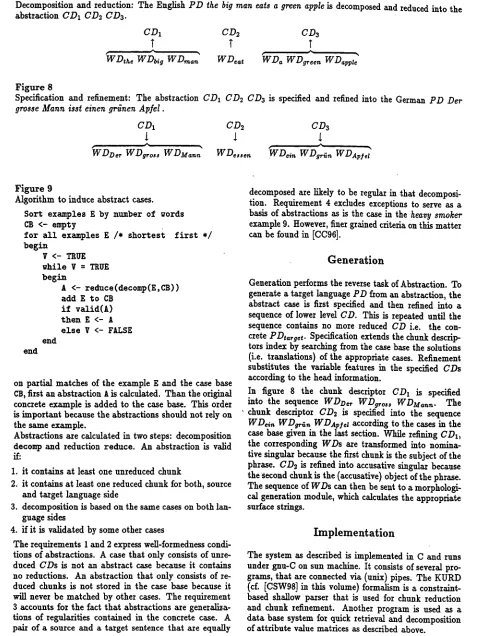
As shown in the figure 7, the English sentence The big man eats a green apple is decomposed into the three c h u n k s / T h e big m a n / / e a t s / a n d / / a green apple/. By abstraction, the sequence C O l C 0 2 CD3 is generated, where C D I and CD3 represent reduced chunks that in- dude information on the type of constituent (such as gender, number etc.) and the index of the matching case. If a W D cannot be integrated into a chunk - - as is the case for eat in the example - - it is integrated as an unreduced chunk into the abstract case.
Abstract cases are generated in a precompilation step as shown in figure 9. A new case base CB is incrementally created starting from an ordered set of examples. Based l~This is even more important for highly inflective lan- guages and paradigms, as for example for Romance verbs which can have up to 40 different surface forms dependent on person, number, modality, aspect and tense.
A Constructivist Approach to Machine Translation
II
II
|
II
II
I!
|
II
as
II
II
II
II
II
at
II
at
II
II
II
II
F i g u r e 7
Decomposition and reduction: The English PD the big man eats a 9teen apple is decomposed and reduced into the abstraction
CDI CD2 CD3.
CDI
CD2
CD3
T
T
T
A
WD~h, WDb~
9 W D ~
W D e o t WDa WD~ee. VfDa~,~
F i g u r e 8
Specification and refinement: The abstraction CD1 CD2 CD3 is specified and refined into the German P D Der grosse Mann isst einen #rinen Apfel.
CDx
CD2
CD3
F i g u r e 9
Algorithm to induce abstract cases.
Sort examples E by number of words CB <- empty
for all examples E / * s h o r t e s t first */ b e g i n
V < - TRUE while V = TRUE b e g i n
A <- reduce(decomp(E,CB))
a d d E t o CB
if valid(A) then E <- A else V <- FALSE end
end
on partial matches of the example g and the case base CB, first an abstraction A is calculated. Than the original concrete example is added to the case base. This order is important because the abstractions should not rely on the same example.
Abstractions are calculated in two steps: decomposition decomp and reduction reduce. An abstraction is valid if:
1. it contains at least one unreduced chunk
2. it contains at least one reduced chunk for both, source and target language side
3. decomposition is based on the same cases on both lan- guage sides
4. if it is validated by some other cases
The requirements 1 and 2 express we11-formedness condi- tions of abstractions. A case that only consists of unre- duced CDs is not an abstract case because it contains no reductions. An abstraction that only consists of re- duced chunks is not stored in the case base because it will never be matched by other cases. The requirement 3 accounts for the fact that abstractions are generaliza- tions of regularities contained in the concrete case. A pair of a source and a target sentence that are equally
decomposed are likely to be regular in that decomposi- tion. Requirement 4 excludes exceptions to serve as a basis of abstractions as is the case in the heary smoker example 9. However, finer grained criteria on this matter
can be found in [CC96].
G e n e r a t i o n
Generation performs the reverse task of Abstraction. To
generate a target language P D from an abstraction, the abstract case is first specified and then refined into a sequence of lower level C D . This is repeated until the sequence contains no more reduced C D i.e. the con- crete PDtarget. Specification extends the chunk descrip- tors index by searching from the case base the solutions (i.e. translations) of the appropriate cases. Refinement substitutes the variable features in the specified C D s according to the head information.
In figure 8 the chunk descriptor C D I is specified
into the sequence WDDe, WD~oss WDMan,. The ' chunk descriptor CD2 is specified into the sequence WDein WD~r~. WD.4ple~ according to the cases in the case base given in the last section. While refining CDh the corresponding WDs are transformed into nomina- tive singular because the first chunk is the subject of the phrase. CDz is refined into accusative singular because the :Second chunk is the (accusative) object of the phrase.
The sequence of
WDs
can then be sent to a morphologi- cal generation module, which calculates the appropriate surface strings.Implementation
The system as described is implemented in C and runs under gnu-C on sun machine. It consists of several pro- grams, that are connected via (unix) pipes. The KURD (cf. [CSW98] in this volume) formalism is a constraint- based shallow parser that is used for chunk reduction and chunk refinement. Another program is used as a data base system for quick retrieval and decomposition of attribute value matrices as described above.
[image:9.612.63.542.62.698.2]