Journal of Physics: Conference Series
PAPER • OPEN ACCESS
Mobile Ad hoc Network Testbed Using Mobile
Robot Technology
To cite this article: Farkhana Muchtar et al 2018 J. Phys.: Conf. Ser. 1019 012047
View the article online for updates and enhancements.
Related content
A Critical Review of MANET Testbed Using Mobile Robot Technology Farkhana Muchtar, Abdul Hanan Abdullah, Marina Md Arshad et al.
-AD HOC Networks for the Autonomous Car
Davidescu Ron and Eugen Negrus
-Gas Source Localization via Behaviour Based Mobile Robot and Weighted Arithmetic Mean
-1
Content from this work may be used under the terms of theCreative Commons Attribution 3.0 licence. Any further distribution of this work must maintain attribution to the author(s) and the title of the work, journal citation and DOI.
Published under licence by IOP Publishing Ltd
1234567890 ‘’“”
1st International Conference on Green and Sustainable Computing (ICoGeS) 2017 IOP Publishing IOP Conf. Series: Journal of Physics: Conf. Series 1019 (2018) 012047 doi :10.1088/1742-6596/1019/1/012047
Mobile Ad hoc Network Testbed Using Mobile Robot
Technology
Farkhana Muchtar*12, Abdul Hanan Abdullah1, Mohd Helmy Abd Wahab3,
Radzi Ambar3, Hafizul Fahri Hanafi4, Siti Nor Zawani Ahmmad5
1 Faculty of Computing, Universiti Teknologi Malaysia, 81310, Skudai, Johor, Malaysia 2 School of Computer Sciences, Universiti Sains Malaysia, 11800, Gelugor, Pulau Pinang,
Malaysia
3 Faculty of Electronic and Electrical Engineering, Universiti Tun Hussein Onn, 86400 Batu Pahat, Johor, Malaysia
4 Faculty of Art, Computing and Creative Industry, Universiti Pendidikan Sultan Idris, 35900 Tanjung Malim, Perak, Malaysia
5 Instrumental and Control Engineering, University Kuala Lumpur, MITEC, Persiaran Sinaran Ilmu, Bandar Seri Alam, 81750, Johor, Malaysia
E-mail: [email protected], [email protected], [email protected],
[email protected], [email protected], [email protected]
Abstract. MANET (Mobile Ad Hoc Network) researchers have shown increased interest in using mobile robot technology for their testbed platforms. Thus, the main motivation of this paper is to review various robot-based MANET testbeds that have been developed in previously reported research. Additionally, suggestions to heighten mobility mechanisms by using mobile robots to be more practical, easy and inexpensive are also included in this paper, as we unveils ToMRobot, a low-cost MANET robot created from an ordinary remote control car that is capable of performing a real system MANET testbed with the addition of only a few low-cost electronic components. Despite greatly reduced costs, the ToMRobot does not sacrifice any of the necessary MANET basic structures and will still be easily customisable and upgradeable through the use of open hardware technology like Cubieboard2 and Arduino, as its robot controller. This paper will also include guidelines to enable technically limited MANET researchers to design and develop the ToMRobot. It is hoped that this paper achieves its two pronged objectives namely (i) to facilitate other MANET researchers by providing them with a source of reference that eases their decision making for selecting the best and most suitable MANET mobile robots for real mobility in their MANET testbeds (ii) to provide MANET researchers with a prospect of building their own MANET robots that can be applied in their own MANET testbed in the future.
1.Introduction
1234567890 ‘’“”
IOP Conf. Series: Journal of Physics: Conf. Series 1019 (2018) 012047 doi :10.1088/1742-6596/1019/1/012047
present, the number of experiments conducted in MANET testbeds are significantly lesser compared t o simulation based MANET experiments [1]. There are various methods of mobility implementation that are used in MANET testbeds. These methods can be categorised into two main divisions, real mobility and emulated mobility or virtual mobility as it is also known.
The main distinctive feature of emulated mobility is due to non- physical node mobility. In other words, although real implementation of MANET testbed are performed on the data-link layer and above (application layer) but node mobility is not conducted physically. Physical node movement and topology changes are carried out through the use of emulation [ 2]. There are several different methods of emulated mobility such as instance migration [3], on/off connection [2], RF matrix switch [4] and the use of virtual machine technology and virtual n e t w o r k [5].
Emulated mobility has the advantage of being repeatable and having reproducible mobility that is almost the same as the network simulator. The mobility mechanism conducted is therefore m o r e manageable and predictable. However, emulated mobility is unable to describe the actual MAC layer and physical layer. Hence data obtained through it is less accurate t han m e t h o d s t h a t use real mobility [2]. Among t h e wireless testbed platforms that use emulated mobility methods are the Open-Access Research Testbed for Next-Generation Wireless Networks (ORBIT) [3], Ad-hoc Protocol Evaluation (APE) testbed with emulated mobility [6], the Carnegie Mellon University Wireless Emulator (CMUWE) [7], Castadiva [8], Mobi-emu [9], Emulab [10], MOBNET [11], MobiNet [12], the Resilience Evaluation Framework for Ad Hoc Networks (REFRAHN) [13], MeshTest [4] and WISEBED [14].
Conversely, real mobility in a MANET testbed experiment is vital i n o r d e r to obtain accurate a n d realistic results, despite the challenging nature of implementing it. Though if done correctly, real mobility implementation is able to provide extremely accurate experimental data on the impact of mobility on a MANET [15].
Previous research on MANETs have reported the use of various approaches to provide real mobility mechanisms in their MANET testbeds. Some of the methods included the use of cars [16], taxis [17], trains [18], bicycles [19], humans [20], and remote control cars [21]. Considering that the main motivation of this paper is to review various robot-based MANET testbeds that have been developed in previously reported research, other available but non-related mechanism types will not be discussed in this paper.
Since cost and other attendant concerns of acquiring robots to perform real mobility in MANET testbed experiments is a major constraint that hinders MANET researchers from using i t as an evaluation tool for MANET testbeds, t his paper also serves to propose and develop a low cost robot for MANET testbeds, named as ToMRobot that is built with a remote control car and low cost electronic components.
This review paper provides a two prong approach in its objectives. In other words, this review paper will allow readers to observe how mobile technology robots have been used to create well-designed MANET testbeds while at the same time providing readers with alternative solution, that is to develop their own MANET robot at a fraction of the cost yet it is still equipped with the basic structure to function well and can easily be upgraded whenever necessary.
This paper is organized as follows. In section 2, background information on former research carried out on MANET robot platforms is detailed. Section 3 describes the development of ToMRobot and finally, in section 4, the research is summarized and the future goals of this work are out lined.
2.Literature Review
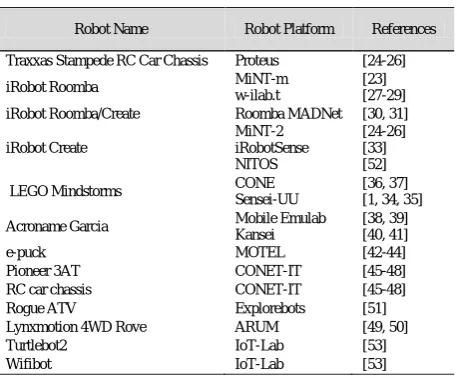
This section list out and discusses earlier robots that were u s e d in previous MANET–based research. Table 1 provides readers with a quick glimpse on the types of robots used in MANET-based research.
3
1234567890 ‘’“”
1st International Conference on Green and Sustainable Computing (ICoGeS) 2017 IOP Publishing IOP Conf. Series: Journal of Physics: Conf. Series 1019 (2018) 012047 doi :10.1088/1742-6596/1019/1/012047
Historically, the use of iRobot Roomba began when it was introduced in 2002 and it became among the earliest household robots made available to the public. It functioned as an autonomous robotic vacuum cleaner while at the same time it became a popular robot choice for robotics researchers and hobbyists that used it to be the main platform for mobile robots.
[image:4.595.184.413.234.423.2]iRobot Create on the other hand was introduced in 2007 and i t w a s based on the iRobot platform due to the popularity of iRobot Roomba amongst robotics researchers and hobbyists. iRobot Create was sold at a lower price because it did not have some of the components attached to iRobot Roomba such as a vacuum cleaning component, although the component could be added separately [22].
Table 1. List of Robots Used in MANET Testbeds
Robot Name Robot Platform References
Traxxas Stampede RC Car Chassis Proteus [24-26]
iRobot Roomba MiNT-m
w-ilab.t [23] [27-29] iRobot Roomba/Create Roomba MADNet [30, 31]
iRobot Create MiNT-2 iRobotSense NITOS [24-26] [33] [52]
LEGO Mindstorms CONE
Sensei-UU [36, 37] [1, 34, 35]
Acroname Garcia Mobile Emulab
Kansei [38, 39] [40, 41]
e-puck MOTEL [42-44]
Pioneer 3AT CONET-IT [45-48] RC car chassis CONET-IT [45-48] Rogue ATV Explorebots [51] Lynxmotion 4WD Rove ARUM [49, 50] Turtlebot2 IoT-Lab [53]
Wifibot IoT-Lab [53]
iRobot Roomba and Create were usually controlled with a robot controller (usually a combination of an embedded PC and microcontroller) through the iRobot Roomba Open Interface (ROI) protocol whereby communication was enabled via a serial port on iRobot Roomba/Create including MINT-m [23], MINT-2 [24-26], Proteus Roomba [24–26], w-ilab.t [27-29], Roomba MADNet [30, 31], SCORPION [32] and iRobotSense [33].
Apart from iRobot Roomba and Create, LEGO Mindstorms was another preferred choice as a robot platform for mobile robots in the MANET testbeds. Examples of MANET testbeds that used the LEGO Mindstorms robot platform are Sensei UU [1, 34, 35] and Cone Testbed [36, 37].
The Acroname Garcia robot platform al so was a popular choice in several MANET testbeds such as the Emulab Mobi l e (TrueMobile) [38, 39] and Kansei Testbed [40, 41]. There have also been reports of other readymade robot platforms that were utilized, such as e-puck that was used in the MOTEL testbed [42-44], the Pioneer 3AT robot platform that was used in CONET-IT [45-48], the Lynxmotion 4WD rover robot platform used in ARUM [49, 50] and the Rogue ATV robot platform used in Explorebot [51].
Previous studies revealed that the cost for robots used in said MANET testbeds ranged from between USD $3000 to USD $6,000. Understandably, procuring the higher end price range robots wer e a constrai nt for many MANET researchers. Opport unel y, t he ToMRobot is able to fill this research need by providing the same benefits as the existing robots, with the difference being that the ToMRobot uses different robotic components. Propitiously, said components are easily available, cheaper and easy to install by MANET researchers themselves because the required components are common ones used by hobbyists and robot makers for making mobile robots.
3.Development of ToMRobot
1234567890 ‘’“”
IOP Conf. Series: Journal of Physics: Conf. Series 1019 (2018) 012047 doi :10.1088/1742-6596/1019/1/012047
3.1. Mechanical Component
The mechanical component of the robot represents the robot anatomy, where it can be compared t o a human body. The main element for t h e mechanical component of t h e robot is the robot chassis because it is the main mechanical structure of the robot and acts as a base to other mechanical components.
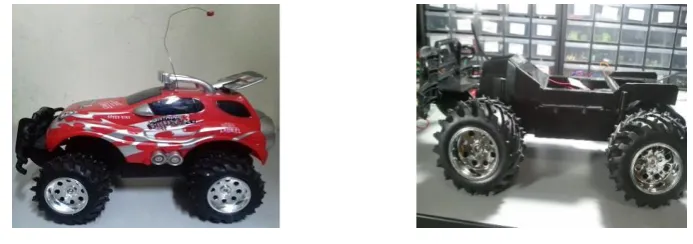
The mechanical component of this study utilizes a modified remote control car as the robot chassis. This is the cheapest solution as the RC car body serves as the robot housing and has a DC motor, gear system to increase torque and big wheels for testbed durability. Figure 1 and Figure 2 shows the original remote control car chassis before and after modification.
Figure 1. Original Remote Control Car Figure 2. Modified Chassis of the Remote Control Car
3.2. Electronic Component
The electronic components are elements used as inputs and outputs to the robot. Input components such as sensors, cameras, LIDAR and IMU act as the information provider to the robot in order to determine the environmental conditions and the location of the robot.
T h e e l e c t r o n i c components used in this study can be divided into two parts namely: ToMRobot and ToMDuino. The components used for ToMDuino and ToMRobot will be discussed in t h e next section.
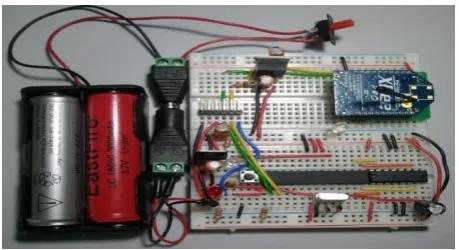
3.2.1. ToMduino Electronic Components. Instead of using an Arduino board, a customized version of the Arduino board, named ToMDuino (Arduino MANET Testbed), was created for this undertaking and can be seen in Figure 3 and Figure 4.
The objectives of developi ng ToMduino are as follows: i. Small. Suitably sized for the testbed robot chassis.
ii. Cheap. Cheaper t h a n the o f f i c i a l Arduino b o a r d w i t h several required s h i e l d s . In most cases, the Arduino shield designs are not optimized for advanced Arduino project requirements, including ToMRobot.
iii. Simplicity. Avoiding the use of a combination of the Arduino board with several shields, which would increase the complexity of the setup.
iv. Compatibility. Some Arduino shields are simply not compatible or cannot be used together with other Arduino shields.
The major differences of this customized A rduino version with the official Arduino Uno R3 version are as follows:
i. Built-in dual h-bridge motor controller to control the ToMRobot DC motors.
ii. Built-in XBee socket for t h e ToMRobot wireless communication u sing the XBee protocol with a 3.3v power source board.
iii. Specific pin header for sensors, serial connection t o cubieboard2 and LCD screen. iv. No generic I/O p i n header-like official.
[image:5.595.102.449.242.364.2] [image:5.595.105.242.244.356.2]5
1234567890 ‘’“”
[image:6.595.181.411.139.264.2]1st International Conference on Green and Sustainable Computing (ICoGeS) 2017 IOP Publishing IOP Conf. Series: Journal of Physics: Conf. Series 1019 (2018) 012047 doi :10.1088/1742-6596/1019/1/012047
[image:6.595.164.455.299.462.2]Figure 3. ToMDuino (Actual Implementation)
Figure 4. ToMDuino (Circuit Design)
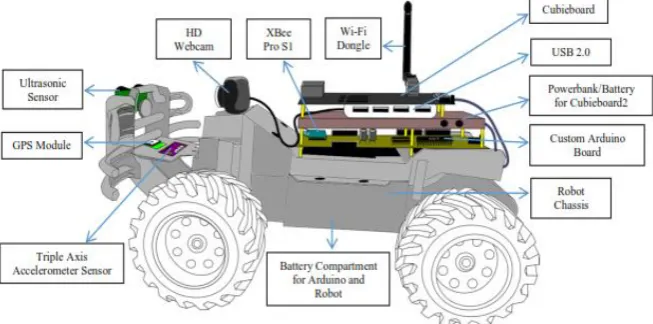
3.2.2.ToMRobot Electronic Components. Table 2 below provide readers with a pictured
[image:6.595.101.496.547.661.2]view on the list of component required to build ToMRobot. Once the listed components in Table 2 have been assembled, the created robot will be similar to that in Figure 5. Figure 6 serves to illustrate how to assemble the ToMRobot.
Table 2. Description of the ToMRobot Components
Name of Component Descriptions
Cubieboard2 To represent mobile device
USB 2.0 hub To provide extra USB port for cubieboard2 Powerbank To supply electric power for cubieboard2
Wi-Fi Dongle To provide Wi-Fi connection for MANET environment testbed XBee Pro S1 To provide remote communication during testbed
HD Webcam To provide life HD v i d e o streaming testbed
GPS Module To provide ToMRobot location during MANET testbed Triple Axis Accelerometer Sensor To provide ToMRobot location during MANET testbed
1234567890 ‘’“”
[image:7.595.137.466.150.348.2]IOP Conf. Series: Journal of Physics: Conf. Series 1019 (2018) 012047 doi :10.1088/1742-6596/1019/1/012047
Figure 5. ToMRobot Components for MANET Testbed (Actual Implementation)
Figure 6. ToMRobot Components for MANET Testbed (Concept Design)
3.3. Software
The last component of ToMRobot is the software, which acts as the brain or control centre of the robot that is based on logic that has been set in advance by t h e robot builder. The software component also acts in translating the input received from the input components and using that information to make decisions before translating it into output components such as t h e movement of robot’s wheels, legs, or arms.
[image:7.595.135.462.392.554.2]7
1234567890 ‘’“”
1st International Conference on Green and Sustainable Computing (ICoGeS) 2017 IOP Publishing IOP Conf. Series: Journal of Physics: Conf. Series 1019 (2018) 012047 doi :10.1088/1742-6596/1019/1/012047
ToMRobot will return the current status of the ToMRobot, mobile devices (Cubieboard2) and testbed data that is captured in real time.
4.Conclusion
The two prong objectives of this paper has been met, that is (i) to be source of reference for other MANET researchers who are considering the choice of the most suitable mobile robots for real mobility in their MANET testbeds. (ii) to be source of reference for MANET researchers to build their own MANET robots that can be used in their future MANET testbed.
The approach used to develop ToMRobot has the advantage of using easily obtainable and affordable robotic components like a remote control car, which serves as the robot chassis, combined with the use of open hardware technology like Cubieboard2 and Arduino as the robot controller. These combined factors is what enables this robot to be c o n v e n i e n t l y developed by anyone who is interested to use it in their MANET testbeds. The provided guidelines in this article will aid MANET researchers who lack the technical background to build their own robot and ultimately increase the number of MANET researchers who choose testbeds as their evaluation tool.
This article also serves as a preliminary step for the development of future research projects. For future work, the ToMRobot will be used to measure energy efficiency in MANET testbeds. Two types of MANET testbeds will be designed and set up for the experiment; (i) passive mode and (ii) testbed with mobility. The remote car chassis used in this paper will also be changed to a Tamiya tank remote car chassis so that it can climb obstacles with ease and traverse crevasses without the wheels getting stuck.
The extension of this article can be referred to our paper entitled “A Technical Review of MANET
Testbed Using Mobile Robot Technology” [54] and “A Critical Review of MANET Testbed Using
Mobile Robot Technology” [55].
5.Acknowledgements
The authors would like to thank the Universiti Teknologi Malaysia (UTM) for supporting this research under VOT NUMBER: Q.J130000.2528.14H81.
References
[1] Rensfelt O Hermans F Gunningberg P Larzon L.-Å. and Björnemo E 2011 The Computer
Journal, 54 (12) pp 1973–1986
[2] Yoon H Kim J Ott M, and Rakotoarivelo T 2009 Proc. of the 4th ACM International
Workshop on Experimental Evaluation and Characterization, WINTECH ’09 (New
York, NY, USA: ACM) pp 51–58
[3] Raychaudhuri D Seskar I M Ott M Ganu S Ramachandran K Kremo H, Siracusa R Liu H, and Singh M 2005 Wireless Communications and Networking Conf., 2005 IEEE, Vol. 3 pp 1664–1669.
[4] Hahn D Lee G Kim Y Walker B Beecher M a n d Mundur P 2 0 1 0 Proc. of the 5th ACM
Workshop on Challenged Networks, CHANTS ’10, (New York, NY, USA: ACM) pp. 79–
82
[5] Kim Y Taylor K Dunbar C Walker B and Mundur P 2 0 1 1 Proc. of the 3rd ACM
International Workshop on MobiArch, Hot Planet ’11, (New York, NY, USA: ACM) pp
23–28
[6] Nordstrom E Gunningberg P and Lundgren H 2005 1st International Conf. on Testbeds
and Research Infrastructures for the Development of Networks and Communities, 2005.
Tridentcom’05 pp100–109
[7] Wang X Borries K Anderson E and Steenkiste P 2011 2011 IEEE Vehicular Technology
Conf. (VTC Fall) pp 1–5.
[8] Hortelano J Cano J -C Calafate C T and Manzoni P 2009 EURASIP J. Wireless
1234567890 ‘’“”
1st International Conference on Green and Sustainable Computing (ICoGeS) 2017 IOP Publishing IOP Conf. Series: Journal of Physics: Conf. Series 1019 (2018) 012047 doi :10.1088/1742-6596/1019/1/012047
[9]
Zhang Y and Li W 2 0 0 1
Proc. of the 3
rdACM International Symposium on Mobile Ad
Hoc Networking & Computing (MobiHoc’02)
, (new York, NY, USA: ACM) pp 104–111
[10] Guruprasad S Ricci R and Lepreau J 2005 1
stInternational Conf. on Testbeds and
Research Infrastructures for the Development of Networks and Communities, 2005.
Tridentcom’05
pp 204–212
[11] Krop T Bredel M Hollick M and Steinmetz R 2007
Proc. of the 2
n dACM International
Workshop
on
Wireless
Network
Testbeds,
Experimental
Evaluation
and
Characterization, WinTECH ’07,
(New York, NY, USA: ACM) pp 27–34
[12] P. Mahadevan, A. Rodriguez, D. Becker, and A. Vahdat,
2005 Workshop on Wireless
Traffic Measurements and Modeling, WiTMeMo ’05,
USENIX Association, Berkeley, CA,
USA, 2005, pp 7–12.
[13] Friginal J Andrés D de Ruiz J-C and Martínez M 2015
C o m p u t e r Networks
82 pp 114–
134.
[14] Coulson G B Porter B Chatzigiannakis I Koninis C Fischer S Pfisterer D Bimschas D Braun
T Hurni P Anwander M Wagenknecht G Fekete S P Kröller A and Baumgartner T 2011
Commun. ACM
55
(1) p p 82–90
[15] Kulla E Ikeda M Barolli L Xhafa F and Iwashige J, 2012
A Survey on MANET T e s t b e d s
and Mobility Models
( e d s ) Park J J J H Chao H-C Obaidat M S Kim J Computer
Science and Convergence, LNEE (Heidelberg: Springer Berlin)
Vol
1 1 4
pp 651–657
[16] Ramanathan R Redi J Santivanez C Wiggins D and Polit S, 2005
IEEE Journal on
Selected Areas in Communications
23
(3) pp 496–506
[17] Galati A Bourchas T Siby S Frey S Olivares M Mangold S, 2 0 1 4
2014 IEEE Global
Humanitarian Technology Conference (GHTC)
pp 699–705
[18] Zarafshan-Araki M a n d Chin K-W 2010
Computer Communications
33
(15) p p 1850–
1863
[19] Kazdaridis G and Stavropoulos D Maglogiannis V Korakis T Lalis S Tassiulas L 2014
2014
IEEE 15th International Conf. on Mobile Data Management (MDM),
Vol. 1 pp 89–98
[20] Kulla E Oda T Ikeda M Barolli L Biberaj A a n d Shurdi O, 2014
Int. J. Wire. Mob.
Comput
.
7
(4) pp 318–326
[21] M. J. F. Alenazi, E. K. Çetinkaya, J. P. Rohrer,
International Telemetering Conf. Proc
[22] De, L P Maestre J Camacho E and Alonso I 2011
International Journal of Ad Hoc and
Ubiquitous Computing 7
(3) pp 192–201.
[23] De P Raniwala A Krishnan R Tatavarthi K Modi J Syed N A Sharma S and Chiueh T-C
2006
Proc.of the 4
thInternational Conf. on Mobile Systems, Applications and Services,
MobiSys’06,
( New York, NY, USA: ACM) pp 124–137.
[24] Mitchell C Munishwar V Singh S Wang X Gopalan K a n d Abu-Ghazaleh N 20 09
Communication Systems and Networks and Workshops (COMSNETS 2009)
First
International pp 1–10
[25] Munishwar V Singh S Wang X Mitchell C Gopalan K and Abu-Ghazaleh N
IEEE International
Conference on Pervasive Computing and Communications (PerCom 2009)
pp. 1–6.
[26] Munishwar V Singh S Mitchell C Wang X Gopalan K Abu-Ghazaleh N 2009
IEEE
International Conf. on Pervasive Computing and Communications (PerCom 2 0 0 9 )
pp
1–3.
[27] Becue P Jooris B Sercu V Bouckaert S Moerman I and Demeester P
Remote Control of
Robots for Setting Up Mobility Scenarios during Wireless Experiments in the IBBT
w-iLab.t,
( e d s )
Ko- rakis T Zink M Ott M LNICST (Heidelberg: Springer Berlin)
44
pp
425–426
[28] Moerman L Korakis T Niavis, H Stavropoulos D Igoumenos I Becue P Sercu V Jooris B
Neuhaus S Lyberopoulos G Theodoropoulou E and Filis K Toolkit f o r wireless mobility
t e s t b e d s , Deliverable Report Del i verabl e D3.5, OpenLab (Oct. 2014)
9
1234567890 ‘’“”
1st International Conference on Green and Sustainable Computing (ICoGeS) 2017 IOP Publishing IOP Conf. Series: Journal of Physics: Conf. Series 1019 (2018) 012047 doi :10.1088/1742-6596/1019/1/012047
[30] Reich J Misra V and Rubenstein D 2 0 0 8
A CM SIGMOBILE Mobile Computing and
Communications Review
12
(1) pp 68–70
[31] Reich J Misra V Rubenstein D and Zussman G 2012
IEEE Journal on Selected Areas in
Communications
30
(5) pp 935–950
[32] Bromage S Engstrom C Koshimoto J Bromage M, Dabideen S and Hu M Menchaca-Mendez
R Nguyen D Nunes B Petkov V Sampath D Taylor H Veyseh M Garcia-Luna-Aceves J
JObraczka K Sadjadpour H Smith B 2009
ACM SIGMOBILE Mobile Computing
and Communications Review
13
(1) pp 65–68
[33] Janansefat S Senturk I Akkaya and K Gloff M 2012
37
thAnnual IEEE Conf. on Local
Computer Networks (LCN
)
[34] Rensfelt O Hermans F Larzon L-Å and Gunningberg P, 2 0 1 0
Proc. of the 5
thACM
International Workshop on Wireless Network Testbeds, Experimental Evaluation and
Characterization, WiNTECH’10,
(New York, NY, USA: ACM) pp63–70
[35] Hermans F Rensfelt O Gunningberg P, Larzon L-Å and Ngai E C
, TRIDENTCOM, 2010,
pp
[36] Vingelmann P Pedersen M Heide J Zhang Q and Fitzek F 2012
IEEE International Conf. on
Communications (ICC 2102)
pp 291–296
[37] Vingelmann V Heide J Pedersen M V Zhang Q and Fitzek F H P, 2014
Computer Networks
74(Part B) pp 34–47
[38] Johnson D Stack T Fish R Flickinger D Ricci R and Lepreau J 2006
The 25
thAnnual Joint
Conf. of the IEEE Computer and Communications Societies.
IEEE Computer Society
[39] Johnson D Stack T Fish R Flickinger D Stoller L Ricci R and Lepreau J 2006
25th IEEE
International Conf. on Computer Communications (INFOCOM’
0 6 ) pp 1–12
[40] Arora A, E Ertin E Ramnath R Nesterenko M and Leal W 2006
IEEE Internet Computing
10
(2) pp 35–47.
[41] Ertin E Arora A Ramnath R Nesterenko M, Naik V Bapat S Kulathumani V Sridharan M
Zhang H and Cao H 2006
The 5
thInternational Conf. on Information Processing in
Sensor Networks (IPSN 2006)
pp 399–406
[42] Forster A Forster A Leidi T Garg K Puccinelli D Ducatelle F Giordano S and Gambardella
L M 2010 MOTEL: Towards Flexible Mobile Wireless Sensor Network Testbeds,
2010.
[43] Förster A Förster A Garg K Puccinelli D Giordano S and Gambardella L M 2013
Wireless
Integration of Sensor networks in Hybrid architectures
13
[44] Foerster A Foerster A Garg K Giordano S and Gambardella L M
Adhoc & Sensor
Wireless Networks
24
(3)
[45] Jiménez-González A Martínez-de Dios J R and A. Ollero A, 2010
IEEE/RSJ
International Conf. on Intelligent Robots and Systems (IROS 2010)
pp 3327–3332
[46] Jimenez-Gonzalez A Martinez-De Dios J R and Ollero A 2 0 1 1
Sensors
11
(12) pp 11516–
11543
[47] Jiménez-González A Martinez-de Dios J R and Ollero A 2013
Robotics and Autonomous
Systems
61
(12) pp 1487–1501
[48] Dios J R M.-d Jimenez-Gonzalez A Bernabe A. d. S. and Ollero A 2014, A Remote
Integrated Testbed for Cooperating Objects, S p r i n g e r B r i e f s i n Electrical and
Computer Engineering, Springer International Publishing, pp 23–39.
[49] Killijian M-O Roy M a n d Severac G 2010
IEEE 6th International Conference on Wireless
and Mobile Computing, Networking and Communications (WiMob 2010)
pp 442–449
[50] Killijian M-O Roy M and Severac G 2 0 1 2
The ARUM Experimentation Platform: An Open
Tool to Evaluate Mobile Systems Applications (eds)
RÃŒckert U Joaquin S Felix W
(Heidelberg: Springer Berlin) pp. 221–234.
1234567890 ‘’“”
1st International Conference on Green and Sustainable Computing (ICoGeS) 2017 IOP Publishing IOP Conf. Series: Journal of Physics: Conf. Series 1019 (2018) 012047 doi :10.1088/1742-6596/1019/1/012047