International Journal of Emerging Technology and Advanced Engineering
Website: www.ijetae.com (ISSN 2250-2459, Volume 2, Issue 7, July 2012)169
Change Detection in Remote Sensing Images Using
Elitist Genetic Algorithm
Amlan Raychaudhuri
1, Shruti Khandelwal
2, Sneha Chhalani
3, Nikhita Kakarania
4Department of Computer Sc. & Engg., B. P. Poddar Institute of Management & Technology, Kolkata – 52,West Bengal, India
Abstract— In this paper, we have discussed the Change Detection in Remote Sensing Images using Elitist Genetic Algorithm. Remote sensing is the acquisition of information about an object or phenomenon, without making physical contact with the object. Change detection is the measure of the distinct data framework and thematic change information that can guide to more tangible insights into underlying process involving land cover and land use changes than the information obtained from continuous change. We have used Elitist Genetic Algorithm here along with K-means clustering technique to detect changes in two remote sensing images of the same region taken at different point of time. Elitist Genetic Algorithm is an improvised version of Simple Genetic Algorithm which preserves the best results for subsequent optimization steps. A fitness function is used to optimize the fitness value obtained in every iteration using the operators of GA like selection, crossover, and mutation. Finally an Output showing the changed pixels in the two images with black color is displayed.
Keywords— Change Detection, Elitist Genetic Algorithm, K-means Clustering, Pixel neighborhood, Remote Sensing Images.
I. INTRODUCTION
Change Detection is a phenomenon of finding changes that have occurred to an entity over a period of time. It is a very useful process generally used for a comparative study of an object, area etc. before and after a certain time in space. It finds its use in Change detection of Remote Sensing Images, extraction of visual information from images, finger print analysis, Character recognition from images and badly illuminated texts etc. Usually change detection is carried out with a threshold found from the histogram of an image automatically. The threshold deciding criteria is the most difficult part since there are several interfering noises that need to be eliminated. However we propose an Elitist Genetic Algorithm here along with K-means Clustering to find changes in the two input images. First a difference image is found by finding the difference between the corresponding pixels of the two input images. Next, the intensities of each pixel from the gray-level difference image are extracted.
Now using K-means algorithm those pixels are mapped into two clusters considering their own and neighboring pixel intensities. The cluster centroids so formed are then fed to the Elitist GA which optimizes the population set into two subsets – one black and the other white representing changed and unchanged pixels between the two images.
K-means (MacQueen, 1967) is one of the simplest unsupervised learning algorithms that solve the well-known clustering problem. This nonhierarchical method initially takes the number of components of the population equal to the final required number of clusters. In this step itself the final required number of clusters is chosen such that the points are mutually farthest apart. Next, it examines each component in the population and assigns it to one of the clusters depending on the minimum distance from the centroids. The centroid’s position is calculated every time and a new chromosome is formed with its value. This continues until the formation of the desired number of chromosomes [5].
GA is a non-deterministic stochastic searching optimization method that utilizes the theories of evolution to solve a problem within a complex solution space [4]. They are based on natural selection discovered by Charles Darwin [1]. They employ natural selection of fittest individuals as optimization problem solver. Optimization is performed through natural exchange of genetic material between parents. Offsprings are formed from parent genes. Fitness of offspring is evaluated. Best fit offsprings are selected and chosen for crossover and mutation. In computer world, genetic material is replaced by strings of bits and natural selection replaced by fitness function. Mating of parents is represented by crossover and mutation operation [2].
A simple GA consists of five steps [3]:
1. Start with a randomly generated population of N chromosomes, where N is the size of population. 2. Calculate the fitness value of function φ(x) of each
International Journal of Emerging Technology and Advanced Engineering
Website: www.ijetae.com (ISSN 2250-2459, Volume 2, Issue 7, July 2012)170 3.1.Probabilistically select a pair of chromosomes
from current population using value of fitness function.
3.2.Produce an offspring yi using crossover and
mutation operators, where i = 1, 2, up to N. 4. Replace current population with newly created one. 5. Go to step 2.
In Elitist Genetic Algorithm, we perform the same steps with a slight modification. During the selection step, we find the best fit chromosome and save it to be used in the next iteration. So in this way we assure that the best fit chromosome is not lost at any cost. It is subsequently used for crossover and preserved in its original form too. This modified form gives better results than Simple GA.
II. RELATED WORK
Earlier work in this area has been done for automated change analysis for thematic data using an object-based image analysis methodology. In [6], it is implemented within the scope of IMALYS, a software system able to conduct a comprehensive object-based investigation of remote sensing imagery including segmentation, feature retrieval and classification.
Another study demonstrates the synergistic use of medium resolution, multitemporal Satellite pour l’Observation de la Terre (SPOT) XS, and fine resolution IKONOS images for landslide inventories [7].
Another method proposes an optimization of a computer based change detection technique based on the Iterative Principal Component Analysis (IPCA) [8].
The USDA Forest Service and California Department of Forestry and Fire Protection are collaborating on a large-area change detection program using Landsat Thematic Mapper satellite imagery [9].
Another work proposed a method to estimate background intensity changes from joint intensity histogram to robustly detect appearance/disappearance changes from satellite images [10].
Change detection is useful in many applications through spatial and temporal analysis techniques such as GIS (Geographic Information System) and Remote Sensing along with digital image processing techniques.
All the reported change detection methods have been demonstrated to be effective in constrained processing environments with predictable images. However, pictures taken in real-life situations may contain different artifacts such as shadow, non-uniform illumination, etc. Proper detection of changes in these images is very important for separating the before image from the after.
A good change detection algorithm will result in better recognition accuracy.
III. PROPOSED TECHNIQUE
A. Subtraction of the Two Input Images to Get the Difference Image
Two grey level remote sensing input images of size m × n pixels are taken and their intensity values at each pixel are subtracted and stored the absolute value of the subtraction result in a 2-D array representing the difference image in matrix form.
The intensity values of each pixel are in the range of 0 - 255. Each pixel (e.g. x[i, j]) is surrounded by eight different neighbouring pixels (e.g. x[i-1, j-1], x[i-1, j], x[i-1, j+1], x[i, j-1], x[i, j+1], x[i+1, j-1], x[i+1, j], x[i+1, j+1]), hence forming a pattern of nine pixels. They are stored in an array like structure as shown below:
{x[i-1, j-1], x[i-1, j], x[i-1, j+1], x[i, j-1], x[i, j], x[i, j+1], x[i+1, j-1], x[i+1, j], x[i+1, j+1]}
B. Initialization of a Chromosome and Clustering Using K-Means Clustering Technique
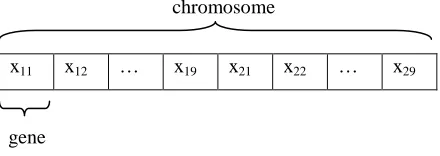
Each pixel is to be clustered into either changed or unchanged cluster so that two clusters are to be formed. That means the difference grey-level image to be converted into binary image (black and white) [12]. Where black represents changed pixels and white represents unchanged pixels. Each cluster has its own centroid. Hence the chromosome contains the two centroids and has a structure like Fig. 1, where x11, x12, ….., x19 is the first centroid and
x21, x22, ….., x29 is the second centroid.
chromosome
x11 x12 … x19 x21 x22 … x29
[image:2.612.335.555.505.583.2]gene
Figure 1: Structure of a Chromosome
Next Clustering is done. The steps involved in the clustering include:
1. Two random patterns are selected from total m × n number of patterns. These two patterns represent two cluster centroids.
International Journal of Emerging Technology and Advanced Engineering
Website: www.ijetae.com (ISSN 2250-2459, Volume 2, Issue 7, July 2012)171 3.Finally an output is generated containing the
information of all m × n patterns where all of them have been mapped to the two clusters initially. The Euclidean distance between points: p and q is the length of the line segment connecting them. In Cartesian coordinates, if p = (p1, p2, ..., pn) and q = (q1, q2, ..., qn) are
two points in Euclidean n-space, then the distance d(p, q) is given by:
d(p, q) = d(q, p) =
n
i
i
i
p
q
1
2
C. Evaluation of the Fitness Value of the Chromosomes
The fitness value of the chromosome is calculated by adding all the minimum distance of each pattern with respect to two centroids. The sum of all such distances,
i.e., D =
n m
i i
D
1
is the intra cluster distance. According to K-Means clustering technique the distance D should be minimized. Then the inverse of this distance correspond to the fitness value of that chromosome which is stored in a variable along with the chromosome.
Fitness (F) =
1
10
6D
Twenty such chromosomes are formed and their average and maximum fitness values are found.
D. Applying the Operators of Genetic Algorithm
The following operators have been implemented here:
1. Selection: It selects good chromosomes in a population and forms a mating pool. We find the probability and cumulative probability of each of the 20 chromosomes. Now we select 20 new chromosomes from the existing chromosomes using the Roulette Wheel method. The Roulette Wheel is spun n times, each time selecting an instance of the chromosome chosen by the roulette-wheel pointer. Using the fitness value Fi of all chromosomes, the probability of selecting a chromosome can be calculated. Thereafter, the cumulative probability of each chromosome being copied can be calculated by adding the individual probabilities from the top of the list.
Chromosomes with higher probability have higher chance of being selected. Also we preserve the chromosome having maximum fitness for the next iteration to save the best fit chromosome.
2. Crossover: In crossover operation, recombination process creates different individuals in the successive generations by combining material from two individuals of the previous generation. The two chromosomes participating in the crossover operation are known as parent chromosomes and the resulting chromosomes are known as children chromosomes.
In this study, we have interchanged the chromosomes at a certain point in order to create better chromosomes. We have used single point crossover in which the selected chromosome values are interchanged from the middle position. The crossover is done only when a randomly generated number is less than the crossover rate (0.8 in our case). This is done 20 times. The chromosome with best fitness is preserved and one copy of it is kept unaltered after crossover.
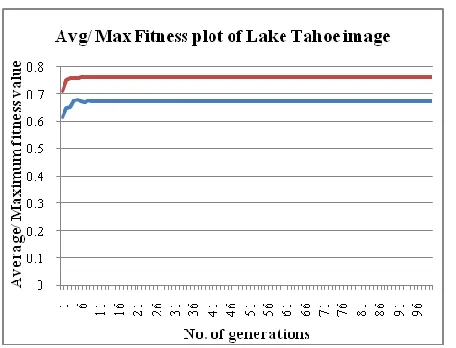
A fixed number of generations are evaluated till we get the best results. In each generation, the average and maximum fitness values are stored to stabilize and optimize the result. A graph is plotted to show the same.
IV. EXPERIMENTAL RESULTS
The first dataset [13] contains a set of multispectral images collected on the part of Alaska to observe the land changes. Two of them are chosen for our simulation experiments which were acquired on 22 July 1985 and 13 July 2005 by Landsat 5 TM. A small area with 352 × 302 pixels are selected from images and presented in Fig. 2(a) and 2(b), respectively. The difference image and the resultant output are shown in Fig. 2(c) and 2(d) respectively.
(a) (b)
(c) (d)
Figure 2: (a) Landsat 5 TM Band 1 image acquired in 22 July 1985; (b) Landsat 5 TM Band 1 image acquired in 13 July 2005; (c) Difference image; (d) The resultant output (white denotes
[image:3.612.331.556.510.679.2]International Journal of Emerging Technology and Advanced Engineering
Website: www.ijetae.com (ISSN 2250-2459, Volume 2, Issue 7, July 2012)172 (a) (b)
(c) (d)
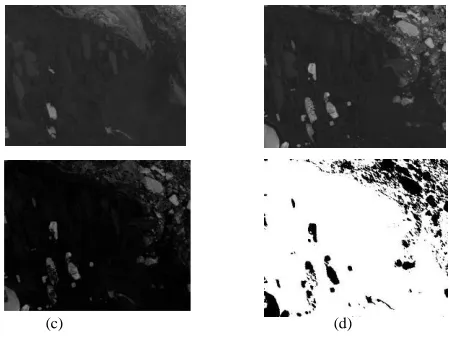
Figure 3: (a) Landsat MSS image acquired on August 5, 1986; (b) Landsat MSS image acquired on August 5, 1992;
(c) Difference image;
(d) Resultant output (white denotes unchanged and black denotes changed areas).
The second data set [14] contains optical images. The images of size 200 × 200 pixels are acquired on August 5, 1986 [see Fig. 3(a)], and August 5, 1992 [see Fig. 3(b)], by the Landsat Multispectral Scanner (MSS) to observe the land deformations on the Reno–Lake Tahoe area of Nevada resulted from a forest fire. The difference image and resultant output is shown in Fig. 3(c) and 3(d) respectively.
The image histograms of the two difference images are also shown in Fig. 4(a) and 4(b) respectively. The histogram gives an idea about the frequency of intensity values (0 - 255) in the image.
(a)
(b)
Figure 4: (a) Histogram for the images of Alaska region; (b) Histogram for the images of Reno-Lake Tahoe region.
Figure 5: (a) Graph of average and maximum fitness values for Alaska image
[image:4.612.59.286.138.344.2] [image:4.612.332.556.306.513.2] [image:4.612.53.284.533.651.2]International Journal of Emerging Technology and Advanced Engineering
Website: www.ijetae.com (ISSN 2250-2459, Volume 2, Issue 7, July 2012)173 Figure 5(b): Graph of average and maximum fitness values for
Reno-Lake Tahoe image
V. CONCLUSIONS
This paper presents a simple but effective method for change detection. The effectiveness of the proposed method has been proven by the experimental results on images from a standard image database. There are lots of scopes of experimenting with remote sensing images, document images, analysis of medical images and change detection in remote-sensing images, testing the noise immunity of the proposed method etc.
REFERENCES
[1] Schwefel, H.P. and Rudolph, G. 1995. Contemporary evolution strategies. Advances in artificial life, 893 – 907. [2] Paulinas, M. and Ušinskas, A. 2007. Survey of genetic
algorithms applications for image enhancement and segmentation, Information technology and control, Vol-36, No. 3, 278-284.
[3] Mitchell, M. 1996. An introduction to genetic algorithms. The MIT Press, 208.
[4] Holland, J.H. 1975. Adaptation in Natural and Artificial Systems, MIT Press.
[5] Faber, V. 1994. Clustering and the Continuous k-Means Algorithm. Los Alamos Science, 138-144.
[6] Reinhold, M. and Selsam, P. Automated change detection for thematic data using object-based analysis of remote sensing imagery, The International Archives of the Photogrammetry, Remote Sensing and Spatial Information Sciences, Vol. XXXVIII, Part 4/C7.
[7] Nichol, J. and Wong, M. S. 2005. Satellite remote sensing for detailed landslide inventories using change detection and image fusion, International Journal of Remote Sensing Vol. 26, No. 9, 1913–1926.
[8] Spitzer, H., Franck, R., Kollewe, M., Rega, N., Rothkirch, A. and Wiemker, R. 2009. Change Detection with 1m Resolution Satellite and Aerial Images, IEEE explore. [9] Levien, L. M., and Fischer, C. S. 1998. Statewide change
detection using Multitemporal remote sensing data, Presented at the First International Conference on Geospatial Information in Agriculture and Forestry, Lake Buena Vista, Florida.
[10]Kita, Y. 2008. A study of change detection from satellite images using joint intensity histogram, IEEE, 978-1-4244-2175-6/08.
[11]Ramachandra, T. V. and Kumar, U. 2004. Geographic Resources Decision Support System for land use, land cover dynamics analysis. Proceedings of the FOSS/GRASS Users Conference - Bangkok, Thailand.
[12]Raychaudhuri, A., Khandelwal, S., Chhalani, S. and Kakarania, N. Image Binarization of Grey Level Images Using Elitist Genetic Algorithm. International Journal of Computer Applications, (July 2012), in press.
[13]Available online at http://change.gsfc.nasa.gov/alaska.html [14]Available online at:
[image:5.612.57.285.131.305.2]