Journal of Chemical and Pharmaceutical Research, 2016, 8(4):801-808
Research Article
CODEN(USA) : JCPRC5
ISSN : 0975-7384
A Study on the Efficiency Influence of Computer-Assisted Translation in
Technical Translation
Zhang Lin
School of Foreign Languages, Luoyang Institute of Science and Technology, Luoyang, China
_____________________________________________________________________________________________ABSTRACT
A growing number of research projects have been conducted in the field of computer-assisted translation (CAT), such as translation memory, terminology management and project management. However, it is noticeable that few studies have focused on the efficiency influence of CAT software to English-Chinese technical translation. This paper aimed at exploring the influences of the CAT software on the efficiency of E-C technical translation, i.e. how the TM system of the Software influences the quality of technical translation. The findings of this study prove that the CAT software is useful to improve the speed and quality of E-C technical translation, and reduce the possibility of mistranslation and maintain the consistency of terms and style. Therefore, it is necessary to incorporate the CAT software into translation training curriculum.
Key words: quality influence; CAT; techniqual; translation
_____________________________________________________________________________________________
INTRODUCTION
It is estimated that technical translation accounts for some 90% of the world’s total translation output annually (Kingscott, 2002). It is unsurprising given the increasing international cooperation in scientific, technological and industrial activity. By the end of 2011, the translation production in China had reached 30 billion Yuan and will continue to increase. But it is estimated that only less than 20% of the needs are met by translation corporations in China. The gap between supply and demand in translation industry requires more qualified translators who are capable of working with the computer-assisted translation (CAT) software.
For scores of years, many kinds of translation tools has been developed, which ranges from machine translation systems, CAT software, corpus analysis tools and terminology management systems. Due to the internationalization and informationalization, translators in today's market are confronted with a number of challenges such as a growing demands for translation, especially technical translation, which has been the mainstream of translation industry in PRC. The core technology of CAT software is the use of translation memory. High quality, high speed and cost-savings are key the basic requirements of CAT software.
LITERATURE REVIEW
Although there are different approaches to translation studies, the main subject under criticism is literary texts. The translation of technical texts especially the application of CAT software in and its influence on E-C technical translation remain unexplored in the literature of translation studies. The translation of technical text belongs to the covert translation, which is to "recreate, reproduce or represent in the translated text the function the original has in its lingua-cultural framework and discourse world”(House 1997:114). According to Reiss (1971/2000), the international scientific efforts were made for the accurate and rapid research communication. The importance of translations in exchanging information and ideas requires that the quality of translation be a matter of special attention.
Terminology is regarded as the systematic designation of defined concepts within a specific field (Bowker 2002; Sager, 1990). In terminology, a terminological unit is defined by Cabré (2007) as "a lexical unit with a morphological or a syntactic structure which corresponds to a minimal autonomous conceptual unit in a given field". From what have been reviewed, the previous studies are limited. Firstly, there are different approaches to translation studies, but the translation of technical texts has been largely neglected in the literature on translation studies. Secondly, recent years have seen the empirical studies on the application of the CAT software in technical translation (e.g., Bowker, 2006; Webb, 1998); several researches have already investigated the impact of the TM of the productivity of technical texts translated from English to Chinese, but there is no studies focused on the quality of CAT to help translate technical materials.
Motivated by the research gaps, the study focuses the effects of TM systems on the E-C technical translation. Particularly, it aims at addressing the following questions: What is the efficiency of the CAT software as perceived by the participant users?
METHODOLOGY
The applied translation studies especially the application of the CAT tool and its influence of the English-Chinese technical translation have not yet much discussed. In order to explore the inf1uence of TM system of the CAT software of the E-C technical translation, an experiment was conducted.
3.1 Subjects
8 translation trainers and a reviewer participated in this study in April, 2015. 4 of translation trainers were teachers of CAT program in Department of Luoyang Institute of Science and Technology. They had completed courses of CAT and Terminology Management courses in Transn Company, ltd (Wuhan, PRC), which offered students the hand-on experience in using translation memory systems. These four participants were moderate users of the CAT software and they were in Group I. The rest participants had no experience in working with the TM system and they were in Group II.
The participants’ age ranged from 20 to 37 years old. Their undergraduate majors were almost same, i.e. English majors, and they had translation courses in their undergraduate studies. All of the students are native Chinese speakers. Therefore, it is assumed that they are proficient in both Chinese and English, and their translation skills are ‘near professional level". This assumption is not without precedent Tirkkonen-Condit (1990) compared the translation behavior of professional and non-professional translators and he asked second-year students 10 represent the "professional translators". When Bowker (2005) analyzed the TM error propagation, she selected her master students as participants.
3.2 Research Tool
SDL Trados 2014 Suite was selected as the CAT software in this research. It is one of the most widely used CAT packages available of the market and it makes nearly 70% of the global CAT market. SDL MultiTerm can not only store, retrieve and update terms but also extract terms from different projects, such as monolingual projects, bilingual projects and translation projects. The equivalence shown by MultiTerm is useful for maintaining terminological consistency throughout the whole project, especially when a team of translators work on the same project. Translator’s Workbench (TWB) is a platform which integrates the TM and tenninology management system. It is a set of a template compatible with any version of MS Word. It adds toolbars for translation-related functions to the standard MS Word. TWB uses MS Word as an editor which provides translators a very familiar working environment. TWB a1so has a wide range of other functions to support other aspects of the trans1ation process such as quality assurance, project management and translation memory exchange.
3.3 Research Course
environment. The recorded data were analyzed to trace the translation process of each translator. But not all the data are used in this study.
The source text of this research is from a camera user guide. The reasons for choosing the guide are comprehensive. First of all, the core function of TM is to reuse the texts that have been pre-translated. Therefore, the higher the percentage of repetitive content within a text, the more desirable it is to use translation memory. As observed by researchers such as Webb (1998) and Bowker (2002), texts dealing with specialized subjects are best suited for working with a TM because the vocabulary and structures tend to be repeated in texts within a specialized domain. Secondly, online help documents and user guide usually are in simple sentence structures and frequently repeated terminologies. In addition,accompanied with the updating of products, the content of user guide and online help document are often revised. In addition, in order to win the market, time for translating online help document or user guide of new products is limited.
The TM contained 500 English-Chinese translation units (segments). 80% of them were chosen from MS Word 2013 and iWork Pages 2009 online help document, a common and frequent topic in localization industry and the rest were from the user guide. About 80 terms were extracted with the assistance of MultiTerm; these glossaries were also imported to the Translators' Workbench along with TM. The source text was about the online help document of text-editing tools and user guide. It was around 900 English words. The ST shared some similarity with the TM. The match rates between source text and TM were analyzed in Chapter Four.
The experiment was designed to reflect a natural translating environment. To make sure that Group I were familiar with the work environment, a pilot study were conducted in this pilot study, Group 1 were asked to translate a 100-word English online help document with the assistance of TM and were recorded by the screen recording 50flware the source text used in this pilot study shared some similarity with TM but was not included in the one used in the later experiment. The purpose of this pilot study was to make sure participants were comfortable with the environment, find and solve potential problems concerned with the equipment. After submitting the translation, participants reported problems regarding the conditions of software and gave some suggestions on how to make improvements.
Before the translating session, questionnaires were distributed to participants in Group I and Group II. The researcher told students that all the data collected would be treated anonymously and used only in the research. Thus, subjects could answer what they really thought. In the translating session, no time restriction was given
Eight participants were divided equally into Group I and Group II. All participants were requested to translate a text of about 900 words from English into Chinese. The text was from the camera user guide and online help document of text-editing tools, a topic normally encountered in the localization industry. The two groups were asked to translate the same source text. Both of the two groups can consult the conventional references such as dictionaries and encyclopedia. Apart from the assistance mentioned above, Group I were also provided with the TM, which meant that they were assisted by Trados to translate the text.
DISSCUSSION
The purpose of a Translation Quality Assessment (TQA) form in the present study is to evaluate the efficiency of English-Chinese technical translation with and without the application of SDL Trados, CAT software. In literature review, scholars from home and abroad proposed different theories to evaluate the quality of translation. However, these theories do not take the CAT software into consideration. In addition, no feasible method has been put forward for evaluating the efficiency of E-C technical translation with CAT software. Based on the above, the author tentatively analyze the efficiency of CAT in E-C technical translation, which mainly includes two aspects, i.e. the productivity and quality.
4.1 Translation Productivity with CAT software
The TWB equips with the analysis function. It is accessible from the toolbar of TWB. After adding the new source text, the TWB carries out an analysis based on the TM the researcher has built before. Before the experiment, the researcher analyzed different types of match ranging from 100% match to no match. In this study four types of match have been investigated, i.e. match of 100%, 85%-99%, 70%-84% and no match. The number of words in each type of match was calculated. Most of the target text, about 722 words cannot find match in the TM.
camera user guide and online help document of mainstream text-editing tools and the source text for test is also about the user guide and online help document. In this study only one TM was built. Through the match analysis, it was found the greater the number of texts stored in the database does not necessarily mean the greater the likelihood that some type of match would be found.
[image:4.595.194.420.215.306.2]In fact, researchers like Bowker (2002) pointed out that size should not come at the expense of organization. Building only one TM is not necessary and desirable. It may be more useful to create separate TMs for different subject fields or build different TMs for different c1ients. A large TM covering all subject fields or clients may retrieve much more "noises" and the translator may waste a considerable amount of time analyzing, revising or editing these poor matches. And a domain adaptive system is badly needed.
Table 1 Translation Time and Speed Comparison
Groups Total Time Average Time VPM Mean VPM
Group I A 00:52:52 00:55:10 16.81 16.11
B 00:55:52 15.90
C 00:47:25 18.70
D 01:04:30 13.80
Group II E 01:28:00 01:20:40 10.10 11.01
F 01:03:30 14.00
G 01:31:00 9.80
H 01:20:15 11.07
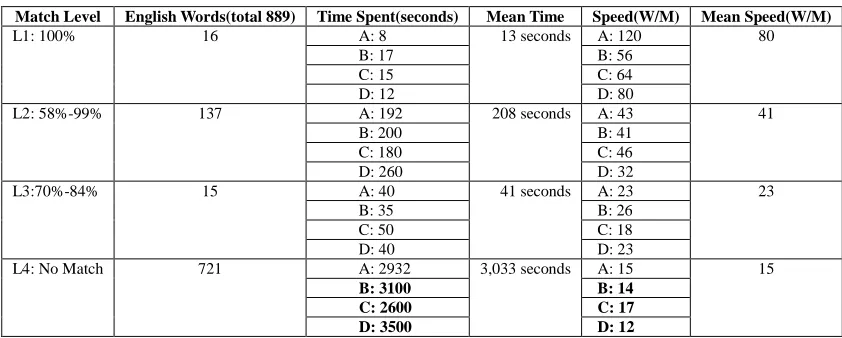
Table 1 demonstrates that Group I noticeably reduced the average translation time by about 30 minutes and improved the average translation speed by 5 words per minute as compared to that of Group II. The overall translation speed in Table 2 shows that Trados improved the speed in translating technical documents through the fuzzy match function. The higher the percentage of the fuzzy match, the faster the translation speed is. The translation speed of the three fuzzy match levels (100%, 85%-99% and 70%-84%) is much faster than that of the no match translations.
Table 2 Match Level and Translation Speed
Match Level English Words(total 889) Time Spent(seconds) Mean Time Speed(W/M) Mean Speed(W/M)
L1: 100% 16 A: 8 13 seconds A: 120 80
B: 17 B: 56
C: 15 C: 64
D: 12 D: 80
L2: 58%-99% 137 A: 192 208 seconds A: 43 41
B: 200 B: 41
C: 180 C: 46
D: 260 D: 32
L3:70%-84% 15 A: 40 41 seconds A: 23 23
B: 35 B: 26
C: 50 C: 18
D: 40 D: 23
L4: No Match 721 A: 2932 3,033 seconds A: 15 15
B: 3100 B: 14
C: 2600 C: 17
D: 3500 D: 12
From Tables 1 and 2, it can be seen that mean speed of no match in Group I is 15, which is about 3 words higher than that of Group II. The reason for the improvernent is that as intentioned before, Trados has integrated MultiTerm, a terminology managernent system, which compares the source text segments against the previously translated segments stored in the TM database. At the sarne time, using active terminology recognition, the terminology management system compares the individual terms contained in each source text segment against the terms contained in the term base. If a term is recognized as being in the term base, the translator's attention is drawn to the fact that an entry exists for this term, and the translator can view the term record and then insert the term from the record directly into the target text. This means that even when no exact or fuzzy matches are found for source-text segments, translators might at least find some translation equivalents for individual terms in the terminology management system's term base, thus their productivity can be improved.
[image:4.595.95.516.412.581.2]said that she set the match value as equal or more than 70% and chose to update TM and replace the translated terms. After the pre-translation, the statistics showed that about 150 words were automatically translated. What the translator D needed to do was to verify the automated translation and translate any text that was left in the source language.
However, Translator D pointed out that the pre-translated text was unreliable. In the pre-translated text, the inflections of "RETAIN" such as "retains" and " retained" can be identified by TWB and translated automatically. However, the inflections of “COPY”, such as “copying” and “copied”, were not translated by the software while “copy” was stored in MultiTerm as a terminology.
Translator D commented that it was time-consuming to check the pre-translated text. It took too much time to check the pre-translated text for a term instead of just looking up the term in a dictionary or online. She found another drawback of pre-translation. Having 3 documents on the screen (i.e., source text, pre-translated text and target text) was too many and involved too much switching back and forth because all of the documents could not be seen on the screen at the same time. The pretranslated text was simply used as a reference rather than their principle resource by some translators.
4.2 Translation Quality with CAT Software
Compared with the translation of literary texts, technical translation puts more emphasis on the consistency of terms and the accuracy. One big issue in technical translation is the consistency of terminology. If a set of texts is translated by a single translator, the consistency of terminology can be guaranteed, though often through painstakingly careful checking and proof reading. But for translating big projects, team work is unavoidable. How to keep the translations of the term consistent is a serious problem.
Consulting conventional resources, translators in Group II encountered numerous difficulties in understanding some of the concepts in the source text, identifying the correct TL terminology, and establishing appropriate TL usage patterns. For example, there are a various equivalences for "pocket guide".
Table 3 Examples of Translation of Terms
Source Language-English Target Language-Chinese
Handy Pocket Reference Guide shǒu chí xiù zhēn cān kǎo zhǐ nán
Pocket Reference Guide xiù zhēn cān kǎo zhǐ nán
OAG Pocket Flight Guide-Asia Pacific OAG xiù zhēn háng bān zhǐ nán
Pocket Guide to China xiù zhēn zhōng guó shǒu cè
Nurse Anesthesia Pocket Guide má zuì yī shī zhǐ dǎo shǒu cè
Pocket guide to diagnostic tests shí yòng lín chuáng jiǎn yàn zhí shǒu cè
Webster's Pocket Guide to Punctuation wéi shì biāo diǎn fú hào yòng fǎ zhǐ dǎo
As shown above, the online dictionary of Baidu provided several bilingual phrases for "pocket guide". However, translator E pointed out that it was time-consuming to read the parallel texts and she had to decide which one to choose. Translators in Group II were confronted with the similar problem. For example, (1) before using the camera, take a few test shots and check that the images are being properly recorded onto the memory card. Translators in Group II rendered "memory card" as “cún chǔ kǎ”, or “jì yì kǎ”, or “nèi cún kǎ”. (2) Camera body (with eyecup, body cap and Lithium backup battery for the date and time). One translator in Group II thought that the equivalence for "eyecup" was. "xǐ yǎn bēi "。In contrast, translators in Group I who activated the MultiTerm were able to overcome many problems faced by Group I and their translations of ‘pocket guide", "memory card" and "eyecup" were consistent.
Participants in Group I emphasized that terminologies collected in MultiTerm were much more valuable and useful than the general vocabulary or dictionaries in translating texts within the domain of science and technology. Another advantage of Multitem is that by setting the Multiterm, translators can also know the clients' preference. For example, “Mouse” is de fined as “shǔ biāo” in the mainland of China, but as “huá shǔ” in Taiwan. The suggestion provided by MultiTerm can remind translators of the clients' preferences in dilferent regions.
modern TM systems like Trados not only help a single translator to maintain the terminology consistency more easily by working on a network environment, but can also help translation organizations to keep the translation of terms consistent among a number of translators separated by a great distance. Since the y are able to access to the same shared translation memory.
However, it should be remembered that technologies in TM need to be updated timely. For instance, TMs may even hinder consistency in some cases. In addition, terminology in some fields evolves quickly. Therefore, even if a text contained appropriate terminology when it was initially stored in a TM, this terminology may have changed by the time a translator consults the TM for help with a new translation. The translator therefore risks incorporating outdated terminology into a new TT.
On the whole, the application of CA T software in E-C technical translation can reduce the possibility of mistranslation and maintain the consistency of terms and style. In this study the application of CAT software does not influence the comprehension of the whole text. Some novice translators may over rely on the suggestions presented by the TM due to the lack of experience. It should be emphasized that careful post-editing is still required in using the CA T tool to ensure that the idiomatic and adequate translation.
4.3 Information Representation and Language Encoding
[image:6.595.64.545.330.462.2]4 examples were selected in this part to discuss about the effects of Trados on the translation quality from the perspectives of information representation and language encoding.
Table 4 Comparison of Examples of Translation Correctness
TM Pair Do not fire the flash at someone driving a car.
qǐng wù shǐ yòng shǎn guāng dēng pāi shè zhèng zài jià shǐ qì chē de sī jī.
New ST Do not fire the flash at someone driving a car, it may cause an accident.
Translation of Group I qǐng wù shǐ yòng shǎn guāng dēng pāi shè zhèng zài jià shǐ qì chē de sī jī. tā kě néng zào chéng yì wài sh
ì gù.
qǐng wù shǐ yòng shǎn guāng dēng pāi shè zhèng zài jià shǐ qì chē de sī jī , fǒu zé kě néng huì zào chéng
yì wài.
Translation of Group II
qǐng wù shǐ yòng shǎn guāng dēng pāi shè zhèng zài jià shǐ qì chē de sī jī ,kě néng huì yǐn fā yì wài shì
gù.
jià chē shí , qǐng wù shǐ yòng shǎn guāng dēng pāi shè 。zhè kě néng zào chéng yì wài shì gù.
bú yào shǐ yòng shǎn guāng dēng pāi shè háng chē de sī jī ,yīn wéi kě néng huì chū shì gù.
qǐng wù shǐ yòng shǎn guāng dēng pāi shè háng chē de sī jī ,kě néng huì zào chéng yì wài shì gù.
Illustrated by example 1, the phrase “driving a car” post modifies someone and it means that the driver who is driving a car. As a result, “jià chē shí ,qǐng wù shǐ yòng shǎn guāng dēng pāi shè”in Group II is a mistranslation. Influenced by the fuzzy match the translation of the first English sentence is the sane with what was stored in the TM. Therefore, the fuzzy match function in the CAT software reduces the possibility of mistranslation to some extent.
Translator E, G and H packed all the English information in one Chinese sentence and Translator F used “zhè” to refer to the information presented in the first sentence. Influenced by the suggestion of the TM, three translators accepted the repetition of “Do not fire the flash at someone driving a car”(“qǐng wù shǐ yòng shǎn guāng dēng pāi shè zhèng zài jià shǐ qì chē de sī jī”) and then they translated the next sentence “It may cause an accident” (“tā kě néng zào chéng yì wài shì gù”). Some people worried that sentence-by-sentence approach imposed by TMs may
not be conductive for an effective translation of the text's message as a whole. However, from the above analysis, when target users read the second sentence in a text, they can refer back to information already presented in the first sentence, which means that it is possible to use pronouns and other references. In fact, translators can also join or split sentences/units within most TM systems. For instance, one translator in Group I combined two sentences together and rendered them into “qǐng wù shǐ yòng shǎn guāng dēng pāi shè zhèng zài jià shǐ qì chē de sī j
ī ,fǒu zé kě néng huì zào chéng yì wài”.
Furthermore, the purpose of the translation determines the translation methods and strategies that are to be employed. Therefore, in skopos theory, knowing why an ST is to be translated and what the function of the TT will be are crucial for the translator. For example, “Do not fire the f1ash at someone driving a car" is an imperative sentence. When this sentence occurs again in the new ST, the suggestion is“qǐng wù……” Translators in Group II accepted this suggestion, because “qǐng” indicates politeness.
of the text it is, let alone what the actual purpose is. For example, if the text sent to the translator is pretranslated or tagged using a translation memory(TM) tool and the visual clues indicating text type may be missing making the linguistic clues more difficult to spot.
This study revealed that translators were unduly influenced by the suggestions presented by the TM. Participants in Group 1 were novices. Lack of experience may be a factor that causes their overdependence on the suggestions provided by Trados. A novice may not have the confidence to question the suitability of a proposal, particularly if the use of TM has been required by the researcher or clients. Other factors such as time pressure in the testing experiment can also lead translators to incorporate inappropriate TM suggestions into the TT.
Table 5 Comparison of Examples of Information Presentation
TM Pair The image cannot be recorded on the card or be read by a personal computer. tú xiàng bú néng jì lù dào cún chǔ kǎ shàng huò wú fǎ bèi diàn nǎo dú qǔ.
New ST The Image cannot be read by a notebook.
Translation of Group I tú xiàng bú néng jì lù dào cún chǔ kǎ shàng huò wú fǎ bèi diàn nǎo dú qǔ.
Translator B translated notebook" as " diàn nǎo " rather than " bǐ jì běn diàn nǎo " She responded that she did, indeed, notice the differences between the new ST and TM segments and she revised some segments. Nevertheless, she left some segments unchanged. For example, in the TM, “computer” was translated as “diàn nǎo”,when the “notebook” occurs in the new source text, Translator B just copied“diàn nǎo”, suggested by the software in the new target text rather than translating it as “bǐ jì běn diàn nǎo”. She thought that “diàn nǎo” could also express what was being said, since “notebook” is also a type of computer. To some extent, the translator’s perception is justifiable. However, the purpose of technical translation is, therefore, to present new technical information to a new audience. A text should give readers just enough information for their purposes; no more, no less. Too much information, like too little information can lead to confusion, stress and unnecessary effort on the part of readers.
Additionally, just as previously mentioned, the TM is part of the CA T software and not used for machine translation. The CA T software cannot replace human translators to do the translation. The performance of the TM system depends on the scope and quality of the existing translation. The performance of the TM system depends on the scope and quality of the existing database. It is expected to be improved as the database grows. If “COMPUTER”as the equivalence for the “notebook” is stored in TM, other users in the future have to spend time correcting the translation, and they risk losing any time that they may have saved by working with the TWB. Therefore, a prerequisite for obtaining a high-quality result from a TM is that the translations stored by human translators must be correct in the first place. Furthermore, it is important to note that even though translations may be accurate when they are initially stored in a TM, they may become inaccurate over tirne. As a resu1t, quality control must be treated as an on-going progress, and it is advisable for translators to verify the correctness and appropriateness before reusing the previous translations.
On the whole, the application of CAT software in E-C technical translation can reduce the possibility of mistranslation and maintain the consistency of terms and style. In this study the application of CAT software does not influence the comprehension of the whole text. Some novice translators may over rely on the suggestions presented by the TM due to the lack of experience. It should be emphasized that careful post-editing is still required in using the CA T tool to ensure that the idiomatic and adequate translation.
CONCLUSION
According to the studies above, it is proved that the applications of CAT software can maintain the consistency of terms, style and format of the whole translation project, which is very important aspects of technical translation. 21st century is an era of internationalization and informationalization, college students of language majors have to learn the newly updated translation technology for meeting the challenge of the present epoch. Therefore, it’s necessary to incorporate the CAT software into translation training curriculum in universities.
Acknowledgments
REFERENCES
[1]Bowker, L. Translation Memory and “Text”. In L. Bowker (Ed.), Lexicography, Terminology, and Translation:
Texted-based Studies in Honor of Ingrid Meyer. Ottawa: University of Ottawa Press, pp175-187, October, 2006.
[2]Bowker, L. Computer-assisted translation technology: A practical introduction. Ottawa: University of Ottawa Press, pp.111-112, May, 2002.
[3]Cabré, T. M. Application-driven terminology engineering. Amsterdam and Philadelphia: John Benjamin’s publishing Company, pp.1-2, September, 2007.
[4]House, J. Translation Quality Assessment: A Model Revisited. Tubingen: Gunter Narr Verlag, August, 1997. [5]Kingscott, G. Technical Translation and Related Disciplines. Perspectives: Studies in Translatology. 10 (4), pp.247-255, July, 2002.
[6]Lv, L. S. & Mu, L. CAT technology and translation teaching. Foreign Language World, 3, pp.35-43, 2007. [7]Reiss, K. Translation Criticism-The Potentials and Limitations: Categories and Criteria for Translation Quality
Assessment. Manchester and New York: St. Jerome Publishing and American Bible Society, 2000.
[8]Sager, J. C. A Practical course in Terminology Processing. Amsterdam and Philadelphia: John Benjamin’s publishing Company, June, 1990.
[9]Somers, H. Translation memory systems. In H. Somers. (Ed.), Computers and Translation, a translator’s guide. Amsterdam/Philadelphia: John Benjamin’s publishing Company, pp. 31-47, April, 2003.
[10] Tirkkonen-Condit, S. Professional vs. Non-Professional Translation: A Think-Aloud Protocol Study. In M.A.K. Halliday, J. Gibbons&H. Nicholas (Eds.), Learning, Keeping and Using Language,pp. Amsterdam: John Benjamin’s, pp.381-394, May, 1990
[11] Webb, L. Advantages and Disadvantages of Translation Memory: a Cost / Benefit Analysis. (Unpublished MA thesis). Monterey Institute of Interactional Studies, California, pp.37-38, November, 1998.