ISSN: 1992-8645 www.jatit.org E-ISSN: 1817-3195
72
VERIFICATION ON THE TRUSTWORTHINESS OF
INFORMATION: A STUDY
1
MOHAMAD NAZRI KHAIRUDDIN YAP, 2MASSILA KAMALRUDIN, 2AHMAD ZAKI A
BAKAR, 2SAFIAH SIDEK 1
Universiti Teknikal Malaysia Melaka, Hang Tuah Jaya, 76100 Durian Tunggal, Melaka, Malaysia.
2
Innovative Software System and Services Group, Universiti Teknikal Malaysia Melaka, Hang Tuah Jaya, 76100 Durian Tunggal, Melaka, Malaysia.
E-mail: [email protected], [email protected], [email protected],
2
ABSTRACT
The pervasive use of social media has generated massive information sharing among its users. Given the fluidity and excessive information available online, issues relating to the trustworthiness of information have become a concern among the users and authorities. Sensational and unreliable information shared in the social media may cause and harm the reputation of an individual, product, organisation or government. Therefore, there is a need to develop a mechanism that helps users to verify the trustworthiness of information that feed in the social media so that they can decide whether to trust or to ignore the information. This paper reports a review on the analysis of the existing work related to trustworthiness of information. The analysis were based on three questions that address the definition of trustworthiness of information, factors influencing trustworthiness of information and existing tools to verify trustworthiness of information. Based on thirty nine selected articles reviewed, it was found that the verification on the trustworthiness of information approach is required. It is anticipated that the adoption of this approach will help to educate and make the public users aware of the level of trustworthiness of information, hence developing an informed, safe and ethical users of media content.
Keywords: Information Trustworthiness, Factors, Social Media, Tools, Approaches
1. INTRODUCTION
Information trustworthiness is very
important as the amount of information freely available in modern day society is phenomenal. Due to the openness of the Web and proliferation of modern communication systems, the difficulty in determining who and what to trust online is more significant than ever before. Information can also be obtained freely via the internet where everyone can publish anything in blogs, Facebook, Twitter or WhatsApp. Not only is there a concern regarding assessing and building trust in Web sites, content sources and other users of cyberspace, but also about the intelligence, information and data itself that is stored and obtained online through social media.
Information poisoning can be avoided.
Information poisoning means the information that could bring negative impact. A small quantity and chosen information will provide the ability of better decision making, while too much of it will fare a better chance.
The necessity in trusting the information is vital in order to have reliable information. As professionals and casual users attempt to pick from this glut of informational content to make decisions, a crucial question that they face is what information to trust, and which sources of information should they trust or rely on. There are very limited studies on verifying information trustworthiness in social media. As readers are confronted with an ever-growing and ever more
overwhelming set of content offerings,
accessible through an ever-multiplying set of channels and services, one hears a great deal of concern about the ability to identify trustworthy information. Therefore, it is subject to factors which information could be taken seriously or
the information is just merely chained
information shared by individual.
ISSN: 1992-8645 www.jatit.org E-ISSN: 1817-3195
73 also important as different articles will present different meaning. From there, this review deliberates the concept of automation approach in verifying trustworthy information from online sources.
2. RESEARCH METHOD
The study was conducted by using search engine like Scopus, IEEEXplore, ACM Digital Library, Science Direct, Google Scholar, Springer, Wiley InterScience and Citeseer Library database. The search string used were (information OR trust OR trustworthiness OR “information trustworthiness”) AND (“trust metric” OR “trustworthiness metric” OR “information trustworthiness technique” OR “information trustworthiness metric”) AND (“factors influencing trust” OR “characteristic of information trustworthiness”) to ensure all related the papers are included. As the initial search based on the keyword “automated
approach in verifying trustworthiness of
information” has resulted 569,000 results from Google and 19,800 results from Google Scholar. By examining the title and abstract of the primary identified studies, we had excluded most of the papers due to irrelevant topic found in the studies. 39 articles were selected as they are relevant studies. Furthermore, we accessed and evaluated the articles by checking the content of the articles. Irrelevant studies will be rejected at this stage and the relevant studies will be examined further. Out of 39 articles, there are only 12 articles considered for further review.
3. RESULTS AND DISCUSSIONS
In this review, we outlined the research questions (RQs) as follow and explain further in the sub section I, II and III:
RQ1 What is the definition of information
trustworthiness?
RQ2 What are the factors influencing
information trustworthiness?
RQ3 What are the existing works in verifying
information trustworthiness?
This section presents the results of the analysis to address the three research questions mentioned above. It is organized in three sections consistent with the sequence of the research questions.
3.1 Information Trustworthiness
As from the review, professionals and causal users attempt to pick from this glut of informational content to make decisions, a crucial question that they face is what information to trust, and which sources of information should they trust or rely on [2]. Relying on available information in crisis is crucial in order to be able to make immediate decision. Such information need to be reliable and trusted. According to Jason et al., this trust problem is exacerbated when accessing Web 2.0 content (e.g., tweets, blogs, posts and wikis), considering that anyone online can be an author, since the customary gatekeepers to publishing, who historically have had some governance over quality, no longer exist in that sphere [1]. Clearly, consumers of content develop their own strategies for avoiding information overload and high risk information, usually using some heuristic (consciously or not) for scoping down the sources that they trust [2].
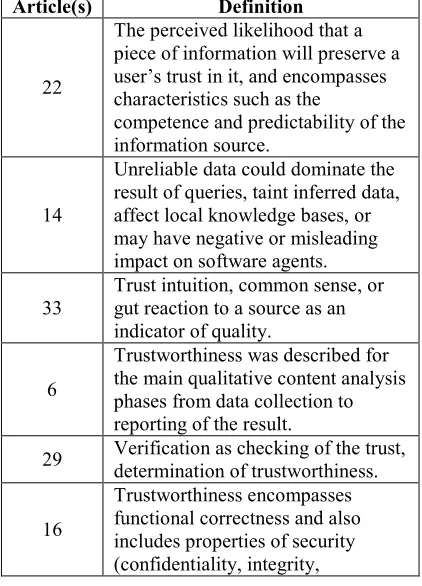
Table 1 shows the definition of
[image:2.612.318.529.442.735.2]trustworthiness from selected articles. Most of the articles are from the aspect of computer science.
Table 1: Definitions of Trustworthiness
Article(s) Definition
22
The perceived likelihood that a piece of information will preserve a user’s trust in it, and encompasses characteristics such as the
competence and predictability of the information source.
14
Unreliable data could dominate the result of queries, taint inferred data, affect local knowledge bases, or may have negative or misleading impact on software agents.
33
Trust intuition, common sense, or gut reaction to a source as an indicator of quality.
6
Trustworthiness was described for the main qualitative content analysis phases from data collection to reporting of the result.
29 Verification as checking of the trust,
determination of trustworthiness.
16
ISSN: 1992-8645 www.jatit.org E-ISSN: 1817-3195
74 availability) and safety (it also
relates to reliability and maintainability)
17
Trust should indeed be regarded as a significant factor in contemporary and should not be taken lightly in view of the fact that trust is by and large coupled with multitude of advantages not only to organizations but also individuals.
26
Worthy of being trusted to fulfil the critical requirements needed for a particular software component, system or system of system.
Based on the definition found as shown in Table 1, there are plenty of research dedicated to the definition and conceptualization of
information trustworthiness. Jason et al.
mentioned that, one way to consider information quality is as an enabler of information trustworthiness. Therefore, if information quality is low, a user is often likely to have less confidence that a piece of information will preserve their trust. In addition to examine characteristics of the information source, the attributes of the information itself are useful for
provenance, quality and trustworthiness
deliberations [21]. Klaus-Peter et al. indicated that there are several viewpoints of trust from the
context of sociologists, psychologists,
economists and computer scientists. He added that computer scientists mainly refer on the context of trustworthiness of information or specific services.
As a result, we concluded that
information trustworthiness requires the
reliability of the information, the integrity, importance to verify the information trust based to factors such as the period of time the information, the reliability of the source, the proximity of the information has occurred and even the popularity of the information.
3.2 Factors Influencing Information Trustworthiness
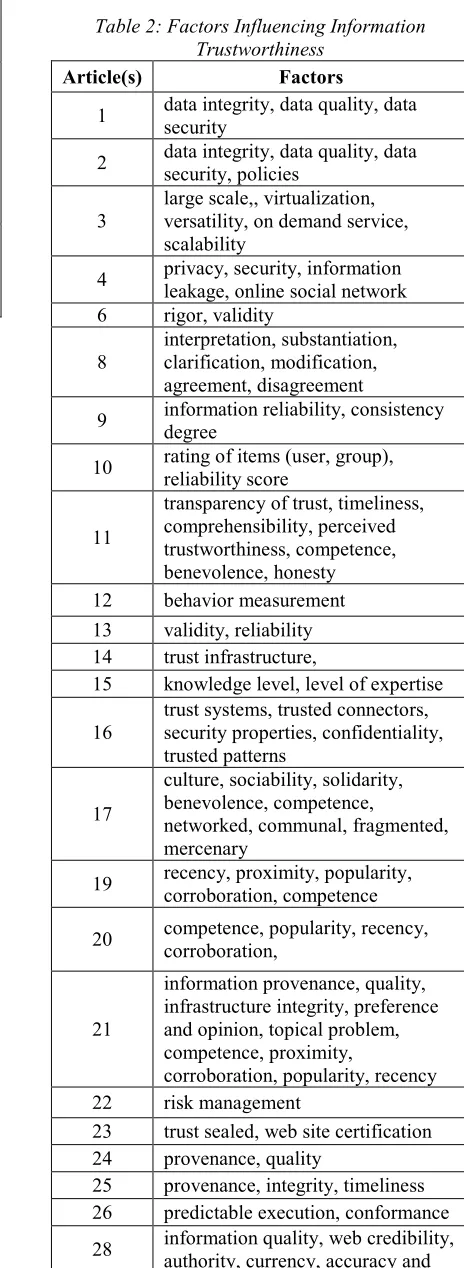
[image:3.612.293.525.98.732.2]Next, we investigated the factors that influence the trustworthiness of information. This is to answer our second RQ: “What are the factors influencing information trustworthiness?” To do this, we have analysed the factors of trustworthiness considered by the authors in Table 2.
Table 2: Factors Influencing Information Trustworthiness
Article(s) Factors
1 data integrity, data quality, data
security
2 data integrity, data quality, data
security, policies
3
large scale,, virtualization, versatility, on demand service, scalability
4 privacy, security, information
leakage, online social network
6 rigor, validity
8
interpretation, substantiation, clarification, modification, agreement, disagreement
9 information reliability, consistency
degree
10 rating of items (user, group),
reliability score
11
transparency of trust, timeliness, comprehensibility, perceived trustworthiness, competence, benevolence, honesty
12 behavior measurement
13 validity, reliability
14 trust infrastructure,
15 knowledge level, level of expertise
16
trust systems, trusted connectors, security properties, confidentiality, trusted patterns
17
culture, sociability, solidarity, benevolence, competence,
networked, communal, fragmented, mercenary
19 recency, proximity, popularity,
corroboration, competence
20 competence, popularity, recency,
corroboration,
21
information provenance, quality, infrastructure integrity, preference and opinion, topical problem, competence, proximity,
corroboration, popularity, recency
22 risk management
23 trust sealed, web site certification
24 provenance, quality
25 provenance, integrity, timeliness
26 predictable execution, conformance
28 information quality, web credibility,
ISSN: 1992-8645 www.jatit.org E-ISSN: 1817-3195
75 relevance
29 competent
30
high quality, authority, related resources, popularity, provenance, age, quality dimension (accuracy, timeliness, relevancy, objectivity, believability)
34 accuracy of impression, impression
formation, truth bias
35
[image:4.612.92.523.261.668.2]platforms, virtualization, multi-tenant, on demand pay, integrity, confidentiality
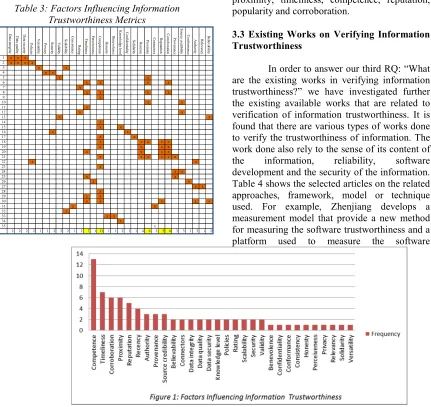
Table 3: Factors Influencing Information Trustworthiness Metrics
Table 2, 3 and Figure 1 above, show the factors of trustworthiness considered in related research conducted. It is found that many factors that there are many factors influence the information trustworthiness. These factors are
summarised in Figure 1. It shows that the factors with the highest frequencies are competence,
timeliness, corroboration, proximity and
reputation. Recency can be grouped together with timeliness as the indication is related to
time. Furthermore, authority and source
credibility as well as knowledge level can be grouped together with competence as it shows the credibility and reliability of the source of information. Based on the analysis, we found that there are some factors with the similar meaning, and being applied in different context. Based on the analysis of matrix in Table 3, it is found that the most influential factors are the proximity, timeliness, competence, reputation, popularity and corroboration.
3.3 Existing Works on Verifying Information Trustworthiness
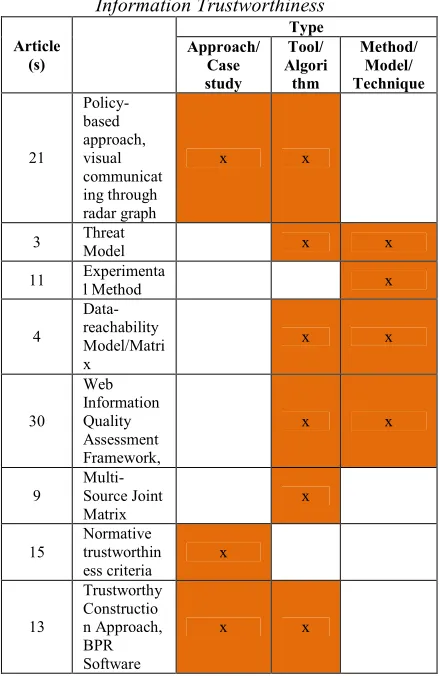
In order to answer our third RQ: “What are the existing works in verifying information trustworthiness?” we have investigated further the existing available works that are related to verification of information trustworthiness. It is found that there are various types of works done to verify the trustworthiness of information. The work done also rely to the sense of its content of
the information, reliability, software
development and the security of the information. Table 4 shows the selected articles on the related approaches, framework, model or technique used. For example, Zhenjiang develops a measurement model that provide a new method for measuring the software trustworthiness and a
platform used to measure the software
trustworthiness of the information system [7]. Zhenjiang establishes a new set of software trustworthiness indices and divides the definition of software trustworthiness into five levels indices. A new algorithm is introduced for measuring the software trustworthiness: fuzzy
D at a in te g rity D at a q u al ity D at a s ec u rity P o lic ie s V er sa til ity P riv ac y S ec u rity V al id ity S ca la b ili ty C o n si st en cy R at in g T im el in es s P er ce iv en es s C o m p ete n ce H o n es ty B en ev o le n ce K n o w led g e l ev el C o n fid en tia lity S o lid ar ity R ec en cy P ro x im ity C o n n ec to rs R ep u ta tio n C o rr o b o ra tio n P ro v en an ce S o u rc e cr ed ib ili ty C o n fo rm an ce A u th o rity R el ev an cy B eli ev ab ili ty
1 x x x 2 x x x x
3 x x
4 x x
5 x x
6 x x x x
7 x
8 x x x x
9 x
10 x x
11 x
12 x x
13 x x
14 x
15 x x
16 x x
17 x x
18 x x x x x
19 x x x x
20 x x x x
21 x x x x x x
22 x x
23 x
24 x x
25 x x
26 x x
27 x x
28 x
29 x x
30 x x x x x
31 x x
32 x
33 x x
34 x
35 x
ISSN: 1992-8645 www.jatit.org E-ISSN: 1817-3195
76 comprehensive evaluation based on stepwise regression and the analytic process. However, this work is only focused on measuring
trustworthiness on intelligent subway
information system. On the other hand, Yen-Hung Hu et. al discuss the challenges in building a trustworthy network and develop a trustworthy network model that is both scalable and interoperable with existing and future network
architecture [8]. They introduce
countermeasures, trustworthy characteristics and major network component into the trustworthy network model and describe their function in their work. Yet, this experiment is considered immature as no assessment is done on the trustworthy network model. Likewise, Xiaoli Liu
investigate on trustworthiness on cloud
[image:5.612.84.304.396.734.2]computing by presenting an approach to address the difficulties in the trust software development of cloud computing [7]. This work is believed to be beneficial since it provides a lightweight framework to explore on the other aspect, Cloud Service Engineering. However, the limitation of this work at the time is lack of concrete methods.
Table 4: Approaches/Techniques/Methods on Information Trustworthiness
Article (s)
Type Approach/
Case study
Tool/ Algori thm
Method/ Model/ Technique
21
Policy-based approach, visual communicat ing through radar graph
x x
3 Threat
Model x x
11 Experimental Method x
4
Data-reachability Model/Matri x
x x
30
Web Information Quality Assessment Framework,
x x
9
Multi-Source Joint Matrix
x
15
Normative trustworthin ess criteria
x
13
Trustworthy Constructio n Approach, BPR Software
x x
System Based, Semantic Model Verification, Petri Net
Therefore, there is the need to verify the trustworthiness of the information. It has become the digital lifestyle relying to such information from the internet. Existing studies [2][3] indicate that perceived trust in the reliability of technical elements and structures, as well as the fairness of other internet user, are the major determinants of sustainable internet usage among individuals. Working with intelligent systems means dealing with information. Furthermore, information presentation and information quality are two elementary functions that make it easier for the consumer to deal with the system where it might otherwise even be impossible.
Nevertheless, an appropriate technology stack is necessary to guarantee a high information quality level. This technology must fulfil two requirements to prevent information overload and hence reactance: distinguishing important and unimportant information from each other and making system performance transparent to its users [5][6]. In such circumstances, decision support which seeks to
convey the potential trustworthiness of
information will be a crucial factor in avoiding potential negative consequences should be wrong (i.e. high-risk) information be relied upon. Existing approaches to deal with this problem rely on trusted third parties who investigate the trustworthiness of Internet sources and create a trusted network of content publishers for customers to access. This has a significant limitation in that you are restricted to preselected sources and so it would not scale appropriately to the scenarios we are considering [2].
ISSN: 1992-8645 www.jatit.org E-ISSN: 1817-3195
[image:6.612.95.534.45.784.2]77
Table 5: Approaches and Tools From Various Authors
Article(s) Approaches/ Case Study
Tools/ Algorithm
Method/ Model/ Technique
1 x
2 x
3 x
4 x
5 x
6 x
7
8 x
9 x
10 x
11 x
12 x
13 x
14 x x
15 x
16 x x
17 x
18 x
19 x
20 x
21 x x
22 x
23 x
24 x x
25 x x
26 x
27 x
28 x
29 x
30 x
31 x
32 x x
33 x
34 x
35 x
36 x
37 x
38 x
39 x
16 9 19
Figure 2: Approaches, Tools, and Methods from Various Authors
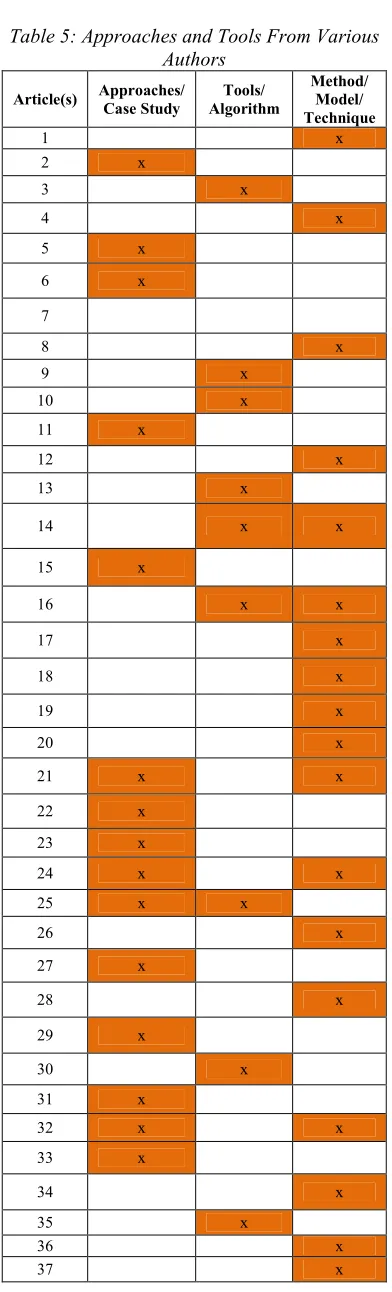
Table 5 shows the various approaches and tools developed for verifying the information trustworthiness. Most tools developed can be summarised for the purpose of verifying network security and software development in form of information trustworthiness. Figure 2 shows the percentage of the approaches from the existing works. Most works focuses on methods, modelling and techniques and case study where not focusing on social media of information trustworthiness. Very few authors focus on the
information trustworthiness on online
information. Therefore, there is the need to look into more detail on verifying information trustworthiness on online information.
4. CONCLUSIONS & FUTURE WORK
This paper discussed the verification on trustworthiness of information from the social media. Based on our findings, it is important to understand the definition of the information trustworthiness, to explore the factors which contribute influencing the trustworthiness and then the approaches of the existing works that being done. From the findings, we conclude that in order to verify the trustworthy of information especially from the social media, we need to obtain the main factors that need to be considered and we outlined the five main factors that give an impact on the information trustworthiness. These factors are proximity,
reputation, competence, corroboration and
[image:6.612.92.288.93.739.2]ISSN: 1992-8645 www.jatit.org E-ISSN: 1817-3195
78
trustfulness of software as well as on the networking security of the information. Less work were found on verifying information trustworthiness especially information from the social media. Therefore, our research aims to develop an automated approach to verify the
degree of perceived trustworthiness of
information in media social. Figure 3 shows our proposed approach drawn from the findings of this analysis. To do this, the factors influencing the degree of perceived trustworthiness will be analysed and a rule to verify the trustworthiness will be constructed. Then, an automated tool embedded with a crawler capability will be developed to realise the approach. The tool will then be evaluated using both qualitative and quantitative approaches for its usability with the users of social media. It is anticipated that the adoption of this approach will help to educate and make the public users aware of the level of trustworthiness of the information, hence developing an informed, safe and ethical users of media content.
For future work, a survey will be conducted with the users of social media to investigate the pattern of usage and the level of trustworthiness as well as the contributing factors on the perceived trustworthiness. Here, the quantitative research approach will be used to analyse the data and to find the most significant factors that
contribute to the degree of perceived
trustworthiness. In the design phase, the researchers will review the findings in the earlier phase and design a new approach to verify the
degree of perceived trustworthiness of
information in social media. Then, rules on the trustworthiness will be constructed based on the identified significant factors in the earlier phase.
Figure 3: The Overview of the Proposed Trustworthiness Verification Framework
ACKNOWLEDGEMENTS
This research is jointly supported by Innovative Software System and Services Group, Universiti
Teknikal Malaysia Melaka (UTeM) and
Universiti Malaysia Sarawak (UNIMAS),
Malaysia.
REFERENCES
[1] Bertino, E., & Lim, H. S. (2010).
“Assuring data trustworthiness-concepts and research challenges”. In Secure Data Management (pp. 1-12). Springer Berlin Heidelberg.
[2] Bertino, E. (2015). “Data
Trustworthiness—Approaches and
Research Challenges”. In Data Privacy
Management, Autonomous Spontaneous Security, and Security Assurance (pp. 17-25). Springer International Publishing.
[3] Chuanyi, L. I. U., Jie, L. I. N., & Binxing,
F. A. N. G. (2013). “T-YUN:
Trustworthiness Verification and Audit on
the Cloud Providers”. IEICE
TRANSACTIONS on Information and Systems, 96(11), 2344-2353.
[4] Creese, S., Goldsmith, M., Nurse, J. R., &
Phillips, E. (2012, June). “A data-reachability model for elucidating privacy and security risks related to the use of online social networks”. In Trust, Security
and Privacy in Computing and
Communications (TrustCom), 2012 IEEE 11th International Conference on Trust, Security and Privacy in Computing and Communications (pp. 1124-1131). IEEE.
[5] E. Chang, T. Dillon, and F. Hussain,
“Trust and reputation for service-oriented environments: Technologies for building
business intelligence and consumer
confidence”. Chichester: Wiley, 2006.
[6] Elo, S., Kääriäinen, M., Kanste, O.,
Pölkki, T., Utriainen, K., & Kyngäs, H. (2014). “Qualitative content analysis a
focus on trustworthiness”. SAGE
Open,4(1), 2158244014522633.
[7] F. Hayes-Roth, and N. Jacobstein, “The
State of Knowledge-based Systems”, Communications of the ACM, pp. 27-39, 1999
[8] Fisher, B. A. (1970). “Decision
emergence: Phases in group decision‐
making”. Communications
ISSN: 1992-8645 www.jatit.org E-ISSN: 1817-3195
79
[9] Ge, L., Gao, J., Li, X., & Zhang, A.
(2013, August). “Multi-source deep
learning for information trustworthiness estimation”. In Proceedings of the 19th ACM SIGKDD international conference on Knowledge discovery and data mining (pp. 766-774). ACM.
[10] Ge, L., Gao, J., Yu, X., Fan, W., & Zhang, A. (2012, December). “Estimating local information trustworthiness via multi-source joint matrix factorization”. In Data Mining (ICDM), 2012 IEEE 12th International Conference on Data Mining (pp. 876-881). IEEE.
[11] Grimmelikhuijsen, S. G., & Meijer, A. J. (2012). “The effects of transparency on the perceived trustworthiness of a government organization: Evidence from an online experiment”. Journal of Public Administration Research and Theory, mus048.
[12] Gui, X., Wang, D., Fu, L., & Zhao, W. (2012). “A Verification Model for Trustworthiness of Interaction between Objects”. International Journal of Digital
Content Technology & its
Applications, 6(20).
[13] Han, Q., Yang, G., Han, J., & Bao, W.
(2014). “Trustworthy Construction
Approach of BPR Software System Based
on Semantic Model Verification”.
International Journal of Hybrid
Information Technology, 7(4).
[14] Hartig, O. (2008, September).
“Trustworthiness of data on the web”. In Proceedings of the STI Berlin & CSW PhD Workshop.
[15] Houmb, S. H., Ray, I., & Ray, I. (2006). “Estimating the relative trustworthiness of information sources in security solution evaluation”. In Trust Management (pp. 135-149). Springer Berlin Heidelberg. [16] Kuz, I., Zhu, L., Bass, L., Staples, M., &
Xu, X. (2012, August). “An architectural approach for cost effective trustworthy
systems”. In Software Architecture
(WICSA) and European Conference on Software Architecture (ECSA), 2012 Joint Working IEEE/IFIP Conference on (pp. 325-328). IEEE.
[17] Ling, C. T. N. (2011). “Culture and trust
in fostering knowledge-sharing”.
Electronic Journal of Knowledge
Management, 9(4), 328-339.
[18] M. Lee, and E. Turban, “A Trust Model
for Consumer Internet Shopping”.
International Journal of Electronic
Commerce, vol. 6, no. 1, pp. 75-91, 2001. [19] Nurse, J. R., Agrafiotis, I., Creese, S.,
Goldsmith, M., & Lamberts, K. (2013,
July). “Building confidence in
information-trustworthiness metrics for decision support”. In Trust, Security and
Privacy in Computing and
Communications (TrustCom), 2013 12th IEEE International Conference on (pp. 535-543). IEEE.
[20] Nurse, J. R., Agrafiotis, I., Creese, S., Goldsmith, M., & Lamberts, K. (2013, July). “Communicating trustworthiness using radar graphs: A detailed look”. In Privacy, Security and Trust (PST), 2013 Eleventh Annual International Conference on (pp. 333-339). IEEE.
[21] Nurse, J. R., Agrafiotis, I., Goldsmith, M., Creese, S., & Lamberts, K. (2014). “Two sides of the coin: measuring and communicating the trustworthiness of online information”. Journal of Trust Management, 1(1), 1-20.
[22] Nurse, J. R., Creese, S., Goldsmith, M., &
Lamberts, K. (2011, September).
“Trustworthy and effective
communication of cybersecurity risks: A review”. In Socio-Technical Aspects in Security and Trust (STAST), 2011 1st Workshop on (pp. 60-68). IEEE.
[23] Nurse, J. R., Creese, S., Goldsmith, M., & Lamberts, K. (2012, June). “Using Information Trustworthiness Advice in Decision Making”. In Socio-Technical Aspects in Security and Trust (STAST), 2012 Workshop on (pp. 35-42). IEEE. [24] Nurse, J. R., Creese, S., Goldsmith, M., &
Rahman, S. S. (2013). “Supporting human
decision-making online using
information-trustworthiness metrics”. In Human Aspects of Information Security,
Privacy, and Trust (pp. 316-325).
Springer Berlin Heidelberg.
[25] Nurse, J. R., Rahman, S. S., Creese, S., Goldsmith, M., & Lamberts, K. (2011). “Information quality and trustworthiness: A topical state-of-the-art review”. In The International Conference on Computer
Applications and Network Security
ISSN: 1992-8645 www.jatit.org E-ISSN: 1817-3195
80 [26] O’Neill, D. (2014). “Software Assurance,
Trustworthiness, and Rigor”. CrossTalk, 25.
[27] P. Maes, “Agents that reduce work and information overload”. Communications of the ACM, vol. 37, no. 7, pp. 30-40, 1994.
[28] Pattanaphanchai, J., O'Hara, K., & Hall, W. (2013, May). “Trustworthiness criteria for supporting users to assess the credibility of web information”. In Proceedings of the 22nd international
conference on World Wide Web
companion (pp. 1123-1130). International World Wide Web Conferences Steering Committee.
[29] Popov, S. “Expert Verification Of The Research Results: Public Administration Aspect”. Editorial Board, 34.
[30] Ramachandran, S., Paulraj, S., Joseph, S., & Ramaraj, V. (2009). “Enhanced trustworthy and high-quality information
retrieval system for web search
engines”. arXiv preprint arXiv:0911.0914. [31] S. Gregor, and I. Benbasat, “Explanations from Intelligent Systems: Theoretical
Foundations and Implications for
Practice”. MIS Quarterly, vol. 23, no. 4, pp. 497-530, 1999.
[32] Shenton, A. K. (2004). “Strategies for ensuring trustworthiness in qualitative
research projects”. Education for
information, 22(2), 63-75.
[33] Stavri, P. Z., Freeman, D. J., & Burroughs, C. M. (2003). “Perception of quality and trustworthiness of internet resources by personal health information seekers”. In AMIA Annual Symposium
Proceedings (Vol. 2003, p. 629).
American Medical Informatics
Association.
[34] Toma, C. L. (2010, February).
“Perceptions of trustworthiness online:
the role of visual and textual
information”. In Proceedings of the 2010 ACM conference on Computer supported cooperative work (pp. 13-22). ACM. [35] Wang, G., & Gao, L. (2014). “An
approach to ensure the trustworthiness of cloud platform using the trusted chain”.
[36] Wiedmann, K. P., Hennigs, N.,
Varelmann, D., & Reeh, M. O. (2010). “Determinants of consumers perceived
trust in IT-ecosystems”. Journal of
theoretical and applied electronic
commerce research, 5(2), 137-154. [37] X. L. Liu, Y. J. Quan, and W. Z. Jiang,
“A Lightweight Framework for Trust Cloud Software Development”, Adv. Eng. Forum, vol. 6–7, pp. 865–870, Sep. 2012. [38] Y.-H. Hu, “Challenges in Building a
Trustworthy Network”, J. Electr.
Electron. Syst., vol. 02, no. 02, pp. 2–5, 2013.
[39] Yang, S., Joy, M., & Nurse, J. R. (2011).
“Experiences on sharing e-learning