
GECAF: A GENERIC AND EXTENSIBLE
FRAMEWORK FOR DEVELOPING
CONTEXT-AWARE SMART ENVIRONMENTS
Angham SABAGH
School of Computing, Science and Engineering
University of Salford, Salford, UK
TABLE OF CONTENTS
LIST OF FIGURES ... v
LIST OF TABLES ... vii
ACKNOWLEDGEMENTS ... viii
ABBREVIATIONS ... ix
ABSTRACT... xii
CHAPTER 1: Introduction... 1
1.1 Ubiquitous Computing...2
1.2 Context-Aware Computing... 3
1.3 Smart Environments... 5
1.4 Research Problem... 9
1.5 Research Aim and Objectives. ... 10
1.6 Research Questions. ... 11
1.7 Research Methodology... 11
1.8 Contribution to Knowledge... 15
1.9 Thesis Layout. ... 15
CHAPTER 2: Context Representation and Applications - Review.. 17
2.1 Introduction to Context and Context Awareness ... 17
2.2 Aspects of Context Representation... 18
2.2.1 Characteristics of Context Information... .18
2.2.2 Context History. ... 21
2.2.3 Context Modelling. ...22
2.3 Aspects of Context-Aware Applications... .30
2.4 Applications in Smart Environments... .32
2.5 Summary... 33
CHAPTER 3: Context-Aware Architectures- Review and Analysis. 34
3.1 Software Architecture Styles. ... .343.1.1 Client-Server Architecture. ...34
3.1.2 Layered Architecture ... 35
3.1.3 Pipe-and-Filter Architecture... 35
3.1.5 Repository Architecture. ...36
3.1.6 Model-View-Controller Architecture. ... 37
3.1.7 Agent Based Architecture. ... 37
3.1.8 Service-Oriented Architecture. ... .38
3.2 Context-Aware Systems. ... 39
3.2.1 Layered Context-Aware Systems. ... 39
3.2.2 Centralised, Server Based Context-A ware Systems. ... 42
3.2.3 Agent Based Context-Aware Systems. ...43
3.2.4 Other Context-Aware Systems. ... 46
3.3 Elements of Context-A ware Architecture - Review. ... 49
3.3.1 Sensory and Context Abstraction. ... 49
3.3.2 Context Modelling...52
3.3.3 Aggregation. ... .53
3.3.4 Context Reasoning. ... .54
3.3.5 Application... 56
3.3.6 Management and Service Discovery. ... .57
3.3.7 Knowledge Base. ... 58
3.4 Analysis of Context-Aware Systems with Respect to Architecture Styles. . . .59
3.5 Analysis of Context-Aware Systems with Respect to Context Representation... 61
3.6 Analysis of Context-A ware Systems with Respect to Context History and Knowledge Base. ...62
3.7 Comparison of Context-Aware Systems. ...63
3.8 Context-Aware Issues... 66
3.9 Summary. ... 67
CHAPTER 4: Research Approach and Concepts...68
4.1 The Conceptual Scheme of The Proposed Framework. ... .68
4.2 Context Representation. ... 70
4.2.1 Context Classification and Definitions. ... 70
4.2.2 Sensor Terminology. ... 72
4.2.3 Context Modelling. ... .73
4.3 The Generic Framework Design. ... 75
4.3.2 Basic Guidelines for Arranging the Architecture Components. ...78
4.3.3 Application Types. ... 79
4.3.4 Context-aware Architecture Deployment Language (CADL). ...80
4.3.5 System Manager and Scheduler. ... 81
4.4 Framework Realisation in Smart Environments - Classroom Scenario... 82
4.9 Summary. ... 83
CHAPTER 5: GECAF Framework - Implementation
... 84
5.1 The Pipe-and-Filter Components. ... 84
5.1.1 Getters ... .85
5.1.2 Formatter. ... 85
5.1.3 Adder. ... 86
5.1.4 Interpreter. ... .88
5.1.5 Manipulator... 88
5.1.6 Outputer. ... .89
5.2 The Interpretation Rule Engine. ... .90
5.3 Deployment of the Framework Filters. ...93
5.3.1 Instantiating the Framework Filters... .93
5.3.2 Using the Creational Pattern for Abstracting the Creation Process... .94
5.3.2.1 Factory Method Design Pattern. ...95
5.4 Event Triggered System Initiation. ... .96
5.5 The Conceptual Process for Using the Pipe-and-Filter Framework. ... 98
5.6 Case Study in a Smart Classroom Scenario...100
5.7 Summary. ... 103
CHAPTER 6: Validation and Critical Evaluation... 104
6.1 Criteria for Evaluating the GECAF Framework. ... 104
6.1.1 Framework Features...106
6.2 Validating the GECAF Framework. ... .107
6.2.1 Validation Using a Quantitative Method. ...107
6.2.2 Validation Using Case Study... .111
6.2.2.1 Case Study for the Context Toolkit... 111
6.2.2.2 Case Study for the SOCAM System. ... 113
CHAPTER 7: Conclusions and Future Work...115
7.1 Conclusions. ... 115
7.2 Framework Limitations. ...116
7.2 Future Work. ...116
PUBLICATIONS ... 118
REFERENCES...119
BIBLIOGRAPHY ... 130
LIST OF FIGURES
Figure 1.1: Architecture of a sensor node. ... 8
Figure 1.2: Two configurations of sensor networks. ... .8
Figure 1.3: Research methodology. ...12
Figure 2.1: Existing work and primitive context... 21
Figure 2.2: Context feature space. ...25
Figure 2.3: 3-D Context Model. ... 25
Figure 2.4: Example to modelling a scenario... .26
Figure 2.5: Class hierarchy diagram for context ontology. ... .27
Figure 2.6: Context ontology and partial serialisation. ...28
Figure 2.7: CALA-ONT model and its properties. ... 29
Figure 2.8: Real World Model. ... 29
Figure 3.1: Layered architecture style. ... 35
Figure 3.2: Pipe-and-Filter architecture style. ... .36
Figure 3.3: Blackboard architecture style. ... .37
Figure 3.4: MVC architecture style. ... 37
Figure 3.5: Layered architecture of TEA system. ... .39
Figure 3.6: Context stack architecture. ... 40
Figure 3.7: Real world modelling architecture. ...40
Figure 3.8: General architecture...41
Figure 3.9: CADBA architecture. ... 41
Figure 3.10: CASS architecture. ... 42
Figure 3.11: SOCAM architecture. ...43
Figure 3.12: CoBrA architecture... 43
Figure 3.13: Multi-agent based architecture...44
Figure 3.14: CALA architecture. ... .45
Figure 3.15: Multi agent service resembling architecture. ... 45
Figure 3.16: A-CoBrA architecture. ... 46
Figure 3.17: Context toolkit architecture. ... 47
Figure 3.18: CMF architecture. ... .47
Figure 3.19: Sentient object model. ... .48
Figure 3.21: WCAM architecture. ... -49
Figure 4.1: GECAF framework components and relationships between them. ... 69
Figure 4.2: Context classification...70
Figure 4.3: Ontology to represent the relations between context categories. ... 71
Figure 4.4: Pipe-and-Filter architecture filters. ...77
Figure 4.5: System Manager and Scheduler ... 82
Figure 5.1: Getter filter of the GECAF framework. ... 85
Figure 5.2: Formatter filter of the GECAF framework. ... 86
Figure 5.3: Adder filter of the GECAF framework. ... 87
Figure 5.4: Interpreter filter of the GECAF framework...88
Figure 5.5: Manipulator filter of the GECAF framework. ... 89
Figure 5.6: Outputer filter of the GECAF framework... 90
Figure 5.7: The XML rule engine using the interpreter design pattern ... .93
Figure 5.8: Factory method design pattern. ...95
Figure 5.9: A simplified UML diagram for the Generic Framework. ...97
Figure 5.10: Component diagram shows general filter types. ...98
Figure 5.11: Filter diagram for the Role context. ... 100
Figure 5.12: Classification to context information in classroom environment. .... 101
Figure 5.13: Filter diagram for lecture type and font size contexts. ... 101
Figure 5.14: Smart classroom web page. ... 102
Figure 5.15: A visualisation of the smart classroom with the designed website. ... 103
Figure 6.1: Architecture components used by the context-aware systems. ... .109
Figure 6.2: Architecture styles of the reviewed context-aware systems. ... 109
Figure 6.3: Filter diagram representing Presence context. ... 112
Figure 6.4: Filter diagram representing Meeting context. ...112
Figure 6.5: In/Out Board and Mailing list implementation using the new framework. ... 113
Figure 6.6: filter diagram representing Locatedln context. ...113
Figure 6.7: Filter diagram architecture representing has Activity...114
Figure A. 1: SOAP message. ... 133
Figure D. 1: Interpreter design pattern... 139
LIST OF TABLES
Table 2.1: Examples of context atoms. ... .23
Table 2.2: A comparison to existing modelling techniques. ...30
Table 3.1: A comparison to the software architecture styles... 38
Table 3.2: Comparison to context-aware systems - context representation...64
Table 3.3: Architecture comparison of context-aware systems. ... 65
Table 4.1: General filter types. ... 77
Table 5.1: The interpreter's rules. ... .90
ACKNOWLEDGMENTS
I would like to thank my supervisor Dr. Adil Al-Yasiri for his contributions of time, ideas, experience and patience in making this PhD thesis possible. His enthusiasm and motivation encouraged me to achieve all the requirements sought for.
I would also like to thank my family, parents, sisters, and brother for their continuous patience and support; especially to my husband for his encouragement and assistance throughout the period of study.
ABBREVIATIONS
4W1H 5W1H A-CoBrA ADC API CADBA CADL CALA
CALA-ONT CAMUS CASS CCA CDL CID CLIPS CMF CoBrA
Who, Where, When, What, and How
Who, Where, When, What, Why, and How Activity-Context Broker Architecture
Analogue to Digital Converter Application Programming Interface
Context-aware Architecture Based on Context Database Context-aware Architecture Deployment Language Context-Aware Learning Architecture
Context-A ware Learning Architecture - Ontology Context-Aware Middleware for URC System Context-Awareness Sub-Structure
Context Collecting Agent Context Description Language Context Identification Code
C Language Integrated Production System Context Management Framework
Context Broker Architecture
COBRA-ONT Set of ontologies provided by CoBrA CONON
CORTEX
CPU DB DOM EID
CONtext ONtology
CO-operating Real-time senTient objects: architecture and Experimental evaluation
Central Processing Unit Database
FIFO GPRS GPS GSM GUI HTML ID US IR ISIS KS LDAP MVC MySQL ORM OS OWL OWL-DL PC
PDA
PERKAM PHP
QoS RAM RDF RF RFID
First In First Out
General Packet Radio Service Global Positioning System
Global System for Mobile communications Graphical User Interface
HyperText Markup Language IDentification
Internet Information Services Infrared
Internal Situation Store Knowledge Source
Light weight Directory Access Protocol Model View Controller
My Structure Query Language Object Role Modelling
Operating System
Web Ontology Language
Web Ontology Language Description Logic Personal Computer
Personal Digital Assistant
PERsonalised Knowledge Awareness Map PHP: Hypertext Preprocessor
Quality of Service
Random Access Memory
Resource Description Framework Radio Frequency
RID ROM RFC RPN RWM SICL SOAP SOCAM SQL
ubi-UCAM UDDI
UML USB WCAM WiFi WSDL XML
Rule Identification Code Read Only Memory Remote Procedure Call Reverse Polish Notation Real World Model
Smart-Its Context Language Simple Object Access Protocol
Service-Oriented Context-Aware Middleware Structured Query Language
Unified Context-A ware Application Model
Universal Description, Discovery and Integration Unified Modelling Language
Universal Serial Bus
Watcher, Controller, Action, and Model Wireless Fidelity
ABSTRACT
Chapter 1
Introduction
1.1 Ubiquitous Computing
Ubiquitous computing is the third era of computing, and also known as pervasive computing where one person benefiting from many computers. It is subsequent to mainframes (single computer for many persons), and personal computers (one computer is dedicated for one person) [4]. This new computing model uses the potential of information and computing technologies to implicitly and naturally aid people in their daily life. It is the age of calm technology, where computing devices resides out in the world with people. Mark Weiser [2, 5] introduced the idea of ubiquitous computing by describing the 21st century computers as; "the most profound technologies are those that disappear. They weave themselves into the fabric of everyday life until they are indistinguishable from it". This vision, perceives that computing devices are vanished into the background, so people are freed to using them without thinking; they give attention to tasks rather than tools (computing devices) that perform the task.
Ubiquitous computing uses a combination of computing devices that have many forms and sizes, where each suits particular task. These computing devices are embedded in almost every object in the environment including cars, clothing, appliances, and various consumer goods; communicating through an interconnected network. They could be either mobile (wearable or portable) or fixed; for example tabs, pads, boards, etc. Ubiquitous computing employs systems that adapt and react with people, predict their behaviour and requirements. As pervasive systems may be geographically large, heterogeneous and distributed sensing is necessary to interact with people and monitor their activities in a scalable mode [6]. Finally, pervasive systems gather information from many sensors to interpret users' situation which is based on their action. Therefore, there should be solutions for access rights to this information to protect it from unauthorised access. The enabling factors for the revolution of ubiquitous computing are the following:
The existence of advanced, smart, high performance and new mobile devices such as Personal Digital Assistant (PDA), smart phones, smart papers, live boards, etc.
Increase in processing speed and storage capacity. The evolution of the internet, and web technology.
Advances in communication technology, with high data transfer rate at lower cost; e.g. fibre optics, wireless and mobile technology (GPRS, Bluetooth, WiFi, etc.).
Standardisation of system components.
Advances in the field of information security.
Ubiquitous computing offers much convenience to our lives, by freeing people from direct interaction with computers. However, ubiquitous computing applications are complicated and are difficult to realise, as there are many aspects that should be considered when building these systems, such as lack of information and others regarding ethical and social issues.
1.2 Context-Aware Computing
The world is based on the surrounding information that our human bodies are able to sense and interpret. People are aware of their environment; they interact with the outside world through their five senses. Through them, they receive information, and then the nervous system conveys the information to the brain to infer what this information could be about and finally responds (do an action). It is in a similar natural way context-aware systems should work. The notion of context and context awareness is introduced by many researchers, and observed in many applications since the end of the past century. Different aspects of context-aware systems have been studied and explored; these include context dimensions, modelling techniques, system architecture, reasoning techniques and their applications. Frameworks, middleware, and infrastructure for context-aware systems are also considered and constructed; although these approaches are still evolving. Security and privacy of context information is another important issue which inspires users' confidence if it is well handled.
adapting system behaviour. The word 'context' is defined as any information that can be used to characterise the situation of an entity. A system is context-aware if it utilises this information to change its behaviour without user intervention [8]. The surrounding information refers to identity (identification of a user in a service environment and could include user profile), time (when context is generated and valid), and location of use (physical and electronic space [9]). Other pieces of surrounding information are activity (users expression and behaviour), and environment (nearby people, weather condition, etc). All these pieces of context information are the primitive contexts which are acquired by software and/or hardware sensors. For more relevance and reliable context information, some systems employ the scheme of sensor fusion (combination of multiple sensors [10]). The acquired information could be either static or dynamic, as these pieces of information change over time, with location, user's situation and other contexts. Since context information is dynamic, historical context would be of great importance; it predicts user's intention, current and future context. Historical context can be used with other information from internal or external sources to enrich the context-aware system and form a new context. Consequently, a large repository is required to store historical data. Recently advances in Cloud computing storage, Google health and HealthVault will solve the growing problems of data and shared storage.
The above discussion reveals the main elements of a context-aware system; these are sensing, modelling, interpretation, aggregation, storage/retrieval, management, and application (provide services), these are summarised as follows:
The sensing element represents a variety of sensors that acquire information from the environment to form primitive context information.
The modelling element transforms primitive context information into machine readable format.
The interpretation element is used for reasoning i.e. infer the abstracted context (meaningful context).
The aggregation element collects and fuses several pieces of abstracted context data in order to enrich the context information.
The storage/retrieval element is used either to store the historical context information and to form the context knowledge base, or to retrieve information from (external and internal) sources to enrich the context information.
The application element takes the action and provides services.
The management element governs and manages the whole system process.
1.3 Smart Environments
Smart environments serve people in their everyday live, at home, work and social life; functioning invisibly and unobtrusively in the background, freeing people from tedious and routine tasks. They integrate technology and services, interact with people and other entities to assist them and deliver a better quality of living. These environments interact with individuals through embedded devices to automatically acquire information from their surrounding, predict and process gathered information so they become meaningful. This information is then used to adapt the environment according to the user intention and needs by providing customised services without technical operation or user intervention.
avoid correction, which can lead to performing the action manually. Suo et al. [14]
have described three phases of smart spaces; these are individual space (a smart
human-computer interactive space), open smart space (use of mobile devices, roaming
with the users to discover smart space environment and making use of the resources in
the space) and smart community (multiple smart spaces communicating and
coordinating with each other).
The design of such environments need a combination of contemporary
technologies; these include smart devices, wireless mobile communication, new
computing paradigm like distributed computing, middleware, and scalable systems
[15, 16]. Smart environments employ three groups of resources [17]; these are control
resources, context resources, and interaction resources. The application type
determines what resources are required to accomplish its goal. Control resources are
the controllable network devices that are accountable for changing the environment,
such as security locks, fire alarms, etc. Context resources are sensors and environment
information that generates context information. Interaction resources are human-
computer interaction devices such as mobile phones, PDAs, computers TV set etc. In
brief, the following features of smart environments can be found:
They are physical spaces with various functions; they use large number of
heterogeneous (static and mobile) devices and sensors, like laptops, smart phones,
Personal Digital Assistants (PDA) (a handheld device that has the function of
cellular phone, fax, provide Internet connectivity, management of personal
information, run application software, etc. PDAs can interface, and synchronise
with computer systems, which may require some optional accessories). Other
examples are Global Positioning System (GPS), cameras, sensor networks,
Radio-Frequency Identification (RFID) technology (a device for tracking which
is used to implicitly acquire identity information), etc.
The communication infrastructure which uses remote communication between
devices (wired and wireless) is made through technologies like WiFi, Infrared
(IR), Bluetooth, and Radio Frequency (RF).
They cover wide range of environment types such as homes, offices, workplaces,
classrooms, and vehicles.
The interaction with these environments is natural as between people in
communication can be accomplished by using voice, gesture, biometric, implanted sensors, etc; and it should be event driven to avoid delay experienced in a polling operation.
They facilitate the collaboration between users and devices through agents or embedded devices.
There is a continuous interaction, or automatic capture of events to adapt the environment, and dynamic capability to manage and process information changes.
They have the ability to model captured information; put the information in a format to become useful and machine readable.
They have the ability of controlling, reasoning and decision making.
They are context-aware, and have some perceptual capabilities, i.e. the ability to predict and be aware of the surrounding situation using low-level details and abstracted information acquired from different sources, and provide services without user intervention.
These environments are user-friendly, seamless interaction, and with good quality of service (QoS).
They should employ information security; i.e. what information is collected from users through sensing and monitoring, and how to prevent unauthorised access. Smart environments employ pervasive context-aware computing paradigms in their construction, in particular location aware systems. In these systems various ways of identifying location can be used. Sensing is the main function of these systems, which provides means to automatically acquire information about the location. Some examples to the most common location and identity awareness devices are:
the reader, in order to exchange information. RFIDs come in many sizes and shapes to suit the applications. They have three types: passive, active, and semi- passive. Passive tags do not need batteries but need external electromagnetic field received from the reader to initiate a signal transmission. Active tags need batteries, and can transmit signals once an external source is identified. Active tags have built-in electronics including sensors, microprocessors and input/output ports, which allow them to be used for a variety of applications [19]. Semi- passive RFID tags use battery to monitor the environment, but rely on the reader to supply its power for broadcasting signals to the reader. RFID tags have three storage types; read-write, read-only and write once - read many.
2. Wireless sensor networks [20]: These networks made up of a very large number of small nodes. Each node is equipped with sensors, analogue to digital converter (ADC), processor (CPU), storage memory, power supply, and transceiver to send and receive data, as shown in Figure 1.1. Sensors transform the physical quantity from the environment into electric signals, which are then converted into digital (by the ADC) to be processed and stored in the memory. Sensors are powered with low power batteries, which are mostly not rechargeable. As shown in Figure 1.2, sensor networks consist of nodes which are scattered in a sensor field (some geographical area), in order to sense the environment. The area is divided into clusters, and nodes in each cluster communicate with a gateway (or sink) to collect the data from the nodes. Sensor networks work in one of two modes of operation, where either the nodes communicate directly with the gateway of the cluster, or communicate through chaining.
Figure 1.1: Architecture of a sensor node [20]
O Sensor node
A Galewav
3. Personal Digital Assistant (PDA) [21]: PDAs have small microprocessors, ROM memory to store the basic programmes, RAM memory to add users' programmes, and are powered by batteries. They have visual displays and audio capabilities. PDAs have different types of operating systems (OS): Palmtop, a special version of Microsoft Windows called Windows CE, Symbian, and Android. The Palmtop OS is used for handheld devices, the Windows CE is a general purpose OS for wireless and personal systems, and the Symbian OS is an open operating system for portable and handheld devices. Android OS is used for internet and mobile applications.
4. Global Positioning System (GPS) [22]: It is a navigation system based on a number of satellites placed into the orbit. A GPS system uses triangulation information to compute the user's location which can be made by measuring the distance to a number of satellites. In this case the time delay between the transmitted and the received signal is measured. Two dimensional location can be measured using the signal of three satellites, while three dimensional location can be calculated using four satellite signals.
1.4 Research Problem
say, there is an inherit problem with context-aware systems for not being similar. Also, there is no common pattern of system organisation; yet, each system is different and deals with different parameters and entities. Nonetheless, context-aware systems have common usual functions, which can be used recursively. Therefore, there is a need for a generic and extensible framework to support a variety of context-aware applications. The framework should facilitate the design of reusable and independent components that represent the common functions of any context-aware system, which can be assembled to construct a given application. The framework should simplify system maintainability, reliability, adaptability, extensibility, scalability, system development and application deployment rather than using a single monolithic structure.
1.5 Research Aim and Objectives
• Research Aim
The aim of this research is to propose a generic and extensible framework to support the design of a variety of context-aware systems. The framework should be made of standard components which represent the main functionalities of any context-aware system. These components should be reusable and could be extended to create new components based on abstracted ones. This would make the framework generic and extensible which enable application designers to build their own systems. It would also reduce the complexity of the design and simplify the implementation of a variety of context-aware applications.
• Research Objectives
Five objectives have been acknowledged to achieve the research aim. The objectives for this research are as below:
-1. To propose a general context model to abstract context primitives into a machine readable format. This model should consider dynamically changing context information such as historical data.
2. To design generic software architecture implementing the general context model provisions in pervasive computing.
and also to specify a particular application on the network. An XML rule language is needed to identify rules used to infer abstracted context in the interpretation and reasoning processes.
4. To study and apply different design tools such as design patterns and frameworks, for the benefit of achieving the generic feature of the context-aware systems.
5. To apply the proposed model and the new framework to a typical smart environment in order to assess their functionalities and performance; also to discover failures and identify defects.
1.6 Research Questions
A number of questions have come up during the research process; these questions will be answered in the subsequent stages of the research process, these are:
-1. What is context-awareness? What are the main components of a context-aware system? Are there general context models and generic frameworks to construct these systems? Why do we need them, and what problems can be solved using these artefacts? How do the general model and the generic framework simplify the system design process? Also, how generic is the solution, and are these issues really applicable to any system?
2. How to make the context model general and how can we ensure that the framework is generic, extensible and scalable?
3. What is context history, why do we need it, and how can we add it to the proposed model?
4. What are the main categories of context-aware applications, and how can they be implemented?
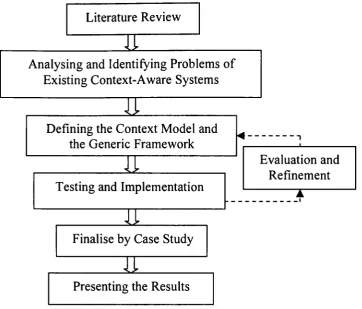
1.7 Research Methodology
objectives and answer the research questions. Figure 1.3 shows the sequence of these activities.
Literature Review
Analysing and Identifying Problems of Existing Context-Aware Systems
JL
Defining the Context Model and the Generic Framework
JL
Testing and Implementation
Evaluation and Refinement
Finalise by Case Study
Presenting the Results
Figure 1.3: Research methodology
Activity 1: Literature Review
The first activity of the research is to conduct a review of previous related literature in order to acquire a thorough knowledge and understanding of pervasive context-aware systems. This will establish a more detailed definition of the research topic, the hypothetical framework and also identifying the core problem of existing context- aware systems. The experience learned from previous literature will prove useful during the development stage. Different types of context modelling techniques, context-aware system architectures and application categories are studied in details as they are essential in the domain of context-aware systems and smart environments. Also, a literature review has been conducted to gain a deep insight into existing software architecture styles in order to determine an architecture which best fits to the proposed system requirements. Finally, a number of researches regarding existing smart environments have been reviewed in chapters 2 and 3.
Activity 2: Analysing and Identifying Problems with Existing Context-A ware Systems
[image:26.727.192.555.142.451.2]way context information can be represented and stored. Attention then is given to find a general model for representing different pieces of context information. Afterwards a study of existing context-aware architectures has been conducted to analyse their functionalities in order to identify what building blocks constitute these architectures, and also to identify their strengths and deficiencies. An analysis of software architecture styles is carried out to find the most suitable style in designing the generic context-aware architecture. Application categories of context-aware systems are studied as well. From this analysis, a number of research questions and related problems are raised. As an outcome of the analysis, finding a solution to some of the existing problems and research questions was a big challenge.
Activity 3: Defining the Context Model and the Generic Framework
The contribution of the research is of three parts; firstly, a new and general context model is proposed and represented using a new XML based language. This simple model characterises context information as a function of context primitives. Secondly, an extensible and generic framework is proposed to represent the common functionalities (architecture components) of the context-aware systems which is followed by the design of an XML based deployment language for arranging the architecture components. Finally, an XML rule mechanism which is concerned with context interpretation is designed and implemented. A detailed design is discussed in chapter 4.
Activity 4: Testing and Implementation
services languages) will be used in the implementation. Detailed information is given in chapter 5.
Activity 5: Evaluation and Refinement
After studying problems related to context-aware systems, a preliminary idea to the design concept is proposed. It is based on the generic Pipe-and-Filter architecture. This concept is justified throughout studying and analysing existing context-aware architectures. Thereafter, an implementation for a given case study is set. Lessons learned from analysing the implemented case study are then used to find defects in the research concept and refine the proposed solution (generic architecture). Next, different case studies are examined carefully and critically evaluated to determine if further improvement and adjustments are necessary. This analysis resulted in adding missing building blocks to the designed architecture, refining the context model, and using an architecture style to govern the system and support multiple contexts. Afterwards, it was thought of building a framework that can be used by application developers to create the architectural building blocks. In this case creational design patterns are adopted to customise the building blocks of the context-aware system and adjust the design.
Finally, some criteria are used to evaluate the framework and justify our finding. This is accomplished by using the proposed framework building blocks to realise existing and well known context-aware systems. The selected systems are capable of using different context dimensions and application categories.
Activity 6: Finalise by Case Study
The smart classroom environment is finalised in this stage of the research. Such environment could use a networked system employing web services with advanced technologies including wireless devices and sensors (such as RFID) to achieve the required degree of intelligence. Then different contexts are used to test the functionality of the design.
Activity 7: Presenting the Results
1.8 Contribution to Knowledge
During this PhD research, literature regarding context-aware systems has been reviewed, through which a number of issues have been found; one of these issues is the complexity of these systems. Accordingly, there is a need to propose a generic and extensible framework that minimises efforts required for building these systems. The contribution of this research is a new way for building context-aware systems, through building the generic and extensible framework that supports the design of a variety of these systems. During the design process a conceptual scheme has been set to show how different concepts collaborate to build the framework. The conceptual scheme included descriptions of a number of concepts that constitute the major elements of the new approach. These elements are a context classification, sensor terminology and a structure for describing the context model using a Context Description Language (CDL). Based on the developed context model, the generic framework that employs a Pipe-and-Filter architecture is built. This framework makes use of the reusable and independent components which represent the usual functions of context-aware systems. In this framework, six abstract and reusable building blocks are used. These are the acquisition, context representation, aggregation, data manipulation, interpretation, and application blocks. Context-aware Architecture Deployment Language (CADL) is used to put all these blocks together. CADL can also be used to represent different contexts which are distinguished using context identification code (CID). To govern the whole system operation and handle continuous context changes, the management block is employed. It assists in sequencing events and activates the whole system operation; see chapter 4.
The new framework depends on context model which arranges context information in a structured way in order to facilitate context reasoning and abstraction. Context history is also added to the model to enrich the context information. XML reasoning rules mechanism is proposed to support context abstraction. Therefore, different context related rules can be used and are distinguished using rule identification code (RID).
1.9 Thesis Layout
Chapter 1 gives a brief introduction to the new computing technologies and smart environments. It also includes the problem domain, the research aim and objectives, research methodology, and the contribution to knowledge.
Chapter 2 depicts a brief review and analysis to context-aware systems, concentrates on context information dimensions. Context-aware systems considered context history are also reviewed to address related issues, as context information is dynamic, and changes over time. Context modelling is also studied and all modelling techniques were reviewed. A brief review to context-aware applications and applications in smart environments are also given.
Chapter 3 presents a literature review and analysis which concentrates on software architecture styles. Then challenges and issues of context-aware systems regarding their architectures, and the software elements that constitute these systems are given.
Chapter 4 demonstrates the research contribution. It gives details of the design development of a general context model, a new generic Pipe-and-Filter architecture and a rule mechanism. It also explains the languages used to assemble the architecture components and to set the interpretation rules. Moreover, different action types and applications categories will be given. Finally, scenario of a smart classroom is given as a case study, which considers all the relevant issues for the design progress.
Chapter 5 presents the system framework; it describes the realisation and deployment of the generic architecture using different creational design patterns. Considering the smart classroom scenario, different examples are given to test the framework functionality.
Chapter 6 adopts a set of heuristics to validate the proposed framework. Then two methods (quantitative and case study) are used to evaluate the framework. The quantitative method includes a comparison of some well known context- aware systems with the proposed framework. The case study method includes realising existing and well known systems using the framework building blocks. Chapter 7 gives concluding remarks of the proposed framework, and discusses
Chapter 2
Context Representation and Applications - Review
The notion of context and context awareness are introduced by many researchers, and observed in many applications since the end of the past century; although these systems are still at their early stages. This chapter presents a review of existing work related to context-aware systems to study their features and design. The background research covers challenges to context information dimensions: context primitives and context history. It also covers issues in context modelling and context-aware applications. At the end of the chapter, smart environment applications with preference to context-aware pervasive computing are reviewed and discussed in terms of their capability and performance in handling context information.
2.1 Introduction to Context and Context Awareness
Context-aware systems use the current status of users and other entities in the environment to adapt their behaviour according to the instantaneous requirements of the users and other objects that interact with them. Such systems need to define what constitutes the context (current status) of those entities and take actions accordingly. Researchers look for a seamless definition to context and context awareness, to assist them recognise the margins of context-aware computing, help application designers select context to use, structure context in applications, and choose what context-aware features to implement [8]. The following shows an overview to how researchers define context and context awareness.
users and IT devices state, including surroundings, situation and location. According to Salber et al. [27] context is described as any environmental information that is relevant to the interaction between user application, and that can be sensed by the application. A more comprehensive and most usable definition to context and context awareness is given by Dey et al. [8]. This definition makes it easier for application developers to specify the context in application scenario; "context is any information that can be used to characterise the situation of an entity. An entity is a person, place, or object that is considered relevant to the interaction between a user and an application, including the user and applications themselves". Their definition to context awareness is: "a system is context-aware if it uses context to provide relevant information and/or services to the user, where relevancy depends on user's task". Another definition to context is given by Gross et al. [28], which described context- awareness as a set of attributes (name, administrator, human members of context, location, artefact, applications, events, access control list of a context, and related contexts). They extend Dey and Abowd's [8] definition to context awareness by extending user's task to contain information about users whole work context. To conclude, it was found that Dey's definition is the closest in spirit to our work and realistic, therefore this definition is adopted in the context of this research. Also, the characteristics of context information are: dynamic, inconsistent, and dependable on application situation [29]. Context is the meaningful properties about that which surrounds and gives meaning to something else [30].
2.2 Aspects of Context Representation
An in-depth review to existing work is done in order to be aware of what constitutes context, and how context information are represented and used in different applications. In the following sections challenges to some of these aspects will be presented.
2.2.1 Characteristics of Context Information
(Why) because of certain intention or emotion. Kunito et al. [38] focused on 3W's these are; when, where and what (environment or surrounding objects) instead of the full 5W1H suite presented by Oh. Bravo et al. [18, 39] use the 5W's (identity, time, location, activity, and why a user is carrying a task) to provide guidelines for context modelling. According to Roussaki et al. [7] context representation scheme was mainly concerned with location, identity and time. Finally, the common and the most widely used contexts are location and proximity [40].
In this respect, some existing works gave different ways to describe and discuss the features of context information and how different pieces of context can be originated and classified. For example, Henricksen et al. [41] described context as a piece of information which has a range of temporal characteristics, imperfect, has many alternative representations and highly interrelated. They categorised context as static or dynamic, sensed information versus information supplied by users. Henricksen et al. [42] also gave the properties of context information and discussed the important design issues when developing applications that rely on imperfect context information. They characterised four types of imperfect context information due to noise or sensor failure. These are unknown, ambiguous, imprecise and erroneous. Gwizdka et al. [43] made a distinction between internal and external context to describe user's state and environmental state. Gu [44] classified a wide range of contexts into two main categories; these are direct context and indirect context based on the means by which context is obtained. Direct context can be further classified into sensed context and defined context. Sensed context is obtained from physical sensors (e.g. curtain's status context sensed by curtain sensors), or from virtual sensors (e.g. a web service). Defined context is typically set by a user. Indirect context is obtained by interpreting direct context through aggregation and reasoning process, while aggregated context can be obtained by aggregating direct context. By using context reasoning engine, deduced context can be obtained and inferred from other types of context.
information. In general there are three schools to distinguish context primitives. The
first considered activity as another important piece of context to be added to identity,
location and time, the second considered environment as the most important one,
whereas, the third school considered environment, activity and 'why' are important in
addition to identity, location and time.
i State lEnv I Act
Loc i Time
id
Figure 2.1: Existing work and primitive context
2.2.2 Context History
Context history is considered as an important feature for approximation of a given
situation or environment. It evaluates users' behaviour to predict future context values
and user actions, where current context depends on previous ones, and will frequently
form part of context description. For example, person's disability context might
change depending on time and health history and has an impact on current context and
derived context. Historical context information represents volatile context, as it
depends on time as well as past history of context information; so time stamp is used
to create history. This section lists existing work that considers context history, shows
its value in their context-aware systems design, and how to maintain and facilitate its
query. For instance, Schmidt [24] considered historical data as an important feature
for approximation of situation, where historical context can be obtained from changes
in the feature space over time. According to Salber [27], context history is an
important aspect; therefore, history of context information is maintained in the context
Widgets and stored in a database. Korpipaa et al. [45] reserved history space of each
context type in a context database, where context history assists in producing high-
level context. Beigl et al. [46] also considered history as an influence property, and
used the Internal Situation Store (ISIS) to hold the context history and all information
Mantoro et al. [47] explained the importance of location history too, and how it is used in the context-aware system. They introduced a history database of events to store user identity and locations, and adopted a technique to control the growth of context history. Gu et al. [44] used a standalone context database and store each domain specific ontologies and context history of such domain in one logic database. Neelima et al. [48] also stored historical context of users and ontology in a database, which can be exploited for reasoning process. Zhang et al. [49] employed historical context stored in a database to support context reasoning as well. Oh et al. [35] used a database to store context history, which can be utilised as a clue to evaluate user's behaviour. They adopted a history based management technique to resolve user conflict and device conflict. Another approaches conducted by Al-Yasiri et al. [50] and Abdulahad et al. [51] intended to add context history to their context model, and insert this information to existing organisational information stored in LDAP server. Fahy et al. [52] gave the requirements that support context history. In their work a sever-based database is used to store context history, applications, and user data, in addition to inference rules, which can be manipulated using SQL. Kunito et al. [38] stored RFID detection history in a database. They adopted a history based recognition to compare between situations at different times to detect situations' change and their duration, and track of transitions to detect sequence, cycle or pattern. Baldauf et al. [53, 54] discussed the need to access context history to predict future context and to deal with sensor conflict, so a centralised high-resource storage is required. According to Chien et al. [55], historical context stored in a database can be used to build the application.
In brief, context history is an important element which is considered in all existing context-aware systems. It takes part during the implementation of context reasoning, predicting future context, and solving inconsistency in context information.
2.2.3 Context Modelling
context type and context value. Each context type can have one or more context values. Context instance is a context value (characteristics) of certain type at certain circumstances. For example context instance is: Context (Environment: Temperature, 50 °C) [53]. Table 2.1 shows instances of context atoms.
Context type_________Context Value Context Environment: Temperature 50 °C Hot
Device: Placement - at hand
Table 2.1: Examples of context atoms [53]
Context modelling is important to provide a formal basis for representing and reasoning about context information, therefore it can be easily used and processed. Context model must support multiple representations of context and their relationships and at different level of abstraction [41]. Different efforts have been put in this area either by conducting a survey to show a classification of context modelling, or through studying the modelled aspects and presenting their general characteristics, and also by conducting analysis framework to context modelling. Other approaches discussed the advantages of modelling context information probabilistically [56]. A review of different aspects of context modelling is outlined in this section.
Schmohl et al. [57] carried out a survey discussing context abstraction and its modelling aspects, taxonomies of approaches to context modelling (theoretic and conceptual), and argued about different context models. Gu et al. [44], on the other hand, classified existing context models into three categories; these are application oriented, model oriented and ontology oriented. A more comprehensive research is conducted by Strang et al. [3] who presented a comparative study and distinguished the following context modelling techniques:
The Key-value model is easy to manage but it is suitable for simple structure of context modelling.
The Mark-up scheme is specific and/or limited to small set of context aspects; it uses hierarchical data structures of mark-up tags with attributes and content.
The Object oriented model uses the full power of object orientation, by using objects to represent context information to encapsulate context processing and representation, so a well defined interface is required to access context.
Logic based is a formal model and based on logic; it uses facts, expressions and rules to define context.
Ontology based model represents concepts and relations between them. It enables context knowledge sharing and reuse to facilitate context reasoning and interoperability between applications.
Bettini et al. [58] discussed the requirements and characteristics of context modelling. These are heterogeneity and mobility, relationship and dependencies, imperfection, reasoning, usability of modelling formalism, and efficient context provisioning. They also conducted a survey investigating approaches to modelling and reasoning techniques for context information which are used by context-aware applications. Then, existing modelling techniques are evaluated; these are the early approaches like Key-value and Markup models, domain-focused models, a more expressive model like Object-Role based, Spatial model, and ontological approaches to modelling like OWL. Afterwards, they introduced a hierarchical hybrid approaches to integrate different formalisms and techniques to context modelling. Bolchini et al. [59] presented the general characteristics of the context model; these are type of formalism, level of formality, flexibility, variable context granularity, and valid context constraints.
Figure 2.2: Context feature space [24]
Schmidt et al. [26] used the object oriented model to describe context through a three-dimensional space (environment, self, activity), see Figure 2.3. Sensors are represented as time dependent function that returns a scalar, vector, or symbolic value. Afterwards, the concept of cues is used to provide abstraction of physical and logical sensors. It is regarded as a function taking the values of a single sensor up to certain time and provides a symbolic or sub-symbolic output; the context is then derived from the available cues. They also described context by a set of two dimensional vectors, each consists of a symbolic value that describes the situation and a number indicating the certainty that a user or device is currently in this situation.
Context
Self
(device state, physiological, cognitive)
Environment (physical, social)
Activity (behavior, task)
Figure 2.3: 3-D Context Model [26]
[image:39.727.263.477.602.805.2]associated with their attributes; for example the person node is associated with name, activity and location.
Activity
works with f
supotvisi'iir"
by *l
n;ITHO<i^
TSiHiie i
* located at/
Person
i \ -i channel
Clu-lllliel
Idenlifict
1 Locution Ccx)t<liiKilcs
^ «,
h located neurf
U authorised "
\» S
Lliamiel
/ \
1
1
\lt)c;ilc<idt
l)ovi<v
/recjiiirc-=.
.Itis type
(Channel Ty lV .
/]
\
Dev ice denlificr il«nlillc(!by ias u-pc Dov ice Type Legend [image:40.727.135.621.144.353.2]Hntily lype h.iuue Attribute Ty|W Name a.->»wialk>uiiai Entitv rvpe Al'riluile type 1C Association
Figure 2.4: Example to modelling a scenario [41]
Logic base approach is another type of modelling which is adopted by Wang et al. [60]. They utilised expressions and conditions such as "and, or, between, >, <" to define complex conditions. The relational data model is used by Fahy et al. [52], where a database has been employed to store context and domain knowledge in the forms of rules and behaviours related to specific applications.
algebra (union, intersection, and complement). They adopted a hierarchical approach
by dividing the context ontology into a common high-level ontology and domain-
specific ontology due to the difficult management and process of large amount of
context knowledge in pervasive computing environments. Figure 2.5 shows a class
hierarchy diagram of the ontology, in which the common ontology has 14 classes that
describes the basic concepts (such as person, location, etc.) and six properties. It also
shows the domain specific ontology (such as vehicle-domain, and home domain)
which defines the details of the general ontology.
ScneduledAclivityT)
Vehicle-domain ontology
[image:41.727.99.634.310.609.2]Home-domain ontology d_?J) owl:Class ——t>rdls:subClassOf ——^owhProperty
Figure 2.5: Class hierarchy diagram for context ontology [62]
Zhang et al. [49] utilised a Web Ontology based Context model (CONON) for
context representation. The ontology for context entities is structured around
describing objects (entities such as person, activity, etc.) which are linked with their
attributes (e.g. user's status) or with other entity, see Figure 2.6. Roussaki et al. [7]
integrate the maintenance, distribution and administrative facilities of a location-based
context model with the semantic advantages of context ontology to develop a hybrid
g|——^ XMJ.ifaJbto | I * •ar-\ ^
?
5 ± ———Iccaledhi——<TnEtnlty 'ir"~ id——^xstfStr-rq
c v- . ^v1 VT ->
description-* JT •• •
j__LT _ ___ __„ _ _ iputa'.k:;ial Entity~^!>
« t_ enqaaedn ' m • *
) xsd:String
rdfs subClassQf ———^atfJiObjaclProperty ———1>owl DatatypeP-upeity CHZ^uvJC'ass
a) Tlu biKicetop-levi.1 context ontology ii O\VL;'RDl; yrv-.ph notation •^owhClass rdf:D
</owl:C'HS5> <rdfvsubOlassOfi
«_\vi:Datetyp«Properlv df:ID="na/n6"> <towlClass>
<rdfe:domainrrjf:rescHJice=>^Entty'*,'> <ow!:Class rdf:fD
<rd^s range rdf re5ource=*&xsd stringV> <rdfs subClassOf rdf:resource=";^Entiiy"/>
<rdfesubClas.sOf :i'f:resour:;«='*!Enli y"/> <rdf:t
< rdfa bv^:dorrioir rdf rojource»»l^Ertity"il >- < rdfs ow rnnge rr|-':resourf;«:="r4|!l.nr:a;inn'V>
'"owl jniooOf rcff pur»j.oTypo-*Col:LH;:iun"> 'VowlX3bjix:tPri.porty>1
zfiabout^'THor^Space"'^ <owl:Ot_ectPro>e'ty rdf:ID~t'TocatecNear"> :f:about="^6thsrSp3ce"/> </owl OofectPrC'perty>
c/ow :uniociOf > <owl:DatatypeFrooerty rcf: ID="lonftude*>
<'owl;Class> <rdf;l>'pe rdf TesQUfce="runction<jPrcx>e''!y' />
</owl:equivalentClass> < r;!f« owuoiT'ain rcJf resource=MCcHiC5ni:4LucH:'Dn',l>
< rdfs ow:range rd':resource=" &;t&d:i±>jo ?'/>
b) A part al OWL/XML serialization
Figure 2.6: Context ontology and partial serialisation [49]
PDA
^ES^fiE^
rojfcto: i Printer.^)
~<^^> FF?..*
iobilfPbon
Figure 2.1: CALA-ONT model and its properties [65]
Regarding application oriented context modelling, Oh et al. [35, 36] proposed the
unified context model, where the preliminary context generator plays an important
role in converting feature extracted from physical sensors into formatted 5W1H.
Kunito et al. [38] proposed an application specific model called Real World Model.
Their model uses XML code in which the tags describe attributes of things (such as
mobile phone, jeans, coats, etc.), attributes of reader (such as name, owner, etc.), and
existence of things, see Figure 2.8. Finally, Choi [66] used the context reducer to
handle context attributes collected from external and internal sources; they didn't give
a specific model as each application has a different model.
<Object id="object00002673"> <TaglD>00002673</TaglD> <Name>mobile-phone</Name> <Owner>Hanako</Owner> <Role>mobile</Role> </Object> <Object id="object00002953"> <TaglD>00002953</TaglD> <Name>jeans</Name> <Owner>Taro</Owner> <Role>merchandise</Role> </Object> <Object id="object00003409"> <TaglD>00003409</TaglD> <Name>jeans</Name> <Owner>Taro</Owner> <Role>merchandise</Role> </Object> <Reader id="readerA102_1"> <Reader1D>A102_1 </Reader1D> <Name>pari(-reader-2</Name> <Location>pari«/Location> <Location> <Place idref="placeP0017> </Location> </Reader> <Exist> <Reader idref="readerA102_1"/> <Object idref="object00002673"/> <SSI>104</SSI> <Motion>false</Motion> <Timestamp> 1122530522640</Timestamp> </E»st>
Existence of things
Attribute of Reader
<ExistWith>
<Reader idref="readerA104_1 "/> <Object idref="object000239287> <Object idref="object00023416'V> <Timestamp> 1122530522640</Timestamp> </E»stWith>
[image:43.727.227.529.81.448.2]Attribute of things Existence of multiple things
Figure 2.8: Real World Model [38]
After reviewing the literature, it was found that different modelling techniques are
scheme, Graphical, Logic based, Object oriented, Ontology based, and application
oriented. However, there are other models in the literature that are not included in this
thesis such as the Context Cube [67]. Each of these models has its own advantages
and disadvantages, where some of these techniques support knowledge sharing and
reasoning, yet they are complicated. Others are simple but have limited capabilities
and are inflexible. Therefore, some existing systems use hybrid models. Table 2.2
illustrates a comparison of some existing modelling techniques to show their benefits
and limitations.
The Modelling
Technique Pros Cons
Key-value
Simple data structure. Easy to manage.
Inefficient in describing complex context information, and dynamic change of context.
Does not support reasoning.
Logic-base
High degree of formality. Flexible.
Applicability to existing ubiquitous computing environment is a major issue.
Mark-up scheme
Can extend, and support dynamic and complex context information.
Support dynamic context
information.
Most existing models are either proprietary or limited to small set of contexts.
Graphical High structure level. Low level of formality.
Object oriented
Have the benefits of abstraction, encapsulation, inheritance, and reusability to support dynamic changes in context information. Scalable and simplify knowledge representation.
Need interface to access context information.
Limited formality.
Ontology
High degree of formality. Support reasoning.
Knowledge sharing and reuse. Flexible, and expressive.
Complex way of representing
knowledge.
Do not offer a complete description of context information.
Require ontology engine to manage the ontology, which has high requirements on resources.______
Table 2.2: A comparison to existing modelling techniques
2.3 Aspects of Context-Aware Applications
Context-aware systems employ computing devices that are aware of their
environments to adapt their behaviour accordingly in the final stage. This section
presents an overview to how context-aware systems make use of context information
Schilit et al. [9] gave two orthogonal dimensions to context applications, taking into consideration whether the task is to get information or to execute a command and whether the task is executed manually or automatically. They presented four types of applications; these are proximate selection, automatic contextual reconfiguration, contextual command and context-triggered actions. Pascoe [68] developed taxonomy to identify the features of context-aware applications that are similar to schilit's classes of applications. These features are: contextual sensing, contextual adaptation, contextual resource discovery and contextual augmentation; the latter represents the ability to associate digital data with user's context. They stated that context-aware systems contain all four types of applications. Dey et al. [8] merged the ideas from Schilit and Pascoe's taxonomies and gave three application categories of context; these are presentation of information and services to a user, automatic execution of a service and tagging of context information for later retrieval. They made a comparison and applied these categories of context and context-aware features to different application systems. Bisgaard et al. [69] studied the above taxonomies [8, 9, 68] and took several application examples of mobile context-aware systems already developed; then applied Dey's application categories [8] to these systems. In their study, context-aware systems' examples were grouped with the type of context and context awareness.
![Figure 2.3: 3-D Context Model [26]](https://thumb-us.123doks.com/thumbv2/123dok_us/8722339.884539/39.727.188.567.87.332/figure-d-context-model.webp)
![Figure 2.4: Example to modelling a scenario [41]](https://thumb-us.123doks.com/thumbv2/123dok_us/8722339.884539/40.727.135.621.144.353/figure-example-to-modelling-a-scenario.webp)
![Figure 2.5: Class hierarchy diagram for context ontology [62]](https://thumb-us.123doks.com/thumbv2/123dok_us/8722339.884539/41.727.99.634.310.609/figure-class-hierarchy-diagram-context-ontology.webp)
![Figure 2.6: Context ontology and partial serialisation [49]](https://thumb-us.123doks.com/thumbv2/123dok_us/8722339.884539/42.727.121.618.80.488/figure-context-ontology-and-partial-serialisation.webp)
![Figure 2.8: Real World Model [38]](https://thumb-us.123doks.com/thumbv2/123dok_us/8722339.884539/43.727.227.529.81.448/figure-real-world-model.webp)
![Figure 3.12: CoBrA architecture [61]](https://thumb-us.123doks.com/thumbv2/123dok_us/8722339.884539/57.727.168.580.72.276/figure-cobra-architecture.webp)
![Figure 3.13: Multi-agent based architecture [60]](https://thumb-us.123doks.com/thumbv2/123dok_us/8722339.884539/58.727.219.513.288.578/figure-multi-agent-based-architecture.webp)
![Figure 3.15: Multi agent service resembling architecture [48]](https://thumb-us.123doks.com/thumbv2/123dok_us/8722339.884539/59.727.109.632.681.938/figure-multi-agent-service-resembling-architecture.webp)
![Figure 3.16: A-CoBrA architecture [97]](https://thumb-us.123doks.com/thumbv2/123dok_us/8722339.884539/60.727.191.558.230.531/figure-a-cobra-architecture.webp)
