
International Journal of Emerging Technology and Advanced Engineering
Website: www.ijetae.com (ISSN 2250-2459,ISO 9001:2008 Certified Journal, Volume 3, Issue 12, December 2013)
609
Critical Analysis of Different Color Constancy Algorithm
Manjinder Singh
1, Sandeep Sharma
2Department Of Computer Science, Guru Nanak Dev University, Amritsar.
Abstract— This paper presents a review on different
color constancy techniques. Color constancy is the capability to determine colors of objects independent of the color of the light source. This work deal with different color constancy algorithms to evaluate the performance of existing color constancy algorithms. Different research papers are evaluated in this paper and it is found that most of existing algorithm work fine and provide efficient results. It is found that the every color constancy algorithm if follow by the gamma correction is proved to be quite efficient than available algorithms.
Index terms-- Color constancy, Gamma correction, Light sources, illumination.
I. INTRODUCTION
Image processing is a method to convert an image into digital form and perform some operations on it, in order to get an enhanced image or to extract some useful information from it. It is a type of signal dispensation in which input is image, like video frame or photograph and output may be image or characteristics associated with that image.
Color [1-12] is an significant cue for computer vision and image processing related topics, like feature extraction, human computer interaction, and color appearance models. Color vision is a process by which organisms and machines are able to distinguish objects based on the different wavelengths of light reflected, transmitted, or emitted by that object. Colors observed in images are determined by the fundamental assets of objects and surfaces, as well as the color of the illuminant. For a robust color-based system, the effects of the illumination should be filtered out. Color Constancy is the ability to identify the correct colors, independently of the illuminant present in the scene. Human vision has a natural capability to correct the color effects of the light source. On the other hand, the mechanism that is involved in this capability is not yet fully understood. The same process is not trivial to machine vision systems in an unconstrained scene.
A. Color Constancy:
Color constancy is a mechanism of detection of color independent of light source. It is a characteristic of the individual color perception system which ensures that the perceived color of objects remains relatively constant under altering illumination conditions. The color of objects is primarily effected [11] by the color of the light source.
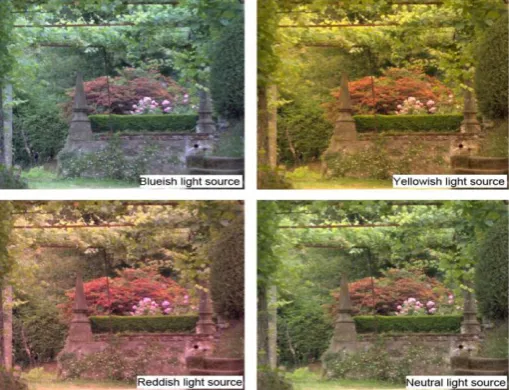
The analogous object, taken by the same camera but under different light, may vary in its measured color appearance. This color variation may negatively affect the result of image and video processing methods for different applications such as image segmentation, object recognition and video retrieval. The principle of color constancy is to eliminate the effect of the color of the light source. a significant number of color constancy algorithms has been proposed. color constancy is intrinsically an ill-posed problem, different assumptions have been proposed, such as the White-Patch assumption and the Grey-World assumption. Consider the images in Fig. 1. These images show the same scene, provided under four different light sources.
Fig. 1. Illustration of the influence of differently colored light sources on the measured image values.(adapted from [12])
B. Color Constancy Algorithms:
We discuss about the two basics algorithms[8] of color constancy i. e. White Patch Retinex (WPR) and Gray World (GW).
a). White Patch Retinex:
White Patch Retinex Algorithm is based on retinex theory by Edwin H. Land in 1971.This algorithm assumes that the highest value of each color channel as white representation of image. White patch found searching for the maximum intensity in each channel, is given by
[image:1.595.321.576.365.560.2]International Journal of Emerging Technology and Advanced Engineering
Website: www.ijetae.com (ISSN 2250-2459,ISO 9001:2008 Certified Journal, Volume 3, Issue 12, December 2013)
610
Where fi(x, y) is pixel intensity at position (x,y) in an
image.
And Ii is the illuminant in the scene.
All pixel intensities are scaled according to the illuminant computed:
( )
( )
b). Gray World:
The Gray World assumption is a white balance method that assumes that your scene is neutral gray. It produce an estimate of illuminant by computing the mean of each channel of the image.
This algorithm suggests that the average value of R, G and B components to the common gray value. To normalize the image channel i, the pixel value is scaled by s1=avg/avgi where avgi is the channel mean and avg is
the illumination estimate.
Another method of normalization is normalizing to the maximum channel by scaling by si
(
)
( )
C. Gamma Correction:Gamma correction[13] controls the overall brightness of an image, which is not properly corrected can look either bleached out, or too dark. Varying the amount of gamma correction changes not only the brightness, but also the ratios of red to green to blue.
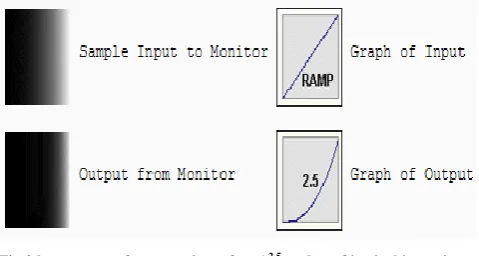
[image:2.595.316.567.164.333.2]To explain the gamma correction we consider computer monitor example, whose intensity to voltage response curve which is roughly a 2.5 power function, it means range of voltages sent to the monitor is between 0 and 1, then it will actually display a pixel which has intensity equal to x ^ 2.5. This means that the intensity value displayed will be less than what you wanted it to be. (e.g. 0.5 ^ 2.5 = 0.177) here, are said to have gamma of 2.5 .
Fig.2 here, output from monitor f = v^2.5 , where f is pixel intensity and v is voltage.
[image:2.595.49.289.603.731.2]The task of gamma correction is accomplished by raising the input value to the 1/2.5 power.
Fig 3.here, gamma corrected output f = v^(1/2.5) .
The luminance nonlinearity introduced by many imaging devices is described with an operation of the form
,
(
( )
( )
Where fi(x, y) ∈ [0, 1] denotes the image pixel
intensity in the component i. If the value of γ is known, then the inverse process is trivial
,
(
( )
( )
The value of γ is determined experimentally with the aid of a calibration target taking a full range of known luminance values through the imaging system.
D. Color Constancy with gamma correction:
Combining color constancy and gamma correction methodologies[8] are used for dynamic range correction in practical applications. Gamma correction is very effective method with color constancy for dark image enhancement. Mainly, the approaches are applied to each color constancy algorithm as follows:
1)Gamma correction 2)Color constancy
3)Gamma correction and then, the color constancy algorithm
International Journal of Emerging Technology and Advanced Engineering
Website: www.ijetae.com (ISSN 2250-2459,ISO 9001:2008 Certified Journal, Volume 3, Issue 12, December 2013)
[image:3.595.52.288.137.316.2]611
Figure 4. Experimental evaluation of four approaches combiningcolor constancy and gamma correction algorithms.(adapted from [8])
After getting the resultant images, a quality measure for each input image and measured results are compared.
II. LITERATURE SURVEY
Yu L. et al. (2010) [1] proposed a novel color constancy-based method to improve the visibility of images under low light conditions. This method applies the Shades-of-Gray algorithm to the active set of pixels in order to reduce the distressing effects of the scene illuminant and highlights. After results of various images, it has been observed that the proposed method can achieve good performance for lightness, contrast and color fidelity without graying-out artifacts or halo artifacts as such present in Retinex approaches.
Wu Z.et al. (2010) [2] explained a novel combination approach based on local texture features and local regression, considering none of single algorithms has capability to recognizing the color regardless of the illuminant. Local texture features based on integrated Weibull distribution are initially extracted on the overlapping patches of the images for enhanced representation of images and then determine a novel image distance metric to search for K most analogous images of the test image. Integrate a theoretical information into the data-driven strategy, at last combine individual algorithms using a local regression according to the frequency ratio of superlative single algorithms. A novel approach has better results than single algorithm as well as popular combination approaches.
Gijsenij G. et al. (2011) [3] discussed the natural image statistics are used to identify the spatial and spectral characteristics of color images, to achieve selection and combining of color constancy algorithms.
The Weibull parameterization (e.g. grain size and contrast) is used which is related to the image attributes to which the used color constancy methods are sensitive and an MoG-classifier is used to study the relation and weighting between the Weibull-parameters and the image attributes (e.g. number of edges and amount of texture). The yield of the classifier is the selection of the best performing color constancy algorithm for a certain image. Results show that by apply proposed algorithm on a given data set, an increase in color constancy performance up to 20 percent as compared to the best-performing single algorithm.
Kandaswamy A. et al. (2011) [4] has worked for a correlation-based transformation that reduces the effect of illumination variation in color texture analysis. Minvariance transformation has been proposed to produce illumination-invariant images, after studying of human color constancy. They demonstrated the consequence of illumination changes as partial changes in the placement and participation statistics that result in a change in the correlation between individual channels of a color texture. An iterative transformation strategy that takes an input color texture image and create an illumination-invariant representation, based on this approach. The proposed minvariance model has improved performance in the analysis of color texture.
Kim J. et al. (2011) [5] has demonstrated a novel Automatic White Balance (AWB) algorithm to improve the unwanted color cast, when numerous images are stitched into a scene. Instead of using local neutral color for different standard illuminant for each input image like conventional AWB algorithm , a novel AWB algorithm use the global neutral color to obtain the natural scene. The result produced by proposed algorithm stitched scene free from color difference when compared with the results from the conventional AWB algorithms.
International Journal of Emerging Technology and Advanced Engineering
Website: www.ijetae.com (ISSN 2250-2459,ISO 9001:2008 Certified Journal, Volume 3, Issue 12, December 2013)
612
The proposed framework exceeds algorithms based on the uniform light-source assumption with chromatic difference between these two illuminants is more than 1. Otherwise, the performance of the proposed method is similar to global color constancy methods.
Brown D. et al. (2012) [7] observed the restrictions of color measurement accuracy and investigate how this information can be used to progress the performance of color correction. It is detected that there exists a strong correlation between hue error and color strength, which is a product of intensity and saturation and then establish the idea of color strength, which is a combination of saturation and intensity information to determine when hue information in a scene is reliable. Color strength model tested on two datasets with ground-truth color information, and in both datasets this model had muscular predictive power for hue error. We verify the predictive capability of this model on two different datasets with ground truth color information. Further, it is clearly shown that how color strength information can be used to significantly improve color correction accuracy for the available real-world dataset.
Cepeda-Negrete and E. et al. (2012) [8] has examined the effect of two well-known color constancy algorithms i.e. White Patch Retinex (WPR) and Gray World (GW) in combination with gamma correction i.e. mainly used for dark image enhancement.
Chang and P. et al. (2013) [9] has proposed the chromaticity neutralization process to select the representative pixels for robust illuminant computing, instead of taking the unreliable maximum image intensities as the estimated illuminant color. Furthermore, they suggested that to improve the color correction results on images lighten by multiple illuminants, soft clustering is performed to first separate the image pixels into several groups, the estimated illuminants of these groups are then combined based on the clustering weights to specifically determine the illuminant of each pixel. The manifest of usefulness of this approach illustrated by experiments on both the widely-used datasets and several web images
Ahn and L. et al. (2013) [10] has proposed a new color constancy method to exploit color channel correlation explicitly to improve the color constancy, but the various conventional color constancy methods based on the low-level statistics are extensively used due to their low computational complexity and satisfactory results with sufficient parameters. They studied to progress the color constancy performance by allotting the dissimilar weights to the pixels based on each saturation value. Two widely used datasets results demonstrate that the proposed method improves the color constancy with a easy and efficient manner and prove that color correlation is the significant aspect for the color constancy.
International Journal of Emerging Technology and Advanced Engineering
Website: www.ijetae.com (ISSN 2250-2459,ISO 9001:2008 Certified Journal, Volume 3, Issue 12, December 2013)
613
III. GAPS IN LITERATURE SURVEY
Ref no. Advantages Disadvantages [1] 1. Improve the visibility of low light images.
2.Reduce the disturbing effects of the scene illuminant and highlights.
1.No filter is applied.
[2] The purposed combination approach achieves the best performance among all the existing single algorithms in local way of color constancy.
1.No use of multiple light sources.
[3] 1.Capture the important image characteristics with Weibull parameterization.
2. Determine the correlation and weighting between the Weibull-parameters and the image attributes with MoG-classifier.
1.In certain case scene classes, instead of the classifier considering several algorithms only one algorithm can be used.
.
[4] 1. Minimize the effect of illumination variation in color texture analysis.
1. Minvariance Transformation (MVT) model is used having Computational Efficiency is less.
[5] 1. Automatic white balance (AWB) reduces the illumination difference across input images.
2. Obtain the natural panorama of input images.
1. No filter is applied.
[6] 1.Helpful more practical scenarios where the uniform light-source assumption is too restrictive.
1. The performance of Proposed approach is less than the clustering-based approach.
[7] 1. Color strength information extensively improve color correction accuracy.
2.Determine the reliability of color information.
1.No individual parameters of the single algorithms.
2.Less efficient. [8] 1.Produce better result for dark image enhancement.
2.More effective for dynamic range correction when combine color constancy algorithm and afterwards gamma correction.
1. It is less efficient in the presence of noise, due to gamma correction used.
2.Only used for dark image enhancement.
[9] 1.Chromaticity neutralization process solves the problem of unreliable maximum intensities of max-RGB algorithm.
2. Robust illuminant computing.
1. Overheads due to lot of work division, by first clustering the image pixels into several groups and then combine.
2. More complex proess.
[10] 1. Improve the color constancy performance with assigning the different weights to the pixels.
International Journal of Emerging Technology and Advanced Engineering
Website: www.ijetae.com (ISSN 2250-2459,ISO 9001:2008 Certified Journal, Volume 3, Issue 12, December 2013)
614
IV. COMPARATIVE ANALYSIS
Color Constancy with Gamma Correction[8] Color Constancy with Chromaticity Neutralization[9]
Texture Based Color Constancy[2] White Patch
Retinex
Gray World Single Illuminant Multiple Illuminant With Gray World With White Patch 1. Experiments
shows that apply GC after the WPR produce better result.
2.Using APSV(quality), WPR+GC=19.14, which is better than GC, WPR,GC+WPR.
1.In case of Gray World, apply GC after GW gives better ouput.
2.GW+GC=94.8, when img idx=050, which is better than GC,GW,GC+GW.
1.With SFU and MS dataset, result shows that proposed method gives improved result than max-RGB,GCW and GEI.
2.In single illuminant, proposed method gives average angular value is 5.238 with SFU, which is less than max-RGB,GCW and GEI.
1.In case of multiple
illuminant, with SFU and MS dataset,
proposed method gives improved result than max-RGB,GCW and GEI.
2. Proposed method gives average angular value is 7.834 with SFU, which is less than max-RGB,GCW and GEI.
1.Experiment applied on real world dataset.
2.In case of Gray World, performance is evaluated. Mean=6.89 Median=6.03
1. Real world dataset is used.
2.In case of White Patch,
performance is evaluated. Mean=6.62 Median=5.14
V. CONCLUSION
This paper has conducted a literature review on different color constancy techniques. Color constancy has the capability to reduce the effect of the light source. After conducting the survey it is found that most of existing algorithm work fine and provide efficient results. It is found that the every color constancy algorithm if follow by the gamma correction is proved to be quite efficient than available algorithms. In near future we will extend this work by integrating the color constancy algorithm with dynamic histogram equalization to improve the accuracy the color constancy algorithms further.
REFERENCES
[1] Jing Yu, Qingmin Liao "Color Constancy-Based Visibility Enhancement in Low-Light Conditions"
2010 Digital Image Computing: Techniques and Applications, IEEE 2010.
[2] Meng Wu, Jun Zhou, Jun Sun, Gengjian Xue "TEXTURE-BASED COLOR CONSTANCY USING LOCAL REGRESSION" IEEE 2010.
[3] Arjan Gijsenij, Member, IEEE, and Theo Gevers, Member, IEEE "Color Constancy Using Natural Image Statistics and Scene Semantics" IEEE 2011.
[4] Umasankar Kandaswamy, Donald A. Adjeroh, Member, IEEE, "Robust Color Texture Features Under Varying Illumination Conditions" IEEE 2011.
[5] Seung-Kyun Kim, Seung-Won Jung, Kang-A Choi, Tae Moon Roh, and Sung-Jea Ko, Senior Member, IEEE "A Novel Automatic White Balance for Image Stitching on Mobile Devices" IEEE 2011.
[6] Arjan Gijsenij, Member, IEEE, Rui Lu, and Theo Gevers, Member, IEEE "Color Constancy for Multiple Light Sources" IEEE 2011.
[7] Lisa Brown, Ankur Datta, Sharathchandra Pankanti "Exploiting Color Strength to Improve Color Correction" 2012 International Symposium on Multimedia , IEEE, 2012.
[8] Jonathan Cepeda-Negrete and Raul E. Sanchez-Yanez. "Combining Color Constancy and Gamma Correction for Image Enhancement" 2012 Ninth Electronics, Robotics and Automotive Mechanics Conference , IEEE, 2012.
[9] Feng-Ju Chang and Soo-Chang Pei. "Color Constancy via Chromaticity Neutralization:From Single to Multiple Illuminants" IEEE 2013.
[10] Hyunchan Ahn, Soobin Lee, and Hwang Soo Lee "improving the color constancy by saturation weighting" IEEE 2013
[11] Li, Bing, Weihua Xiong, Weiming Hu, and OuWu. "Evaluating combinational color constancy methods on real-world images." In Computer Vision and Pattern Recognition (CVPR), IEEE, 2011.
[12] Arjan Gijsenij ,Theo Gevers and Joost van de Weijer. "Computational Color Constancy: Survey and Experiments" IEEE transaction on image processing, vol. 20, no. 9, september 2011.
![Figure 4. Experimental evaluation of four approaches combining color constancy and gamma correction algorithms.(adapted from [8])](https://thumb-us.123doks.com/thumbv2/123dok_us/8722370.884542/3.595.52.288.137.316/figure-experimental-evaluation-approaches-combining-constancy-correction-algorithms.webp)
