International Journal of Emerging Technology and Advanced Engineering
Website: www.ijetae.com (ISSN 2250-2459,ISO 9001:2008 Certified Journal, Volume 4, Issue 9, September 2014)
786
Handwritten Devnagri Script Recognition: A Review
Prashant M. Kakde
1, Dr. Sanjay M.Gulhane
21Research Scholar, S.G.B.A.U Amravati, India 2Professor, J.D.I.E.T, Yavatmal, India
Abstract—Character recognition plays an important role in the modern world. It can solve more complex problems and makes humans’ job easier. Character Recognition (CR) has been an active area of research and due to its diverse applicable environment; it continues to be a challenging research topic. As the size of the vocabulary increases, the complexity of algorithms also increases linearly due to the need for a larger search space. The problem arise in Devnagari script character recognition using Zernike moments, fuzzy rule and quadratic classifier provide less accuracy and less efficiency. Classification methods based on learning from examples have been widely applied to character recognition from the 1990s and have brought forth significant improvements of recognition accuracies. This class of methods includes statistical methods, artificial neural networks, support vector machines (SVM), genetic algorithm, particle swarm optimization (PSO) algorithm etc. This includes comparative analysis using neural network, genetic algorithm, SVM and POS. This paper describes all these methods.
Index Terms— Handwritten Character Recognition, Genetic Algorithms, artificial neural networks, support vector machines (SVM), genetic algorithm, particle swarm optimization (PSO) algorithm
I. INTRODUCTION
Over the years, computerization has taken over large number of manual operations, one such example is offline handwritten character recognition, which is the ability of a computer system to receive and interpret handwriting input present in the form of scanned images. In the early stage of OCR (optical character recognition) development, template matching based recognition techniques were used [1]. The templates or prototypes in these early methods were designed artificially, selected or averaged from few samples. As the number of samples increased, these simple design methodologies, became insufficient to accommodate the shape variability of samples, and so, are not able to yield high recognition accuracies. To take full advantage of large volume of sample data, the character recognition community has turned attention to classification methods based on learning from examples strategy, especially based on artificial neural networks (ANNs) from the late 1980s and the 1990s. New learning methods, using support vector machines (SVMs), are now actively studied and applied in pattern recognition problems. Learning methods have beneficiated character recognition methods tremendously. They relieve us from painful job of template selection and tuning, and the recognition accuracies get improved significantly because of learning from large sample data.
Some excellent results have been reported [2][3][4]. Despite the improvements, the problem is far from being solved. The recognition accuracies of either machine-printed characters on degraded document image or freely handwritten characters are still insufficient.
Handwriting recognition (or HWR) is the ability of a computer to receive and interpret intelligible handwritten input from sources such as paper documents, photographs, touch-screens and other devices. The image of the written text may be sensed “off line” from a piece of paper by optical scanning (optical character recognition) or intelligent character recognition. Alternatively, the movements of the pen tip may be sensed “on line”, for example by a pen based computer screen surface.
International Journal of Emerging Technology and Advanced Engineering
Website: www.ijetae.com (ISSN 2250-2459,ISO 9001:2008 Certified Journal, Volume 4, Issue 9, September 2014)
787 II. CHARACTERISTICS OF DEVNAGARI SCRIPT
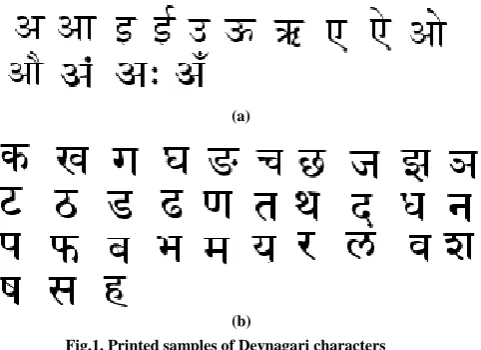
Devnagari script is different from Roman script in several ways. This script has two-dimensional compositions of symbols: core characters in the middle strip, optional modifiers above and/or below core characters. Two characters may be in shadow of each other. While line segments (strokes) are the predominant features for English, most of the characters in Devnagari script is formed by curves, holes, and also strokes. In Devnagari language scripts, the concept of upper-case, the lower-case characters is absent. It consists of 14 vowels and 33 consonants. Vowels occur either in isolation or in combination with consonants. Apart from vowels and consonants characters called basic characters, there are compound characters in Devnagari script, which are formed by combining two or more basic characters. Coupled to this in Devnagari script there is a practice of having twelve forms of modifiers with each for 33 consonants , giving rise to modified shapes which, depending on whether the modifier is placed to the left, right, top or bottom of the character. The net result is that there are several thousand different shapes or patterns, which makes Devnagari OCR more difficult to develop.
(a)
[image:2.595.379.484.135.217.2](b)
Fig.1. Printed samples of Devnagari characters (a) Vowels (b) Consonants.
III. FEATURE EXTRACTION
In this section we give a brief description of the feature sets used in our proposed multiple classifier system. Chain code histogram features are extracted by chain coding the contour points of the scaled character bitmapped image. Moment based features are extracted from scaled, thinned one pixel wide skeleton of character image.
A. Chain Code Histogram of Character Contour
[image:2.595.315.547.351.543.2]Given a scaled binary image, we first find the contour points of the character image. We consider a 3 × 3 window surrounded by the object points of the image. If any of the 4-connected neighbor points is a background point then the object point (P), as shown in Fig.2 is considered as contour point.
Fig 2. Contour point detection
The contour following procedure generates a contour representation called “chain coding” that is used for contour following proposed by Freeman, shown in Fig. 3a. Each pixel of the contour is assigned a different code that indicates the direction of the next pixel that belongs to the contour in some given direction. In this methodology of using a chain coding of connecting neighboring contour pixels, the points and the outline coding are captured. Contour following procedure may proceed in clockwise or in counter clockwise direction. Here, we have chosen to proceed in a clockwise direction.
(a) (b) (c)
Fig 3. Chain Coding: (a) direction of connectivity, (b) 4- connectivity, (c) 8-connectivity. Generate the chain code by
detecting the direction of the next-in-line pixel
The chain code for the character contour will yield a smooth, unbroken curve as it grows along the perimeter of the character and completely encompasses the character. When there is multiple connectivity in the character, then there can be multiple chain codes to represent the contour of the character. We chose to move with minimum chain code number first. We divide the contour image in 5 × 5 equal sub-images. In each of these sub-images, the frequency of the 8-way direction code is computed and a histogram of chain codes is prepared for each block. Thus we get 5 × 5 × 8 = 200 chain code features for recognition.
B. Moment based features
[image:2.595.51.292.409.584.2]International Journal of Emerging Technology and Advanced Engineering
Website: www.ijetae.com (ISSN 2250-2459,ISO 9001:2008 Certified Journal, Volume 4, Issue 9, September 2014)
788 Where x, yare the co-ordinates of the region’s center of gravity (centroid). These can be obtained using the following equations:
The central moments of up to order 3 can be obtained from the above equation by choosing p, q = 0, 1, 2, 3 such that p + q ≤ 3. The normalized central moments denoted by ηpq, are denoted by ηpq = µpq⁄ µ00 y where y = (p + q) ⁄ 2 + 1 for p + q = 2, 3.... Rotation invariance can be achieved if the coordinate system is chosen such that µ11 = 0. Seven rotation, translation, and scale invariant moment characteristics can be derived from the second and third moments.
The values of these seven moments for a given basic symbol image represent the basic symbol and are used to create a feature vector consisting of seven values. Image is segmented into nine equal sub-images and in each sub-images moment features are calculated so total 63 features are formed.
IV. METHODES OF RECOGNIZATION OF DEVNAGARI
SCRIPT
A. Genetic Algorithm
A GAs is an optimization and search method utilized in computer science to find fairly accurate solutions to problems. It is inspired by processes in biological evolution such as natural selection, inheritance, recombination, and mutation. GAs is generally realized in a computer model, in which a population of runner solutions to an optimization problem progress to better solutions. The evolution starts from a population of completely random Individuals and occurs in generations.
In each generation, the fitness of the entire population is evaluated, and multiple individuals are selected from the present population based on their fitness. These are modified, mutated, or recombined to make a new population, which becomes present in the next iteration of the algorithm. Usually, the solutions are represented in strings of 0s and 1s, though different encodings are also possible. So, evolutionary algorithms play on populations, in its place of coming to one solution.
When the features of the characters in the sub-word are determined, the next phase is to recognize the characters of the sub-word. The genetic algorithm approach will be used for this purpose.
B. Artificial Neural Networks
In Artificial Neural Networks, including multilayer perceptron (MLP), radial basis function (RBF) network [12], the probabilistic neural network (PNN) [13], higher-order neural network (HONN) [14], etc., have been widely applied to pattern recognition. The connecting weights are usually adjusted to minimize the squared error on training samples in supervised learning. Using a modular network for each class was shown to improve the classification accuracy [15]. A network using local connection and shared weights, called convolutional neural network, has reported great success in character recognition [16]. Kumar and Singh [15] proposed a Zernike moment feature based approach for Devnagari handwritten character recognition. They used an artificial neural network for classification. Bhattacharya et al [18] [19] proposed a Multi-Layer Perceptron (MLP) neural network based classification approach for the recognition of Devnagari handwritten numerals. S.Arora [20] proposed a MLP designed on some statistical features for handwritten devnagari characters recognition. The RBF network can yield competitive accuracy with the MLP when training all parameters by error minimization [21]. The HONN is also called as functional-link network, polynomial network or polynomial classifier (PC). Its complexity can be reduced by dimensionality reduction before polynomial expansion [22] or polynomial term selection [23]. Vector quantization (VQ) networks and auto association networks, with the sub-net of each class trained independently in unsupervised learning, are also useful for classification. The learning vector quantization (LVQ) of Kohonen [24] is a supervised learning method and can give higher classification accuracy than VQ. Some improvements of LVQ learn prototypes by error minimization instead of heuristic adjustment [25].
International Journal of Emerging Technology and Advanced Engineering
Website: www.ijetae.com (ISSN 2250-2459,ISO 9001:2008 Certified Journal, Volume 4, Issue 9, September 2014)
789 A Neural Network often has multiple layers and neurons of a certain layer connect neurons of the next level in some way. Every connection between them is assigned with a weight value.
At the beginning, input data are fed into the neurons of the first layer, and by computing the weighted sum of all connected first layer neurons, we can get the neuron value of a second layer neuron and so on finally, we can reach the last layer, which is the output. All the computations involved in operating a Neural Network are a bunch of dot products. We need to train our network with sample inputs and compare the outcomes with our desired answers. Some algorithm can take the errors as inputs and modify the network [5].
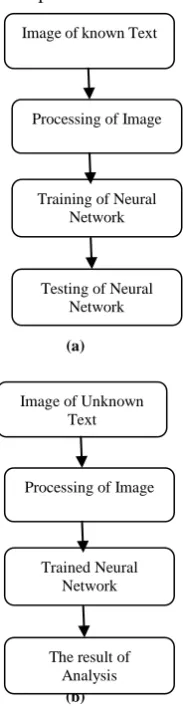
Neural network is first trained by multiple sample images of each alphabet. Then in recognition process, the input image is directly given to neural network and recognized symbol is outputted. Although even best of the recognition approaches are able to recognize all those texts that human can. Major reason for this has been wide variation in writing practices and styles of different people and lot of context based information that human brain uses to interpret any text sample.
(a)
[image:4.595.126.218.398.754.2](b)
Figure 4 The main steps of a) first part and b) second part of Feed Neural Network method
C. Support Vector Machines
The objective of any machine capable of learning is to achieve good generalization performance, given a finite amount of training data, by striking a balance between the goodness of fit attained on a given training dataset and the ability of the machine to achieve error-free recognition on other datasets. With this concept as the basis, support vector machines have proved to achieve good generalization performance with no prior knowledge of the data. The principle of an SVM is to map the input data onto a higher dimensional feature space nonlinearly related to the input space and determine a separating hyperplane with maximum margin between the two classes in the feature space[22]. A support vector machine is a maximal margin hyperplane in feature space built by using a kernel function in gene space. This results in a nonlinear boundary in the input space. The optimal separating hyperplane can be determined without any computations in the higher dimensional feature space by using kernel functions in the input space. Commonly used kernels include:-
1. Linear Kernel:
K(x, y) = x.y
2. Radial Basis Function (Gaussian) Kernel :
( ) ( )
3. Polynomial Kernel:
K(x, y) = (x.y + 1)d
An SVM in its elementary form can be used for binary classification. It may, however, be extended to multiclass problems using the one-against-the-rest approach or by using the one-against-one approach. We begin our experiment with SVM’s that use the Linear Kernel because they are simple and can be computed quickly. There are no kernel parameter choices needed to create a linear SVM, but it is necessary to choose a value for the soft margin (C) in advance. Then, given training data with feature vectors xi assigned to class yi € {-1,1} for i = 1,……l, the support vector machines solve
( (
) )
Where ξ is an l-dimensional vector, and ω is a vector in the same feature space as the xi . The values ω and b determine a hyper plane in the original feature space, giving a linear classifier. A priori, one does not know which value of soft margin will yield the classifier with the best generalization ability. We optimize this choice for best performance on the selection portion of our data.
D. Particle Swarm Optimization
The Particle Swarm Optimization algorithm design by Kennedy and Eberhart in 1995. PSO is a population-based searching method which imitates the social behavior of bird flocks or fish schools.
Image of known Text
Processing of Image
Training of Neural Network
Testing of Neural Network
Image of Unknown Text
Processing of Image
Trained Neural Network
The result of Analysis
International Journal of Emerging Technology and Advanced Engineering
Website: www.ijetae.com (ISSN 2250-2459,ISO 9001:2008 Certified Journal, Volume 4, Issue 9, September 2014)
790 In PSO population and the individuals are called a “swarm” and “particles”, respectively. Each particle moves in the swarm with a velocity that is adjusted according to its own flying experience and retains the best position it has ever encountered in memory. The best local and global positions ever encountered by all particles of the swarm are also communicated to all other particles. The popular form of particle swarm optimizer is defined in the following equations and in the flow chart in Figure 5 [11][13].
( ) ( ) ( ( ) ( ))
( ( ) ( )) (1)
( ) ( ) ( ) (2) Where:
: is the velocity of particle i along dimension d. : is the position of particle i in dimension d.
: is a weight applied to the cognitive learning portion. : is a similar weight applied to the influence of the social learning portion.
, : are separately generated random numbers in the range of zero and one.
[image:5.595.316.571.250.372.2]W: is the inertia weight.
Figure 5 PSO Flow Chart
V. PERFORMANCE EVALUATION
The performance evaluation shows the the result of different methods for handwritten devnagari characters recognition. As till date no standard dataset is available for Handwritten Devnagari Characters we collected some samples from ISI. Table shows the compression between the SVM and neural network method accuracy on ISI dataset.
Table 1.
Results of SVM and ANN on ISI dataset
[image:5.595.58.275.437.753.2]Table 2 shows the different results for the all the above methods which used by given authors in there paper for the handwritten devnagari characters recognition. It also shows the accuracy of all the methods for character reorganization.
Table 2. Comparison of Results
SR. NO
Method purposed by Accuracy
1 Kumar and Singh [24] 80%
2 N. Sharma, U. Pal, F. Kimura, and S. Pal [25]
80.36%
3 M. Hanmandlu, O.V. R. Murthy, V.K.
Madasu[26]
90.65%
4 S. Arora, D. Bhattacharjee, M. Nasipuri,
[18]
92.80%
5 U. Pal, N. Sharma, T. Wakabayashi and F. Kimura [27]
95.13%
Table 3.
Comparison of Results for different methods
SR. No
Proposed By Method Accuracy
1 Sushama Shelke [28]
Neural Network 94.22 %
2 Vedgupt Saraf [29]
Genetic Algorithm
97.68%
3 Sandip Arora
[18]
SVM 94.77%
4 C.Namrata Mahender[30]
[image:5.595.169.555.452.773.2]International Journal of Emerging Technology and Advanced Engineering
Website: www.ijetae.com (ISSN 2250-2459,ISO 9001:2008 Certified Journal, Volume 4, Issue 9, September 2014)
791 VI. CONCLUSION
This paper has attempted to review a significant number of papers to cover the recent development in the field of handwritten devnagari characters recognition. Present study reveals that various methods have been used. It includes a Genetic Algorithms, artificial neural networks, support vector machines (SVM), genetic algorithm, particle swarm optimization (PSO) algorithm and many other. The list of references to provide more detailed understanding of the approaches described is enlisted. We apologize to researchers whose important contributions may have been overlooked.
REFERENCES
[1] Brijmohan Singh, Ankush Mittal ” An Evaluation of Different Feature Extractors and Classifiers for Offline Handwritten Devnagari Character Recognition” Journal of Pattern Recognition Research 2 (2011) 269-277.
[2] Srihari SN, Ball G (2008) An assessment of arabic handwriting recognition technology. CEDAR Technical Report, TR-03-07. [3] Yin F, Liu C-L (2009) Handwritten Chinese text line segmentation
by clustering with distance metric learning. Pattern Recogn 42(12):3146–3157
[4] C.-L. Liu, K. Nakashima, H. Sako, H. Fujisawa, Handwritten digit Recognition: benchmarking of state-of-the-art techniques, Pattern Recognition, 36(10): 2271-2285, 2003.
[5] C. Anton, C. Ştirbu ,“ Identify Handwriting Individually Using Feed Forward Neural Networks” at International Journal of Intelligent Computing Research (IJICR), Volume 1, Issue 4, December 2010
[6] U. Pal, R. K. Roy, K. Roy, and F. Kimura, “Indian Multi Script Full Pin-code String Recognition for Postal Automation”, Proc. 10th Int. Conf. Document Analysis and Recognition, Barcelona, Spain, Jul. 26-29, 2009, pp. 456-460.
[7] B. B. Chaudhari, Digital Document Processing - Major Directions and Recent Advances, Springer, London, 2007.
[8] Simone Marinai, and Hiromichi Fujisawa, Machine Learning in Document Analysis and Recognition, Springer-Verlag, Berlin Heidelberg, 2008.
[9] U. Pal, and B. B. Chaudhari, “Indian Script Character Recognition: a Survey”, Pattern Recognition, vol. 37, 2004, pp. 1887-1899. [10] Utpal Garain, and B. B. Chaudhuri, “Segmentation of Touching
Characters in Printed Devanagari and Bangla Scripts using Fuzzy Multifactorial Analysis”, IEEE Trans. Systems, Man and Cybernetics-Part C, Applications and Reviews, vol. 32, no. 4, 2002, pp. 449-459.
[11] Moraglio, A., C. Di Chio, J. Togelius, and R. Poli. 2008. “Geometric particle swarm optimization.” Journal of Artificial Evolution and Applications ID 143624, 14 pages.
[12] D. Ghosh, T. Dube, and A.P. Shivaprasad, Script Recognition – A Review. IEEE Trans. Pattern Analysis & Machine Intelligence, vol. 32, no. 12, pp. 2142 – 2161, 2010.
[13] M. ALI ABED,“Simplifying Handwritten Characters Recognition Using a Particle Swarm Optimization Approach” at EUROPEAN ACADEMIC RESEARCH, VOL. I, ISSUE 5/ AUGUST 2013 [14] P.Y. Simard, D. Steinkraus, J.C. Platt, Best practices for
convolutional neural networks applied to visual document analysis, Proc. 7th ICDAR, Edinburgh,UK, 2003, Vol.2, pp.958- 962.
[15] Satish Kumar and Chandan Singh, “A Study of Zernike Moments and its use in Devnagari Handwritten Character Recognition”, Intl.Conf. on Cognition and Recognition, pp. 514- 520, 2005. [16] U. Bhattacharya, B. B. Chaudhuri, R. Ghosh and M. Ghosh, “On
Recognition of Handwritten Devnagari Numerals”, In Proc. Of the Workshop on Learning Algorithms for Pattern Recognition (in conjunction with the 18th Australian Joint Conference on Artificial Intelligence), Sydney, pp.1-7, 2005.
[17] J. Hertz, A. Krogh, R.G. Palmer, ”An Introduction to neural Computation”, Addison-Wesley (1991)
[18] S. Arora, D. Bhattacharjee, M. Nasipuri, M.Kundu, D.K. Basu, “Application of Statistical Features in Handwritten Devnagari Character Recognition”, International Journal of Recent Trendsm in Engineering[ISSN 1797-9617], IJRTE Nov 2009
[19] Sumetphong C. and Tangwongsan S., Recognizing broken characters in Thai Historical documents, Proceedings of the 3rd International Conference on Advanced Computer Theory and Engineering, Vol. 1, pp 99-103, 2010.
[20] U. Kre¼el, J. SchÄurmann, Pattern classification techniques based on function approximation, Handbook of Character Recognition and Document Image Analysis,H. Bunke and P.S.P. Wang (eds.), World Scientific,1997, pp.49-78.
[21] J. Franke, Isolated handprinted digit recognition,Handbook of Character Recognition and Document Image Analysis, H. Bunke and P.S.P. Wang (eds.), World Scientific, 1997, pp.103-121. [22] Gerardo Miramontes-de Le´on, Arturo Moreno-B´aez,
“Assessment in subsets of MNIST Handwritten Digits and their Effect in the Recognition Rate”, Journal of Pattern Recognition Research 2 (2011) 244-252
[23] C.-L. Liu, M. Nakagawa, Evaluation of prototype learning algorithms for nearest neighbor classifier in application to handwritten character recognition, Pattern Recognition, 34(3): 601-615, 2001.
[24] Satish Kumar and Chandan Singh, “A Study of Zernike Moments and its use in Devnagari Handwritten Character Recognition”, Intl.Conf. on Cognition and Recognition, pp. 514- 520, 2005. [25] N. Sharma, U. Pal, F. Kimura, and S. Pal, ” Recognition of
Off-Line Handwritten Devnagari Characters Using Quadratic Classifier”, ICVGIP 2006, LNCS 4338, pp. 805 – 816, 2006. [26] M. Hanmandlu, O.V. Ramana Murthy, Vamsi Krishna Madasu,
“Fuzzy Model based recognition of Handwritten Hindi characters”, IEEE Computer society, Digital Image Computing Techniques and Applications , 2007
[27] U.Pal, N. Sharma, T. Wakabayashi and F. Kimura, “Offline Handwritten Character Recognition of Devnagari Script”, In Proc. 9th International Conference on Document Analysis and Recognition, 2007, pp. 496-500.
[28] Sushama Shelke,” A Multistage Handwritten Marathi Compound Character Recognition Scheme using Neural Networks and Wavelet Features”, at International Journal of Signal Processing, Image Processing and Pattern Recognition Vol. 4, No. 1, March 2011
[29] vedgupt saraf, “offline handwritten character recognition of devnagari script using genetic algorithm for improve efficiency”, at international conference on computer science and engineering, 28th april-2013, bangaluru, isbn: 978-93-83060-05-4