1071
A STUDY ON iBiz.FS ARCHITECTURE DESIGN FOR
ESTABLISHING ELECTRONIC FINANCE SYSTEM
1KYUNG-MO KOO, 2*KOO-RACK PARK, 3DONG-HYUN KIM
1Dept. of Multimedia Engineering, Kongju National University, 31080, Rep. of Korea 2*Dept. of Computer Science & Engineering, Kongju National University, 31080, Rep. of Korea
3Dept. of Computer Engineering, Kongju National University, 31080, Rep. of Korea
E-mail: 1[email protected], 2*[email protected], 3[email protected]
ABSTRACT
Recently, financial institutions regard the role of bank branches as important but the cases of branches' closure and integration are occurring more often. Also electronic finance related services of financial institutions are migrating to further diverse and complicated shape, and customers' dependence on system is abruptly increasing. Accordingly, accurate processing of transaction data produced from the system and the security thereof shall be deemed as very important factors. In order to establish this system, it is necessary to set up the system with further systematic and standardized element. In this regard, this thesis proposes the architecture design methodology suitable to establishment of electronic finance system based on information engineering design methodology. The development methodology proposed herein is equipped with efficient and standardized structure, and is expected to enable establishment of speedy and stable system by software design based on application architecture. The verification result of the proposed design methodology shows the effect of reducing the number of duration days by 13.2%, and cost reduction by 15.1%. Through the proposed architecture design methodology, the ground for systemic design at even high level in the area to establish electronic finance system would be introduced, and through this system development period would be accelerated and development costs would be saved. By application of further systematic standardization in development of electronic finance system, high quality system could be developed. As the direction for future study, studies are required for additional analyses on technology and security architecture applicable to electronic finance system. Through these analyses, further studies on flexible expandability and systematic practice architecture application method shall be maintained.
Keywords: Application Architecture, Information Engineering Methodology, e-Bank System, Software
Development Standard, Message Processing Method, Framework, Business Process
1. INTRODUCTION
Recently, financial institutions regard the role of bank branches as important but the cases of branches' closure and integration are occurring more often. This is based on the satisfaction level of e-banking to customers such as smart banking. Actually since 1990s, e-banking has evolved as the main distribution channel of financial institutions [1].
As numerous financial institutions are actually providing diverse services through e-banking, this service has evolved as the indispensable service to enhance customer satisfaction level and relationship with customer,
and secure customer loyalty to the bank [2]. At the center of providing these services is the development of internet. One of the important areas of application is regarded as the scope of bank related financial institutions [3].
1072 As financial institutions' e-banking related services are developing abruptly these days, their dependence upon e-banking is ever increasing and continuously growing. Due to complexation in products and service and enlargement of financial institutions, e-banking system is on the trend to complexation and complication. Within these financial environment, speedy establishment of e-banking system is required to provide efficient services.
However, system setup requires much costs and time, precluding any tolerance of defect. To resolve this issue, it is deemed mandatory to apply the development methodology that enhances the productivity and quality of software development quality and the satisfaction level in works. Recent systems compose the system with standardized and systemic components, using the architecture design based on the design drawing concept [6].
In this regard, this study proposes e-banking architecture design methodology based on information engineering design methodology for the purpose of cost savings and minimization of development manpower and development period in development of e-banking SW for system establishment. The proposed architecture design methodology is equipped with the stability indispensable to e-banking system development and establishment, with standardized and efficient structure for rendering services through various channels.
And application to the system within a short period is expected by standardized software design based on the application architecture.
2. RELATED WORK
2.1 e-Banking
Thanks to development of internet, electronic commerce, telecommunication technology and extended demand from customers for electronic finance, various business opportunities have come to numerous enterprises including financial institutions [7].
This e-banking provides many benefits to both banks and customer due to the following two reasons [8].
Firstly, banks can save the operational costs greatly, through e-banking services, and the online banking channel has been proved as the
channel for banks to introduce and sell bank products at very minimal expenses.
Secondly, financial institutions have opened the way to reduce branches as the channel capable of self-services, and the number of banking staff can be reduced through this channel.
However, not all bank customers use e-banking services, and the reason can be classified as the following three categories. First, before use of services such as internet and mobile banking, customer shall access internet, and new online user shall learn how to use such services. Second, there are users who feel difficulties in understanding online banking, and they feel unsatisfied with lack of opportunities to face the staffs enrolled to financial institutions [9],[10].
Third, bank customers are worried at security issue.
2.2 Zachman’s Framework
Zachman Framework is the architecture framework announced by IBM System Journal in 1987[11].
Initially this was presented as information system architecture framework. But this is known to be able to depict various structures such as car, airplane, building etc. as the cell as the logical composing element is general, and has the characteristics to be used in defining enterprise architecture without difficulties thanks to diverse level of abstract painting [12].
According to the Zachman Framework, a single system may be depicted by (5X6) matrix defined as two axes of focus for perspective/ modeling and realization per stakeholder, in other words 30 cells in total.
Perspective is classified into 5 areas of Planner (Scope), Owner (Enterprise Model), Designer (Technology Model), Sub-Contractor (Components, Functioning System). The focus is classified into 6 areas by 5W and 1H principle of What (Data), How (Function), Where (Network), Who (People), When (Time), Why (Motivation).
Also, depiction by consistent language is possible, and the relationship between each cell can be standardized using the conceptual graph that is capable of mapping with this framework as the symbolic logic [13].
1073 Most methodologies of system development provide a single development path in the lifecycle of system, and faces many difficulties in application of consistent development method according to diverse situations. The information engineering methodology is good at maintaining overall structure and select proper development path according to individual situation, in response to these difficult situations [14].
James Martin's information engineering methodology is the methodology that facilitates the processing of individual data sourced at other time and place by multiple software development teams and integration of decision making system etc., with the capacity to establish system and automation of integration work [15], also, information engineering methodology uses engineering technics to grasp the information and works needed by enterprises and to model these in systemic, effective and holistic way, and to develop into system form within a short period, and is the automation oriented method through systemization of work procedures.
In comparison with other methodologies, this method accepts cutting-edge method and technics for the purpose of materiality of application and user friendliness.
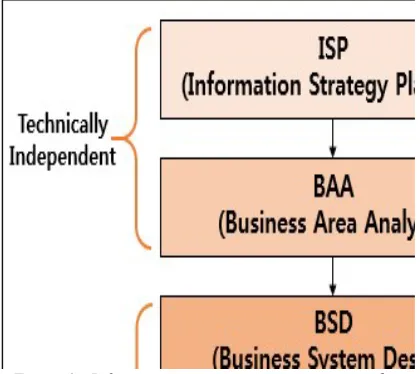
[image:3.612.311.523.156.525.2]Implementation contents of information engineering design methodology at each stage comprises information strategy plan, work scope analysis, work system design and system establishment. The following [Figure 1] is the implementation hierarchy diagram by information engineering stage.
Figure 1 : Information engineering execution step-by-step flow
[image:3.612.91.301.512.699.2]The following [Table 1] is the arrangement of the information engineering methodology by stage.
Table 1 : Information Engineering Methodology
Step Contents
Information Strategy Planning
∙ Management Strategy
∙ Related Organization,
∙ Work Data Macroscopic Analysis
∙ Evaluation of the Current System
Business Area Analysis
∙ Data Modeling
: Entity Relationship Diagram(ERD)
∙ Process Modeling
: Process Hierarchy Diagram(PHD)
∙ Process Modeling
: Data Dependent Diagram(PDD)
∙ Process Modeling : Data Flow Diagram(DFD)
Business System Design
∙ Definition of Business Procedure
∙ Designing the Presentation
∙ Distributed Design
System
Construction ∙ Application Program Coding
This methodology provides strategically recognizing opportunity and methods for securing competitive edge based on software engineering, capable of establishment of consistent and unified information system, applicable to long term evolution and development of system.
2.4 The IEEE 12207 Standard for Information Technology-Software Life Cycle Processes
IEEE 12207 standard establishes the framework for software lifecycle process, and provides the terminology defined to be used by all stakeholders [16].
1074 services. Also this standard includes the whole lifecycle stage such as supply, development, operation and maintenance of software. The dependence at the process defined by IEEE 12207 standard and stratified architecture is as follows.
The highest stratum includes 5 classes of basic lifecycle process defined by the standard, which are procurement, supply, development, operation and maintenance processes. 8 other support processes defined at medium stratum is defined to support the basic process and management process at the highest stratum, hence the dependence between processes are designated. For example, acceptance process and supply process mutually operates to establish the project contract, to commence management process.
And the management process manages the development, operation and maintenance process. Also operation process varies according to their dependence on the maintenance process to correct any error revealed and the development process for redevelopment of composing elements that requires significant change subsequently [17].
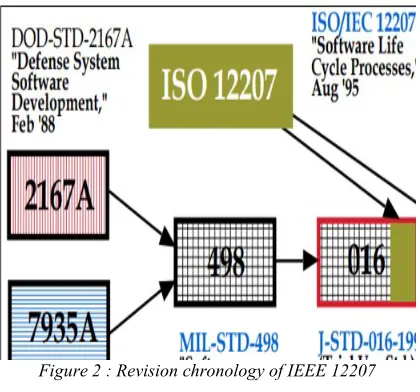
[image:4.612.313.524.127.313.2]The following [Figure 2] is the revision chronology of IEEE 12207.
Figure 2 : Revision chronology of IEEE 12207
3. iBiz.FS ARCHITECTURE DESIGN
3.1 Development methodology related process
The following [Figure 3] is the structural view on the development methodology based on electronic finance.
The purpose of development methodology is to enable realization of more stable and systematic system. Through this, establishment of consistent and more standardized system is possible. This is the development methodology
based on data focused specialized processing method specialized in electronic finance.
Figure 3 : Structural view on development methodology of electronic finance
The purpose of development methodology is to enable realization of more stable and systematic system. Through this, establishment of consistent and more standardized system is possible. This is the development methodology based on data focused specialized processing method specialized in electronic finance.
[image:4.612.91.301.405.601.2]Detailed overall procedure of the development methodology presented by this study is shown at the following [Table 2], comprising mainly 5 stages.
Table 2: Detailed procedure of development methodology
Step Contents
Concept Design (CD)
∙ User System Environment Analysis (USEA)
∙ Task Concept Analysis (TCA)
∙ Task Flow Analysis (TFA)
Logical Design (LD)
∙ Task Detail Design (TDD)
∙ User Interface Design (UID)
∙ Message Structure Design(MSD)
∙ Database Design (DbD)
∙ Standardization Rule (SR)
1075
Physical Design (PD)
∙ Program List/Spec (PLS)
∙ Storyboard Detail (SbD)
∙ Database Created (DbC)
∙ Code Design (CdD)
Implementation Design (ID)
∙ Program Coding (PC)
∙ Implementation Test (IT)
Based Design (BD)
∙ Concept Design
∙ Logical Design
∙ Physical Design
∙ Platform
∙ iBiz.FS Architecture
Firstly at concept design, structure chart of existing system and related materials are requested and analyzed for application of new project, and the user environment for user of relevant project is grasped. The concept on major duties of overall project is prepared in diagram. The sequential flow of work flow (series of events) or transactions is briefly stated.
Secondly in design of logic, sequential flow of duty flow (series of events) or transactions is defined as the message flow between objectives, and how to give and take message between the objectives is modeled. The color chip, story board etc. to design the screen is prepared. Also, the special structure of designed to exchange materials between host and relay servers.
[image:5.612.88.300.72.292.2]Through the results from mapping result at analytical stage and data modeling, the preparatory design is made to create actual physical schema. Efficient management and easy understanding is regularized so as to be added to program source, table and field item etc. By defining integration and system test plan and scenario at this stage, the accuracy and efficacy of test is enhanced to system stability and reliability.
Thirdly at physical design, system database is established suitably to actual operational environment, so as to put the system at use. Program module and common module are composed in practicable code, and source code and design is allocated according to each program list.
Fourth at realization design, test case is selected on physical source code, table is prepared on the performed items and anticipated test results. Whether actual result is identical is confirmed and
stated. For any rest result with error, the contents of error correction are separately managed and stated.
Fifth at basic design, the platform for work and system is designed, and module packaging work is performed for smooth telecommunication.
3.2 Data focused specialized processing method
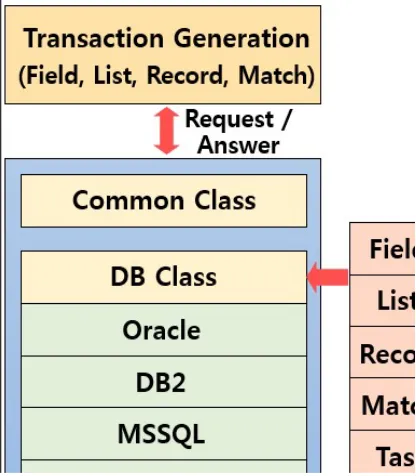
Data focused specialized processing method performs a very important role in electronic finance system. Financial system requires stability and standardization at rather high level. The standardization of program entry/exit is managed by control of data I/O by rule (specialized regulation) at the transaction based process realized by pure Java capable of application in integration to various channel work, by the specialized processing method following the message transmission /receiving for processing of transaction based online work.
The following [Figure 4] is the structural diagram in message processing method. Upon any request for interface with protocol in this class, application is possible easily with related adapter only. The created rule is used together in business logic, facilitating development.
Figure 4 : Structural diagram of message processing method
[image:5.612.314.522.419.657.2]1076 in the support system area as the rule interface in the presentation scope of integration system.
The specialized processing method is composed of the engine that manages transaction I/O rule systematically and the database related part that informatizes it, and the part to export rule information to the repository.
[image:6.612.90.302.218.706.2]The following [Figure 5] and [Figure 6] shows the standard message layout.
Figure 5 : Specialized standard layout(1)
Figure 6 : Specialized standard layout(2)
The definition of layout on data focused specialized structure design is made in common part form by processing zone, for the sake of smooth interface of electronic finance common network under the Korea Financial Telecommunications and Clearings Institute.
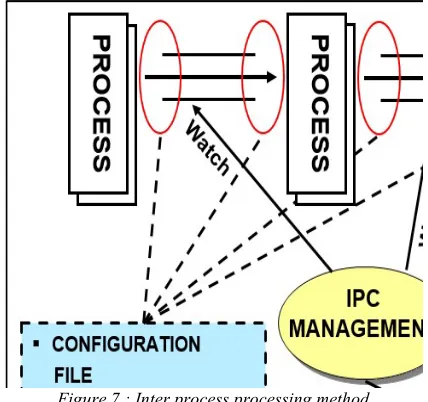
[image:6.612.311.525.233.434.2]The following [Figure 7] shows the processing method between processes. The data focused message processing method is managed in the form of IPC (iBiz.FS Process Control) and file system between processes.
Figure 7 : Inter process processing method
IPC operation management uses inter-process standard message. The message type between transaction and system signal is differentiated in processing. Also shared memory and Semaphore operation is possible, managing the monitoring in IPC section and transaction log.
File system operation is composed of component file, transaction log file for management. Error log file is operated by inter-process standard message.
In case of telecommunication by protocol, port number is granted dynamically by server system. The port number granted by server system is transmitted to UDP (User Datagram Protocol) at client system. The client system requests for access to the port number received from server. Upon normal access, repeated message is requested subsequently since then. In case of no further message or termination of access, termination is possible at whatever process zone without any differentiation of server or client.
1077 receiving message, processing is implemented in the way to transmit and receive the length of initial message firstly and then to transmit and receive the remaining message to the extent of the length of the initial message.
3.3 Core based design iBiz.FS
[image:7.612.91.299.199.464.2]The following [Figure 8] is the architecture structure of iBiz.FS.
Figure 8 : Structural diagram of iBiz.FS architecture
iBiz.FS (integrated Business & architecture Framework Service) is the channel integration architecture to manage various channels more efficiently. iBiz.FS is expandable, supports various telecommunication protocol and operational environment to compose free architecture, and enables preservation of existing system investment resources as well as integration work between heterogeneous system in safe and speedy way. Also through various telecommunication relay management architecture, stable and standard establishment of electronic finance system is possible.
The iBiz.FS as the core based design has the characteristics of expandability, process management, system and network control function. The iBiz.FS is capable of processing through business logic component, by managing input and output of data by rule at the transaction based processes such as various channels (Internet, CD/ATM, PDA, Mobile, B2B etc) and by
realization of interface to channel only. Upon request of protocol interface for this class, application is possible easily by related adapter only, and the created rule is used together at the business logic, facilitating development.
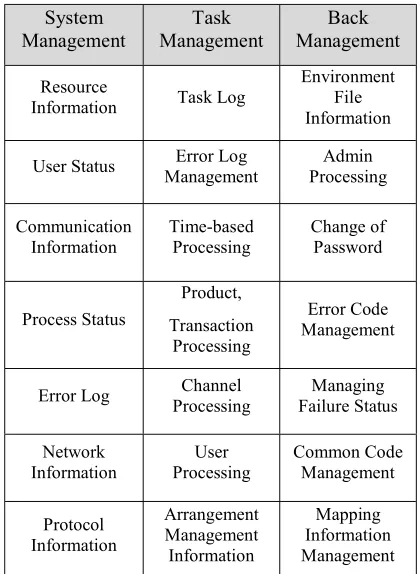
BAL (Business Application Logic) as the major component element to iBiz.FS comprises message mapping element that defines the standard message for transmitting and receiving processing and log controller that stores, manages various log file. Also, there are JOB Scheduling function for processing common work in electronic finance, equipped with controllers processing various transactions as well as monitoring system that verifies and observes the process by each zone. Lastly, the part named system manager is maintained.
[image:7.612.313.523.356.643.2]The following [Table 3] shows the component items of the system manager, which enables detailed composition.
Table 3 : Components of system manager
System
Management Management Task Management Back
Resource
Information Task Log
Environment File Information
User Status Management Error Log Processing Admin
Communication Information
Time-based Processing
Change of Password
Process Status
Product, Transaction
Processing
Error Code Management
Error Log Processing Channel Failure Status Managing
Network Information
User Processing
Common Code Management
Protocol Information
Arrangement Management
Information
Mapping Information Management
Efficient work process is realized, with relevant information such as system management, task management, back management etc. is provided individually or in integration.
1078 information, process management, network management and telecommunication protocol management etc., and is used for predictor basic materials for efficient system management and future system expansion.
Also, system conditions such as utilization ratio of CPU, Memory, Disk, network status and error information etc. can be monitored. The task management provides online transaction information, in other words the task and error log, user, date, processing information by region etc, and can be used actively for user response in future. Also reference to placement process by type is provided. Back management provides the various back support information needed by total manger or partial manager, in intuitive and highly useful GUI environment, and supports materials for various reports.
3.4 Composition of implementation
architecture logic
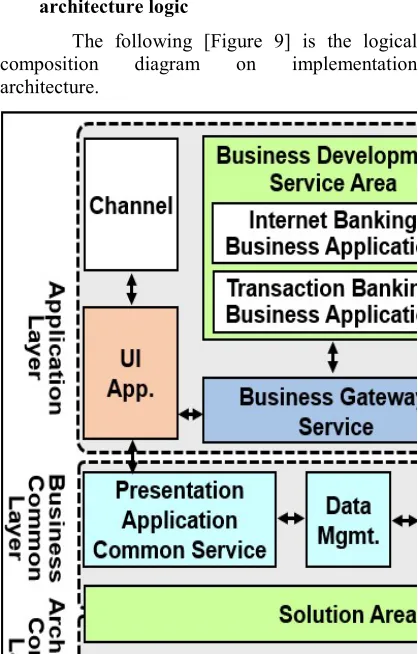
[image:8.612.90.299.333.660.2]The following [Figure 9] is the logical composition diagram on implementation architecture.
Figure 9 : Logical composition diagram of architecture
Implementation architecture is composed of 4 layers logically. The electronic finance system is composed of detailed areas of business common
layer and application layer in standardized system, upon the integration framework as the base design
The detailed contents of implementation architecture are as follows.
• AppL (Application Layer) : Development module set for component processing various e-business channel is provided. Customer settlement banking services such as reference, transfer, loan, credit card, electronic settlement, escrow etc. are provided.
This is the area to interface web environment and media used, and is edited and managed reflecting the business process by UI (User Interface) application. The application by domain is implemented by composition and assembly of common components supported at the Presentation Common Service Area as the interface area contacting users. Also, by establishment of various business Pool serviced by browser channel, basic unit service is provided.
1079 user only. For any duplicated work, by linking common page registered on repository Pool by screen composition, duplication of code can be minimized. These processing logic enables easy composition of menu for dispersed sites without separate coding, thanks to menu control on the whole sites enabled through management console. By providing tree shape screen like the searcher familiar to manager, intuitive work is possible and composition of menu can be verified easily at a glance.
• ArchCL (Architecture Common Layer) : J2EE (Java 2 Enterprise Edition) Integrated development environment is supported through development tool for standard base integration framework, component architecture, code standardization, shape management, build automation. In the common component area, noticeboard instance is dynamically created, corrected and deleted, creating and processing various types of noticeboard component. Contents can be registered using integration search plug-in and multi-function editor. Also, pre-determined common components are composed in relation to the business required for SOA based web application. The security component composes the security related components that shall inevitably be used in finance related web application such as certification, encryption, SSO etc. Regarding processing of client related common component, page sources created in XML are compressed for management, each source is versioned for packaging processing, and the source composed of Javascript is analyzed to run Applet. For data processing, table component is used to load data and various document types are separated by extension for storage.
• AdmL (Administrator Layer) : This can perform system management, operation management and support work on risk/issue management etc., and provides management services on project output, schedule, report, information. The operation architecture is located in AdmL in the composition of business framework, supports the electronic finance related system in the system operation management scope in integration using framework functions. Also this is realized focused on major tasks such as system monitoring and set up management, work automation, convenience in composition management, backup composition and operation, response to obstacle etc. Especially in case of AdmL, system monitoring observes the function of electronic finance system including obstacle sensing function, all users, and
transactions. This observes the response time within the whole zones, and measures page processing time in real time. Also this measures user browser processing time, network server, and even creating time in real time. Monitoring of measurement object verifies the status of use information such as the number of calling whole page, client/server data traffic and Realized bandwidth, number of users accessed, number of HTTP requests etc., from application viewpoint. Function information center monitors number of creating slow pages, function indicator, number of users affected, number of creating slow HTTP sessions, average response time, and average page size. Lastly, this monitors the number of stopped pages, number of TCP and HTTP errors, availability indicator of TCP and HTTP.
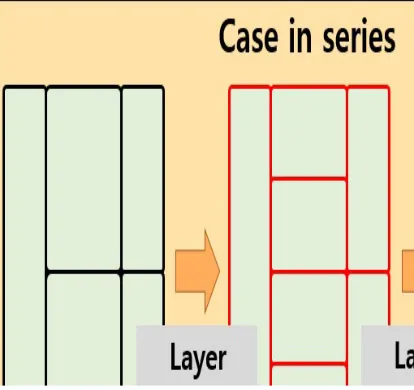
The following [Figure 10] shows the physical structure expansion in series on availability of system expansion
[image:9.612.315.522.412.607.2]This facilitates easy system expansion such as flexible architecture, business integration and independence, development environment with high productivity, speedy work application, interface and protocol support, various channel integration etc.
Figure 10 : Physical structure expansion in series
1080 of future system expansion due to added business logic and increased customers.
4. EXPERIMENTS AND DISCUSSION
The architecture design methodology proposed in this thesis is equipped with the stability indispensable to development and establishment of electronic finance system, with standard and effective structure.
In order to verify the proposed architecture design methodology, the acting level organization comprising 35 system integration project manager and software designers performed the verification procedure.
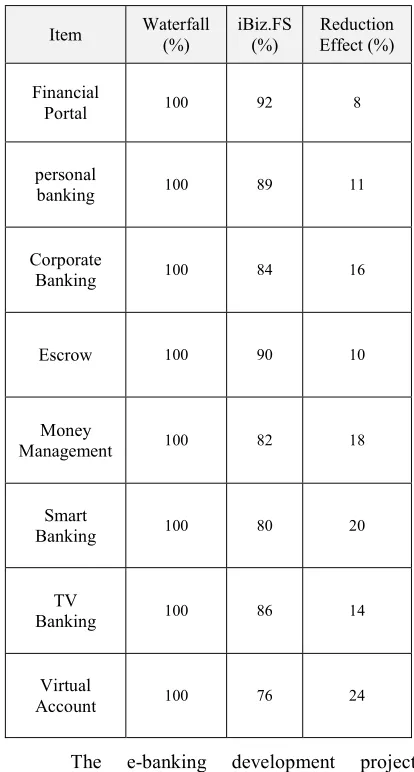
The following [Table 4] and [Table 5] shows the comparison of the number of days spent and costs incurred, between the waterfall model as the traditional development methodology and the iBiz.FS development methodology as the proposed method.
[image:10.612.314.521.98.484.2]The verification result shows the effect of reducing the number of days spent by 13.2%, and cost savings by 15.1%.
Table 4 : Number of days spent for development and establishment
Item Waterfall (%) iBiz.FS (%) Effect (%) Reduction
Financial
Portal 100 90 10
personal
banking 100 95 5
Corporate
Banking 100 95 5
Escrow 100 92 8
Money
Management 100 75 25
Smart
Banking 100 78 22
TV
Banking 100 89 11
Virtual
[image:10.612.93.297.391.703.2]Account 100 81 19
Table 5 : Costs Incurred For Development And Establishment
Item Waterfall (%) iBiz.FS (%) Effect (%) Reduction
Financial
Portal 100 92 8
personal
banking 100 89 11
Corporate
Banking 100 84 16
Escrow 100 90 10
Money
Management 100 82 18
Smart
Banking 100 80 20
TV
Banking 100 86 14
Virtual
Account 100 76 24
The e-banking development project requires a development methodology to improve productivity, quality improvement, and availability of software development. However, how to develop that waterfall is applied to solve the problem.
The proposed model is an intermediary platform that integrates e-banking and can integrate various channels and transactions.
In addition, communication relay between systems and protocols of other models, application integration support through standard API, system monitoring function, and broker function between transaction messages can be realized, and business logic integration and network simplification can be realized.
1081 rule, it is possible to process through the business logic component simply by implementing the interface.
Therefore, when applied to the e-banking development project, the proposed model has the ability to reduce the number of days required for development and the development cost compared with the conventional waterfall model, and it has a systematic standard plan, it is possible to guarantee a higher level of reliability and expandability.
5. CONCLUSION
Recently numerous changes are occurring due to abrupt development in electronic finance services by financial institutions. The dependence on the electronic finance system has risen to a very high level, and is advancing continuously. Accordingly, electronic finance system is further complicated and enlarged.
However, much efforts and investment costs are incurred for establishment of electronic finance system suitable to the diversely changing finance environment. In this regard, it is necessary to compose the system with systematic and standardized elements, and adopt the architecture design technology based on design diagram concept based on principles and guidance, in design and establishment of electronic finance system. In this regard, this thesis proposes iBiz.Fs that is the architecture design methodology suitable to development of electronic finance system based on information engineering design methodology.
The verification result of comparison between the waterfall model as the traditional development methodology in 7 electronic finance fields and the iBiz.FS development methodology as the proposed method, shows the effect of reducing the number of days spent by 13.2%, and cost savings by 15.1%, during system development and establishment. With the ibiz.FS architecture as the proposed methodology, it is anticipated that stable electronic finance system would be established.
In the future, additional analyses are required on the technology and security architecture applicable to electronic finance system. Through these analyses, further studies on flexible expandability and systematic implementation architecture application method are needed consistently.
REFRENCES:
[1] Karjaluoto, H., Mattila, M. and Pento, T., “Factors underlying attitude formation toward online banking in Finland”, International
Journal of Bank Marketing, Vol. 20 No. 6, 2002,
pp. 261-272.
[2] Liébana-Cabanillas, Francisco, Francisco Munoz-Leiva, and Francisco Rejón-Guardia. “The determinants of satisfaction with e-banking”, Industrial Management & Data
Systems, Vol. 113, No. 5, 2013, pp. 750-767.
[3] M.M Anuar, F. Adam, and Z. Mohammad, “Muslim consumers’ perception on Internet Banking services”, International Journal of
Business and social Science, Vol. 3, No. 5, 2012,
pp. 63-71.
[4] M. P. Neghab S. M. Heravi and M. Kahani, “Simulation and Optimization of Affective Causes on Quality of Electronic Services”,
Journal of Mathematics and Computer Science,
Vol. 7, 2013, pp. 23-32.
[5] R.A. Gbadeyan and O.O. Akinyosoye-Gbonda, “Customers’ Preference For E-Banking Services: A Case study of Selected Banks in Sierra Leone”, Australian Journal of Business
and Management Research, Vol. 1, No. 4, 2011,
pp. 108-116.
[6] K. M. Koo , J. W. Kim , K. R. Park, Y. Y. Lee, D. H. Kim, “The Study on Methodology for Establishment and Development of Information Engineering-Based e-Banking System”, The 2nd
International Conference on Computing
Convergence and Applications, August 17-20,
2017, pp. 9-12.
[7] Aderonke, Adesina A., “An empirical investigation of the level of users' acceptance of e-banking in Nigeria”, Journal of Internet
Banking and Commerce, Vol. 15, No.1, 2010.
[8] Pikkarainen, T., Pikkarainen, K., Karjaluoto, H. and Pahnila, S., “Consumer acceptance of online banking: an extension of the technology acceptance model”, Internet Research, Vol. 14, No. 3, 2004, pp. 224-35.
[9] Karjaluoto, H, Mattila, M. and Pento T., “Electronic banking in Finland: Consumer beliefs and reaction to a new delivery channel”,
Journal of Financial Services Marketing, Vol. 6,
No. 4, 2001, pp. 346-361.
[10] Mattila, Minna, Heikki Karjaluoto, and Tapio Pento, “Internet banking adoption among mature customers: early majority or laggards?”,
Journal of services marketing, Vol. 17, No. 5,
1082 [11] John A. Zachman, “A Framework for
Information Systems Architecture”, IBM
Systems Journal, Vol. 26, No. 3, 1987.
[12] John A. Zachman, “Enterprise Architecture: The Issue of the Century”, 1996, www.zafa.com/zafajz01.htm.
[13] Sowa, J. F. and J. A. Zachman, “Extending and formalizing the framework for information systems architecture”, IBM Systems Journal, Vol. 31, No. 3, 1992, pp. 590-616.
[14] James Martin, “Information Engineering Ⅱ”,
Prentice-Hall International, Inc., 1990.
[15] James Martin, “Information Engineering Ⅰ”,
Prentice-Hall International, Inc., 1990.
[16] IEEE Computer Society, “IEEE Standard for Information Technology -- Software Life Cycle Processes”, IEEE Std 12207, 1995.
[17] Ammar, Hany H., Walid Abdelmoez, and Mohamed Salah Hamdi. “Software engineering using artificial intelligence techniques: Current state and open problems”, Proceedings of the
First Taibah University International
Conference on Computing and Information Technology (ICCIT 2012), Madinah