University of Huddersfield Repository
Naveed, Munir, Crampton, Andrew, Kitchin, Diane E. and McCluskey, T.L.
RealTime Path Planning using a SimulationBased Markov Decision Process
Original Citation
Naveed, Munir, Crampton, Andrew, Kitchin, Diane E. and McCluskey, T.L. (2011) RealTime Path
Planning using a SimulationBased Markov Decision Process. Research and Development in
Intelligent Systems XXVIII Research and Development in Intelligent Systems XXVIII . Springer,
London. ISBN 9781447123170
This version is available at http://eprints.hud.ac.uk/id/eprint/11200/
The University Repository is a digital collection of the research output of the
University, available on Open Access. Copyright and Moral Rights for the items
on this site are retained by the individual author and/or other copyright owners.
Users may access full items free of charge; copies of full text items generally
can be reproduced, displayed or performed and given to third parties in any
format or medium for personal research or study, educational or notforprofit
purposes without prior permission or charge, provided:
•
The authors, title and full bibliographic details is credited in any copy;
•
A hyperlink and/or URL is included for the original metadata page; and
•
The content is not changed in any way.
For more information, including our policy and submission procedure, please
contact the Repository Team at: [email protected].
Real-Time Path Planning using a
Simulation-Based Markov Decision Process
M. Naveed, A. Crampton, D. Kitchin and T.L. McCluskey
Abstract This paper introduces a novel path planning technique called MCRT which is aimed at non-deterministic, partially known, real-time domains populated with dynamically moving obstacles, such as might be found in a real-time strat-egy (RTS) game. The technique combines an efficient form of Monte-Carlo tree search with the randomized exploration capabilities of rapidly exploring random tree (RRT) planning. The main innovation of MCRT is in incrementally building an RRT structure with a collision-sensitive reward function, and then re-using it to efficiently solve multiple, sequential goals. We have implemented the technique in MCRT-planner, a program which solves non-deterministic path planning problems in imperfect information RTS games, and evaluated it in comparison to four other state of the art techniques. Planners embedding each technique were applied to a typical RTS game and evaluated using the game score and the planning cost. The empirical evidence demonstrates the success of MCRT-planner.
1 Introduction
Real-Time Strategy (RTS) games are complex real-time concurrent systems where players build societies and engage in simulated combat to capture territory and ex-plore the game world to collect resources. Path planning is a challenging task that is required frequently in RTS games by human or AI players. The key challeng-ing aspects of path plannchalleng-ing problems in RTS games are tight time constraints, limited CPU and memory, partial visibility, and large and dynamic game worlds. These domains require an automated planner to solve planning problems with
deterministic effects. Markov Decision Process (MDP) is a common planning for-malism used to represent planning problems in nondeterministic domains. MDPs can be solved using either Dynamic Programming (DP) [3] or Monte-Carlo Sim-ulations [20]. The current dynamic programming based planners such as mGPT [6] are applicable in domains that are modeled in a specific planning language (e.g. Probabilistic planning domain language) and all transition probabilities in the do-main must be available before planning is started. The transition probabilities are used in DP to calculate the state values. Monte-Carlo (MC) planning requires only a simulation model that can generate a sequence of samples (of states or actions) ac-cording to the desired sampling distribution and a reward function to evaluate them. MC Planning uses the average rewards (of the samples) to estimate action (or state) values rather than using the pre-computed transition probabilities in a stochastic domain. Therefore, MC Planning does not need the availability of transition prob-abilities before the start of planning. The modeling of a RTS game in a planning language is a challenging task. MC planning is suitable for RTS games as it is easy to build a simulator for the game.
The main challenging issue in MC planning is the adjustment of the balance be-tween the exploration of new actions and exploitation of the previously discovered promising actions. A recent MC planning approach called Upper Confidence bounds applied to Trees (UCT) [14] uses the selective action sampling approach to control the trade-off between exploration and exploitation. UCT exploits the best actions to generate the look-ahead search tree in a Monte-Carlo simulation. An action is best if its estimated value is higher than other applicable actions at a state. UCT main-tains exploration by using a domain-dependent constant and the number of times an action is sampled since the start of the simulations. UCT has been an effective planning approach in domains where the reward of the state-action pairs is in the range of [ 0,1] e.g. Go [10]. In RTS games, the action values can be greater than this range [1]. UCT in its original form is not suitable for RTS games. The varia-tions of UCT have been explored in RTS games for tactical assault planning [1] and path planning [19]. In this paper, we extend the work of [19] with the following contributions:
1. We introduce a new domain-independent way of controlling the trade-off be-tween exploration and exploitation in the Monte-Carlo simulations. The new ap-proach combines the exploration feature of rapidly-exploring random trees (RRT [18]) with the exploitation scheme of UCT. The look-ahead tree in a simulation is built by performing exploitation and exploration in a sequence. The new ap-proach is called MCRT search.
2. The paper presents a new path planner - called MCRT Planner - that uses MCRT search. MCRT planner is a real-time path planner that interleaves planning and plan execution. MCRT planner also incrementally builds a tree to reuse the searching efforts.
The experimental results demonstrate the success of MCRT planner over its rival techniques.
2 Problem Formulation
The class of problems we consider are typical of autonomous agent path planning in RTS games. It is assumed an agent knows the size of the world, its position and velocity (collectively called its state), the position of its target goal states, and the set of obstacles that are within the pre set limits of its sight (which takes into account occlusion by obstacles blocking places it would normally see). The set of obstacles include both static and dynamic obstacles. The dynamic obstacles make the agent’s moves non-deterministic. We formulate the path planning problem as a simulation-based Markov Decision Process (MDP) [20]. It is represented as(S,A,T,Q,so,G)
whereSis a finite set of states, Ais a finite set of actions,T is a stochastic state transition function,Q(s,a,h)represents the estimated value of the actiona∈A(s)
over a finite horizonhat states,sois the initial state andGis the set of the goal
states. For any states∈S, we define A(s)to be the set of applicable actions ats
whereA(s)⊂A. The stochastic transition functionT is a function of a state-action pair that randomly selects a next state for the input state-action pair. For example, for the current statesand actiona,Tselects a statesnextrandomly from all successor
states ofsthat are possible to reach witha.
snext=T(s,a) (1)
An actionais encoded as(dx,dy,u)wheredx∈ {−1,0,1},dy∈ {−1,0,1}anduis the speed of the movable agent.V(s)represents the value of the states.The value of a statesis measured using the estimated action values.
V(s) =maxaQ(s,a,h) (2)
The stochastic transition functionT is built using a probability distributionP.Pis used to estimate the transition probabilities in the state space. A transition prob-ability p(si,a,sj)∈P represents the probability of moving an agent to sj when
a∈A(si)is applied at si.P is updated during online planning using a frequency
based approach [2] and is given in (3).
p(si,a,sj) =N(si,a,sj)/N(si,a) (3)
whereN(si,a,sj) is the total number of times action a is selected at si to move
tosj andN(si,a)is the total number of timesais selected atsi since the start of
3 The MCRT Search
MCRT search has been designed to find a new domain-independent way of handling the exploration and exploitation trade-off in the Monte-Carlo simulations and to in-troduce a multi-objective reward function. MCRT search evaluates an action with respect to two objectives. The first objective is to reduce the distance to the goal state and other is to avoid the collision with the static objects. Tuning the domain specific parameters (e.g. UCT uses one parameter) to balance the exploration and exploitation in a domain requires an offline empirical work. Such empirical work is a cumbersome and time-consuming task in RTS games. An investigation to find a domain independent way of managing the exploration and exploitation is crucial for RTS-type domains. Path planning in RTS games is not only required to find the shortest path but also to handle other issues e.g. to avoid areas occupied by static objects or enemy units. Intuitively, a multi-objective reward function is suitable for RTS games.
MCRT is a local search algorithm that is designed for planners that interleave plan-ning and plan execution. MCRT search starts by finding the local search space for the current state of the planning agent. The size of the local space for a state s
is |A(s)|. The value of each neighbouring state in the local space is measured at least once using the Monte-Carlo simulations. The Monte-Carlo simulations are performed for a fixed time duration. The simulation time is independent of the size of the search space. In every simulation, the look-ahead depth is kept finite and fixed to keep MCRT a real-time search method. In the simulations, the non-deterministic transition function is used to estimate the value and effects of sampled action. The value of each state is calculated using (2). At the end of the simulations, MCRT selects the action to move the agent to the neighbouring state that gains the highest value since the start of the simulations. Ties are broken by random selection.
3.1 Algorithmic Details
The MCRT technique borrows the idea of the generic Monte Carlo algorithm given in [14] and integrates it with the RRT sampling technique [18] for applications in path planning. Based on the problem formulation, the current state (i.e.sc), and the
current target goal (g), the MCRT function (Figure 1) returns the action it evaluates to be the most promising. It has access to system parameters that are calculated to take into account the real-time characteristics of the application to which MCRT is applied: the look-ahead depth, the time elapsed and its allowed cycle time. MCRT starts (line 1, Figure 1) by initialising the setSof(state,reward)pairs, wherestate
is a neighbour ofsc, the current state. The repeat loop iterates as long as the
real-time constraints allow. TheChooseNeighbourfunction (line 3) selects whichsnwill
be used for expansion: the choice is initially random from the set of unexpanded neighbouring states of state sc, but once all neighbouring states have been seen it
S. After each call to theRewardSimfunction is made (line 4),S is updated with a new reward value for a particular neighboursn. After the simulations have finished,
line 7 determinessbest, the neighbour with the maximum estimated reward. Line 8
returns the actionawhich is aimed in the direction of neighboursbest. We assume
ais unique as the actions are directional (i.e. only one action atscis for the motion
in the direction of sbest). Key to MCRT is the simulation procedure RewardSim
FunctionMCRT(sc,g)
Read accessdepth,timelimit;
1. S:={(s,0):sis a neighbour ofsc};
2. REPEAT
3. sn:=ChooseNeighbour(sc);
4. rn:=RewardSim(sn,g,depth,1);
5. UpdateSwith(sn,rn)
6. UNTIL(ElapsedTime()>timelimit); 7. find(sbest,rmax)∈S:(s,r)∈S⇒rmax≥r;
8. RETURN the actionathat aims towardssbest
EndMCRT
Fig. 1: High Level Design of MCRT
(Figure 2) which estimates the reward of moving tosn. This is adapted from the
generic Monte Carlo algorithm given in [14]. The latter work introduced a bandit algorithm for this, whereas we adapt the technique to RTS games using a novel reward estimator which takes into account potential collisions, and a static estimate involving distance from the goal.RewardSimexpands a look-ahead tree from the neighbouring statesnof current statesc, by generating random samples of states,
and accumulating rewards as it searches, as explained below. The main recursive
FunctionRewardSim(sn,g,depth,d)
Read accessMDP; 1. IFd6=depthTHEN
2. srand:=RandomSample();
3. a:=SelectAction(sn,srand);
4. [snext,rw]:=SimulateAction(sn,a,g);
5. RETURNrw+RewardSim(snext,g,depth,d+1)
6. ELSE RETURN 1/dist(sn,g)
EndRewardSim
Fig. 2: RewardSim: MCRT Look-ahead Search
loop ofRewardSimstarts in line 2 where a state positionsrandis chosen at random
from any position on the map excluding (i) the agent’s position (ii) the position of any obstacle that the agent can see. An action is selected to progress towards
nearest to srand using the Euclidean metric, and selects an action which is aimed
towards the neighbour ofsn. A statesnextis generated that might be produced by the
execution of this action in theSimulateActionexplained below, and the estimated reward of that state is returned. The recursive call sums a series of rewards for each of the advancing states, with a base case calculating the reward statically as the inverse Euclidean distance fromsto the target. The functionSimulateActionreturns
FunctionSimulateAction(sn,a,g)
Read accessMDP,Wd;
1. snext:=Transition(sn,a);
2. rw:=k{t:p(sn,a,t))>0}k/(Wd∗dist(snext,g));
3. return[snext,rw]
EndSimulateAction
Fig. 3: Simulate Action
a randomly selected statesnextthat the agent may occupy after execution of actiona,
and the estimate of the reward in moving to the new statesnext. The simulator uses
the probability distributionPto estimate the outcome of an action. A statesnextis a
possible new state after the execution of actionaatsifp(sn,a,snext)>0.Transition
(line 1 in Figure 3) assembles a list of the possible new states, and selects the next statesnext randomly from the list, where the random choice takes into account the
probability that the state is reached by the execution ofa. Thus the higher the chance a state would be reached, the more likely it is to be chosen. In line 2 the reward for that state is calculated; the idea is that the larger the list of possible new states is for an action, then the higher the reward. This is based on the intuition that a larger list indicates there are likely to be less obstacles present in that action’s direction of travel (and thus less chance of future collisions). The size of the list is divided bydist(snext,g), the Euclidean distance to the goalg from the new state snext, as
the further away, the less the reward. Finally the reward is given a scaling factor
Wd which normalises the relationship between the collision-free path and distance
to goal: for a particular application of MCRT, this would be tuned to balance the importance of directing towards collision free paths with minimising the Euclidean distance to goal states.
Figure 4 shows a grid example of MCRT search with look-ahead of depth 5. The search starts atSand determines the immediate neighbours ofS(line 1, Figure 1). These neighbours are labeled as 1.1 in Figure 4 (in Figure 4, label X.Y means that the state is produced by Figure X in line Y). IfSis seen for the first time, then a neighbour is selected randomly (line 3, Figure 1). Suppose the randomly chosen neighbour is E2. Then MCRT runs MC simulations (RewardSim) to estimate the reward for the transition from S to E2.RewardSimexpands the look-ahead search using the RRT sampling approach. A state, say C9, is selected randomly at look-ahead depthd=1 from the state space (according to line 2 of Figure 2). An actiona
Fig. 4 An MCRT Example:
Sis the current state,Gis the goal state anddis the look-ahead depth. The cells in Black are the static obstacle.
assumed as the estimated next state of E2 when actionais applied. The simulation also estimates and stores a reward for the state-action pair i.e. (E2,a). The depth of the look-ahead search is increased andRewardSimis run from the next state i.e. D3. An actionaat D3 is selected according to the second random sample, say L7, and simulated to estimate the reward and the next state of D3 with actiona, and this reward is added to the previously stored reward. This process continues until look-ahead search reaches a depth of five. The next state at depth five is a leaf node of the look-ahead search. In Figure 4, G4 is the leaf node of the look-ahead search, and is evaluated using line 6 of Figure 2. The evaluated value is added to the accumulated reward and used as the final value of the reward for the transition fromSto E2. The simulations are continued for the maximum allowed time.
4 An MCRT-based Path Planner
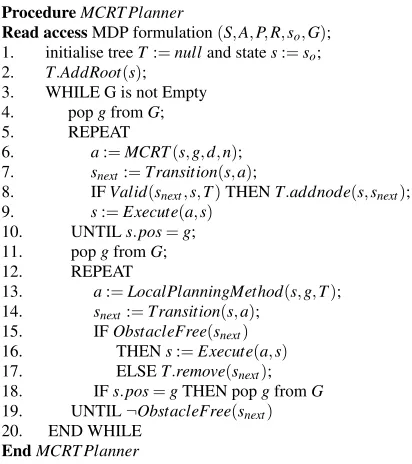
In this section we describe how to embed the MCRT technique into a real-time path planner with a list of goal states to visit. The planner is supplied with information described in the “Problem Formulation” section above, and interleaves planning and execution as follows. Lines 1 and 2 (Figure 5) initialise a RRT tree structure (T). At the start of the planning loop in line 4, “popgfromG” has the effect of assigning
gto the head of listG, and reducingG. IfGis found to be empty, then the “pop” function will exit the loop and the program will end. The planner proceeds in two stages: in the first stage (lines 5 - 10), the RRT tree structure is populated using the MCRT technique, interleaved with action execution (line 9).
The RRT structure T builds up atree of the collision free states of the search space withinS, as it is possible thatscan be revisited if (a) states are retraced (b)
Execute(a,s)leavessunchanged - where there is an obstacle.Tis expanded with an edge fromstosnextif it passes the Valid test: this test returns true unlesssnextalready
appears inT, or ifsalready has a child edge inTthat has a greater estimated reward thansnext. In either case, the returned action is executed onsand the new state of
[image:8.612.283.467.97.227.2]ProcedureMCRT Planner
Read accessMDP formulation(S,A,P,R,so,G);
1. initialise treeT:=nulland states:=so;
2. T.AddRoot(s); 3. WHILE G is not Empty 4. popgfromG;
5. REPEAT
6. a:=MCRT(s,g,d,n); 7. snext:=Transition(s,a);
8. IFValid(snext,s,T)THENT.addnode(s,snext);
9. s:=Execute(a,s) 10. UNTILs.pos=g; 11. popgfromG;
12. REPEAT
13. a:=LocalPlanningMethod(s,g,T); 14. snext:=Transition(s,a);
15. IFObstacleFree(snext)
16. THENs:=Execute(a,s) 17. ELSET.remove(snext);
18. IFs.pos=gTHEN popgfromG
19. UNTIL¬ObstacleFree(snext)
[image:9.612.134.340.94.326.2]20. END WHILE EndMCRT Planner
Fig. 5: MCRT-Planner
the second stage. In the second stage (lines 12 - 19), the planner exploits the fact thatT has been built up in the first phase, searchingT to find the path to the next goal state from the current location. The local planning method (line 13, Figure 5) is a breadth first search of fixed depth to find an action to the neighbouring state of the current state which reduces the distance to the next goal state. If the simulation of actiona(utilizing theTransitiondescribed above) changes the agent’s state to a state which is obstacle free, then that action is actually executed, otherwise the state is removed from the tree. The planner leaves the second stage and starts running the first stage again ifsis occupied by an obstacle. This interchange between stage one and two continues until the end of the game when all goal states have been reached, or a fixed time bound is reached for the game.
5 An RTS game
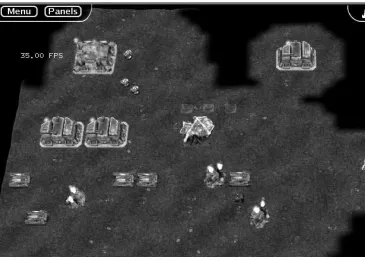
Fig. 6 RC-RTS with Map 2.
It incorporates dynamically changing objects (tanks and bugs, which move ran-domly), and partially known static obstacles (ridges, water ponds, nurseries, gey-sers, communication towers and military barracks). An AI client controls workers who have to collect the minerals and return them to a control centre. With their vi-sion restricted to only eleven tiles in any direction, they must find a path from their start location to the mineral cluster, pick up ten pieces of the minerals – gaining ten points for doing so – and then find a path from the mineral cluster back to the con-trol centre. A worker who successfully returns minerals to the concon-trol centre gets a further twenty points. A sample of the game map is shown in figure 6.
6 Related Work
[image:10.612.284.467.95.225.2]per-formance than D* Lite on static maps. aLSS-LRTA is a variation of LSS-LRTA that avoids HD by appropriately selecting the best state (in a look-ahead search). How-ever, LSS-LRTA and aLSS-LRTA do not decrease the action costs if required due to a dynamic change in the game world. Due to these drawbacks, LSS-LRTA and its variation can be expensive for path planning in dynamic worlds. MCRT search does not get stuck in small regions due to its exploration capabilities. The action values of a state are decreased or increased by MCRT search according to the current set-tings of the environment. This makes MCRT search suitable for dynamic worlds. A recent variation of LRTA called Real-Time D* (RTD*) [4] handles the problem of the increase and decrease of an edge cost due to the dynamic change in the domain. Real-Time D* uses bidirectional search, combining real-time and dynamic search, which allows it to react to dynamic changes in the world and update the heuristic values accordingly. It seems a promising approach but the main reason for not using RTD* in our domain is its dependency on backward global search. MCRT is also applicable in the high dimensional search spaces [18] due to its RRT based sampling capabilities.
7 Experimental Setup
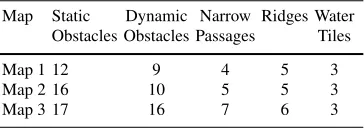
We have designed a set of experiments which test the MCRT technique against four of its main rivals: RRT, UCT, LSS-LRTA* and RTDP. Ten tests have been per-formed on three different game maps; each with a grid of size 60×60. The criteria that we have used to evaluate the performance of each planning method, within the RTS environment are:Score– which measures the total amount of mineral re-covered by the workers andPlanning Cost– which represents the total number of states visited by the planner during the planning process for the whole game. As success in many games is measured by who gets the highest score, we naturally consider the first of these to be the most important performance indicator. The level of difficulty is controlled by constructing maps with differing numbers of static and dynamic obstacles and by introducing a successively increasing number of narrow passages and ridges. The complexity of the environments created for each of the three test maps used in our experiments are shown in table 1. Each of the
plan-Table 1: Environment variables set for each test map.
Map Static Dynamic Narrow Ridges Water Obstacles Obstacles Passages Tiles
Map 1 12 9 4 5 3
Map 2 16 10 5 5 3
Map 3 17 16 7 6 3
[image:11.612.210.392.542.606.2]domain, and in particular we found that different planners perform better for differ-ent look-ahead depths. We decided to make the comparisons between planners with each one performing optimally. For UCT the trade-off parameterCpwas set to 0.1
(see [14]). A look-ahead depth of four was chosen for MCRT and UCT, a depth of seven for RTDP and a depth of nine for LSS-LRTA*. In our experiments, RRT has been implemented as detailed in [17]. The RRT structure is expanded heuristically, using random samples, towards a nearest neighbour. We use Euclidean distance as a heuristic to expand the tree. This means that given the current state, a neigbouring state that is nearest to the random state is selected and added into the tree if it is collision free (i.e., not occupied by a static obstacle). Once the first goal is achieved then RRT re-uses the constructed tree to plan the path to subsequent goals (this is a two stage planner similar to MCRT). The resulting tree can be thought of as having a similar structure to that of traditional way-points. For UCT, we have implemented the algorithm given in [14] but with some variations. These variations are made due to the time-constraints and the presence of multiple goals in a planning problem. UCT uses the same reward function as given in MCRT. To reuse the outcomes of previous searches in UCT, the estimated action values for each goal are stored in a separate vector for future use. RTDP is implemented using the details given in [2] and [5]. RTDP formulates the path planning problem as a Markov Decision Process and tunes the policy (a mapping from states to actions) during the online search; we use hash tables to store the policy values. In our implementation, policy values are updated using a fixed number of iterations. Furthermore, we use a frequency based approach given in (3) to measure the probability distribution for RTDP, and Euclidean distance as the initial heuristic in all RTDP simulations. We use two hash tables to store the state values in RTDP - one for each goal in a planning problem - to reuse the efforts done in the previous search. To implement LSS-LRTA* in RC-RTS, we modify the A* implementation given with the ORTS download. The priority queue is implemented as a heap. The goal assigning task is simple. Each worker has its own goal. At the start of the game, all workers are assigned the same goal i.e. the minerals. Once a worker reaches the mineral cluster ( and picks them up), the planner changes the goal of the worker to Control Centre and sets a boolean variable as true. This boolean variable is used to decide which data structure (hash tables or vectors) is to use for path planning in the case of UCT, LSS-LRTA and RTDP. If a worker returns to the Control centre, the planner changes the goal of the worker and sets the boolean variable as false.
8 Results
dur-ing planndur-ing in the first stage, it does not perform the same as MCRT. This is due to the huge size of the tree built by the RRT planner. The MCRT planner adds only the collision-free nodes into the incremental tree if they are found to be promising by the policy roll-out. This reduces the size of the tree structure by keeping the useful nodes only. The small size of the MCRT tree also minimises the time required to update it if the game world is changed during the game play. It is notable that the
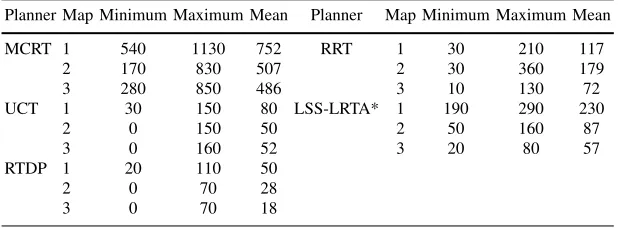
Table 2: Scores for each planner on Maps 1-3.
Planner Map Minimum Maximum Mean Planner Map Minimum Maximum Mean
MCRT 1 540 1130 752 RRT 1 30 210 117
2 170 830 507 2 30 360 179
3 280 850 486 3 10 130 72
UCT 1 30 150 80 LSS-LRTA* 1 190 290 230
2 0 150 50 2 50 160 87
3 0 160 52 3 20 80 57
RTDP 1 20 110 50
2 0 70 28
3 0 70 18
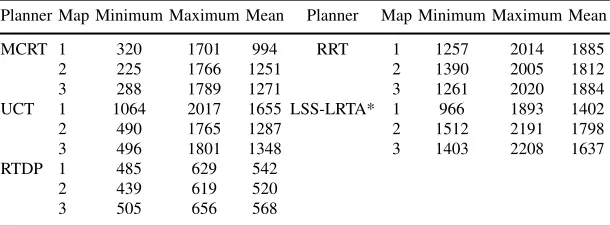
Table 3: Planning Cost for each planner on Maps 1-3.
Planner Map Minimum Maximum Mean Planner Map Minimum Maximum Mean
MCRT 1 320 1701 994 RRT 1 1257 2014 1885
2 225 1766 1251 2 1390 2005 1812
3 288 1789 1271 3 1261 2020 1884
UCT 1 1064 2017 1655 LSS-LRTA* 1 966 1893 1402
2 490 1765 1287 2 1512 2191 1798
3 496 1801 1348 3 1403 2208 1637
RTDP 1 485 629 542
2 439 619 520
3 505 656 568
RRT planner produces the highest planning cost due to its sampling approach, i.e., exploring the state space based on the random samples. The results also show that the planning cost of MCRT is related to the difficulty level of the map; the higher the difficulty levels the more planning cost it consumes. UCT keeps a balance between the exploration and the exploitation of the actions during the simulations, therefore, its planning cost is smaller than RRT and LSS-LRTA*. However, we observe from table 3 that the minimum planning cost of UCT has dropped for maps 2 and 3. This is due to the fact that when the complexity of the maps increase (i.e., an increase in static and dynamic obstacles) the planner is more likely to become stuck in local minima. This is further evidenced by the scores shown in table 2, where the zero scores indicate no goals achieved.
9 Conclusions
In this paper we have introduced a new real-time path planning algorithm which is aimed at finding paths for agents in applications as typified by real-time strategy games. Here the agents inhabit a world containing obstacles some of which continu-ously change positions; they have multiple sequential goal states to find, limited time to plan their next move, imperfect information about the effect of their move actions and partial information about the positions of obstacles. Our planner is founded on two key innovations:
- the MCRT search for finding the next action to execute. This technique is based on a fusion of two existing techniques (UCT and rapidly expanding random trees) together with a novel reward function which takes into account the likelihood of collisions along a path
These features of MCRT leverage the domain characteristics that multiple sequen-tial goals have to be solved, and that reward estimates should be collision-sensitive, to make it superior to its rivals. In future work, we aim to explore the performance of MCRT planner on the pathfinding benchmark problems. MCRT is also extendable for path planning in the environments modeled as a Digital Elevation Model [21] by introducing a height parameter in the reward function.
References
[1] Balla R, Fern A (2009) UCT for Tactical Assault Planning in Real-Time Strategy Games. In: Proceedings of the 21st International Joint Conference on Artificial Intelligence, pp 40–45 [2] Barto A, Bradtke S, Singh S (1995) Learning to act using Real-time Dynamic Programming.
Artificial Intelligence 72:81–138
[3] Bellman R (1954) The theory of dynamic programming. Bulletin of The American Mathe-matical Society-BULL AMER MATH SOC 60(6):503 – 516
[4] Bond D, Widger N, Ruml W, Sun X (2010) Real-Time Search in Dynamic Worlds. In: Pro-ceedings of the Third Annual Symposium on Combinatorial Search
[5] Bonet B, Geffner H (2003) Labelled RTDP: Improving the Convergence of Real-Time Dy-namic Programming. In: Proceedings of ICAPS, pp 12–21
[6] Bonet B, Geffner H (2005) mGPT: A Probabilistic Planner Based on Heuristic Search. Jour-nal of Artificial Intelligence Research 24:933–944
[7] Bulitko V, Lee G (2006) Learning in Real-Time Search: A unifying framework. Journal of Aritificial Intelligence Research (JAIR) 25(1):119–157
[8] Buro M (2002) ORTS: A Hack-free RTS Game Environment. In: Proceedings of the Interna-tional Computers and Games Conference, pp 280–291
[9] Dijkstra E (1959) A note on two problems in connexion with graphs. Numerische Mathe-matik 1:269–271
[10] Gelly S, DSilver (2007) Combining Online and Offline Knowledge in UCT. In: ICML 2007, pp 273–280
[11] Hart P, Nilsson N, Raphael B (1968) A Formal Basis for the Heuristic Determination of Minimum Cost Paths. IEEE Transactions of Systems Science and Cybernetics 4(2):100–107 [12] Hern´andez C, Baier J (2011) Real-Time Heuristic Search with Depression Avoidance. In:
Proceedings of the twenty-second international joint conference on Artificial Intelligence [13] Ishida T (1992) Moving target search with intelligence. In: Proceedings of the tenth national
conference on Artificial intelligence (AAAI92)
[14] Kocsis L, Szepesv´ari C (2006) Bandit Based Monte-Carlo Planning. In: Proceedings of the 17th European Conference on Machine Learning, pp 282–293
[15] Koenig S, Sun X (2009) Comparing Time and Incremental Heuristic Search for Real-Time Situated Agents. Journal of Autonomous Agents and Multi-Agent Systems 18(3):313– 341
[16] Korf RE (1990) Real-Time Heuristic Search. Artificial Intelligence 42:189–211
[17] Kuffner J, LaValle S (2000) RRT-Connect: An Efficient Approach to Single-Query Path Plan-ning. In: Proceedings of the IEEE International Conference on Robotics and Automation, pp 995–1001
[18] LaValle S (2006) Planning Algorithms. Cambridge University Press
[19] Naveed M, Kitchin D, Crampton A (2010) Monte-Carlo Planning for Pathfinding in Real-Time Strategy Games. In: Proceedings of PlanSIG 2010., pp 125–132
[20] Sutton R, Barto A (1998) Reinforcement Learning: An Introduction. MIT Press